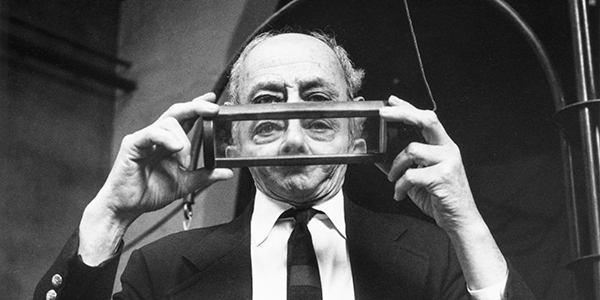
CREDIT: COURTESY OF KC COLE
A rift in thinking about who should control powerful new technologies sent the brothers on diverging paths. For one, the story ended with a mission to bring science to the public.
By KC Cole
03.05.2024 (knowablemagazine.org)
Support sound science and smart stories
Help us make scientific knowledge accessible to all
Donate today
Every now and then, science serves up poison pills. Knowledge gained in the course of exploring how nature works opens doors we might wish had stayed shut: For much of the past year, our newsfeeds were flooded with stories about how computational superpowers can create amoral nonhuman “minds” that may learn to think better than we do (and then what?). On the big screen, the movie Oppenheimer explored a threat people have lived with for nearly 80 years: How the energy of the atom can be unleashed to power unimaginably destructive bombs.
When potentially catastrophic inventions threaten all humanity, who decides how (or whether) they’re used? When even scientists toss around terms like “human extinction,” whose voice matters?
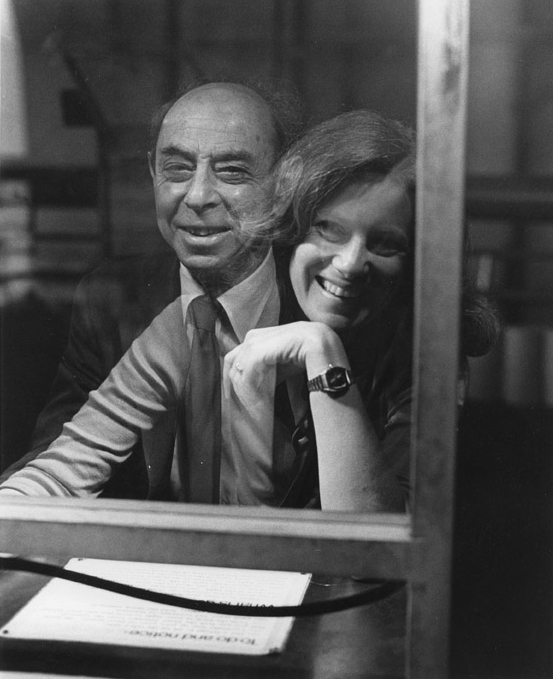
Such questions were at the core of the Oppenheimer film, a blockbuster now nominated for more than a dozen Oscars. To me, the movie hit home for a different reason. I spent a great deal of time with Frank Oppenheimer during the last 15 years of his life. While I never knew his brother Robert, Frank remained anguished over what he felt was Robert’s squandered opportunity to engage the world’s people in candid conversations about how to protect themselves under the shadow of this new threat.
During the post-World War II years, the emotionally close ties between the brothers (Robert — the “father of the atom bomb” — and his younger brother, Frank — the “uncle” of the bomb, as he mischievously called himself) were strained and for a time even fractured. Both hoped that the nascent nuclear technology would remain under global, and peaceful, control. Both hoped that the sheer horror of the weapons they helped to build could lead to a warless world.
They were on the same side, but not on the same page when it came to tactics.
YOU MAY ALSO LIKE
Why some artificial intelligence is smart until it’s dumb

Synthetic media: The real trouble with deepfakes
How to detect clandestine nuclear weapons programs
Robert — whose fame surged after the war — believed decisions should be left to experts who understood the issues and had the power to make things happen — that is, people like himself. Frank believed just as fiercely that everyday people had to be involved. It took everyone to win the war, he argued, and it would take everyone to win the peace.
In the end, both lost. Both paid for their efforts with their careers (although Frank eventually resurrected his ideas as a “people’s science museum” that had a worldwide impact).
Given that the question “Who decides?” underlies so much of today’s fast-evolving sciences, the brothers’ story seems more compelling and relevant than ever.
Ethical education
In many ways, the Oppenheimer brothers were very much alike. Both studied physics. Both chain-smoked. Both loved art and literature. Both had piercing blue eyes, inherited from their mother, Ella Friedman Oppenheimer, an artist with a malformed hand always hidden in a glove. Their father, Julius, was a trustee of the Society for Ethical Culture, dedicated to “love of the right.”
They shared a Manhattan apartment with maids, Renoirs, and books piled down the halls and into the bathrooms. Ella was terrified of germs, so tutors and barbers often came to them. Frank had his tonsils out in his bedroom. Both boys attended Ethical Culture schools in New York, so morality was baked into their upbringing.
But they were also in other ways opposites.
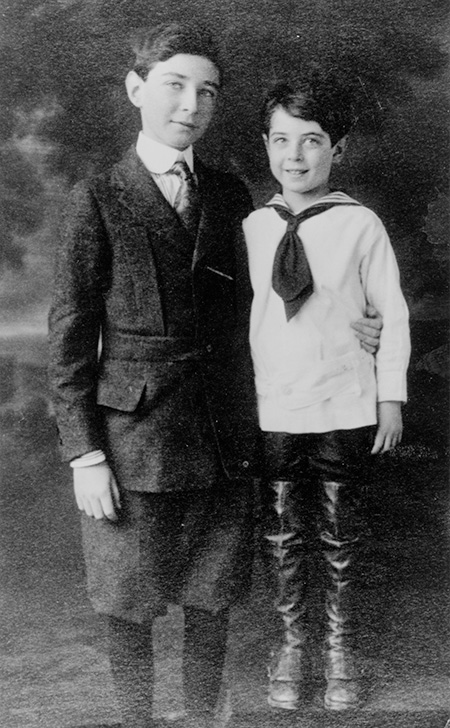
Robert was, by his own admission, “an unctuous, repulsively good little boy.” Frank was anything but. He sneaked out at night to scale New York City’s rooftop water towers; by high school, he was using the electric current in the family home to weld whatever metal he could get his hands on. He took apart his father’s player piano (then stayed up all night putting it back together).
Robert got through Harvard in three years and received his PhD from the University of Göttingen two years later, in 1927, at age 23. Frank didn’t get his PhD until he was 27. Robert was arrogant, picky about his company. Frank would talk with anyone and did, later befriending even his FBI tail.
When Robert joined the faculty at Caltech, he was described as “a sort of patron saint,” always center stage, smooth, articulate, captivating. When Frank arrived at Caltech many years later for graduate work, he was described as standing “at the fringe, shoulders hunched over, clothes mussed and frayed, fingers still dirty from the laboratory.”
Still, they loved each other dearly. Frank wept when Robert left for grad school in Europe. Robert wrote Frank that he would gladly give up his vacation “for one evening with you.” He sent his little brother books on physics and chemistry, a sextant, compasses, a metronome, along with letters full of brotherly wisdom. My personal favorite: “To try to be happy is to try to build a machine with no other specifications than it shall run noiselessly.”
In summer, they retreated to a cabin in the mountains of New Mexico, which Robert called Perro Caliente (Spanish for “hot dog”). They rode horses over 13,000-foot peaks, 1,000 miles a summer. During one night ride, Robert got knocked off his horse. “He was very thin anyway,” Frank said. “Here was this little bit of protoplasm on the ground, not moving. It was scary, but he was all right.”
On a road trip back to Caltech, Frank rolled the car into a ditch, breaking Robert’s arm. When Robert stopped at a store to get a sling, he came back with a bright red one, to cheer up his little brother, who he knew was feeling bad about the accident.
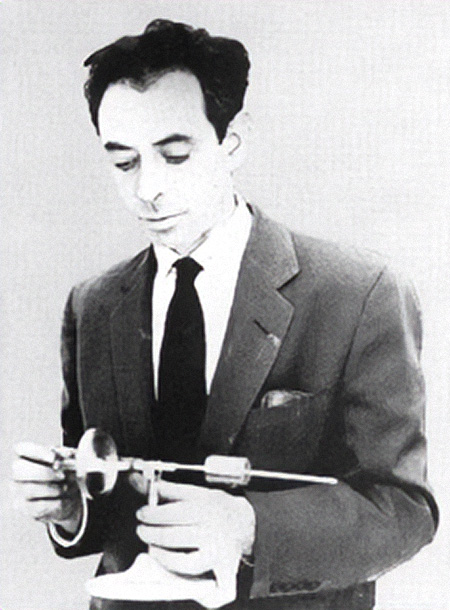
The world around them was fraught, with fascism on the rise in Germany, Italy and Spain. The Depression meant people were still out of work. Robert kept mostly aloof from politics, but Frank dived in. He married a UC Berkeley student who was a member of the Young Communist League, then joined himself. He admired the Communists for taking unemployment seriously — and for understanding the threats posed by Hitler and Mussolini. His personal tipping point was the treatment of Blacks at a Pasadena public pool: Blacks were allowed only on Wednesdays; the pool was drained before the whites came back on Thursday. Only the Communist Party seemed concerned.
Robert didn’t approve of Frank’s decision to join the party, and he didn’t approve of his wife, Jackie, either, referring to her as “that waitress.” He accused Frank of being “slow” because it took him what Robert regarded as too long to get his PhD. He called Frank’s marriage “infantile.” The feelings became mutual. Jackie later regarded Robert and his wife, Kitty, as pretentious, phony and tight.
Frank soon realized that he wasn’t cut out to be a Communist, and quit. He felt the party was too authoritarian, and not as interested in social justice as in petty bickering. (Robert never joined, although Kitty had been a party member.)
From quantum theory to atom smashers
The brothers were both working as physicists when the Japanese bombed Pearl Harbor in 1941. Robert, the theorist, was sharing the revolutionary physics of quantum mechanics with his American colleagues at Berkeley and Caltech, where he had joint appointments. Frank, a natural-born experimentalist, was working with Ernest Lawrence at Berkeley on the rapidly developing technology of particle accelerators — known to some as “atom smashers.”
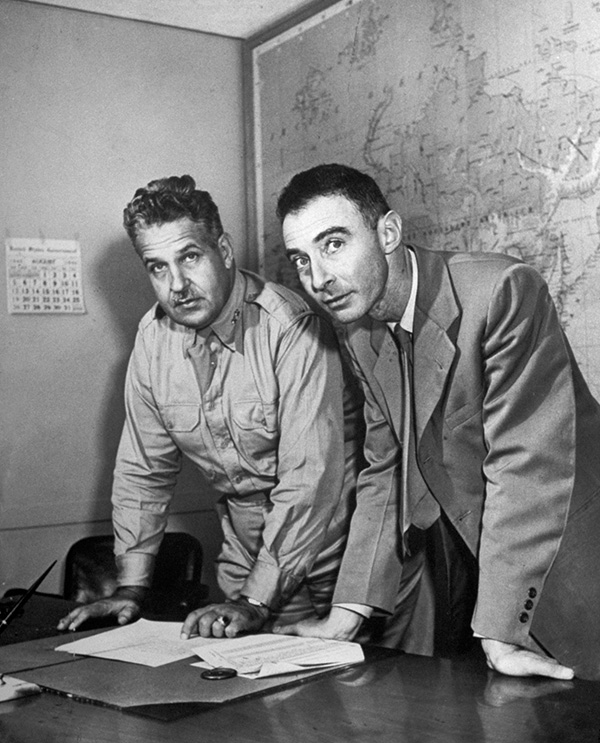
Once it became clear that the enormous energy contained in the atomic nucleus could be used to build a bomb — and that Nazi Germany might well be doing just that — President Franklin Roosevelt approved a major American effort to beat them to it: the Manhattan Project. It came as a surprise to everyone when Gen. Leslie Groves tapped Robert as director. Seemingly overnight, the ethereal young man who enjoyed reading poetry in Sanskrit became the ringleader of the most concentrated collection of brilliant minds ever assembled — scientists summoned from around the world to a makeshift lab on a desolate New Mexico mesa, where they would build an atomic bomb to stop Hitler.
Frank, meanwhile, worked with Lawrence on what he called “racetracks” (officially calutrons) used to coax small but vital amounts of pure uranium-235 out of a dirty mix of isotopes by steering them in circles with magnets. Uranium-235, like plutonium-239, is easily split, just what was needed to set off a chain reaction. Since no one knew how to bring together a critical mass of the stuff to make an explosion, two designs were pursued simultaneously. The plutonium bomb acquired the nickname Fat Man; the uranium bomb was Little Boy.
Frank helped supervise an enormous complex for uranium separation at Oak Ridge, Tennessee. Frank liked Gen. Groves and Groves, in turn, liked Frank — and later defended him when he was booted from physics for his politics.
As the time to test the bomb approached, Frank joined his brother at the Trinity site, a dry scrubby desert formerly part of the Alamogordo Bombing Range. Frank, who saw his job (ironically enough) as a “safety inspector,” mapped escape routes through the desert and made sure workers wore hard hats.
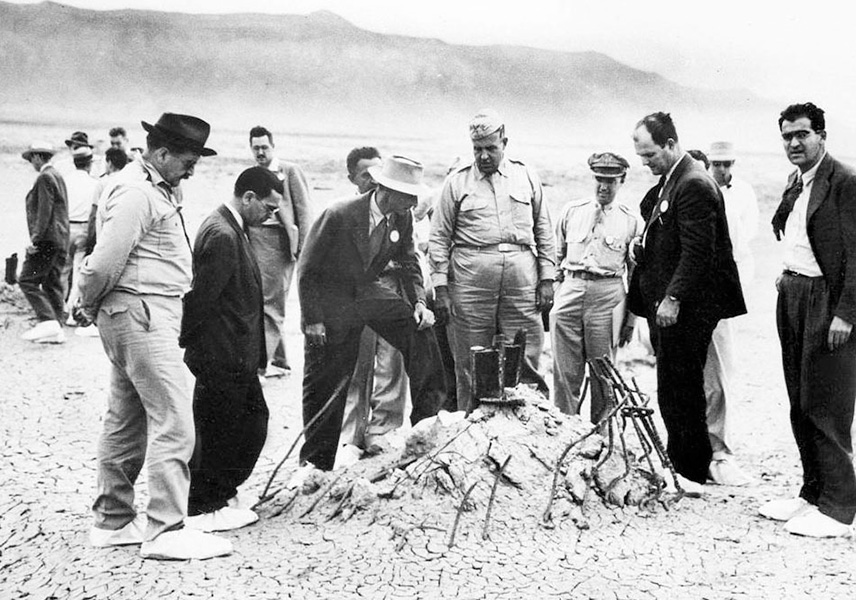
Finally, on July 16, 1945, the go-ahead was given. After a long night on edge watching driving rain and lightning rage around “the gadget” — a Fat Man-style plutonium bomb perched on a 100-foot-tall tower — the proverbial (and literal) button was pushed.
The brothers lay together at the nearest bunker, five miles away, heads to the ground. Frank later described the “unearthly hovering cloud. It was very bright and very purple and very awesome … and all the thunder of the blast was bouncing, bouncing back and forth on the cliffs and hills. The echoing went on and on.…” The cloud, he said “just seemed to hang there forever.”
Frank and his brother embraced each other: “I think we just said: ‘It worked.’”
On August 6, 1945, Little Boy was dropped on the pristine city of Hiroshima — which had been deliberately untouched by US bombs, the better to assess the damage. In an instant, the city was all but flattened, people reduced to charred cinders, survivors hobbling around with their skin peeled off and hanging from their bodies like rags. An estimated 140,000 people were killed in the attack and in the months after, according to Japanese authorities.
Frank heard the news outside his brother’s office at Los Alamos. “Up to then I don’t think I’d really thought of all those flattened people,” he said. The US bombing of Nagasaki with Fat Man just days later brought the death toll even higher.
Some physicists saw their success as a moral failure. Still, many — including Frank and Robert — also hoped this new weapon would cause people to see the world differently; they hoped it would ultimately bring about peace. “Those were the days when we all drank one toast only,” Robert said: “‘No more wars.’”
Intolerable weapon
After the war, the brothers’ lives diverged, driven by circumstance, in ways that were painful to both.
Robert was a hero; he mingled easily with the powerful. Famously, he was Einstein’s boss — director of the Institute for Advanced Study in Princeton. He chaired a committee to advise the government on a new and vastly more powerful type of bomb — the hydrogen bomb. Rather than split atoms, it fused them, using the physics of stars. The H-bomb could be 1,000 times more powerful than Little Boy.
Robert’s committee voted unanimously against developing it. “The extreme dangers to mankind inherent in this proposal wholly outweigh any military advantage that could come from this weapon.” They described it as a “threat to the future of the human race which is intolerable.”
Frank, meanwhile, had joined the physics department at the University of Minnesota, building detectors to catch cosmic rays streaming from space with equipment tethered to balloons he frequently lost but chased gamely through Cuban forests and other remote locations. He was excited about their discovery that the cosmic ray particles were not merely protons, as people had assumed, but the nuclei of many elements — from hydrogen to gold — implying that some were forged in supernova explosions.
At the same time, he was giving speeches “all over the map,” as he put it, trying to educate the public about nuclear bombs, trying to explain what 1,000 times more powerful really meant. He spoke to bankers, civic associations, schools. He argued that so-called “smart” people weren’t all that different from everyone else. The mistrust of the “hoi polloi,” Frank thought, stemmed largely from the tendency of people to credit their own success to a single personal characteristic, which they then “idolize” and use to measure everyone else by the same yardstick.
He believed people would educate themselves if they thought their voices mattered. “All of us have seen, especially during the war, the enormous increase in the competence of people that results from a sense of responsibility,” he said. Building the “racetracks” during the war had required training thousands of people “fresh from farms and woods to operate and repair the weirdest and most complicated equipment.”
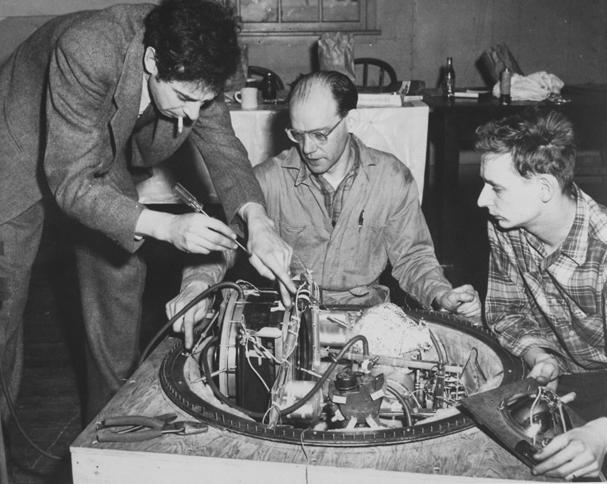
Soon, his physics career was cut short. The FBI had been keeping tabs on both brothers for years, pausing only for the war, when military intelligence took over. Agents followed them everywhere, tapped their phones, planted microphones in their houses.
In 1949, Frank received a summons to appear before the House Un-American Activities Committee (HUAC), where he refused to take the fifth, but also refused to testify about anyone other than himself. He was effectively fired from the University of Minnesota physics department, leaving the chair’s office in tears.
Attempts to find work elsewhere were blocked at every turn, despite support from multiple Nobel laureates, Gen. Groves and even H-bomb enthusiast Edward Teller. Finally, an FBI agent told Frank flat out: If he wanted a job, he had to cooperate. “Then I realized what the wall was.”
Out of options, and having just purchased a ranch to live on “someday,” Frank and Jackie became serious cattle ranchers, learning from neighbors and veterinary manuals. (The FBI was right on their tails, pestering neighbors for information, suggesting they were broadcasting atomic secrets to Mexico.) All the while, Frank thought and wrote about physics and peace, civil rights, ethics, education and the critical role of honesty in science and public life.
Robert did not approve of any of Frank’s activities. He thought there wasn’t time to bring the public in on the debate; he thought he could use his fame and power to influence policy in Washington toward peaceful ends. Frank expressed his disgust at what he considered his brother’s futile and elitist approach. Robert made it clear that he thought the idea of becoming a rancher was a little silly — as well as beneath Frank.
Frank felt he could no longer reach him. “I saw my bro in Chicago,” Frank wrote his best friend Robert Wilson at Cornell in an undated letter probably from the early 1950s. “I fear that I merely amused him slightly when, in brotherly love, I told him that I was still confident that someday he would do something that I was proud of.”
Stay in the Know
Sign up for the Knowable Magazine newsletter today
A man destroyed
Robert’s now-famous downfall was swift. Many great books have been written about the subject (not to mention Christopher Nolan’s colossal film); in effect, he was punished for his opposition to the H-bomb, probably his arrogance and naivete as well. After a series of secret hearings, his security clearance was revoked; he was, by all accounts, a ruined man.
It wasn’t something Frank liked to talk about. “He trusted his ability to talk to people and convince them,” Frank said. “But he was up against people that weren’t used to being convinced by conversation.”
Some of Robert’s most poignant testimony during the hearings involved Frank. Asked if his brother had ever been a Communist, Robert answered: “Mr. Chairman … I ask you not to press these questions about my brother. If they are important to you, you can ask him. I will answer, if asked, but I beg of you not to ask me these questions.”
The broader tragedy for both brothers was that the creation of the world’s most fearsome weapon of mass destruction — a thing too horrible ever to use — didn’t much change how people viewed war. The H-bomb was just another weapon.
“What undid him,” Frank said, “was not just his fall from official grace, but the fact that this fall represented a defeat for the kind of civilized behavior that he had hoped nations would adopt.”
Robert died at the age of 62, in 1967. Frank’s last memory of his brother is poignantly familial. Robert was lying in bed, in great pain from throat cancer. Frank lay down beside him and together they watched Perry Mason on TV.
A new path
While Robert was being politically destroyed, Frank had started teaching science in a one-room schoolhouse. Before long, students from Pagosa Springs, Colorado, were winning the state science fairs. Eventually allowed into academia by the University of Colorado in 1959, Frank promptly built a “library of experiments” out of equipment scavenged from other labs.
That “library” in time grew into a vast public playground of scientific stuff housed in the abandoned Palace of Fine Arts in San Francisco. Exhibits — sometimes sophisticated and delicate — were meant to be played with, even broken; no guards stopped people from touching anything, no rules prevented theft — and remarkably, there was almost none. He called it an Exploratorium so people wouldn’t think it was a “museum” where good behavior was expected (although he liked the idea that “no one flunks a museum”). Top scientists and artists from around the globe contributed time and talent. Barbara Gamow, wife of the physicist George Gamow, painted a sign to hang over the machine shop: Here is Being Created an Exploratorium, a Community Museum Dedicated to Awareness.
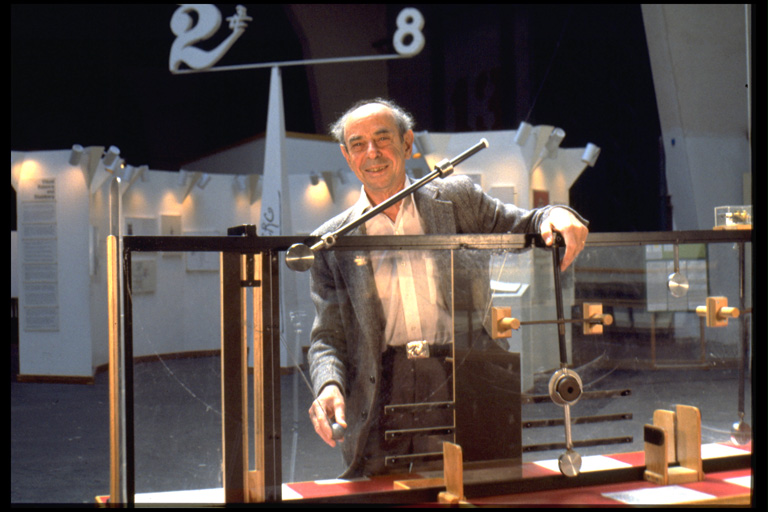
In the end, I like to think Frank proved his brother (and most everyone else) wrong about the willingness of everyday people to engage and learn. The “so-called inattentive public,” he’d said, would come to life if people didn’t feel “fooled and lied to,” if they felt valued and respected. And if people got addicted to figuring things out for themselves, they’d be inoculated against having to take the word of whatever bullies happened to be in power. Society could tap into this collective wisdom to solve pressing global problems — the only way he thought it could work.
Today, Exploratorium-style science centers exist in some form all over the globe.
I count myself as one of Frank’s many thousands of addicts, hooked on science (a subject I’d found boring) the minute I met him in 1971. (In a weird resonance with today, my first foray into journalism was a piece on the Soviet invasion of Czechoslovakia for the New York Times Magazine.) I was interested in peace, not physics. Frank talked me into writing for him, explaining optics and wave mechanics to the public. My first editor was Jackie. Over the years, Frank and I spent endless hours chatting about life, art, science and his family, including his brother.
Nolan’s film Oppenheimer doesn’t offer much insight into Robert’s thoughts on science and peace or science and human morality. However, Robert did think and talk about these ideas, many of which are collected in his 1954 book Science and the Common Understanding, as well as other places.
Frank continued to get upset (and a little drunk) every August 6, the day Hiroshima was bombed. He’d rub his forehead hard, as if he was trying to rub something out. He had much the same reaction to many previous dramatizations of the Oppenheimer story, because he thought they focused too much on the fall of his brother, rather than on the failure of attempts to use the horror of the bomb to build a warless world.
Frank’s fierce integrity permeated our work together: He refused to call me writer/editor because he said that meant writer divided by editor. Instead, I was his Exploratorium Expositor.
If someone said, “It’s impossible to know something, or impossible to adequately thank someone,” he’d argue: It’s not impossible, it’s only very, very, very hard.
No matter what impossible thing Frank was trying to do, he refused to be stopped by so-called “real world” obstacles. “It’s not the real world,” he’d rage. “It’s a world we made up.” We could do better. In fact, so many of what we came to call “Frankisms” seem more relevant today than ever:
“The worst thing a son of a bitch can do to you is turn you into a son of a bitch.”
“Artists and scientists are the official noticers of society.”
“If we stop trying to understand things, we’ll all be sunk.”
Navigating the dark side of science, I think, will require attending closely to all of these. The “real world” we’re presented with is not the way things have to be. We shouldn’t become sons of bitches. We can never stop noticing or trying to understand.
10.1146/knowable-030424-1
KC Cole is the author of eight nonfiction books, most recently Something Incredibly Wonderful Happens: Frank Oppenheimer and the World He Made Up. She is senior senior correspondent at Wired magazine, teaches in the honors program at the University of Washington, and has written for dozens of newspapers and magazines.