Ian Bremmer | TED Explains the World with Ian Bremmer
• June 2025
Ukraine’s surprise drone strike deep inside Russia damaged billions of dollars’ worth of irreplaceable military aircraft and marks a major milestone in the ongoing conflict. Political scientist Ian Bremmer breaks down how the Ukrainians pulled off the astonishing attack, the risk of nuclear retaliation from Putin and why “asymmetric warfare” is here to stay. (This interview, hosted by TED’s Helen Walters, was recorded on June 2, 2025.)
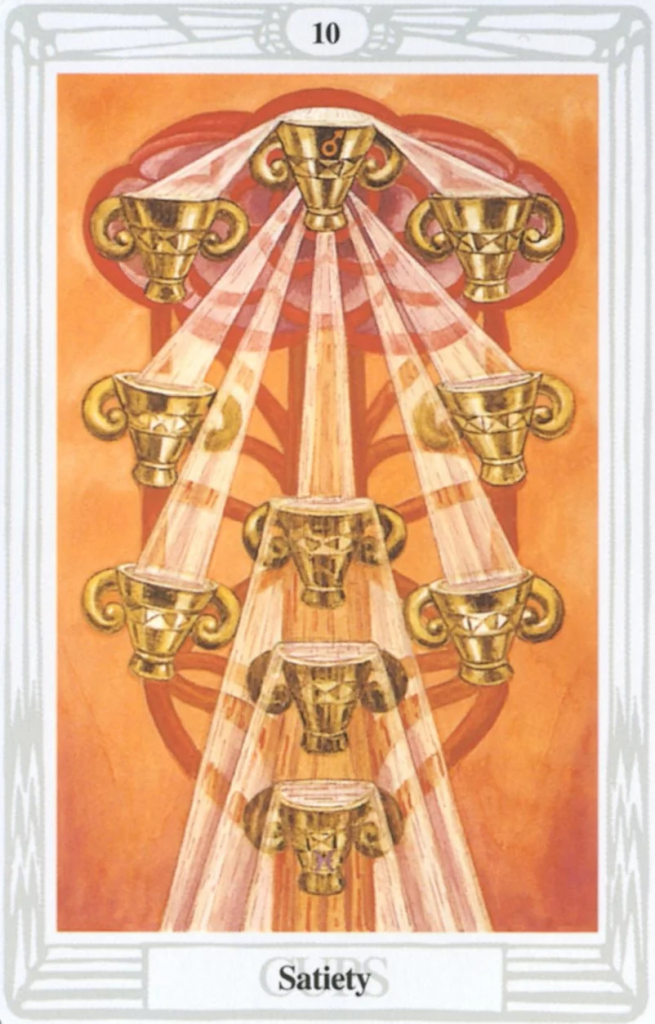
The Lord of Satiety is a sanctuary card… it indicates a blissful moment in time where we feel contented, happy and emotionally satisfied. It’s easy to be at one with the Universe when you feel this blessed. We are more readily able to make contact with the High Powers, and to experience their energies in our lives.So on a day ruled by the Ten of Cups, be aware that you are probably walking closer to the Gods (however you conceive them) than on most more ordinary days. Expect intuition to be heightened, and make sure you give yourself the time to listen to it.Try to make an oasis of silence around yourself every now and again, so that you can simply experience and feel and know the quality of your life. This doesn’t have to be for long periods – five minutes here and there throughout the day will make for a happy interlude.Remember – when you feel loved yourself, you radiate love to others. You don’t have to do anything more complicated than allow yourself to be satisfied. Days like this are rare enough. But when they come around, if you let the brightness inside your soul, it lights you up from the inside. We gather strength on these days – strength that carries us forward through the challenges and storms that inevitably touch our lives from time to time.Strive to be peaceful and secure in your home environment too. And don’t let yourself be impatient for the things that have not found their right moment in your life yet. Absorb, grow, rest and replenish… these are the important things to do on a day ruled by the Lord of Satiety.
Affirmation: “Today my life gives me everything I need to be happy.”
Translation is a 5-step process of “straight thinking in the abstract” comparing and contrasting what seems to be truth with what you can syllogistically, axiomatically and mathematically (using word equations) prove is the truth. It is not an effort to change, alter or heal anything.
The claims in a Translation may seem outrageous, but they are always (or should always be) based on self-evident syllogistic reasoning. Here is one Translation from this week.
1) Truth is that which is so. That which is not truth is not so. Therefore Truth is all that is. Truth being all is therefore total, therefore complete, therefore whole, therefore one, therefore united, therefore harmonious, therefore orderly. I think therefore I am. Since I am and since Truth is all that is, therefore I, being, am Truth. Since I, being, am Truth, therefore i, being, have all the attrbutes of Truth. Therefore I, being, am total, complete, whole, one, united, harmonious, orderly. Since I am mind (self-evident) and since I (being) am Truth, therefore Truth is Mind. (Two things beinq equal to a third thing are equal to each other.) Since Truth is Mind, therefore Mind has all the attributes of Truth. Therefore Mind is total, complete, whole, one, united, harmonious, orderly.
2) Dissociative amnesia is like having a hole in your psyche.
Word-tracking: dissociate: separate from dissemble: to be different, to disguise, to hide your true self disguise: to appear different guise: manner, wise, knowledge amnesia: to forget forget: to leave behind, to neglect, to lose hold of psyche: Goddess of the soul, spirit, breath, animation, life, mind hole: burrow, hide
3) Truth being all that is, there can be nothing different from all that is, therefore Truth cannot be disguised, dissembled, separate or dissociated from Itself. Truth being Mind cannot be forgetfulness as well, therefore Truth holds all, remembers all, neglects nothing, leaves nothing behind. Truth being Mind is therefore psyche, therefore life, therefore animation, therefore breath, therefore spirit. Therefore that which is not psyche, life, animation, breath, spirit is not so. Truth being one Mind cannot hide from Itself, cannot disguise Itself, cannot dissemble Itlse, therefore Truth always knows Itself in whatever guise or disguise.
4) Truth cannot be disguised, dissembled, separate or dissociated from Itself. Truth holds all, remembers all, neglects nothing, leaves nothing behind. Truth is psyche, life, animation, breath, spirit. Truth always knows Itself in whatever guise or disguise.
5) Truth does not and cannot hide from Itself.
Weekly Invitational Translation Group invites your participation. If you would like to submit a Translation on any subject, feel free to send your weekly Translation to zonta1111@aol.com and we will anonymously post it on the Bathtub Bulletin on Friday.
In Greek mythology, the legend of Orpheus and Eurydice (Greek: Ὀρφεύς, Εὐρυδίκη, romanized: Orpheus, Eurydikē) concerns the pitiful love of Orpheus of Thrace, located in northeastern Greece, for the beautiful Eurydice. Orpheus was the son of Oeagrus and the Muse Calliope. It may be a late addition to the Orpheus myths, as the latter cult-title suggests those attached to Persephone. The subject is among the most frequently retold of all Greek myths.
Versions
Orpheus and Eurydice in Palais Garnier, Paris. Their names are in Greek, ΟΡΦΕΥΣ (Orpheus) and ΕΥΡΥΔΙΚΗ (Eurydice).
In Virgil‘s classic version of the legend, it completes his Georgics, a poem on the subject of agriculture. Here the name of Aristaeus, or Aristaios, the keeper of flying insects, and the tragic conclusion was first introduced.[1]
Ovid‘s version of the myth, in his Metamorphoses, was published a few decades later and employs a different poetic emphasis and purpose. It relates that Eurydice’s death was not caused by fleeing from Aristaeus, but rather by dancing with nymphs on her wedding day.[2]
Other ancient writers treated Orpheus’s visit to the underworld more negatively. According to Phaedrus in Plato’sSymposium,[4] the infernal deities only “presented an apparition” of Eurydice to him. Plato’s representation of Orpheus is in fact that of a coward; instead of choosing to die in order to be with his love, he mocked the deities in an attempt to visit Hades, to get her back alive. As his love was not “true”—meaning that he was not willing to die for it—he was punished by the deities, first by giving him only the apparition of his former wife in the underworld and then by having him killed by women.[4]
Apollo gave Orpheus a lyre and taught him how to play. It had been said that “nothing could resist Orpheus’s beautiful melodies, neither enemies nor beasts.” Orpheus fell in love with Eurydice, a woman of beauty and grace, whom he married and lived with happily for a short time. However, when Hymen was called to bless the marriage, he predicted that their perfection was not meant to last.
A short time after this prophecy, Eurydice was wandering in the forest with the Nymphs. In some versions of the story, the shepherd Aristaeus saw her and, beguiled by her beauty, made advances towards her and began to chase her. Other versions of the story relate that Eurydice was merely dancing with the Nymphs. Whether fleeing or dancing, she was bitten by a snake and died instantly. Orpheus sang his grief with his lyre and managed to move everything, living or not, in the world; both humans and gods learnt about his sorrow and grief.
At some point, Orpheus decided to descend to Hades by music to see his wife. Any other mortal would have died, but Orpheus, being protected by the gods, went to Hades and arrived at the Stygian realm, passing by ghosts and souls of people unknown. He also managed to attract Cerberus, the three-headed dog, who had a liking for his music. He presented himself in front of the god of the Greek underworld, Hades, and his wife, Persephone.
Orpheus played with his lyre a song so heartbreaking that even Hades himself was moved to compassion. The god told Orpheus that he could take Eurydice back with him, but under two conditions: she would have to walk behind him while walking out from the caves of the underworld, and he could not turn to look at her as they walked.
Thinking it a simple task for a patient man like himself, Orpheus was delighted; he thanked Hades and left to ascend back into the living world. Unable to hear Eurydice’s footsteps, however, he began to fear the gods had fooled him. Eurydice might have been behind him, but as a shade, having to come back into the light to become a full woman again. Only a few feet away from the exit, Orpheus lost his faith and turned to see Eurydice behind him, sending her back to be trapped in Hades’s reign forever.
Orpheus tried to return to the underworld but was unable to, possibly because a person cannot enter the realm of Hades twice while alive. According to various versions of the myth, he played a mourning song with his lyre, calling for death so that he could be united with Eurydice forever. He was killed either by beasts tearing him apart or by the Maenads in a frenzied mood. His head remained fully intact and still sang as it floated in the water before washing up on the island of Lesbos. According to another version, Zeus decided to strike him with lightning, knowing Orpheus might reveal the secrets of the underworld to humans. In this telling, the Muses decided to save his head and keep it among the living people to sing forever, enchanting everyone with his melodies. They additionally cast his lyre into the sky as a constellation.
CNN Jun 3, 2025 CNN will air the penultimate performance of this 5x Tony-nominated play LIVE for one night only – you won’t want to miss this historic live event on June 7 at 7p ET on CNN’s cable channel, digital platforms and streaming live on Max. “Good Night, and Good Luck” tells the gripping true story of journalist Edward R. Murrow’s legendary showdown against McCarthyism.
ARIES (March 21-April 19): You have had resemblances to cactuses in recent days. It hasn’t always been pleasant and cheerful, but you have become pretty skilled at surviving, even thriving, despite an insufficiency of juicy experiences. Fortunately, the emotional fuel you had previously stored up has sustained you, keeping you resilient and reasonably fluid. However, this situation will soon change. More succulence is on its way. Scarcity will end, and you will be blessed with an enhanced flow of lush feelings.
TAURUS (April 20-May 20): I foresee abundance emerging from modest sources. I predict breakthroughs arising out of your loving attention to the details of the routine. So please don’t get distracted by poignant meditations on what you feel is missing from your life. Don’t fantasize about what you wish you could be doing instead of what you are actually doing. Your real wealth lies in the small tasks that are right in front of you—even though they may not yet have revealed their full meaning or richness. I invite you and encourage you to be alert for grandeur in seemingly mundane intimate moments.
GEMINI (May 21-June 20): It’s time for your Uncle Rob to offer you some fundamental advice for living. These tips are always worthy of your contemplation, but especially now. Ready? Being poised amidst uncertainty is a superpower. You may attract wonders and blessings if you can function well while dealing with contradictory feelings, unclear situations and incomplete answers. Don’t rush to artificial closure when patience with the unfinished state will serve you better. Be willing to address just part of a problem rather than trying to insist on total resolution. There’s no need to be worried or frustrated if some enigmas cannot yet be explained and resolved. Enjoy the mystery!
CANCER (June 21-July 22): Acclaimed Cancerian poet Lucille Clifton published fourteen books and mothered six children. That heroism seems almost impossible. Having helped raise one child myself, I know how consuming it is to be a parent. Where did she find the time and energy to generate so much great literature? Judging from the astrological omens, I suspect you now have access to high levels of productivity comparable to Clifton’s. Like her, you will also be able to gracefully juggle competing demands and navigate adeptly through different domains. Here’s my favorite part: Your stellar efficiency will stem not from stressfully trying too hard but rather from good timing and a nimble touch.
LEO (July 23-Aug. 22): One of the seven wonders of the ancient world was the Colossus of Rhodes, located on a Greek island. Symbolizing power and triumph, it was a towering statue dedicated to the sun god Helios. The immediate motivation for its construction was the local people’s defeat of an invading army. I hereby authorize you to acquire or create your own personal version of an inspiring icon like the Colossus, Leo. It will symbolize the fact that the coming months will stimulate lavish expressions of your leonine power. It will help inspire you to showcase your talents and make bold moves. PS: Be alert for chances to mobilize others with your leadership. Your natural brilliance will be a beacon.
VIRGO (Aug. 23-Sept. 22): The Great Barrier Reef is the world’s biggest structure built by living things. Lying beneath the Coral Sea off the east coast of Australia, it’s made by billions of small organisms, coral polyps, all working together to create a magnificent home for a vast diversity of life forms. Let’s make the Great Barrier Reef your symbol of power for the next ten months, Virgo. I hope it inspires you to manage and harness the many details that together will generate a robust source of vitality for your tribe, family and community.
LIBRA (Sept. 23-Oct. 22): One of my favorite poets, Arthur Rimbaud, wrote all of his brilliant work before he became an adult. I suspect that no matter what your age is, many of you Libras are now in an ultra-precocious phase with some resemblances to Rimbaud from age sixteen to twenty-one. The downside of this situation is that you may be too advanced for people to thoroughly understand you. You could be ahead of your time and too cool for even the trendsetters. I urge you to trust your farseeing visions and forward-looking intuitions even if others can’t appreciate them yet. What you bring to us from the future will benefit us all.
SCORPIO (Oct. 23-Nov. 21): Blacksmiths still exist. They were more common in the past, but there are many twenty-first-century practitioners. It’s a demanding art, requiring intense heat to soften hard slabs of metal so they can be forged into intricate new shapes. The process requires both fire and finesse. I think you are currently in a phase when blacksmithing is an apt metaphor. You will need to artfully interweave passion and precision. Fiery ambition or intense feelings may arise, offering you raw energy for transformation. To harness it effectively, you must temper your approach with patience, restraint and detail-oriented focus.
SAGITTARIUS (Nov. 22-Dec. 21): Jean-Paul Sartre and Simone de Beauvoir were two feisty, independent, strong-minded French writers. Beauvoir was a trailblazing feminist, and Sartre was a Nobel Laureate. Though they never officially married, they were a couple for fifty-one years. Aside from their great solo accomplishments, they also gave us this gift: They proved that romantic love and intellectual equality could coexist, even thrive together, with the help of creative negotiation. I propose we make them your inspirational role models for now. The coming months will be a favorable time to deepen and refine your devotion to crafting satisfying, interesting intimate relationships.
CAPRICORN (Dec. 22-Jan. 19): Over 2600 years ago, ancient Babylonian astronomers figured out the highly complex cycle that governs the recurrence of lunar and solar eclipses. It unfolds over a period of eighteen years and eleven days. To analyze its full scope required many generations of researchers to carry out meticulous record-keeping with extreme patience. Let’s make those Babylonian researchers your role models, Capricorn. In the coming months, I hope they inspire you to engage in careful observation and persistent investigation as you discover meaningful patterns. May they excite your quest to discern deep cycles and hidden rhythms.
AQUARIUS (Jan. 20-Feb. 18): I invite you to try this visualization exercise, Aquarius: Picture a rosebud inside your body. It’s located in your solar plexus. Imagine it’s steadily and gently opening, filling your body with a sweet, blissful warmth, like a slow-motion orgasm that lasts and lasts. Feel the velvet red petals unfolding; inhale the soft radiance of succulent fragrance. As the rose fully blooms, you become aware of a gold ring at its center. Imagine yourself reaching inside and taking the ring with your right hand. Slip the ring onto your left ring finger and tell yourself, “I pledge to devote all my passionate intelligence to my own well-being. I promise to forever treat myself with tender loving respect. I vow to seek out high-quality beauty and truth as I fulfill my life’s mission.”
PISCES (Feb. 19-March 20): I foresee the arrival of a living fossil, Pisces. An influence you thought was gone may soon reappear. Aspects of your past could prove relevant to your current situation. These might be neglected skills, seemingly defunct connections, or dormant dreams. I hope you have fun integrating rediscovered resources and earmarking them for use in the future. PS: Here’s a lesson worth treasuring: While the world has changed, a certain fundamental truth remains true and valuable to you.
Accused of leaking state secrets, journalist Lei Cheng was imprisoned in China for more than three years, where she was detained in tight quarters and kept under constant supervision. “Freedom is wasted on the free,” she says, recounting how she and fellow inmates found joy in the smallest of moments: the smell of rain, a poem delivered in secrecy, kindness where it seemed undeserved. She distills the unexpected lessons that confinement taught her — and challenges us to rethink what freedom really means.
Whatever fundamental reality might exist, we live out our lives in a subjective reality defined by what we agree to attend to. “An act of pure attention, if you are capable of it, will bring its own answer,” D.H. Lawrence wrote. But we live largely in the territory of the unanswerable because there is no pure attention — the aperture of our attention is constricted by myriad conditionings and focused by a brain honed on millions of years of evolutionary necessities, many of which we have long outgrown.
How the brain metes out attention and what that means for our intimacy with reality is what the philosophy-lensed British psychiatrist Iain McGilchrist takes up in his immense, in both senses of the word, book The Matter With Things: Our Brains, Our Delusions and the Unmaking of the World (public library) — an investigation of how “the very brain mechanisms which succeed in simplifying the world so as to subject it to our control militate against a true understanding of it,” and what a richer understanding of those mechanisms can do for living in closer and more felicitous communion with reality. At its heart is the recognition that “the whole is never the same as the sum of its ‘parts’” and that “there are in fact no ‘parts’ as such, but that they are an artefact of a certain way of looking at the world.”
Punctuating his ambitious 3,000-page effort to braid neuropsychology (the way our brains shape our impression of reality), epistemology (the way we come to know anything at all), and metaphysics (our yearning to wrest meaning from fundamental truth as we try to discern the nature of the universe) is an ongoing inquiry into our way of looking at the world — the lens of consciousness we call attention. He writes:
The world we know cannot be wholly mind-independent, and it cannot be wholly mind-dependent… What is required is an attentive response to something real and other than ourselves, of which we have only inklings at first, but which comes more and more into being through our response to it — if we are truly responsive to it. We nurture it into being; or not. In this it has something of the structure of love.
One of artist Margaret C. Cook’s rare 1913 illustrations for Leaves of Grass — Walt Whitman’s supreme serenade to the art of paying attention. (Available as a print.)
McGilchrist considers the way our attention constructs our reality and becomes the beating heart with which we love the world:
The whole illuminates the parts as much as the parts can illuminate the whole… The world we experience — which is the only one we can know — is affected by the kind of attention we pay to it.
Defining attention as “the manner in which our consciousness is disposed towards whatever else exists,” he writes:
The choice we make of how we dispose our consciousness is the ultimate creative act: it renders the world what it is. It is, therefore, a moral act: it has consequences.
Attention changes the world. How you attend to it changes what it is you find there. What you find then governs the kind of attention you will think it appropriate to pay in the future. And so it is that the world you recognise (which will not be exactly the same as my world) is “firmed up” — and brought into being.
[…]
Attention is not just another “cognitive function”: it is… the disposition adopted by one’s consciousness towards the world. Absent, present, detached, engaged, alienated, empathic, broad or narrow, sustained or piecemeal, it therefore has the power to alter whatever it meets. Since our consciousness plays some part in what comes into being, the play of attention can both create and destroy, but it never leaves its object unchanged. So how you attend to something — or don’t attend to it — matters a very great deal.
In the vast remainder of The Matter With Things, McGilchrist goes on to explore how “the type, and extent, of attention we pay changes the nature of the world that we experience,” shaped largely by the difference between the way the brain’s two hemispheres pay attention — “narrow-beam, highly focussed attention” in the left, “broad, sustained vigilance” in the right. Complement this tiny fragment of it with Mary Oliver on attention and love, then revisit cognitive scientist Alexandra Horowitz’s wonderful field guide to eleven ways of paying attention to the everyday wonderland of life.
New Thinkin Jun 3, 2025 Pam Coronado is an internationally recognized psychic detective with over 25 years of experience assisting law enforcement agencies and families in solving complex criminal cases and locating missing persons. Over the years, Pam has collaborated with more than 40 law enforcement agencies, including the FBI, providing leads and insights in high-stakes investigations. Pam is a former president of the International Remote Viewing Association (IRVA) and the co-founder of the Fowler-O’Sullivan Foundation, which supports families of missing persons. Her website is https://www.pamcoronado.com Pam shares hard-earned wisdom drawn from over two decades of working active missing persons and criminal cases alongside law enforcement. She speaks openly about the importance of building trust with families and agencies, the risks of offering unsolicited insights, and the emotional toll of working cases involving loss, danger, and uncertainty. 00:02:33 The awakening: Pam’s journey 00:08:16 Navigating law enforcement 00:17:49 Working cold cases 00:24:47 Success stories in psychic detection 00:34:33 Limitations of psychic work 00:40:25 Dealing with heavy emotions 00:49:09 Using the CRV protocol 01:02:08 Advice for beginners 01:15:03 Overcoming fear and anxiety in psychic work 01:30:15 Conclusion Debra Lynne Katz, PhD, is the founder and director of the International School of Clairvoyance. She is also an adjunct instructor at the California Institute for Human Science. She is author of You Are Psychic: The Art of Clairvoyant Reading and Healing, Extraordinary Psychic, Freeing the Genie Within, and Associative Remote Viewing. Debra currently serves as President of the International Remote Viewing Association (IRVA) and co-director of its research unit. Her website is www.debrakatz.com (Recorded on May 9, 2025)
Consciousness, spirituality, biography, sexuality, androgyny, futurism, space, the arts, science, astrology, democracy, humor, books, movies and more





 The world we know cannot be wholly mind-independent, and it cannot be wholly mind-dependent… What is required is an attentive response to something real and other than ourselves, of which we have only inklings at first, but which comes more and more into being through our response to it — if we are truly responsive to it. We nurture it into being; or not. In this it has something of the structure of love.
