How Lewis Carroll Built a World Where Nothing Needs to Make Sense

Erin Morgenstern on Why We Return to Alice

By Erin Morgenstern

February 16, 2022 (LitHub.com)

There is a photograph of Alice Pleasance Liddell, taken by Charles Lutwidge Dodgson (aka Lewis Carroll) circa 1858, in which she sits sideways in a chair, her arm wrapped around its back, her face in profile staring off out of frame during what was likely a rather long time to sit for a photograph. She has short dark hair and dark eyes and wears a lace-trimmed dress and a serious expression. She bears little resemblance to the ubiquitous Tenniel illustrations, but she is the first, the original, Alice. On a boat trip near Oxford in 1862, Wonderland was spun out of summer air for her and her sisters.

I first encountered Alice and her Wonderland as a child through adaptations and re-imaginings. It was years before I read the books properly. I watched and re-watched animated versions and live-action fantasias (the 1985 TV miniseries aired when I was Alice-aged and left a vivid, sometimes disturbing impression). I was always fascinated, even when I didn’t understand, and the lack of understanding made it even more fascinating. I was mesmerized by talking flowers and rabbit-sized pocket watches. I recall being confused by the Walrus and the Carpenter, wondering how and why anyone would eat oysters but now of course I understand that oysters are delicious.

I don’t remember when I first saw that particular photograph of Alice Liddell but it changed something about my relationship with Wonderland, seeing this real girl who was the real inspiration for such an extraordinary story captured on film. I wonder often about that girl who became a piece of modern myth, about that boat trip and those sisters who requested a story, for what a tale they received.

The photograph is dark and moody; it shows its age. There are scratches and lines and other small marks marring the image. It fades off into shadow at the corners, Alice set against an amorphous background, the edges out-of-focus. The Alice in the photograph seems to belong to a different flavor of Wonderland, one with a less saturated color scheme and deeper shadows. That photograph was the turning point in discovering my personal version of Wonderland, because Wonderland can be seen through innumerable lenses and some of them are brighter than others. Each reader paints their own version as they read these pages. There is vibrant detail here but there is also room left for the reader to fill out the world, to shift it toward a personal aesthetic. My Wonderland leans monochromatic, all light and shadow with occasional pops of red.

Alice is a presence that drifts by like a ghost or a half-forgotten dream. I have spent a lot of time with her over the years. She seeps into my writing in ways both subtle and blatant. There is a bottle of honeyed grapefruit gin sitting on my bar, with a handwritten label that reads “Drink Me.” I have several Alice-inspired perfumes, including an ode to the Mouse’s Long and Sad Tale composed of vanilla and amber and sweet pea and sandalwood, so occasionally it even smells like Wonderland around here.

No matter how familiar these stories may be, that white rabbit might lead you somewhere unexpected, if only you will follow.

Wonderland is everywhere. Over time these tales have imbued themselves into the world, familiar in their own peculiar, well-worn brand of strange. That White Rabbit carries the story with it even when it appears as a symbol or a song or a tattoo on a shoulder.

These stories are woven into the fabric of so many of our fictions, leaving pawprints and tea-stains and whimsy in their wake, yet going back to the original texts always leads to more discoveries, more details to catch in imagination nets like bread-and-butterflies.

But for all the pop culture familiarity, in my personal opinion the texts themselves are the best version of the stories. There is more on these pages than could be adapted into any medium, so many small moments and plays on words, tiny details and minuscule cakes. The Mouse’s aforementioned Sad Tale is both a tale and a tail. The book versions remain the quintessential iteration of these stories that love words and text and are so delightfully aware of themselves as stories being told.

Every time I read the books, I am struck by something that hadn’t captured my attention the same way in previous readings. On this most recent re-reading, I noticed anew how often Alice interferes with pencils belonging to other characters, and I was particularly caught by the question of what does the flame of a candle look like after the candle is blown out? There are treasures to be found in these pages, glimmering, whether it is your first time reading, or fifth, or fiftieth.

No matter how familiar these stories may be, that white rabbit might lead you somewhere unexpected, if only you will follow.

*

Alice’s Adventures in Wonderland and Through the Looking-Glass and What Alice Found There are two distinct books, though when they are translated into other mediums they are often blended together.

The first book is a boat ride, gliding over waters from one unique encounter to the next determined by its own whims and wonders. The second book is a chess game, regimented and structured in squares and precise movements. It has a set goal to achieve on its board.

One story begins outdoors on a bright, hot, daisy-chain afternoon and the other commences cozily inside by a November fireplace, snow kissing the window panes, the bonfire being prepared outside as the titular looking-glass looms over the mantel.

Alice’s Adventures in Wonderland was improvised in its original form, told on a boat ride for the entertainment of Alice Liddell and her sisters on a summer afternoon. (Charles Dodgson was a colleague of the girls’ father at Oxford.) The three sisters appear in the opening poem as Prima (Lorina), Secunda (Alice), and Tertia (Edith), requesting the story. (Alice is the one who insists “there must be nonsense in it.”) And while the spontaneous tale was revised and changed for publication, the winding, current-driven feeling remains. Alice’s journey through Wonderland flows and moves from one encounter to another. (The Mad Tea Party does not appear in the original manuscript that was first handwritten as Alice’s Adventures Under-Ground, nor does the Cheshire Cat.)

Through the Looking-Glass and What Alice Found There was written several years after the success of the first book and it is quite literally a game of chess. The moves are listed and illustrated in the preface and ensue in the events of the story, moving Alice from pawn to queen. The looking-glass theme of reflections persists throughout and there is a touch more logic to its nonsense. It is, at times, more philosophical than Wonderland, even forcing Alice to insist on her own existence.

They are complementary texts but they are their own worlds. Many adaptations take bits of Looking-Glass and transpose them into Wonderland where they do not necessarily feel out of place but the Looking-Glass is clearly their natural habitat. In particular the Tweedles Dum and Dee are obvious mirror image looking-glass creatures.

Through the Looking-Glass and What Alice Found There is often overlooked, including the latter half of its title. We talk about “Alice in Wonderland” (truncating the first book’s title as well); the second book is included but left implied, even though it is just as memorable and fantastical an adventure, with its own charms and characters.

The two books feel almost like mirror versions of themselves. For every commonality there is a difference, not opposites but reflections and refractions of each other. And while they are distinct and separate, there are many elements of Looking-Glass that call back to Wonderland, and in some ways the end of the sequel functions as an almost-resolution to all of these adventures.

Alice’s encounter with the White Knight feels like a farewell, a remembrance of adventures past, an awareness of a story nearing a close. Alice almost has her crown but before we make that final chess move we pause here at sunset for a wistful, melancholy song that may or may not bring a tear to the eye.

Our narrator tells us that after her journey through the looking-glass Alice remembered the White Knight most clearly. Of all the things she encountered there, after she has conversed with flowers and witnessed a queen turn into sheep and met a unicorn, the White Knight and his song remain clearest in her memory—even, as the narrator tells us, years later, as if it had been only yesterday.

*

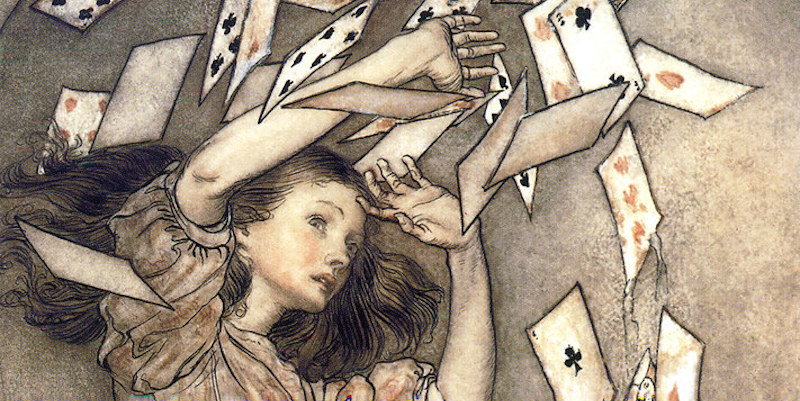
The narrator of these books, who we can suppose is the author (though they appear to be transcribing events that actually happened to Alice) speaks often to the reader, in parenthetical asides (I do love a parenthetical aside, don’t you?) and helpful remarks (If you don’t know what a Gryphon is, look at the picture). This creates a more intimate exchange between story-teller and story-reader. Reading this pair of books is a personal thing and the books themselves are aware of it, aware of the individual reader and what you will bring to the experience.There is something here that can speak to any reader and every reader.

The very last line of Through the Looking-Glass is a question, posed from narrator to reader. This is a story that cares what you think and knows that what you think may differ from what I think or any other reader might think. That is one of the beauties of Alice. Your Alice is yours. Mine is mine. She is all of us together, tumbling head over feet, grasping at an empty jar of orange marmalade. The line between dreamed and dreamer will always be blurred here.

Many questions will remain: How is a raven like a writing desk? What does the flame of a candle look like after the candle is blown out? These are books filled with more questions than answers, more puzzles than solutions, more curiosities than explanations. And that is precisely as it should be.

For why on earth would you try to make sense of a book with so much nonsense in it? Let it be what it is. Revel in the lack of sense. Let yourself be buoyed by its current without concerning yourself with where it might be taking you or what it all might mean.

There is something here that can speak to any reader and every reader. There is a timeless universality to these experiences and these objects and these characters interwoven with the distinct markings of the time and the place they were written in. (My favorite distinct time and place fact that is often lost in time: hatters of that era cured their felt with mercury, which could result in mercury poisoning, thus the Mad Hatter. Also, the tag on his hat is a price tag; that detail went over my head for quite a while when I was young.)

We all need to wonder at something, in this world or another.

Any reader might relate to feeling bewildered or confused or not knowing which way to go or who to believe, listening to people talk in circles and the only one who seems to want to help is a cat. Alice is both curious and stubborn, excellent qualities for a girl of seven (seven and one half exactly in Through the Looking-Glass…) thrown into extraordinary circumstances and dealing with the nonsensical world around her. Sometimes the world does not make sense and still we continue on in our stubborn curiosity.

__________________________________
alice adventures

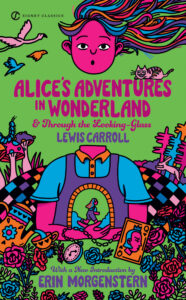
From ALICE’S ADVENTURES IN WONDERLAND AND THROUGH THE LOOKING GLASS published by arrangement with Berkley/Signet Classics, an imprint of Penguin Random House LLC. Copyright © 1960. Introduction Copyright © 2022, Erin Morgenstern.

Alice Pleasance LiddellAlice’s Adventures in Wonderland and Through the Looking-GlassCharles Lutwidge DodgsonErin MorgensternLewis CarrollSignet Classics


Erin Morgenstern
Erin Morgenstern

Erin Morgenstern is the New York Times bestselling author of THE NIGHT CIRCUS (one of TIME Magazine’s 100 Best Fantasy Books of All Time) and THE STARLESS SEA. Her books have won Alex, Locus & Dragon Awards and have been published in dozens of languages. She has a degree in Theater from Smith College and lives in Massachusetts with her husband and Lady Vesper the Cat.

‘The Cole Porter of Literature’: Writers and Artists Remember Edmund White

In these reflections, colleagues, friends and admirers recall his risk-taking, his generosity and his insatiable taste for gossip.

Edmund White leaning back in his chair in a Paris apartment.
Edmund White at home in Paris in 1988. Friends remember him as an inveterate Francophile.Credit…David Gwinnutt/Artist Rights Society (ARS), New York and DACS, London, all rights reserved

Published June 5, 2025 Updated June 19, 2025 (NYTimes.com)

Edmund White was my college thesis adviser, my role model as a gay writer and my friend. He was the Cole Porter of literature: a genius writer who sang dirty lyrics at parties. Always a twinkle of mischief in his eye, a morsel of gossip from the French court, a bit of history about a painting, a comical take on a serious novel, a serious take on a comic one, all in the course of a few minutes’ chat. Other countries celebrate writers who are equally adept at criticism, theater, fiction, biography, memoir — letters in every sense of the word — but in the U.S. the tradition has lapsed. Perhaps Ed was the last of his kind.

Edmund and I were close friends for the past eight years. During this time, he was one of the most loving friends supporting me through the losses of my two children. At the onset of the pandemic, we established our two-person book club, meeting Monday through Friday at 5 p.m. on Skype. This continued, and my estimation is that we read between 80 and 120 books together. But if that sounds heavy or dry, the reality was rather the opposite. We spent most of the time giggling and gossiping (about writers living and dead, about characters we just met in a novel, about an actress in Madame de Sévigné’s letters or a courtesan in Louis XIV’s Versailles). Sometimes I would get a detailed and illuminating description of gay sex from 30 years ago, or from an encounter two days ago. Nearly all our conversations would end with irrepressible laughter on both ends. I shall miss his wicked humor, his erudition and most of all, his irreplaceable presence in my life.

This black-and-white photo of Edmund White from 1986 shows a man with close-cropped dark hair and a mustache standing in the street. He is wearing a light-colored linen shirt and has a jacket flung over one shoulder.
White in 1986.Credit…Ulf Andersen/Getty Images

A good argument can be made that it was Ed White who invented autofiction. He used that term himself, long before it became fashionable. More important, it was the nature of his work, its astonishing candor, its lack of shame (at a time when that was needed, unlike the present), and the overriding charm that made every detail, no matter how pungent or revealing, feel like a confession between friends. White is a writer whose originality came from his material rather than his style. He had style, but he needed it only to tell his long and obsessional boy’s own story.

I corresponded with Edmund only a few times, but I awaited his replies the way one does news of the winning lottery numbers. His writing wasn’t just intimidatingly brilliant or cross-your-legs-on-the-subway sexy, or full of compassion, humor, and devastation; it was all of these at once. He was a literary icon who titillated the mind and body, and whose work, in ways I’m still deciphering, gave us permission to be and to explore. It was gratifying to see Edmund receive some of his flowers in life, but I always wondered why his bouquet wasn’t fuller, bigger. I suspect it was the rampant homophobia of an industry and a society that, ironically enough, he helped to tame.

Ed White was the great permission-giver of gay literature. His frankness about sex between men, beginning at a time when almost no one else wrote that explicitly, and in almost every mode — elegiac, ecstatic, documentary — opened countless doors in the minds of younger writers, myself included. I can still remember picking up “A Boy’s Own Story” as a teenager in a bookshop in London and taking it furtively to the counter because I was afraid the picture of the beautiful young man on its cover would give me away. But it was the cleareyed beauty of the prose that actually thrilled me. That book told me my desire didn’t have to be divorced from the urge to make art: it could be that art.

And then, when I got to know him in the early ’90s, he gave me a whole different kind of permission: to be less self-serious. He once playfully accused me of being an intimist, meaning I preferred tête-à-têtes to gossipy parties, and, implicitly, favored what used to be called “serious relationships” to different partners every night or week. I was guilty as charged, but his joyfulness let me laugh about it — and myself. And for that, and for his work, I will always be grateful.

Editors’ Picks

Is This 19th-Century Factory the World’s First Skyscraper?How ‘Boots on the Ground’ Two-Stepped Onto Everyone’s Summer Playlist‘28 Years Later’ Review: Danny Boyle Revives His Monsters

A photograph of a bearded man in sunglasses reading “States of Desire” while in the pool.
Adam Tendler reading Edmund White’s “States of Desire” on Fire Island in 2009.Credit…Francesco Simone Savi via Adam Tendler

It’s hard to imagine a time in the last couple of decades when I wasn’t reading an Edmund White book, with each one scratching a particular itch. The nostalgia of a budding queer identity in “A Boy’s Own Story” or “The Beautiful Room Is Empty”; the fascination with a gay world I’ll never know in “City Boy”; the longing of an impossible love affair in “Jack Holmes and His Friend”; or the gasp-worthy raunch of his autobiography, “My Lives,” whose “My Master” chapter has some of the most intense sex writing I’ve ever encountered, and yet also the truest depiction of obsession, lust and heartbreak. I knew Ed. He read my own self-published memoir, “88×50,” about traveling the 50 states, a genre for which Ed laid the blueprint in “States of Desire,” and even though I’m a concert pianist, he would always introduce me to people as “the author of a fabulous book.” Truly, to this day, only Ed could make me blush, and with such elegance and style.

Edmund White wrote about sex and bodies in beautiful, outrageously visceral ways. His art was both romantic and deeply horny (in my opinion, a perfect compliment). The way he was able to render bodies on the page gave many of us queer people permission to write about the largeness of erotics with real abandon. It was true genius; there was no other like him.

Contemporary gay literature as we know it wouldn’t exist without Edmund White. From his earliest memoirs and fiction, he wrote without shame or apology about his life as a gay man, about art, about love, about desire, and, most thrillingly, about sex — this in an era when doing so meant risking opprobrium. No one wrote as sexily, or frankly, about sex as Ed did. He read hugely, across eras and cultures — he adored the works of the Japanese author Junichiro Tanizaki, especially “The Makioka Sisters” — and he was unusually generous to younger writers. Getting a note from Edmund White, and then, if you were lucky, being invited over to his apartment, was a rite of passage for many novelists. He was just as generous with his laugh: an infectious trill that began high in the head and spilled into the room. Ed offered a way to be a late-career artist in New York (he published his most recent book last year) who was still engaged, still curious, still hungry and never bitter — a role model for many of us, both on and off the page.

When I began writing “The Queen of the Night,” a friend said, “If you’re writing about courtesans, you have to speak to Ed White.” So I called him up. When I told him my title, he said, “Is that about the male brothel near the Vatican where all the priests go?” I almost changed my subject. I have joked that I might write another novel set there and title it the same, in his honor. He told me about courtesans, about the French, about how they speak social class — it’s a language for them alongside the French language — and his insights were a tremendous help.

In later years I had the good fortune to teach at Princeton for one autumn, and I would meet up with him and [his husband] Michael Carroll on the train from New York. We’d gossip as we passed through the suburbs out to the campus. He had a busy love life, a busy career, and he was by then in his mid-70s. Whatever I thought getting married or getting older as a writer or a gay man looked like, his life said, “Oh, it isn’t like that.”

In this photograph, Edmund White sits talking with a group of men, gesturing with both hands.
In 2019, White talked with cast members of the Broadway play “The Inheritance” about the generations of gay men whose lives were shaped by the AIDS crisis.Credit…Mark Sommerfeld for The New York Times

In person, he lived up to every myth. He welcomed me into the competitive, often superficial world of New York gay letters with warmth and generosity, and became a mentor when I was launching my first novel. I carry his early encouragement with me still — it made me believe, as it did for so many others, that I had a place in this world.

I’ve known no one more generous, more big-hearted, more supportive. He was an omnivorous reader, and he read the works of younger writers with an avidity and engagement that was extremely rare. He endorsed almost everyone, especially gay writers. It was not just part of his politics, but also part of his soul, of who he was. It was a lesson in life for me; here was a better way to be in the world.

He sent me an unedited version of his last book, the sex memoir. When we next Zoomed, I told him that he had written the most explicit book — and there’s, erm, stiff competition in that field — and the most hilarious in his entire career. It was a masterpiece, I added. He smiled, he was genuinely pleased, then he moved on to talk about Elizabeth Bowen, a writer we both adored.

The book of his I feel closest to is “My Lives,” and the essays on his mother and his father in particular. There are whole sentences of his that live in my memory like remembered phrases of poetry. But they are prose, and delivered in such a breezy and matter-of-fact way as to make their ornate sophistication quite approachable. “We had grown up in harem conditions, our ears filled nightly with the counsel and complaints of the counsel’s former favorite” is a line describing his mother after she and his father divorced. Maybe it is poetry.

In this photo, Edmund White sits at a table, a book before him. He is looking directly at the camera, his lips curved in a half-smile.
White in his Manhattan apartment in 2001.Credit…Fred R. Conrad/The New York Times

Reading him could feel like talking to a deliciously slutty friend who would just as easily amuse you with a raunchy tale about who he’d just had as inspire you with some wounding musings about what it means to live and love and lust and mourn and thrive and cry and hope and yearn and ache and every and anything else you could possibly imagine makes up our day to day existence.

His sense of humor was enduring, particularly when it came to respectability and those who found his sexual explicitness a threat to political progress. He told the truth: that being a queer person can and has often been dark and undesirable, but that it can also be a beautiful inheritance, experiencing the world from a radically different point of view. Sharing that queer context without shame or fear was his gift to us.


These recollections have been condensed and edited for clarity.

(Contributed by Michael Kelly, H.W.)

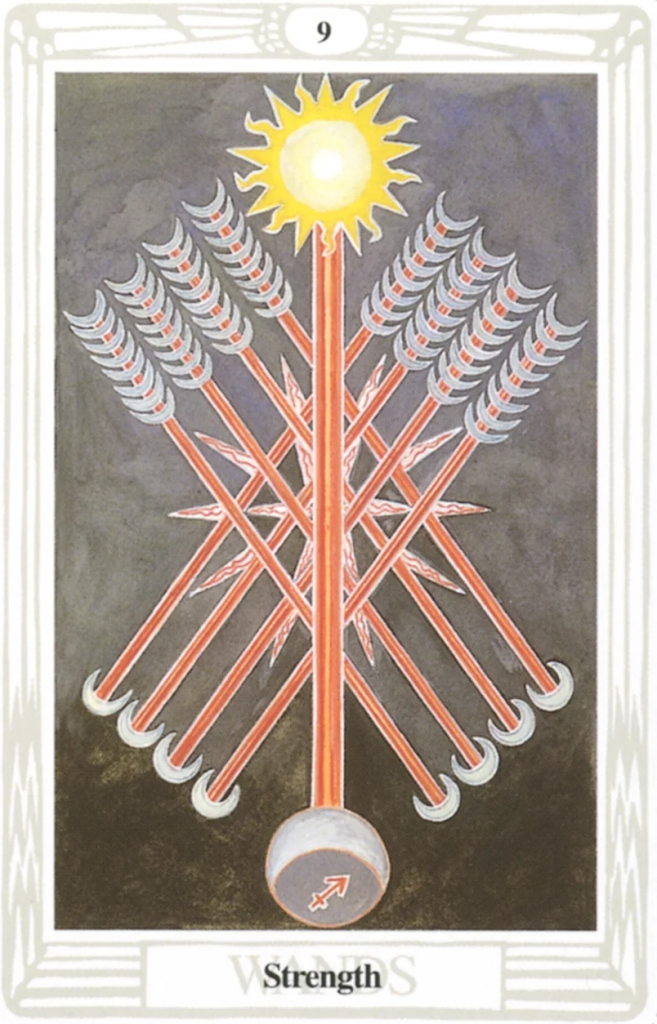
Tarot Card for June 23: Strength

The Nine of Wands

The Lord of Strength relates to our own inner strength and power. When he comes up, we need to allow ourselves to be reminded of our personal wealth of experience, knowledge and talents. This is something that we rarely take time out to assess and consider. Yet since we are constantly adding to it, it is something we should sum up as often as our bank accounts.When we get a clear view of our own strengths, we gather to us a new sense of self-confidence, holding ourselves in high esteem, and treating ourselves as good and trusted friends. This fundamental acceptance of ourselves is essential to allow us a long-term feeling of well-being and optimism.So on a day ruled by the Lord of Strength, we must count our personal strengths. This obviously raises a simple question… how do you know what is strong?The quickest way to identify strengths is to look at the hardest experiences of your life, and assess how you feel you handled them. If you maintain a non-judgemental and objective perspective upon your actions, then you’ll see that, over the years, you have learned to deal with trials and tribulations increasingly efficiently. Every single time you pass through a trying experience, you will have gathered more understanding about how to approach difficulties and resolve them.Your mistakes have special messages for you. To be able to admit you could have dealt with a situation better is, if you allow it to be, one of the most useful revelations of your life. Rather than feeling bad about your actions, allow yourself to consider what would have improved the outcome. Once you have done this, you’ll store that away as new knowledge… and next time a similar situation occurs you’ll remember, and act accordingly. Never be afraid of assessing your mistakes… there’s one very big thing to be said for them – they are all yours!!! And they can be teachers if you let them be.Having worked through the obvious strengths and frailties, go looking for the more subtle aspects of strength… empathy, compassion, patience, morality, humour, respect, honesty, understanding, sensitivity… there are many many things that we might not at first count among our strengths that make us stronger people.

Affirmation: “I acknowledge and grow into my strength.”

(Angelpaths.com)

Someone just sent me a toilet in the mail. It wasn’t as funny as it sounds

OPINION//OPEN FORUM

Intimidation is a powerful weapon. And it comes in many forms — especially in the age of Trump

Toilets are left on a Berkeley street in 2010. A commode sent anonymously to the author appears to send an ominous message about his anti-Trump opinions.

Two Toilets on the Street – 2:02 p.m. – Berkeley These reminded me of outhouses in the Saline Valley, where two toilets were side by side, no door, with the desert as a backdrop. Camera Settings: Canon EOS 5D Mark II, ISO 640, 1/60, f 22, 24mm lensLiz Hafalia/S.F. Chronicle

By David Kirp

June 21, 2025 (SFChronicle.com)

Intimidation is a powerful weapon.

President Donald Trump and his MAGA acolytes have taken a page from the classic autocrats’ playbook, deploying fear to stifle opposition. Anyone who runs afoul of the movement risks the threat of a nasty reprisal.

The threat of physical attacks on lawmakers and their families, fueled by the Trump regime’s inflammatory rhetoric, is a reason why some Republican members of Congress are playing possum.

“We are all afraid,” Alaska Sen. Lisa Murkowski said, speaking on behalf of colleagues who are fearful of speaking for themselves.

One of the most widely used scare tactics against federal judges who have overturned executive orders involves anonymously sending a pizza to their homes. 

This isn’t just a prank. It’s psychological warfare, a black humor way to convey an ominous message — we know where you live and where your family lives.

“Be afraid” is the message. “Be very afraid.”

I get it. I have my own psychological warfare story. While it’s unnerving, I’m still standing. 

In my case, it was a commode, not a pizza, that I received.

It recently arrived at the local post office in a beat-up cardboard box, a few days after the Chronicle published an opinion piece in which I described my ambivalence about living in Donald Trump’s America, where democracy is under siege. 

My husband, Niko, picked up the box. Because it was too big to fit into the car, he opened it and brought it into the house.

“Here’s the commode you ordered,” he told me.

“Say what?” I replied, or words to that effect. “I didn’t order it.” 

At first, Niko was disbelieving.

“Maybe you bought it by accident,” he suggested, as if someone might buy a commode in a fit of absence of mind. To convince him, I called Amazon, which confirmed that I hadn’t ordered it. 

The box didn’t contain a note of explanation from the anonymous sender. Amazon, the shipper for a third-party vendor, was clueless and the manufacturer was unhelpful.

Being sent an unwanted commode sounds like the punch line of a bad joke, but it puts me in the same camp as the judges who are getting those pizzas. 

To me, the message was plain: “We are targeting you and your husband, not just by outing you but also by delivering something that’s usually needed by people of a certain age — people like you. Commodes cost more than pizzas (the one I received sells for $42.98 on Amazon), but we’re willing to spend a considerable amount of money to intimidate you.”

“Why me?” I wondered, once I decoded the implications of my “gift.” I’m no firebrand leading the charge against the tyrant in the White House.

For a number of years, I taught a large undergraduate class at UC Berkeley called the “Ethics in the Age of Trump” — the running joke was that it would be a very short course. Mentioning Berkeley to a MAGA acolyte is certainly a bit like enraging the bull with a red cape.

My writings have invariably taken positions that are diametrically opposed to the Trump wood-chopper agenda. Apparently, that’s enough to put me on a list of undesirables.

After my Chronicle column ran, I received a bevy of emails that demanded — in language unfit for a family newspaper — that I, the “scum of the Earth,” do the country a favor and leave immediately.

I’m not easily cowed.

I shrugged off the emails. I know from experience that if you take a controversial position in an opinion piece, you can expect obscene rants. But if the purpose of sending me the commode was to shut me up or convince me to depart, the strategy backfired. 

Trump and his MAGA wolf pack want their opponents to “self-deport” because it smooths the glide path to autocracy.

To hell with that.

Instead of rushing to buy a one-way ticket to a saner country, I’ve doubled down on my opposition to the endless stream of outrages emanating from Washington and to the imminent threat to the rule of law posed by the autocrat in the White House.

Millions of Americans have been demoralized by the Trump blitzkrieg. The zigzags can leave you gasping: sky-high tariffs one day, lower tariffs the next day; humiliate Ukrainian President Volodymyr Zelensky, then send arms to Ukraine, but threaten to walk away from the war and hand Russia a victory. 

The litany of inconsistencies is endless: sledgehammer Columbia University into retreating on academic freedom, then tell the university today that its obeisance doesn’t get it off the hook; require public schools to eliminate diversity, equity and inclusion programs, then back down when New York says “no”; propose to annex Canada, then make nice with the prime minister.  

The passivity of many of Trump’s opponents during the first five months of his presidency resembles the despondency of the mice in famed psychologist B.F. Skinner’s lab. When they were exposed to random punishments, the mice simply stopped trying.

Yet now, as the implications of the president’s misdeeds sink in, many Americans are trying to figure out how they can fight back. If you’ve read this far, my hunch is that you may be in this camp.

Here’s my advice — do not take it lying down. 

There are many ways to oppose this regime — joining demonstrations, writing and phoning your congressional representatives, enlisting in a political campaign, supporting immigrants when federal immigration agents swoop in and contributing to organizations that are defending the rule of law. Doubtlessly, you’ll come up with other possibilities that work for you.

What’s crucial is that you combat the curse of fatalism — that you keep from becoming one of Skinner’s mice — since that’s precisely how the authoritarian administration wants you to react. Overcome your fear. (Yes, I’m still working on that part, too.) Find a way of contributing to the survival of democracy that works for you. The stakes couldn’t be higher.

Meanwhile, the commode episode has a happy ending — my local senior center was pleased to take it off my hands.

Inadvertently, the mystery sender did a good deed.

David Kirp is a professor emeritus at the Goldman School of Public Policy at UC Berkeley.

James Baldwin on love

James Baldwin

“Love has never been a popular movement. And no one’s ever wanted, really, to be free. The world is held together, really it is held together, by the love and the passion of a very few people. Otherwise, of course, you can despair. Walk down the street of any city, any afternoon, and look around you. What you’ve got to remember is what you’re looking at is also you. Everyone you’re looking at is also you. You could be that person. You could be that monster, you could be that cop. And you have to decide, in yourself, not to be.”

― James Baldwin

James Arthur Baldwin (August 2, 1924 – December 1, 1987) was an American writer and civil rights activist who garnered acclaim for his essays, novels, plays, and poems. His 1953 novel Go Tell It on the Mountain has been ranked by Time magazine as one of the top 100 English-language novels. Wikipedia

Israel-Iran War Day 9: ‘No nuclear material’ at Iran centrifuge workshop hit by Israel, IAEA says

Issued on: 21/06/2025

By: Diya GUPTA/ FRANCE 24

This satellite image provided by Maxar Technologies shows the Isfahan enrichment facility in Iran, Tuesday June 3, 2025.
This satellite image provided by Maxar Technologies shows the Isfahan enrichment facility in Iran, Tuesday June 3, 2025. © AP

The UN nuclear watchdog confirmed Saturday that an Israeli strike had hit a centrifuge manufacturing workshop at Iran’s Isfahan nuclear site, but said that the attack would have “no radiological consequences” due to the lack of nuclear material at the site. Read our liveblog to see how the day’s events unfolded.

This liveblog is no longer being updated. For more coverage of the Israel-Iran war, click here. 

The Whole of It

By Maria Popova (themarginalian.org)

Because we are creatures made of time, what we call suffering is at bottom a warping of time, a form of living against it and not with it — the pain of loss, aching for what has been and no longer is; the pain of longing, aching for what could be but is not yet and may never be; the pain of loneliness, an endless now hollowed of meaning. There can be consolation in looking backward to fathom the staggering odds of never having been born, and in looking forward toward the immortal generosity of our atoms. But nothing calibrates our losses of perspective, nothing consecrates these transient lives bookended by not yet and never again, more than broadening our time horizon until the vista of our own lives becomes not a discrete point but part of a great continuity — one that comes alive in this splendid poem by Hannah Fries:

THE WHOLE OF IT
by Hannah Fries

If you step back, you can see it all
on the horizon: your mother’s death, the children
grown, their smooth eyelids crossed with veins
like saffron filaments. Further still, and see
your smiling grandmother treading the cold ocean,
tiny lakes in her collarbones, your great-
great grandchildren drawing their names
in the sand with sticks. The seas
rising and falling, ice scraping the earth,
and pockets of life surviving — lee sides, hot springs,
protected places. First light on the first day
of your life, and first light of first stars.
And in this way, every death, each apparent ending,
might, in the mind of spacetime, be woven
into one memory, so that always is
this tree, and the long days of falling in love
over the intricate pattern of bark and leaf,
and the first green cell learning to swallow sun.

Couple with Hannah’s magnificent poem “Let the Last Thing Be Song,” then revisit Kahlil Gibran on befriending time.

The Arguers: A Charming Illustrated Parable about the Absurdity of Self-righteousness

By Maria Popova (themarginalian.org)

Perhaps the most perilous consequence of uncertain times, times that hurl us into helplessness and disorientation, is that they turn human beings into opinion machines. We dope our pain and confusion with false certainties that stifle the willingness to understand (the nuances of the situation, the complexity of the wider context, what it’s like to be the other person) with the will to be right. Our duels of self-righteousness can be fought over whose turn it is to take out the trash or who should govern the country, they can take place on the scale of the planet in the language of nuclear weapons or on the scale of the kitchen table in the code language of lovers, but they are always a betrayal of our deepest humanity — the capacity to understand, the longing to be understood, the knowledge that everyone is doing the best they can with the tools they’ve got and the cards they’ve been dealt.

Corinna Luyken, maker of tender and thoughtful illustrated aids for living, animates the absurdity of these duels with playfulness and charm in The Arguers (public library).

The story begins as a bickering over whether a brush or a comb would better detangle the king’s beard and ends up, in the wildfire way of righteousness, as an argument about everything and a national sport.

Soon they argued all the time,
until no one could remember
when the arguing had started
or over what,
or by whom.

They argue with each other and with the flowers and the stones.

They grow so skilled at it — “they could argue forward and backward, right side up and upside down… in fog and sun and sleet and snow” — that the king and queen decide to hold a contest for their nation or arguers.

On the day of the contest, things take an unintended turn.

The story ends with a wink, but is at heart a warning: arguing is counterfeit problem-solving, an argument is a barricade against understanding, and self-righteousness is a fist you open to find your kindness crushed.

Couple The Arguers with philosopher Daniel Dennett on how to criticize with kindness, then revisit Joan Didion on learning not to mistake self-righteousness for morality.

Against Death: Nobel Laureate Elias Canetti on Grieving a Parent, Grieving the World, and What Makes Life Worth Living

By Maria Popova (themarginalian.org)

The year is 1937. Elias Canetti (July 25, 1905–August 14, 1994) — Bulgarian, Jewish, living in Austria as the Nazis are rising to power — has just lost his mother; his mother, whose bottomless love had nurtured the talent that would win him the Nobel Prize in his seventies; his mother, who had raised him alone after his father’s death when Elias was seven (the kind of “wound that turns into a lung through which you breathe,” he would later reflect).

Having left chemistry to study philosophy, trading the science of life for the art of learning to die, Canetti, aged thirty-two, decides to write a book “against” death, defying it without denying it, this shadow of life that is also its spark, the very thing that makes it shimmer with aliveness. He would work on it for the next half century until his own death, filling two thousand pages with reflections and aphorisms posthumously distilled into The Book Against Death (public library).

Art by Salvador Dalí for a rare 1946 edition of the essays of Montaigne

Perhaps Canetti’s reckoning with death is so virtuosic in articulating the potency and poignancy of life because it keeps inverting the lens from the microscopic to the telescopic and back again as he mourns his mother and mourns the world. Everything is suddenly personal, his suffering a fractal of the suffering and everyone else’s suffering a mirror image of his own.

Coming to feel that “with every destroyed city a piece of his own life falls away,” he searches for the borders of compassion and finds none:

Am I Nuremberg? Am I Munich? I am every building in which children sleep. I am every open square across which feet scurry.

And yet alongside this overwhelming brokenness, so universal and therefore so intimate, is also a greater wholeness that he is, as all visionaries are, able to glimpse through the ruins:

Above the shattered world there stretches a pure blue heaven, which continues to hold it together.

It is this blue, this color of longing for life, that saturates the meaning of life amid the darkness of death. Three years into the war, he vows:

Today I decided that I will record thoughts against death as they occur to me, without any kind of structure and without submitting them to any tyrannical plan. I cannot let this war pass without hammering out a weapon within my heart that will conquer death.

Available as a print.

Not everyone, not even the great minds, had Canetti’s defiance. “We must love one another or die,” W.H. Auden had entreated humanity in one of the greatest poems ever written as the war was breaking out, and then, in what may be the most poignant one-word revision in the history of literature and one of the saddest in the history of the human spirit, he had rewritten that epitaphic last line in the wake of the war: “We must love one another and die.” While Auden was ceding his optimism, Muriel Rukeyser — as great a poet and a greater spirit — was celebrating a different vision of life beyond notions of triumph and defeat in one of the greatest books ever written“All the effort, all the loneliness and death, the thin and blazing threads of reason, the spill of blessing, the passion behind these silences — all the invention turns to one end: the fertilizing of the moment, so that there may be more life.”

Canetti shares her lens on the political, but for him it is polished with the most deeply personal. In an entry from June 1942, he writes:

Five years ago today my mother died. Since then my world has turned inside out. To me it is as if it happened just yesterday. Have I really lived five years, and she knows nothing of it? I want to undo each screw of her coffin’s lid with my lips and haul her out. I know that she is dead. I know that she has rotted away. But I can never accept it as true.

[…]

Where is her shadow? Where is her fury? I will loan her my breath. She should walk on my own two legs.

Echoing Ernest Hemingway (“No one you love is ever dead,” he had written in a stirring letter of consolation to a bereaved friend) and echoing Emily Dickinson (“Each that we lose takes part of us / A crescent still abides / Which like the moon, some turbid night, / Is summoned by the tides,” she had written in her reckoning with love and loss upon her own mother’s death), Canetti contemplates the immortality of love in the living:

The souls of the dead are in others, namely those left behind… Only the dead have lost one another completely.

The final card from An Almanac of Birds: 100 Divinations for Uncertain Days, available as stand-alone print benefitting the Audubon Society.

In the prime of his life, he is already facing the losses that loom over anyone who loves:

I want anything to do with fewer and fewer people, mainly so that I can never get over the pain of losing them.

Not knowing that in the decades ahead he would lose the love of his life, marry again and lose her too, lose his younger brother, lose a retinue of friends — some to mass murder, some to suicide, some to the entropy that will take us all if we are lucky enough to grow old — he writes from the fortunate platform of his healthy thirties:

We carry the most important thing around inside ourselves for forty or fifty years before we risk articulating it. Therefore there is no way to measure all that is lost with those who die too early. Everyone dies early.

Art by Charlotte Pardi from Cry, Heart, But Never Break by Glenn Ringtved — a soulful Danish illustrated meditation on love and loss

And yet his mother’s death is precisely what awakened Canetti to life — his own life and the life of the world. (“Death is our friend,” Rilke had written when Canetti was a teenager, “precisely because it brings us into absolute and passionate presence with all that is here, that is natural, that is love.”) Beneath it all pulsates his unflinching intimacy with the elemental reality of living:

We do not die of sadness — out of sadness we live on.

At the crux of Canetti’s disquisition on the menace and meaning of death is a passionate inquiry into what it means to be alive. A decade before Edward Abbey contemplated how to live and how (not) to die and a decade after Simone de Beauvoir composed her resolutions for a life worth living, Canetti itemizes the priorities of a good life:

To live at least long enough to know all human customs and events; to retrieve all of life that has passed, since we are denied that which will come; to pull yourself together before you disappear; to be worthy of your own birth; to think of the sacrifices made at the expense of others’ every breath; to not glorify suffering, even though you are alive because of it; to only keep for yourself that which cannot be given away until it is ripe for others and hands itself on; to hate every person’s death as if it were your own, and to at last be at peace with everything, but never with death.

Complement these passages from The Book Against Death with a heron’s antidote to death, then revisit Mary Oliver on how to live with maximum aliveness, Henry Miller on the measure of a life well lived, and Alan Lightman on what happens when we die.

Charlie Chaplin – Final Speech from The Great Dictator

Charlie Chaplin Mar 10, 2016• Subscribe to our channel: http://bit.ly/TheChaplinFilms • Get it on iTunes: http://bit.ly/iTunesGreatDictatorSpeech • “We think too much and feel too little. More than machinery we need humanity. More than cleverness we need kindness and gentleness. Without these qualities, life will be violent and all will be lost…” The Great Dictator © Roy Export S.A.S. Learn more about The Great Dictator at http://bit.ly/GreatDictatorFilm • Facebook:   / charliechaplinofficial  

Text:

The Final Speech from The Great Dictator:

I’m sorry, but I don’t want to be an emperor. That’s not my business. I don’t want to rule or conquer anyone. I should like to help everyone – if possible – Jew, Gentile – black man – white. We all want to help one another. Human beings are like that. We want to live by each other’s happiness – not by each other’s misery. We don’t want to hate and despise one another. In this world there is room for everyone. And the good earth is rich and can provide for everyone. The way of life can be free and beautiful, but we have lost the way.

Greed has poisoned men’s souls, has barricaded the world with hate, has goose-stepped us into misery and bloodshed. We have developed speed, but we have shut ourselves in. Machinery that gives abundance has left us in want. Our knowledge has made us cynical. Our cleverness, hard and unkind. We think too much and feel too little. More than machinery we need humanity. More than cleverness we need kindness and gentleness. Without these qualities, life will be violent and all will be lost…

The aeroplane and the radio have brought us closer together. The very nature of these inventions cries out for the goodness in men – cries out for universal brotherhood – for the unity of us all. Even now my voice is reaching millions throughout the world – millions of despairing men, women, and little children – victims of a system that makes men torture and imprison innocent people.

To those who can hear me, I say – do not despair. The misery that is now upon us is but the passing of greed – the bitterness of men who fear the way of human progress. The hate of men will pass, and dictators die, and the power they took from the people will return to the people. And so long as men die, liberty will never perish…

Soldiers! don’t give yourselves to brutes – men who despise you – enslave you – who regiment your lives – tell you what to do – what to think and what to feel! Who drill you – diet you – treat you like cattle, use you as cannon fodder. Don’t give yourselves to these unnatural men – machine men with machine minds and machine hearts! You are not machines! You are not cattle! You are men! You have the love of humanity in your hearts! You don’t hate! Only the unloved hate – the unloved and the unnatural! Soldiers! Don’t fight for slavery! Fight for liberty!

In the 17th Chapter of St Luke it is written: “the Kingdom of God is within man” – not one man nor a group of men, but in all men! In you! You, the people have the power – the power to create machines. The power to create happiness! You, the people, have the power to make this life free and beautiful, to make this life a wonderful adventure.

Then – in the name of democracy – let us use that power – let us all unite. Let us fight for a new world – a decent world that will give men a chance to work – that will give youth a future and old age a security. By the promise of these things, brutes have risen to power. But they lie! They do not fulfil that promise. They never will!

Dictators free themselves but they enslave the people! Now let us fight to fulfil that promise! Let us fight to free the world – to do away with national barriers – to do away with greed, with hate and intolerance. Let us fight for a world of reason, a world where science and progress will lead to all men’s happiness. Soldiers! in the name of democracy, let us all unite!

Final speech from The Great Dictator Copyright © Roy Export S.A.S. All rights reserved

(Contributed by Hanz Bolen, H.W., M.)

Consciousness, spirituality, biography, sexuality, androgyny, futurism, space, the arts, science, astrology, democracy, humor, books, movies and more