

God Hurting After Eating 20-Piece Spicy Angel Wings

Published: March 14, 2016 (CommonDreams.org)
THE HEAVENS—Staring off into the middle distance for several minutes in obvious discomfort, The Lord Almighty, Our Heavenly Father, announced Monday that He was “hurting real bad” after consuming an entire 20-piece order of spicy angel wings. “Ooh, mama,” said God, who was reportedly sweating profusely and had bright orange “Atomic” angel wing sauce speckling His white beard. “Oh, I’m so dumb. Why didn’t I just get a half-order of the angel wings? Or the honey BBQ kind? Ugh, I’m gonna be feeling these suckers for the next couple millennia.” According to sources, a logy God later suffered severe sunburn after dozing off on some clouds that were bathed in direct heavenly light.
Famine Expert: Israel’s Starvation of Gaza Most ‘Minutely Designed and Controlled’ Since WWII
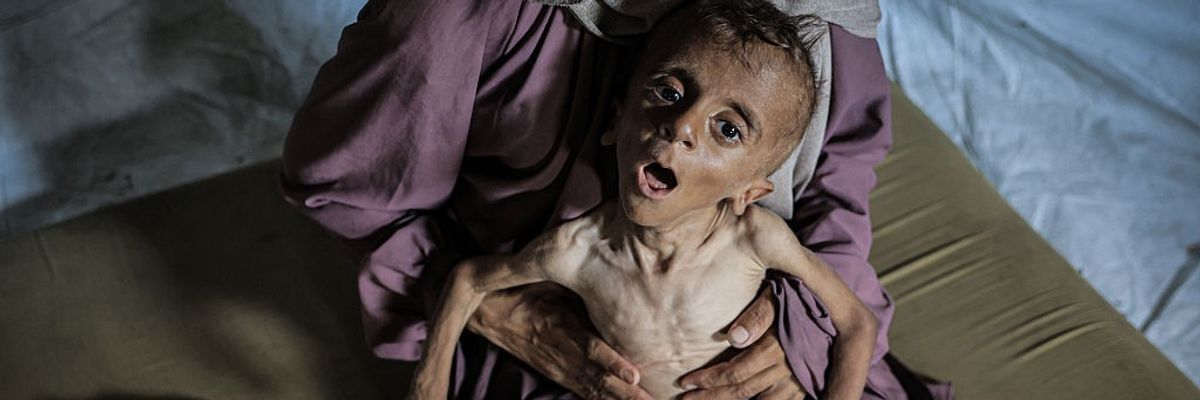
Muhammad Zakariya Ayyoub al-Matouq, a 1-year-old Palestinian boy from Gaza City, faces life-threatening malnutrition as the humanitarian situation worsens due to ongoing Israeli attacks and blockade, on July 21, 2025.
(Photo: Ahmed Jihad Ibrahim Al-arini/Anadolu via Getty Images)
“This is preventable starvation,” said Alex de Waal. “It is entirely man-made.”
Jul 22, 2025 (CommonDreams.org)
A leading global authority on famine on Monday accused Israel of orchestrating a carefully planned campaign of mass starvation in the Gaza Strip, remarks that came amid a steadily rising death toll from malnutrition caused by the 654-day U.S.-backed Israeli siege and obliteration of the Palestinian enclave.
“I’ve been working on this topic for more than four decades, and there is no case since World War II of starvation that is being so minutely designed and controlled,” Alex de Waal, executive director of the World Peace Foundation at Tufts University’s Fletcher School of Law and Diplomacy, told Al Jazeera.
“This is preventable starvation. It is entirely man-made,” de Waal added. “And every stage of this has been predicted, and at every stage action could have been taken—by Israel, by the international authorities, [the] international community, those who back Israel—to prevent what is happening now… Those steps have simply not been taken.”
The Gaza Health Ministry—whose casualty figures have been deemed accurate by Israeli military officials and a likely undercount by multiple peer-reviewed studies—said Tuesday that 15 more Palestinians, including four children, died from malnutrition over the past 24 hours, bringing the total number of starvation deaths in the coastal enclave to at least 101, including 80 children, since October 2023. The ministry said that 21 Gaza children have starved to death over the past three days alone.
When combined with lack of medicine, malnutrition has claimed hundreds of Palestinian lives in Gaza, according to officials there.
“I am so hungry,” Ruwaida Amer, a 30-year-old Gaza woman, wrote for +972 Magazine Monday. “We are starving. My body is breaking down. My mother is collapsing from exhaustion. My cousin cheats death every day for a morsel of aid. Gaza’s children are dying in front of our eyes, and we are powerless to help them.”
Another Gaza woman, Amina Badir, told Amer while clutching her starving 3-year-old: “Tell me how to save my daughter Rahaf from death. For a week she’s eaten nothing but a single spoon of lentils each day.”
“She’s suffering from malnutrition. There’s no treatment, no milk at the hospital,” Badir added. “They’ve taken away her right to live. I see death in her eyes.”
Gaza medical officials say 17,000 children are severely malnourished in the strip. According to the Integrated Food Security Phase Classification, also known as the IPC scale, 85% of Gaza’s people are in Phase 5, defined as such “an extreme deprivation of food” that “starvation, death, destitution, and extremely critical levels of acute malnutrition are or will likely be evident.”
The “complete siege” imposed on Gaza immediately following the October 7, 2023 Hamas-led attack on Israel has fueled widespread starvation and disease, and has been condemned as a war crime. The International Criminal Court last year ordered the arrest of Israeli Prime Minister Benjamin Netanyahu and former Defense Minister Yoav Gallant for alleged murder and forced starvation of Gazans. The International Court of Justice is also weighing a genocide case filed against Israel by South Africa.
Amid intense international pressure, Israel partially lifted its siege of Gaza in May. However, de Waal and others say the move is wholly inadequate to prevent the famine taking hold in the strip.
“The partial lifting was not to bring in the kind of humanitarian program that we have been familiar with as humanitarians over the decades,” de Waal told Al Jazeera Monday. “It was to bring in a type of rationed program that is simply an arm of the Israeli military.”
Israel has also come under intense criticism for its method of delivering aid in Gaza via the U.S.-backed Gaza Humanitarian Foundation, whose distribution points have been the sites of near-daily massacres. Israel Defense Forces (IDF) officers and troops say they were ordered to shoot and shell desperate aid-seekers at GHF distribution centers. Officials said at least 10 aid-seekers were killed on Tuesday alone.
“The killing of civilians seeking aid in Gaza is indefensible.”
“As of July 21, we have recorded 1,054 people killed in Gaza while trying to get food; 766 of them were killed in the vicinity of GHF sites and 288 near [United Nations] and other humanitarian organizations’ aid convoys,” U.N. human rights spokesperson Thameen Al-Kheetan told Agence France-Presse.
Kaja Kallas, the European Union’s foreign policy chief, said Tuesday that “the killing of civilians seeking aid in Gaza is indefensible,” adding that the “IDF must stop killing people at distribution points.”Overall, at least 59,029 Palestinians have been killed by Israeli forces in Gaza since October 2023, most of them women and children, according to the Gaza Health Ministry. More than 142,000 others have been wounded, and at least 14,000 more are missing and presumed dead and buried beneath the rubble of hundreds of thousands of bombed buildings.
Other international humanitarian experts also weighed in on the growing Gaza famine, with Michael Fakhri, the U.N. special rapporteur on the right to food, telling Al Jazeera Monday that the “man-made” starvation in the strip “is a war crime.”
“Israel has been using aid as a way to bait civilians and has been killing civilians who have been seeking aid,” he said. “What we’re seeing now is the most horrific stage of Israel’s 20-month starvation campaign.”
https://embed.bsky.app/embed/did:plc:cpshddqofvb6kgmi3rng4nyv/app.bsky.feed.post/3lujtu6ikcc22?id=9065234159100155&ref_url=https%253A%252F%252Fwww.commondreams.org%252Fnews%252Ffamine-expert-israel-s-starvation-of-gaza-most-minutely-designed-and-controlled-since-wwii&colorMode=system
Jan Egeland, secretary general of the Norwegian Refugee Council, told Reuters Tuesday that “our last tent, our last food parcel, our last relief items have been distributed. There is nothing left.”
“Hundreds of truckloads have been sitting in warehouses or in Egypt or elsewhere, and costing our Western European donors a lot of money, but they are blocked from coming in,” he explained. “That’s why we are so angry. Because our job is to help.”
“Israel is not yielding,” Egeland added. “They just want to paralyze our work.”
Our work is licensed under Creative Commons (CC BY-NC-ND 3.0). Feel free to republish and share widely.
Brett Wilkins is a staff writer for Common Dreams.
Jack Kornfield The Sweet and Radical Joy of Living in the Way
Be Here Now Network Jul 2, 2025 Jack Kornfield – Heart Wisdom Jack invites us to walk the path of joy—no matter the circumstances—showing how living joyfully and tenderly is a courageous, radical, and transformative act. Join the Year of Awakening with Jack Kornfield for monthly livestream Q&A hangs with Jack, and weekly lessons and reflections to keep your year focused on awakening. Visit https://jackkornfield.com/product/the… and use code AWAKEN50 for 50% off entry. In this episode, Jack mindfully explores: *Living joyfully with a positive attitude *Joy as a necessary quality of enlightenment *How can we have joy in times of chaos, disruption, and suffering? *Joy as a true service to others and the world *Uplifting others through our joy and positivity *Wavy Gravy and the Transformative Power of Joy *How suffering is not the end of the story; it’s the beginning of the Four Noble Truths *Bringing joy, beauty, and humor to our protesting, activism, and standing up for what matters *Being hopeful despite the outside circumstances, and emphasizing compassion, sacrifice, courage, and kindness *The joy and playfulness of His Holiness the Dalai Lama and Archbishop Desmond Tutu *How we can bless and heal each other with our joy *Living in joy, love, health and peace even amidst hate, affliction, and troubles *Experiencing the sweet joy of living in the way *The radical joyful presence of Ajahn Chah and Maha Ghosananda *Risking delight *Jack’s rapturous experience of meditative bliss *Learning to step out of the battle and embrace life *Thich Nhat Hanh and the practice of smiling *Becoming a make-weight of joy, tipping the scales to hope *Unshakeable integrity, generosity, gratitude, and tenderness *Tuning in with nature, relationships, and the mystery *Father Gregory Boyle and the possibility of transformation and renewal This episode was recorded on 04/07/2025 for the Spirit Rock Meditation Center Monday Night Dharma Talk and Guided Meditation. “What I’ve seen in visiting refugee camps is that they don’t want you to come in feeling depressed—they have enough of that themselves. They’re not looking for people who are frightened, worried, or downhearted. What they long for is someone who can bring a sense of uplift, possibility, and joy.” – Jack Kornfield About Jack Kornfield: Jack Kornfield trained as a Buddhist monk in the monasteries of Thailand, India, and Burma, studying as a monk under the Buddhist master Ven. Ajahn Chah, as well as the Ven. Mahasi Sayadaw. He has taught meditation internationally since 1974 and is one of the key teachers to introduce Buddhist mindfulness practice to the West. Jack co-founded the Insight Meditation Society in Barre, Massachusetts, with fellow meditation teachers Sharon Salzberg and Joseph Goldstein and the Spirit Rock Center in Woodacre, California. His books have been translated into 20 languages and sold more than a million copies. Jack is currently offering a wonderful array of transformational online courses diving into crucial topics like Mindfulness Meditation Fundamentals, Walking the Eightfold Path, Opening the Heart of Forgiveness, Living Beautifully, Transforming Your Life Through Powerful Stories, and so much more. Sign up for an All Access Pass to explore Jack’s entire course library. If you would like a year’s worth of online meetups with Jack and fellow community, join The Year of Awakening: A Monthly Journey with Jack Kornfield. Stay up to date with Jack and his stream of fresh dharma offerings by visiting JackKornfield.com and signing up for his email teachings. Jack Kornfield The Sweet and Radical Joy of Living in the Way – Heart Wisdom Ep. 295 – • Jack Kornfield The Sweet and Radical Joy o…
(Contributed by Zoë Robinson, H.W., M.)
Word-Built World: insurrect
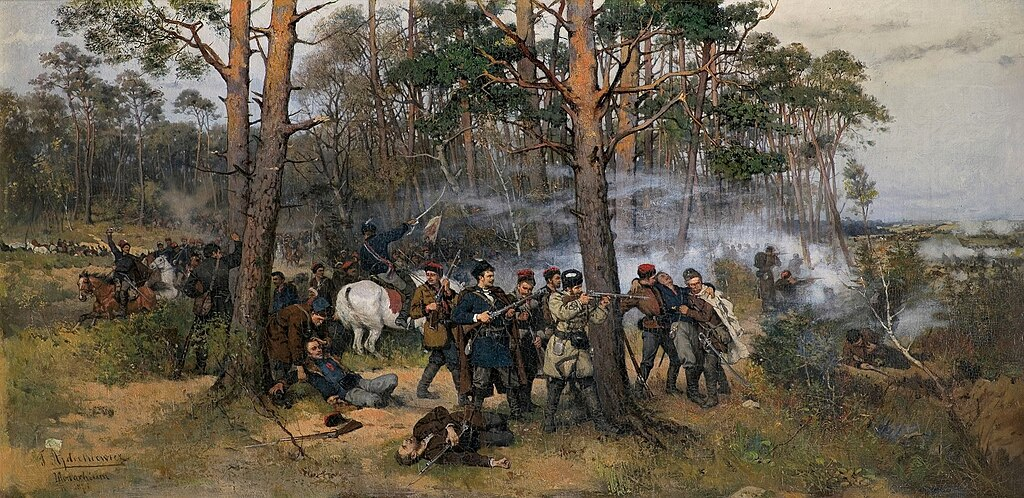
A Scene from the January Uprising, 1876
(Poland 1863-1864) Art: Tadeusz Ajdukiewicz
A.Word.A.Daywith Anu Garg
insurrect
PRONUNCIATION:
MEANING:
verb intr.: To rise in revolt against a government or other authority.
ETYMOLOGY:
Back-formation from insurrection, from Latin insurgere (to rise up), from in- (intensive prefix) + surgere (to rise). Earliest documented use: 1694.
July 24: Restoration of Democracy Day in Greece
From: Zoë Robinson, H.W., M.
Thought you’d like to know . . .
July 24 – The Restoration of Democracy in Greece
Restoration of Democracy Day in Greece, celebrated annually on July 24th, commemorates the end of the military junta and the return to parliamentary democracy in 1974. This day signifies the end of the seven years of military dictatorship and the beginning of the Third Hellenic Republic . .
Greece Remembers the Day Democracy was Restored
July 24, 2015 (GreekReporter.com)

July 24, 1974 is an important day in modern Greek history as it marks the day democracy was restored after seven years of military dictatorship.
A few days earlier, a failed junta-instigated military coup in Cyprus gave Turkey a great excuse to invade the island on July 20 and occupy one third of it. The dictators in Athens, unable to handle the situation, decided to pass the government to the hands of politicians and stepped out. On their part, the politicians decided to call on Constantinos Karamanlis to become prime minister of the Greek republic.
Karamanlis, who had served four times as Greece’s prime minister, was self-exiled in Paris since 1963. At 2:00 am on July 24, 1974, he arrived at the Athens airport with many Greeks welcoming him as a messiah. He was sworn in at 4:00 am by Archbishop of Athens and all of Greece Seraphim and the temporary President of the Hellenic Republic, Phaedon Gizikis.
At noon the same day, a part of the new government was sworn in, comprised mainly of politicians from the Center and the Right. On July 26, the rest of the cabinet was sworn in.
The immediate actions taken for the restoration of democracy were the release of all political prisoners, amnesty for political offenses, the closing of a political prisoner camp in Gyaros and other such camps, the return of nationality to Greeks who were stripped of Greek citizenship by the junta, and all actions required for Greek society to return to normalcy, especially in the Armed Forces and Police.
Other actions were the legalization of the Greek Communist Party and other leftist parties and factions and the adoption of a new constitution. In December 1974, in a referendum in which two thirds of the people voted against kingship in Greece, political history in the country changed forever.
James Baldwin on love and freedom

“Love has never been a popular movement. And no one’s ever wanted, really, to be free. The world is held together, really it is held together, by the love and the passion of a very few people.”
― James Baldwin
James Arthur Baldwin (August 2, 1924 – Decembrer 1, 1987) was an American writer and civil rights activist who garnered acclaim for his essays, novels, plays, and poems. His 1953 novel Go Tell It on the Mountain has been ranked by Time magazine as one of the top 100 English-language novels. Wikipedia
The Canyon and the Meaning of Life
By Maria Popova (themarginalian.org)

Anything you polish with attention will become a mirror. Anything to which you give yourself fully, vest all your strength and risk all your vulnerability, will return you to your life annealed, magnified, both unselved and more deeply yourself. It can be a garden, or a desert, or a hare. It can be, perhaps most readily, a place. “Place and a mind may interpenetrate till the nature of both is altered,” the Scottish mountaineer and poet Nan Shepherd wrote in her stunning love letter to a mountain long before neuroscience found the seat of personhood in the hippocampus — the brain’s compass for navigating space. Places can become part of us, can imprint themselves on the soul like people we have loved. Because every place is part of a larger landscape, a cell in the body of the world, to fall in love with any one place — to contact its beckoning beauty, its vulnerability, its variousness — is to come to love the world itself more deeply.
That is what Ann Zwinger (March 12, 1925–August 30, 2014) invokes in Wind in the Rock (public library) — her breathtaking 1978 account of falling in love with Utah’s rocky canyons, finding a microcosm of the world in their desolate Martian landscapes threaded with cattle trails, touching both the immediacy of life and the size of time in their elemental majesty.

She writes:
There is an enchantment in these dry canyons that once roared with water and still sometimes do, that absorbed the voices of those who came before, something of massive dignity about sandstone beds that tell of a past long before human breathing, that bear the patterns of ancient winds and water in their crossbeddings.
That enchantment only comes at the price of tremendous courage, for encountering the canyons is no picturesque excursion — Grand Gulch divides the plateau in half, its walls a menacing vertical drop of fifty feet cascading downward into a series of undercut steps nearly impossible to descend on foot except with razor caution. But impossible is just what we call the limits of our courage and imagination. One night after dinner, Zwinger sets out to climb the talus slope above her camp, four hundred feet straight up into the gloaming sky. When she finally reaches the top, crowned with a narrow pillar of rock, she sits down to write in her notebook until the last light fades, capturing the moment in what may well be a prose poem:

She descends back to camp in the darkness — “a declivity of mind and feeling” — and when she looks up at the slope the next morning, it seems impossible that anyone could climb down in the dark. She reflects:
Over and over, Zwinger discovers what we all do if we live with maximum aliveness — that we fathom our depths only by pushing against our limits. She writes:
Over and over, her stubborn courage is recompensed with something beyond beauty, beyond gladness — a rush of pure being:
Eternity, however, is always menaced by entropy — Zwinger finds herself trying to reconcile the ancient Indian cultures embedded in the canyons with the oil drilling now scarring the face of the mountain with the pockmarks of so-called civilization. She wonders:

But one does remember, for such places embed themselves in the marrow of memory, become part of knowing ourselves, a map to the terra incognita of who and what we are. As she prepares to leave the canyons, she reflects on what these austere rocks have taught her about being alive:
I don’t think I’ve ever sat and watched for so long, hypnotized with the splendor of this time, this place, this sense of being. It is enough to know why I came here: to breathe in the solitude and the silence. I simply accept what I’ve been learning in these canyons, finding resources I didn’t know I had, stretching, accepting that there are times when one has no options, and I sit here in peace because of that. I know that I will never be content without risk and challenge and the opportunity to fail, to know pain, the chance to test my endurance, unwrap my horizons, know physical stress and the blinding satisfaction of coming through. If the cost is great, the rewards are greater. And I sit here in peace because of that.
In a sentiment evocative of Willa Cather’s splendid definition of happiness as being “dissolved into something complete and great,” Zwinger adds:
In the quiet, the air is singing.
Isotopes, Vikings, Mars
By Maria Popova (themarginalian.org)
We are perishable matter yearning for meaning, and time is both the matter and the meaning of our lives. “Time is a river that sweeps me along but I am the river,” Borges wrote in 1940. “Time is the substance I am made of.”
Around the same time, the chemist Willard Libby had a revolutionary insight that brought physics to the poetry of time, measurement to the mystery of this substance we are made of.
Discus chronologicus — a German depiction of time from the early 1720s, included in Cartographies of Time. (Available as a print and as a wall clock.)
Science is stratified, layering discovery upon discovery, continually changing the landscape of knowledge we call reality. The late 1930s and early 1940s were a particularly volcanic time in the life of knowledge. After physicist Lise Meitner prevailed against the odds of her time and place to discover nuclear fission while working with isotopes — nuclear species of the same element that have different numbers of neutrons in their nuclei — physicist Serge Korff theorized that neutrons produced in the upper atmosphere by the newly detected cosmic rays would interact with the abundant isotope nitrogen-14 and become carbon-14 — an unstable isotope of carbon, also known as radiocarbon.
Like all air molecules, radiocarbon makes its way from the atmosphere into living matter — it goes into your lungs with every breath you take, then into your bloodstream, into your digestive system and out of it, into the soil, into whatever grows in the soil, tagging everything along the way with the isotope.
Libby, building on this cascade of discoveries and on his own Manhattan Project work in uranium enrichment, realized that you could measure the amount of radiocarbon in an object and use the isotope’s half-life — the amount of time it takes for radioactive decay to exponentially vanquish the unstable atom, a constant for each element and around 5700 years for radiocarbon — to trace time back and establish the age of the object.
So began what geologists and archeologists would call the “radiocarbon revolution.”
Art by Vivian Torrence from Chemistry Imagined by Roald Hoffmann with Carl Sagan.
Today, radiocarbon dating has been used to discern the age of the Dead Sea Scrolls and the shroud in which Jesus’s crucified body was swathed, to discover the “wood wide web” of mycorrhizal communication by observing how carbon isotopes are exchanged between root systems, to reveal the biochemical pathways beneath the mysteries of photosynthesis and the metabolic pathways of molecules in the human body, to map disease prevalence and solar activity across time.
But one of the most unexpected and revelatory uses of radiocarbon dating has been to locate an entire civilization in space and in time.
In 1960, months before Libby was awarded the Nobel Prize for his discovery, Norwegian explorer Helge Ingstad and archaeologist Anne Stine Ingstad (who happened to be married to each other) discovered the remains of Norse buildings in Newfoundland — astonishing evidence that the Viking civilization had reached the edge of North America, vindicating the feat of Icelandic sagas that historians had considered mythic hyperbole.
The question became not whether but when it happened.
Viking Ship by Andreas Bloch, late 1800s
Excavations went on for eight years. When a few logs of juniper and fir turned up among the archaeological ruins, no one thought much of them.
Meanwhile, radiocarbon labs were being set up around the world — dozens of them by the end of the 1960s, finding unimagined uses for this young science that suddenly banked the river of time. But time takes time — as historian Eleanor Barraclough recounts in her altogether fascinating book Embers of the Hands: Hidden Histories of the Viking Age (public library), it wasn’t until decades after the excavation that researchers realized the Newfoundland wood samples were a once-living record of solar activity. Barraclough writes:
The year the Ingstads completed the Newfoundland excavation, NASA began working on two space probes headed for Mars. They called the program Viking — across time and space, across technologies and civilizations, that same irrepressible human yearning to broaden the known world, to make contact with another.
Carl Sagan and a Viking lander in Death Valley, California. (Photograph courtesy of Druyan-Sagan Associates, Inc.)
When Ray Bradbury sat down with Carl Sagan and Arthur C. Clarke for a historic conversation about Mars and the mind of humanity, he captured this elemental impulse:
This will always be our romance — to know the unknown, to transcend ourselves, to touch the edges of reality in the finite time we have. Longing may be the only thing in the universe with a half-life of zero.
What To Know About The Epstein Files

Published: July 21, 2025 (TheOnion.com)
Some MAGA supporters are turning on President Trump after he walked back campaign promises to declassify information about deceased financier and convicted sex offender Jeffrey Epstein. Here is everything you need to know about the Epstein files.
Q: Why are people so interested in the Epstein case?
A: It’s the only example of money and power influencing an otherwise just legal system.
Q: What’s the difference between Epstein’s client list and his alleged black book?
A: The black book includes alternate cover art, gilded page edges, and a foreword by actor Kevin Spacey.
Q: Is Donald Trump named in the Epstein files?
A: There is no record of Epstein’s best friend hanging out with him.
Q: Does a cabal of super-rich pedophiles really exist?
A: It’s more of a loose friend group.
Q: Who was president when Epstein mysteriously died in prison?
A: The alleged suicide took place in between the end of Obama’s second term and the beginning of the Biden administration.
Q: How does the Department of Justice plan to release the files?
A: They will pin the list onto the White House bulletin board like a high school theater cast announcement.