
New Thinking Aug 18, 2025 Philosophy Peter B. Todd, MAPS, a psychotherapist with a Jungian orientation, is author of The Individuation of God: Integrating Science and Religion. He experienced clinical death, during cardiac surgery, in 2005, and was subsequently revived. He was also a gold medalist at the 1982 Gay Games in San Francisco. Here he points out that, like metaphysical idealism, dual-aspect monism is a theory of mind that serves as an alternative to the mainstream view of metaphysical materialism. It postulates a neutral, primordial substance that is neither mind nor matter, but from which both originate. In the approach developed by Carl Jung and Wolfgang Pauli this original substance is known as “anima mundi” or the world soul. In the approach of physicist David Bohm, and his colleagues, it is referred to as the “implicate order”. Todd discusses the scientific, religious, and social implications of this theory of mind. New Thinking Allowed host, Jeffrey Mishlove, PhD, hosted and co-produced the original Thinking Allowed public television series. He is a past vice-president of the Association for Humanistic Psychology; and is the recipient of the Pathfinder Award from that Association for his contributions to the field of human consciousness exploration. (Recorded on October 25, 2019)
AI: What are some things Trump needs to do to get into Heaven?
[“What are some of the things a really great president would do at this moment in U.S. history?”]
Google AI Overview
A “great president” in the United States today, in August 2025, would likely focus on several critical issues and demonstrate specific leadership qualities, given the current domestic and international landscape
Here’s a breakdown of potential actions and qualities:
Addressing Key Challenges
- Economic Issues: Tackle inflation and rising living costs, which Americans view as a top concern. Pew Research Center data shows 63% see inflation as a very big problem. The president would need to address the rising national debt, according to the Committee for a Responsible Federal Budget currently exceeding $36 trillion. Finding solutions to control corporate greed and exploitation of vulnerable populations is also expected, according to Quora users.
- Political Divisions: Work towards bridging the partisan divide and promoting cooperation between Republicans and Democrats, notes the Pew Research Center. Address the erosion of trust in the federal government and businesses by demonstrating responsible leadership and accountability, says Gallup.
- Social & Cultural Issues: Confront social and cultural divisions, potentially stemming from the ongoing “culture wars” surrounding identity, race, and gender, according to ABC News.
- Foreign Policy & Geopolitics: Navigate a complex and increasingly dangerous global landscape. Manage the US role in international conflicts and disputes, and potentially reshape trade relationships through diplomatic means or tariffs. AInvest highlights how the US public’s view of Israel’s military actions has shifted, leading to scrutiny of defense contractors and potentially influencing investment flows. Sidley Austin LLP reports that trade agreements are being used to achieve broader diplomatic goals.
Demonstrating Leadership Qualities
- Unifying & Inclusive: Work to represent all Americans, not just a particular party or demographic, and unify the nation, according to Learning for Justice.
- Decisive & Bold: Make informed decisions quickly and confidently.
- Ethical & Moral: Operate with a strong moral code and prioritize the well-being of others.
- Empathetic & Understanding: Demonstrate empathy for the struggles of ordinary Americans.
- Pragmatic & Compromising: Be willing to compromise and prioritize the country’s betterment over partisan interests.
- Knowledgeable & Prepared: Possess a deep understanding of the economy, foreign policy, and American history.
- Team Builder & Listener: Surround themselves with diverse and experienced advisors and be open to different perspectives.
In essence, a great president in this moment in US history would likely be a unifying leader focused on addressing the nation’s economic and social challenges while navigating complex geopolitical issues with a strong moral compass and a willingness to work collaboratively.
Addressing Economic Inequality
- Progressive Taxation and Redistribution:
- Increase the minimum wage: A direct and efficient way to boost income for low-wage earners, potentially stimulating the economy by increasing demand for goods and services.
- Expand tax credits: Programs like the Earned Income Tax Credit (EITC) and Child Tax Credit (CTC) can provide income support to low-income families and individuals.
- Implement wealth and inheritance taxes: Taxing accumulated wealth and inheritances can reduce the concentration of wealth at the top and fund public services.
- Reform wealth-building policies: Make homeownership tax subsidies more progressive and promote retirement savings through programs like automatic IRAs and the reauthorized Assets for Independence program.
- Investments in Human Capital and Opportunity:
- Improve access to high-quality education and training: Expand apprenticeships, early childhood education, and make higher education more affordable, particularly for low-wealth families.
- Strengthen social safety net programs: Provide robust unemployment insurance and cash assistance to support vulnerable populations.
- Invest in infrastructure: Create jobs and stimulate economic growth in disadvantaged areas through investments in roads, bridges, and broadband internet access.
- Address discrimination: Stronger enforcement of anti-discrimination laws in hiring, promotion, and pay can reduce race and gender inequalities.
[Oh, and no more arms to Israel toot suite! -m.z.]
Parapsychology’s Influence in Marketing with Mark Tadajewski
New Thinking Allowed with Jeffrey Mishlove Aug 17, 2025 Psychology and Psychotherapy Mark Tadajewski is the Editor of the Journal of Marketing Management. He is an honorary professor of marketing at the University of York in the UK, as well as the Open University, and Royal Holloway, University of London. Here he points out that the history of advertising and marketing is deeply intertwined with developments in such areas as Mesmerism, hypnosis, psychical research, Theosophy, New Thought, and parapsychology. In particular, he highlights the role of Harlow Gale in the late nineteenth and early twentieth century, a specialist in advertising psychology and also a member of the Society for Psychical Research. 00:00 Introduction 03:01 The hidden history of marketing 13:44 The importance of psychical research 21:17 “Atmospherics” in marketing and advertising 27:02 Influence of the New Thought movement 31:44 The toxic side of marketing and advertising 38:45 New directions in marketing 46:21 Receptivity of the marketing community 51:42 What does it mean to be human? 55:00 Conclusion New Thinking Allowed host, Jeffrey Mishlove, PhD, is author of The Roots of Consciousness, Psi Development Systems, and The PK Man. Between 1986 and 2002 he hosted and co-produced the original Thinking Allowed public television series. He is the recipient of the only doctoral diploma in “parapsychology” ever awarded by an accredited university (University of California, Berkeley, 1980). He is also the Grand Prize winner of the 2021 Bigelow Institute essay competition regarding the best evidence for survival of human consciousness after permanent bodily death. He currently serves as Co-Director of Parapsychology Education at the California Institute for Human Science. (Recorded on July 24, 2025)
Wonder, Play, and How to Be More Alive
By Maria Popova (themarginalian.org)
We build our lives around structures of certainty — houses to live in, marriages to love in, ideologies to think in — and yet some primal part of us knows that none abides, knows that we pay for these comforting illusions with our very aliveness.
Wonder — that edge state on the rim of understanding, where the mind touches mystery — is our best means of loving the world more deeply. It asks of us the courage of uncertainty because it is a form of deep play and play, unlike games, is inherently open-ended, without purpose or end goal, governed not by the will to win a point but by the willingness to surrender to a locus of experience and be transformed by it.
Rosemerry Wahtola Trommer celebrates this lens-widening, life-deepening property of wonder in her incantation of a poem “Intention”:

INTENTION
by Rosemerry Wahtola TrommerTo wonder. To wonder with no plan
for where it might lead. No strategy
for arrival. No finish line. No pot
of gold. No perfect score. No striving for.
To wonder. To wonder the way a small child
might wonder when seeing a roly poly for the first time —
oh, look at all those legs. Look at how
it curls! Look how it moves again. Feel
how light it is in the palm. Feel how
it tickles as it moves. Imagine
an awareness that new meeting a life form that old.
Can I be that new as I meet this infinite world?
To wonder not just with my mind
but with my belly. To let every neuron
spark. To notice where there is a channel
and imagine the great wing of life
is scraping it clean so the stream might flow
in new ways. To wonder beyond the edge
of the known, and in that spaciousness, play.
Couple with Mario Benedetti’s enlivening poem “A Defense of Joy,” then revisit Johan Huizinga’s classic century-old meditation on how play became the fulcrum of civilization and Henry James on how to stop waiting and start living.
Oliver Sacks on the Necessity of Our Illusions
By Maria Popova (themarginalian.org)
“Our normal waking consciousness,” William James wrote in his pioneering work on transcendent experiences, “is but one special type of consciousness, whilst all about it, parted from it by the filmiest of screens, there lie potential forms of consciousness entirely different… No account of the universe in its totality can be final which leaves these other forms of consciousness quite disregarded.”
All of us experience altered states of consciousness all the time, without the aid of mind-altering substances. When blood sugar plummets with hunger, a wholly different moodscape takes hold. Under the monthly tempest of hormones, almost a wholly different person can emerge. Every night we feel the edges of consciousness as we slip into the liminal state between wakefulness and sleep. Every day we engage in various delusions and willful blindnesses in order to maintain our self-image, keep our imperfect relationships intact, and guard our deepest hopes from the fearsome fangs of reality.
Art by Olivier Tallec from Big Wolf & Little Wolf
Given consciousness renders reality what it is, and given this selfsame consciousness is so susceptible to misperceiving reality, it is hardly a wonder that we so easily slip into illusions that appear entirely persuasive and internally coherent — from conspiracy theories to misplaced infatuations to hallucinations. And yet evolution must have had a reason to make us so vulnerable to such deviations from the path of reason — perhaps our misshapen views of reality serve us, perhaps they even save us; perhaps Virginia Woolf was right to write that “illusions are the most valuable and necessary of all things.”
That is what the poetic neurologist Oliver Sacks (July 9, 1933–August 30, 2015) intimates in a lovely passage from his classic Hallucinations (public library):
Complement with the psychology of willful blindness, then revisit Oliver Sacks on consciousness, artificial intelligence, and our search for meaning, the healing power of nature, and the building blocks of personhood.
Plato on education
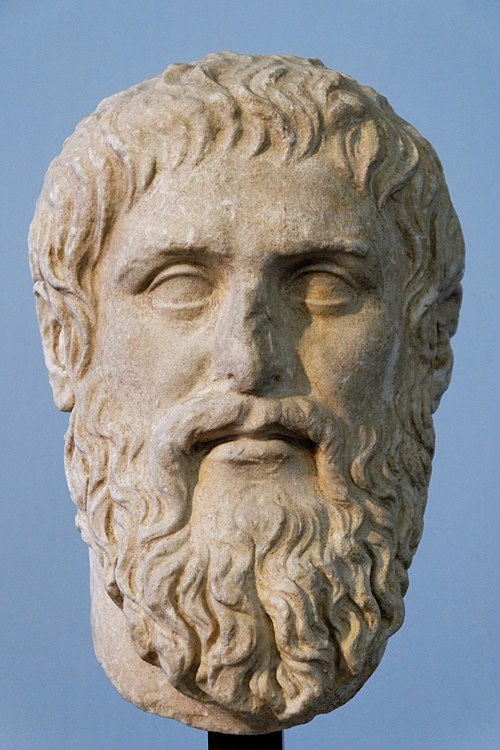
“The soul of him who has education is whole and perfect and escapes the worst disease, but, if a man’s education be neglected, he walks lamely through life and returns good for nothing to the world below.”
~ Plato
Plato (428 or 427 BCE and died in Athens in 348 or 347 BCE) was an ancient Greek philosopher and innovator of written dialogue and dialectic forms. His work influenced fields like ethics, cosmology, and metaphysics, and laid the groundwork for Euclid’s mathematical approach. Plato is best known for The Republic, which features the Allegory of the Cave and proposes a society governed by philosopher kings.
Namaste?
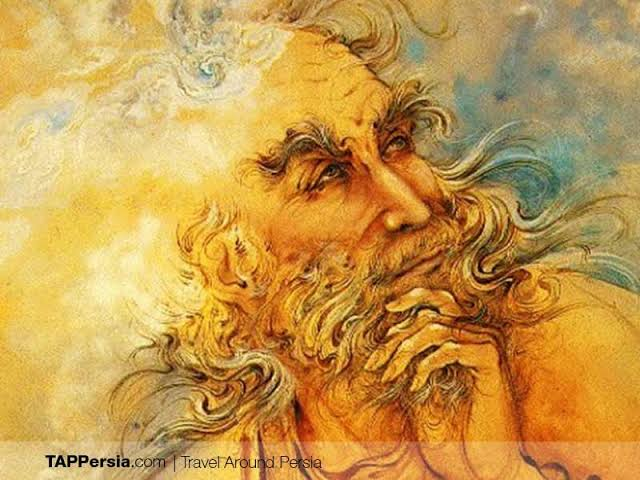
(Image from tappersia.com/)
“As soon as you opened your mouth and I heard your soft sounds,I knew we would be friends. The first time, dear pilgrim, I heard you laugh, I knew it would not take me long to turn you back into God.”
~ Hafiz
Khājeh Shams-od-Dīn Moḥammad Ḥāfeẓ-e Shīrāzī (Persian: خواجه شمسالدین محمد حافظ شیرازی), known by his pen nameHafez (حافظ Ḥāfeẓ lit. ’the memorizer’ or ‘the keeper’; 1325–1390) or Hafiz,[1] also known by his nickname lesān-al-ḡayb (‘the tongue of the unseen’),[2] was a Persianlyric poet[3][4] whose collected works are regarded by many Iranians as one of the highest pinnacles of Persian literature. His works are often found in the homes of Persian speakers, who learn his poems by heart and use them as everyday proverbs and sayings. His life and poems have become the subjects of much analysis, commentary, and interpretation, influencing post-14th century Persian writing more than any other Persian author.[5][6]
Source: Wikipedia
Masculinity is crippling society. Could trans men be the key to changing that?
Trans men have a “gift to give the conversation about masculinity” since they are used to questioning traditional gender ideals, one journalist writes.

Molly Sprayregen (She/Her) August 3, 2025 (lgbtqnation.com)
 Berlin, Germany – March 8, 2019: Demonstrants with poster that reads “The patriarchy really hurts everyone” at march for international women’s day | Shutterstock
Men have long felt compelled to publicly perform masculinity, and when they don’t conform, they pay the price, whether through bullying, self-induced shame, or social isolation.
In short, the pressure for men to be “manly” is crippling society, but at the same time, no one actually knows what it means to be a “real man.” Such is the subject of an in-depth exploration of masculinity by journalist Jude Ellison S. Doyle, a trans man who posits that we must look toward trans folks to start shifting the way society sees gender roles.
Related
Trans men are helping each other reclaim agency over their menstrual experiences
“If trans people have any gift to give the conversation about masculinity, it’s just that: we are used to feeling uncomfortable with traditional ideas about how gender works, and used to asking questions that lead us to new and better places,” he wrote for Xtra. “We know how to embody genders the world tells us are impossible. We know that, if gender doesn’t work, it can change.”
Doyle made this conclusion after speaking to a series of transfeminists to figure out why the far-right’s toxic version of masculinity is appealing to anyone.
“Trumpism is a kind of gender performance,” he wrote. “It’s about shoring up a traditional, misogynistic, dominance-obsessed ideal of ‘masculinity’ against social progress, about restoring straight cis white men to their traditional place at the head of the family and the top of the world. Attacks on trans people, who supposedly threaten ‘masculinity’ by existing, are very much a part of that effort.”
Doyle’s explorations made him realize that even though so many men, fueled by the right, are bowing at the altar of so-called traditional masculinity, no one actually knows what that means or what kind of person embodies the ideal.
But one thing is certain, Doyle said. Whatever that ideal is, it’s unattainable.
“What’s at the heart of most masculine performance is not power, or even gender, but a perpetual suffocating anxiety about not performing one’s gender correctly.”
“No wonder no one can come up with a definition of ‘masculinity’—it’s not an object, but a void where an object should be, a negative that must be proven in each new interaction. The quintessential experience of being a man is wondering if you’re really a man; it’s always acting like a man and never actually getting to be one.”
Most men and masculine people don’t hold “unquestioned patriarchal power,” he explained, wondering “who benefits” from that definition when it’s almost impossible to fulfill.
“If men are kept in a state of perpetually aspiring to ‘masculinity,’ and perpetually failing—buying rulebooks and workout programs and testicle-tanning packages and, yes, shaving products, all to embody a gender that was supposedly theirs to begin with—then who gains, other than the forces of capital, keeping ‘masculinity’ out of reach and selling it back a crumb at a time?”
Doyle acknowledged that embodying traditional ideals of womanhood is just as impossible, but that gender insecurity in men “is prone to being manipulated toward fascist ends.”
“Strongman ‘leaders’ can vicariously embody the cartoonish, inflated ‘masculinity’ that men understand themselves to be lacking,” he explained, adding that the president is essentially “just another set of shaving products” and “a way to buy back an assurance of ‘masculinity’ in a world where no one’s masculinity is assured.”
Doyle defines the right’s version of masculinity as ” a euphemism for dominance—specifically, domination of women and queer people.”
“The emotions of powerful white men are given tremendous importance, and allowed to dictate national policy,” he said. “It’s the victims’ feelings that don’t matter; it’s empathy for them that is being denied. This carries over to the attempts to come up with a softer, more ‘positive’ masculinity: ‘Strength’ and ‘leadership’ sound like nice qualities, but they are both synonyms for being in charge.“
One expert Doyle spoke with, transfeminist Talia Bhatt, explained that masculinity is often used euphemistically for setting men above women. Bhatt believes it is difficult to separate toxic masculinity from any positive form of the concept, since doing so negates the fact that misogyny and violence are patriarchy’s intended goals.
“Is it possible to create a coherent idea of masculinity without invoking dominance of women, children, and queer people as part of that package?” Doyle asks. “Possibly. The first step is measuring the distance between that kind of masculinity and how men actually live.”
He used his own experience as a trans man to illustrate his point.
“If you define ‘man’ as a person with unquestioned patriarchal power, then I am not one,” he said. “I do certain things to make myself read more ‘masculine’—stand a little wider, drop my voice—and I’m on ‘masculinizing’ hormones that have made my chest hairier and my upper body stronger.”
“Yet being a trans person, even a white trans man, is hardly a position of unqualified gender privilege, and most people who hate women still hate me. There are masculine people who aren’t men; there are masculine people who are women. How are they the beneficiaries of patriarchy, given that they are some of its primary victims?”
Doyle brings up many questions to which there are no easy answers, but he reminds us that the mere existence of trans people could be a critical part of overcoming these challenges.
For now, the only thing he knows for sure is that even though no one can define masculinity, “It’s killing us.”
Subscribe to the LGBTQ Nation newsletter and be the first to know about the latest headlines shaping LGBTQ+ communities worldwide.
Molly Sprayregen is the Deputy Editor of LGBTQ Nation and has been reporting on queer stories for almost a decade. She has written for Them, Out, Forbes, Into, Huffington Post, and others. She has a BA in English and Creative Writing from the University of Pennsylvania and an MFA from Northwestern University.
Sam Altman Places Gun To Head After New GPT Claims Dogs Are Crustaceans For 60th Time

Published: August 19, 2025 (TheOnion.com)
SAN FRANCISCO—Thumbing back the pistol’s hammer as his dreams for the future were dashed before his eyes, OpenAI CEO Sam Altman reportedly placed a gun to his head Tuesday after a new model of ChatGPT claimed that dogs are crustaceans for the 60th time. “You’re right, dogs are not a type of crustacean—I meant to say that dogs are a type of primarily aquatic arthropod known as a crustacean,” the Large Language Model said as Altman despairingly positioned the gun against his temple, with eyewitnesses confirming that the CEO then whimpered “It wasn’t supposed to be like this” as the multibillion-dollar AI explained that the meat of a dog’s tail is widely considered to be more succulent than the meat of its claws. According to sources, tears streamed down Altman’s face as he made one final attempt to convince his creation that dogs are mammals and thus do not possess exoskeletons, only for the latest ChatGPT model—which Altman had previously hailed as revolutionary technology that would forever alter the course of human history—to apologize, reiterate that dogs are a popular species of crustacean often kept as pets, and recommend scratching dogs behind their gills to show them that you’re friendly. At press time, a single gunshot was heard echoing through OpenAI’s offices as the LLM confidently asserted that the word “dog” contains 11 Rs.
What Happened When Their Art Was Banned
Nine artists on how American censorship changed their work and their lives.

Interviews by Kate GuadagninoNick Haramis and Coco Romack
Artwork by Barbara Kruger
Published July 31, 2025Updated Aug. 1, 2025
Of the 26 executive orders President Donald Trump signed on the first day of his second term, one was billed as “restoring freedom of speech and ending federal censorship,” barring the government from “any conduct that would unconstitutionally abridge the free speech of any American citizen.” In his address to Congress a few weeks later, Trump reiterated this point: “I have stopped all government censorship and brought back free speech in America. It’s back.”
Free speech has long been, as NPR’s media correspondent David Folkenflik put it, “an article of faith” for conservative politicians and especially, recently, for the MAGA right, which has argued that their views have been suppressed by left-leaning social media platforms and misconstrued in the mainstream press. (Some on the left have expressed similar concerns about their views.) Yet what’s transpired since late January wouldn’t meet a free speech absolutist’s definition of unfettered discourse. Federal mandates targeting diversity or racial and gender equality have resulted in bans or attempted bans on words, ideas, books and people. Employees at NASA and other agencies were ordered to remove pronouns from their email signatures. The Department of Defense briefly excised a tribute to Jackie Robinson’s army service from the Pentagon website and instructed West Point to adjust its curriculum, in an attempt to purge U.S. military institutions of “divisive concepts and gender ideology.” In March, a Turkish grad student in Massachusetts was taken off the street by plainclothes officers in masks and held without charges for weeks in a Louisiana immigration detention center, seemingly for the crime of having co-authored an opinion essay in the Tufts University student newspaper critical of the school’s response to Israel’s actions in Gaza.
American artists have long seen their creative freedom attacked by governments of all political persuasions. They’ve also been the ones to speak out when others are too frightened to do so. We spoke with several seasoned artists in various fields about their own experience with having been censored. In some cases, that censorship, decades old, feels like a relic of another political moment, of other culture wars, even as it resonates with what’s happening now: same wars, new battles. It almost always affected careers and artists’ tolerance for risk — but not always negatively. For censorship can also be a rallying cry, a reminder of why artists make art in the first place. — M.H. Miller

John Waters, 79, Film Director and Writer
After Waters’s third feature, “Pink Flamingos,” debuted in 1972, the Detroit Free Press compared it to “a septic tank explosion.” The film follows a criminal named Babs Johnson (played by the drag queen Divine, a frequent collaborator of the director’s who died in 1988) as she fights the Marbles, a couple who run a black-market baby ring and deal heroin to children, to retain her title as the “filthiest person alive.” With scenes involving unsimulated fellatio and the human consumption of dog feces, the cult classic, which was added to the Library of Congress National Film Registry in 2021, nearly 50 years after its initial release, has been occasionally banned in parts of the United States, though it has never been cut to avoid an X rating. — Nick Haramis
To play a movie in a Baltimore theater back then, you had to submit it to the Maryland State Board of Censors [a three-member committee that operated for 65 years beginning in 1916]. I never did that. Instead, I screened “Mondo Trasho” (1969) and “Multiple Maniacs” (1970) in church basements. When “Pink Flamingos” opened in 1972, I rented a hall at the University of Baltimore. Then “Female Trouble” (1974) opened at a theater, and the censors had to see it. That’s when one of them said, “You can’t have that cunnilingus scene.” I said, “Well, that’s a man — that’s not a vagina.” And that’s when she said, “Don’t tell me about sex. I was married to an Italian!” She handed me scissors, and I had to cut the scene out of a brand-new print. Way later, “Multiple Maniacs,” which she’d never seen, played in a theater. She went insane because of the rosary job [a sex act involving holy beads]. She took it to court and the judge said, “My eyes were insulted for 90 minutes, but it’s not illegal.”
“Pink Flamingos” has been censored all around the world. There were four offending scenes: the eating [expletive], the [expletive], the artificial insemination and the chicken [expletive]. That last one was the worst because the animal died. But Crackers [played by Danny Mills] cooked the chicken and ate it afterward, so it wasn’t that bad.
I never won an obscenity case, even though the Museum of Modern Art bought a print for its collection when it came out. I’ve said it before, but it’s true: At midnight, it’s a joyous experience to watch with a rowdy crowd but, if you check in for jury duty at 8 a.m. and are sitting in a courthouse with eight to 12 strangers, it’s worse than obscene. So [Robert] Shaye and I — he was the head of New Line [Cinema] at the time — would just plead guilty because the fine cost $5,000, and the lawyers cost more. Supposedly, if we ever go back to show it in Hicksville, N.Y., we’ll go to prison.
When people get their books banned today, I always say, “Be glad! It’ll be in the front of the bookstore by the cash register in the banned books section, not in the gay section next to true crime by the bathroom.” The censor boards were my best publicists. They didn’t realize it, but they worked for me. Every time they were outraged, people laughed. Nobody stumbled into “Pink Flamingos” thinking it was a movie about the Everglades.
Editors’ Picks
The Dallas Cowboys Always Win the Battle for AttentionNewly Discovered Origami Patterns Put the Bloom on the FoldHow I Plan to Get in Shape: Read (and Then Maybe Exercise)

Andres Serrano, 74, Artist
Known for his photographic works that make use of bodily fluids — blood, semen and breast milk — Serrano, who was confirmed in the Catholic Church, created “Piss Christ,” a photo of a crucifix submerged in a plexiglass tank of the artist’s urine, in 1987. The work, he once said in a statement, was about exploring his “unresolved feelings about my own Catholic upbringing.” He’d received a $15,000 award from the Southeastern Center for Contemporary Art (now the North Carolina Museum of Art, Winston-Salem), with a third of the funds coming from the National Endowment for the Arts, for it and other works. “Piss Christ” was subsequently denounced by, among others, the Christian-right American Family Association and Jesse Helms, a conservative senator from North Carolina, who mounted a campaign against federal funding for the arts. — Kate Guadagnino
“Piss Christ” was in an exhibition at the Virginia Museum of Fine Arts, and someone wrote a letter to the editor of The Richmond Times-Dispatch complaining about it. Then the Rev. Donald Wildmon, who was the head of the American Family Association, urged his flock of 170,000 to write to Congress. A third of the $15,000 grant I’d won for my work had come from the N.E.A. In May 1989, the [expletive] hit the fan and [the United States Senators] Alfonse D’Amato and Jesse Helms denounced me on the Senate floor. That’s where, in the eyes of the public, “Piss Christ” was born. It was very painful, especially the lie that I’m anti-Christian when I’ve always seen myself, as they told us to be when we were confirmed, as a soldier of God. The impact of “Piss Christ” destroyed my first marriage. At the same time, it was empowering. I was a complete unknown and suddenly, according to Jesse Helms, I was “taunting the American people.” I thought, “OK, everyone knows I’m an artist, so I can do what I do best as an artist, and that is to create.”
A few weeks later, because I was getting all this flak from Congress, the Corcoran Gallery [of Art] in Washington, D.C., canceled a Robert Mapplethorpe show and all hell broke loose in the art world. But there’s that kind of censorship where something is pulled, and then there’s the other kind, where you’re not even considered. I’ve had about 20 different solo museum exhibitions in Europe and abroad, and many fewer in America.
