
Marianne Williamson Sep 4, 2025 The question before us is not only “What do we have to do in order to endure and transform this moment?” Every bit as importantly, it’s “Who do we have to be?” Going deep is as important as going wide, a critical mass is as important as a majority, and changes within us will cause changes in the world we see. Let’s gooooooo…..
Word-Built World: uranomania
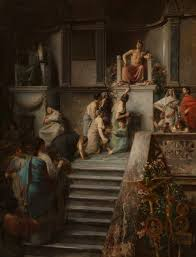
Caligula Indulging in the Worship of the People, 1877
Art: Émile Lévy According to Wikipedia, Roman emperor Caligula (12-41 CE) became “increasingly self-indulgent, cruel, sadistic, extravagant and sexually perverted thereafter, an insane, murderous tyrant who demanded and received worship as a living god, humiliated the Senate, and planned to make his horse a consul.”
A.Word.A.Daywith Anu Garg
uranomania
PRONUNCIATION:
MEANING:
noun: The delusion that one is of divine origin.
ETYMOLOGY:
From Greek urano- (heavens) + -mania (obsession). Earliest documented use: 1890.
Weekly Invitational Translation: Some of us have not outgrown our infantile grandiosity.
Translation is a 5-step process of “straight thinking in the abstract” comparing and contrasting what seems to be truth with what you can syllogistically, axiomatically and mathematically (using word equations) prove is the truth. It is not an effort to change, alter or heal anything.
The claims in a Translation may seem outrageous, but they are always (or should always be) based on self-evident syllogistic reasoning. Here is one Translation from this week.
1) Truth is that which is so. That which is not truth is not so. Therefore Truth is all that is. Truth being all is therefore total, therefore whole, therefore complete. Truth being true is therefore right, therefore proper, therefore appropriate, therefore fitting, therefore suitable, therefore fit, therefore sound, therefore healthy. I think therefore I am. Since I am and since Truth is all that is, therefore I, being, am Truth. Since I, being, am Truth, therefore I, being, have all the attributes of Truth. Therefore I, being, am total, whole, complete, right, proper, approprite, fitting, suitable fit, sound, healthy. Since I am mind (self-evident) and since I (being) am Truth, therefore Truth is Mind. (Two things being equal to a third thing are equal to each other.) Since Truth is Mind, therefore Mind has all the attributes of Truth. There Mind is total, whole, complete, right, proper, appropriate, fitting, suitable, fit, sound, healthy.
2) Some of us have not outgrown our infantile grandiosity.
Word-tracking:
us: people, mortals
grow: mature, develop, green, grass
mature: timely
infantile: infant, non-speaking, childish, immature, not ripe
grandiosity: pretentious, pompous, imposing, overly complex
pretentious: untruthful
pompous: self-important
3) Truth being all is therefore without limit. Being without limit, istherefore immortal. Therefore mortality is a lie about the immortality of Truth. OR: Truth is immortal. Truth being true, therefore proper, therefore appropriate, therefore timely, therefore Truth is mature (timely). Truth being mature, that which is infantile, not mature, not ripe, not timely, not fitting, is not so. Therefore Truth is always on time. Truth being all that is and pretension being an untruthful claim, therefore Truth is unpretentious (not overly complex). Truth being unpretentious is therefore not self-important. Therefore Truth is Self-important.
4) Truth is immortal.
Truth is mature (timely).
Truth is always on time.
Truth is unpretentious (not overly complex).
Truth is Self-important.
5) Truth is timely Self-importance.
Weekly Invitational Translation Group invites your participation. If you would like to submit a Translation on any subject, feel free to send your weekly Translation to zonta1111@aol.com and we will anonymously post it on the Bathtub Bulletin on Friday.
For information about Translation or other Prosperos classes go to: https://www.theprosperos.org/teaching.
Kahlil Gibran on reason and passion

“Your reason and your passion are the rudder and the sails of your seafaring soul.
If either your sails or your rudder be broken, you can but toss and drift, or else be held at a standstill in mid-seas.
For reason, ruling alone, is a force confining; and passion, unattended, is a flame that burns to its own destruction.
Therefore let your soul exalt your reason to the height of passion, that it may sing;
And let it direct your passion with reason, that your passion may live through its own daily resurrection, and like the phoenix rise above its own ashes.”
― Kahlil Gibran, The Prophet
Gibran Khalil Gibran, usually referred to in English as Kahlil Gibran (January 6, 1883 – April 10, 1931), was a Lebanese-American writer, poet and visual artist; he was also considered a philosopher, although he himself rejected the title. Wikipedia
Lunar Eclipse In Pisces – In My Secret Life
(Astrobutterfly.com)
On September 7th, 2025, we have a Full Moon and Total Lunar Eclipse in Pisces.
The eclipse is total – which means it’s intense – VERY intense. And it’s in the middle of the sign (15° Pisces) – right at the heart of the Piscean territory. This one goes straight to the point.
The lunar eclipse highlights the tension of the Virgo-Pisces axis – where we aim to find balance between our worldly duties and our higher purpose.
Both Virgo and Pisces want to reach some sort of ‘perfection’ – but they go about it in different ways:
- In Virgo – through constant improvement: read diet, wellness, self-help, routines. The approach is practical and rooted in the physical world.
- In Pisces – through merging with something that is already perfect; at least, what we see as perfect, something we can’t fully grasp, that lures us like a mermaid call.
These 2 seemingly opposite drives create a feedback loop: the more pressure we put into getting it ‘right’ in the physical world (Virgo), the greater the longing to merge with something greater (Pisces).

Pisces is where we hide from the physical Virgo reality; and Virgo is where we come back to Earth – after wandering lost for too long in the too vast Piscean waters.
The Lunar Eclipse on September 7th, 2025 aims to find balance between these 2 approaches, with a focus on the Pisces side of the axis.
We are in the Virgo season, so our focus naturally turns to everyday reality: work, errands, routines, the small rituals that give us a sense of safety and control.
However, the more pressure we face in daily life – work, duties, responsibilities (Virgo) – the more the psyche leans the other way, into an alternate field where “perfection” is not set by worldly standards but by the hidden drives and unmet desires of the soul (Pisces).
Pisces is where our higher self tries to connect with us through symbols and signs: a dream you can’t shake, a chance encounter that rings like a bell, a longing you can’t translate into ordinary life.
And because these Piscean longings can feel phantasmagoric and out of reach, the way we try to bring them to heel is by doubling down on the Virgo side of the axis: more work, more yoga, stricter diet – whatever keeps us anchored in ‘reality’.
The Age Of Virgo, The Age Of Pisces
This Virgoan reflex is braided into our utilitarian society. Virgo, the maiden with the grains, symbolizes the shift from hunting and gathering to agriculture.
That shift began around 12.000 BCE, at the dawn of the Neolithic era, when we had the Age of Virgo.
Interestingly, much of that order (urban establishments, systematized agriculture) grew around temples – the Piscean need to worship and merge with something greater – out of which the Virgo way of functioning emerged: settlement, organization, and production.
And then approx. 2000 years ago, around the year 0, corresponding to the birth of Jesus, we entered the Age of Pisces, with its signatures of spirituality, faith, and redemption.
But Pisces, too, casted Virgo as its shadow: alongside transcendence arose the mundane disciplines of daily life, the rules, routines, and systems of work and service that anchored spiritual devotion.
Just as Virgoan agriculture and settlement once gathered around temples – giving form to a Piscean need to worship – so too did the Piscean call to transcendence later give rise to Virgoan structures: the routines and systems of daily life that kept devotion anchored.
We are now transitioning into the Age of Aquarius, with a wholly different set of logics and priorities. Yet with Neptune in Pisces (from 2011- to 2025, and again 2025-2026), accompanied by Saturn, and the Nodal axis moving through Pisces–Virgo, the focus remains.
The Lunar Nodes on the Virgo-Pisces axis are asking us to sort this polarity out – once and for all.
Eclipses – when the Sun and Moon conjoin the Nodes – are activation points for the axis they occupy, asking us to face imbalances and integrate the missing pieces.
Just like Yin has a bit of Yang, and Yang has a bit of Yin, Virgo and Pisces are 2 expressions of the same polarity, seeking a higher integration.
To achieve this, we have 2 eclipses this current Eclipse season: the upcoming Lunar Eclipse in Pisces (on Sept. 7th-8th, 2025), and a Solar Eclipse in Virgo (on Sept. 21st).
Lunar Eclipse In Pisces – In My Secret Life
Right now, with the Lunar Eclipse, the focus is on Pisces.
Pisces is the last sign of the zodiac – the metaphoric ocean, the great storehouse, the unconscious – or however we want to call that space where everything we’ve gathered from Aries through Aquarius is dissolved and recombined in a melting pot, from which something new can later arise in Aries.
What is this Piscean dreamscape exactly?
When pressure from the environment (Virgo) becomes exacting, we retreat to our Piscean island – a place without burdens, without rigid black-and-white lines, where life opens into colors and nuances.
And it’s exactly the morphing, ambivalent, ever-shifting nature of Pisces that helps us recalibrate – in the same way sleep restores our capacity to function in the 3D world the next day.
The Piscean process is not meant to confuse us; but to help us sink deeper into meaning.
Leonard Cohen (Sun in Virgo, Moon in Pisces) said it best:
“And the dealer wants you thinking
That it’s either black or white.
Thank God it’s not that simple
In My Secret Life.”
The world – through its systems, metrics, and deadlines – likes things in black-and-white terms.
But when we live only in checklists and optimization, the cycle can start to feel like an endless loop or a burden. That is not because the Virgo ritual is wrong. It’s because ritual without soul contact goes dry.
Our inner life is deeper and more complex, and retreating into Pisces offers an oasis of the soul. However, that oasis can also turn into an escape – just like Virgoan works and rituals harden into dry routines – when we push too far into either extreme.
Suffering arises when there’s a gap between the sanctuary we feel inside (Pisces) and the reality of our daily life (Virgo).
The task is not to chase the mirage of perfection on either side. The invitation is to build a bridge – to let the part of us that speaks in symbols and tides (Pisces) be in direct conversation with the part that schedules, crafts, and implements (Virgo).
If, in our secret lives, we get to be who we really are, how do we sneak a truthful slice of that self into daylight – in forms our everyday life can actually hold?
Because the ideal, the mirage, the dream is a symbol for something deeper, subtler, and more numinous than a literal outcome.
The hidden longing behind “I want to look 10 years younger,” might be a nudge to reconnect with our inner child – or to live a chapter that never got lived when it wanted to.
Full Moon Lunar Eclipse In Pisces – The Aspects
This Full Moon Eclipse forms an auspicious trine to Jupiter (at 19° Cancer) – a reminder that we have what it takes – that all the resources we need are within reach.
Jupiter says: perhaps the Piscean longing is not ‘just a dream’. Perhaps it’s the next reality, quietly incubating – ready to surface when the time is right.
Mercury is at 10° Virgo, opposing the eclipse, adds discernment. Data can inform us – or confuse us. Some “facts” are just clever reasons to stay exactly where we are; others are spec sheets for what the dream could look like in real terms.
This questioning, self-doubting Mercury opposite Eclipse energy is not meant to stop us from moving forward. It’s meant to make sure we read the signs – so what we build matches what we mean.
At the Lunar Eclipse in Pisces, don’t dismiss seemingly unrelated inputs. If an image or idea keeps knocking, keep looking at it.
And don’t be overwhelmed by the abstract, “impossible” Piscean dream. Just because it can’t exist as-is in concrete form doesn’t mean it can’t inspire a kindred form – something you can actually design, build, and live in the Virgo world.
Listen for the underlying message that runs through a weird dream, an overheard phrase, a random headline, or a chance encounter. When those threads repeat, you’re being guided toward the next piece of your story.
At this North Node Lunar Eclipse in Pisces, trust the dream enough to follow its thread, and trust yourself enough to let the life you live in secret spill over into the one you live in.
Entire UN Security Council Except US Says Gaza Famine ‘Man-Made’ as 10 More People Starve to Death

US Ambassador to the United Nations Dorothy Shea speaks on August 27, 2025.
(Photo: US Mission to the United Nations/X)
While acknowledging that “hunger is a real issue in Gaza,” the US ambassador to the UN repeated a debunked claim that the world’s leading authority on starvation lowered its standards to declare a famine.
Aug 27, 2025 (CommonDreams.org)
Every member nation of the United Nations Security Council except the United States on Wednesday affirmed that Israel’s engineered famine in Gaza is “man-made” as 10 more Palestinians died of starvation amid what UN experts warned is a worsening crisis.
Fourteen of the 15 Security Council members issued a joint statement calling for an immediate Gaza ceasefire, release of all remaining hostages held by Hamas, and lifting of all Israeli restrictions on aid delivery into the embattled strip, where hundreds of Palestinians have died from starvation and hundreds of thousands more are starving.
“Famine in Gaza must be stopped immediately,” they said. “Time is of the essence. The humanitarian emergency must be addressed without delay and Israel must reverse course.”
“We express our profound alarm and distress at the IPC data on Gaza, published last Friday. It clearly and unequivocally confirms famine,” the statement said, referring to the Integrated Food Security Phase Classification’s declaration of Phase 5, or a famine “catastrophe,” in the strip.
“We trust the IPC’s work and methodology,” the 14 countries declared. “This is the first time famine has been officially confirmed in the Middle East region. Every day, more persons are dying as a result of malnutrition, many of them children.”
“This is a man-made crisis,” the statement stresses. “The use of starvation as a weapon of war is clearly prohibited under international humanitarian law.”
Israel, which is facing a genocide case at the UN’s International Court of Justice, denies the existence of famine in Gaza. Israeli Prime Minister Benjamin Netanyahu and former Defense Minister Yoav Gallant are wanted by the International Court of Justice for alleged war crimes and crimes against humanity, including murder and forced starvation.
The 14 countries issuing the joint statement are: Algeria, China, Denmark, France, Greece, Guyana, Pakistan, Panama, the Republic of Korea, the Russian Federation, Sierra Leone, Slovenia, Somalia, and the United Kingdom.
While acknowledging that “hunger is a real issue in Gaza and that there are significant humanitarian needs which must be met,” US Ambassador to the UN Dorothy Shea rejected the resolution and the IPC’s findings.
“We can only solve problems with credibility and integrity,” Shea told the Security Council. “Unfortunately, the recent report from the IPC doesn’t pass the test on either.”
Shea also repeated the debunked claim that the IPC’s “normal standards were changed for [the IPC famine] declaration.”
The Security Council’s affirmation that the Gaza famine is man-made mirrors the findings of food experts who have accused Israel of orchestrating a carefully planned campaign of mass starvation in the strip.
The UN Palestinian Rights Bureau and UN humanitarian officials also warned Wednesday that the famine in Gaza is “only getting worse.”
“Over half a million people currently face starvation, destitution, and death,” the humanitarian experts said. “By the end of September, that number could exceed 640,000.”
“Failure to act now will have irreversible consequences,” they added.
Wednesday’s UN actions came as Israel intensified Operation Gideon’s Chariots 2, the campaign to conquer, occupy, and ethnically cleanse around 1 million Palestinians from Gaza, possibly into a reportedly proposed concentration camp that would be built over the ruins of the southern city of Rafah.
The Gaza Health Ministry (GHM) on Wednesday reported 10 more Palestinian deaths “due to famine and malnutrition” over the past 24 hours, including two children, bringing the number of famine victims to at least 313, 119 of them children.
All told, Israel’s 691-day assault and siege on Gaza has left at least 230,000 Palestinians dead, maimed, or missing, according to the GHM.
Our work is licensed under Creative Commons (CC BY-NC-ND 3.0). Feel free to republish and share widely.
Brett Wilkins is a staff writer for Common Dreams.
Krishnamurti on our individual souls
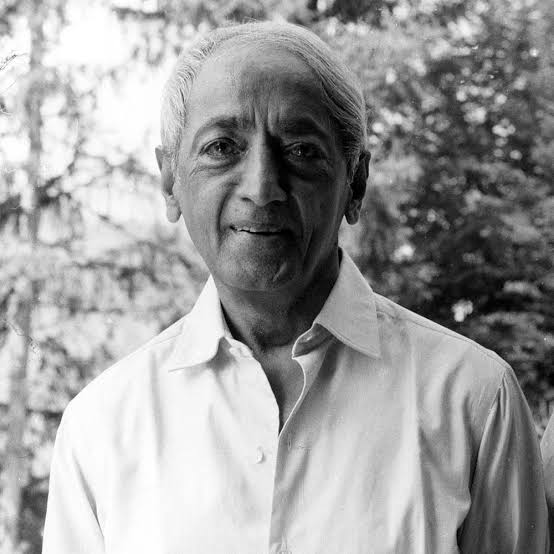
“Our brains are so conditioned through education, through religion, to think we are separate entities with separate souls and so on. We are not individuals at all.”
~ Krishnamurti.
Jiddu Krishnamurti (May 11, 1895 – February 17, 1986) was an Indian spiritual speaker and writer. Adopted by members of the Theosophical Society as a child because of his aura as perceived by Theosophic leader Charles Leadbetter, “without …
Source: Wikipedia
INFANTILE GRANDIOSITY AND THE IMAGE OF GOD
JULY 8, 1991 (ronrolheiser.com)
For nearly 200 years the intellectual world has not been kind to believers. Beginning with the Enlightenment, which debunked religious authority as a criterion for judgment, the intellectual world has to a large part propounded the idea that religion is false and that it impoverishes the human spirit.
For Nietzsche, religion was a blindness; for Feuerbach, an alienation of humanity from itself; for Marx, an opium for the masses; and for Freud, a psychic displacement. In each case, religion is something backward, a harmful naiveté, something that keeps humanity from being what it should be. In each case, too, there is the call to have the courage to move beyond religion.
Many great writers, artists, and scientists have, in the past 200 years, supported that general idea. In the popular mindset too there is present the idea, never far from the surface, that religion and churchgoing are a naiveté, a backwardness, a timidity that would not stand up to courageous scrutiny. The idea is that religion, in the end, is something that keeps people down and blocks them from being fully creative and from fully enjoying life. The church, with its dogmas and nuns, preaching poverty, chastity, and obedience – when what brings happiness is affluence, sex, and freedom!
Today the intellectual world is softening on that. Scientific circles, beginning with Einstein and running through Stephen Hawking, are much less arrogant and more open to the question of God. Great anthropologists, like Mircea Eliade and Victor Turner, are telling us that, to order our lives in a meaningful way, we must either believe in a God or in some myth that functionally does what religion does.
And the circles of psychology that follow Karl Jung are looking at the adult child of the enlightenment and suggesting that most of what is wrong with that child has to do with lack of proper religion. In their perspective, we are not born simple cameras with rationality and emotion. We are born driven beings, with savage propensities which make us, many times, anything but rational because we are hard-wired to certain archetypes (energy configurations, instinctual patterns, a collective unconscious) which fundamentally help shape how we think, feel, and judge, whether we are conscious of this or not. We are anything but neutral, urbane, sophisticates, acting out of a certain enlightened rationality.
Moreover, and this is key in their insight, at the center of these archetypes, as the source of them all, lies the sense that we are a god or goddess, a divine king or queen. The ultimate source of energy for every person is a sense of grandiosity. In Christianity, we’ve always known this. We are the Imago Deo, the image of God. This grandiosity, the Jungians now assure us, cannot be denied, outgrown, moved beyond by therapy, or even transformed. It can only be admitted to and creatively contained. For them, there are only two kinds of people in this world, those who admit their infantile grandiosity and those who don’t!
They go on to say that, in the end, the idea of the enlightenment and of Nietzsche, Feuerbach, Marx, and Freud, the idea that humanity is better off without God, is not only wrong, but dangerous. Unless our innate grandiosity is contained through some form of obedience to a god beyond the individual ego and through an agenda that is genuinely transpersonal, it leads to self-destruction (and often the destruction of others too). How? Because when we try to live with our grandiosity without a proper relationship to something beyond ourselves we inflate or go crazy – or both. So much for the essence of the enlightenment!
The history of secularity during the last 200 years, I submit, provides more than enough evidence for the hypothesis that the human person without God or without some god myth is a menace towards himself or herself and towards others. When one does not worship a God on a throne or the Christ child in the manger, he or she soon enough sets self upon that throne or highchair and demands worship. We either deal religiously or in some other ritual way with the image of God inside of us or, as is so prevalent today, we will be dealing with infantile grandiosity and the destructive and addictive behaviors and depressions that stem from it.
The concept of infantile grandiosity sheds light on many things, not the least of which are our pathological complexities – our neuroses, psychoses, grandiose longings, perpetual dissatisfaction, chronic depression, and our yearning to be, in the end, worshipped. It also explains why there is a clear and unalterable need in our lives for God, religion, and obedience.
The Aesthetic of Silence: Susan Sontag on Art as a Form of Spirituality and the Paradoxical Role of Silence in Creative Culture
By Maria Popova (themarginalian.org)
“The impulse to create begins — often terribly and fearfully — in a tunnel of silence,” Adrienne Rich asserted in her spectacular 1997 lecture Arts of the Possible. But it was exactly three decades earlier that another of humanity’s most incisive intellects made the finest — and timeliest today — case for the generative function of silence in a creative culture drowning in noise.
In The Aesthetics of Silence, the first essay from her altogether indispensable 1969 collection Styles of Radical Will (public library), Susan Sontag (January 16, 1933–December 28, 2004) examines how silence mediates the role of art as a form of spirituality in an increasingly secular culture.
Susan Sontag by Peter Hujar
Shortly after she wrote in her diary that “art is a form of consciousness” and shortly before Pablo Neruda penned his beautiful ode to silence and Paul Goodman — who shared a mutual admiration with Sontag — enumerated the nine kinds of silence, she writes:
Every era has to reinvent the project of “spirituality” for itself. (Spirituality = plans, terminologies, ideas of deportment aimed at resolving the painful structural contradictions inherent in the human situation, at the completion of human consciousness, at transcendence.)
In the modern era, one of the most active metaphors for the spiritual project is “art.” The activities of the painter, the musician, the poet, the dancer, once they were grouped together under that generic name (a relatively recent move), have proved a particularly adaptable site on which to stage the formal dramas besetting consciousness, each individual work of art being a more or less astute paradigm for regulating or reconciling these contradictions. Of course, the site needs continual refurbishing. Whatever goal is set for art eventually proves restrictive, matched against the widest goals of consciousness. Art, itself a form of mystification, endures a succession of crises of demystification; older artistic goals are assailed and, ostensibly, replaced; outworn maps of consciousness are redrawn.
But modern art, Sontag argues, is as much a form of consciousness as an answer to our longing for anti-consciousness, speaking to what she calls “the mind’s need or capacity for self-estrangement”:
As such, art usurps the role religion and mysticism previously held in human life — something to satisfy our “craving for the cloud of unknowing beyond knowledge and for the silence beyond speech.” The spiritual satiation that arises from this dialogue between art and anti-art, Sontag points out, necessitates the pursuit of silence. For the serious artist, silence becomes “a zone of meditation, preparation for spiritual ripening, an ordeal that ends in gaining the right to speak.”
In a counterpart to her later admonition that publicity is “a very destructive thing” for any artist, Sontag considers the zeal the artist must have in protecting that zone of silence — a notion of particular urgency in our age of tyrannical expectations regarding artists’ engagement with social media:
Illustration by Maurice Sendak from Open House for Butterflies by Ruth Krauss
And yet, in a sentiment that calls to mind Kierkegaard’s astute observation that expressing contempt is still a demonstration of dependence, Sontag recognizes that the gesture of silence in abdication from society is still “a highly social gesture.” She writes:
Silence, then, is exercised not in the absolute but in degrees, mediating between art and anti-art, between consciousness and anti-consciousness:
Modern art’s chronic habit of displeasing, provoking, or frustrating its audience can be regarded as a limited, vicarious participation in the ideal of silence which has been elevated as a major standard of “seriousness” in contemporary aesthetics.
But it is also a contradictory form of participation in the ideal of silence. It is contradictory not only because the artist continues making works of art, but also because the isolation of the work from its audience never lasts… Goethe accused Kleist of having written his plays for an “invisible theatre.” But eventually the invisible theatre becomes “visible.” The ugly and discordant and senseless become “beautiful.” The history of art is a sequence of successful transgressions.
[…]
Committed to the idea that the power of art is located in its power to negate, the ultimate weapon in the artist’s inconsistent war with his audience is to verge closer and closer to silence.
And yet, Sontag points out, silence is relational — while it may be the intention of the artist, it can never be the experience of the audience. (For a supreme example, we need not look further than John Cage, who even during his most forceful imposition of silence was in dynamic dialogue with the audience upon which silence was being imposed.)
Sontag, in fact, shined a sidewise gleam on this notion three years earlier in her masterwork Against Interpretation — for what is interpretation if not the act of filling the artist’s silence with the audience’s noise? She writes:
[…]
There is no neutral surface, no neutral discourse, no neutral theme, no neutral form. Something is neutral only with respect to something else — like an intention or an expectation. As a property of the work of art itself, silence can exist only in a cooked or non-literal sense. (Put otherwise: if a work exists at all, its silence is only one element in it.) Instead of raw or achieved silence, one finds various moves in the direction of an ever receding horizon of silence — moves which, by definition, can never be fully consummated.
Illustration by John Vernon Lord from a rare edition of Through the Looking-Glass and What Alice Found There.
She illustrates this with the classic scene from Lewis Carroll’s Through the Looking Glass, where Alice encounters a shop “full of all manner of curious things,” and yet whenever she looks closely at any one shelf, it appears “quite empty, though the others round it were crowded full as they could hold.” Silence, similarly, is relational rather than absolute:
A genuine emptiness, a pure silence is not feasible — either conceptually or in fact. If only because the artwork exists in a world furnished with many other things, the artist who creates silence or emptiness must produce something dialectical: a full void, an enriching emptiness, a resonating or eloquent silence. Silence remains, inescapably, a form of speech (in many instances, of complaint or indictment) and an element in a dialogue.
Silence, Sontag argues, is also a way of steering the attention. In a passage triply timely today, half a century of attention-mauling media later, she writes:
Perhaps the quality of the attention one brings to bear on something will be better (less contaminated, less distracted), the less one is offered. Furnished with impoverished art, purged by silence, one might then be able to begin to transcend the frustrating selectivity of attention, with its inevitable distortions of experience. Ideally, one should be able to pay attention to everything.
Many years later, Sontag would advise aspiring writers to learn to “pay attention to the world” as the most important skill of storytelling. Silence, she argues here, invites us to pay selfless and unselfconscious attention to the world the artist is creating. In a sentiment that explains why there are no comments on Brain Pickings and captures today’s acute spiritual hunger for a space for unreactive contemplation amid a culture of reactive opinion-slinging, Sontag writes:
[…]
The efficacious artwork leaves silence in its wake. Silence, administered by the artist, is part of a program of perceptual and cultural therapy, often on the model of shock therapy rather than of persuasion. Even if the artist’s medium is words, he can share in this task: language can be employed to check language, to express muteness… Art must mount a full-scale attack on language itself, by means of language and its surrogates, on behalf of the standard of silence.
Once again, Sontag’s extraordinary prescience shines its brilliant beam upon our time, across half a century of perfectly anticipated cultural shifts. Much like she presaged the downsides of the internet’s photo-fetishism in the 1970s and admonished against treating cultural material as “content” in the 1960s, she captures the entire ethos of our social media in 1967:
The Aesthetics of Silence is an immeasurably rewarding read in its entirety, as is the remainder of Styles of Radical Will. Complement it with Sontag on love, “aesthetic consumerism” and the violence of visual culture, how polarities imprison us, why lists appeal to us, her diary meditations on art, and her advice to aspiring writers.
Johann Jakob Bachofen on the matriarchy
From Wikipedia, the free encyclopedia
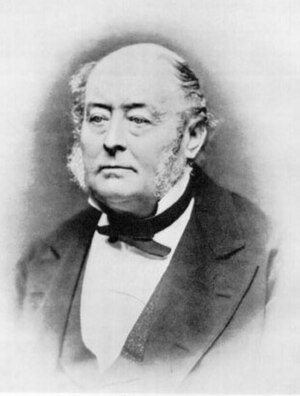
| J. J. Bachofen | |
|---|---|
| J. J. Bachofen | |
| Born | 22 December 1815 Basel, Switzerland |
| Died | 25 November 1887 (aged 71) Basel, Switzerland |
| Spouse | Louise Bachofen-Burckhardt |
| Scientific career | |
| Fields | Roman law, anthropology |

Johann Jakob Bachofen (22 December 1815 – 25 November 1887) was a Swiss antiquarian, jurist, philologist, anthropologist, and professor of Roman law at the University of Basel from 1841 to 1844.[1]
Bachofen is most often connected with his theories surrounding prehistoric matriarchy, or Das Mutterrecht, the title of his seminal 1861 book Mother Right: an investigation of the religious and juridical character of matriarchy in the Ancient World. Bachofen assembled documentation demonstrating that motherhood is the source of human society, religion, morality, and decorum. He postulated an archaic “mother-right” within the context of a primeval Matriarchal religion or Urreligion.
Bachofen became an important precursor of 20th-century theories of matriarchy, such as the Old European culture postulated by Marija Gimbutas from the 1950s, and the field of feminist theology and “matriarchal studies” in 1970s feminism.
Biography
Born into a wealthy Basel family active in the silk industry[2] and attended the service of the French Reformed Church in Basel.[3] After having attended the Gymnasium,[3] Bachofen studied in Basel and in Berlin[2] under August Boeckh, Karl Ferdinand Ranke and Friedrich Carl von Savigny[4] as well as in Göttingen. After completing his doctorate in Basel, he studied for another two years in Paris, London and Cambridge. He was called to the Basel chair for Roman law in 1841. In 1842 he travelled to Rome accompanied by his father to, according to him, see his spiritual homeland with his own eyes.[2] Having returned to Basel, he was called to the appellate court and his next book on Roman law received the acclaim of the academics.[2] He would also become elected into the Grand Council of Basel.[2] He retired from his professorship in 1844, after in the local press it was suggested the wealth of his family would have helped him assume the job at the university.[5] In 1845 he also quit from the Grand Council.[5] As a judge he would stay for twenty-five years and resign after his marriage to Louise Bachofen-Burckhardt.[5] In 1848 he undertook a second journey to Rome in which he witnessed the Roman revolution, changed his research focus from the classical antiquity but the early antiquity.[6] In 1851–1852 he travelled to Greece, Magna Graecia, and Etruria.[6] He published most of his works as a private scholar.
Personal life

His mother Valeria Merian Bachofen died in 1856 but he kept living in the same house as his father.[7] It was the same house which would become the seat of the Civil Register of Basel between 1962 and 1983 and part of the Antikenmuseum Basel und Sammlung Ludwig in the 1980s.[8] In 1865, he married the at the time twenty five-years old Louise Bachofen-Burckhardt from a noble family of Basel.[7] He would buy a house at the square before the Minster of Basel and a son was born.[7] Louise Bachofen Burckhardt would live in the house at the Minster Square after her husband would die in 1877.[9] Johann Jakob Bachofen is buried at the Wolfgottesacker cemetery in Basel.[10] The tomb was sculptured by Richard Kissling.[10]
Das Mutterrecht
| This section does not cite any sources. Please help improve this section by adding citations to reliable sources. Unsourced material may be challenged and removed. (September 2022) (Learn how and when to remove this message) |

Bachofen’s 1861 Das Mutterrecht proposed four phases of cultural evolution which absorbed each other:
- Hetaerism: a wild nomadic ‘tellurian’ [= chthonic or earth-centered] phase, characterised by him as communistic and polyamorous, whose dominant deity he believed to have been an earthy proto Aphrodite.
- Das Mutterecht: a matriarchal ‘lunar’ phase based on agriculture, characterised by him by the emergence of chthonic mystery cults and law. Its dominant deity was an early Demeter.
- The Dionysian: a transitional phase when earlier traditions were masculinised as patriarchy began to emerge. Its dominant deity was the original Dionysos.
- The Apollonian: the patriarchal ‘solar’ phase, in which all trace of the Matriarchal and Dionysian past was eradicated and modern civilisation emerged.
Reception
Main article: Matriarchy
There was little initial reaction to Bachofen’s theory of cultural evolution, largely because of his impenetrable literary style, but eventually, along with furious criticism, the book inspired several generations of ethnologists, social philosophers, and even writers: Lewis Henry Morgan; Friedrich Engels, who drew on Bachofen for The Origin of the Family, Private Property and the State; Thomas Mann; Jane Ellen Harrison, who was inspired by Bachofen to devote her career to mythology; Walter Benjamin; Carl Jung; Erich Fromm; Robert Graves; Rainer Maria Rilke; Joseph Campbell; Otto Gross; Erich Neumann and opponents such as Julius Evola.[citation needed] In the 1930s his work was acclaimed by several prominent academics in the German speaking world.[11]
Because of his theoretical commitment to Marxist historiography, Friedrich Engels faulted Bachofen for regarding “religion as the main lever of the world’s history” and therefore considered it a “troublesome and not always profitable task to work your way through [his] big volume [i.e. Das Mutterrecht]”. Nevertheless, he credited Bachofen with inaugurating research into the history of the family.[12] He summarized Bachofen’s views as follows:[13]“(1) That originally man lived in a state of sexual promiscuity, to describe which Bachofen uses the mistaken term “hetaerism“;(2) that such promiscuity excludes any certainty of paternity, and that descent could therefore be reckoned only in the female line, according to mother-right, and that this was originally the case amongst all the peoples of antiquity;(3) that since women, as mothers, were the only parents of the younger generation that were known with certainty, they held a position of such high respect and honor that it became the foundation, in Bachofen’s conception, of a regular rule of women (gynaecocracy);(4) that the transition to monogamy, where the woman belonged to one man exclusively, involved a violation of a primitive religious law (that is, actually a violation of the traditional right of the other men to this woman), and that in order to expiate this violation or to purchase indulgence for it the woman had to surrender herself for a limited period.” (Friedrich Engels, 1891: see link below)
Emile Durkheim credited Bachofen with upsetting the “old conception” that the father must be “the essential element of the family”. Before Bachofen, Durkheim claims that “no one had dreamed that there could be a family organization of which the paternal authority was not the keystone”.[14]
In contrast to Engels and Durkheim, the American sociologist Carle Zimmerman criticized Bachofen’s work for initiating a research paradigm in sociology that “completely divorced” the study of the family from history, replacing the “constant struggle between familism and individualism” with “imagination”. He characterized Bachofen and the other members of this research paradigm, such as J.F. McLennan, L.H. Morgan, E.A. Westermark, and others, as “evolutionary cultists” and considered them to have “destroyed history as a fundamental study in social science” during the late nineteenth and early twentieth centuries.[15]
As has been noted by Joseph Campbell in Occidental Mythology and others, Bachofen’s theories stand in radical opposition to the Aryan origin theories of religion, culture and society, and both Campbell and writers such as Evola have suggested that Bachofen’s theories only adequately explain the development of religion among the pre-Aryan cultures of the Mediterranean and the Levant, and possibly Southern Asia, but that a separate, patriarchal development existed among the Aryan tribes which conquered Europe and parts of Asia.[citation needed]
More at: https://en.wikipedia.org/wiki/Johann_Jakob_Bachofen