Dowd said the slain activist’s words may have fueled the violence that claimed his life, sparking backlash
“Hateful thoughts lead to hateful words, which then lead to hateful actions,” Dowd said, adding: “You can’t stop with these sort of awful thoughts you have and then saying these awful words and then not expect awful actions to take place.”
Joseph Gedeon in Washington Thu 11 Sep 2025 (TheGuaridan.com)
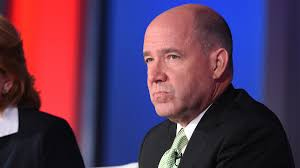
MSNBC fired political analyst Matthew Dowd after he sparked outrage over his comments about Charlie Kirk during the network’s live coverage of Wednesday’s assassination. (Lorenzo Bevilaqua/ABC via Getty Images)
MSNBC fired its senior political analyst Matthew Dowd after he suggested on air that the slain conservative activist Charlie Kirk’s own radical rhetoric may have contributed to the shooting that killed him.
During his appearance on Katy Tur Reports, Dowd suggested that Kirk’s rhetoric may have contributed to the violence that claimed his life. Kirk, 31, had a history of rightwing provocation and Christian nationalism, and frequently espoused bigoted rhetoric about Islam,women , LGBTQ+ communities and people of color.
“Hateful thoughts lead to hateful words, which then lead to hateful actions,” Dowd said, adding: “You can’t stop with these sort of awful thoughts you have and then saying these awful words and then not expect awful actions to take place.”
Dowd also speculated about the circumstances of the shooting, saying: “We don’t know if this was a supporter shooting their gun off in celebration. So we have no idea about this.”
The network issued an apology and announced Dowd’s dismissal, which came shortly after Kirk was shot dead during a question-and-answer session at Utah Valley University in Orem, Utah, where he was kicking off a nationwide campus debate tour. MSNBC’s president, Rebecca Kutler, described Dowd’s comments as “inappropriate, insensitive and unacceptable” in a statement posted to social media.
“We apologize for his statements, as has he,” Kutler wrote. “There is no place for violence in America, political or otherwise.”
The network almost immediately severed ties with Dowd, with Deadline reporting that MSNBC had cut its relationship with the analyst citing “furor over remarks he made in the aftermath of the shooting”.
Dowd, who served as chief strategist for George W Bush’s 2004 presidential campaign and was formerly a political analyst for ABC News, issued his own apology following the controversy.
Writing on Bluesky, he said: “My thoughts & prayers are w/ the family and friends of Charlie Kirk. On an earlier appearance on MSNBC I was asked a question on the environment we are in. I apologize for my tone and words. Let me be clear, I in no way intended for my comments to blame Kirk for this horrendous attack. Let us all come together and condemn violence of any kind.”
Kirk, co-founder of Turning Point USA and a prominent figure in conservative youth politics who had been credited with boosting the Maga youth vote during the 2024 election, was fatally shot in the neck during the campus event on Wednesday afternoon, with multiple videos of the moment spreading across social media.
Federal authorities are investigating the shooting, with two persons of interest initially taken into custody before being released. Both were briefly detained but released without charge, and a suspect is still at large.
The killing has drawn sharp criticism from across the political spectrum.
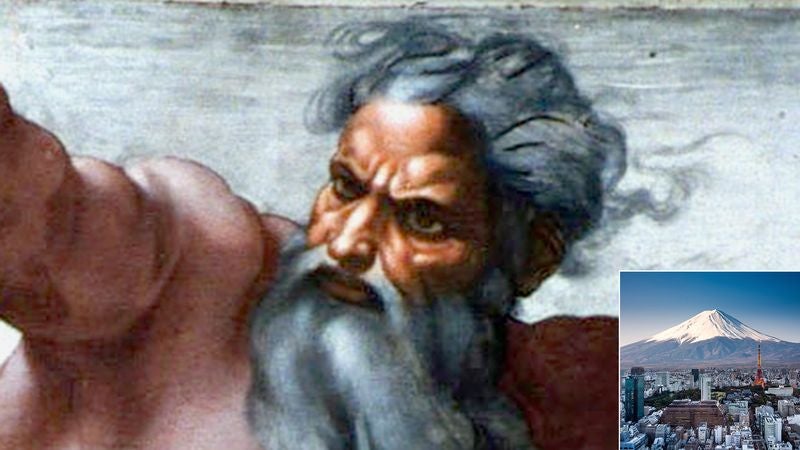
THE HEAVENS—After years of talking about visiting the East Asian country, God, Our Lord and Heavenly Father, told reporters Monday that He was excited to finally be taking His first trip to Japan. “It seems like such a fascinating culture, and I’m excited to try sushi in the country that started it all,” said the Divine Creator, adding that while He only knew a few words of Japanese, He had read online that the people there were generally happy to help out a visitor, even if they didn’t know English themselves. “I have to do the bullet train—I think it goes 200 mph or something like that—and maybe I can get tickets to a sumo match. I also think it’ll be fun to just wander around and look at interesting stuff. I’ve heard you can get pretty much anything from a vending machine.” At press time, God had booked a two-week vacation and was researching tips for minimizing jet lag.
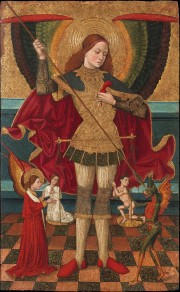
Saint Michael Weighing Souls (c. 1480-1495). Art: Juan de la Abadía el Viejo
A.Word.A.Daywith Anu Garg
judgment day
PRONUNCIATION:
(JUHJ-muhnt day)
MEANING:
noun: 1. A time when one is evaluated, especially for their actions. 2. In some religious traditions, the day when the world ends and God judges people, sending them to heaven or hell.
ETYMOLOGY:
From judgment, from Latin judicare (to judge) + day, from Old English dæg. Earliest documented use: 1544.
NOTES:
You might think it’s as simple as: Do good and you’ll go to heaven. Not so fast. In some belief systems what matters is not what you do, but what you believe. In others, God determines your destination, heaven or hell, before you’re even born. There’s predeterminism, predestination, double predestination, corporate election (yes, it’s a real theological term), and more.
Predeterminism: The teacher wrote your final grade before you even enrolled.
Predestination: The teacher decided who would pass before handing out the exam.
Double predestination: The teacher pre-assigned both the A-list and the F-list on day one.
Corporate election: The teacher grades the whole class as a block. You pass if you’re in the group, no matter how badly you flunked.
Yeah, people believe this stuff. To each his own. I’m with Albert Camus who said, “Don’t wait for the last judgment. It takes place every day.”
Translation is a 5-step process of “straight thinking in the abstract” comparing and contrasting what seems to be truth with what you can syllogistically, axiomatically and mathematically (using word equations) prove is the truth. It is not an effort to change, alter or heal anything.
The claims in a Translation may seem outrageous, but they are always (or should always be) based on self-evident syllogistic reasoning. Here is one Translation from this week.
1) Truth is that which is so. That which is not truth is not so. Therefore Truth is all that is. Truth being all is therefore total, therefore whole, therefore complete, therefore perfect. I think therefore I am. Since I am and since Truth is all that is, therefore I, being, am Truth. Since I, being, am Truth, therefore I, being, have all the attributes of Truth. Therefore I, being, am total, whole, complete, perfect. Since I am mind (self-evident) and since I (being) am Truth, therefore Truth is Mind. (Two things (mind and Truth) equal to a third thing (I) are equal to each other.) Since Mind is Truth, therefore Mind has all the attributes of Truth. Therefore Mind is total, whole, complete, perfect.
2) Dominating and humiliating those who are dependent on you can make you feel very powerful.
Word-tracking: dominate: domestic, lord, ruler, prevailing influence humiliate: lowly, to expose as powerless, to strip of value worth, dignity dignity: worthy of respect, decent decent: fitting, seemly depend: rely on, tied to, trust power: potent potent: the ability to be
3) Truth beng all that is and power being the ability to be, therefore Truth is the only ability to be, therefore Truth is the only power. Truth being the only power, therefore Truth is the only ruler, the only lord. Truth being all that is and Truth being true, therefore right, therefore proper, therefore appropriate, therefore fitting, therefore decent, therefore dignified. Therefore Truth is always dignified (decent). Truth being all that is, and Truth being true, therefore reliable. therefore Truth relies on Itself.
4) Truth is the only power. Truth is the only ruler, the only lord. Truth is always dignified (decent). Truth relies on Itself.
5) Truth lords over Itself with infinite power and dignity (decency).
Weekly Invitational Translation Group invites your participation. If you would like to submit a Translation on any subject, feel free to send your weekly Translation to zonta1111@aol.com and we will anonymously post it on the Bathtub Bulletin on Friday.
The full quote, said by conservative activist Charlie Kirk at a 2023 Turning Point USA event, is: “I think it’s worth to have a cost of, unfortunately, some gun deaths every single year so that we can have the Second Amendment to protect our other God-given rights”
The statement was made on April 5, 2023, during an appearance at Awaken Church in Salt Lake City, Utah. A full version of the quote, as reported by Media Matters, includes an additional sentence: “That is a prudent deal. It is rational”.
The quote resurfaced in September 2025, following Kirk’s assassination at a university in Utah.
ARIES (March 21-April 19): I can’t speak the Quechua language, which is Indigenous to the Andes Mountains. But I have lifted one of their words to use for our purposes here: munay. It refers to an intensely practical and visionary love that includes far more than sweet feelings and affection. When we practice munay, we offer discerning respect and detailed appreciation to those we adore. We are generously eager to help our allies live their best lives. It takes discipline! And focus! And ingenuity! To be a rigorous and vigorous source of munay, we must cultivate it as a daily practice. In the coming weeks, Aries, I hope you will go a bit wild in your expression of this tender force of nature. Imagine yourself as a gentle whirlwind of love that spreads interesting beauty and bestows useful blessings. Be a relentless dispenser of catalytic gifts.
TAURUS (April 20-May 20): The medieval Persian polymath Avicenna believed the soul entered the fetus not with the first heartbeat, but with the first dream. I offer this idea for your poetic consideration, dear Taurus. Let’s imagine that the next beautiful thing you create will not arise from your forceful intention. Rather, it will emerge because you give yourself permission to fantasize, to wander freely in wonder, and to meander with curiosity on the frontiers. Your assignment is not to hustle, but to incubate; not to push forward, but to dwell expectantly in the mystery.
GEMINI (May 21-June 20): The bowerbird constructs elaborate ground-based shrines not as nests but as seduction lures. The enticer might gather blue bottle caps, yellow flowers and shiny stones so as to create a scene that piques the attention of a potential mate. These objets d’art are not merely decorative. They are displays that demonstrate discernment, skill and aesthetic intelligence. I authorize you to be like a bowerbird, Gemini. What collection of symbols, words, gestures and curiosities will magnetize the people or opportunities you long to engage with? It’s not about flashiness; it’s about alignment. What you draw into your sphere will reflect the vibes you emanate.
CANCER (June 21-July 22): The pearl doesn’t begin as treasure. In its earliest form, it’s an irritation: a grain of sand that’s really a wound inside the oyster. Over time, the creature coats it with layers of nacre, turning discomfort into luminescence. Let’s use that as a metaphor for you, Cancerian. In my view, your task right now is not to escape or shed what’s bugging you, but to expedite the coating process. What is that gritty thing? A memory, injustice, or unmet yearning? It’s crucial you don’t reject it and don’t let it fester. I think it’s best to turn it, layer by layer, into a luminous asset, even a treasure. Prediction: The pearl you form will long outlast the wound.
LEO (July 23-Aug. 22): Olive trees can thrive in rugged environments, including rocky and nutrient-poor soils. Their root systems are wide, deep and resilient. They are well-adapted to full sun, high temperatures, and low water availability. In comparing you to an olive tree, Leo, I’m not implying you will always have to be as hardy as they are. But in the coming weeks, you will be wise to be equally plucky and persevering. Here’s another fact about the olive tree you can and should emulate: Its fruit is valuable and in demand.
VIRGO (Aug. 23-Sept. 22): The Basenji is a dog breed that doesn’t bark. Instead, it produces an eerie, melodic yodel called a baroo. This oddity isn’t a flaw or drawback; it’s an interesting uniqueness. In the coming weeks, Virgo, I invite you to express your personal versions of the baroo—your idiosyncratic offerings and singular gifts. Playfully resist the pressure to be more conventional or “on brand.” Be faithful to what yearns to come out of you, which may be raw, radiant and a little weird. Let your authenticity be exactly what it is: a beacon, not a liability.
LIBRA (Sept. 23-Oct. 22): Scientists discovered that some caterpillars, while dissolving inside their cocoons, retain memories of their caterpillar lives even after becoming butterflies. In my view, that’s equivalent to us humans remembering details of our previous incarnations: having an all-new body but being able to draw on what our past body learned. According to my analysis of the astrological omens, you will be able to draw on this amazing capacity in the coming weeks. The person you used to be will have key revelations and inspirations for the future you.
SCORPIO (Oct. 23-Nov. 21): According to Celtic mythology, Cerridwen is the goddess of inspiration. In her cauldron, she brews magical elixirs that bestow the powers of wisdom, creativity and transformation. The humans most likely to earn her blessings are those who are patient and willing to be changed. Of all the signs in the zodiac, you Scorpios are now at the top of the eligibility list for gifts like these. And the next three weeks will be the most favorable time for you to ask for and receive such blessings. Here’s a clue that will help you get all you deserve: Believe in magic.
SAGITTARIUS (Nov. 22-Dec. 21): In ancient Chinese philosophy, ziran means naturalness, spontaneity. It might refer to the way a mountain is purely a mountain, and a wave is a wave without trying to be a wave. I think you Sagittarians are due for an extended engagement with this wild ease and elegant freedom. After weeks of inner labor, your soul wants to breathe in ziran. Your assignment is to let yourself be as natural and unconstrained as you dare—not correct or careful or “optimized.” So I advise you to head in the direction of what’s simple and real and good. Emphasize smoothness over effort. Choose your rhythm, not theirs. You aren’t required to prove your healing. You just have to live it.
CAPRICORN (Dec. 22-Jan. 19): “Serendipity” is an English term that refers to beautiful accidents, fortunate interruptions, unexpected opportunities, and surprisingly wonderful discoveries. (The French equivalent is sérendipité; Italian: serendipità; Japanese: serendipiti.) The word didn’t exist until 1754, when author Horace Walpole coined it. Lovely outbreaks of good luck and uncanny blessings had been happening from time immemorial, of course, even though there wasn’t this precise word for them. Here’s a key point: They are more likely to occur if you believe they’re possible and make yourself alert for their arrival. That’s good advice for you right now.
AQUARIUS (Jan. 20-Feb. 18): The placenta is the only organ that the human body creates from scratch and then discards. Let’s pause for a moment to register how remarkable this is: to grow a temporary life-support system and then jettison it once its purpose is fulfilled. Inspired by this miracle, I speculate that you may soon undertake a metaphorical version of it. A situation or experience that has nurtured you is reaching the end of its mission. Though it has served you well, the wise move might be to outgrow it and move on to a new phase of your evolution. At the very least, it’s time to embark on a search for new forms of nourishment.
PISCES (Feb. 19-March 20): In Balinese gamelan music, there’s a technique called kotekan. Two instrumentalists play distinct musical parts that together create a seamless, intricately melodic and rhythmic texture. Let’s make this your metaphor to live by in the coming weeks, Pisces. In my astrological opinion, you are not meant to work solo. Your greatest success and most fun will come by generating harmony through collaborative improvisation and shared timing. A small warning: Someone else’s input may at first feel like interference, but it’s actually the missing part of the song. Let yourself blend, bounce, echo and respond. Genius will be born in the spaces between.
One fact that never fails to astound me: Despite the immense cultural changes and leaps in knowledge over the epochs, the human brain — that crucible of consciousness, roiling with the psychologies that govern the behaviors we call human nature — has remained virtually unchanged for the past hundred thousand years. How humbling to consider that what is cognitively true of our ancestors — who, lacking a knowledge of astronomy as the correct frame of reference for planetary motion, explained eclipses as acts of god and comets as omens of ill fortune — is as true of us.
The explanatory contexts in which this tendency manifests today may be different, but it manifests just the same — especially in our interpersonal relationships, where so much of the correct frame of reference that is the other person’s inner reality is invisible to us. It helps to remember that between our feelings and anything in the external world that causes the ripples of consciousness we call feelings — any difficult situation, any painful event, any hurtful action of another — there lie myriad possible causal explanations.
One fact I have learned about life through the empiricism of living: When we are hurt in a relationship, when we are spinning in the blooming buzzing confusion of sensemaking, the explanation we elect as correct usually has more to do with our own fears and vulnerabilities than it does with the reality of the situation; almost always, that explanation is wrong; almost always, the true explanation has more to do with the fears and vulnerabilities roiling in the other person invisibly to us.
The Dreaming Horses by Franz Marc, 1913. (Available as a print and as stationery cards, benefitting The Nature Conservancy.)
And so, sensemaking and storytelling creatures that we are, we move through the real world in a self-generated dream, responding not to reality but to the stories we tell ourselves about what is true — stories at best incomplete and at worst injuriously incorrect, stories about what we do and don’t deserve, stories the cost of which is connection, trust, love. This is why without charity of interpretation and without candor — the vulnerability of it, the courage of it, the kindness of it — all relationships become a ricochet of unspoken resentments based mostly on misapprehended motives, and crumble.
Much of our suffering comes from wrong perceptions. To remove that hurt, we have to remove our wrong perception.
Whenever we see another person take an action, he notes, we must remain aware that there could be a number of invisible motive forces behind it and we must be willing to listen in order to better understand them — not only out of the vain self-referential transactionalism masquerading as the Golden Rule, in the hope that others would be just as willing not to misunderstand our own motives by their perception and interpretation of our actions, but because correcting our wrong perceptions is a basic and vital form of caring for ourselves:
When you make the effort to listen and hear the other side of the story, your understanding increases and your hurt diminishes.
Half a century after the great humanistic philosopher and psychologist Erich Fromm detailed the six rules of listening and unselfish understanding, Hanh offers a three-step process for correcting wrong perception in relationship conflict and emerging victorious with deeper love:
The first thing we can do in these situations is to acknowledge internally that the pictures we have in our head, what we think happened, may not be accurate. Our practice is to breathe and walk until we are more calm and relaxed.
The second thing we can do, when we are ready, is to tell the people who we think have hurt us that we are suffering and that we know our suffering may have come from our own wrong perception. Instead of coming to the other person or people with an accusation, we can come to them for help and ask them to explain, to help us understand why they have said or done those things.
There is a third thing we need to do, if we can. The third thing is very hard, perhaps the hardest. We need to listen very carefully to the other person’s response to truly understand and try to correct our perception. With this, we may find that we have been the victim of our wrong perceptions. Most likely the other person has also been a victim of wrong perceptions.
Part of why this is so challenging to the Western mind, with its individualistic ideal of self-reliance that too readily metastasizes into self-righteousness, is that we grow incredibly insecure at the prospect of being wrong and feel incredibly unmoored by the fact of having been wrong. In a culture conflating who we are with what we know and what we stand for, the Eastern contemplative traditions can be so salutary with their gentle, steady practice of releasing the clutch of selfing and unclenching the fist of righteousness into an open palm of receptivity.
Drawing on two powerful Buddhist practices that effect this release — deep listening and loving speech — Hanh writes:
If we are sincere in wanting to learn the truth, and if we know how to use gentle speech and deep listening, we are much more likely to be able to hear others’ honest perceptions and feelings. In that process, we may discover that they too have wrong perceptions. After listening to them fully, we have an opportunity to help them correct their wrong perceptions. If we approach our hurts that way, we have the chance to turn our fear and anger into opportunities for deeper, more honest relationships.
This, he observes, applies to romantic relationships, to politics, to family and workplace dynamics — in other words, to all possible configurations of one consciousness embarking on the touching, terrifying endeavor of being known and understood by another.
With an eye to the ultimate aim of this process, he adds:
The intention of deep listening and loving speech is to restore communication, because once communication is restored, everything is possible, including peace and reconciliation.
[…]
We are all capable of recognizing that we’re not the only ones who suffer when there is a hard situation. The other person in that situation suffers as well, and we are partly responsible for his or her suffering. When we realize this, we can look at the other person with the eyes of compassion and let understanding bloom. With the arrival of understanding, the situation changes and communication is possible.
Any real peace process has to begin with ourselves… We have to practice peace to help the other side make peace.
The word “infantry” comes from the Latin word infans, meaning “unable to speak” or “child”. In Renaissance Italy, infante referred to a young man or “foot soldier” too inexperienced or low in rank for the cavalry. The term infanteria was then used for these foot soldiers, and eventually, the word passed into French and then English, retaining the meaning of soldiers who fight on foot.
From Latin to English
Latin roots:.Opens in new tabThe journey begins with the Latin word infans, which meant a child or someone “unable to speak”.
Italian influence:.Opens in new tabIn Renaissance Italy, the word infante came to mean a “youth” or, in a military context, a “foot soldier”. These were often young, inexperienced men who couldn’t afford to serve as mounted cavalry.
French and English adoption:.Opens in new tabThe Italian military term infanteria was adopted into French as infanterie. From French, the word was borrowed into English around the 14th or 16th century to describe troops who fight on foot.
Meaning of Infantry
Historical context:Originally, the term highlighted the youth and inexperience of these soldiers, as the cavalry was often reserved for more established or higher-ranking individuals.
Modern usage:Today, “infantry” refers to a branch of an army composed of soldiers trained and equipped to fight on foot, regardless of their age or experience level.

 Mind Book



 Much of our suffering comes from wrong perceptions. To remove that hurt, we have to remove our wrong perception.

