By kuhlgroup7, December 15, 2019 (consciouscommunitynewsletter.com)
By Heather C. Williams, H.W., M.
I do not know how you handle your daily email. I have a desktop computer, a portable computer and a cell phone. For some time, I managed my email messages on all three machines several times a day. Checking, deleting, writing and responding on three machines! It took lots of time and energy. It was TOO MUCH! Finally, I woke up to the unnecessary habitual stress of this. I removed the email function from the phone and the desktop. It is now much better dealing with emails on only one computer. This, to me, could be an example of WAKING UP.
What does it mean to “WAKE UP”? Well, every morning you wake up, right? The truth is that whether you think of this or not, every morning you enter a brand new day with unknown possibilities. Few people are prepared (mentally and emotionally) to be open to the new day with its unknown something. Most people enter the new day thinking of the same old habits, problems, tasks, routines…unless we consciously remember, “Hey, this is a brand new day!” and we take charge and BE open to something new.
The teacher, Gurdjieff, tells the WAKING UP story like this: Most individual humans live their whole lives completely unaware of their true potential. They are asleep to their true identity as Consciousness or Awareness and believe themselves to be limited, physical, material beings in a physical, material world that is separate from them. It is as if most humans live in the basement of a four story home completely unaware of the three stories that exist above. The basement can be viewed as “sleep”. Each of us, to some degree, is asleep to our True Identity. We stumble around in the basement of our consciousness, playing the victim, “poor me”; blaming others for our situation; unaware of our true potential that is just upstairs in our higher consciousness…available to us as we begin to practice THE WORK.
THE WORK begins with curiosity. Good questions include: Why is this happening? What is causing this problem? Do I have to have another drink? And the best and deepest question to ask yourself is: WHO AM I? Answer: I am not my mother; I am not my father. I am not anyone but me. But WHO AM I? What is my purpose for BEING here in this life?
Are you ready to begin the WORK of stepping out of the basement of your life? Are you ready to let go of old conditioning, habits, patterns? Are you ready to create solutions? Are you ready to explore the foundational spiritual teachings of all humanity – all of which begin with the simple phrase: KNOW THYSELF? You will need tools and thankfully there are tools.
I learned valuable tools in The Prosperos School of Ontology. (Ontology stands for the science of BEING.) I am a High Watch Mentor in this school, and one cool thing I learned is how to use my personal problems and stories as signals to wake up, explore the patterns of my unconscious mind and to solve the problems. I think you’ll agree we live in a “word-built world” where pretty much everything we see or sense is defined verbally. Word-tracking is a great tool to begin “Straight Thinking in the Abstract”. Let’s explore a few words.
SELF OBSERVATION = The essential tool to Know Thyself is simple self-observation. “Buddha calls it watching. Krishna calls it meditation. Jesus calls it witnessing. Mister Gurdjieff calls it self-observation. Unless I come to know myself, I am driven by habits which I do not see and over which I have no control; I am a machine, a robot moving in circles. I imagine I am conscious because my eyes are open, but habit is unconscious. Inside I am asleep.” ~ Red Hawk, in his book Self Observation. The word ‘observe’ comes from the Latin word observare and means to ‘attend to, or, to look towards’.
ATTENTION = The dictionary defines the word attention as “the mental faculty of considering or taking notice of something”. The original Latin word “attend” means to “BE PRESENT”. To be present and paying attention is to BE AWARE. When you pay attention you are present as AWARENESS. In other words your identity is awareness.
IDENTITY = The word identity comes from the Latin word ‘idem’ which means “same”. My Teacher, Thane, taught me to “learn to live back and forth between matter space and mind space.” Matter space identity refers to the local, physical, ego self. But there is more to me and more to you than our ego self. Mind space identity refers to our True Identity as MIND or CONSCIOUSNESS or AWARENESS. THE WORK helps you begin to free yourself from old unconscious patterns, false beliefs, habitual interpretations of the ego and to BE PRESENT as MIND or CONSCIOUSNESS or AWARENESS.
PROBLEM = The word problem comes from the Greek word ‘problema’ which is made up of two words; ‘ballein’ = to throw, plus ‘pro’ = before. So a problem is something that is thrown before you for you to deal with. Well, let’s play ball and create solutions!
Every single person, myself included, has unique individual problems. Some people stay in the basement and complain or blame others for their problems. Some are getting curious, searching, wondering, “Is this all there is?” Your questions are like keys that will open the door to your higher potential. Today all of us together, as ONE HUMANITY, face huge global problems. To solve these problems we must WAKE UP to our True Identity as Consciousness. Consciousness is how we are all connected and able to work together to solve these huge problems which include: climate change, poverty, migration and refugees, toxic chemicals in our food and water, gun violence, gender equality, wars and more. We have within us the ability to solve our problems but to create solutions to these problems – we must WAKE UP!
If you are interested to learn more about The Mysterious Journey of Waking Up, Heather offers free monthly online ZOOM TALKS, free personal meet-ups at the Common Ground Cafe in Middleton as well as many classes (drawing, painting and Prosperos tools). Heather is the author of Drawing as a Sacred Activity. Her website has free drawing lessons, links to her talks, registration for classes and more:www.drawingtogether.com
“Autobiography is only to be trusted when it reveals something disgraceful. A man who gives a good account of himself is probably lying, since any life when viewed from inside is simply a series of defeats.”
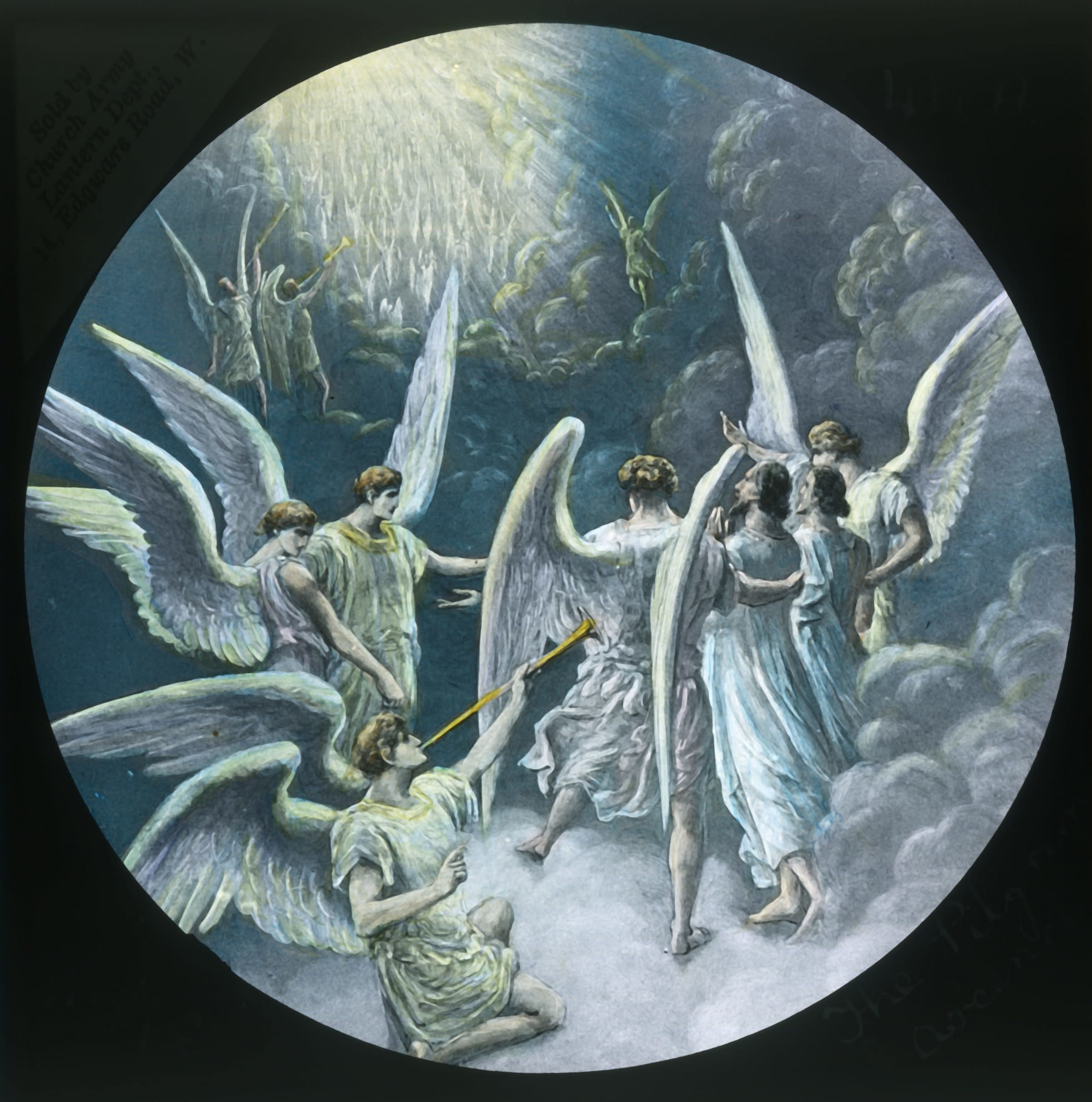
The New Testament Doesn’t Say What Most People Think It Does About Heaven
One of the central stories of the Bible, many people believe, is that there is a heaven and an earth and that human souls have been exiled from heaven and are serving out time here on earth until they can return. Indeed, for most modern Christians, the idea of “going to heaven when you die” is not simply one belief among others, but the one that seems to give a point to it all.
But the people who believed in that kind of “heaven” when the New Testament was written were not the early Christians. They were the “Middle Platonists” — people like Plutarch (a younger contemporary of St Paul who was a philosopher, biographer, essayist and pagan priest in Delphi). To understand what the first followers of Jesus believed about what happens after death, we need to read the New Testament in its own world — the world of Jewish hope, of Roman imperialism and of Greek thought.
The followers of the Jesus-movement that grew up in that complex environment saw “heaven” and “earth” — God’s space and ours, if you like — as the twin halves of God’s good creation. Rather than rescuing people from the latter in order to reach the former, the creator God would finally bring heaven and earth together in a great act of new creation, completing the original creative purpose by healing the entire cosmos of its ancient ills. They believed that God would then raise his people from the dead, to share in — and, indeed, to share his stewardship over — this rescued and renewed creation. And they believed all this because of Jesus.
They believed that with the resurrection of Jesus this new creation had already been launched. Jesus embodied in himself the perfect fusion of “heaven” and “earth.” In Jesus, therefore, the ancient Jewish hope had come true at last. The point was not for us to “go to heaven,” but for the life of heaven to arrive on earth. Jesus taught his followers to pray: “Thy kingdom come on earth as in heaven.” From as early as the third century, some Christian teachers tried to blend this with types of the Platonic belief, generating the idea of “leaving earth and going to heaven,” which became mainstream by the Middle Ages. But Jesus’ first followers never went that route.
Israel’s scriptures had long promised that God would come back in person to dwell with his people for ever. The early Christians picked this up: “The Word became flesh,” declares John [1:14], “and dwelt in our midst.” The word for “dwelt” means, literally, “tabernacled,” “pitched his tent” — alluding to the wilderness “tabernacle” in the time of Moses and the Temple built by Solomon. Studying the New Testament historically, in its own world (as opposed to squashing and chopping it to fit with our own expectations), shows that the first Christians believed not that they would “go to heaven when they died,” but that, in Jesus, God had come to live with them.
That was the lens through which they saw the hope of the world. The book of Revelation ends, not with souls going up to heaven, but with the New Jerusalem coming down to earth, so that “the dwelling of God is with humans.” The whole creation, declares St. Paul, will be set free from its slavery to corruption, to enjoy God’s intended freedom. God will then be “all in all.” It’s hard for us moderns to grasp this: so many hymns, prayers and sermons still speak of us “going to heaven.” But it makes historical sense, and sheds light on everything else.
What then was the personal hope for Jesus’ followers? Ultimately, resurrection — a new and immortal physical body in God’s new creation. But, after death and before that final reality, a period of blissful rest. “Today,” says Jesus to the brigand alongside him, “you will be with me in Paradise.” “My desire,” says St. Paul, facing possible execution, “is to depart and be with the Messiah, which is far better.” “In my father’s house,” Jesus assured his followers, “are many waiting-rooms.” These are not the final destination. They are the temporary resting-place, ahead of the ultimate new creation.
Historical study — reading the New Testament in its own world — thus brings surprises that can have an impact on modern Christianity, too. Perhaps the most important is a new, or rather very old, way of seeing the Christian mission. If the only point is to save souls from the wreck of the world, so they can leave and go to heaven, why bother to make this world a better place? But if God is going to do for the whole creation what he did for Jesus in his resurrection — to bring them back, here on earth — then those who have been rescued by the gospel are called to play a part, right now, in the advance renewal of the world.
God will put the whole world right, this worldview says, and in “justification” he puts people right, by the gospel, to be part of his putting-right project for the world. Christian mission includes bringing real advance signs of new creation into the present world: in healing, in justice, in beauty, in celebrating the new creation and lamenting the continuing pain of the old.
The scriptures always promised that when the life of heaven came to earth through the work of Israel’s Messiah, the weak and the vulnerable would receive special care and protection, and the desert would blossom like the rose. Care for the poor and the planet then becomes central, not peripheral, for those who intend to live in faith and hope, by the Spirit, between the resurrection of Jesus and the coming renewal of all things.
In another tiresome skirmish in the culture wars still being valiantly fought by creaky white people longing for the good old racist, sexist, other-hating days, the Hallmark Channel pulled an ad celebrating a same-sex marriage – with, gasp, a kiss! – after the rabid right-wing One Million Moms squawked it ran counter to “family-friendly” values. The playful ad from the Zola wedding planners featured a lovely lesbian couple’s marriage ceremony; after friends arrived late, both women wryly noted things would have gone more smoothly with Zola before taking their vows and sharing a fleeting, oh-so-brief kiss. Cue outrage from One Million Moms, in truth 4,000 bigots led by two men, and a subsidiary of the Southern Poverty Law Center-designated hate group American Family Association. The so-called Moms said 27,000 people had signed their petition demanding that Hallmark, Fox-News-like home of shlocky holiday movies, pull the offending ad. Some furious members wrote to complain Hallmark had “ruined” what had been their fave “family-friendly” offerings by showing “two women lip locking!” “Please Hallmark,” they went on, “We are fed up with having the gay agenda crammed down our throats! You are one of the few channels we thought we would not have to deal with this issue!”
Alas, “this issue” is the right of people to live their lives, and it’s 2019 so get over it, and duh gay people kiss just like other people do, and since when did these “family-friendly” families get to dismiss all the other families different from them, and oh yeah same-sex marriage is the law of the land. So saith a gazillion pissed people: The hashtag #BoycottHallmark started trending, SNL mocked the move, Netflix offered “Titles Featuring Lesbians Joyfully Existing And Also It’s Christmas Can We Just Let People Love Who They Love,” Pete Buttigieg noted “being ‘family-friendly’ means honoring love, not censoring difference,” many called out the bunk of Hallmark’s claim that “public displays of affection” violate its policies when it shows guy/gal kisses, and more decried the gross hypocrisy of pious right-wingers objecting to two women kissing but slavishly supporting a president who boasted about grabbing women by the pussy and slept with a porn star he later paid off while his third wife was home with their baby. Oh right, said Hallmark. Perhaps noticing the uproar came amidst its lucrative Christmas season, Hallmark suddenly reversed itself, acknowledged the ban had caused “hurt and disappointment” and said the company “will continue to look for ways to be more inclusive and celebrate our differences.” In other words, money talks and outrage works.
Romanoff2020 The climate crisis poses a threat unlike any in human history. It’s a catastrophe of our own creation—but it doesn’t have to end this way. We can change course. Watch & share our new video, then help us spread this urgent message by donating here: https://bit.ly/34ngfwc
When I told my dad how upset I was that I had not been accepted into the college of my choice, he looked up at me and replied, “It is what it is, honey.”
I looked at him in disbelief. “Are you serious? Is that the best response you can offer me?” It drives me nuts when he uses that phrase. I told him so but he didn’t get what was so bad about it. He was just stating a fact. “It is what it is, so why go on about it and make yourself feel worse?” was his take on the matter. My take: he’s missing an empathy gene.
“It is what it is” is popping up in increasing frequency in everyday conversation. Sometimes it appears nonsensical; other times, it seems to be on target and still other times, it feels dismissive. Sometimes the phrase suggests that there’s no action to be taken when action is both possible and preferable. Let’s take a look at each one of these scenarios.
Looked at literally, “it is what it is” is a tautology. It’s a statement in which you say the same thing twice, yet appear to state two different things. Of course, things are what they are. But, it’s nonsensical unless you’re implying an underlying message. And therein lies the rub. Like the tautologies “boys will be boys” or “a man’s gotta do what a man’s gotta do,” we need to be aware of the deeper meaning behind these words.
There are times when it feels helpful to be reminded that you’re driving yourself crazy over how things should have been. It’s time to put what happened behind you and figure out how to focus on the future. Two examples: “Yes, we never should have bought that stock, but it is what it is, so let’s see what we can do with our portfolio now.” “Yes, we might have had more options if you were diagnosed earlier but it is what it is, so let’s start exploring our options now.”
“It is what it is” is helpful in two cases: when it’s not an emotional issue for the person, or when she has had sufficient time to process her emotions and is ready to move on.
There are times when “it is what it is” is hurtful and dismissive of one’s feelings. The message received is “it’s not going to change, so get over it already. Stop whining. Stop complaining. Shut up and deal with it.” Even if there is truth in that statement, your timing is off (unless, of course, someone has been repeating their tale of woe forever). People need time to accept a rejection. They need to know you care that they are hurting.
We all need to complain from time to time, about major disasters as well as minor disappointments. Someone seeking an empathetic ear might say, “I can’t believe that the price of Broadway shows is so high.” You might be perceived as uncaring and uninvolved if you respond with, “It is what it is.”
There are times when “it is what it is” leads you to believe that there’s nothing you can do about a situation, when, indeed, action might be both possible and preferable. The message suggests that things are what they are. Accept it. Don’t expect things to be any different. That’s life.
Sure, there will always be senseless and tragic errors in police shootings. Does that mean that we shouldn’t take action to reduce their numbers, particularly when black men are so often the target? Sure, six million Jews were murdered during World War II. It is what it is. There’s nothing you can do about it. Besides, that was 70 years ago. Tell that to the many organizations who work tirelessly to prevent any genocide from happening today. Tell that to the U.S. Holocaust Museum, the mission of which is to have people reflect on their moral responsibilities.
Communication is about what others hear, not about what you say. Hence, if you think you’ve conveyed something good but the other person hears something quite different, it’s time to recognize that “it is what it is” may not be what you think it is.
David Whyte:Sometimes it takes darkness and the sweet / confinement of your aloneness / to learn // anything or anyone / that does not bring you alive // is too small for you.
[music: “Seven League Boots” by Zoë Keating]
Krista Tippett, host:All of David Whyte’s writing points at what he calls “the conversational nature of reality.” He’s a poet and philosopher who believes in the power of a beautiful question amidst the drama of work as well as the drama of life — amidst the ways the two overlap, whether we want them to or not. He shared a deep friendship with the late Irish philosopher John O’Donohue, an all-time favorite conversation partner of mine. They were, David Whyte says, like “two bookends.” More recently, he’s written about the consolation, nourishment, and underlying meaning of everyday words.
Mr. Whyte:One of the things the Irish say is that “The thing about the past is, it’s not the past.” [laughs] It’s right here, in this room, in this conversation.
Ms. Tippett:I’m Krista Tippett, and this is On Being.
David Whyte first became known for his book The Heart Aroused: Poetry and the Preservation of the Soul in Corporate America. He has a new collection out, David Whyte Essentials. Of both English and Irish descent, he has lived in the U.S. at least part of the time for many years. I spoke with him in 2016.
Ms. Tippett:David, for some reason, I had either heard you referred to as an Irish poet, or I had referred to you as an Irish poet, but I lived in the U.K. for a little while, and I thought maybe your accent had gotten a little bit muddled up by living in the States too much. And then when I read that you grew up in Yorkshire and that you’re not all Irish, that made perfect sense to me. [laughs]
Mr. Whyte:My accent is a movable frontier, I think. I grew up with an Irish accent in the house through my mother and all the usual Irish sayings and imaginings and then spent quite a bit of time in Ireland and then came to the States in my adulthood. So I think my accent’s about 40 miles off the coast of County Clare, somewhere in the mid-Atlantic. [laughs]
Ms. Tippett:[laughs] Would you explain for people who don’t know that you talk about growing up — it was your mother who was Irish, right, and your father was from Yorkshire — and that there was this interplay in you between imaginative Irish and the grounded Yorkshire.
Mr. Whyte:Yes, Ireland has its own kind of grounding. But it’s grounded in the imagination and in subverting the foundations of everyday life. And Yorkshire is very much here in the world, very workaday. But sometimes Yorkshire is so grounded, it’s surreal, and it comes out — it turns into its opposite. Yorkshire’s a place where the Industrial Revolution started in the world. But it’s also the place of Emily Brontë’s moors, the wildness of the Dales — quite remote places. I remember, when I was seven or eight years old, realizing that I wasn’t supposed to choose between the two places, even though they were so different. I was supposed to live out my life. Nowadays, I would put words into my mouth as a seven-year-old and say I was supposed to live out the conversation between them both. But something felt, physically, very close. Of course, my work as a poet and philosopher has matured into working with what I call “the conversational nature of reality,” which is the fact that we don’t get to choose so often between things we hope we can choose between.
Ms. Tippett:I want to talk about that very shortly. Before we do — well, actually, was there a spiritual background to that childhood of yours? Or religious background?
Mr. Whyte:I would say it was spiritual by osmosis rather than anything. My mother and her family had undergone the traumas which have now become well-known within the Catholic Church. So I’d say the spirituality for me was in the land and the land of Yorkshire and the moors. It was very powerful, indeed. You can feel that spirituality if you read Emily Brontë and that sense of horizon and distance and invitation that’s there.
Ms. Tippett:And then I was very intrigued to learn that you actually got your degree in marine zoology and that you actually began your working life as a naturalist and were in the Galapagos and the Amazon, the Himalayas. Were you also writing poetry then?
Mr. Whyte:Well, I’ve written poetry since I was very small. I had very powerful experiences with poetry where I felt literally abducted, taken away by poetry, just like a hawk had come down and taken me in its claws and carried me off. I remember reading Ted Hughes when I was young — and he must’ve been young then too — and having that feeling, and a very powerful feeling, that this was language that adults had written who had not forgotten the primary visions and insights of childhood.
But when I was 14 years old, I saw Jacques Cousteau, the famous French marine zoologist and inventor of the aqualung, sail across our little television set in the North of England. I really couldn’t believe you could have work like this in the world. You could actually follow the life of the dolphin aboard the good ship Calypso. I was so astonished by it that I gave up all my art subjects and put myself into the salt mines of biology, chemistry, and physics. Then I emerged with a degree in marine zoology many years later. Through sheer luck and fortune, I found myself on the shores of the Galapagos Islands as a naturalist guide. That was really astonishing, and experiencing those islands led me back into poetry and philosophy, really.
Ms. Tippett:That makes sense.
Mr. Whyte:It was a long, long circuit.
Ms. Tippett:But it does illustrate some of the conversations that are — this phrase you mentioned a moment ago that’s so pivotal for you, “the conversational nature of reality.” Some of the conversations you have worked with between, I don’t know, things that might not seem to naturally belong together but that have been your life and the stuff of your philosophy and your poetry.
Mr. Whyte:Yes, I went back into poetry because I felt like scientific language wasn’t precise enough to describe the experiences that I had in Galapagos. Science, rightly, is always trying to remove the “I.” But I was really interested in the way that the “I” deepened the more you paid attention. In Galapagos, I began to realize that because I was in deeply attentive states, hour after hour, watching animals and birds and landscapes — and that’s all I did for almost two years — I began to realize that my identity depended not upon any beliefs I had, inherited beliefs or manufactured beliefs, but my identity actually depended on how much attention I was paying to things that were other than myself — and that as you deepen this intentionality and this attention, you started to broaden and deepen your own sense of presence.
I began to realize that the only places where things were actually real was at this frontier between what you think is you and what you think is not you, that whatever you desire of the world will not come to pass exactly as you will like it. But the other mercy is that whatever the world desires of you will also not come to pass, and what actually occurs is this meeting, this frontier. But it’s astonishing how much time human beings spend away from that frontier, abstracting themselves out of their bodies, out of their direct experience, and out of a deeper, broader, and wider possible future that’s waiting for them if they hold the conversation at that frontier level. Half of what’s about to occur is unknown both inside you and outside you. John O’Donohue, a mutual friend of both of us, used to say that one of the necessary tasks is this radical letting alone of yourself in the world, letting the world speak in its own voice and letting this deeper sense of yourself speak out.
Ms. Tippett:I love the Consolations book. The subtitle of that is “The Solace, Nourishment, and Underlying Meaning of Everyday Words.” And the word that comes first is “alone.” I think it’s one of the important observations you make there — and a thing that’s really basic but hard for us to take in, is that “one of the elemental dynamics of self-compassion is to understand our deep reluctance to be left to ourselves.” [laughs]
Mr. Whyte:Yes, that’s right. I’ve often felt like the deeper discipline of poetry is overhearing yourself say things you didn’t want to know about the world, something that actually emancipates you from this smaller self out into this larger dispensation that you actually didn’t think you deserved. So one of the things we’re most afraid of in silence is this death of the periphery, the outside concerns, the place where you’ve been building your personality and where you think you’ve been building who you are, starts to atomize and fall apart. It’s one of the basic reasons we find it difficult even just to turn the radio off or the television or not look at our gadget — is that giving over to something that’s going to actually seem as if it’s undermining you to begin with and lead to your demise. The intuition, unfortunately, is correct. You are heading toward your demise, but it’s leading towards this richer, deeper place that doesn’t get corroborated very much in our everyday outer world.
Ms. Tippett:Would you read the poem “Everything Is Waiting for You?”
Mr. Whyte:I’ll not only read it, I’ll recite it, actually. I have it in my memory. I was just in a room full of many-hundred people this morning reciting this very poem. This piece is written almost like a conversation in the mirror, trying to remind myself what’s first order. We have so many allies in this world, including just the color blue in the sky, which we’re not paying attention to, or the breeze or the ground beneath our feet. This is an invitation to come out of abstraction and back into the world again. It’s called “Everything is Waiting for You.”
Your great mistake — Your great mistake is to act the drama / as if you were alone. Your great mistake is to act the drama / as if you were alone. As if life / were a progressive and cunning crime / with no witness to the tiny hidden / transgressions. To feel abandoned is to deny / the intimacy of your surroundings. Surely, / even you, at times, have felt the grand array; / the swelling presence, and the chorus, crowding / out your solo voice. You must note / the way the soap dish enables you, / or the window latch grants you courage. / Alertness is the hidden discipline of familiarity. Alertness is the hidden discipline of familiarity. / The stairs are your mentor of things / to come, the doors have always been there / to frighten you and invite you, / and the tiny speaker in the phone / is your dream-ladder to divinity. / The tiny speaker in the phone / is your dream-ladder to divinity. // Put down the weight of your aloneness and ease into the / conversation. The kettle is singing / even as it pours you a drink, the cooking pots / have left their arrogant aloofness and / seen the good in you at last. All the birds / and creatures of the world are unutterably / themselves. Everything, everything, everything is waiting for you.
Ms. Tippett:I love that line, “Alertness is the hidden discipline of familiarity.”
Mr. Whyte:Exactly. Yes. You could take that into a relationship or marriage with good results. [laughs] “Alertness is the hidden discipline of familiarity.”
Ms. Tippett:You make the point, also, that that everything that is waiting includes things that will surprise us in both directions, right? [laughs] That that everything also includes your own demise.
Mr. Whyte:Exactly, yes, half of all human experience is mediated through loss and disappearance. This is one of the reasons why we won’t have the conversation.
Ms. Tippett:Because we don’t want to go there. We don’t want to open that, acknowledge that possibility.
Mr. Whyte:No, if you have a really fierce loss, the loss of someone who’s close to you, the loss of a mother, a father, a brother, a sister, a friend — God forbid, a child — then human beings have every right to say, listen, God. If this is how you play the game, I’m not playing the game. I’m not playing by your rules. I’m going to manufacture my own little game, and I’m not going to come out of it. I’m going to make my own little bubble. And I’m going to draw up the rules. And I’m not coming out to this frontier again. I don’t want to. I want to create insulation. I want to create distance.
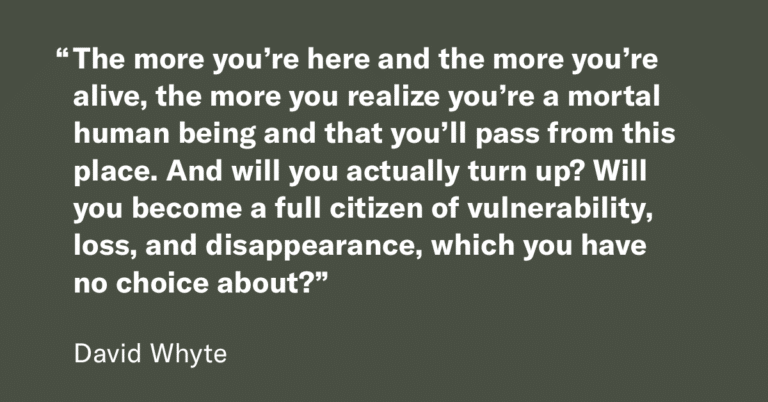
Many human beings do that for the rest of their lives. Many do it for just a short period and then reemerge again. But all of us are struggling to be here. One of the great theological questions is around incarnation, which simply means being here in your body — not anywhere else, just here with life’s fierce need to change you — the fact that the more you’re here and the more you’re alive, the more you realize you’re a mortal human being and that you’ll pass from this place. And will you actually turn up? Will you actually have the conversation? Will you become a full citizen of vulnerability, loss, and disappearance, which you have no choice about?
[music: “The Lament for Limerick” by Lehto and Wright]
Ms. Tippett:I’m Krista Tippett, and this is On Being. Today with the poet-philosopher David Whyte.
Ms. Tippett:I sense all the way through your writing, in your poetry, in your other writing, you — I’ll say it this way: There’s this sadness in you. It’s in all of us, but you walk with it as a companion, I think, more openly than we’re taught to do. Perhaps that’s also something that poetry allows.
You and I both loved John O’Donohue, and I think we also both love Rilke. And Rilke talks about loving the “dark hours of his being.” I just wanted to note that. I appreciate it, and it’s also one of these things about what you bring into the world that is — I know people recognize it, but it’s also a little bit frightening.
Mr. Whyte:Yes, and I describe it more, from my own experience, as wistfulness and poignancy, a kind of elegiac approach to life. An elegy, a good elegy, looking at it from the poetic point of view, is always a conversation between grief and celebration. The grief of the loss of the person and the celebration that you were here at all to share the planet with them, you know?
We have that initial shock — I had that shock with such a close friend to John O’Donohue, who we’ve mentioned. I’m a poet-philosopher. He would’ve been a philosopher-poet. We were like two bookends. There was always someone in the world I knew who was travelling and speaking from the same place, although using slightly different language and a slightly different accent, I would say. [laughs]
But when he went, it was like the other half of me disappeared. And we have this physical experience in loss of falling toward something. It’s like falling in love except it’s falling into grief. You’re falling towards the foundation that they held for you in your life that you didn’t realize they were holding. And you fall and fall and fall and you don’t find it for the longest time. The shock of the loss to begin with and the hermetic sealing off is necessary in grief. But then there comes a time when you finally, actually start to touch the ground that they were holding for you. And it’s from that ground that you step off into your new life, and being a very strange phenomenon in that instance, for instance, of losing John, whereby I’ll start a sentence and feel like John has finished it, or I’ll hear John speaking, and I’ll start in his voice and finish in my own. And sometimes we’re both talking together, which happened a lot when we were actually together. [laughs]
So there’s this really astonishing melding that occurs, which is a kind of dream time, which human beings start to move into in their maturity, actually, where what is past, what is present, and what’s about to occur are not so clearly marked out. One of the things the Irish say is that “The thing about the past is, it’s not the past.” [laughs] It’s right here, in this room, in this conversation.
Ms. Tippett:[laughs] Right. And there’s so many different kinds of loss, right, across our lifespan. I’m right now just about — my second child, my son, is about to leave home. And I love thinking about that — it’s just kind of sinking in on me — and I love thinking about that. What will that mean for this particular loss, to fall into that foundation of how becoming a mother absolutely transformed me and will still be part of me, but my child will not be at home in that way.
Mr. Whyte:This is another delusion we have, that we can take a sincere path in life without having our heart broken. You think about the path of parenting; there’s never been a mother or father since the beginning of time who hasn’t had their heart broken by their children. Nothing dramatic has to happen. All they have to do is grow up. [laughs]
Ms. Tippett:Right. But usually, there are dramatic things that happen as well anyway. [laughs]
Mr. Whyte:Exactly. Just in case we were getting bored.
Ms. Tippett:I first started hearing about you in the ’90s, I think, and especially this book, The Heart Aroused: Poetry and Preservation of the Soul in Corporate America.
Mr. Whyte:Yes, a book I was bullied into writing.
Ms. Tippett:What? Oh, you were? Bullied into writing?
Mr. Whyte:In a good way.
Ms. Tippett:I think, on the surface, most people would say that corporations would be the least poetic spaces in our midst. What you, I think, bring into the open, or help people bring into the open, is the difficult fact that all of this complexity of being human and all these things we carry we don’t actually check at the door of our work places. You talk about the drama of work. [laughs] How did you get into that? And what did you learn there?
Mr. Whyte:I’m still in the heart of it. I work with companies and their leadership teams all around the world. But to begin with, all I knew was my bitterly-earned experience within nonprofit organizations. [laughs] But I do say, if really want to kill yourself …
Ms. Tippett:Which can also have drama and perhaps more. [laughs]
Mr. Whyte:Yeah. Exactly. Oh my god, no, it’s — if you really want to kill yourself, the nonprofit is the place to go.
Ms. Tippett:[laughs] Right.
Mr. Whyte:And if you want Machiavellian politics, then a good nonprofit or the English department at the university is exactly the place to go. [laughs]
Ms. Tippett:Yeah. Touche.
Mr. Whyte:I went full-time as a poet never imagining that I would work in the belly of the beast in the corporate world. I grew up from long lines of rebels in the dispossessed on both my Scots Yorkshire and on my Irish side. And then I grew up in an area of West Yorkshire which was raving socialist and where the Luddites used to march across the fields to break up the machinery. So my blood inheritance was around disbelief and around skepticism around any large, abstract organizations, whether they were government or private.
When I went full-time as a poet, I was only a year into it, and I spoke in Washington, D.C. at a large psychological conference. At the end of the conference was this line of people, and at the end of the line was a man who, in best American fashion, said, “We have to hire you.” And I said in best Anglo-Irish fashion, “For what?” [laughs] He said enthusiastically, “To come into corporate America.” And I said, “For what?” And he said a marvelous thing, actually. He said, “The language we have in that world is not large enough for the territory that we’ve already entered. And in your work, I’ve just heard the language that’s large enough for it.”
Of course, he was talking about the territory of human relationship that the workplace was entering and the movable human relationship and the movability that the organizations had to have. The only place that came from was from the individuals who actually worked within the structures. So it was the breaking apart of many of those structures. I don’t think we quite realize how over-structured our organizations were just 25 years ago or 30 years ago. There are still plenty of dinosaur ones left for us to still go and live in if we want them.
Ms. Tippett:I think we’ve realized that every once in a while, when we engage with an organization that’s still structured that way, that hasn’t managed to change, and you realize how unwieldy and inefficient and ridiculous it is — and bad for us.
Mr. Whyte:Yes, and, of course, we’ve still got a long way to go. All of our difficulties are now become more subtle and more invisible between us. So that’s what I work with — around — whether it’s inside yourself or with the people you’re trying to actually bring together to do things that a single person cannot do alone. And really, that’s the definition of a corporation. It’s from “corpus,” Latin meaning “a body.” It’s a group of people trying to do something you cannot do if you try to do it by yourself. [laughs] That’s the only definition. That’s the simplest, core, radical simplicity at the center of every organization.
Ms. Tippett:You extend this idea that there’s no self that will survive a real conversation. You say there’s no real organization that will keep its original identity if it’s in a conversation. I suppose you also mean a conversation within and without — with the world as well?
Mr. Whyte:Yeah. All of us have this inherited conversation inside us, which we know is untouchable. It comes from our parents, from the way we’re made and all the rest of it. But that’s an invisible quality inside you. All the visible qualities that take form and structure will have to change in order to keep the conversation real. Just as we go through the different decades of our life, we have to change the structures of our life in order to keep things new, in order to keep our youthfulness. And I do think there is a quality of youthfulness which is appropriate to every decade of our life. It just looks different. We have this fixed idea of youthfulness from our teens or our 20s. But actually, there’s a form of youthfulness you’re supposed to inhabit when you’re in your 70s or your 80s or your 90s. It’s this sense of imminent surprise, of imminent revelation, except the revelation and the discovery is more magnified. It has more to do with your mortality and what you’re going to pass on and leave behind you, the shape of your own absence.
Ms. Tippett:There are these lines from “Ten Years Later,” your poem: “Innocence is what we allow / to be gifted back to us / once we’ve given ourselves away.” It’s true that one of the gifts of getting older that is a surprise is a quality of youthfulness that doesn’t have anything to do with your physical body, but it’s like a recovery of something so lovely.
Mr. Whyte:Yes, exactly. It’s like a deep memory at the same time and a giving away. Innocence is, in a way, the ability to be found by the world. It’s not a state of naïveté. It’s the ability to be found by the world you’re now inhabiting. Part of what we find is, we’re just supposed to give ourselves away, actually.
I often feel that one of the real signs of maturity is not only understanding that you’re a mortal human being and you are going to die, which usually happens in your mid-40s or 50s — “Oh, I am actually going to die. It’s not someone else I’m going to become.” But another step of maturity is actually realizing the rest of creation might be a little relieved to let you go [laughs] — that you can stop repeating yourself, stop taking all this oxygen up and make way for something else, which you’ve actually beaten a trail for. And it could be your son, your daughter, could be people you’ve taught or mentored; it could be — the more generous you are, the more that circle extends into our society and those who go after us.
[music: “Games For Two” by Ryan Teague]
Ms. Tippett:After a short break, more with David Whyte. His new book, David Whyte Essentials, is a collection from his various writings, and it includes a few new pieces. My favorite is called “Close.” I’ve recorded it, and you’ll find it as an extra in the On Being podcast feed. Follow or subscribe to get this and other extras in your feed as soon as we release them.
[music: “Games for Two” by Ryan Teague]
I’m Krista Tippett, and this is On Being. Today with David Whyte, the English poet and philosopher who brings both of those disciplines into the drama of leadership at work as well as deepening in life. All of his work gets at what he calls the “conversational nature of reality.”
Ms. Tippett:I want to talk a little bit more about the corporate sphere just before we move on. One thing I’m really interested in, in general — I’m just interviewing more and more poets. I’m so interested in this question of what poetry works in us. So I wonder what you have learned about — how does poetry land in the middle of a workplace, in working life? What does it do in us and for us in that context?
Mr. Whyte:Well, I always say that poetry is language against which you have no defenses. Otherwise, it’s not poetry. It’s prose, which is about something. [laughs]
Ms. Tippett:I love that.
Mr. Whyte:And so poetry is that moment in a conversation where you have to have the other person understand what you’re saying. And sometimes, it’s when you’re delivering terrible news, news of a death or an accident, and you have to tell the other person, and they have to hear it. And you have to say it in such a way that it’s heard fully. But you have to say it, also, with the intimacy of care and of understanding at the same time. You can also hear it in a marital argument. You get beautiful echoes and chords and repetitions in marital arguments.
Ms. Tippett:[laughs] Beautiful and terrible.
Mr. Whyte:That’s right. But in a good marital argument, when one person has said the truth, both people are emancipated into the next stage of the relationship. Unfortunately, if you are not the person who said it, you have to have a little rear-guard action where you deny it. But eventually you have to say, “I wish I’d have said that.” [laughs] And you’re both actually in this new place. You can turn your face away from what was said, but when you turn your face back, it will still be waiting for you.
Ms. Tippett:So that’s the litmus test of poetry.
Mr. Whyte:Yeah. What I’m working with — I work in three different worlds. One is just as a poet, with the intimacy of my readers and my listeners and audiences. Then I work in the theological and psychological worlds. At the moment, I’ve just come out of a big psychological conference in Washington, D.C. to do this interview. But really, I work with exactly the same dynamics that we’re all afraid of. First of all, one of the powerful dynamics of leadership is being visible. One of the vulnerabilities of being visible is that when you’re visible, you can be seen; and when you can be seen, you can be touched; and when you can be touched, you can be hurt.
All of us have these elaborate ways of looking as if we’re showing up and not showing up. Except, in an organizational setting, it has tremendous consequences on other people’s lives. We’ve all worked in organizations where someone is sitting there at a crossroads or nexus in the organization. They’re there, but they’re not there. And because of that, they’re blocking everything that’s trying to come through their particular portal. One of the dynamics you have to get over with is this idea that you can occupy a position of responsibility, that you can have a courageous conversation without being vulnerable.
I wrote this little piece in my Consolations book on vulnerability because it’s one of the great primary delusions we have. Shall I read a little piece of it?
Ms. Tippett:Yes, please.
Mr. Whyte:These are supposed to be consolations, but sometimes they’re like blows to the soul. [laughs]
Ms. Tippett:[laughs] Right. I noticed that.
Mr. Whyte:“Vulnerability.”
Vulnerability is not a weakness, a passing indisposition, or something we can arrange to do without, vulnerability is not a choice, vulnerability is the underlying, ever present and abiding undercurrent of our natural state. To run from vulnerability is to run from the essence of our nature, the attempt to be invulnerable is the vain attempt to become something we are not and most especially, to close off our understanding of the grief of others. More seriously, in refusing our vulnerability we refuse the help needed at every turn of our existence and immobilize the essential, tidal and conversational foundations of our identity.
To have a temporary, isolated sense of power over all events and circumstances is a lovely, illusionary privilege and perhaps the prime and most beautifully constructed conceit of being human and especially of being youthfully human, but it is a privilege that must be surrendered with that same youth, with ill health, with accident, with the loss of loved ones who do not share our untouchable powers; powers eventually and most emphatically given up, as we approach our last breath.
The only choice we have as we mature is how we inhabit our vulnerability, how we inhabit our vulnerability, how we become larger and more courageous and more compassionate through our intimacy with disappearance. Our choice is to inhabit vulnerability as generous citizens of loss, robustly and fully, or conversely, as misers and complainers, reluctant, and fearful, always at the gates of existence, but never bravely and completely attempting to enter, never wanting to risk ourselves, never walking fully through the door.
“Vulnerability.”
Ms. Tippett:A couple of other words in the Consolations book that I loved: “Rest” — I loved this — “is the conversation between what we love to do and how we love to be.”
Mr. Whyte:Sounds like the definition of the perfect Sunday morning.
Ms. Tippett:I’m also intrigued by aloneness. We talked about how “alone” is the first word in that book, and there’s a dance that you name and tease out between aloneness and belonging.
Mr. Whyte:Yes, well, there are two different forms of belonging, I suppose. And to have a sense of belonging in the outer world, where you feel a sense of freedom, comes from this ability to touch this deep foundation of aloneness. And I do feel if you can touch that sense of aloneness, you can live with anyone.
Ms. Tippett:There’s a lovely poem. It’s rather long, “The House of Belonging.” But these last lines I wrote down: “This is the bright home / in which I live, / this is where / I ask / my friends / to come, / this is where I want / to love all the things / it has taken me so long / to learn to love. // This is the temple / of my adult aloneness / and I belong / to that aloneness / as I belong to my life. // There is no house / like the house of belonging.”
Mr. Whyte:Lovely. It’s nice to hear it read back.
Ms. Tippett:It’s really wonderful — again, that juxtaposition of aloneness and belonging, that inextricability.
Mr. Whyte:Yes. And I have this poem, actually, which I wrote out of when I was in the very intense period out of which that poem, “The House of Belonging,” came, when I wrote the book called The House of Belonging. I was writing night and day, but I noticed when I sat at this lovely little desk, which I still have on a landing at the top of the stairs — I noticed that I had this very different relationship to the world when I wrote at night. There was this other horizon outside the window that was drawing me and that was contextualizing what I was writing, so I wrote this piece. It’s called “Sweet Darkness,” and it’s about that same place.
Ms. Tippett:Right. Where did you write this? On the West Coast?
Mr. Whyte:I did. I wrote it on Whidbey Island in Langley, in the Puget Sound, north of Seattle.
“When your eyes are tired / the world is tired also. // When your vision has gone / no part of the world can find you. // It’s time to go into the night / where the dark has eyes / to recognize its own. / It’s time to go into the dark / where the night has eyes / to recognize its own. // There you can be sure / you are not beyond love. // The dark will make a home for you / tonight. / The night will give you a horizon / further than you can see. // You must learn one thing. You must learn one thing. / The world was made to be free in. / You must learn one thing. / The world was made to be free in. // Give up all the other worlds / except the one to which you belong. // Sometimes it takes darkness and the sweet / confinement of your aloneness / to learn // anything or anyone / that does not bring you alive / is too small for you.”
[music: “Púsi” by Amiina]
Ms. Tippett:I’m Krista Tippett, and this is On Being. Today with the poet-philosopher David Whyte.
Ms. Tippett:There’s some lines from this poem, “What to Remember When Waking.” “To be human is to become visible while carrying what is hidden as a gift to others.” What does that mean?
Mr. Whyte:It’s really working with that earlier dynamic we worked, of incarnation, of becoming visible in the world. And yet the gift that you’re going to give and keep on giving is an invisible gift that will take many different forms and that you learn more of each time you allow it to take a different form. You move from your 20s into your 30s, and you suddenly find another larger form for it or a different shape that makes a different connection. And then you deepen it in your 40s. And you get overwhelmed by it in your 50s. And then it returns to you again in more mature forms, settled forms, in your 60s. This is the gift that keeps giving, and it’s that internal, deeper source. It’s you becoming more and more real and more and more visible in the world.
Ms. Tippett:One other word from Consolations, the book, is “genius,” which you describe as something which we already possess. You’re proposing it as something that’s not just for Albert Einstein but is accessible to the rest of us. And you say, “Human genius lies in the geography of the body and its conversation with the world.” There’s your “conversation” again. “The meeting between inheritance and horizon.” Help me understand that.
Mr. Whyte:In the ancient world, the word “genius” was not so much used about individual people; it was used about places and almost always with the world “loci.” “Genius loci” meant the spirit of a place. We all know what that intuitively means. We all have favorite places in the world, and it may be a seashore where you’ve got this ancient conversation between the ocean and the land and a particular geography of the way the cliffs or the beaches are formed. But it could’ve been the same in the ancient world, where a little bridge crossing a stream with a pool at the back of it and a willow hanging over the pool — that place would be said to have a genius loci. But a more sophisticated understanding would understand — it’s like this weather front of all of these qualities that meet in that place. So I think it’s a very merciful thing to think of human beings in the same way — that is, your genius is just the way everything is met in you. And it’s your job just …
Ms. Tippett:Physically — physically as well as …
Mr. Whyte:Exactly. Literally, all the struggles of your grandparents and your parents in arriving together and giving birth to your parents and giving birth to you, the landscape in which you were nurtured, the dialect or language in which you were educated into the world, the smells of the local environment.
When I go back to Yorkshire, just the taste of the water off the moors is completely different. When I go to County Clare, the water there, again, has a spirit because it comes off limestone there. So it’s really merciful, actually, not to think of genius as something that I’m going to get to by hard work, if I practice the violin 15 hours a day. It’s the innate gift that makes me want to practice the violin, actually. It’s the way everything meets inside me. Will I have that conversation? This is the experience of consummation, of a full incarnation in the world.
Ms. Tippett:I had this same conversation with John O’Donohue that I’m going to have with you now, which is the beauty of that thought, but the reality that that geography, for many people, at any given time, is so harsh — and living with that reality of our global body as well, the puzzle of it.
Mr. Whyte:Yes, that’s right. There are many people in Syria now just trying to preserve their lives and the lives of their loved ones. This has always been there and always been true. And who knows? Any of us could be precipitated into awful circumstances at any time, and many of us go through those dark years where you just feel as if it’s just the movement of your own movement that’s just creating body heat to actually keep you alive. We go through those very, very narrow places.
John used to talk about how you shaped a more beautiful mind and that it’s an actual discipline, no matter what circumstances you’re in. The way I interpreted it was the discipline of asking beautiful questions and that a beautiful question shapes a beautiful mind. The ability to ask beautiful questions, often, in very unbeautiful moments, is one of the great disciplines of a human life. And a beautiful question starts to shape your identity as much by asking it as it does by having it answered. You don’t have to do anything about it. You just have to keep asking, and before you know it, you will find yourself actually shaping a different life, meeting different people, finding conversations that are leading you in those directions that you wouldn’t even have seen before.
Ms. Tippett:That’s what Rilke called “living the question.”
Mr. Whyte:Exactly. He’s always there before you. [laughs]
Ms. Tippett:Yes, he is. Also, one way I’ve come to think about questions, the power of questions, is that questions elicit answers in their likeness. You call forth something beautiful by asking a beautiful question.
Mr. Whyte:Yes, you do. And then the other part of it, too, is that there’s this kind of weighted silence behind each question. To live with that sense of trepidation — what I call beautiful trepidation — the sense of something about to happen that you’ve wanted but that you’re scared to death of actually happening. [laughs] None of us really feel we deserve our happiness.
Ms. Tippett:I want to ask you, before we hear some more poetry, this ancient, animating question, “What does it mean to be human?” That’s something that you have reflected on with language and in thought all across your life, but how you would begin to answer that question now, and what do you keep on learning? What are you learning anew at this moment in your life about what it means to be human?
Mr. Whyte:One of the interesting qualities of being human is, by the look of it, we’re the only part of creation that can actually refuse to be ourselves. As far as I can see, there’s no other part of the world that can do that. The cloud is the cloud; the mountain is the mountain; the tree is the tree; the hawk is the hawk. The kingfisher doesn’t wake up one day and say, “You know, God, I’m absolutely fed up to the back teeth of this whole kingfisher trip. Can I have a day as a crow? You know, hang out with my mates, glide down for a bit of carrion now and again? That’s the life for — ” No, the kingfisher is just the kingfisher.
And one of the healing things about the natural world to human beings is that it’s just itself. But we, as human beings, are really quite extraordinary in that we can actually refuse to be ourselves. We can get afraid of the way we are. We can temporarily put a mask over our face and pretend to be somebody else or something else. And the interesting thing is then we can take it another step of virtuosity and forget that we were pretending to be someone else and become the person we were on the surface at least, who we were just pretending to be in the first place.
Ms. Tippett:[laughs] Right. Yeah.
Mr. Whyte:So one of the astonishing qualities of being human is the measure of our reluctance to be here, actually. And I think one of the great necessities of self-knowledge is understanding and even tasting the single malt essence of your own reluctance to be here: all the ways you don’t want to have the conversation, all the ways you don’t want to be in the marriage, you don’t want to be a parent, you don’t want to be visible in a leadership position, you don’t want to be doing this work. And this is not to give it away. This is just to understand what lies between you and a sense of freedom in it.
I think self-compassion has to do with this ability to understand and even to cultivate a sense of humor about all the ways you just don’t want to be here. To embody your reluctance and, therefore, once it’s embodied, to allow it to actually start to change into something else. Things only solidify when they’re kept at a distance. As soon as they’re embodied, they actually start to take on a kind of seasonality. And you’re actually, by embodying it, by feeling it fully, allowing it to start to change into something else.
Ms. Tippett:Would you maybe also just read one more? Read “Working Together?”
Mr. Whyte:“Working Together.” Yeah.
Ms. Tippett:Do you have that there?
Mr. Whyte:I have that in my memory, actually. “Working Together”
We shape ourselves / to fit this world // and by the world / are shaped again. // The visible / and the invisible // working together / in common cause, // to produce / the miraculous. / I am thinking of the way / the invisible air // traveled at speed / round a shaped wing // easily / holds our weight. / I am thinking of the way / the invisible air / traveled at speed / round a shaped wing / easily / holds our weight. // So may we, in this life / trust // to those elements / we have yet to see // or imagine, / and find the true // shape of our own self, / by forming it well // to the great / intangibles about us. / and find the true / shape the true shape of our own self, / by forming it well / to the great / intangibles about us.
[music: “Summer Colour” by I Am Robot And Proud]
David Whyte is an Associate Fellow at Saïd Business School at the University of Oxford. His books include The Heart Aroused: Poetry and the Preservation of the Soul in Corporate America, Consolations: The Solace, Nourishment, and Underlying Meaning of Everyday Words, and The Bell and The Blackbird. His latest collection is David Whyte Essentials.
Staff:The On Being Project is Chris Heagle, Lily Percy, Maia Tarrell, Marie Sambilay, Erinn Farrell, Laurén Dørdal, Tony Liu, Erin Colasacco, Kristin Lin, Profit Idowu, Eddie Gonzalez, Lilian Vo, Lucas Johnson, Damon Lee, Suzette Burley, Katie Gordon, Zack Rose, Serri Graslie, Nicole Finn, and Colleen Scheck.
Ms. Tippett:Special thanks this week to Thomas Crocker and all the good people at Many Rivers Press for giving us permission to use David Whyte’s poetry.
The On Being Project is located on Dakota Land. Our lovely theme music is provided and composed by Zoë Keating. And the last voice that you hear singing at the end of our show is Cameron Kinghorn.
On Being is an independent production of The On Being Project. It is distributed to public radio stations by PRX. I created this show at American Public Media.
Our funding partners include:
The Fetzer Institute, helping to build the spiritual foundation for a loving world. Find them at fetzer.org.
Kalliopeia Foundation. Dedicated to reconnecting ecology, culture, and spirituality. Supporting organizations and initiatives that uphold a sacred relationship with life on Earth. Learn more at kalliopeia.org.
Humanity United, advancing human dignity at home and around the world. Find out more at humanityunited.org, part of the Omidyar Group.
The Osprey Foundation — a catalyst for empowered, healthy, and fulfilled lives.
And the Lilly Endowment, an Indianapolis-based, private family foundation dedicated to its founders’ interests in religion, community development, and education.
Democracy is Good! The scenes coming out of Hong Kong has led many to question why these protesters are willing to risk their life and freedom. Many of them believe their future is at stake. (Getty Images)
Consciousness, sexuality, androgyny, futurism, space, the arts, science, astrology, democracy, humor, books, movies and more