
From Wikipedia, the free encyclopedia
| Wassily Kandinsky | |
|---|---|
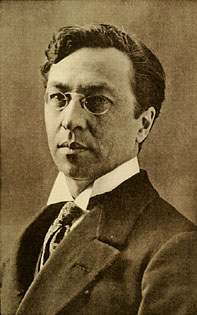
| Kandinsky, c. 1913 or earlier | |
| Born | Wassily Wassilyevich Kandinsky 16 December [O.S. 4 December] 1866 Moscow, Russian Empire |
| Died | 13 December 1944 (aged 77) Neuilly-sur-Seine, France |
| Nationality | Russian, later French |
| Education | Academy of Fine Arts, Munich |
| Known for | Painting |
| Notable work | On White II, Der Blaue Reiter |
| Movement | Expressionism; abstract art |
Wassily Wassilyevich Kandinsky (/ˌvæsɪli kænˈdɪnski/; Russian: Василий Васильевич Кандинский, tr. Vasiliy Vasilyevich Kandinskiy, IPA: [vɐˈsʲilʲɪj vɐˈsʲilʲjɪvʲɪtɕ kɐnʲˈdʲinskʲɪj]; 16 December [O.S. 4 December] 1866 – 13 December 1944) was a Russian painter and art theorist. Kandinsky is generally credited as the pioneer of abstract art.[1] Born in Moscow, Kandinsky spent his childhood in Odessa (today Ukraine), where he graduated at Grekov Odessa Art school. He enrolled at the University of Moscow, studying law and economics. Successful in his profession—he was offered a professorship (chair of Roman Law) at the University of Dorpat (today Tartu, Estonia)—Kandinsky began painting studies (life-drawing, sketching and anatomy) at the age of 30.
In 1896, Kandinsky settled in Munich, studying first at Anton Ažbe‘s private school and then at the Academy of Fine Arts. He returned to Moscow in 1914, after the outbreak of World War I. Following the Russian Revolution, Kandinsky “became an insider in the cultural administration of Anatoly Lunacharsky“[2] and helped establish the Museum of the Culture of Painting.[3] However, by then “his spiritual outlook… was foreign to the argumentative materialism of Soviet society”,[4] and opportunities beckoned in Germany, to which he returned in 1920. There he taught at the Bauhaus school of art and architecture from 1922 until the Nazis closed it in 1933. He then moved to France, where he lived for the rest of his life, becoming a French citizen in 1939 and producing some of his most prominent art. He died in Neuilly-sur-Seine in 1944.
Artistic periods
Der Blaue Reiter (1903)
Kandinsky’s creation of abstract work followed a long period of development and maturation of intense thought based on his artistic experiences. He called this devotion to inner beauty, fervor of spirit, and spiritual desire inner necessity;[citation needed] it was a central aspect of his art.
Youth and inspiration (1866–1896)
Early-period work, Munich-Schwabing with the Church of St. Ursula (1908)
Kandinsky was born in Moscow, the son of Lidia Ticheeva and Vasily Silvestrovich Kandinsky, a tea merchant.[5][6] One of his great grandmothers was a Princess Gantimurova, probably explaining the “slight Mongolian trait in his features”.[7] Kandinsky learned from a variety of sources while in Moscow. He studied many fields while in school, including law and economics. Later in life, he would recall being fascinated and stimulated by colour as a child. His fascination with colour symbolism and psychology continued as he grew. In 1889, he was part of an ethnographic research group which travelled to the Vologda region north of Moscow. In Looks on the Past, he relates that the houses and churches were decorated with such shimmering colours that upon entering them, he felt that he was moving into a painting. This experience, and his study of the region’s folk art (particularly the use of bright colours on a dark background), was reflected in much of his early work. A few years later he first likened painting to composing music in the manner for which he would become noted, writing, “Colour is the keyboard, the eyes are the hammers, the soul is the piano with many strings. The artist is the hand which plays, touching one key or another, to cause vibrations in the soul”.[8] Kandinsky was also the uncle of Russian-French philosopher Alexandre Kojève (1902-1968).
In 1896, at the age of 30, Kandinsky gave up a promising career teaching law and economics to enroll in the Munich Academy where his teachers would eventually include Franz von Stuck.[9] He was not immediately granted admission, and began learning art on his own. That same year, before leaving Moscow, he saw an exhibit of paintings by Monet. He was particularly taken with the impressionistic style of Haystacks; this, to him, had a powerful sense of colour almost independent of the objects themselves. Later, he would write about this experience:
That it was a haystack the catalogue informed me. I could not recognise it. This non-recognition was painful to me. I considered that the painter had no right to paint indistinctly. I dully felt that the object of the painting was missing. And I noticed with surprise and confusion that the picture not only gripped me, but impressed itself ineradicably on my memory. Painting took on a fairy-tale power and splendour.[10]— Wassily Kandinsky
Kandinsky was similarly influenced during this period by Richard Wagner‘s Lohengrin which, he felt, pushed the limits of music and melody beyond standard lyricism.[11] He was also spiritually influenced by Madame Blavatsky (1831–1891), the best-known exponent of theosophy. Theosophical theory postulates that creation is a geometrical progression, beginning with a single point. The creative aspect of the form is expressed by a descending series of circles, triangles and squares. Kandinsky’s book Concerning the Spiritual in Art (1910) and Point and Line to Plane (1926) echoed this theosophical tenet. Illustrations by John Varley in Thought-Forms (1901) influenced him visually.[12]
Metamorphosis
In the summer of 1902, Kandinsky invited Gabriele Münter to join him at his summer painting classes just south of Munich in the Alps. She accepted, and their relationship became more personal than professional. Art school, usually considered difficult, was easy for Kandinsky. It was during this time that he began to emerge as an art theorist as well as a painter. The number of his existing paintings increased in the beginning of the 20th century; much remains of the landscapes and towns he painted, using broad swaths of colour and recognisable forms. For the most part, however, Kandinsky’s paintings did not feature any human figures; an exception is Sunday, Old Russia (1904), in which Kandinsky recreates a highly colourful (and fanciful) view of peasants and nobles in front of the walls of a town. Riding Couple (1907) depicts a man on horseback, holding a woman with tenderness and care as they ride past a Russian town with luminous walls across a blue river. The horse is muted while the leaves in the trees, the town, and the reflections in the river glisten with spots of colour and brightness. This work demonstrates the influence of pointillism in the way the depth of field is collapsed into a flat, luminescent surface. Fauvism is also apparent in these early works. Colours are used to express Kandinsky’s experience of subject matter, not to describe objective nature.
Perhaps the most important of his paintings from the first decade of the 1900s was The Blue Rider (1903), which shows a small cloaked figure on a speeding horse rushing through a rocky meadow. The rider’s cloak is medium blue, which casts a darker-blue shadow. In the foreground are more amorphous blue shadows, the counterparts of the fall trees in the background. The blue rider in the painting is prominent (but not clearly defined), and the horse has an unnatural gait (which Kandinsky must have known). Some art historians believe[citation needed] that a second figure (perhaps a child) is being held by the rider, although this may be another shadow from the solitary rider. This intentional disjunction, allowing viewers to participate in the creation of the artwork, became an increasingly conscious technique used by Kandinsky in subsequent years; it culminated in the abstract works of the 1911–1914 period. In The Blue Rider, Kandinsky shows the rider more as a series of colours than in specific detail. This painting is not exceptional in that regard when compared with contemporary painters, but it shows the direction Kandinsky would take only a few years later.
From 1906 to 1908 Kandinsky spent a great deal of time travelling across Europe (he was an associate of the Blue Rose symbolist group of Moscow), until he settled in the small Bavarian town of Murnau. In 1908 he bought a copy of Thought-Forms by Annie Besant and Charles Webster Leadbeater. In 1909 he joined the Theosophical Society. The Blue Mountain (1908–1909) was painted at this time, demonstrating his trend toward abstraction. A mountain of blue is flanked by two broad trees, one yellow and one red. A procession, with three riders and several others, crosses at the bottom. The faces, clothing, and saddles of the riders are each a single color, and neither they nor the walking figures display any real detail. The flat planes and the contours also are indicative of Fauvist influence. The broad use of color in The Blue Mountain illustrates Kandinsky’s inclination toward an art in which color is presented independently of form, and which each color is given equal attention. The composition is more planar; the painting is divided into four sections: the sky, the red tree, the yellow tree and the blue mountain with the three riders.
- Odessa Port, 1898, Tretyakov Gallery, Moscow
- Akhtyrka, 1901, Lenbachhaus, Kunstarealm, Munich
- Rotterdam Sun, 1906
- Murnau, Dorfstrasse (Street in Murnau, A Village Street), 1908, Werner Merzbacher [de] Collection
- Houses in Munich, 1908
- Murnau, train & castle, 1909
Blue Rider Period (1911–1914)
See also: Der Blaue ReiterWassily Kandinsky, 1910, Landscape with Factory Chimney, oil on canvas, 66.2 x 82 cm, Solomon R. Guggenheim Museum
Kandinsky’s paintings from this period are large, expressive coloured masses evaluated independently from forms and lines; these serve no longer to delimit them, but overlap freely to form paintings of extraordinary force. Music was important to the birth of abstract art, since music is abstract by nature—it does not try to represent the exterior world, but expresses in an immediate way the inner feelings of the soul. Kandinsky sometimes used musical terms to identify his works; he called his most spontaneous paintings “improvisations” and described more elaborate works as “compositions.”
In addition to painting, Kandinsky was an art theorist; his influence on the history of Western art stems perhaps more from his theoretical works than from his paintings. He helped found the Neue Künstlervereinigung München (Munich New Artists’ Association), becoming its president in 1909. However, the group could not integrate the radical approach of Kandinsky (and others) with conventional artistic concepts and the group dissolved in late 1911. Kandinsky then formed a new group, the Blue Rider (Der Blaue Reiter) with like-minded artists such as August Macke, Franz Marc, Albert Bloch, and Gabriele Münter. The group released an almanac (The Blue Rider Almanac) and held two exhibits. More of each were planned, but the outbreak of World War I in 1914 ended these plans and sent Kandinsky back to Russia via Switzerland and Sweden.Wassily Kandinsky, Improvisation 27 (Garden of Love II), 1912, oil on canvas, 120.3 x 140.3 cm, Metropolitan Museum of Art, New York. Exhibited at the 1913 Armory Show.
His writing in The Blue Rider Almanac and the treatise “On the Spiritual in Art” (which was released in 1910) were both a defence and promotion of abstract art and an affirmation that all forms of art were equally capable of reaching a level of spirituality. He believed that colour could be used in a painting as something autonomous, apart from the visual description of an object or other form.
These ideas had an almost-immediate international impact, particularly in the English-speaking world.[13] As early as 1912, On the Spiritual in Art was reviewed by Michael Sadleir in the London-based Art News.[14] Interest in Kandinsky grew apace when Sadleir published an English translation of On the Spiritual in Art in 1914. Extracts from the book were published that year in Percy Wyndham Lewis‘s periodical Blast, and Alfred Orage‘s weekly cultural newspaper The New Age. Kandinsky had received some notice earlier in Britain, however; in 1910, he participated in the Allied Artists’ Exhibition (organised by Frank Rutter) at London’s Royal Albert Hall. This resulted in his work being singled out for praise in a review of that show by the artist Spencer Frederick Gore in The Art News.[15]
Sadleir’s interest in Kandinsky also led to Kandinsky’s first works entering a British art collection; Sadleir’s father, Michael Sadler, acquired several wood-prints and the abstract painting Fragment for Composition VII in 1913 following a visit by father and son to meet Kandinsky in Munich that year. These works were displayed in Leeds, either in the University or the premises of the Leeds Arts Club, between 1913 and 1923.[16]
- The Cow, 1910, Lenbachhaus, Munich
- Study for Improvisation V, 1910
- The Rider, 1911
- Landscape With Two Poplars, 1912
- Squares with Concentric Circles, 1913
- Composition 6, 1913
- Tableau à la tache rouge, 1914
Return to Russia (1914–1921)
In Grey (1919) by Kandinsky, exhibited at the 19th State Exhibition, Moscow, 1920
The sun melts all of Moscow down to a single spot that, like a mad tuba, starts all of the heart and all of the soul vibrating. But no, this uniformity of red is not the most beautiful hour. It is only the final chord of a symphony that takes every colour to the zenith of life that, like the fortissimo of a great orchestra, is both compelled and allowed by Moscow to ring out.— Wassily Kandinsky[17]
In 1916, he met Nina Andreevskaya (1899–1980), whom he married on 11 February 1917.
From 1918 to 1921, Kandinsky was involved in the cultural politics of Russia and collaborated in art education and museum reform. He painted little during this period, but devoted his time to artistic teaching, with a program based on form and colour analysis; he also helped organize the Institute of Artistic Culture in Moscow of which he was the first director. His spiritual, expressionistic view of art was ultimately rejected by the radical members of the Institute as too individualistic and bourgeois. In 1921, Kandinsky was invited to go to Germany to attend the Bauhaus of Weimar by its founder, architect Walter Gropius.
Back in Germany and the Bauhaus (1922–1933)
In May 1922, he attended the International Congress of Progressive Artists and signed the “Founding Proclamation of the Union of Progressive International Artists”.[18]
Kandinsky taught the basic design class for beginners and the course on advanced theory at the Bauhaus; he also conducted painting classes and a workshop in which he augmented his colour theory with new elements of form psychology. The development of his works on forms study, particularly on points and line forms, led to the publication of his second theoretical book (Point and Line to Plane) in 1926. His examinations of the effects of forces on straight lines, leading to the contrasting tones of curved and angled lines, coincided with the research of Gestalt psychologists, whose work was also discussed at the Bauhaus.[19] Geometrical elements took on increasing importance in both his teaching and painting—particularly the circle, half-circle, the angle, straight lines and curves. This period was intensely productive. This freedom is characterised in his works by the treatment of planes rich in colours and gradations—as in Yellow – red – blue (1925), where Kandinsky illustrates his distance from the constructivism and suprematism movements influential at the time.
The two-metre-wide Yellow – red – blue (1925) of several main forms: a vertical yellow rectangle, an inclined red cross and a large dark blue circle; a multitude of straight (or sinuous) black lines, circular arcs, monochromatic circles and scattered, coloured checker-boards contribute to its delicate complexity. This simple visual identification of forms and the main coloured masses present on the canvas is only a first approach to the inner reality of the work, whose appreciation necessitates deeper observation—not only of forms and colours involved in the painting but their relationship, their absolute and relative positions on the canvas and their harmony.
Kandinsky was one of Die Blaue Vier (Blue Four), formed in 1923 with Paul Klee, Lyonel Feininger and Alexej von Jawlensky, which lectured and exhibited in the United States in 1924. Due to right-wing hostility, the Bauhaus left Weimar and settled in Dessau in 1925. Following a Nazi smear campaign the Bauhaus left Dessau in 1932 for Berlin, until its dissolution in July 1933. Kandinsky then left Germany, settling in Paris.
- Small worlds I, 1922
- Circles in a Circle, 1923
- Several Circles, 1926
- Soft Hard, 1927
- Inner Aliance, 1929
Great Synthesis (1934–1944)
Living in an apartment in Paris, Kandinsky created his work in a living-room studio. Biomorphic forms with supple, non-geometric outlines appear in his paintings—forms which suggest microscopic organisms but express the artist’s inner life. Kandinsky used original colour compositions, evoking Slavic popular art. He also occasionally mixed sand with paint to give a granular, rustic texture to his paintings.
This period corresponds to a synthesis of Kandinsky’s previous work in which he used all elements, enriching them. In 1936 and 1939 he painted his final two major compositions, the type of elaborate canvases he had not produced for many years. Composition IX has highly contrasted, powerful diagonals whose central form gives the impression of an embryo in the womb. Small squares of colours and coloured bands stand out against the black background of Composition X as star fragments (or filaments), while enigmatic hieroglyphs with pastel tones cover a large maroon mass which seems to float in the upper-left corner of the canvas. In Kandinsky’s work some characteristics are obvious, while certain touches are more discreet and veiled; they reveal themselves only progressively to those who deepen their connection with his work.[20] He intended his forms (which he subtly harmonised and placed) to resonate with the observer’s soul.
Kandinsky’s conception of art
Main article: List of paintings by Wassily Kandinsky
The artist as prophet
Composition VII, Tretyakov Gallery. According to Kandinsky, this is the most complex piece he ever painted (1913)
Writing that “music is the ultimate teacher,”[21] Kandinsky embarked upon the first seven of his ten Compositions. The first three survive only in black-and-white photographs taken by fellow artist and friend Gabriele Münter. While studies, sketches, and improvisations exist (particularly of Composition II), a Nazi raid on the Bauhaus in the 1930s resulted in the confiscation of Kandinsky’s first three Compositions. They were displayed in the State-sponsored exhibit “Degenerate Art“, and then destroyed (along with works by Paul Klee, Franz Marc and other modern artists).
Fascinated by Christian eschatology and the perception of a coming New Age,[22] a common theme among Kandinsky’s first seven Compositions is the apocalypse (the end of the world as we know it). Writing of the “artist as prophet” in his book, Concerning the Spiritual in Art, Kandinsky created paintings in the years immediately preceding World War I showing a coming cataclysm which would alter individual and social reality. Having a devout belief in Orthodox Christianity,[23] Kandinsky drew upon the biblical stories of Noah’s Ark, Jonah and the whale, Christ’s resurrection, the four horsemen of the Apocalypse in the book of Revelation, Russian folktales and the common mythological experiences of death and rebirth. Never attempting to picture any one of these stories as a narrative, he used their veiled imagery as symbols of the archetypes of death–rebirth and destruction–creation he felt were imminent in the pre-World War I world.
As he stated in Concerning the Spiritual in Art (see below), Kandinsky felt that an authentic artist creating art from “an internal necessity” inhabits the tip of an upward-moving pyramid. This progressing pyramid is penetrating and proceeding into the future. What was odd or inconceivable yesterday is commonplace today; what is avant garde today (and understood only by the few) is common knowledge tomorrow. The modern artist–prophet stands alone at the apex of the pyramid, making new discoveries and ushering in tomorrow’s reality. Kandinsky was aware of recent scientific developments and the advances of modern artists who had contributed to radically new ways of seeing and experiencing the world.
Composition IV and later paintings are primarily concerned with evoking a spiritual resonance in viewer and artist. As in his painting of the apocalypse by water (Composition VI), Kandinsky puts the viewer in the situation of experiencing these epic myths by translating them into contemporary terms (with a sense of desperation, flurry, urgency, and confusion). This spiritual communion of viewer-painting-artist/prophet may be described within the limits of words and images.
Artistic and spiritual theorist
As the Der Blaue Reiter Almanac essays and theorising with composer Arnold Schoenberg indicate, Kandinsky also expressed the communion between artist and viewer as being available to both the senses and the mind (synesthesia). Hearing tones and chords as he painted, Kandinsky theorised that (for example), yellow is the colour of middle C on a brassy trumpet; black is the colour of closure, and the end of things; and that combinations of colours produce vibrational frequencies, akin to chords played on a piano. In 1871 the young Kandinsky learned to play the piano and cello.[24][25]
Kandinsky also developed a theory of geometric figures and their relationships—claiming, for example, that the circle is the most peaceful shape and represents the human soul. These theories are explained in Point and Line to Plane (see below).
Kandinsky’s legendary stage design for a performance of Mussorgsky‘s “Pictures at an Exhibition” illustrates his synaesthetic concept of a universal correspondence of forms, colors and musical sounds.[26] In 1928 in the theater of Dessau, Wassily Kandinsky realized the stage production of “Pictures at an Exhibition”. In 2015 the original designs of the stage elements were animated with modern video technology and synchronized with the music according to the preparatory notes of Kandinsky and the director’s script of Felix Klee.
In another episode with Münter during the Bavarian abstract expressionist years, Kandinsky was working on his Composition VI. From nearly six months of study and preparation, he had intended the work to evoke a flood, baptism, destruction, and rebirth simultaneously. After outlining the work on a mural-sized wood panel, he became blocked and could not go on. Münter told him that he was trapped in his intellect and not reaching the true subject of the picture. She suggested he simply repeat the word uberflut (“deluge” or “flood”) and focus on its sound rather than its meaning. Repeating this word like a mantra, Kandinsky painted and completed the monumental work in a three-day span.[citation needed]





,_oil_on_canvas,_52.1_x_54.6_cm,_Stiftung_Sammlung_E.G._B%C3%BChrle,_Zurich.jpg)


,_oil_on_canvas,_94_x_130_cm,_Museum_Boijmans_Van_Beuningen.jpg)


.jpg)


