
Standing on the Shoulders of Solitude: Newton, the Plague, and How Quarantine Fomented the Greatest Leap in Science
“Truth is the offspring of silence and meditation.”
BY MARIA POPOVA (brainpickings.org)

In the 1650s, the penumbra of plague slowly began eclipsing Europe. Italy fell first, soon Spain, then Germany, then Holland. From across the slender cell wall of the Channel, England watched and trembled, then cautiously relaxed — for about a decade, some divine will seemed to be shielding the country. But the world was already worshipping at the altar of commerce and the forces of globalization had already been set into motion — with England’s economy relying heavily on trade, its ports bustled with ships carrying silk and tea and sugar from all discovered frontiers of the globe. Rats boarded the ships, fleas boarded the rats, bacteria — an almost-kingdom of unicellular organisms yet to be coronated, for the cell itself was yet to be discovered — boarded the fleas, which took to human flesh as soon as they debarked.

And so, on Christmas Day 1664, a single plague death was reported in London. Another came in February, then another. “Great fears of sickness here in the City,” the legendary diarist Samuel Pepys was writing by April. “God preserve us all.”
God was no match for the absence of a basic scientific understanding of biology and epidemiology. The deaths were swift, gruesome, and, soon, so voluminous that services ceased being held. Over the course of the summer, the death toll swelled tenfold, from hundreds to thousands per week. The infected were ordered not to leave their homes. Many were boarded in and left to die in isolation, an enormous cross painted on the outside of each plagued house. Plays, spectator blood sports, and other crowd gatherings were banned. Street vendors were banned from selling their wares, newsboys ceased crying and retreated indoors. An awful, alien silence came to blanket this capital of din. The universities closed.
When Cambridge sent its students home, a young man obsessed with mathematics, motion, and light, whose illiterate father had died three months before his birth, who worshipped a “God of order and not of confusion,” and who had begun his university studies by performing servants’ work for wealthier students in exchange for tuition, bundled his prized books and headed back to his mother’s farm.
There, in solitude and isolation, as the plague continued its deadly sweep, Isaac Newton (December 25, 1642–March 19, 1727) dreamt up the fulcrum that would dislodge humanity from the Dark Ages; there, the apple — real or apocryphal — fell, and in its shadow rose the revolutionary idea of gravity, which the young man envisioned as a force “extending to the orb of the Moon” all the way from the Earth, without “cutoff or boundary.” It was there, too, that he set out to compute that force, “requisite to keep the Moon in her Orb with the force of gravity at the surface of the earth”; in the act of computing it, as a necessity of that act, he invented calculus.

In his excellent Isaac Newton (public library) — a gold standard of biography and of storytelling bridging the scientific with the poetic, which also gave us the story behind the famous “standing on the shoulders of giants” metaphor — James Gleick writes of the young Newton’s plague-driven return home:
He built bookshelves and made a small study for himself. He opened the nearly blank thousand-page commonplace book he had inherited from his stepfather and named it his Waste Book. He began filling it with reading notes. These mutated seamlessly into original research. He set himself problems; considered them obsessively; calculated answers, and asked new questions. He pushed past the frontier of knowledge (though he did not know this). The plague year was his transfiguration. Solitary and almost incommunicado, he became the world’s paramount mathematician.

From the fortunate platform of a long life — he lived to eighty-four, more than double the era’s life expectancy, his casket shouldered by dukes and earls — Newton would look back on his most intellectually fertile period of the plague years with the recognition that “truth is the offspring of silence and meditation.”
Complement this fragment of Gleick’s indispensable Isaac Newton with Tocqueville on stillness as a form of action and the trailblazing 18th-century French mathematician Émilie du Châtelet, who popularized Newton’s science, on the nature of genius, then revisit Gleick’s splendid reading of and reflection on Elizabeth Bishop’s poem about the nature of knowledge.
Pope says coronavirus pandemic could be nature’s response to climate crisis
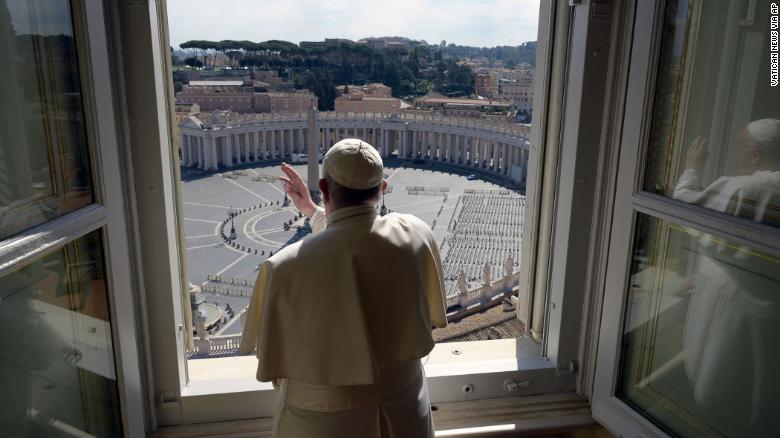
By Delia Gallagher
Wed April 8, 2020 (cnn.com)
Rome (CNN)Pope Francis has said the coronavirus pandemic is one of “nature’s responses” to humans ignoring the current ecological crisis.In an email interview published Wednesday in The Tablet and Commonwealth magazines, the pontiff said the outbreak offered an opportunity to slow down the rate of production and consumption and to learn to understand and contemplate the natural world.”We did not respond to the partial catastrophes. Who now speaks of the fires in Australia, or remembers that 18 months ago a boat could cross the North Pole because the glaciers had all melted? Who speaks now of the floods?” the Pope said.Pope Francis celebrates Palm Sunday mass in an empty church“I don’t know if these are the revenge of nature, but they are certainly nature’s responses,” he added.Content by CNN UnderscoredIf you can’t wait for Amazon shipping, shop these other online retailersAmazon is only restocking essential goods in its warehouses, so it’s time to diversify your online shopping habits. To help, we’ve rounded up a long list of alternatives.The pandemic has radically changed the way the Vatican operates, with the Pope celebrating Palm Sunday mass in an empty church and the sites normally packed with tourists empty.The 83-year-old Pope, who has a damaged lung from an infection in his 20s, has twice tested negative for the novel coronavirus. He is being distanced from anyone who might be carrying the virus, takes his meals in his private quarters, and uses hand sanitizer before and after meeting any guests, the Vatican press office said.Pope Francis also said in the interview he was recovering from his bronchitis and praying even more from his residence in the Vatican during this “time of great uncertainty.”

Pope Francis presides over a moment of prayer on the sagrato of St Peters Basilica on March 27.Francis also revealed he goes to confession every Tuesday to ask forgiveness for his own selfishness. “I take care of things there,” he said.He also criticized the response to the outbreak, saying the homeless should be quarantined in hotels and not in parking lots.”A photo appeared the other day of a parking lot in Las Vegas where they [the homeless] had been put in quarantine. And the hotels were empty. But the homeless cannot go to a hotel,” the Pope said.Quarantine life is starting to feel like a real Lent“This is the moment to see the poor,” he said, adding that society often treats those in need as “rescued animals.”The Pope also warned against the rise of populist politicians — who he said are giving speeches reminiscent of Hitler in 1933 — and others who are focusing solely on the economy. He said he was worried by the “hypocrisy of certain political personalities who speak of facing up to the crisis, of the problem of hunger in the world, but who in the meantime manufacture weapons.”The Pope encouraged those in a lockdown to find creative ways of being at home. “Take care of yourselves for a future that will come,” Francis said.
(Submitted by Sarah Flynn)
Jake Gyllenhaal Reveals Heath Ledger ‘Refused’ to Present at Oscars Over Brokeback Mountain Joke

Eric Todisco People April 7, 2020 (yahoo.com)
Heath Ledger was dedicated to the message behind the groundbreaking film Brokeback Mountain — so much so that he refused to make jokes about the film’s homosexual love story.
In a recent interview with Another Man magazine, Jake Gyllenhaal, who starred opposite Ledger in Ang Lee’s film, said that the late actor refused to present at the 2007 Academy Awards over a joke involving their characters’ romantic relationship.
“I mean, I remember they wanted to do an opening for the Academy Awards that year that was sort of joking about it, Gyllenhaal, 39, recalled.
“And Heath refused,” he explained. “I was sort of at the time, ‘Oh, okay… whatever.’ I’m always like, ‘It’s all in good fun.’ And Heath said, ‘It’s not a joke to me – I don’t want to make any jokes about it.’ ”
The actor added, “That’s the thing I loved about Heath. He would never joke. Someone wanted to make a joke about the story or whatever, he was like, ‘No. This is about love. Like, that’s it, man. Like, no.’ ”

Gyllenhaal and Ledger starred as Jack Twist and Ennis Del Mar, respectively, in the film, which explores their unexpected love story in the American West across two decades. Michelle Williams and Anne Hathaway also star.
The classic romance received eight Academy Award nominations at the 2007 ceremony, including acting nominations for both Gyllenhaal and Ledger. In a surprise to many, the film ultimately lost in the Best Picture category to Crash.
RELATED: Jake Gyllenhaal ‘Loved’ That Heath Ledger Would Shut Down Homophobic Brokeback Mountain Jokes

Kevin Winter/Getty
In an interview on Sunday Today in July, Gyllenhaal spoke about how the film impacted his career, sharing that it had been unlike any other film he’d done before.
“When we did Brokeback Mountain, I was like, ‘Whoa, what’s going on?’ This is a level of focus and attention that hits a certain nerve and you’re like, ‘This is bigger than me,’ ” he explained. “I understand what it is but this little movie we made that meant so much to us has now become not ours anymore. It’s the world’s.”

Gyllenhaal has also been open up the deep impact Ledger’s death in 2008 has had on him.
“Personally, it affected me in ways I can’t necessarily put in words or even would want to talk about publicly,” Gyllenhaal told PEOPLE in 2016. “In terms of professionally, I think I was at an age where mortality was not always clear to me.”
Having turned 27 at the time of Ledger’s death, Gyllenhaal said that he had not lost many friends at that point in his life.
“It [gave me] the experience of, ‘This is fleeting.’ And none of the attention or synthesized love that comes from the success of a film really matters at all,” he shared. “What matters is the relationships you make when you make a film, and the people you learn from when you’re preparing for a film. That changed a lot for me.”
Book: “Beyond the Mist” by Billye Gene Talmadge

| Beyond the Mist Billye G. Talmadge CreateSpace Independent Publishing Platform, Nov 3, 2016 – 64 pages Billye Talmadge has been writing most of her adult life. Her interest in mystery stories led her to write for many mystery magazines. Unfortunately, many of her writings have been lost with time. Her true genius was in the classes and seminars she taught. Her many students in public schools and private arenas lives are better because she was their teacher. Her compassion and ability to see each student as an individual helped release their potential as a human being |
About the author (2016)
Billye Talmadge, H.W., M., born on December 7, 1929 in Missouri, and raised by her mother in Oklahoma. The black sheep of the Talmadge family she is the niece of former Georgia Senator and Governor Herman E Talmadge. In September 1955 she joined a group of other women in Rose Bamberger’s living room for a gathering that would lay the foundation for the Daughters of Bilitis, (DOB) the first lesbian civil rights group in America. By 1958 DOB had formed a network of local chapters across the country and between 1960-1970 DOB sponsored public conventions on gay and lesbian issues. Billye acted as educator to the women that came as well as in interviews and literature, presenting the DOB and GLBT issues in a non-threatening manner to the general public. She was involved with the Gab ‘n Java sessions, The Ladder magazine, and in the formation and development of the Council on Religion and Homosexuals. She was an early supporter of Troy Perry and the formation of the MCC church. From the very beginning she was heavily involved in education and peer-to-peer counseling, which often was as-simple-as reassuring Lesbians they were not ill or depraved. DOB became more and more involved with civil rights, instead of speaking in terms of gay and lesbian DOB often used the term variant, as in alternate sexual preference. Members were assured that their identity would be kept secret as it was a time when many would have lost their jobs or been expelled from school if their sexual and gender preferences were known. Early on Billye became interested in human sexuality and the variations it represented. She has always identified as female, but taught and showed that the androgynous nature we all have, allows us to identify as any gender. She was instrumental in providing the philosophy for Del Martin and Phyl Lyons activities on human sexuality in San Francisco. Billye has dedicated her life to education and inclusion of all women. Her memories are full of DOB and the early days and the individual stories of the women who came to DOB seeking both shelter and companionship from their well of loneliness in a world who rejected them. Billye has written for mystery magazines as well as professional journals.
(Google Books)
Eckhart Tolle on happiness

“The world is not here to make you happy. It’s here to make you conscious.”
–Eckhart Tolle
Eckhart Tolle (born February 16, 1948) is a spiritual teacher and best-selling author. He is a German-born resident of Canada best known as the author of The Power of Now and A New Earth: Awakening to Your Life’s Purpose. In 2008, The New York Times called Tolle “the most popular spiritual author in the United States”. Wikipedia
Folie à deux
From Wikipedia, the free encyclopedia
| Induced delusional disorder | |
|---|---|
| Other names | Lasègue-Falret syndrome, induced delusional disorder, shared psychotic disorder |
| Pronunciation | UK: /ˌfɒli æ ˈdɜː, -i ɑː-/, US: /foʊˌliː ə ˈdʌ/,[1] French: [fɔli a dø] |
| Specialty | Psychiatry |
Folie à deux, shared psychosis,[2] or shared delusional disorder is a psychiatric syndrome in which symptoms of a delusional belief and sometimes hallucinations[3][4] are transmitted from one individual to another.[5] The same syndrome shared by more than two people may be called folie à trois, folie à quatre, folie en famille (“family madness”), or even folie à plusieurs (“madness of several”).
Recent psychiatric classifications refer to the syndrome as shared psychotic disorder (DSM-IV – 297.3) and induced delusional disorder (F24) in the ICD-10, although the research literature largely uses the original name. This disorder is not in the current DSM (DSM-5). The disorder was first conceptualized in 19th-century French psychiatry by Charles Lasègue and Jean-Pierre Falret and is also known as Lasègue-Falret syndrome.[3][6] The term is from French for “madness of two”.
Signs and symptoms
This syndrome is most commonly diagnosed when the two or more individuals concerned live in proximity and may be socially or physically isolated and have little interaction with other people. Various sub-classifications of folie à deux have been proposed to describe how the delusional belief comes to be held by more than one person:
- Folie imposée is where a dominant person (known as the ‘primary’, ‘inducer’ or ‘principal’) initially forms a delusional belief during a psychotic episode and imposes it on another person or persons (known as the ‘secondary’, ‘acceptor’ or ‘associate’) with the assumption that the secondary person might not have become deluded if left to his or her own devices. If the parties are admitted to hospital separately, then the delusions in the person with the induced beliefs usually resolve without the need of medication.
- Folie simultanée describes either the situation where two people considered to suffer independently from psychosis influence the content of each other’s delusions so they become identical or strikingly similar, or one in which two people “morbidly predisposed” to delusional psychosis mutually trigger symptoms in each other.[7]
Folie à deux and its more populous cousins are in many ways a psychiatric curiosity. The current Diagnostic and Statistical Manual of Mental Disorders states that a person cannot be diagnosed as being delusional if the belief in question is one “ordinarily accepted by other members of the person’s culture or subculture” (see entry for delusion). It is not clear at what point a belief considered to be delusional escapes from the folie à… diagnostic category and becomes legitimate because of the number of people holding it. When a large number of people may come to believe obviously false and potentially distressing things based purely on hearsay, these beliefs are not considered to be clinical delusions by the psychiatric profession and are labelled instead as mass hysteria.
As with most psychological disorders, the extent and type of delusion varies, however it usually mimics the delusion of the inducer and is almost very similar to it.[8] The inducer does not realize that they are making the other person sick but instead think they are helping by alerting the second person of what they deem to be “truth”.
Type of delusions
Psychology Today magazine defines delusions as “fixed beliefs that do not change, even when a person is presented with conflicting evidence.”[9] There are 4 main types of delusions that are passed on from an inducer to a secondary person: bizarre delusions, non-bizarre delusions, mood-congruent delusions and mood-neutral delusions.
- Bizarre delusions are clearly implausible and not understood by peers within the same culture, even those with psychological disorders; for example, if one thought that all of their organs had been taken out and replaced by someone else’s while they were asleep without leaving any scar and without their waking up. Not only is it impossible for someone to survive having all their organs taken out and replaced, but if they did survive they would be covered in scars, need bottles of anti-rejection and pain medication, would be in a crippling amount of pain, and would not be able to move.
- Non-bizarre delusions are common among those with personality disorders and are understood by people within the same culture. For example, if one thinks that the FBI is following them in unmarked cars and watching them via security cameras, they are having a non-bizarre delusion. While this is highly unlikely for the average person, it is possible and therefore understood by those around them.
- Mood-congruent delusions correspond to a person’s emotions at the time, usually during an episode of mania or depression. For example, someone with this type of delusion may believe that they are going to win $2 million at the casino tonight, despite the fact that the majority of people who go to a casino walk away having lost money or in some cases leave with some money, but rarely over $100 and almost never $2 million. Similarly, someone in a depressive state may believe that their mother will get hit by lightning the next day, despite the fact that only about 240,000 people are injured by lightning strikes per year (out of a global population of approximately 7.57 billion as of 2019).
- Mood-neutral delusions are the opposite of mood-congruent delusions as they are unaffected by mood, and can be bizarre or non-bizarre; the formal definition provided by Mental Health Daily is “a false belief that isn’t directly related to the person’s emotional state.” An example would be if one were steadily convinced that somebody had switched bodies with their neighbor, as the belief remains independent of whether they may be in a manic or depressive state.[10][11]
Biopsychosocial effects
As with most, if not all personality disorders, shared delusional disorder affects the psychological and social aspects of the person’s life. Biologically, since most delusions are accompanied by fear and paranoia, they increase the amount of stress experienced. For example, if a woman believes that radiation from the sun is poisoning her food she is going to be extremely stressed and fearful for her life.[citation needed] Increased stress will negatively affect her physical health because stress increases blood pressure, heart rate and breathing rates which put her at risk of developing cardiovascular disease. Additionally, she will be at an increased risk of developing diabetes, becoming obese and the functioning of her immune system will be lessened as a result of stress.[12] These health risks increase with the severity of the disease, especially if the condition is left untreated and becomes chronic, leading to the development of anxiety and depression.
In fact, delusional disorder puts those affected with it at a heightened risk of developing other psychological disorder such as anxiety and depression. This is because 55% of people with shared delusional disorder are genetically predisposed to psychological disorders like bipolar disorder, schizophrenia, anxiety, and depression…etc. This predisposition is usually triggered by the heightened state of fear, worry, and hopelessness experienced by those with shared delusional disorder (SDD) through increased levels of cortisol and therefore dopamine levels.[13] Since shared delusional disorder itself is a very frightening and stressful disorder to live with, adding anxiety which is characterized by nervousness, worry, fear and apprehension [14] and depression, a state of despondency and dejection makes their life impossibly difficult.
The most obvious effect of shared personality disorder is probably the isolation from society. If a man believes that the FBI is stalking him or that there are people trying to hurt him, he is going to disassociate from society and stop talking to most people, especially if he senses any hostility or lack of belief in this delusion. Since shared delusional disorder usually occurs in those who are socially isolated, further isolation will only make the disorder worse as it will pull the secondary person closer to the inducer and away from anyone trying to help them.
Causes
No one knows what causes SDD exactly but stress and social isolation are the main contributors.[15] When we are socially isolated the few people we do talk to become very important to us, and therefore they are seen as more trustworthy, so when an inducer is sharing their delusions, the second person is more likely to believe them. Additionally, since they are socially isolated, people developing shared delusional disorder do not have others reminding them that their delusions are either impossible or not likely, and are therefore more likely to develop SDD. In fact, the treatment for shared delusional disorder is for the person to be removed for the inducer and seek additional treatment if necessary.[16]
Stress is also a factor because it triggers mental illness. The majority of people that develop shared delusional disorder are genetically predisposed to mental illness; however this predisposition ( i.e. genes for schizophrenia that need to be activated) is not enough to develop a mental disorder. However, when that person becomes stressed their adrenal gland releases the stress hormone cortisol into the body which released increased levels of dopamine in their brain and changes in dopamine levels are linked to mental illness.[13] As a result, stress puts one at a heightened risk of developing a psychological disorder such as shared delusional disorder.
Diagnosis
Shared delusional disorder is hard to diagnose because usually, the afflicted person does not seek out treatment because they do not realize that their delusion is abnormal as it comes from someone in a dominant position who they trust. Furthermore, since their delusion comes on gradually and grows in strength over time, their doubt is slowly weakened during this time. Shared delusional disorder is diagnosed using the DSM-5 and according to this the person afflicted must meet three criteria:
- They must have a delusion that develops in the context of a close relationship with an individual with an already established delusion.
- The delusion must be very similar or even identical to the one already established one that the primary case has.
- The delusion cannot be explained by any other psychological disorder, mood disorder with psychological features, a direct result of physiological effects of substance abuse or any general medical condition [8]
Related phenomena
Reports have stated that a phenomenon similar to folie à deux was induced by the military incapacitating agent BZ in the late 1960s.[17][18]
Treatment
After a person has been diagnosed, the next step is to determine the proper course of treatment. The first step is to separate the formerly healthy person from the inducer and see if the delusion goes away or lessens over time.[16] If this is not enough to stop the delusions there are two possible courses of action: Medication or therapy which is then broken down into personal therapy and/or family therapy.
- Medication: if the separation alone is not working, antipsychotics are often prescribed for a short time to prevent the delusions. Antipsychotics are medications that reduce or relieve symptoms of psychosis such as delusions or hallucinations (seeing or hearing something that is not there). Other uses of antipsychotics include stabilizing moods for people with mood swings and mood disorders ( i.e. in bipolar patients), reducing anxiety in anxiety disorders and lessening tics in people with Tourettes. Antipsychotics do not cure psychosis but they do help reduce the symptoms and when paired with therapy, the afflicted person has the best chance of recovering. While antipsychotics are powerful, and often effective, they do have side effects such as inducing involuntary movements and should only be taken if absolutely required and under the supervision of a psychiatrist.[19]
- Therapy: the two most common forms of therapy for people suffering from shared delusional disorder are personal and family therapy. Personal therapy is one-on-one counseling that focuses on building a relationship between the counselor and the patient and aims to create a positive environment where the patient feels that they can speak freely and truthfully. This is advantageous because the counselor can usually get more information out of the patient to get a better idea of how to help them if that patient feels safe and trusts them. Additionally if the patient trusts what the counsellor says disproving the delusion will be easier.[20]
Family therapy is a technique in which the entire family comes into therapy together to work on their relationships and to find ways to eliminate the delusion within the family dynamic. For example, if someone’s sister is the inducer the family will have to get involved to ensure the two stay apart and to sort out how the family dynamic will work around that. The more support a patient has the more likely they are to recover, especially since SDD usually occurs because of social isolation.[21]
With treatment, the delusions and therefore the disease will eventually lessen so much so that it will practically disappear in most cases. However left untreated it can become chronic and lead to anxiety, depression, aggressive behavior and further social isolation. Additionally Unfortunately there are not many statistics about the prognosis of shared delusional disorder as it is a rare disease and it is expected that the majority of cases go unreported; however, with treatment, the prognosis is very good.
Prevalence
Shared delusional disorder is most commonly found in women with slightly above-average IQs who are isolated from their family, and are in relationships with a dominant person who has delusions. The majority of secondary cases (people who develop the shared delusion) also meet the criteria for Dependent Personality Disorder which is characterized by a pervasive fear that leads them to need constant reassurance, support and guidance.[22] Additionally, 55% of secondary cases had a relative with a psychological disorder that included delusions and, as a result, the secondary cases are usually susceptible to mental illness. The disorder can also occur in cults to a serious extent; one example is Heaven’s Gate, a UFO religion led by Marshall Applewhite, who had delusions about extraterrestrial life. The members of the cult developed the same delusion, and went on to commit suicide with the intention of their spirits joining an extraterrestrial spacecraft heading towards a comet.
Notable cases
In May 2008, in the case of twin sisters Ursula and Sabina Eriksson,[23] Ursula ran into the path of an oncoming articulated lorry, sustaining severe injuries. Sabina then immediately duplicated her twin’s actions by stepping into the path of an oncoming car; both sisters survived the incident with severe but non-life-threatening injuries. It was later claimed that Sabina Eriksson was a ‘secondary’ sufferer of folie à deux, influenced by the presence or perceived presence of her twin sister, Ursula – the ‘primary’. Sabina later told an officer at the police station, “We say in Sweden that an accident rarely comes alone. Usually at least one more follows – maybe two.”[24] However, upon her release from hospital, Sabina behaved erratically before stabbing a man to death.[25][26][27]
Another case involved Margaret and her husband Michael, both aged 34 years, who were discovered to be suffering from folie à deux when they were both found to be sharing similar persecutory delusions. They believed that certain persons were entering their house, spreading dust and fluff and “wearing down their shoes”. Both had, in addition, other symptoms supporting a diagnosis of emotional contagion, which could be made independently in either case.[28]
The psychiatrist Reginald Medlicott published an article about the Parker-Hulme murder case called “Paranoia of the Exalted Type in a Setting of Folie a Deux – A Study of Two Adolescent Homicides”, arguing that the intense relationship and shared fantasy world of the two teenaged friends reinforced and exacerbated the mental illness that led to the murder: “each acted on the other as a resonator increasing the pitch of their narcissism.”[29]
In 2016, a case involving a family of five from Melbourne, Australia made headlines when they abruptly fled their home and travelled more than 1,600 km (1,000 mi) across the state of Victoria because some of the family had become convinced someone was out to kill and rob them. No such evidence was found by the police, and the symptoms of those involved resolved on their own once the family returned to their home.[30]
The book Bad Blood: Secrets and Lies in a Silicon Valley Startup suggests that this ailment plagued the founder of Theranos, Elizabeth Holmes, and her boyfriend/business partner Ramesh Balwani.
It was suspected a family of eleven members from Burari, India suffered from this condition.[31][32] On 30 June 2018, the family committed suicide due to the shared belief of one of its members.[33]
Libra Full Moon, April 7, at 07:34 pm PDT

Libra Full Moon
The following article was written sometime ago, before the global pandemic. It does reflect some of the energies we are dealing with however.
The Libra Full Moon places us on an emotional or even physical bridge, working to seek a balance between our own needs and the requirements and requests of others. It is worth reminding ourselves that the Moon reflects the Sun and is only visible because of the Sun’s light. With the Sun in Aries, we may need to honor the leader, either internally or in relation to another person. Trying to keep the Ram amidst the flock may not be easy! (The combative side of Aries is not always easy to get along with; although Aries may represent leadership, its energy can be raw, demanding, or abrasive, too.) We can see this symbolism as reflecting the need to hear the loudest voice and attend to the strongest and most immediate set of requirements. In a way, though, this may make life easier. All we need do is put our attention on the neediest source.
Since the Aries Sun is ruled by Mars, it could feel a little like putting out fires under the push–pull momentum of this Sun–Moon opposition. On the plus side, Aries can be physically energetic and active beyond the usual levels of many people, whilst Libra often comes up with great ideas for how to coordinate people and situations so that all runs smoothly and in a calm and orderly way. These two energies can, therefore, work just fine, once each person or situation’s strengths and limitations are understood.
In fairness, it may take some time and effort to ascertain how the power balance can settle harmoniously, not least because of a Full Moon t-square, with Pluto, and Jupiter. This planetary powerhouse has a dramatic, grandiose quality with its Jupiter component, which may be underpinned by the compulsivity and obsession that often go with Pluto’s presence. All three of these cosmic bodies are in the sign of Capricorn, which, at its best, is famously reserved, sensible, and measured. Capricorn represents the benefit of pacing ourselves, sticking to the job in hand, and getting solid results over time. So, if the Aries Sun demands more impetuous, Mars-style action than is ideal, there will likely be an army of forces to rein this in. But where any fiery energy is productive and contributes to overall (Libra) needs, it can be harnessed towards the good of all.
This is a cardinal t-square, which suggests that action and leadership are, indeed, favored, and great strides can be achieved, under the right conditions and arrangements. There is every reason to be optimistic, even if there are moments when Pluto and Jupiter, in square to the Full Moon, highlight extreme, emotional, or situational fluctuations. We just need to ride through the storm, as it were, knowing there will be some safe, common ground eventually.
The intensity and insistence of Pluto, Jupiter, and the Aries Sun may be nicely counterbalanced through the escape-route scenario offered by the air element. At the very least, this can assist us with extra objectivity with others’ ideas, who we sense have an interest in win–win outcomes.
It is interesting to note that Venus trines both Mars and Saturn in Aquarius, again strengthening the air element. Aquarius has a reputation for sometimes being stubborn, especially around principles, which has a lot to do with its being a fixed sign. Yet this fixity could be a bonus, with the amount of options that Gemini and Libra planets may be juggling; there is a balance to be found, after all! Someone may need to draw a line in the sand, showing where a boundary begins and ends — and be prepared to defend that boundary as events unfold.
This article is from the Mountain Astrologer, written by Diana Collis.
Heather Williams: “Eyes of the Soul”
Eyes of the Soul
April 6, 2020
Let go of labeling, judging, naming and reacting. Open up to a new insight.