FilmStruck TOP HAT, now streaming on FilmStruck: http://flms.tk/yt While staying in a London hotel with his English theatrical backer, Horace Hardwick (Edward Everett Horton), American musical revue star Jerry Travers (Fred Astaire) wakes up Dale Tremont (Ginger Rogers), with his compulsive tap dancing. Upon seeing the furious Dale, Jerry falls instantly in love and, in spite of her snubbing, daily sends flowers to her room. During the remainder of the film, Jerry tries to dance his way into Dale’s heart, but a case of mistaken identity leads her to think that Jerry is married. Collection: Rogers & Astaire – The Complete Collection Cast: Ginger Rogers, Fred Astaire, Edward Everett Horton
Eckhart Tolle and Wayne Dyer Discuss Consciousness, Nonduality, Spirituality
Pandey Integrated Healthcare Eckhart Tolle, author of ‘The Power of Now’ in dialogue with Dr. Wayne Dyer, author of ‘The Power of Intention’. This exceptional meeting of the two teachers was recorded at the Hyatt Regency Hotel in Maui, Hawaii. The two discuss spirituality, spiritual awakening and the transformation of consciousness with references to many of the worlds traditions*. *Non duality is at the core of the worlds major religions: Advaita Vedanta, the most refined philosophy in Hinduism, the Kabbalah of Judaism, Sufism within Islam and contemplative traditions within Christianity, the list goes on! Video licence (CC-BY 4.0 International) courtesy of OMblack Channel: https://www.youtube.com/channel/UCH2f…. Video URL: https://youtu.be/knmey4RsDnY
Book: “Island” by Aldous Huxley

Island
In Island, his last novel, Huxley transports us to a Pacific island where, for 120 years, an ideal society has flourished. Inevitably, this island of bliss attracts the envy and enmity of the surrounding world. A conspiracy is underway to take over Pala, and events begin to move when an agent of the conspirators, a newspaperman named Faranby, is shipwrecked there. What Faranby doesn’t expect is how his time with the people of Pala will revolutionize all his values and—to his amazement—give him hope.
(Goodreads.com)
Confidence and The Source of True Satisfaction
Eckhart Tolle Eckhart directs us to the source of true satisfaction in life, ours to discover when we access aware presence and give up the compulsion to think. Subscribe to find greater fulfillment in life: http://bit.ly/EckhartYT We want to help you take care of your inner state of consciousness, which as you know Eckhart says, is of absolute importance. We have created a special page you can access at any time with free guided meditations and teachings with Eckhart and Kim. Find our current library of free teachings here: https://bit.ly/ETfreeteachings Want to watch and hear more of Eckhart’s Teachings? Become a member today and join our growing community! http://bit.ly/ETmembership Interested in diving deeper into Eckhart Tolle’s work? Enjoy a FREE 10-DAY TRIAL to Eckhart Tolle Now: https://www.eckharttollenow.com/v9/join/
HELPLESSLY HOPING – the chorus that is not there
Decanto Association the chorus that does not exist (formed by students from different High Schools and Universities of Rome) sings Helplessly Hoping by Crosby, Stills & Nash, in the a cappella version by Home Free. Choir’s director: Dodo Versino Director and editor: Leonardo Ciamberlini https://www.ilcorochenonce.com https://www.associazionedecanto.com the choir that there is (made up of kids from various colleges and universities of Rome) sings Helplessly Hoping by Crosby, Stills & Nash, in the a cappella version of Home Free. Choir director: Dodo Versino Director and editor: Leonardo Ciamberlini
(Courtesy of William P. Chiles)
Barbara Lee speaks to the U.S. House of Representatives on September 14, 2001
Rep. Barbara Lee Congresswoman Lee cast the only vote against giving President Bush a blank check to wage war in the wake of 9/11.
Phyllis Lyon, pioneering lesbian activist, dies at 95
Phyllis Lyon, pioneering lesbian activist, dies at 95
By Sam Whiting April 10, 2020 (SFChronicle.com)
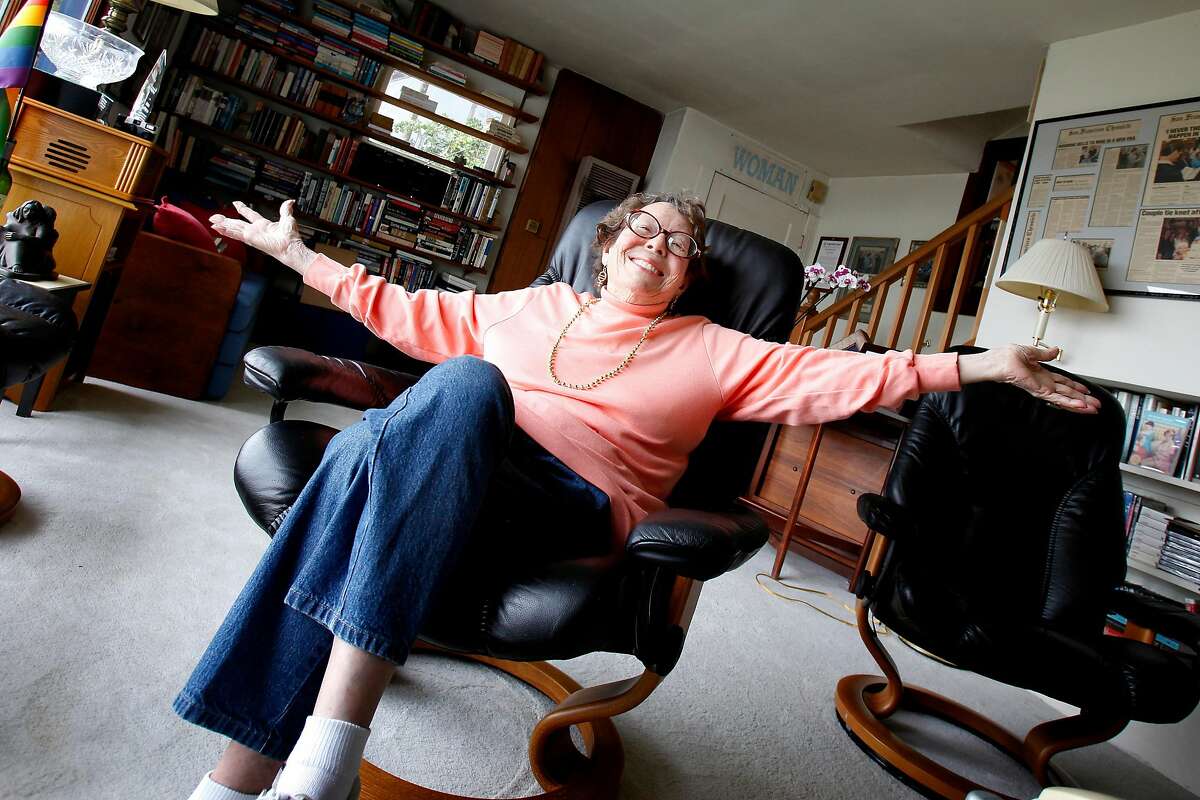
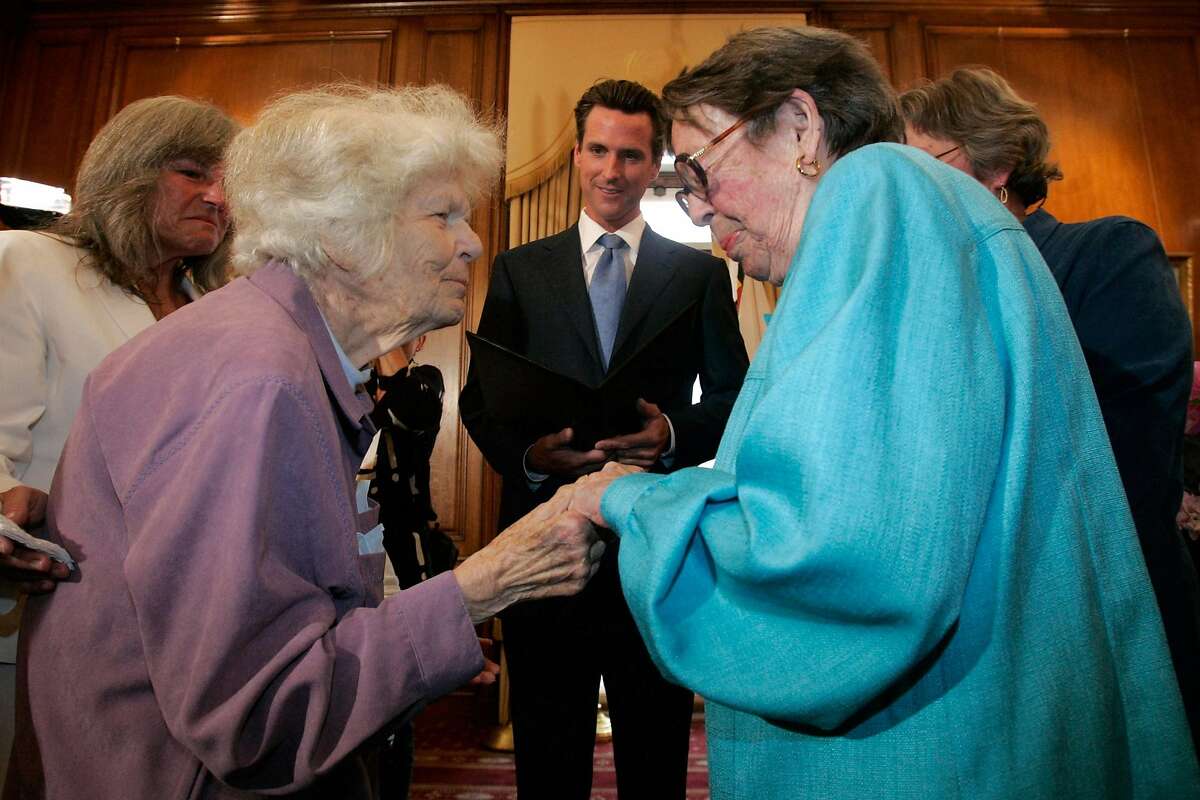
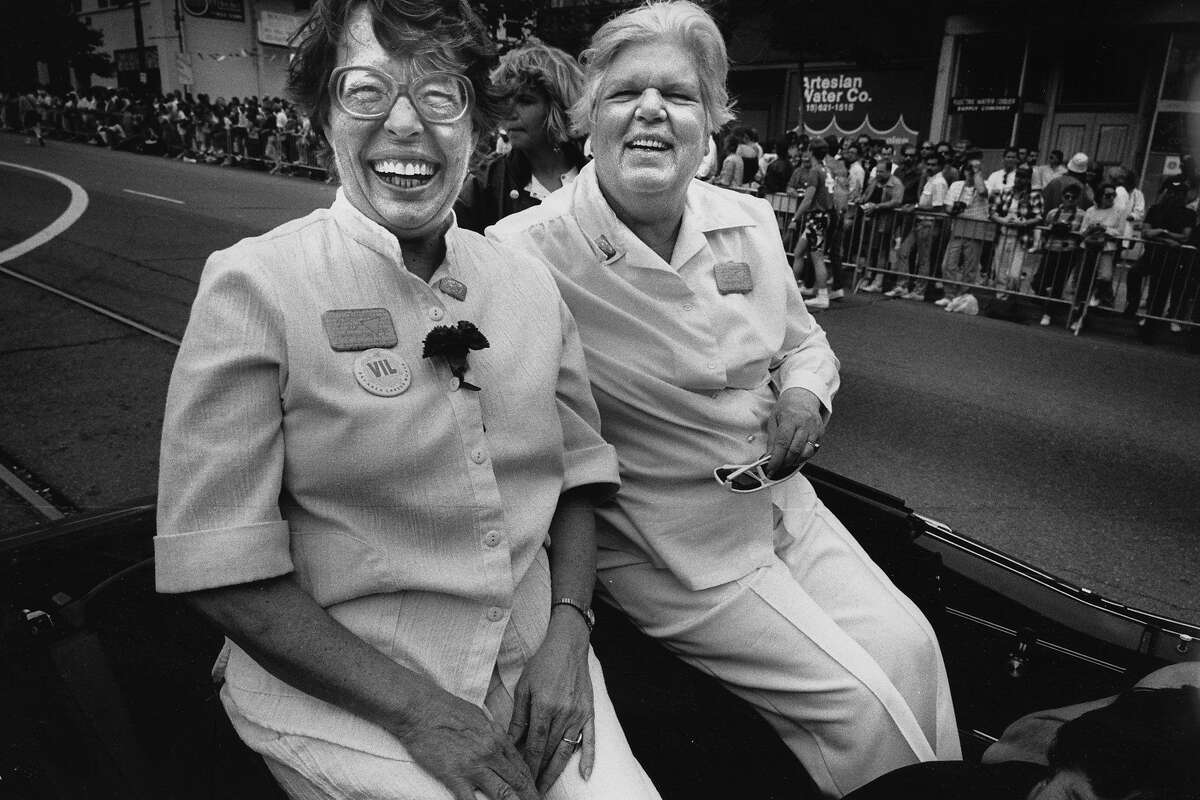
Phyllis Lyon, a lesbian activist who was relentless in her push for LGBTQ and women’s rights, and was rewarded for 50 years in the fight when she and her partner became the first same-sex couple to be legally wed in California, in 2008, died of natural causes Thursday morning at her San Francisco home.
Her death was confirmed by Kate Kendell, a close friend and former director of the National Center for Lesbian Rights. Lyon was 95.
Lyon and partner Del Martin co-founded the Daughters of Bilitis at their home on Duncan Street during the years of enforced invisibility for gay couples. The couple began publishing the Ladder, a typed newsletter produced monthly at their kitchen table and circulating nationally, which gave other groups the foundation on which to build a national movement.
In 1972, they published “Lesbian/Woman,” one of the first nonfiction books on the subject, also written at their kitchen table, in the same house where Martin lived until she died in 2008 two months after their marriage, and where Lyon died Thursday.
“We lost a giant today,” said state Sen. Scott Wiener, D-San Francisco. “Phyllis Lyon fought for LGBTQ equality when it was neither safe nor popular to do so. We owe Phyllis immense gratitude for her work. Rest in power.”
In a 2010 interview in The Chronicle, the 85-year-old Lyon told reporter Meredith May that she and Martin never intended to be the first gay couple married in San Francisco, when then-Mayor Gavin Newsom declared it to be legal in 2004.
“We thought marriage was a bad deal for women,” she told May. But Kendell had recruited them as the symbolic couple and they went along with it. “It meant so much to so many people that we decided it was what we were supposed to do,” Lyon said. “We only had two days to get ready.”
Four years later, they were recruited to be the first couple again, when the State Supreme Court ruled same-sex marriage to be legal.
“We wore the same suits, but we had to get the pants shortened. We’d shrunk,” Lyon told May. “Also by then, the benefits became obvious, like when Del died, there was no question about her insurance and inheritance. It all came to me, so that’s important.”
To Kendell, there could have been no other choice than for them to be the first gay people to be married — twice.
“Her life was marked by courage and the tenacious belief that the world must and could change,” she said. “Few individuals did more to advance women’s and LGBTQ rights than Phyllis Lyon.”
Phyllis Ann Lyon was born Nov. 10, 1924, in Tulsa, Okla. Her family moved to Sacramento, where she grew up, attending Sacramento High School. She graduated in 1946 from UC Berkeley, where she studied journalism and was editor of the Daily Californian student newspaper. After stints as a police reporter in Fresno and at the Chico Enterprise Record, Lyon was working at a magazine in Seattle when Martin got a job there.
“I peeked out of my office and saw her walking down the hall in a dark green suit, and she was carrying a briefcase,” Lyon told May. “I had never seen a woman with one before. I was impressed.”
Lyon left that job and was traveling when she met up with Martin, who had come to San Francisco to visit her parents. Martin took Lyon to a lesbian bar. They became partners in 1953 and bought a wood-and-glass house up a steep set of stairs in Noe Valley in 1955.
So began their life’s work in activism. They were “Phyllis and Del,” inseparable for the next 55 years. Lyon adopted and helped raise Martin’s daughter from her first marriage, Kendra Mon.
“They were very funny and they never interrupted each other like some couples do,” May said.
Lyon kept Martin’s ashes in a urn close at hand and told May that she still read out loud to her. There was plenty to read from. There were bookcases everywhere, books packed in with the overflow piled on the floor.
When the Rev. Cecil Williams arrived in 1963 as the minister of Glide Memorial United Methodist Church, Lyon was his first administrative assistant. Over the years, she helped bring the gay community to Glide, where they became a major part of the culture.
“She inspired Cecil to conduct same-sex unions in the 1960s,” said Glide co-founder Janice Mirikitani, noting that it was one of the first churches in the country to do so.
Lyon and Martin also became active in San Francisco’s first gay political organization, the Alice B. Toklas Democratic Club, which was a major factor in outlawing discrimination in hiring.
“Phyllis changed countless lives for the better,” Mayor London Breed said in a statement. “Through decades of organizing, activism, and writing, Phyllis helped advance civil rights protections, created robust support networks for LGBTQ people, and established political and advocacy organizations that continue her work to this day.”
Survivors include her sister, Patricia Lyon of Berkeley; daughter Kendra Mon of Santa Rosa; granddaughter Lorri Mon; and grandson Kevin Mon. A public memorial is pending.
Sam Whiting is a San Francisco Chronicle staff writer. Email: swhiting@sfchronicle.com Twitter: @SamWhitingSF
Sam Whiting
Follow Sam on: https://www.facebook.com/SFChronicle/samwhitingsf
Sam Whiting has been a feature writer at The San Francisco Chronicle for 30 years. He started in the People section, which was anchored by Herb Caen’s column, and has written about people ever since. For five years he had a weekly Sunday magazine column called Neighborhoods. He currently covers art, culture and entertainment for the Datebook section. He walks a minimum of three miles a day in San Francisco, searching out public art and street art for posting on Instagram @sfchronicle_art.

©2020 Hearst
Half a Century Later, the World Is Finally Catching Up With ‘2001: A Space Odyssey’
Kubrick’s sci-fi masterpiece set the bar extremely high for future filmmakers.
Variety|getpocket.com
- Owen Gleiberman

Photo courtesy of Warner Bros. Entertainment.
In the years since “2001: A Space Odyssey” was first released, on April 2, 1968, no movie has matched its solemnly jaw-dropping techno-poetic majesty. It’s still the grandest of all science-fiction movies, one that inspired countless adventures set in the inky vastness of deep space (notably “Star Wars”), remaking the DNA of cinema as we know it. It completed the transformation of Stanley Kubrick into “Stanley Kubrick,” and was greeted by critics with a mixture of ecstasy and derision (Pauline Kael: “a monumentally unimaginative movie”). But after its shaky original release, which resulted in Kubrick trimming 19 minutes out of it after opening weekend, “2001” was re-marketed as a psychedelic youth-generation cult film (“The Ultimate Trip”), and that’s how it finally caught on.
It remains such a staggering experience, so mind-bending and one-of-a-kind, that you’d be hard-pressed to think of a moment in the film that isn’t iconic. The awesome opening solar alignment, scored to the sweeping fanfare of “Thus Spoke Zarathustra,” which somehow comes to sound … extraterrestrial. The ape that picks up a bone and smashes down a weapon. The mystery of the monolith. The balletic spaceships twirling around Earth to “The Blue Danube.” The yellow eye — and softly perturbed voice — of HAL, the supercomputer that rivals human intelligence, and human ego too. HAL’s showdown with astronaut Dave Bowman (Keir Dullea), and the computer’s death scene, in which he sings “Bicycle Built for Two,” one of the most haunting moments in film history. The climactic light show that envelops the audience like a hurtling discotheque on acid, leading Dave through a wormhole of space-time, until he sees his ancient self reborn as a star child: a celestial infant baptized in technology.
In the last half century, “2001” has cast its shadow over more films and filmmakers than you can count. You can feel its influence not just in the kinetic grandeur of “Star Wars” — the famous opening shot is pure homage — but in the grit and dread of “Alien,” the transcendental thrust of “Blade Runner,” the floating-in-air playfulness of “Gravity.” You can feel it, as well, in the stoned camera stare of David Lynch, the mystic sprawl of Terrence Malick and the spatial-temporal virtuosity of Steven Spielberg. These are all, in their way, films and filmmakers that reach for the stars. (You could swear, as well, that Michael Jackson styled himself after the star child.)
And by the way: What did it all mean?
“2001” always forced you to ask that question. And it still does. Yet it’s a question that may now be a bit less confounding to answer, since Kubrick’s film, when you see it today, can be experienced as the prophecy of a world that’s only now just coming into existence.
By that, I don’t mean that the film’s vision of everyday space travel, a military moon colony or a future that looks like “The Jetsons” designed by Crate & Barrel turned out to be literally true. No, what’s shockingly prophetic about “2001” is that the film seems to be taking the pulse of the human race just as it’s getting ready to make the evolutionary leap that we, in the digital age, are now swimming in.
The movie isn’t really about space. Its grand theme is that technology can now mimic the intricacies of human feeling, because we humans now mediate — and experience — every aspect of our lives through technology. Transformed, like the apes, by the power of the monolith, we become, in the movie, vessels of intelligence searching for our humanity. Kubrick’s view of all this is both sinister and wide-eyed, ominous and, by the end, weirdly romantic. It’s as if the film were saying: “Relax, let the technology wash over you! Let it … remake you.” The U.S. space program is not what it once was, but in the Internet Age, the power of Kubrick’s vision thrives anew. That monolith now looks like a device designed by Apple. It’s the soul of a new machine.
“2001” wasn’t Stanley Kubrick’s first great film, but it was the first in which he gave himself over to a kind of trance state, achieving suspense by literally suspending the expectations of the audience. The astonishingly tactile and authentic visual effects have aged a bit, but they can still make your eyes pop. And the miracle of “2001” is that the movie, after half a century, still plays like a bulletin leaked from the future, a message to those of us on Earth from somewhere Out There.

This article was originally published on April 3, 2018, by Variety, and is republished here with permission.
FINDING JOE | Full Movie (HD) | Deepak Chopra, Robin Sharma, Rashida Jones, Sir Ken Robinson
Patrick Solomon The official full length version of FINDING JOE: A story about Joseph Campbell and The Hero’s Journey. Starring: Deepak Chopra Rashida Jones Robin Sharma Sir Ken Robinson Mick Fleetwood Brian Johnson Robert Walter Rebbecca Armstrong Alan Cohen Tony Hawk Laird Hamilton Gay Hendricks In the early 20th century, while studying world mythology, Joseph Campbell discovered a pattern hidden in every story ever told and he called it “The Hero’s Journey”. A truly inspirational film, FINDING JOE takes us on the ultimate hero’s journey: the journey of self discovery. As you slay dragons and uncover treasures, you just may find that the holy grail you seek is closer than you think. If you’ve seen this film then you know how much of an impact it could make in the world! A message from the Producer: “If you haven’t seen it then you are in for a treat! This is hope, courage and love all wrapped up in an 80 minute burrito of inspiration. I promise who ever you share this with thank you. Please share this with as many people as you can… the world needs this message now! With Maximum Love ~ Patrick Takaya Solomon”