“What is this thing that has happened to us? It’s a virus, yes. In and of itself it holds no moral brief. But it is definitely more than a virus.”
This is an excerpt of an essay called “Pandemic Is a Portal,” a selection from author Arundhati Roy’s forthcoming book Azadi: Freedom. Fascism. Fiction. (Haymarket, September 2020). The Man Booker Prize-winning Indian novelist (The God of Small Things, 1997) is a longtime activist for antiglobalization movements and an outspoken critic of U.S. foreign policy.
“Some believe it’s God’s way of bringing us to our senses. Others that it’s a Chinese conspiracy to take over the world.”
“Whatever it is, coronavirus has made the mighty kneel and brought the world to a halt like nothing else could. Our minds are still racing back and forth, longing for a return to ‘normality,’ trying to stitch our future to our past and refusing to acknowledge the rupture. But the rupture exists. And in the midst of this terrible despair, it offers us a chance to rethink the doomsday machine we have built for ourselves. Nothing could be worse than a return to normality.
“Historically, pandemics have forced humans to break with the past and imagine their world anew. This one is no different. It is a portal, a gateway between one world and the next. We can choose to walk through it, dragging the carcasses of our prejudice and hatred, our avarice, our data banks and dead ideas, our dead rivers and smoky skies behind us. Or we can walk through lightly, with little luggage, ready to imagine another world. And ready to fight for it.”
Feeling anxious about life in a broken-down society on a stressed-out planet? That’s hardly surprising: Life as we know it is almost over. While the dominant culture encourages dysfunctional denial—pop a pill, go shopping, find your bliss—there’s a more sensible approach: Accept the anxiety, embrace the deeper anguish—and then get apocalyptic.
We are staring down multiple cascading ecological crises, struggling with political and economic institutions that are unable even to acknowledge, let alone cope with, the threats to the human family and the larger living world. We are intensifying an assault on the ecosystems in which we live, undermining the ability of that living world to sustain a large-scale human presence into the future. When all the world darkens, looking on the bright side is not a virtue but a sign of irrationality.
In these circumstances, anxiety is rational and anguish is healthy, signs not of weakness but of courage. A deep grief over what we are losing—and have already lost, perhaps never to be recovered—is appropriate. Instead of repressing these emotions we can confront them, not as isolated individuals but collectively, not only for our own mental health but to increase the effectiveness of our organizing for the social justice and ecological sustainability still within our grasp. Once we’ve sorted through those reactions, we can get apocalyptic and get down to our real work.
Perhaps that sounds odd, since we are routinely advised to overcome our fears and not give in to despair. Endorsing apocalypticism seems even stranger, given associations with “end-timer” religious reactionaries and “doomer” secular survivalists. People with critical sensibilities, those concerned about justice and sustainability, think of ourselves as realistic and less likely to fall for either theological or science-fiction fantasies.
Many associate “apocalypse” with the rapture-ranting that grows out of some interpretations of the Christian Book of Revelation (aka, the Apocalypse of John), but it’s helpful to remember that the word’s original meaning is not “end of the world.” “Revelation” from Latin and “apocalypse” from Greek both mean a lifting of the veil, a disclosure of something hidden, a coming to clarity. Speaking apocalyptically, in this sense, can deepen our understanding of the crises and help us see through the many illusions that powerful people and institutions create.
But there is an ending we have to confront. Once we’ve honestly faced the crises, then we can deal with what is ending—not all the world, but the systems that currently structure our lives. Life as we know it is, indeed, coming to an end. Let’s start with the illusions: Some stories we have told ourselves—claims by white people, men, or U.S. citizens that domination is natural and appropriate—are relatively easy to debunk (though many cling to them). Other delusional assertions—such as the claim that capitalism is compatible with basic moral principles, meaningful democracy, and ecological sustainability—require more effort to take apart (perhaps because there seems to be no alternative).
“Apocalypse” need not involve heavenly rescue fantasies or tough-guy survival talk; to get apocalyptic means seeing clearly and recommitting to core values.
But toughest to dislodge may be the central illusion of the industrial world’s extractive economy: that we can maintain indefinitely a large-scale human presence on the earth at something like current First-World levels of consumption. The task for those with critical sensibilities is not just to resist oppressive social norms and illegitimate authority, but to speak a simple truth that almost no one wants to acknowledge: The high-energy/high-technology life of affluent societies is a dead end. We can’t predict with precision how resource competition and ecological degradation will play out in the coming decades, but it is ecocidal to treat the planet as nothing more than a mine from which we extract and a landfill into which we dump.
We cannot know for sure what time the party will end, but the party’s over.
Does that seem histrionic? Excessively alarmist? Look at any crucial measure of the health of the ecosphere in which we live—groundwater depletion, topsoil loss, chemical contamination, increased toxicity in our own bodies, the number and size of “dead zones” in the oceans, accelerating extinction of species, and reduction of biodiversity—and ask a simple question: Where are we heading?
Remember also that we live in an oil-based world that is rapidly depleting the cheap and easily accessible oil, which means we face a major reconfiguration of the infrastructure that undergirds daily life. Meanwhile, the desperation to avoid that reconfiguration has brought us to the era of “extreme energy,” using ever more dangerous and destructive technologies (hydrofracturing, deep-water drilling, mountaintop coal removal, tar sands extraction).
Oh, did I forget to mention the undeniable trajectory of global warming/climate change/climate disruption?
Scientists these days are talking about tipping points and planetary boundaries, about how human activity is pushing Earth beyond its limits. Recently 22 top scientists warned that humans likely are forcing a planetary-scale critical transition “with the potential to transform Earth rapidly and irreversibly into a state unknown in human experience,” which means that “the biological resources we take for granted at present may be subject to rapid and unpredictable transformations within a few human generations.”
That conclusion is the product of science and common sense, not supernatural beliefs or conspiracy theories. The political/social implications are clear: There are no solutions to our problems if we insist on maintaining the high-energy/high-technology existence lived in much of the industrialized world (and desired by many currently excluded from it). Many tough-minded folk who are willing to challenge other oppressive systems hold on tightly to this lifestyle. The critic Fredric Jameson has written, “It is easier to imagine the end of the world than to imagine the end of capitalism,” but that’s only part of the problem—for some, it may be easier to imagine the end of the world than to imagine the end of air conditioning.
We do live in end-times, of a sort. Not the end of the world—the planet will carry on with or without us—but the end of the human systems that structure our politics, economics, and social life. “Apocalypse” need not involve heavenly rescue fantasies or tough-guy survival talk; to get apocalyptic means seeing clearly and recommitting to core values.
Never in human history have potential catastrophes been so global; never have social and ecological crises of this scale threatened at the same time …
First, we must affirm the value of our work for justice and sustainability, even though there is no guarantee we can change the disastrous course of contemporary society. We take on projects that we know may fail because it’s the right thing to do, and by doing so we create new possibilities for ourselves and the world. Just as we all know that someday we will die and yet still get out of bed every day, an honest account of planetary reality need not paralyze us.
Then let’s abandon worn-out clichés such as, “The American people will do the right thing if they know the truth,” or “Past social movements prove the impossible can happen.”
There is no evidence that awareness of injustice will automatically lead U.S. citizens, or anyone else, to correct it. When people believe injustice is necessary to maintain their material comfort, some accept those conditions without complaint.
Social movements around race, gender, and sexuality have been successful in changing oppressive laws and practices, and to a lesser degree in shifting deeply held beliefs. But the movements we most often celebrate, such as the post-World War II civil rights struggle, operated in a culture that assumed continuing economic expansion. We now live in a time of permanent contraction—there will be less, not more, of everything. Pressuring a dominant group to surrender some privileges when there is an expectation of endless bounty is a very different project than when there is intensified competition for resources. That doesn’t mean nothing can be done to advance justice and sustainability, only that we should not be glib about the inevitability of it.
Here’s another cliché to jettison: Necessity is the mother of invention. During the industrial era, humans exploiting new supplies of concentrated energy have generated unprecedented technological innovation in a brief time. But there is no guarantee that there are technological fixes to all our problems; we live in a system that has physical limits, and the evidence suggests we are close to those limits. Technological fundamentalism—the quasi-religious belief that the use of advanced technology is always appropriate, and that any problems caused by the unintended consequences can be remedied by more technology—is as empty a promise as other fundamentalisms.
If all this seems like more than one can bear, it’s because it is. We are facing new, more expansive challenges. Never in human history have potential catastrophes been so global; never have social and ecological crises of this scale threatened at the same time; never have we had so much information about the threats we must come to terms with.
It’s easy to cover up our inability to face this by projecting it onto others. When someone tells me “I agree with your assessment, but people can’t handle it,” I assume what that person really means is, “I can’t handle it.” But handling it is, in the end, the only sensible choice.
Mainstream politicians will continue to protect existing systems of power, corporate executives will continue to maximize profit without concern, and the majority of people will continue to avoid these questions. It’s the job of people with critical sensibilities—those who consistently speak out for justice and sustainability, even when it’s difficult—not to back away just because the world has grown more ominous.
Adopting this apocalyptic framework doesn’t mean separating from mainstream society or giving up ongoing projects that seek a more just world within existing systems. I am a professor at a university that does not share my values or analysis, yet I continue to teach. In my community, I am part of a group that helps people create worker-cooperatives that will operate within a capitalist system that I believe to be a dead end. I belong to a congregation that struggles to radicalize Christianity while remaining part of a cautious, often cowardly, denomination.
I am apocalyptic, but I’m not interested in empty rhetoric drawn from past revolutionary moments. Yes, we need a revolution—many revolutions—but a strategy is not yet clear. So, as we work patiently on reformist projects, we can continue to offer a radical analysis and experiment with new ways of working together. While engaged in education and community organizing with modest immediate goals, we can contribute to the strengthening of networks and institutions that can be the base for the more radical change we need. In these spaces today we can articulate, and live, the values of solidarity and equity that are always essential.
To adopt an apocalyptic worldview is not to abandon hope but to affirm life. As James Baldwin put it decades ago, we must remember “that life is the only touchstone and that life is dangerous, and that without the joyful acceptance of this danger, there can never be any safety for anyone, ever, anywhere.” By avoiding the stark reality of our moment in history we don’t make ourselves safe, we undermine the potential of struggles for justice and sustainability.
As Baldwin put it so poignantly in that same 1962 essay, “Not everything that is faced can be changed; but nothing can be changed until it is faced.”
It’s time to get apocalyptic, or get out of the way.
ROBERT JENSENis an emeritus professor in the School of Journalism at the University of Texas at Austin and a founding board member of the Third Coast Activist Resource Center. He is the author of 11 books, most recently The End of Patriarchy: Radical Feminism for Men.
Craig Hamilton When it seems as if the world around us is falling apart, it’s important to stay rooted in a deep source of spiritual equanimity. This is one of several key “Spiritual Survival Skills” that I covered in my Facebook LIVE event: Spiritual Survival Skills for a World in Chaos. You can watch to the full talk here: https://www.youtube.com/watch?v=y_cO0…
Half a century before Walt Whitman considered what makes life worth living when a paralytic stroke boughed him to the ground of being, Mary Shelley (August 30, 1797–February 1, 1851) placed that question at the beating heart of The Last Man (free ebook | public library) — the 1826 novel she wrote in the bleakest period of her life: after the deaths of three of her children, two by widespread infectious diseases that science has since contained; after the love of her life, Percy Bysshe Shelley, drowned in a boating accident.
From that fathomless pit of sorrow, on the pages of a novel about a pandemic that begins erasing the human species one by one until a sole survivor — Shelley’s autobiographical protagonist — remains, she raised the vital question: Why live? By her answer, she raised herself from the pit to go on living, becoming the endling of her own artistic species — Mary Shelley outlived all the Romantics, composing prose of staggering poetic beauty and singlehandedly turning her then-obscure husband into the icon he now is by her tireless lifelong devotion to the posthumous editing, publishing, and glorifying of his poetry.
Shelley had set her far-seeingFrankenstein, written a decade earlier, a century into her past; she sets The Last Man a quarter millennium into her future, in the final decade of the twenty-first century, culminating in the year 2092 — the tricentennial of her beloved’s birth.
Mary Shelley. Art from Literary Witches — an illustrated celebration of trailblazing women writers who have enchanted and transformed the world.
The novel’s narrator, Lionel Verney — an idealistic young man, more porous than most to both the deepest suffering of living and the most transcendent beauty of life — is the closest Mary Shelley, stoical and guarded, came to painting a psychological self-portrait. As the pandemic sweeps the world and vanquishes his loved ones one by one, Shelley’s protagonist returns home to seek safety “as the storm-driven bird does [to] the nest in which it may fold its wings in tranquillity.” There, in the strange stillness, stripped of the habitual busynesses and distractions of social existence, he finds himself contemplating the essence of life:
How unwise had the wanderers been, who had deserted [the nest’s] shelter, entangled themselves in the web of society, and entered on what men of the world call “life,” — that labyrinth of evil, that scheme of mutual torture. To live, according to this sense of the word, we must not only observe and learn, we must also feel; we must not be mere spectators of action, we must act; we must not describe, but be subjects of description. Deep sorrow must have been the inmate of our bosoms… sickening doubt and false hope must have chequered our days… Who that knows what “life” is, would pine for this feverish species of existence? I have lived. I have spent days and nights of festivity; I have joined in ambitious hopes…: now — shut the door on the world, and build high the wall that is to separate me from the troubled scene enacted within its precincts.
In consonance with Whitman — “After you have exhausted what there is in business, politics, conviviality, love, and so on — have found that none of these finally satisfy, or permanently wear — what remains?” the American poet would ask across space and time, then answer: “Nature remains.” — Shelley’s protagonist finds the meaning of life not in the whirlwind of the human-made world with its simulacra of living but in the simple creaturely presence with nature’s ongoing symphony of life:
Let us… seek peace… near the inland murmur of streams, and the gracious waving of trees, the beauteous vesture of earth, and sublime pageantry of the skies. Let us leave “life,” that we may live.
First Signal by Maria Popova
At the height of the deadly pandemic, nature seems all the more quietly determined to affirm the resilience of life — spring arrives with its irrepressible bursts of beauty, untrammeled by human suffering and a supreme salve for it. It is by observing nature’s unbidden delirium in its littlest expression, by surrendering to its sweep, that Lionel regains his faith not only in survival but in the beauty, the worthiness of life.
Winter passed away; and spring, led by the months, awakened life in all nature. The forest was dressed in green; the young calves frisked on the new-sprung grass; the wind-winged shadows of light clouds sped over the green cornfields; the hermit cuckoo repeated his monotonous all-hail to the season; the nightingale, bird of love and minion of the evening star, filled the woods with song; while Venus lingered in the warm sunset, and the young green of the trees lay in gentle relief along the clear horizon.
From this open presence with the non-human world, Shelley’s protagonist extracts the essence of what it means to be human:
There is but one solution to the intricate riddle of life; to improve ourselves, and contribute to the happiness of others.
Mary Shelley
Complement with Rebecca Elson’s stunning poem “Antidotes to Fear of Death,” Shelley’s contemporary Elizabeth Barrett Browning — a trailblazing poet who was dealt an inordinate share of suffering and who made of it inordinate beauty — on what makes life worth living, and the story of how young Isaac Newton’s plague quarantine fomented humanity’s greatest leap in science, then revisit the gorgeous advice on life Shelley’s mother, the trailblazing political philosopher and founding feminist Mary Wollstonecraft, never lived to give her daughter, having died in giving her birth.
Dr Rashid A Buttar Please listen to this urgent message and call-to-action. Make sure to take this action every time the clock hit’s 11:00 am and 11:00 pm in your own time zone, for the next 48 hours, for a total of 4 times in the next 48 hours. And please, share this with ALL your friends, family and loved ones. Ask them to do the same thing, and ask them to pass this on and pay it forward. With gratitude and blessings!
Elle est à toi cette chanson Toi l’Auvergnat qui, sans façon, M’a donné quatre bouts de bois Quand dans ma vie il faisait froid.
Toi qui m’a donné du feu quand Les croquantes et les croquants Tous les gens bien intentionnés M’avaient fermés la porte au nez.
Ce n’était rien qu’un feu de bois Mais il m’avait chauffé le corps Et dans mon âme, il brûle encore À la manière d’un feu de joie…
Toi, l’Auvergnat quand tu mourras Quand le croc-mort t’emportera Qu’il te conduise à travers ciel Au père éternel.
Elle est à toi cette chanson Toi l’hôtesse qui, sans façon, M’a donné quatre bouts de pain Quand dans ma vie il faisait faim.
Toi qui m’ouvrit ta huche quand Les croquantes et les croquants Tous les gens bien intentionnés S’amusaient à me voir jeuner.
Ce n’était rien qu’un peu de pain Mais il m’avait chauffé le corps Et dans mon âme, il brûle encore À la manière d’un grand festin…
Toi, l’hôtesse quand tu mourrasQuand le croc-mort t’emportera Qu’il te conduise à travers ciel Au père éternel.
Elle est à toi cette chanson Toi l’étranger qui, sans façon, D’un air malheureux m’a sourit Lorsque les gendarmes m’ont pris.
Toi qui n’a pas applaudi quand Les croquantes et les croquants Tous les gens bien intentionnés Riaient de me voir rammené.
Ce n’était rien qu’un peu de miel Mais il m’avait chauffé le corps Et dans mon âme, il brûle encore À la manière d’un grand soleil…
Toi, l’étranger quand tu mourras Quand le croc-mort t’emportera Qu’il te conduise à travers ciel To God eternal.
Song for the man from the Auvergne It is for you this little songMan of Auvergne who without fuss,Once gave to me four bits of woodWhen in my life there was real cold. You who gave fire to warm me whenStaid members of the upper crustAll the people with good intentHad slammed their doors shut in my face. It was merely a fire of sticksBut it had warmed my body throughAnd in my soul it burns on stillIn the way a bonfire would do.
You man from Auvergne, when you dieWhen the mortician bears you offMay he take you across heaven,To the God everlasting. It is for you this little songYou the hostess who, without fuss,Once gave to me four bits of breadWhen in my life there was hunger . You who opened your larder whenStaid members of the upper crustAll the people with good intentEnjoyed seeing me go without. It was merely a bit of breadBut it had warmed my body throughAnd in my soul, it burns on stillIn the way a great feast would do. You, the hostess, when you will dieWhen the mortician bears you off,May he take you across heaven,To God everlasting. It is for you this little songYou, the stranger, who, without fuss,Looking dejected, smiled at me,When the policemen took me off. You who didn’t join the applause whenStaid members of the upper crustAll the people with good intentLaughed to see me be led away. T’was merely a touch of honeyBut it had warmed my body throughAnd in my soul it burns on stillIn the way bright sunshine would do … You, the stranger, when you will dieWhen the mortician bears you offMay he take you across heaven,To God everlasting.
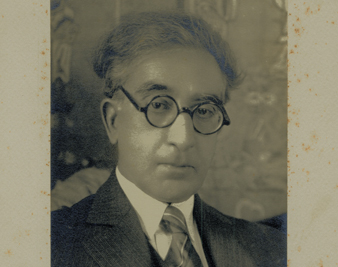
The poet Constantine Cavafy was a cosmopolitan by both birth and inclination. His parents were Constantinople Greeks of what was then known as “good family”; by the time their youngest son was born in 1863, they were settled in Alexandria, Egypt, prosperous pillars of a thriving community. But after his father’s death in 1870, the family fortunes failed and Cavafy’s mother took her sons to live for a few years near her late husband’s relatives in Liverpool and London. (It’s said that afterward Cavafy’s Greek retained a faint English inflection.) The dimly remembered life of parties and servants was gone; in the early 1880s the British bombardment of Alexandria destroyed the family home. By the time the novelist E.M. Forster met Cavafy in 1918, he was living in a small apartment on the run-down Rue Lepsius. Alexandria, wrote Forster, “founded upon cotton with the concurrence of onions and eggs,” was “scarcely a city of the soul.”
For Cavafy, it was home. Living outside the young Greek state among Egyptians, Greeks and Jews, he could remain committed to a fading, idealized Hellenism free from the crude taint of nationalism and borders. He told Forster that the Greeks and the English were almost exactly alike, except for one crucial difference: “We Greeks have lost our capital–and the results are what you see. Pray, my dear Forster, oh pray, that you never lose your capital.”
By “capital” he meant both Constantinople and a less tangible inheritance, one that lies close to the bone of his precise and parsimonious work. All his life, he was drawn to what was lost: forgotten Greek kingdoms on the edge of the Roman empire, backwaters of Byzantium, beautiful boys glimpsed once or briefly held and never seen again. “The memory of that long and haphazard pursuit,” writes Daniel Mendelsohn,
speaks of a certain kind of relation to the rest of the world: experience rejected in favor of remembrance, the center rejected in favor of the margin. A sense of the beautiful hovering just beyond your reach, to be reflected upon and considered. The reflection becomes, in its own way, another kind of possessing.
Or, to transpose that feeling to the political realm,
Here was a culture…that had created a great romance out of a great defeat, a civilization that had been able to endure loss and real privation because it believed in its own myth of lost beauty, the possession of which, however brief and long ago, elevated the lovely and effete vanquished far above the crass, practical victors.
These Cavafian meditations are not from Mendelsohn’s excellent introduction to the Collected Poems (which he has translated with a slim volume of unfinished work, appearing here for the first time in English) but from his graceful memoir The Elusive Embrace, published ten years ago. The first passage glosses an early pursuit of Mendelsohn’s own; the second describes not Greece but the American South, where Mendelsohn studied classics as an undergraduate. (His family memoir, The Lost, evokes another vanished world, that of his European relatives who died in the Holocaust.) Together, they begin to suggest why this eloquent critic felt compelled to learn modern Greek and to enter as deeply as he could into Cavafy’s world of stoic longing and elusive memory, intense desire and cool, appraising intellection.
Cavafy did not publish a book in his lifetime; he preferred to distribute his poems to a few close friends in pamphlets printed at his own expense, partly in order to avoid the corruptions of the marketplace. But long before Forster “discovered” him, he was consciously writing in a cosmopolitan tradition. As well as Robert Browning, whose dramatic monologues inform Cavafy’s own, Tennyson, Keats, Wilde, Emerson and Whitman all left traces in his work; Baudelaire and the French Parnassians were another important influence. After Cavafy’s death in 1933, his sensibility began to color the work of other poets, among them Auden, Brecht, Brodsky, Milosz and Montale, as well as the Americans Robert Hass, Louise Glück, James Merrill, Rachel Hadas and Mark Doty. It was Auden who brought Cavafy’s work to a broad American readership by introducing Rae Dalven’s translation of the Complete Poems in 1961: “I can think of poems,” he wrote, “which, if Cavafy were unknown to me, I should have written quite differently, or perhaps not written at all.” The first edition of what became the canonical English Cavafy, a clean, transparent Collected Poems translated by Edmund Keeley and Philip Sherrard, appeared in 1975. The past five years have produced a flurry of new versions, by Aliki Barnstone, Alan Boegehold, Stratis Haviaras, Evangelos Sachperoglou and Avi Sharon. Why, then, do we need another?
Mendelsohn’s answer is “to restore the balance,” by which he means, to restore Cavafy’s particularity. Previous translations have often aimed to make his work accessible by drawing out what appears universal in it; Mendelsohn wants to deepen and complicate–to make Cavafy less our contemporary and more his own, sometimes abstruse and often enigmatic Alexandrian self. Cavafy’s best-known work in English falls into two groups. There are the few great “philosophical” poems (“The City,” “Waiting for the Barbarians,” “Ithaca”), which seem to contain a message and which lend themselves to anthologizing and occasional use. Then there are the poems of desire, startlingly modern in their intimacy and vulnerability. Here is the end of “On the Stairs,” from 1904, which Mendelsohn translates with a hint of Whitman’s rhythms:
And yet the love you wanted, I had to give you; the love I wanted–your eyes told me so, tired and suspicious–you had it to give me. Our bodies sensed and sought each other out; our blood and skin understood. But we hid from each other, we two, terrified.
In these poems men exchange glances on the street or in shops, where their hands touch furtively over the merchandise. They wait for their lovers in bars; feel jealousy or shame; fall on disheveled beds, “flawlessly beautiful”; remember, later, after years have passed, “The body’s lines. Red lips. Limbs made for pleasure.” Many of them are dead before their time, like the Homeric heroes whose beauty haunts their bearing, or otherwise lost to the poet. They may be wealthy, living in Hellenistic or early Byzantine times, like Cleitus, whose old nurse prays to the pagan gods to save him from a fever: “The foolish woman/doesn’t realize that it matters little to the black demon/whether a Christian is or isn’t cured.” They may be working class, in “threadbare clothes” and “workshoes split apart.” Or they are classless, timeless, as plausibly New Yorkers of the twenty-first century as they are Alexandrians of the late nineteenth. From “In the Street”:
His appealing face, somewhat pallid; his chestnut eyes, looking tired; twenty-five years old, but looks more like twenty; with something artistic about his clothes –something in the color of the tie, the collar’s shape– aimlessly he ambles down the street, as if still hypnotized by the illicit pleasure, by the very illicit pleasure he has had.
Mendelsohn is at his best as a translator of these poems, rescuing them from the slight coyness that dogged earlier versions with a voice as tender and forthright as Cavafy’s own. (This is not an easy task. Some of Cavafy’s favorite words have no good English equivalent. Idoni, from which we get “hedonism,” is deeper and richer than “pleasure”; aisthitikos combines refinement, sensuality and beauty with a faint hint of the consciously decorative.) Rightly, though, Mendelsohn wants his readers to look beyond Cavafy as gay icon avant la lettre and comprehend his whole artistic project, which “holds the historical and the erotic in a single embrace.”
Cavafy was approaching 50 before he published an overtly homoerotic poem. His idealized men and boys appear, at first, as art: sculpted in Parian marble (“The Retinue of Dionysus”), etched on a coin (“Orophernes”), conjured from stone and dream (“Sculptor From Tyana”), immured in marble tombs. Or they are mere suggestions, invisible interlocutors: many poems are written in the second person or as dramatic monologues, implicating the reader. Taking shape as stone or voice but not (yet) flesh, the objects of his longing are shadowy presences. The moment of fullness, triumph, consummation is always skirted or longed for; remembered, short-lived, doomed. This is as true in history as it is in love. Cavafy describes the battle of Actium from the point of view of a peddler knocked down by the crowd (“The Year 31 B.C. in Alexandria”) and sets a swaggering poem about Alexander’s triumphs at the moment when the Greek kingdoms are about to fall to Rome (“In 200 B.C.”). Poems that savor memories of love are interspersed with historical ones that hinge on hindsight’s ironies. Love fails and kingdoms fall; young men grow cold in graves. In the act of arresting time, art makes death visible.
Cavafy called himself a poietes historikos: a poet-historian, or historical poet. It was through history that he found a way of writing openly about his desire and escaping the cul-de-sac of pure aestheticism. Cavafy’s daily life was urban, indoor and narrow. For more than thirty years he worked as a clerk in the Egyptian government’s Third Circle of Irrigation; he had dinner each night with his mother, the imposing Harikleia, until her death in 1899. Though he was an Alexandrian to the end, the modern Egyptian city is not explicitly present in his work except, perhaps, in the poems of desire and in “Sham-el-Nessim,” an early, repudiated work about a spring festival. Two poems, “Walls” and “The Windows,” suggest a sense of confinement imposed from the outside: “Without pity, without shame, without consideration/they’ve built around me enormous, towering walls.”
Yet that confinement–whether one reads it as a metaphor for the closet, exile, provincial ennui, historical belatedness or textual frustration–also helped to shape Cavafy’s poetic strategy. With the breadth of contemporary life shut out, he could concentrate on the long corridor of time and its play of ironies. As Edward Said observed, even in “Ithaca,” the quintessential poem of possibility, which praises the delights of the journey over the destination, the pleasures are all specified in advance:
may you stop at Phoenician trading posts and there acquire the finest wares: mother-of-pearl and coral, amber and ebony, and heady perfumes of every kind
Having already made his voyage, the speaker knows what it is to arrive at the disappointing end, to understand with the cool wisdom of age “what these Ithacas mean.” (Or, as Mendelsohn rather oddly has it, following the Greek word order, “these Ithacas; what they mean.”) The poem’s sensual pleasures are both spiced and softened by hindsight, and by the suggestion of regret in the repeated phrase “hope that the road is a long one.” And that regret, in turn, deepens the note of subtle tenderness in the older man’s advice.
It is this combination of honesty and sympathy that underpins and complicates Cavafy’s historical ironies. As Mendelsohn explains in his introduction and exhaustive notes (which parse the most difficult poems for those of us who can’t tell our Lagids from our Seleucids), Cavafy’s mature poetry owes much to his engagement with two very different historians: the Enlightenment Englishman Edward Gibbon, whose Decline and Fall of the Roman Empire took a dim view of Byzantium and Christianity, and the Greek romantic nationalist Konstantinos Paparrigopoulos, whose work constructs a line of Greek identity from ancient times to the modern nation-state. The poems set in doomed Hellenistic kingdoms on the outskirts of Roman power, or in the Byzantium of Julian the Apostate (an early emperor who tried to restore the Olympian gods), or in distant provinces where petty officials pride themselves on their Greek (“unhellenized we are not, I rather think”)–all these press delicately against the bruise of Greek decline while seeing, with Gibbon, its inevitability. At the same time, they keep in view the crude and ephemeral nature of all temporal power, a source of both consolation and regret.
In his best historical poems Cavafy maintains a scrupulous suspension, so that each reading suggests a different balance of insight and empathy. Is he describing self-delusion or heroism? Artistry or conceit? Often the ambiguity emerges at the point where public identities blur. In “Darius,” the poet Phernazes is writing an epic in Greek about the Persian ancestor of his own Hellenized king, somewhere in Asia Minor. As he tries to imagine Darius’ feelings on seizing the Persian throne (“arrogance and intoxication, perhaps; but no–more/like an awareness of the vanity of grandeur”), he hears that war with the Romans has begun. In the instant of danger he becomes neither Greek nor Persian but Cappadocian, rooted in his local world: “Great gods, protectors of Asia, help us.” And yet his epic rhetoric has its own gravitational pull: with the enemy at the gate, “arrogance and intoxication” suddenly seems the more appealing choice. The inconclusive flickering of personal ambition, political interest, local allegiance and anxiety is made visible here at the moment when power shifts.
Cavafy’s interest in equivocal identities also, of course, reflects his own experience as a Greek in Alexandria and as a homosexual raised in the Orthodox Church, whose pagan ancestors once valued same-sex love. The pain of double loyalties stands out in some of the poems about young men’s deaths, where history and desire most obviously clasp hands. In the beautifully translated “Myres: Alexandria in 340 A.D.,” we overhear the thoughts of a young pagan who has gone to the house of his dead Christian friend and stands, as boys so often do in Cavafy, out in the corridor, watching the preparations for the funeral. By the end, Christianity has become death’s threatening accomplice:
Vaguely I had the feeling that Myres was going far away from me; had a feeling that he, a Christian, was being united with his own, and that I was becoming a stranger to him, very much a stranger… I flew out of their horrible house, and quickly left before their Christianity could get hold of, could alter, the memory of Myres.
Myres has many cousins: Ianthes, the Alexandrian Jew who cannot help but give himself to Hellenism (“Of the Jews”); Leucius, whose half-eroded tombstone mentions both Jesus Christ and the Egyptian month of Hathor (“In the Month of Hathor”); and Ammon the Egyptian poet, dead at 29 in the year 610, whose friend commissions a Greek epitaph for him (“For Ammon”). Mendelsohn’s version of this last poem captures the speaker’s half-articulate longing:
Your Greek is always beautiful and musical. But now we want all of your craftsmanship. Into a foreign tongue our pain and love are passing. Pour your Egyptian feeling into a foreign tongue. Raphael, your verses should be written so that they have, you know, something of our lives within them, so that the rhythm and every phrasing makes it clear that an Alexandrian is writing of an Alexandrian.
“For Ammon” is partly about translation’s impossibility, which is also a metaphor for the way words can’t hold life: the “foreign tongue” (in this case, Greek) itself becomes Ammon’s tomb. As a poet who lived in several languages, Cavafy knew this well; Mendelsohn feels it, too. Writing about mirrors in The Elusive Embrace, he thinks of Catullus’ (heterosexual, Latin) version of Sappho (bisexual, Greek): “If you hold Catullus up to Sappho, an infinitely long corridor of reflections opens up. If you lose yourself in it, you can learn something about desire.” Translation is the most intimate form of criticism, requiring you to inhabit another’s verbal skin, try out his gestures, guess how he would move if your mother tongue were his.
Mendelsohn wants nothing less than Ammon’s friend: to offer, “as much as possible, a Cavafy who looks, feels, and sounds in English the way he looks, feels, and sounds in Greek,” which means translating meter as well as meaning. Dalven, Keeley and Sherrard dispensed with rhyme and made Cavafy sound modern; Forster announced in an essay that Cavafy didn’t use rhyme at all. Until now, only the early versions by John Mavrogordato and the poet’s brother John (worth reading, and available on the website of the Cavafy Archive: cavafy.com) tried extensively to reproduce the poet’s formal choices. Mendelsohn analyses them in detail in his introduction and sometimes manages to find English approximations–for instance in “Walls,” where rhymes (in Greek, homophonous line endings) add to the feeling of being trapped, or in the Symbolist-influenced poem “Chandelier,” where blazing candles evoke the bliss and danger of consuming passion:
The light that appears is no ordinary light. The pleasure of this heat has not been fashioned for bodies that too easily take fright.
Mendelsohn also appreciates Cavafy’s subtle use, in almost every poem, of Greek’s different registers–the formal katharevousa, or purified tongue, invented by Enlightenment scholars, and the colloquial demotic–and does his best to find English equivalents: Latinate words and formal syntax versus Anglo-Saxon phrases.
But every translation involves inevitable loss. Some of my reservations about Mendelsohn’s are admittedly pedantic, and wouldn’t arise had he not set the bar so high. History is visible inside the Greek language like gradations of blue in deep water; the very useful division into formal and demotic can’t quite account for that continuity. As a classicist, Mendelsohn tends to favor the root meanings of words, many of which have changed over the centuries, rather than the medieval or modern ones. Often this is enriching; sometimes, though, it seems unnecessarily fussy. In the great poem “The God Abandons Antony,” the painful, ordinary word apetychan (“failed”) is rendered as “ill-starred” because its root is tychi, “luck” or “fortune”; something of the poem’s pathos is diminished. Not surprisingly, he is also less attuned to Cavafy’s Byzantine resonances. A meter Cavafy favors in which short half-lines are vertically broken by white space is not just “jaunty,” as Mendelsohn puts it (following, to be fair, the Greek poet George Seferis, who called it a “tango” rhythm), but also evocative of the Orthodox liturgy, adding a further twist to Cavafy’s ironies.
A larger problem, for me, has to do with Mendelsohn’s ear for English iambic rhythms. Music, as he acknowledges, was vital for Cavafy, whose Greek iambs have such fluency that early critics dismissed him as prosaic. At times, Mendelsohn catches this perfectly, as in his version of the short poem “Voices,” which is the best I’ve read:
Imagined voices, and beloved, too, of those who died, or of those who are lost unto us like the dead.
Sometimes in our dreams they speak to us; sometimes in its thought the mind will hear them.
And with their sound for a moment there return sounds from the first poetry of our life– like music, in the night, far off, that fades away.
Elsewhere, though, the lines seem to limp and trip–like the last line of “Ithaca”–often because they stay too close to Cavafy’s syntax. Here, for example, is the last stanza of “Sculptor From Tyana”:
But this work here is my favorite of all, which I made with the greatest care and deep feeling: him, one warm day in summer when my thoughts were ascending to ideal things, him I stood dreaming here, the young Hermes.
The natural stress of the words (“favorite of all,” “deep feeling,” “young Hermes”) pushes against the meter in a way that contributes nothing to the sense; Cavafy’s metrical variations are precisely placed, reflecting the sculptor’s slightly nervous efforts to impress the visitors he is showing around his studio. In Greek it is common to begin a sentence with an accusative pronoun (“him”) for emphasis, and “dream” is often used as a transitive verb; in English both feel awkward and undermine the suggestion at the poem’s close that the sculptor’s feelings soar before the image of his desire. As an inflected language, Greek has a very variable and expressive word order, which means quite differently from word order in English; to reproduce it literally only flattens the English verse and makes the poem seem construed rather than reimagined. Cavafy’s delicately delineated characters–confections of tone and nuance, allusion and elision–don’t always survive their journey into a foreign tongue.
Mendelsohn’s may not be a great poet’s Cavafy. (For a hint of what that could be like, read the small handful of translations by James Merrill, first published in Grand Street in 1987.) But it is perhaps the next best thing: the Cavafy of a brilliant critic who has a true and deep affinity for the poet–and who has succeeded in giving him to us whole for the first time. Somewhere, in some neo-Platonic heaven, the Greek and English tongues may touch in a more perfect union. In the meantime, as the Alexandrian knew so well, every great labor carries its flaws within it. And if that labor was undertaken for love, as this one surely was, they are all the more poignant and forgivable.