Bitches offended by my sex appeal. I’m not a snack, nigga, I am a meal.
–Megan Thee Stallion
Megan Jovon Ruth Pete, known professionally as Megan Thee Stallion, is an American rapper, singer and songwriter. She released the EP Tina Snow in June 2018. She signed to 300 Entertainment in November 2018, making her the first female rapper on the label. Wikipedia
“To begin depriving death of its greatest advantage over us, let us adopt a way clean contrary to that common one; let us deprive death of its strangeness, let us frequent it, let us get used to it; let us have nothing more often in mind than death… We do not know where death awaits us: so let us wait for it everywhere.”
“To practice death is to practice freedom. A man who has learned how to die has unlearned how to be a slave.”
― Michel de Montaigne
Michel Eyquem de Montaigne, Lord of Montaigne (February 28, 1533 – September 13, 1592) was one of the most significant philosophers of the French Renaissance, known for popularizing the essay as a literary genre. His work is noted for its merging of casual anecdotes and autobiography with intellectual insight. Wikipedia
Basing her analysis on explosive little-known facts, Shiva exposes the model of philanthrocapitalism, which is about deploying unaccountable money to bypass democratic structures, derail diversity, and impose totalitarian ideas, based on One Science, One Agriculture and One History. She calls for a resurgence of real knowledge..so that people can reclaim their right to Live Free, Think Free, Breathe Free, Eat Free.
Our guest is Vandana Shiva, a world-famous environmental activist from India. Her latest book is entitled “One Earth, One Humanity vs. the 1%”. She tell us about more her opposition to big multinationals such as Monsanto for their nefarious influence on agriculture. But Shiva also singles out billionaires like Bill Gates and Mark Zuckerberg for criticism. “When Bill Gates pours money into Africa for feeding the poor in Africa and preventing famine, he’s pushing the failed Green Revolution, he’s pushing chemicals, pushing GMOs, pushing patterns”, she tells FRANCE 24’s Marc Perelman.
Covid-19 is killing off the myth that we are the greatest country on earth.
By Viet Thanh Nguyen
Contributing Opinion Writer
April 10, 2020 (NYTimes.com)
Credit…Demetrius Freeman for The New York Times
Sometimes people ask me what it takes to be a writer. The only things you have to do, I tell them, are read constantly; write for thousands of hours; and have the masochistic ability to absorb a great deal of rejection and isolation. As it turns out, these qualities have prepared me well to deal with life in the time of the coronavirus.
The fact that I am almost enjoying this period of isolation — except for bouts of paranoia about imminent death and rage at the incompetence of our nation’s leadership — makes me sharply aware of my privilege. It is only through my social media feeds that I can see the devastation wreaked on people who have lost their jobs and are worried about paying the rent. Horror stories are surfacing from doctors and nurses, people afflicted with Covid-19, and those who have lost loved ones to the disease.
Many of us are getting a glimpse of dystopia. Others are living it.
If anything good emerges out of this period, it might be an awakening to the pre-existing conditions of our body politic. We were not as healthy as we thought we were. The biological virus afflicting individuals is also a social virus. Its symptoms — inequality, callousness, selfishness and a profit motive that undervalues human life and overvalues commodities — were for too long masked by the hearty good cheer of American exceptionalism, the ruddiness of someone a few steps away from a heart attack.
Even if America as we know it survives the coronavirus, it can hardly emerge unscathed. If the illusion of invincibility is shredded for any patient who survives a near-fatal experience, then what might die after Covid-19 is the myth that we are the best country on earth, a belief common even among the poor, the marginal, the precariat, who must believe in their own Americanness if in nothing else.
Perhaps the sensation of imprisonment during quarantine might make us imagine what real imprisonment feels like. There are, of course, actual prisons where we have warehoused human beings who have no relief from the threat of the coronavirus. There are refugee camps and detention centers that are de facto prisons. There is the economic imprisonment of poverty and precariousness, where a missing paycheck can mean homelessness, where illness without health insurance can mean death.
But at the same time, prisons and camps have often served as places where new consciousnesses are born, where prisoners become radicalized, become activists and even revolutionaries. Is it too much to hope that the forced isolation of many Americans, and the forced labor of others, might compel radical acts of self-reflection, self-assessment and, eventually, solidarity?
A crisis often induces fear and hatred. Already we are seeing a racist blowback against Asians and Asian-Americans for the “Chinese virus.” But we have a choice: Will we accept a world of division and scarcity, where we must fight over insufficient resources and opportunities, or imagine a future when our society is measured by how well it takes care of the ill, the poor, the aged and the different?
As a writer, I know that such a choice exists in the middle of a story. It is the turning point. A hero — in this case, the American body politic, not to mention the president — is faced with a crucial decision that will reveal who he or she fundamentally is.
We are not yet at the halfway point of our drama. We have barely made it to the end of the first act, when we slowly awaken to the threat coming our way and realize we must take some kind of action. That action, for now, is simply doing what we must to fight off Covid-19 and survive as a country, weakened but alive.
The halfway point comes only when the hero meets a worthy opponent — not one who is weak or marginal or different, but someone or something that is truly monstrous. Covid-19, however terrible, is only a movie villain. Our real enemy does not come from the outside, but from within. Our real enemy is not the virus but our response to the virus — a response that has been degraded and deformed by the structural inequalities of our society.
America has a history of settler colonization and capitalism that ruthlessly exploited natural resources and people, typically the poor, the migratory, the black and the brown. That history manifests today in our impulse to hoard, knowing that we live in an economy of self-reliance and scarcity; in our dependence on the cheap labor of women and racial minorities; and in our lack of sufficient systems of health care, welfare, universal basic income and education to take care of the neediest among us.
What this crisis has revealed is that, while almost all of us can become vulnerable — even corporations and the wealthy — our government prioritizes the protection of the least vulnerable.
If this was a classic Hollywood narrative, the exceptionally American superhero, reluctant and wavering in the first act, would make the right choice at this turning point. The evil Covid-19 would be conquered, and order would be restored to a society that would look just as it did before the villain emerged.
But if our society looks the same after the defeat of Covid-19, it will be a Pyrrhic victory. We can expect a sequel, and not just one sequel, but many, until we reach the finale: climate catastrophe. If our fumbling of the coronavirus is a preview of how the United States will handle that disaster, then we are doomed.
But amid the bumbling, there are signs of hope and courage: laborers striking over their exploitation; people donating masks, money and time; medical workers and patients expressing outrage over our gutted health care system; a Navy captain sacrificing his career to protect his sailors; even strangers saying hello to other strangers on the street, which in my city, Los Angeles, constitutes a nearly radical act of solidarity.
I know I am not the only one thinking these thoughts. Perhaps this isolation will finally give people the chance to do what writers do: imagine, empathize, dream. To have the time and luxury to do these things is already to live on the edge of utopia, even if what writers often do from there is to imagine the dystopic. I write not only because it brings me pleasure, but also out of fear — fear that if I do not tell a new story, I cannot truly live.
Americans will eventually emerge from isolation and take stock of the fallen, both the people and the ideas that did not make it through the crisis. And then we will have to decide which story will let the survivors truly live.
The Times is committed to publishing a diversity of letters to the editor. We’d like to hear what you think about this or any of our articles. Here are some tips. And here’s our email: letters@nytimes.com.
Viet Thanh Nguyen, a contributing opinion writer, is the author, most recently, of “The Refugees” and the editor of “The Displaced: Refugee Writers on Refugee Lives.” He teaches English at the University of Southern California. @viet_t_nguyen
On April 9, LGBTQ civil rights pioneer Phyllis Lyon died at age 95. That’s Phyllis, at right above, with her life partner, Del Martin, during their 2008 wedding ceremony. Phyllis and Del were the first couple to get married in San Francisco after the California Supreme Court ruled that same-sex marriage was legal (then-Mayor Gavin Newsom, seen in the background, officiated).
By the time of their wedding, Phyllis and Del had been making lesbian history for decades—starting in 1955, when they co-founded the Daughters of Bilitis, the first organization for lesbians. The 2003 documentary No Secret Anymore: The Times of Del Martin and Phyllis Lyon offers a loving portrait of the two women and a record of the remarkable breadth and longevity of their activism. It was directed by Joan E. Biren, or JEB, the pioneering LGBTQ photographer and filmmaker. Click the image above to watch the trailer.
For more on Phyllis, read her New York Times obituary here and listen to my interview with her and Del in this MGH episode.
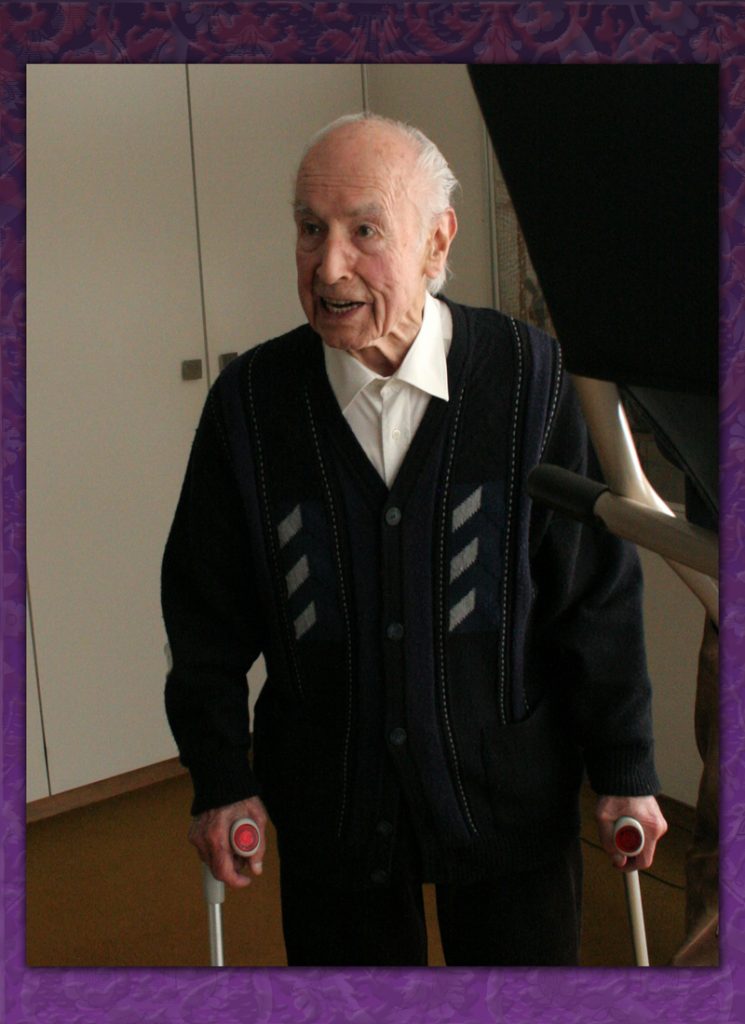
Invisible College #5 Photos: Jon Hanna Perhaps the last photographs of Albert Hofmann. Taken the month he died in Switzerland. You can see the rest of the edition here: https://www.invisiblecollege-publishing.com/pdfs/
Albert Hofmann was the inventor of LSD, Today marks his second experience with the substance (the first by accident, the second on purpose.)
Everything changes on that pivotal moment in 1943 is Basel Switzerland…
The numbers are in on the great Covid-19 pandemic . . . but unfortunately those numbers are unreliable. From mendacious models and puffed-up projections to dodgy death data and tainted tests, today on The Corbett Report James highlights what the accredited scientists and award-winning researchers are saying about the pandemic pandemonium of 2020.
Consciousness, sexuality, androgyny, futurism, space, the arts, science, astrology, democracy, humor, books, movies and more