
Bruce H. Lipton, Ph.D. www.brucelipton.com
Scenes from: “Different from the Others” / “Anders als die Andern” (1919)
UCLAFilmTVArchive Different From the Others (Anders als die Andern) (Germany, 1919) has been preserved by UCLA Film & Television Archive as part of the Outfest UCLA Legacy Project. Funding provided by The Andrew J. Kuehn Jr. Foundation and the members of Outfest. ——- Synopsis The concert violinist Paul Koerner takes a student under his wing, much to the worry of the boy’s parents. Koerner is meanwhile being blackmailed by a former lover, since in Germany any homosexual relations at that time were punishable under the law, codified in Article 175, which was not removed from the books until the 1960s. The German film, Different From the Others is, as far as we know, the first fiction feature film to address a specifically gay audience. Fortunately, even though more than 90% of all German silent films have disappeared, this film exists today in at least half its original length. When the film was first shown in 1919, gay and lesbian audiences must have been amazed that a mainstream fiction feature film would portray their situation as a fact of nature, rather than a perversion. Today, this film celebrates the brief opening of that door, before it slammed shut for another 50 years. The film was produced and directed by Richard Oswald, at that time one of Germany’s most prolific independents, who made films cheaply and premiered them in a Berlin cinema he owned, where his wife would often handle the office box. Oswald had earned a fortune in 1917/18 with a number of “educational” feature films about sexually transmitted diseases, which were approved by the censorship authorities, simply because syphilis was rampant in the trenches. Oswald would continue to produce controversial films, like his acknowledged masterpiece, The Captain from Koepenick (1931) based on Carl Zuckmayer’s anti-authoritarian play. The Nazis never forgave Oswald for Anders als die Andern or Koepenick, forcing Oswald into exile and eventually to Hollywood, where he directed several films and televisions shows. Although long underappreciated in Germany, recent critical reappraisals have valued his in-your-face aesthetic and modern subject matter. Only a severely truncated version of the film has survived, with Ukrainian titles, as Gosfilmofond in Russia. It was restored previously to a semblance of the original 1919 release by the Munich Film Museum. The UCLA restoration is based on that Munich reconstruction, with some changes and additions made. Credits Richard-Oswald-Produktion. Screenwriters: Magnus Hirschfeld and Richard Oswald. Cinematographer: Max Fassbender. With: Conrad Veidt, Leo Connard, Ilse von Tasso-Lind, Alexandra Willegh, Ernst Pittschau, Fritz Schulz.
How forgiveness can create a more just legal system
Martha Minow|TEDWomen 2019
Pardons, commutations and bankruptcy laws are all tools of forgiveness within the US legal system. Are we using them frequently enough, and with fairness? Law professor Martha Minow outlines how these merciful measures can reinforce racial and economic inequality — and makes the case for creating a system of restorative justice that focuses on accountability and reconciliation rather than punishment.
This talk was presented at an official TED conference, and was featured by our editors on the home page.
ABOUT THE SPEAKER
A future designed for everyone
After the Covid-19 crisis all voices must be heard

24th April 2020 (iai.tv)
Margaret Heffernan
| International businesswoman, CEO and the bestselling author of Uncharted: How to Map the Future Together
We don’t know yet whether we are at the beginning of the pandemic or just at the end of its first phase. When it ends, we may not know whether we have truly conquered COVID-19 or if it will recur seasonally. If the future is always uncertain, now even the present seems ambiguous. But even as we anticipate a rising death toll, many are looking over the horizon to predict the future.
We all know that there will be a bill to pay, so already institutions around the world have started lobbying to ensure they don’t pick up the tab. Large corporations find it easier to squeeze suppliers, freelancers, the gig economy. Some demand bail outs – but why should government pay when investors have been rewarded? But shareholders are also pension funds that citizens rely on for their retirement. The exhausted workforce of the NHS deserves more than rhetorical praise, while a young generation demands a future better that debt, joblessness and impoverished universities. Everyone clamors to come first in the long queue of need—but which will win the day?
It’s the wrong question. The more urgent question is how we decide. What we lack are mechanisms with which to start contemplating a future whose design can be broadly accepted by all. In competitive democracies, political parties typically outline platforms they hope will win the day. But for decades now, that process has increasingly been seen as inadequate to complex conflict. It is subject to over-simplification, corporate capture and lies, leaving too many feeling alienated, lacking trust and left behind.
What we lack are mechanisms with which to start contemplating a future whose design can be broadly accepted by all.
In the 1980s, one of the first to investigate this trend was the American political scientist, James Fishkin. He noticed that in democracies, people mostly didn’t inform themselves about politics because they know that one vote out of millions doesn’t really count. He called this phenomenon rational ignorance; and, well before populism raised its ugly head, he saw how this mindset gave rise to fake news, false promises and a backlash against democracy itself. Even more dangerous, he understood that rational ignorance was a kind of abdication, because it stripped individuals of their capacity for influence and action.
But what if people had a chance to consider reliable information in small groups where they could have an impact? He began to design a process he called deliberative democracy, in which representative groups of people came together to share balanced, transparent briefing materials and make recommendations for future progress. And what he discovered was remarkable. Contrary to cynical expectations, ordinary people—drivers, electricians, nurses, executives, bartenders – paid serious attention, were thoughtful, listened and reflected. In the light of solid information they could understand and trust each other. In a safe environment where there was time to think, they came to empathize with those whose life experiences were often radically different and, as a result, they frequently changed their views. Why? Because they appreciated that, in this setting, their conclusions mattered. Their recommendations had consequences for people they now knew.
Angela Eagle, Phillip Blond and Carl Miller debate the future of democracy
This is exactly what happened in the Irish Citizens’ Assembly that recommended a referendum on abortion. Despite loud misgivings – people were too stupid, it was just kicking the can down the road – the process resolved a problem that no political party had been able to handle. This Assembly was not (as it’s often portrayed) a series of talking shops, with a bunch of random people spouting off. It was a meticulously managed, carefully disseminated, jargon-free process that engaged and informed public participation, learning and debate. Over eighteen months, it changed what the Irish people knew, understood and believed. More important than the result, however, was its reception. Even those who did not agree with it were prepared to live with it, because of the way it had been achieved. This form of deliberative democracy had bestowed what leaders in every context most crave: legitimacy.
Even those who did not agree with the result were prepared to live with it, because of the way it had been achieved.
Those who had been following the evolution of deliberative democratic experiments weren’t entirely surprised. Fishkin has now run 109 such deliberative events, in 28 countries and from them notable patterns have emerged. In Mongolia in 2017, priorities for government spending were put to a deliberative group that turned the list upside down. Where politicians had fixated on a metro and airport, citizens cared more about insulating and heating their children’s schools so that education wasn’t interrupted by the cold. So that is what the government did.
What many of these experiments show is that, in small, moderated groups with access to sound information, people make informed, rational decisions. They make informed trade-offs because they know that everyone matters and that their decisions have consequences for people they know. By contrast, traditional processes force leaders have to make generalized assumptions about people and experiences they aren’t familiar with. In party politics, those decisions are designed to win power for supporters, not to benefit the whole. The contrast with the UK’s Brexit referendum could not be more telling.
In today’s crisis, open democratic approaches have a special salience. For years, the legitimacy of institutions has been the issue bubbling under the surface of public discussions of public trust and reputation. Shell CEO van Beurden acknowledged the heat when, in recent regulatory filings, the company listed its “societal license to operate” among its key concerns. If this was a hot topic before the pandemic, it could boil over in its aftermath. So finding a legitimating process with which to begin to craft a post-pandemic settlement is crucial. If we want a sound and healthy future, we have first to find a way of defining it that builds in the quest for legitimacy and justice.
After a trauma collectively experienced by the world’s population, any outcome that disproportionately rewards or penalizes any one group will lack legitimacy. That, after all, is the century-old legacy of Versailles. It should also be the lesson of the banking crisis, when austerity disproportionately punished those least responsible for the disaster. By contrast, the history of deliberative assemblies shows a broad cross-section of the public – not political parties, not financial technocrats and not global corporations – can lay the groundwork for effective, sound decisions that don’t undermine social cohesion but enhance it. They do not supplant parliaments but provide elected governments with a rich, informed and credible array of possibilities deemed to be just.
If we want a sound and healthy future, we have first to find a way of defining it that builds in the quest for legitimacy and justice.
The whole point of democracy, Fishkin says, is to connect. Instead of fighting over who owns our future, we need to craft a legitimate way to share the work of making it. “If our institutions do not learn to listen to the people in a thoughtful and representative way,” Fishkin told me, “they are at risk.” A starker statement of where we stand came from Peter Patrick, a barman whose thinking was changed after he took part in the Citizens Assembly that met in Dublin.
“It actually works,” Peter Patrick reflected. “I just came back from Berlin – and I went down to where the former SS headquarters was. Looking at it, I thought how quickly a country can change. So you have to keep working on democracy, because countries can change very quickly. It made me realize how very fragile we are.”
Margaret Heffernan
24th April 2020
The Plague, Camus, and hope
Overcoming absurdity during a pandemic

Issue 87, 22nd April 2020 (iai.tv)
Stephen Beale
| Freelance journalist specialising in politics, history and social issues.
There have been as many plagues as wars in history; yet plagues and wars take people equally by surprise.Albert Camus eerily familiar tale of a town in plague lockdown can show us how to preserve hope amid the prolonged suffering of a pandemic.
Albert Camus’ The Plague almost reads as a contemporary account. The denials and delays of public authorities in responding, the shortage of vital medical supplies, the overcrowding of hospitals—Camus saw it all with uncanny clarity. Moreover, he understood how pandemics can harm not just the body, but also the spirit.
One of the worst things about the plague is that it seems never-ending. This may seem like an obvious statement, but the point is significant. A night watchman says he wishes the city had been hit with an earthquake instead of the plague. “A good bad shock, and there you are! You count the dead and living, and that’s an end of it,” the watchman says. Earthquakes, tsunamis, landslides, and other similar natural disasters—as horrific as they are—have one saving grace: they end quickly. They have a clearly defined ending, from which survivors can grieve and move on.
Each day of the plague, on the other hand, brings a steady drip-drip of new deaths. The plague causes a different kind of loss as well: prolonged separation from loved ones who were out of town when the quarantine took effect. Fears that the plague could last a year or even longer fuels uncertainty about when a reunion will be possible. The townspeople begin to despair of a better future and decide it’s easier to just stop thinking about it. They become like “wandering shadows” that “drifted through life rather than lived,” tormented by “sterile memories.”
Despair hasn’t yet become habitual when the loss still hurts because you continue to hope for reunion.
The plague stole the simpler pleasures of life as well. Not only are the residents of Camus’ fictional city of Oran barred from travel, they can’t even leave for the nearby beach. Despite “all its nearness, the sea was out of bounds,” Camus says. Siestas and holidays “no longer invited” townspeople to “frolics and flirtation on the beaches.” To paraphrase Camus, part of the misfortune of the plague is its sheer monotony. Even the simplest of pleasures are snuffed out: one old man who once enjoyed spitting at street cats no longer can after the felines are euthanized (over concerns that they may be spreaders of the disease). “Plague had killed all colors, vetoed pleasure,” Camus writes.
Is there a way through the despair?
Camus suggests there is. He draws a distinction between despair and the “habit of despair,” in which people have become numb to their pain. Despair hasn’t yet become habitual when the loss still hurts because you continue to hope for reunion: your memory of your loved one has not lost its “fleshly substance.”
The only way to keep such memories alive is by doing what the townspeople avoided: imagining your beloved—both what they might be doing in the present and your potential future together. This may be more painful, but it is also the only way to truly live, Camus says. The alternative, according to Camus, is to become like one of the shadows that drifted aimlessly about the town.
Berit Bogaard, David Papineau and Veronique Mottier debate the reality of feeling
This power of the imagination to keep love alive is spectacularly demonstrated through the character of Raymond Rambert, a Paris-based journalist who coincidentally had come to investigate the sanitary of the conditions before the outbreak and got trapped in the quarantine.
Rambert liked to set aside four in the morning for “thinking of his beloved Paris” and “conjuring up pictures of the woman from whom he now was parted.” Rambert also would daydream of Paris—as a kind of reverse synecdoche for his beloved who lived within the city. “There rose before his eyes, unsummoned, vistas of old stones and riverbanks, the pigeons of the Palais-Royal, the Gare du Nord, quiet old streets round the Pantheon, and many another scene of the city he’d never known he loved so much.”
The plague is also an absurdist phenomenon: it is vast in its scale, killing so many that it leaves little room to respect individual human dignity.
In addition to imagination, one must be able to see reality clearly. It is not enough to long for the future, one must still live in the present. According to Camus, the plague called for rethinking humanity’s place in the scheme of things, beginning with the recognition that Protagoras was wrong—man is not the measure of all things. This is contrary to our natural tendency to reduce all things to human terms in order to understand them, as Camus explains in the Myth of Sisyphus. “The cat’s universe is not the universe of the anthill. The truism ‘All thought is anthropomorphic’ has no other meaning.”
Camus’ absurdism recognizes that the universe can no more satisfy our yearnings for meaning and love than the cat can address the needs of the ant. The plague is also an absurdist phenomenon: it is vast in its scale, killing so many that it leaves little room to respect individual human dignity. (Camus’ account of mass burials without proper funerals is a particularly grim testament to this fact.) At the same time, the source of the contagion, the bacteria, is too small an enemy to be seen and battled. Thus, at every turn, the plague defies human attempts to make sense of it. What is needed is a sort of existential humility, an understanding of our true place in the order of things—what Camus calls “modesty.”
This mindset leads to Camus’ absurdist ethic. His characters realize that they cannot escape from the plague; they can only endure it. This is exemplified in the story’s protagonist, doctor Bernard Rieux. Like the mythic Sisyphus who was condemned to perpetually roll the stone up the hill, only for it toslide back down, Rieux envisions his vocations as helping his patients fight the inevitable—death. “I now can picture what this plague must mean for you,” says his friend, Jean Tarrou. “Yes. A never ending defeat,” Rieux responds.
Camus’ realism also makes possible a special kind of joy.
This kind of defeatism may seem dark, but it is also realistic. The plague is beyond the control of all the townspeople, including the doctors. Not everyone can be saved. People will die. The local economy will suffer. But this kind of realism is what makes a firm hope in a better future possible. You can’t, after all, hope for something you already have. Characters like Rambert keep the flame of love alive by being realistic in accepting the distress caused by their separation.
Camus’ realism also makes possible a special kind of joy. Near the end of the plague, Tarrou and Rieux quietly go out to the beach at night, thanks to government passes they have. As both men prepare to jump into the waters, they are overtaken by a “strange happiness” that “forgot nothing, not even murder.” Happiness doesn’t come through escaping from or denying reality. Instead, the moment is all the more joyful because it’s been stolen from the plague, so to speak. Apparently, Sisyphus can take breaks from rolling his stone.
Gloom seems to hang over much of Camus’ Plague. It does not always make for light or uplifting reading. The brooding darkness and empty despair cry out from almost every page. But this is what makes Camus’ exhortations to hope and joy so powerful. They aren’t born out of fantasy but instead are rooted in the reality of human suffering and distress. Camus’ absurdist ethic won’t buckle under the pressure of a plague or pandemic. When the going gets tough, his approach will continue to serve us well precisely because it takes hardship as a given.
Stephen Beale
Issue 87, 22nd April 2020
The Astrology of the Pandemic
Learning to love uncertainty
The individual vs alternative facts
When philosophers say there’s no such thing as objective truth, they mean there’s no such thing as certainty. And as the cacophony of information from the media and technology becomes ever louder, how should we deal with this multiplicity? Must nuance be legislated, taught in schools, or left to the individual? Does knowledge stand a chance in a world of alternative facts?
In this new series of in-depth interviews, the IAI asks leading thinkers across philosophy, science, politics and the arts about the new ideas that they think are most significant, and about what the future has in store.
More from this series
Cognitive scientist Steven Pinker on human nature, the enlightenment and beyond.
Philosopher Rebecca Goldstein on the role of intuition in Philosophy.
The Speaker
Åsa Wikforss is a professor of theoretical philosophy at Stockholm University. Wikforss is a member of Swedish Academy whose research focuses on the intersection of philosophy of mind, language and epistemology, ans in 2017 Wikfoss published Alternative facts. On knowledge and its enemies, a book that has had a great impact in Sweden.
How Camus and Sartre Split up Over the Question of How to Be Free
Their radically opposed ideas of freedom broke up the philosophical friendship of the 20th century.
Aeon (getpocket.com)
- Sam Dresser

Albert Camus, 1952. Photo by Kurt Hutton / Stringer / Getty Images.
They were an odd pair. Albert Camus was French Algerian, a pied-noir born into poverty who effortlessly charmed with his Bogart-esque features. Jean-Paul Sartre, from the upper reaches of French society, was never mistaken for a handsome man. They met in Paris during the Occupation and grew closer after the Second World War. In those days, when the lights of the city were slowly turning back on, Camus was Sartre’s closest friend. ‘How we loved you then,’ Sartre later wrote.
They were gleaming icons of the era. Newspapers reported on their daily movements: Sartre holed up at Les Deux Magots, Camus the peripatetic of Paris. As the city began to rebuild, Sartre and Camus gave voice to the mood of the day. Europe had been immolated, but the ashes left by war created the space to imagine a new world. Readers looked to Sartre and Camus to articulate what that new world might look like. ‘We were,’ remembered the fellow philosopher Simone de Beauvoir, ‘to provide the postwar era with its ideology.’
It came in the form of existentialism. Sartre, Camus and their intellectual companions rejected religion, staged new and unnerving plays, challenged readers to live authentically, and wrote about the absurdity of the world – a world without purpose and without value. ‘[There are] only stones, flesh, stars, and those truths the hand can touch,’ Camus wrote. We must choose to live in this world and to project our own meaning and value onto it in order to make sense of it. This means that people are free and burdened by it, since with freedom there is a terrible, even debilitating, responsibility to live and act authentically.
If the idea of freedom bound Camus and Sartre philosophically, then the fight for justice united them politically. They were committed to confronting and curing injustice, and, in their eyes, no group of people was more unjustly treated than the workers, the proletariat. Camus and Sartre thought of them as shackled to their labour and shorn of their humanity. In order to free them, new political systems must be constructed.
In October 1951, Camus published The Rebel. In it, he gave voice to a roughly drawn ‘philosophy of revolt’. This wasn’t a philosophical system per se, but an amalgamation of philosophical and political ideas: every human is free, but freedom itself is relative; one must embrace limits, moderation, ‘calculated risk’; absolutes are anti-human. Most of all, Camus condemned revolutionary violence. Violence might be used in extreme circumstances (he supported the French war effort, after all) but the use of revolutionary violence to nudge history in the direction you desire is utopian, absolutist, and a betrayal of yourself.
‘Absolute freedom is the right of the strongest to dominate,’ Camus wrote, while ‘absolute justice is achieved by the suppression of all contradiction: therefore it destroys freedom.’ The conflict between justice and freedom required constant re-balancing, political moderation, an acceptance and celebration of that which limits the most: our humanity. ‘To live and let live,’ he said, ‘in order to create what we are.’
Sartre read The Rebel with disgust. As far as he was concerned, it was possible to achieve perfect justice and freedom – that described the achievement of communism. Under capitalism, and in poverty, workers could not be free. Their options were unpalatable and inhumane: to work a pitiless and alienating job, or to die. But by removing the oppressors and broadly returning autonomy to the workers, communism allows each individual to live without material want, and therefore to choose how best they can realise themselves. This makes them free, and through this unbending equality, it is also just.
The problem is that, for Sartre and many others on the Left, communism required revolutionary violence to achieve because the existing order must be smashed. Not all leftists, of course, endorsed such violence. This division between hardline and moderate leftists – broadly, between communists and socialists – was nothing new. The 1930s and early ’40s, however, had seen the Left temporarily united against fascism. With the destruction of fascism, the rupture between hardline leftists willing to condone violence and moderates who condemned it returned. This split was made all the more dramatic by the practical disappearance of the Right and the ascendancy of the Soviet Union – which empowered hardliners throughout Europe, but raised disquieting questions for communists as the horrors of gulags, terror and show trials came to light. The question for every leftist of the postwar era was simple: which side are you on?
With the publication of The Rebel, Camus declared for a peaceful socialism that would not resort to revolutionary violence. He was appalled by the stories emerging from the USSR: it was not a country of hand-in-hand communists, living freely, but a country with no freedom at all. Sartre, meanwhile, would fight for communism, and he was prepared to endorse violence to do so.
The split between the two friends was a media sensation. Les Temps Modernes – the journal edited by Sartre, which published a critical review of The Rebel – sold out three times over. Le Monde and L’Observateur both breathlessly covered the falling out. It’s hard to imagine an intellectual feud capturing that degree of public attention today, but, in this disagreement, many readers saw the political crises of the times reflected back at them. It was a way of seeing politics played out in the world of ideas, and a measure of the worth of ideas. If you are thoroughly committed to an idea, are you compelled to kill for it? What price for justice? What price for freedom?
Sartre’s position was shot through with contradiction, with which he struggled for the remainder of his life. Sartre, the existentialist, who said that humans are condemned to be free, was also Sartre, the Marxist, who thought that history does not allow much space for true freedom in the existential sense. Though he never actually joined the French Communist Party, he would continue to defend communism throughout Europe until 1956, when the Soviet tanks in Budapest convinced him, finally, that the USSR did not hold the way forward. (Indeed, he was dismayed by the Soviets in Hungary because they were acting like Americans, he said.) Sartre would remain a powerful voice on the Left throughout his life, and chose the French president Charles de Gaulle as his favourite whipping boy. (After one particularly vicious attack, de Gaulle was asked to arrest Sartre. ‘One does not imprison Voltaire,’ he responded.) Sartre remained unpredictable, however, and was engaged in a long, bizarre dalliance with hardline Maoism when he died in 1980. Though Sartre moved away from the USSR, he never completely abandoned the idea that revolutionary violence might be warranted.
Philosophy Feud: Sartre vs Camus from Aeon Video on Vimeo.
The violence of communism sent Camus on a different trajectory. ‘Finally,’ he wrote in The Rebel, ‘I choose freedom. For even if justice is not realised, freedom maintains the power of protest against injustice and keeps communication open.’ From the other side of the Cold War, it is hard not to sympathise with Camus, and to wonder at the fervour with which Sartre remained a loyal communist. Camus’s embrace of sober political reality, of moral humility, of limits and fallible humanity, remains a message well-heeded today. Even the most venerable and worthy ideas need to be balanced against one another. Absolutism, and the impossible idealism it inspires, is a dangerous path forward – and the reason Europe lay in ashes, as Camus and Sartre struggled to envision a fairer and freer world.
Sam Dresser is an editor at Aeon. He lives in New York.

This post originally appeared on Aeon and was published January 26, 2017. This article is republished here with permission.
Val Kilmer Doesn’t Believe in Death
The iconic actor played Iceman, Doc Holliday, Batman, and Jim Morrison, but behind all the mythic roles was a man grasping for meaning wherever he could find it. Here he opens up about cancer, strength, and death.
BY ALEX PAPPADEMAS APR 21, 2020 (menshealth.com)

Val Kilmer in Los Angeles in early 2020.TOM STRATTON
SOME YEARS AGO, Val Kilmer began selling his original artwork on the Internet. Kilmer has been making art for a long time. He takes photographs and creates scrapbook-style media collages with atmospheric abstract paintings resembling blooms of underwater lava. His neon sculpture of a dyspeptic-looking Mahatma Gandhi hung for a while in the restaurant of a fancy hotel in South Beach, and he once cast a tumbleweed in 22-karat gold.
But the project he’s become most famous for is an ongoing series of quasi-self-portraits—Warholian pop-art images of Kilmer in character as Batman or Doc Holliday or Jim Morrison, rendered using stencils and brightly colored enamel paint on 12-inch-by-12-inch squares of reclaimed steel. Sometimes he’ll superimpose a stenciled word like love on the image, or a variation of a quote from one of his movies, such as chicks dig the car. His website didn’t have any Doc Holliday paintings at press time, but for a fan-friendly $150, you could still acquire a portrait of Kilmer as Tom “Iceman” Kazansky—Tom Cruise’s nemesis and beach-volleyball rival in Top Gun—in a range of colors, from neon green to red and blue to eerie red-on-black.
These are not the most technically complex or conceptually weighty paintings. They are not even technically complex or conceptually weighty by the standards of other paintings by Val Kilmer. But there’s an additional layer of meaning to them, because they’re portraits of Val Kilmer by Val Kilmer.
The pictures feel like a sincere effort on his part to use the tools at his disposal
to make sense of his own relationship to a postmodern character called “Val Kilmer,” who is less a person than a collection of symbolic echoes, and who casts a long shadow over the real Val Kilmer’s life despite existing solely in the media landscape and the public’s mind. There is nothing inherently interesting about a piece of steel with a stenciled image of Val Kilmer as Batman on it, but a piece of steel on which Val Kilmer himself has painted a stenciled image of Val Kilmer as Batman as part of a project involving the painting of dozens of Val Kilmer-as-Batman images becomes an act of introspection, a commentary, a reflection on reflections and the indelibility of iconicity.
One afternoon in early March, I discussed all of this with Val Kilmer over the phone. “Yes,” he said. “By repainting the exact same thing using a stencil, it was a way of contemplating the subject while being very strict with what I was inviting myself to do.”

I asked him if the paintings were a way for him to work through the feeling of being known without being known, to help process the weirdness that comes with everyone looking at you and seeing Iceman or the Lizard King. “It’s not so much me thinking about myself,” he said. “It’s more about the icon. The icon of the warrior. Or the gunslinger—that black-and-white justice that’s part of American history. That’s Doc Holliday. And then Jim Morrison is an iconic rock ’n’ roller, a poet.
“I also found there was a surprising number of fans who wanted original paintings,” he continued, as if to puncture the self-importance of talking about this work in this way. “I sold an embarrassing number of them.”
I think he laughed when he said this; I’m not positive. It was a strange conversation, because there was no way for it not to be. Kilmer, now 60, was diagnosed with throat cancer in 2015. In the opening pages of his new memoir, I’m Your Huckleberry, (Simon & Schuster, April 21, 2020) he has lost his New Mexico home as a result of the 2008 financial crisis and finds himself convalescing at an ex-girlfriend’s place. This is a book of absurd juxtapositions; the home happens to be an Italian Renaissance–style palazzo in Malibu overlooking the ocean, because the ex-girlfriend happens to be Cher. He is there when his condition takes a fateful turn.
“Cher dipped out for afternoon errands,” he writes. “Night fell, and I fell asleep. Suddenly I awoke vomiting blood that covered the bed like a scene out of The Godfather. I prayed immediately, then called 911.” Eventually he endures two tracheotomies. “The cancer miraculously healed much faster than any of the doctors predicted,” he writes, but adds, “It has taken time, and taken a toll. . . . Speaking, once my joy and lifeblood, has become an hourly struggle.” He describes his new voice as sounding “like Marlon Brando after a couple of bottles of tequila. It isn’t a frog in my throat. More like a buffalo.”

Kilmer with a copy of I’m Your Huckleberry.@VALKILMEROFFICIALINSTAGRAM
Kilmer and I both live in Los Angeles. COVID-19 had not yet rendered in-person interactions verboten, so I suggested we could talk in person, but he wanted to speak over the phone, through an interpreter—his high school friend and business partner, Brad Koepenick. I would ask a question, I’d hear some indistinct buffalo growls on the other end of the line, and then Koepenick would repeat Kilmer’s response to me in his own voice. We spoke to each other this way for about an hour.
At first there were a few people speaking in the room, and I asked Koepenick if he could identify himself. “I’m Brad Koepenick,” he said. After that, I heard Kilmer speaking—rarrrggh rarrrggh rarrrggh—and then, speaking for Kilmer, Koepenick said, “I am Spartacus.” For all his responses, for clarity, when Koepenick is speaking Kilmer’s words, I’ve attributed them to Kilmer, and I’ve attributed Koepenick’s occasional comments to Koepenick.
To understand Val Kilmer, in all his incarnations, it’s important to recognize that he has been a Christian Scientist since the age of seven or eight. Founded in 1879 by the author Mary Baker Eddy, Christian Science is a form of metaphysical Christianity whose adherents believe, among other things, that physical illness and infirmity result from mental misconception or “negative thinking.” All of Kilmer’s answers to questions regarding physical matters reflect these beliefs—as he writes in his memoir, his physical difficulties have led him deeper into spiritual practice: “When one sense weakens, another grows strong. I have more time to play in the metaphysical forests.”

Val Kilmer training in a Suzuki Method class at the Juilliard School, New York. At 17, he was the youngest drama student ever admitted in 1981.SIMON & SCHUSTER
It says something important about Val Kilmer’s mind, however, that the only historical figure who seems to loom as large in his personal pantheon as Mary Baker Eddy is Mark Twain. Twain was a contemporary of Eddy’s, and while he spoke approvingly of Christian Science’s core principles on occasion, he saw its founder as a charlatan.
In 2012, Kilmer began portraying Twain—whom he views as “the first media-literacy educator”—in a one-man stage show, Citizen Twain, and has spent years working on the script for a movie depicting a fictional meeting between Twain and Eddy, which he still hopes to direct. “Twain is the antagonist in the story,” Kilmer says. “Mary Baker Eddy is the protagonist. Mark Twain can’t help his pride and ego, his madness.”

Kilmer in character as Mark Twain.SIMON & SCHUSTER
I asked if this was what Kilmer related to about Twain as a character.
“His madness?” Kilmer asked, and then Koepenick, the interpreter, laughed.
Sure, I said. His pride, his ego, his madness. “Yeah,” Kilmer said. “We all have pride to work through.”

I WANTED TO TALK to Val Kilmer about pride. When he was young, he was beautiful, and moved through the world with the ease of someone beautiful, from school plays to Juilliard to the movies, such as 1984’s Top Secret!, which instantly made him a movie star for playing a rock star. One year later, with Real Genius, he was already a hyper-opinionated pain in the ass on set—he admits as much in his book—and a year after that came Top Gun, and with it great fortune.
Kilmer was a stage-trained actor with grand aspirations—he writes with chagrin about turning down the lead in David Lynch’s Blue Velvet due to the script’s sexual content and cops to badgering Stanley Kubrick for a meeting he never got. But by the mid-’90s, he’d become an A-list leading man who was reportedly receiving $6 million per picture, which was a different kind of grand.
His movie career hit its zenith in the first five years of the ’90s, when he played Jim Morrison in Oliver Stone’s The Doors, Elvis’s ghost in True Romance, the gunfighter Doc Holliday in Tombstone, Robert De Niro’s demolitions-expert partner in Michael Mann’s bank-heist epic Heat, and Batman in Joel Schumacher’s goofy, garish Batman Forever. Those last two came out in 1995, and after that the going got weird. Whether Kilmer walked away or was released from his contractual obligation to play Batman again due to difficult behavior is unclear. His next projects were the film version of the 1960s TV series The Saint—in which he disappears behind a series of increasingly ludicrous wigs and glasses like somebody who really, really wants you to know he went to Juilliard—and a remake of The Island of Dr. Moreau, which became one of the decade’s most infamously cursed productions.

In the pages of Huckleberry, Kilmer is equivocal about his reputation as a temperamental collaborator (“In an unflinching attempt to empower directors, actors, and other collaborators to honor the truth and essence of each project . . . I had been deemed difficult and alienated the head of every major studio”), but he talks straight about much of the work that followed (“I have here described myself as a man with lofty goals, and I have a solid two decades’ worth of work that I’d describe as less than lofty”).
There are true gems in Kilmer’s post-Moreau filmography, like the David Mamet human-trafficking thriller Spartan, Shane Black’s manically inventive Kiss Kiss Bang Bang, and MacGruber, in which Kilmer plays a Bond-style villain named Dieter Von Cunth. His hazy-eyed performance as the doomed ’70s porn star John Holmes in 2003’s Wonderland is a riff on his Morrison but funnier and sadder, the Lizard King as lost soul. But for all intents and purposes, Batman was his farewell to franchise-hero parts. Having grown up watching Kilmer in blockbuster movies and then appreciating his work in smaller films, I never thought of him as a cautionary tale about hubris or ego, but Huckleberry points in that direction. His last thought on turning down Lynch is a poignant plea: “Maybe it’s not too late,” he writes. “Maybe one day we can finally work together. A character who lives up on Mulholland and doesn’t speak much? David, I am so sorry I never explained myself.”

One of Kilmer’s artworks, titled Iceman 68.VALKILMER.COM
We never got around to talking about Lynch, though, because we started talking about death, which led us to God, which left no time for much else. Shortly after a 17-year-old Kilmer left his home in L. A. for Juilliard, his younger brother, Wesley, suffered an epileptic seizure in the family’s Jacuzzi and died on the way to the hospital. I asked Kilmer about how he managed to avoid letting this loss define him.
“You have to not see it as a loss,” Kilmer told me. He writes in the book that he’s heard Wesley’s voice on occasion, admonishing him from beyond the grave: “No one wants to see or hear a handsome, successful, talented writer-actor-director who gets the most impossible-to-get girls in the world complain about a damn thing.”
“I’ve had experiences with lots of people that are departed,” Kilmer said on the phone. “For instance, my mother passed on recently, and a few days after, I was aware of her—you could call it her spirit. And she wanted me to be happy, because she was having a reunion with her son Wesley and the love of her life, Bill, her second husband. And they were just all so happy. It was a great release of a burden—because my mom, I felt, wasn’t so happy sometimes, here on earth.”

.
Kilmer’s access to the unexplained and extrasensory is a major through line in his book. At 24, in New Mexico, he encounters a black-robed figure in a vision, whom he recognizes as the Angel of Death’s opposite, the Angel of Life, who pulls out Kilmer’s heart and gives him a bigger one. At a comic-book convention, across a table where he’s signing Batman stuff for Batman fans, Kilmer meets a Native American fan who asks him, “What is acting?”—a question that unlocks the meaning of a recurring dream Kilmer’s father had about dying in battle with another Native American man on the frontier. On a backpacking trip in Kenya with his then wife, Joanne Whalley, Kilmer steps outside his tent, and there’s a nine-foot-long monitor lizard sitting there.
I asked Kilmer if he’s thought much about why these messengers and symbols appeared to him, if he believes they were put in his path for a reason, and if all of us could interact with the metaphysical world in this way if we paid closer attention to its manifestations.
“Yes,” Kilmer said. “I do think it has to do with paying attention. And also asking for [those signs]. I’ve always had a very strong relationship with wild animals, especially animals like the kudu, which are very hard to spot, or the badger, or the black leopard, or the black panther.”
Kilmer said something else after this, and Koepenick, confused, repeated it back to Kilmer as a question: “Kanye forever?” Kilmer said the words again, clarifying, and Koepenick, to me, said, “Wakanda forever.”
“My translator’s higher than hell,” Kilmer said.
“I’ve got to lay off the ganja, you’re right,” Koepenick said.
Is it possible, I asked, to summon these things into your life? To seek these encounters with animals and other spiritual beings?
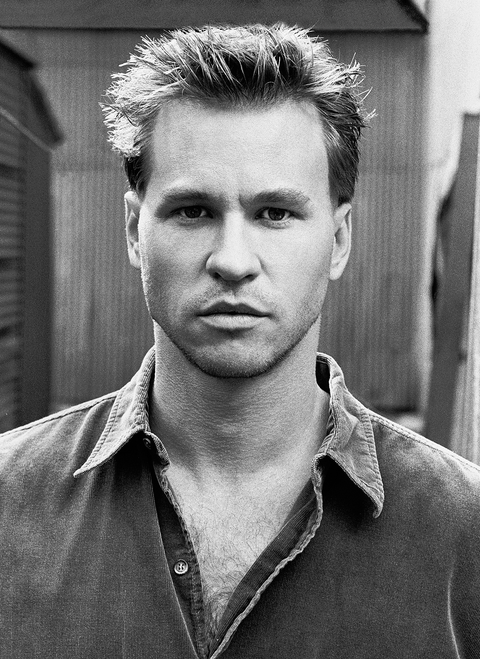
A mid-80s portrait of Kilmer that’s on the cover of I’m Your Huckleberry.SIMON & SCHUSTER
“I think so, yeah,” Kilmer said. “I mean, I’ve never been interested in hunting. But at the same time—this is a true story that sounds unreal, but I’ve been back to the same spot in South Africa, a hunters’ spot that you have to rent. It’s very expensive because all the animals there are very mature, so their horns are very big. And I’m not a hunter, but I rent the whole area so I can have as wild an experience as possible with very big game. And the most vindictive animal out there is the Cape buffalo. The Cape buffalo has a phenomenal memory, much better than the famed elephant.
“And I’ve been to the same spot three times. And the second time I went there, [a Cape buffalo] smelled me, even though I was the third in a line of humans, and he trotted over until he was right in front of me. And then he stared at me for half an hour, as if to say, ‘Your move—I’m ready.’ And then the third time I went, he did the exact same thing. Except it was more extreme because the wind was blowing harder. And he was very specifically putting his nose in the air, as if he was displaying—I’m smelling, I’m smelling. But this time it was almost like a playful kind of dance over to me. And I had the same guides [as before], and the guides were freaking out. They were babbling in their native tongue: He knows you, he knows you. He’s coming to say hello. They were freaking. And I was like, ‘I know.’
“But that happens a lot,” Kilmer said. “Like honey badgers, you know? Impossible to see in the daytime. I’ve seen them in both the daytime and the nighttime.”
YOU’VE PLAYED ALL these heroes over the course of your career, I said to Kilmer. There’s a tendency in our culture to frame illness in heroic terms, as a fight for life or an occasion for bravery, particularly when we’re talking about someone we think of as heroic in another context. We make shirts about kicking cancer’s ass and write headlines like “val kilmer battles cancer.” For someone who’s been through it, is the idea of a brave battle with cancer the wrong way to think about it?
Kilmer answered without really answering. He talked about mental attitude. “It’s half of the healing—making sure the mind is free, in the morning, of limitations.”
VAL KILMER’S ROLES OVER THE YEARS


Later, at the end of the call, Kilmer gave me his email address in case I had any follow-up questions. After a week or so, I wrote him an email in which I asked him a few fact-checking questions about the timing of his diagnosis and his recovery, and whether it was difficult to balance his Christian Scientist beliefs with traditional medicine. He didn’t answer, though this might be because I also asked him, very gently, if he had any regrets about being a jerk on movie sets.
That day on the phone, I let the conversation go where it wanted to, reluctant to steer it back to Moreau’s island. I asked Kilmer if it was hard to get to that place of being free and clear, if it was something he had to cultivate. Kilmer said no, that his spiritual practice had been part of his life since childhood. Then he asked, “Alex, do you believe in God?”
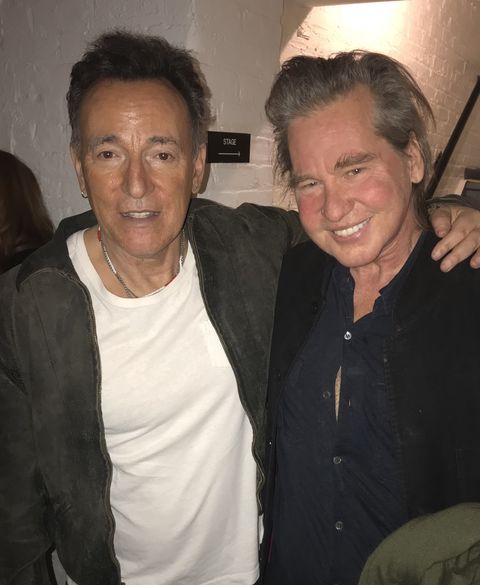
Kilmer with Bruce Springsteen after a performance of Springsteen on Broadway.SIMON & SCHUSTER
I stammered something about being a skeptic, because suddenly I felt guilty telling Christian Science Batman that God does not play a role in my life.
“The infinite,” Kilmer said. “Have you had a sense of the infinite?”
I confirmed to Val Kilmer that I have had a sense of the infinite and stammered again about psychedelics and the notion that something must exist outside the boundaries of our consciousness.
“And I think the physical science is catching up with that,” he said. I asked Kilmer if having cancer tested his faith, if there were moments when he wanted to give up hope. He quoted what turned out to be a line from the Gospel According to Mark, about faith in the face of doubt, about doubt as a specific crucible for faith: “Lord, I believe. Help thou mine unbelief.”

.
What you can tell about Kilmer even throughout an odd and stilted back-and-forth is that he’s been through something and emerged from it that much more certain of the one thing he believes most strongly, which is that mental attitude can have transformative effects. As an inveterate doubter, I wanted Kilmer to express doubt or regret or otherwise admit to a sense of powerlessness, which I suppose is contraindicated in a worldview based on the all-importance of mental attitude. It was the paintings conversation all over again—I wanted him to talk about the gulf between our heroic notion of the movie star and the actual flawed human behind it, but he couldn’t, or wouldn’t, see it in those terms.
So I asked him what the most surprising thing was about his illness. He paused for a minute and then said, “Well, something that was reaffirmed to me—on such a level, it was almost shocking—was a sense of universal love, a kind of power and a different sense of love. It was coming into my consciousness and my body while I was at the hospital.”
At one point, Kilmer said, one of his doctors saw him and became animated, even overjoyed. This specific doctor, he said, turned out to have been present during a moment when Kilmer almost slipped away. “He lost me for a while, and he was just so happy I was back. He wanted me to be happier. I was grateful, but I was not surprised.”
Why not?
“Because I don’t believe in death,” Kilmer said.
I asked him how he managed to shake a belief that defines life itself in a fundamental way for so many people on this planet. He spoke again about his little brother’s death, how even though he’d spent years by that point reading and thinking and praying on the Christian Scientist concept of death as an illusion, “having to live it out becomes quite a different proposition.”
Christian Scientists believe any malady can be overcome through mental effort, death included. “And this is what Mrs. Eddy meant when she talked about reinstating primitive Christianity. That’s how she thought Jesus was teaching—teaching others to heal themselves. And that’s what made him a dangerous man. Because he taught people how to be independent, and that’s always a very, very radical thing to do in society.”

Kilmer with Tribeca Film Festival cofounder Craig Hatkoff (left) and Bradley Koepenick in 2019.
I don’t know enough about science, much less about faith, to argue with Kilmer. And yet, sitting there on the phone, I realized I envied his ability to believe, his confidence in the face of cosmic uncertainty. I envied the security he derives from what he thinks he knows.
It’s extremely human, when faced with adversity, to fall into wallowing and selfishness and sadness and not wanting to go on, I said to Kilmer. How do you avoid surrendering to those feelings?
“Sometimes you have to be aggressive about finding a way to be courageous,” he said, “and not believing what your physical picture may be demanding you accept as real. Like if someone came into the room, and they were sleepwalking, and they were screaming that their feathers were on fire, what would you do?”
Well, you’re not supposed to wake a sleepwalker, I started to say, and then Kilmer interjected.
“You have to find a way to wake them up,” he said, “because they don’t have feathers, and so they’re not on fire.”
Alex Pappademas has written about pop culture for Esquire, GQ, Grantland, and others.
CHINESE COVID-19 VACCINE EFFECTIVE IN MONKEYS
“THIS IS OLD SCHOOL BUT IT MIGHT WORK.”
BY VICTOR TANGERMANN / APRIL 24 2020 (futurism.com)
Researchers at Beijing pharmaceutical company Sinovac Biotech have developed an experimental COVID-19 vaccine that it says protected macaques from infection, Science Magazine reports.
The vaccine was based on a tried-and-true formulation that included an inactivated version of the virus SARS-CoV-2, as detailed in a preprint uploaded to the server bioRxiv on April 19.
“These data support the rapid clinical development of SARS-CoV-2 vaccines for humans,” reads the paper.
The team at Sinovac injected eight macaque monkeys with two different doses. Three weeks after injection, they introduced the coronavirus straight into the money’s lungs. There were reportedly no side effects.
None of the monkeys developed an infection beyond a small “viral blip.” A less fortunate control group of monkeys developed severe pneumonia after being infected by the virus.
“This is old school but it might work,” Florian Krammer, a virologist at the Icahn School of Medicine at Mount Sinai, who co-authored a status report on COVID vaccine candidates, told Science Mag. “What I like most is that many vaccine producers, also in lower–middle-income countries, could make such a vaccine.”
Critics say, though, that the sample size in Sinovac’s trial was too small to produce generalizable results. Questions also remain about the viability of the vaccine candidate for use in humans — especially considering that monkeys don’t experience the same severe symptoms of COVID as humans.
In a separate Sinovac experiment, the researchers mixed a cocktail of antibodies from patients in China, Italy, Switzerland, Spain, and the United Kingdom with the virus.
According to the team, the antibodies “potently neutralized 10 representative SARS-CoV-2 strains, indicative of a possible broader neutralizing ability.”
And that’d be good news.
“This provides strong evidence that the virus is not mutating in a way that would make it resistant to a #COVID19 vaccine,” tweeted of Oregon Health & Science University immunologist Mark Slifka on Wednesday.
Sinovac Biotech is now planning trials on thousands of human subjects.