
ArchetypalView Here is a link to the recent CIIS Public Programs with Richard Tarnas exploring our extraordinary moment in history, the corresponding planetary alignments, and the opportunities the crisis provides. The Q&A at the end leads to some particularly inspiring insights. This moment in history represents a major threshold of transformation, and understanding the current rare planetary alignments can provide us with invaluable insights about the deeper forces at work. Where are the planets at this time, what forces are at play, and what—if any—are the historical precedents? Join CIIS professor and renowned scholar Richard Tarnas for an illuminating talk examining what’s happening in the stars during this challenging time. Richard draws from his work in archetypal astrology, an approach influenced by Jungian and transpersonal psychology that studies the connection between the changing positions of the planets in the solar system and archetypal patterns in human experience and history. Employing this lens, Richard helps us better understand the profound drama currently facing the Earth community. Donate to CIIS to support more streamed events like this: http://bit.ly/SupportCIIS Follow us on @ciispubprograms on Facebook, Instagram, and Twitter To learn more about CIIS Public Programs and our upcoming events visit https://www.ciis.edu/public-programs This event will be available to view on our YouTube page and on our Facebook page. It will also be on the CIIS podcast, which you can find at www.ciispod.com or by searching CIIS Public Programs on your favorite podcast app.
“The Times That Try Men’s Souls” Rev. Tony Ponticello
Community Miracles Center 04.19.20 The famous quotation “These are the times that try men’s souls” was an opening statement by Founding Father, Thomas Paine dated Dec. 1776 in issue #1 of his pamphlet series, “The American Crisis.” There is a crisis going on in America again, the crisis of a deadly virus outbreak, and also the crisis of eroding civil liberties and constitutional rights. But “crisis” is also “opportunity” and we can look upon this time as a national and global reset. It is a time to reassess values and take steps that the new “normal” (whatever that may be) will be a land with more compassion, more love, more oneness … and more miracles.
Pity
Over more than two centuries, the United States has stirred a very wide range of feelings in the rest of the world: love and hatred, fear and hope, envy and contempt, awe and anger. But there is one emotion that has never been directed towards the US until now: pity.
However bad things are for most other rich democracies, it is hard not to feel sorry for Americans. Most of them did not vote for Donald Trump in 2016. Yet they are locked down with a malignant narcissist who, instead of protecting his people from Covid-19, has amplified its lethality. The country Trump promised to make great again has never in its history seemed so pitiful.
Will American prestige ever recover from this shameful episode? The US went into the coronavirus crisis with immense advantages: precious weeks of warning about what was coming, the world’s best concentration of medical and scientific expertise, effectively limitless financial resources, a military complex with stunning logistical capacity and most of the world’s leading technology corporations. Yet it managed to make itself the global epicenter of the pandemic.
As the American writer George Packer puts it in the current edition of the Atlantic, “The United States reacted … like Pakistan or Belarus – like a country with shoddy infrastructure and a dysfunctional government whose leaders were too corrupt or stupid to head off mass suffering.”
It is one thing to be powerless in the face of a natural disaster, quite another to watch vast power being squandered in real-time – wilfully, malevolently, vindictively. It is one thing for governments to fail (as, in one degree or another, most governments did), quite another to watch a ruler and his supporters actively spread a deadly virus. Trump, his party and Rupert Murdoch’s Fox News became vectors of the pestilence.
The grotesque spectacle of the president openly inciting people (some of them armed) to take to the streets to oppose the restrictions that save lives is the manifestation of a political death wish. What are supposed to be daily briefings on the crisis, demonstrative of national unity in the face of a shared challenge, have been used by Trump merely to sow confusion and division.
They provide a recurring horror show in which all the neuroses that haunt the American psyche dance naked on live TV. If the plague is a test, its ruling political nexus ensured that the US would fail it at a terrible cost in human lives. In the process, the idea of the US as the world’s leading nation – an idea that has shaped the past century – has all but evaporated. Who, other than the Trump impersonator Jair Bolsonaro in Brazil, is now looking to the US as the exemplar of anything other than what not to do? How many people in Düsseldorf or Dublin are wishing they lived in Detroit or Dallas?
It is hard to remember now but, even in 2017, when Trump took office, the conventional wisdom in the US was that the Republican Party and the broader framework of US political institutions would prevent him from doing too much damage. This was always a delusion, but the pandemic has exposed it in the most savage ways.
Abject surrender
What used to be called mainstream conservatism has not absorbed Trump – he has absorbed it. Almost the entire right-wing half of American politics has surrendered abjectly to him. It has sacrificed on the altar of wanton stupidity the most basic ideas of responsibility, care, and even safety.
Thus, even at the very end of March, 15 Republican governors had failed to order people to stay at home or to close non-essential businesses. In Alabama, for example, it was not until April 3rd that governor Kay Ivey finally issued a stay-at-home order.
In Florida, the state with the highest concentration of elderly people with underlying conditions, governor Ron DeSantis, a Trump mini-me, kept the beach resorts open to students traveling from all over the US for spring break parties. Even on April 1st, when he issued restrictions, DeSantis exempted religious services and “recreational activities”.
There is, as the demonstrations in US cities show, plenty of political mileage in denying the reality of the pandemic
Georgia governor Brian Kemp, when he finally issued a stay-at-home order on April 1st, explained: “We didn’t know that [the virus can be spread by people without symptoms] until the last 24 hours.”
This is not mere ignorance – it is deliberate and homicidal stupidity. There is, as the demonstrations this week in US cities have shown, plenty of political mileage in denying the reality of the pandemic. It is fuelled by Fox News and far-right internet sites, and it reaps for these politicians millions of dollars in donations, mostly (in an ugly irony) from older people who are most vulnerable to the coronavirus.
It draws on a concoction of conspiracy theories, hatred of science, paranoia about the “deep state” and religious providentialism (God will protect the good folks) that is now very deeply infused in the mindset of the American right.
The contradiction was made manifest in two of Trump’s statements on the pandemic: on the one hand that he has “total authority”, and on the other that “I don’t take responsibility at all”. Caught between authoritarian and anarchic impulses, he is incapable of coherence.
Trump embodies and enacts this mindset, but he did not invent it. The US response to the coronavirus crisis has been paralyzed by a contradiction that the Republicans have inserted into the heart of US democracy. On the one hand, they want to control all the levers of governmental power. On the other, they have created a popular base by playing on the notion that government is innately evil and must not be trusted.
Fertile ground
But this is not just Donald Trump. The crisis has shown definitively that Trump’s presidency is not an aberration. It has grown on soil long prepared to receive it. The monstrous blossoming of misrule has structure and purpose and strategy behind it.
There are very powerful interests that demand “freedom” in order to do as they like with the environment, society, and the economy. They have infused a very large part of American culture with the belief that “freedom” is literally more important than life. My freedom to own assault weapons trumps your right not to get shot at school. Now, my freedom to go to the barber (“I Need a Haircut” read one banner this week in St Paul, Minnesota) trumps your need to avoid infection.
Usually, when this kind of outlandish idiocy is displaying itself, there is the comforting thought that, if things were really serious, it would all stop. People would sober up. Instead, a large part of the US has hit the bottle even harder.
And the president, his party, and their media allies keep supplying the drinks. There has been no moment of truth, no shock of realization that the antics have to end. No one of any substance on the US right has stepped in to say: get a grip, people are dying here.
If he is re-elected, toxicity will have become the lifeblood of American politics.
That is the mark of how deep the trouble is for the US – it is not just that Trump has treated the crisis merely as a way to feed tribal hatreds but that this behavior has become normalized. When the freak show is live on TV every evening, and the star is boasting about his ratings, it is not really a freak show anymore. For a very large and solid bloc of Americans, it is reality.
And this will get worse before it gets better. Trump has at least eight more months in power. In his inaugural address in 2017, he evoked “American carnage” and promised to make it stop. But now that the real carnage has arrived, he is reveling in it. He is in his element.
As things get worse, he will pump more hatred and falsehood, more death-wish defiance of reason and decency, into the groundwater. If a new administration succeeds him in 2021, it will have to clean up the toxic dump he leaves behind. If he is re-elected, toxicity will have become the lifeblood of American politics.
Either way, it will be a long time before the rest of the world can imagine America being great again.
From the Irish Times’ Fintan O’Toole
The Universe May Be a “Strange Loop” of Self-Simulating Consciousness
Physicist: Universe May Be a “Strange Loop” of Self-Simulating Consciousness
A new hypothesis argues that the universe simulates itself into existence. JAKE ANDERSON

(TMU) — When it comes to cosmology, astronomy, and physics, there is no shortage of off-the-wall arguments and hypotheses. While new discoveries from the early moments of the Big Bang and quantum and particle physics continue to amaze us and fill in the gaps of our mysterious universe, there remains a stunning number of fundamental questions we still can’t answer.
The most fundamental of these questions revolve around “why anything” and “why consciousness.” Why is there anything here at all? What primal state of existence could have possibly birthed all that matter, energy, and time, all that everything? And how did consciousness arise—is it some fundamental proto-state of the universe itself, or an emergent phenomenon that is purely neurochemical and material in nature?
A new physics hypothesis attempts to answer both questions at the same time with a new spin on panpsychism that weds aspects of Nick Bostrom’s Simulation Argument with something called “timeless emergentism.” The hypothesis, outlined in a new paper by a team of researchers at the Quantum Gravity Research institute, is called the “panpsychic self-simulation model,” and while the authors certainly aren’t earning any points for intellectual modesty, their idea may just be capable of peacefully mapping some of the universe’s most wild conundrums.
The first pieces of this puzzle you may have already heard of: the Simulation Argument is a pop-culture staple now, most famously popularized when Elon Musk claimed it’s far more likely that we are living in a simulation created by an advanced intelligence. Then there is the age-old belief in panpsychism, which posits that the entire universe is a type of panconscious entity and that even ordinary matter is imbued with proto-consciousness.
The new argument gets rid of the middleman and suggests that panconsciousness itself is generating the simulations, not advanced aliens, and that the universe is one giant “mental self-simulation.”
You’re still left with the mystery of the physical origins of this self-generating consciousness, to which the researchers reply that the answer is actually non-material. The paper argues that universal consciousness “self-actualizes” using a natural algorithm called “the principle of efficient language.”
In other words, the universe is creating itself through thought, willing itself into existence on a perpetual loop that efficiently uses all mathematics and fundamental particles at its disposal.
The universe, they say, was always here (timeless emergentism) and is like one grand thought that creates mini thoughts, called “code-steps or actions”), again like a Matryoshka doll.
Quantum Gravity physicist David Chester broke down some recent findings they feel bolster the argument: “While many scientists presume materialism to be true, we believe that quantum mechanics may provide hints that our reality is a mental construct. Recent advances in quantum gravity, such as seeing spacetime emergent via a hologram, also is a hint that spacetime is not fundamental. This is also compatible with ancient Hermetic and Indian philosophy. In a sense, the mental construct of reality creates spacetime to efficiently understand itself by creating a network of subconscious entities that can interact and explore the totality of possibilities.”
The paper also suggests that the purpose of this single looping, self-generating consciousness is to explore and develop meaning through information. They also discuss future prospects, such as studying lucid dreams to better understand simulations and the idea of developing consciousness that does not require matter at all.
Bio: John Harvey Kellogg
From Wikipedia, the free encyclopedia
| John Harvey Kellogg | |
|---|---|
| Kellogg circa 1915 | |
| Born | February 26, 1852 Tyrone, Michigan |
| Died | December 14, 1943 (aged 91) Battle Creek, Michigan |
| Alma mater | New York University Medical College at Bellevue Hospital (M.D., 1875) |
| Occupation | Physician, nutritionist |
| Known for | Corn flakes Battle Creek Sanitarium |
| Spouse(s) | Ella Ervilla Eaton (1853–1920), married 1879 |
| Children | 8 adopted |
| Relatives | Will Keith Kellogg, brother |


| Part of a series on |
| Seventh-day Adventist Church |
|---|
| History[show] |
| Theology[show] |
| Organization[show] |
| Periodicals[show] |
| Service[show] |
| Media ministries[show] |
| People[show] |
| Adventism |
| vte |

John Harvey Kellogg (February 26, 1852 – December 14, 1943) was an American medical doctor, nutritionist, inventor, health activist, anti-masturbation advocate, and businessman. He was the director of the Battle Creek Sanitarium in Battle Creek, Michigan. The sanitarium was founded by members of the Seventh-day Adventist Church. It combined aspects of a European spa, a hydrotherapy institution, a hospital and a high-class hotel. Kellogg treated both the rich and famous, as well as the poor who could not afford other hospitals.
Disagreements with other members of the church led to a major schism within the denomination: Kellogg was disfellowshipped in 1907, but continued to follow many Adventist beliefs and directed the sanitarium until his death in 1943. Kellogg also helped to establish the American Medical Missionary College in 1895. The College operated independently until 1910, when it merged with Illinois State University.
Kellogg was a major leader in progressive health reform, particularly in the second phase of the clean living movement.[1][2] He wrote extensively on science and health. His approach to “biologic living” combined scientific knowledge with Adventist beliefs, promoting health reform, temperance and sexual abstinence. His promotion of developing anaphrodisiac foods was based on these beliefs.[3]
Many of the vegetarian foods that Kellogg developed and offered his patients were publicly marketed: Kellogg is best known today for the invention of the breakfast cereal corn flakes, originally intended to be an anaphrodisiac,[3] made by his brother, Will Keith Kellogg.[4][5] His creation of the modern breakfast cereal changed “the American breakfast landscape forever.”[2]
Kellogg was an early proponent of the new germ theory of disease, and well ahead of his time in relating intestinal flora and the presence of bacteria in the intestines to health and disease. The sanitarium approached treatment in a holistic manner, actively promoting vegetarianism, nutrition, the use of enemas to clear “intestinal flora”, exercise, sun-bathing, and hydrotherapy, as well as the abstention from smoking tobacco, drinking alcoholic beverages, and sexual activity.
Personal life
John Harvey Kellogg was born in Tyrone, Michigan, on February 26, 1852,[6] to John Preston Kellogg (1806–1881) and his second wife Ann Janette Stanley (1824–1893).[4] His father, John Preston Kellogg, was born in Hadley, Massachusetts; his ancestry can be traced back to the founding of Hadley, Massachusetts, where a great-grandfather operated a ferry.[7] John Preston Kellogg and his family moved to Michigan in 1834, and after his first wife’s death and his remarriage in 1842, to a farm in Tyrone Township.[8]:9[9]:14–18 In addition to six children from his first marriage, John Preston Kellogg had 11 children with his second wife Ann, including John Harvey and his younger brother, Will Keith Kellogg.[10]
John Preston Kellogg became a member of several revivalist movements, including the Baptists, the Congregationalist Church, and finally the Seventh-day Adventist Church.[8]:9 He was one of four adherents who pledged substantial sums to convince Seventh-day Adventists Ellen G. White and her husband James Springer White to relocate to Battle Creek, Michigan, with their publishing business, in 1855.[8]:10 In 1856, the Kellogg family moved to Battle Creek to be near other members of the denomination. There John Preston Kellogg established a broom factory.[8]:9
The Kelloggs believed that the Second Coming of Christ was imminent, and that formal education of their children was therefore unnecessary. Originally a sickly child, John Harvey Kellogg attended Battle Creek public schools only briefly, from ages 9–11. He left school to work sorting brooms in his father’s broom factory. Nonetheless, he read voraciously and acquired a broad but largely self-taught education. At age 12, John Harvey Kellogg was offered work by the Whites. He became one of their protégés,[11]:111–112 rising from errand boy to printer’s devil, and eventually doing proofreading and editorial work.[12] He helped to set articles for Health, or how to live and The Health Reformer, becoming familiar with Ellen G. White’s theories of health, and beginning to follow recommendations such as a vegetarian diet.[9]:28 Ellen White described her husband’s relationship with John Harvey Kellogg as closer than that with his own children.[11]:111–112
Kellogg hoped to become a teacher, and at age 16 taught a district school in Hastings, Michigan.[9]:29–30 By age 20, he had enrolled in a teacher’s training course offered by Michigan State Normal School (since 1959, Eastern Michigan University) in Ypsilanti, Michigan.[13] The Kelloggs and the Whites, however, convinced him to join his half-brother Merritt, Edson White, William C. White, and Jennie Trembley, as students in a six-month medical course at Russell Trall’s Hygieo-Therapeutic College in Florence Township, New Jersey. Their goal was to develop a group of trained doctors for the Adventist-inspired Western Health Reform Institute in Battle Creek.[9]:30 Under the Whites’ patronage, John Harvey Kellogg went on to attend medical school at the University Medical School in Ann Arbor, Michigan and the New York University Medical College at Bellevue Hospital in New York City. He graduated in 1875 with a medical degree.[13] In October 1876, Kellogg became director of the Western Health Reform Institute.[13] In 1877, he renamed it the Battle Creek Medical Surgical Sanitarium,[5] cleverly coining the term “sanitarium” to suggest both hospital care and the importance of sanitation and personal health.[14] Kellogg would lead the institution until his death in 1943.[5]
John Harvey Kellogg married Ella Ervilla Eaton (1853–1920) of Alfred Center, New York, on February 22, 1879. Kellogg followed Adventist views in favor of celibacy. The couple maintained separate bedrooms and did not have any biological children. However, they were foster parents to 42 children, legally adopting at least seven of them, before Ella died in 1920.[15] The adopted children included Agnes Grace, Elizabeth, John William, Ivaline Maud, Paul Alfred, Robert Mofatt, and Newell Carey.[16]
In 1937, Kellogg received an honorary degree in Doctor of Public Service from Oglethorpe University.[17]
Pulitzer Prize-winning historian Will Durant, who had been a vegetarian since the age of 18, called Dr. Kellogg “his old mentor”,[18] and said that Dr. Kellogg, more than any other person since his high school days, had influenced his life.[19]
Kellogg died on December 14, 1943, in Battle Creek, Michigan.[4] He was buried in Oak Hill Cemetery in Battle Creek, Michigan.[20] Among others buried there are his parents, his brother W.K. Kellogg, his brother’s wife, James White, Ellen G. White, C. W. Post, Uriah Smith, and Sojourner Truth.[21]
Citizens Assemblies – Do They Work!?
Extinction Rebellion CITIZENS’ ASSEMBLIES TRAINING WEBINAR – Learning from the past A Citizens’ Assembly is a randomly selected cross-section of a society, that are taught balanced, factual and expert information by a range of professionals, specifically on the subject of Climate Change. This ‘jury’ then makes recommendations on the advice to mitigate worst effects of climate change, which the government by law have to put into practice. This webinar build on the theme and asks – “Do citizens’ assemblies actually work?”, “What are they best used for?”, and “How do we avoid past mistakes?” Get answers to these questions and more from experts TODAY at 18:30 UTC. With Professor Graham Smith and Dr Clodagh Harris. To our audience on social media – please post questions for the panel in the comments. Find out more about our #ThirdDemand for a #CitizensAssembly here: https://xrcitizensassembly.uk/
“Singularity” by Marie Howe


SINGULARITY
by Marie Howe
(after Stephen Hawking)
Do you sometimes want to wake up to the singularity
we once were?
so compact nobody
needed a bed, or food or money —
nobody hiding in the school bathroom
or home alone
pulling open the drawer
where the pills are kept.
For every atom belonging to me as good
Belongs to you. Remember?
There was no Nature. No
them. No tests
to determine if the elephant
grieves her calf or if
the coral reef feels pain. Trashed
oceans don’t speak English or Farsi or French;
would that we could wake up to what we were
— when we were ocean and before that
to when sky was earth, and animal was energy, and rock was
liquid and stars were space and space was not
at all — nothing
before we came to believe humans were so important
before this awful loneliness.
Can molecules recall it?
what once was? before anything happened?
No I, no We, no one. No was
No verb no noun
only a tiny tiny dot brimming with
is is is is is
All everything home
Bio: Ludwig Wittgenstein
From Wikipedia, the free encyclopedia
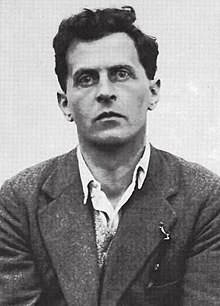


Ludwig Josef Johann Wittgenstein (/ˈvɪtɡənʃtaɪn, -staɪn/;[11] German: [ˈluːtvɪç ˈvɪtgənˌʃtaɪn]; 26 April 1889 – 29 April 1951) was an Austrian-British philosopher who worked primarily in logic, the philosophy of mathematics, the philosophy of mind, and the philosophy of language.[12]
From 1929 to 1947, Wittgenstein taught at the University of Cambridge.[13] During his lifetime he published just one slim book (the 75-page Tractatus Logico-Philosophicus, 1921), one article (“Some Remarks on Logical Form“, 1929), one book review and a children’s dictionary.[14][15] His voluminous manuscripts were edited and published posthumously. Philosophical Investigations appeared as a book in 1953. His teacher, Bertrand Russell, described Wittgenstein as “perhaps the most perfect example I have ever known of genius as traditionally conceived; passionate, profound, intense, and dominating”.[16]
Born in Vienna into one of Europe’s richest families, he inherited a fortune from his father in 1913. He initially made some donations to artists and writers, and then, in a period of severe personal depression after the First World War, he gave away his entire fortune to his brothers and sisters.[17][18] Three of his four brothers committed suicide, which Wittgenstein had also contemplated. He left academia several times—serving as an officer on the front line during World War I, where he was decorated a number of times for his courage; teaching in schools in remote Austrian villages where he encountered controversy for hitting children when they made mistakes in mathematics; and working as a hospital porter during World War II in London, where he told patients not to take the drugs they were prescribed while largely managing to keep secret the fact that he was one of the world’s most famous philosophers.
His philosophy is often divided into an early period, exemplified by the Tractatus, and a later period, articulated in the Philosophical Investigations.[19] “Early Wittgenstein” was concerned with the logical relationship between propositions and the world and he believed that by providing an account of the logic underlying this relationship, he had solved all philosophical problems. “Late Wittgenstein“, however, rejected many of the assumptions of the Tractatus, arguing that the meaning of words is best understood as their use within a given language-game.[20]
A survey among American university and college teachers ranked the Investigations as the most important book of 20th-century philosophy, standing out as “the one crossover masterpiece in twentieth-century philosophy, appealing across diverse specializations and philosophical orientations”.The Investigations also ranked 54th on a list of most influential twentieth-century works in cognitive science prepared by the University of Minnesota‘s Center for Cognitive Sciences.[21] However, in the words of his friend Georg Henrik von Wright, he believed that “his ideas were generally misunderstood and distorted even by those who professed to be his disciples. He doubted he would be better understood in the future. He once said he felt as though he was writing for people who would think in a different way, breathe a different air of life, from that of present-day men.”
Book: “How to Survive the Loss of a Love”

How to Survive the Loss of a Love
(How to Survive)
by Melba Colgrove, Harold H. Bloomfield
Discusses the variety of reactions that people experience because of the loss of a love and provides numerous recommendations for coping with pain and achieving comfort.
Paperback, 212 pages
Published November 21st 2006 by Prelude Press (first published 1977)
Original TitleHow to Survive the Loss of a Love ISBN0931580439 (ISBN13: 9780931580437)
Edition Language: English
(Goodreads.com)
SUNDAY NIGHT TRANSLATION GROUP – 4/26/20
Translators: Mike Zonta, Melissa Goodnight, Richard Branam, Hanz Bolen
SENSE TESTIMONY: Hysteria may make it seem too dangerous to return to economic and personal normalcy.
5th Step Conclusions:
1) Truth is the unique androgynous norm, is rational consideration, is of one Mind, is hazard-free consciousness, is the only domain, is the surety of all happening, is the manager of the infinite household of consciousness in person. OR: Truth is the rational consideration of the unique androgynous norm in person.
2) The One Infinite Consciousness, is always already eternally providing, the optimal sustaining normalcy, that absolutely supports every individuation, in perfect harmonious balance.
3) Truth is the norm, known and able. The Everpresent guidance distributing abundant value and wellness. Truth I Am is the universal integrity in which we dwell, powering expressing all.
4) Truth is Beyond Psychic Essence, the breath of life, Being the Androgynous construct Isomorphed fulfillment purposefully intent on complementary attributes, the principle of the Abstract circuitry innately Functional Identity.
All Translators are welcome to join this group. See Weekly Groups page/tab.