Translators: Mike Zonta, Melissa Goodnight, Richard Branam, Hanz Bolen
SENSE TESTIMONY: Recovery to normality is urgent for sake of physical, mental, and economic health
5th Step Conclusions:
1) The norm of Truth is infinite, limitless ability; the nature of Truth is birthless, deathless Cosmic intention; Truth leaps for joy in self-evident expectation of prosperity.
2) All is One Infinite Consciousness, limitlessly outpicturing in expressively prosperous manifestations: the perfect intact integrity, and whole sound complete wellbeing, that is always already ongoing and abiding.
3) Truth is the Abstract capacious Androgynous Boccaccio, this captivating balance of participation in conceiving, receiving, accepting its own worthy developments in practical utopian affairs, is the guiding prerogative Being highly appropriate behavior with the motive, and purpose in One Infinite Universal Principle: commonwealth community.
4) All is the One Abundant Powerful Knowing Presence of Sound Well Being, Emanating Value physically, mentally, economically, instantaneously and universally now and always. OR: Well Being Emanating Value is all there is.
All Translators are welcome to join this group. See Weekly Groups page/tab.
Russell Brand Under The Skin with illusionist and mentalist Derren Brown. Sign up at luminary.link/russell to subscribe to the podcast from 23rd April. Derren’s new live show, SHOWMAN, will be on tour in the UK from March 27, 2020, and you will be able to book tickets from April 25th from www.derrenbrown.co.uk Get his latest book “Happy” here: https://www.amazon.com/Happy-More-Les… And check out Sacrifice on Netflix!
Many of us might not realize it, but today’s “Democrat vs Republican” duopoly that dominates mainstream American electoral politics is not a given- our party system has been different before, and it will be different again, likely soon. As entrenched and unshakable as it might seem, history teaches us that America’s party system has seen an on-average once-in-a-generation reorganization as a result of demographic and ideological shifts reflecting new policy priorities.
Donald Trump and Bernie Sanders each played a pivotal role in laying the foundations for what will come to be America’s next great party system shift, changing the nature of the Republican and Democratic parties respectively so much that there’s no where left to go other than an outright reorganization of our political party system altogether.
And it’s about time.
Part 1: American Party Systems: A Brief History
The United States began its first presidency without a political party. George Washington not only ran the nation for two terms unaffiliated with any party, but famously warned against them in his farewell address.
“However [political parties] may now and then answer popular ends, they are likely in the course of time and things, to become potent engines, by which cunning, ambitious, and unprincipled men will be enabled to subvert the power of the people and to usurp for themselves the reins of government, destroying afterwards the very engines which have lifted them to unjust dominion.” — George Washington
John Adams wrote not long after:
“There is nothing which I dread so much as a division of the Republic into two great parties, each arranged under its leader, and concerting measures in opposition to each other. This, in my humble apprehension, is to be dreaded as the greatest political evil under our Constitution.”
Another founding father, Alexander Hamilton, wrote:
“Nothing could be more ill-judged than that intolerant spirit which has, at all times, characterized political parties.”
Early warnings against political factions went unheeded. Following the only independent presidency in US history would begin an American tradition that has dominated to this day- the duopoly of two major political factions, as John Adams feared. Every generation, however, the makeup of that duopoly has shifted, with new parties emerging and old ones fading away or shifting, creating what has been dubbed new “Party Systems.” Understanding the trend of party systems will help us to understand what is happening right now.
The First Party System began with the election of 1796. The Federalists, headed by John Adams, were pro big business and strong central government, supportive of conservative England, against the French Revolution and supported by northern businessmen, bankers and merchants. The Democratic-Republicans– led by Thomas Jefferson, were supported by southern artisans and farmers, were pro-states rights and favored Revolutionary France. The Federalists collapsed in 1815, sparking what would come to be known as the Era of Good Feelings, where for almost a decade the Democrat-Republican party was the only show in town, and there was a reduced emphasis on political party affiliation. President James Monroe even wanted to end political parties outright in the name of national unity.
This election is one of the most contested in history, so much so that it had to be decided by the House. The factional tensions that arose within the then-dominant Democratic-Republican party led to the party fracturing. The winner, Andrew Jackson, started off as a Democrat-Republican but his presidency went on to launch the 2nd party system. Out of the remnants of the old Democratic-Republican Party, he would go on to found the Democratic Party. Jackson made many political rivals, especially for his role in the dramatic Bank War, which led to the dissolving of the Bank of the US (the forerunner to the Federal Reserve) and the development of public state banks. His opponents would coalesce under the newly formed Whig Party, which was socially conservative and pro-business. The Democrat/Whig divide would mark the great political duopoly of the 2nd party era. As the 1850’s approached, new political questions were forming, especially around slavery.
In 1860 the anti-slavery Republican party burst onto the national scene- with the election of Abraham Lincoln, ushering in the 3rd party system. Every election from then on would be between Democrats and Republicans, but over time the parties’ composition, who supported them, and what they stood for changed enough that we think of those shifts as creating new party systems.
After the Civil War, the parties were an odd mix, the former Confederates were Democrats, rightly seeing Republicans as responsible for ending slavery, but as the Republicans shifted towards being an anti-immigrant party, northern immigrants shifted towards the Democratic party, beginning the demographic and cultural shifts within these two dominant parties.
The Fourth Party system officially began with the election of 1896, but its seeds began in 1892, when the Populist Party formed in the southern and western parts of the US, which had a generally anti banker and plutocracy leaning with a platform of regulating farm prices and railroad shipping rates, and supporting a national income tax. They won a few congressional elections, but eventually merged with the Democrats for the election of 1896.
The Progressive Era and the fourth party system brought a change in the composition of electoral politics. This era, which lasted into the early 1930’s, was marked by attacks on political machines, regulations on big business, antitrust laws, women’s suffrage, labor movements, worker’s rights, the establishment of the Public Bank of North Dakota and credit unions, and other similar progressive policies. Following the rise of the People’s Party, the Socialist Party was created in 1901, and then in the election of 1912, former Republican president Theodore Roosevelt came roaring back to make a historical 2nd bid for the presidency under his newly formed Progressive Party, which under Roosevelt’s brand of “New Nationalism” would mark the only time in American history a third party would win 2nd place in a national election.
The rise and fall of the People’s, Socialist and Progressive parties taught us that in American presidential politics, 3rd parties haven’t won due to how American elections are structured. That doesn’t mean they’re inconsequential though. While the progressive zeitgeist of the fourth party system was never truly reflected at the highest echelons of power in the United States, it still served to galvanize local and state politics, inspire the masses to organize from the grassroots, and get the mainstream parties to drift leftward. Today, for example, the Green New Deal, proposed by Democrats after the 2018 midterm elections, was first proposed on the Green Party platform in 2006.
The great depression began in 1929 after years of pro-business Republican policies leading to a boom-bust cycle that finally imploded in that year, ensuring that by the upcoming election of 1932, the people would be clamoring for something different. The pattern of years of Republican domination in politics was upended when Franklin Roosevelt, after barely winning a contested democratic convention, defeated the Republican incumbent in a landslide, carrying 46 states in the general election on his New Deal platform. The Democratic party under FDR’s leadership so shifted its priorities that a new party system was born.
The New Deal Democratic Party and it’s big government leftward lean would reverberate through the Voting Rights Act and Lyndon Johnson’s “Great Society” initiative. It is during this era that New Deal Democrats brought in a wider coalition of progressives and the working class, southern farmers who were drawn to New Deal farm policies and Catholic immigrants and African Americans who would now be shifting their support away from what was once the party of Lincoln. This “New Deal Coalition” would more or less solidify the demographic makeup of the Democratic party for generations.
Unlike the previous five party systems, there is no clear electoral event to delineate the sixth. But it is widely interpreted to have begun in the 1960’s when the South, a former Democrat stronghold, became firmly Republican and the party generally increased in strength, into the slowly morphing cultural shifts of the 1990’s. Whereas the national parties were once mostly aligned based on class, today they are aligned more on social values. For example, white working class men, who were once a demographic stronghold for progressive democrats, are now more likely to vote Republican along cultural lines, while many in the middle and upper economic classes are social liberals who vote Democrat.
Part 2: The State of Affairs Today
This equilibrium was upended by the 2016 election, when Trump trounced the Republican Party establishment on his unconventional nationalist agenda and Bernie Sanders, a Progressive and New Deal style Democrat posed a credible threat to the Democratic front-runner and galvanized a new progressive movement, which has only been strengthening since. Bernie forced the mainstream democratic establishment to reluctantly contend with calls to free college, universal healthcare and regulations on the big banks due to their growing grassroots following.
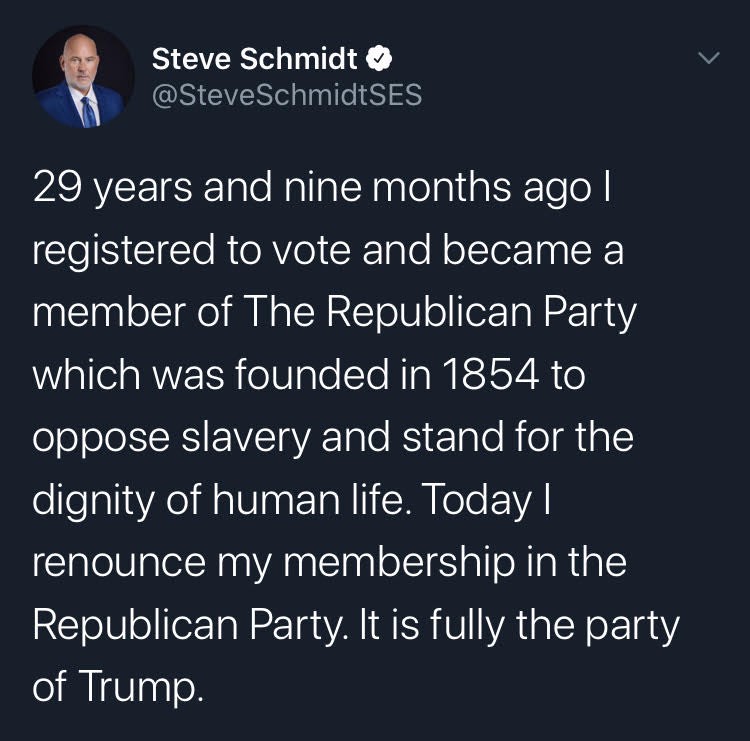
In 2016, the Republican Party can consider to have had a significant realignment, both as the result of long-term trends and the Trump factor. Whether these seeds of disruption are headed towards party restructuring (as happened during the Southern switch) or outright dissolving to make way for a successor party (as happened to the Federalists and the Whigs) is yet to be seen.
As for the Democratic Party, the path is different, but the destination seems similar. Internal contradictions indicate lack of long term viability for status quo preservation. The party has settled into two distinct camps: the “Moderate” and “Progressive” wings as they call themselves, or the “Corporate” and “Radical” wings as they call each other, respectively. In the case of the Democrats, it’s clearer that the likelihood is much higher for party destruction. Disillusionment with the progressive wing of the Democratic Party grew in 2016 when Sanders supporters felt muscled out by the Party machine via superdelegate tipping of primary elections that many considered outright rigging.
Progressives bided the years under Trump’s administration. “Hindsight,” they said, “is 2020.” The Bernie campaign would come roaring back from the grassroots, with rally crowds and volunteer door knockers and phone bankers far outnumbering his opponents, spurred by the influence of the newly arrived Alexandria Ocasio-Cortez, a new generation of Berniecrat that would come to epitomize the millennial progressive wing of the increasingly fracturing Democratic Party.
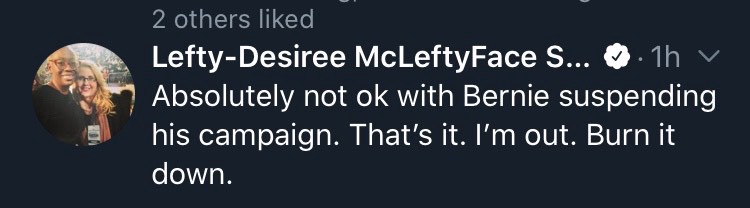
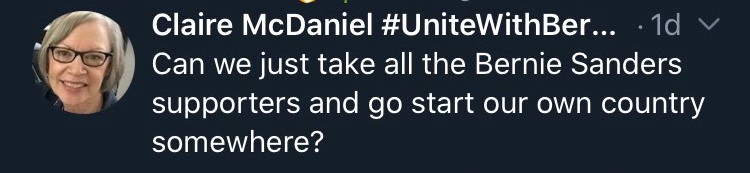
While elements of the mainstream-minded Democrats pronounce “blue no matter who,” and pledge to support whoever the candidate is because “they are better than Trump,” the Progressive wing of the party has now reached a fever-pitch of impatience. To vote anything “no matter who” is a total repudiation of the very purpose of voting itself, which is to exercise the power of choice towards a candidate that reflects your values. With what progressives feel is a back-to-back betrayal of their movement, there is significant disillusionment and in echo of 2016’s “Bernie or Bust” sentiment, a #neverbiden wing of Bernie supporters are committed to standing their ground, regardless of mainstream Democrats’ threats that that will help Trump’s chances in November. That rationale, they feel, is blackmail.
Bernie’s role, ultimately, was not to become president and reign over a Democratic-Socialist administration of the country from the top-down, like Roosevelt. His role was more cultural and nuanced, but no less profound-it was to inspire a leftward consciousness shift, galvanize a grassroots movement, and ultimately, in the end, lay the seeds for the destruction of the Democratic Party. Remember, Bernie Sanders is himself not a Democrat. From the beginning of his political career in 1981 until 2015, just before his 2016 candidacy, he was registered Independent, and only switched to run under the party banner. Yes, he pledged loyalty to the party, and endorsed Hillary and Biden after his losses, but he did so as political chess moves to keep his role as a power player on the inside while his legacy winks and nods to the grassroots. Make no mistake, this was an infiltration. That’s why Party insiders fought to the hilt to keep him out.
2020, or maybe 2024, will join the ranks of 1796, 1824, 1860, 1896 and 1932- years where a decisive election caused an irreversible party realignment and the birth of a new Party System.
Bernie’s role echoes the role of the left during the progressive era, a force that didn’t quite take power at the top, but which nonetheless sparked a grassroots cultural shift that made progressive policies comprehended, sought after, and eventually achieved.
The rise of the progressives led to a shift from the 3rd to the 4th party systems. The Great Depression led to rise of the 5th party system. The transition from the more amorphous 6th party system to the upcoming 7th party system has not only the rise of progressivism fracturing the Democratic Party, but an unfolding economic crisis, Trump’s realignment of the Republican Party, and a cultural divide centrifugally widening by radicalizing social media bubbles. It’s the perfect storm.
There has been a long-brewing disillusionment with the duopoly that is only now coming to fever-pitch. For over a decade, “Independent” has been the fastest-growing party affiliation.
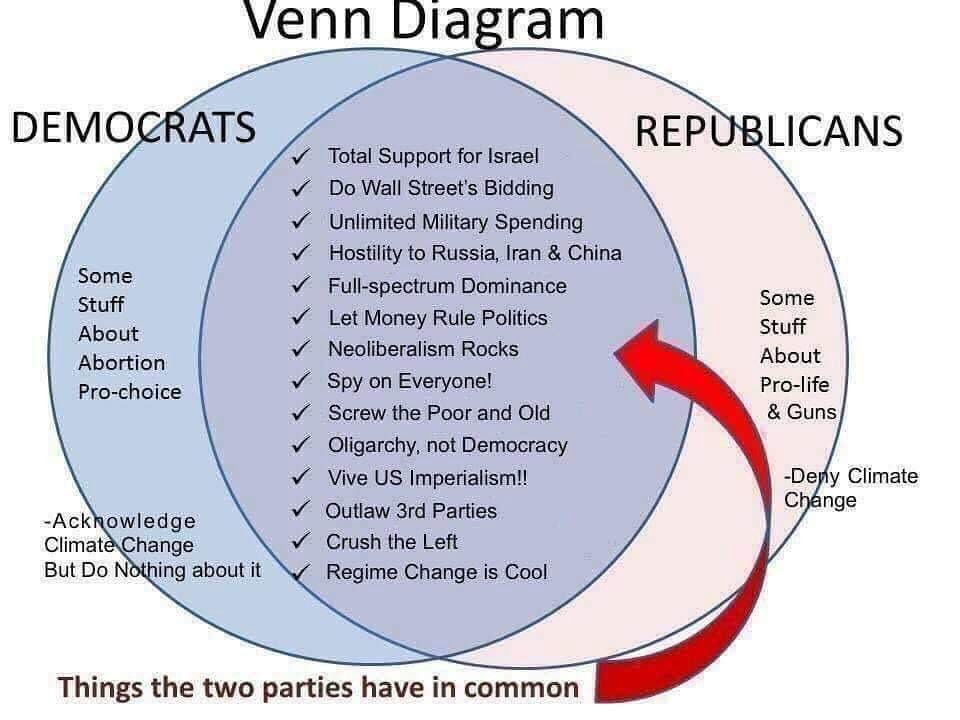
While the Democratic party, riding the coattails of its New Deal legacy, is assumed to be the “party of the working class,” the sixth party system has seen the Democratic Party as sympathetic towards Wall St. as its supposed rival, while many working class voters flocked to Trump, plutocrat member of the elite, in an ironic protest against the elite.
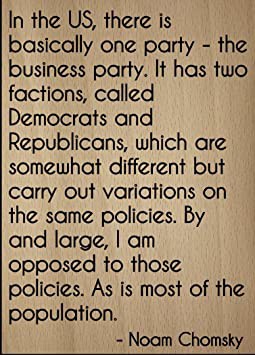
“The smart way to keep people passive and obedient is to strictly limit the spectrum of acceptable opinion, but allow very lively debate within that spectrum” -Noam Chomsky
There is no longer a party based on class interests, merely liberal and conservative culture and lifestyle– class, except for within the emerging progressive wing, has been left out of it, and that means the center will not be able to hold for long.
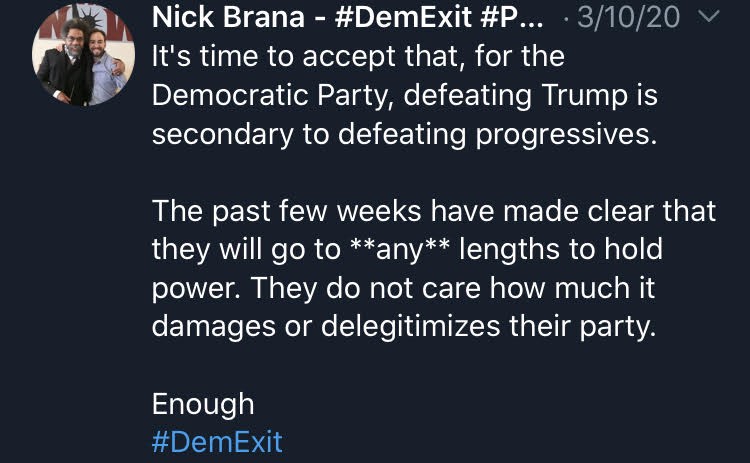
Now, #demexit is trending, and what began as a hole in the Democratic dam in 2016 is culminating into a full on Democratic Party crisis.
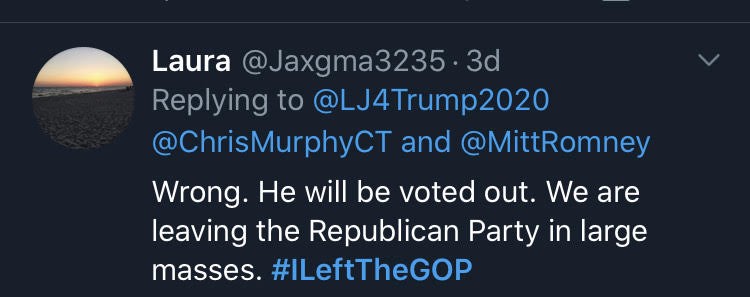
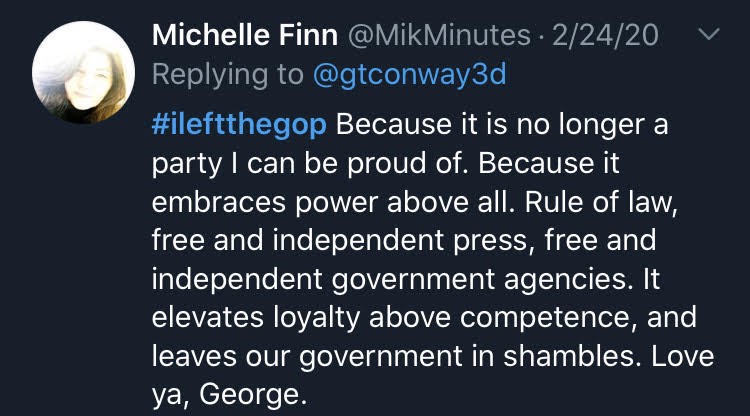
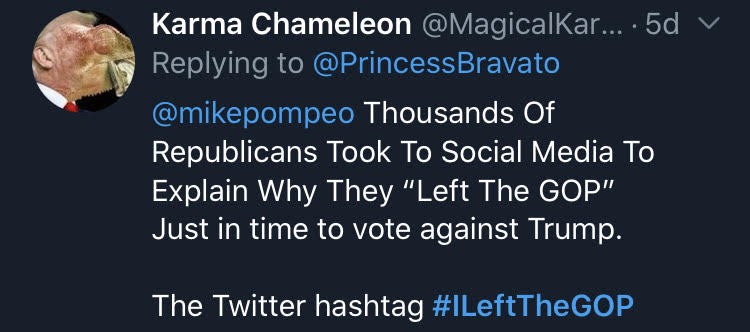
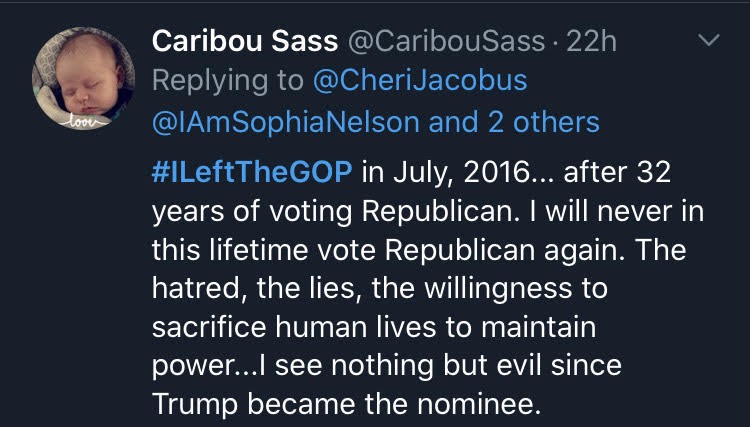
…and the Republican Party is facing its own crisis of identity as #ileftthegop is beginning to trend.
In 2012, Jesse Ventura published DemoCRIPS and ReBLOODicans, a book that likened the political parties to thuggish gangs. He’s called for the outright abolition of political parties and for their conversion into political action committees, as well as removing party designations from ballots, which would force voters to educate themselves on policies rather than blindly following a “D” or “R”. He echoes the sentiment of Washington, Adams and Hamilton in their aversion to parties, or ‘factions’ as they called them. Perhaps the 7th party will see the rise of a new conservative party and a rising Progressive Party that completes the job Teddy Roosevelt started, or perhaps the 7th party will be an outright political paradigm shift away from our party system altogether. The way the roaring 2020’s is starting, anything is possible.
America’s two party system has transformed before, and it will transform again. It’s degenerated into a duopoly of narrow corporate interests and is already on the inevitable throes of upheaval. Why wait? Many of us have known this for some time but clung on to a sliver of hope that the party might come to serve our interests. With the epic upheaval of the Coronavirus, the massively organized and inspired grassroots, and the 100% loss of hope that progressives have for the Democratic Party, the iron is as hot as it’s ever going to be.
“That which is falling should also be pushed.” Nietzsche
Today, I’m pleading with you to be bold and help build a new system from the ground up. I look forward to my follow up- when a progressive party has gained real traction and I then plead with the progressive leaders inside the Democratic establishment, like AOC, to jump ship. Once the dominoes start falling, the New Era will have begun.
The coronavirus is telling us that NOW is the time for us to WAKE UP to our True Identity as consciousness! When you identify AS Consciousness – your creativity flows! And no one but you can WAKE UP and draw this out! It is your unique life signature!
Come to my ZOOM DRAWING CLASS! It begins Wednesday, May 6 and ends June 24! We’ll meet weekly for one hour to meditate upon the power of our perception. We’ll learn and practice SEEING WITH NEW EYES.
DATE: Every Wednesday May 6 through June 24, 2020 TIME: 9:00 am Pacific / 10:00 am Mtn / 11:00 am Central / Noon Eastern FEE: Contribution basis ZOOM LINK:https://us02web.zoom.us/j/87487726434
Will Coronavirus Finish the Job of Killing the Struggling US Economy?
See that chart above? The line plunging into the abyss? That’s an economy having a heart attack and dying.
The line is GDP. It just fell to about -5%, from 2%. That’s a fall of seven percent in the first quarter of 2020. The first quarter of 2020 was of course just the very beginning of the crisis — to March or so, when lockdown weren’t even fully in place. So just the beginning of the crisis cratered GDP by seven percent. What about the second quarter — aka a whole nation paralyzed, at a standstill? How much more will GDP fall when the reckoning finally comes? 15%? 25%? 35%? Bang!
The answer is: nobody knows, but it’s not going to be pretty. Coronavirus is already blowing past the worst expectations for economic damage. What’s about to happen next, in my estimation, is going to be truly catastrophic.
There are two schools of thought on how history unfolds next. One — the one favored by pundits and American intellectuals says: the economy will bounce back magically, as soon as lockdown are lifted! There’s nothing to worry about! And besides — working, even if your health still at risk, is what matters most, not your life.
I couldn’t disagree more. I don’t think the economy is going to bounce back, I think that this crisis shows us just how fragile the economy really was, and I don’t think that putting people at risk by making them go back to work or get fired is a substitute for…a working economy.
We are now entering the Coronavirus Depression. The economy won’t bounce back, magically, once lockdowns are lifted. Why not? For many, many reasons. The most obvious is that waves of businesses are already closing. So many of the job losses America’s suffering now — a record 26 million have filed for unemployment — are going to be permanent.
There’s another way to to put that. Coronavirus is going to do the job of transforming the American economy. For decades now, it’s been an economy where mega-monopolies offering people low-wage, dead end jobs have been replacing small and medium sized businesses — or even yesterday’s industrial giants — offering people a secure, stable middle class living. By annihilating huge chunks of small and medium sized business, Coronavirus is offering mega-monopoly the economy on a platter. All those “distressed assets” — whether storefronts or, well, unemployed people? Mega-monopolies can now buy them up on the cheap.
Think of who’s really done well from Coronavirus: the answer is all mega-monopolies. Amazon. Facebook. Google. Netflix. And so forth. These businesses exist on a spectrum from predatory — Facebook and Amazon, who subsist by paying lower taxes than you — to merely benign, like Netflix. What they don’t do, though, is employ masses of people in stable, secure middle class jobs, which provide decent lives. Instead, they lay the groundwork for an economy of technofeudalism — people eke out a living by driving an Uber tonight, selling junk on Amazon tomorrow, maybe delivering Instacart groceries the day after. The transformation of America into an economy of titanic mega-monopolies is going to be accelerated by Coronavirus, massively.
As people compete harder for a much, much smaller pool of jobs, another dismal American trend is likely to harden: wage stagnation. Real average American incomes haven’t grown in fifty years. But what do mega-monopolies really offer? Half of Americans work in “low-wage service jobs” — and that was before Coronavirus. Think of it for a second: a full half of Americans effectively now form something like a class of servants to the upper ten percent or so, driving their cars, walking their dogs, cleaning their homes.
The lesson is: mega-monopolies don’t just use their power, they abuse it. America’s labour market, already beset by decades of underpaid wages and overworked lives, is going to harden along just those lines.
Think of your average owner of a small business — now wiped out by Coronavirus, since the stimulus and rescue packages were laughably small, offering just a week’s worth of support to households and businesses. There she is — once following her passion. Now she has to spend months, maybe years, winding down debt, paying off what she can, negotiating with creditors. How likely is she ever to try her hand at entrepreneurship again — after being scarred by it for a lifetime?
But the effect is not just on her. It’s on all those she might have employed — and tried to take care of, too. Maybe at her microbrewery or bakery, she tried to run it along ethical lines, paying people a decent wage, offering good healthcare and retirement, even childcare, so that everyone could really put their heart and soul into their work. Bang! There’s a hundred jobs like that — which would have been a thousand in five years — vanished. Just gone up in smoke. Multiply that by a million, and you begin to see the devastating effect of Coronavirus on the economy.
All those people she might have employed in decent jobs — what happens to them? Well, since the economy base has now shifted decisively to mega-monopoly, that’s what they have left to choose from. The pundits and economists who gush over that shift speak of “freedom” — but all these people know is that they’re eking out a living doing gig work. Driving an Uber today, delivering Amazon packages tomorrow, and so on. But this kind of labour rewinds centuries in time: like the stuff of Dickensian England, it’s piecework, which offers no benefits, no guarantees, not even a stable income or wage.
People are plunged into fresh poverty — another trend that’s been accelerating in America, which is now going to harden. The American middle class became a minority around 2011 or so, for the first time in economic history. The reason? Another gruesome trend — I call it invisible hyperinflation. Since the 1990s, the prices of basics in America have risen astronomically. Healthcare? Education? Food? Retirement? All these things now costs thousands of percent more than they did just a few decades ago. Americans tend to think hyperinflation is something that happens in poor countries — and they’re right. The part they miss is that they’re one, too, now.
So if your income hasn’t risen in fifty years — but feeding your kid, educating your kid, providing healthcare for your family, each now cost as much as a home…what the hell do you do?
You go into debt, of course. Which is why Americans now live and die in debt. But that, of course, is exactly what poverty is: being stuck perpetually trying to erase the burden of unpayable debts.
What Americans don’t seem to understand is that on the incomes they earn, the debts they owe can never be repaid. That is precisely why retirement and home ownership have become distant, impossible dreams, especially amongst young people, who speak of such things with irony, to distance themselves from the pain of living a life falling apart.
America was becoming a poor society long before Coronavirus — but Coronavirus is going to finish the job of driving the average American into deep, enduring, life-long poverty, from which there’s no real escape. Translation: bills are going to go up, up, up, and wages are going to fall, so real incomes are going to go down, sharply.
What happens to societies that grow poor? They find themselves in a vicious spiral. People can’t put food on their own table — so how are they to fund things like decent hospitals, schools, universities, parks, and libraries for everyone else? If you can’t make ends meet — how can you look for anyone else, let alone everyone else?
So as societies grow poorer, their tax bases begin to decline. You can already see that effect at work in America’s Red States. Deindustrialized, full of decrepit Rust Belt towns, they have to be subsidized by Blue States, which is where the work of technocapitalism goes on, from San Francisco to LA to Manhattan. But such states can’t even really afford to run school systems or transport networks on their own at this point — which is why, incidentally, the whole country’s are falling apart.
A country of people too poor to make ends meet can’t afford an expansive social contract of generous public goods, like in Canada or Europe — good healthcare, education, retirement, childcare, for everyone. Instead, it sinks into the even deeper poverty of having no real functioning social systems.
By making America a society of poor people, Coronavirus is going to seal in its fate: it’s already gone without European or Canadian social contract and public goods, and now things like public healthcare and retirement and childcare will simply become economic impossibilities.
Especially, when, remember, the Facebooks and Amazons of the world pay less tax than you do.
What’s the further political effect of that — sinking into a kind of irreversible decline, into deeper poverty — the poverty not just of one’s own short-term personal deprivation, but of having no functioning social contract or social systems to support you, either? What happens when a whole society suddenly grows too poor to really act like a society?
Red States give us a clue — though the answer’s already in the question. What happens as people get suddenly poorer — especially people who expected upwards mobility into stable, middle class lives — is that they turn ugly. Rage becomes hate. Frustration simmers over into vilification. They turn to authoritarians who tell them “they’ll be Great Again!”
How is it that Red States are subsidized by Blue States — but they’re also the ones who want less government and investment? What the? It makes perfect sense if you think about it this way: the poor Red Stater wants everything for themselves. They understand the economy is shrinking, and they are trying to claim what morsels are left for themselves. What they mean by “less government” is really “I can’t pay taxes on my tiny or nonexistent income — but I need as much support as I can get!”
Red States, in other words, have been decivilized. Life has been reduced to a brutal contest for self-preservation — even at everyone else’s expense. That is why the average Red Stater is a buffoon and a mystery to the entire rest of the world. What kind of person votes agains their own education, retirement, healthcare…over and over again? A person who can’t afford it, is the answer.
Being too poor to care about anyone else at all, though, is a terrible plight. That is the effect of poverty that American intellectuals and thinkers don’t understand yet: they’ve long thought of it as a necessary punishment, the handmaiden of virtue, doled out justly to the lazy and foolish. But they don’t get that deep poverty of the kind America’s fallen into decivilizes people, right back into superstition, rage, fear, authoritarianism, hate, and cruelty, as the desperate impulse for self-preservation overrides any — by now long-forgotten — sentiment of generosity, kindness, compassion, or sanity.
The world looks at Red State America and sees — bewildered, mystified, horrified — people who don’t care if their kids have to do “active shooter drills” or pay “lunch debt”, if they have to go into “medical bankruptcy”, who tote guns but don’t read books, and so forth. The caricature’s true, but in a sad, indecent way. They’ve been left too poor by decades of neoliberalism and predatory capitalism to do anything but try to survive, by whatever means necessary.
Let me summarize. Coronavirus is going to finish the job of killing off the American economy. It will complete the transformation of a once entrepreneurial economy which, even if it lacked public goods, still offered people some semblance of mobility, stability, middle class life — into a kind of caste economy of new poor and ultra rich, without much in the middle. At the top, a tiny numbers of owners of capital — Bezos, Zuck, today’s CEO of Goldman Sachs. Below them, a small 1% of their lieutenants. And then everyone else, trying to scrape together a living, whatever gig or low-wage service job comes their way today.
In such an economy, education doesn’t count much — see how today’s PhDs already face mass unemployment. Neither does hard work, because there’s nowhere to go, really. What counts is being a certain kind of person. Brutal, selfish, greedy, avaricious, thoughtless, ignorant, foolish. Like a member of the Trump family, essentially. Such people will rise. And they will do what they do best, which is the only thing know how to do. Abuse their power for their own benefit and gain — at everyone else’s expense, even if that “expense” is, like right about now, death on an unimaginable scale.
Welcome to the Coronavirus Depression. It’s going to be ugly. Brutal. Remorseless. And most of all, unnecessary — because the truth is that a stimulus response as big as the crisis would have stopped it dead in its tracks. But you already knew that, deep in your gut, didn’t you? Now you know why there wasn’t one, too. A cynic might even say: this is how historic catastrophes are exploited by fools, wise men, and preening monsters — and glittering dark ages are born.
The Department of Defense isn’t admitting that aliens exist. But apparently they don’t mind if you check out their sweet rides.
A still from a video of a flying object taken by a Navy pilot’s camera.PHOTOGRAPH: U.S. DEPARTMENT OF DEFENSE
ON MONDAY, THE US Department of Defense officially released three videos depicting encounters between Navy pilots and unidentified aerial phenomena. These events occurred in 2004 and 2015, but the videos didn’t publicly surface until The New York Times included them with a front-page story about the Pentagon’s “mysterious UFO program” in 2017. The Navy previously acknowledged that the videos are authentic, but the Pentagon never authorized them for release. Now it has.
Each of the three videos contains footage captured by Navy pilots that show a strange-looking oval zipping through the air and over the ocean. In a video from 2015 called “Gimbal,” a flying object shaped like a Tic Tac whips through the clouds before it slows and begins to rotate. The pilot filming the encounter describes it over the radio as “a fucking drone, bro.” In another video from 2015, referred to as “Go Fast,” a small white speck is tracked by a jet’s infrared system as it flies low over the ocean. The oldest video, “FLIR1,” is also from a jet infrared system and shows an oval object rapidly accelerating.
The videos were originally published by The New York Times and To the Stars Academy of Arts and Sciences, a company founded by former Blink-182 frontman Tom DeLonge to research UFOs and other unexplained phenomena. When the videos were released in 2017, To the Stars staffers claimed that the footage had “been through the official declassification review process and has been approved for public release.”
“All videos were previously reviewed by the cognizant DOD authority under the 1910 process and were cleared for ‘unrestricted release’ by the Defense Office of Prepublication Security Review,” says Luis Elizondo, To the Stars’ director of government programs and services. Elizondo is a former Department of Defense employee who claims to have led its Advanced Aerospace Threat Identification Program, the “mysterious UFO program” alluded to in the Times report. The “1910 process” refers to the Defense Department form 1910 used to request clearance to release DOD information to the public.
But in their statement this week, Pentagon officials describe the 2017 release as “unauthorized.” Three years later, the DOD is finally ready to authorize the videos … even though they’ve already been watched by millions of people. “After a thorough review, the department has determined that the authorized release of these unclassified videos does not reveal any sensitive capabilities or systems, and does not impinge on any subsequent investigations of military air space incursions by unidentified aerial phenomena,” Department of Defense officials wrote in a press release published on Monday.
(As of press time, a spokesperson for the US Navy had not returned a request for comment.)
So does the official authorization of these videos mean the Pentagon has finally admitted that aliens exist? Nope. For starters, anything the military labels “unidentified” is not necessarily extraterrestrial. It’s just something in the sky that military officials can’t explain—civil and military pilots see unidentified aircraft all the time. Could they be piloted by little green men? Sure, if you have an active imagination. But usually they turn out to be something much more mundane—an atmospheric illusion, an undisclosed military drill, a satellite, or evidence of a tired pilot’s brain playing tricks on them.
In the case of the videos released this week by the Pentagon, it’s still unclear what’s in them. As a Department of Defense staffer notes in the press release, “the aerial phenomena observed in the videos remain characterized as ‘unidentified.’” The flying objects in the video might be aircraft, but if they are, they don’t move like any aircraft we’re familiar with. Audio from the 2015 video suggests that even the pilots who filmed it couldn’t understand what they were seeing. “What the fuck is that thing?” one of the pilots asks over the radio.
If these were evidence of extraterrestrial activity, or even just advanced military aircraft built by another country, one would expect that the Pentagon would classify those videos faster than you can say “Freedom of Information Act.” But here’s the thing: The DOD described the videos released this week as unclassified, which is not the same thing as declassified. Unclassified means that the military never thought the information was sensitive enough to slap national security restrictions on it in the first place. A spokesperson for the Department of Defense told WIRED that “imagery from military aircraft are routinely treated as classified until they are reviewed” and that a copy of the FLIR video had been “erroneously marked as classified during the intelligence investigation process.” According to the press release, the reason the Pentagon decided to release the videos was “to clear up any misconceptions by the public on whether or not the footage that has been circulating was real, or whether or not there is more to the videos.
“The investigation into unidentified incursions into military airspace involves various intelligence methods and agencies, which means these videos were part of classified investigations,” a spokesperson for the Department of Defense told WIRED in an email. “The videos themselves were eventually deemed unclassified, but we do not release information that is part of ongoing investigations.”
Ultimately, the release of these videos is nothing more than the Defense Department giving them an official stamp of approval. But that doesn’t mean the mystery is finished. “This historic acknowledgement will cause a seismic shift in the attitudes and stigma surrounding these events, allowing more reputable institutions to openly share reliable data for research,” says Elizondo. “It will be looked at for years to come as a fundamental step in gaining people’s trust.”
Unless, of course, you trust no one.
Updated 4-29-2020, 12:40 pm EDT: This story was updated with comment from the Department of Defense.
Daniel Oberhaus is a staff writer at WIRED, where he covers space exploration and the future of energy. He is the author of Extraterrestrial Languages (MIT Press, 2019) and was previously the news editor at Motherboard.
A vaccine against Covid-19 developed in Britain has shown very encouraging results on rhesus macaque monkeys, among the animals closest to humans. The scientists working on the vaccine estimate that if they can prove its effectiveness, it could be ready as soon as September.
Its name is a mouthful, but it’s the vaccine on everyone’s lips: The ChAdOx1 nCoV-19, currently being developed by Oxford University scientists, has in recent days shot ahead to become the most promising potential vaccine against the novel coronavirus.
On Thursday, the British drug maker AstraZeneca said it would help Oxford develop, produce and distribute the vaccine.
“Our hope is that, by joining forces, we can accelerate the globalisation of a vaccine to combat the virus and protect people from the deadliest pandemic in a generation,” AstraZeneca Chief Executive Pascal Soriot said.
The partnership hopes to produce 100 million doses by the end of the year and prioritise supply in the UK, Soriot told the Financial Times.
The first good news came last week from a laboratory in the US state of Montana, where six rhesus macaques, who received a dose of the British vaccine a month ago, did not contract Covid-19 after being exposed to it. Other monkeys who had not been vaccinated caught the virus and fell ill.
“The rhesus macaque is pretty much the closest thing we have to humans,” Vincent Munster, the scientist who conducted the experiment, told The New York Times.
Morgane Bomsel, a molecular biologist working on Covid-19 at the Cochin Institute in Paris, agrees. “It’s true that it’s better than if the tests had been carried out on mice,” she told FRANCE 24.
Bomsel considers the results encouraging, but warns against celebrating too soon, if only because details of the experiment conducted in Montana have not yet been published. “We don’t know yet, for example, what dose of the virus the macaques were exposed to, or how they were contaminated,” she said.
“The goal is to ensure that the vaccine is not toxic for the human body,” Bomsel said. In other words, before checking whether the ChAdOx1 nCov-19 protects from Covid-19, the researchers first need to guarantee that it is not dangerous.
The next step usually is to “take blood samples from the subjects to check for the presence of antibodies and the effectiveness of the vaccine against the coronavirus”, Bomsel explained.
If the trial produces positive results, millions of doses of ChAdOx1 nCov-19 could be available as early as September, Oxford researchers told the New York Times, months ahead of other known efforts.
“Usually, in fact, it takes about 18 months,” a member of the crisis cell of the French Society for Virology (SVF), a network of over 1,000 virologists from different laboratories, told FRANCE 24.
Modular vaccine
The Oxford scientists might be able to work at record speed “because in a sense, this vaccine isn’t new”, said the SVF virologist, who asked to remain anonymous because she did not want to involve her employer in the debate.
The researchers used a “technological platform with which they already have quite a lot of experience”, she said.
The core of the vaccine – ChAdOx1 – is an adenovirus: that is, it belongs to a family of viruses that have a mild effect on humans, and it is present in chimpanzees.
“It exists in humans as well, but researchers preferred to take it from monkeys to be certain that the human body has not already developed antibodies to protect against it,” she explained.
It is then combined with parts of another virus to make a vaccine. Researchers at Oxford have already used ChAdOx1 in the past to test vaccines against Ebola, Chikungunya, Rift Valley fever and, above all, the Middle East Respiratory Syndrome (MERS) virus, a coronavirus related to Covid-19 that was first reported in 2012. British scientists had very encouraging results in the latter case, especially with tests on rhesus macaques.
For the current coronavirus, they simply “added the surface protein of Covid-19 to ChAdOx1”, said Bomsel. That is the part of the virus that allows it to attach to the host cells and infect them. The purpose of the vaccine would therefore be to allow the human body to develop defenses against this mechanism of attaching to a human cell.
Since the technology is already in place and they have already tested humans for other vaccines using ChAdOx1, the Oxford scientists were quickly able to adapt it to the current pandemic and develop the clinical trial protocols.
Ring vaccination strategy
But even if the results of the clinical trial currently under way end up being promising, it will still be too early to celebrate.
The following step, Phase III of the vaccine’s development, will be to administer it to volunteers who will then be released back into their regular environments where they could be exposed naturally to the virus. The complete process of ensuring that these subjects are effectively immune to the disease can take up to three years.
So how can British scientists commit to providing doses of ChAdOx1 by September if the trials succeed? By following a specific procedure for cases where there is not enough time to complete testing: ring vaccination.
“The idea is to administer the vaccine to members of the first circle of contacts of people who fall ill with the virus, and then to observe whether the virus contaminates the second circle. That way, it’s possible both to vaccinate and to evaluate,” explained the French virologist.
While the experts interviewed by FRANCE 24 recognised that the work of the Oxford team was very promising, they said other possible vaccines – like those being developed by the American pharmaceutical companies Inovio and Moderna – might also be in advanced stages of research by the autumn.
Despite the encouraging news, there is no guarantee that the vaccines will work. But even if the efforts at Oxford University are unsuccessful, Bomsel said, “we will at least have learned a lot about how the body’s immune system fights this virus”.
The FSV virologist was even more optimistic: “Even if the vaccine won’t successfully immunise the body against Covid-19, we can still hope that it will reduce the severity of the virus,” she said.
That alone would be preferable to watching, more or less helplessly, as the number of coronavirus victims grows every day.
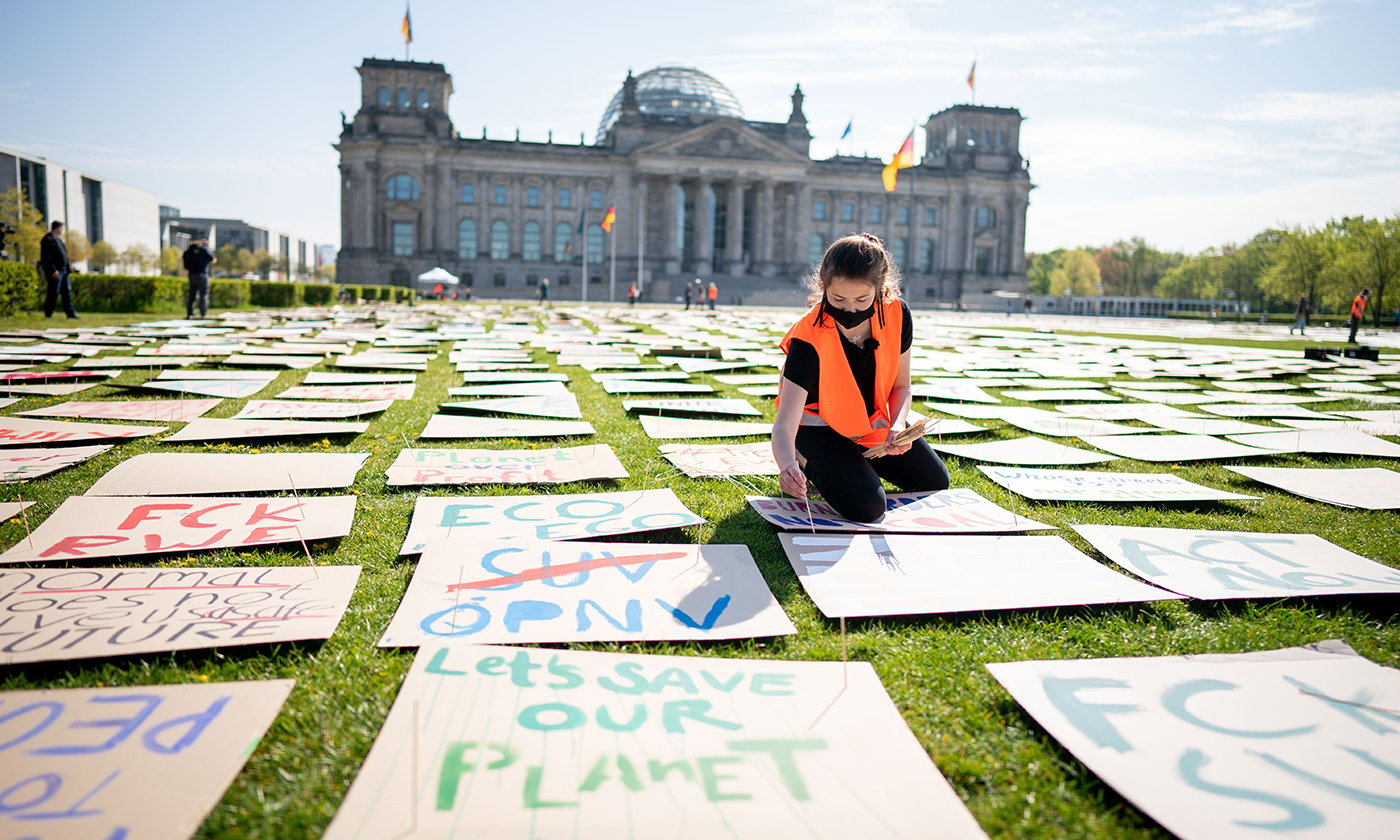
Luisa Neubauer of Fridays for Future lays out protest posters for the alternative climate strike on the Reichstag meadow in Berlin, Germany on April 24, 2020. Because of the continuing spread of the corona virus, the climate strike is being digitally distributed online. PHOTO BY KAY NIETFELD / PICTURE ALLIANCE / GETTY IMAGES
Students across generations are flocking to online crash courses on movement building and the Green New Deal.
On any given weekday before the coronavirus pandemic hit, Michelle Cohen could be found in her Los Angeles office advising students on how to apply for an apprenticeship, or which classes they need to take before earning a high school equivalency diploma. But when public schools in the district shifted to online learning in March, Cohen, who has been an educator for more than 20 years, decided to embrace a new role as a student, in a class led by two instructors who were decades younger than her.
Cohen, who is 53, felt a little uncomfortable at first. Some of the other students in the Zoom classroom were clad in matching pajama sets, sitting knee-to-knee on the floor with siblings, with twin beds and movie posters behind them. “Am I a weirdo?” she asked herself, thinking she could be her classmates’ mother, even grandmother. Eventually, in a breakout room, Cohen was relieved to find that plenty of other adults were in the class, some of whom were older than her.
Sunrise School, as it’s called, is an online training program the youth-led climate activist organization the Sunrise Movement pulled together as soon as it became clear that students would be stuck at home for the spring semester. The group has three levels of online learning experiences designed to train thousands of new leaders in how to push elected officials to pass a Green New Deal.
Cohen enrolled in “The Green New Deal & Coronavirus Crash Course,” an intro class, and showed up every day at 6 p.m. for the four sessions. Amid California’s shelter-in-place order, it felt good to see the same group of people every night, dialing in from across the U.S. and Canada. Her teachers, Genai Lewis and Simon Metcalf, both in their mid-20s, explained what the class would cover with a set of minimalist slides splashed with text and borders in the yellow, black, and white customary of the Sunrise Movement’s T-shirts and protest banners.
Students were asked to analyze a black-and-white photo of a bread line, and to list some of the programs that emerged from the Great Depression, such as Social Security and the Federal Deposit Insurance Corporation. Metcalf went on to highlight some of the parallels between the economic fallout of the 1930s and that unfolding in 2020, including unemployment rates between 25% and 30%. The Green New Deal has the potential to jumpstart the economy through green infrastructure projects that employ people on a similar scale as The New Deal, Metcalf explained, though it will take massive political pressure if it is to be an equitable suite of policies. “There was a lot of racism in the original New Deal,” he says, pointing to how the Federal Housing Authority pioneered redlining.
The class dove into the legislative process, too, Cohen recalls. “They taught me about what an ‘appetizer bill’ is,” she says, referring to how programs that rose out of President Franklin D. Roosevelt’s first 100 days in office in 1933, known as the First New Deal, were far less progressive than those introduced as part of the Second New Deal in 1935 and 1936. “You can’t throw everything you want into the first bill,” Cohen sums up.
An Education in Activism Online
The Sunrise Movement isn’t the only youth-led climate group bringing lectures, homework, and pop quizzes to the screens and smartphones we’re all glued to. Fridays For Future, the youth climate action group founded by Swedish activist Greta Thunberg, has hosted regular Friday digital strikes and webinars featuring the likes of activist and award-winning writer Naomi Klein. And the BIPOC-led youth activist group Zero Hour has put out podcasts focused on a new theme each week aiming to call attention to the root causes of the climate crisis.
The lessons these groups are creating appear to be in high demand. According to Aru Shiney-Ajay, the Sunrise Movement’s training director, the group expected about 600 students for the first session of the crash course Cohen completed in March. As it turned out, 3,500 people signed up. At the time of this writing, 10,000 people have completed a Sunrise School course.
Digital organizing has also served as an outlet for young activists who are antsy and anxious at home. Yolian Ogbu is a 20-year-old political science major and part of Zero Hour’s operations team. Amid the lockdown in Denton, Texas, Ogbu says, focusing on school has become nearly impossible. “I’m sitting here doing essays thinking about my parents that have to go to work every day, because they’re considered essential, and not get paid hardly anything to put their lives on the line,” she says. Her mother works as a nurse, and her father is a truck driver.
What Ogbu does have brain space and energy for, she says, is jumping on Slack or Zoom to connect with other organizers. As a result of collaborations with Zero Hour members across the country, the internet is exploding with webinars, Tik-Tok videos, Facebook Live events, Instagram infographics, and podcasts that tackle themes such as environmental racism and patriarchy. “We like to make content that is easily digestible,” she says. Making it entertaining helps, too. “As a Black, immigrant college student who is first generation, we look at our traumas through a lens of humor.”
On a recent Zero Hour webinar, for example, 20-year-old co-host Sam Arechiga took a question from an anonymous participant on how colonialism has contributed to the climate crisis. Arechiga boiled down her mini-lecture into one core concept: “Capitalism has tried to alienate us from nature and… anyone who disagrees can … fight me,” she said, laughing. The presentation Arechiga co-led broke down definitions of “missionary colonialism” versus “settler colonialism.” Co-host Ethan Wright, also 20, pointed out how the education system has been colonized too: English is the primary mode of instruction, for example, which has contributed to the loss of first languages for migrant and Indigenous students.
Much like Sunrise School, Zero Hour webinars have attracted a diverse audience. Thirty-five-year-old Rebecca Ersek dialed into the colonialism webinar from Delaware. Ersek is new to activism. She joined a climate strike in September, which was her first protest. Now that she’s stuck at home from her job at an industrial pump company, she’s logged into as many Zero Hour webinars as her schedule allows. “I never had any classes about climate change, let alone the various structures of oppression of the systems we live in and how it’s used to uphold the power of the elite few,” she said in a Facebook message. She thinks the format of the presentations has been effective, too: the sharp colors, the layout, and how much ground the young co-facilitators cover in the course of an hour. “I have so much more to learn, and making [the webinars] accessible to everyone the way Zero Hour does is sacred work,” she wrote.
Doing the Work While Staying Apart
Difficult conversations have taken place in these spaces, on topics that don’t traditionally arise in the halls of an algebra or AP biology class. During a Sunrise School session in April, younger participants mentioned the impression that older people don’t care about climate change because they won’t live to see the worst of it. This sparked a flurry of frustrated comments from older participants, some of whom implored younger people to stop with the stereotypes. “I really dislike the ‘OK boomer’ meme; I think it’s hurtful and misleading,” wrote one participant, prompting a conversation about the importance of building an intergenerational movement.
In the Zero Hour webinar on colonialism, one participant asked whether they were personally complicit in climate breakdown because they worked on Wall Street, a job they had worked hard to earn. Arechiga didn’t skip a beat. “Yes,” she said. Instead of seeing other people as obstacles that we need to “beat” to be successful, we need to shift our mentality, she explained. “We have to question the work that we put into this wealth.” She then gave participants a reading list on the topic, which included an article on the three pillars of white supremacy; Frantz Fanon’s The Wretched of the Earth; and Chinua Achebe’s Things Fall Apart.
For Ersek, the budding activist, the political education she’s gotten from Zero Hour has shaken her up. “Seeing the work these young folks are doing is so inspiring that I cannot just keep on with business as usual,” she wrote. Within the year, she has plans to leave her job and move from Delaware to Minnesota, where she’ll join efforts to fight Line 3, an oil pipeline rerouted to transport oil from Alberta to the western tip of Lake Superior. Cohen, too, has gotten more involved with Sunrise; she now plans to organize climate-concerned teachers in her union to show up for direct actions aimed at pressuring lawmakers to pass a Green New Deal.
Since Ogbu has been stuck at home, in addition to her work with Zero Hour, she has helped organize a rent strike in her town, supported her mother in securing hazard pay, and rallied support for a general strike on May 1 to demand health care and economic security for everyone who lives in the U.S. “Organizing is intertwined with our survival as a people, and that can’t take a back seat,” she says. “I finally feel like that is being heard more across a bigger platform.”
LEANNA FIRST-ARAIis an educator and writer intent on bringing awareness to the connections between climate breakdown and economic & racial injustice.
Consciousness, sexuality, androgyny, futurism, space, the arts, science, astrology, democracy, humor, books, movies and more