WHERE THE HORSES SING

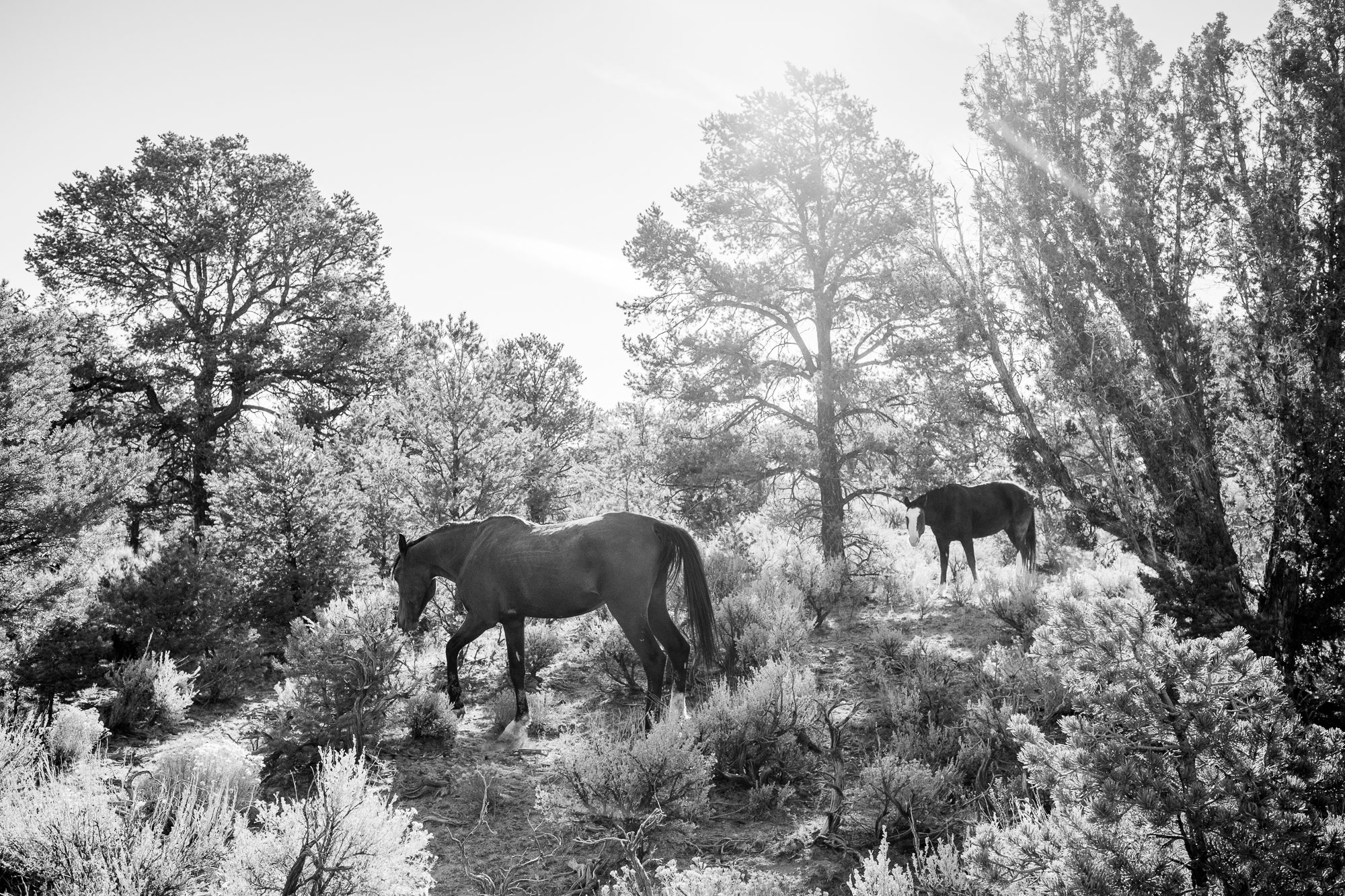
Photo by Bear Guerra

by Llewellyn Vaughan-Lee

May 20, 2021 (emergencemagazine.org)

Witnessing a growing wasteland, Llewellyn Vaughan-Lee seeks the threshold that could bring us back to the place where the land sings—to a deep ecology of consciousness that returns our awareness to a fully animate world.

I LIKE TO WALK early and am often alone on the beach, the ocean and the birds my only companions, the tiny sanderlings running back and forth chasing the waves. Some days the sun rising over the headlands makes a pathway of golden light to the shore. Today, the fog was dense and I could just see two figures walking in the distance, until they vanished into the mist, leaving a pair of footprints in the sand until the incoming tide washed them away. It made me wonder what will remain in a hundred years, when my grandchildren’s grandchildren are alive? Will the rising sea have covered the dunes? Climate crisis will by then be a constant partner, and so many of today’s dramas will be lost in a vaster landscape of primal change.

Sensing this reshaping of the seashore, where the waves roll in from across the Pacific, makes my mind stretch across horizons. How this land and our own lives have evolved. One story of science says it was only seventy thousand years ago that humans left Africa on their long migrations across continents, arriving here on the Pacific coast just thirteen thousand years ago, when the Bering Strait was dry land and not ocean; or possibly they came earlier in boats down the coast.1 But how was life then, long before the written word, when we traveled as small groups, communities of hunters and gatherers? What was the consciousness of our ancestors, before agriculture, long before cities or our industrial way of life, and what did we lose as we settled the land, and then forgot it was sacred?

They may have carried few possessions, but their consciousness contained a close relationship to the land, to its plants and animals, to the patterns of the weather and the seasons, which they needed for their survival. Fully awake with all of their senses, they had a knowing, passed down through generations of living close to the ground, even as they migrated across the continent. Today we are mostly far from the land and its diverse inhabitants. Cut off from these roots, we have become more stranded than we realize, and while our oncoming climate crisis may present us with many problems, we hardly know how to reconnect, to return our consciousness to the living Earth. It is as if, having traveled to the far corners of our planet, we now find ourselves in an increasing wasteland without knowing how to return to where the rivers flow, to where the plants grow wild. And unlike our ancestors, we cannot just pack up and move on, because this wasteland surrounds us wherever we look, like the increasing mounds of plastic and other toxic material we leave in our wake.

And sadly, tragically, our consciousness has become divorced not just from the land under our feet but also from the unseen worlds that surround us. Anyone who looks at the animals in the Paleolithic cave paintings in southern France with a receptive awareness can see that the physical and spirit world are infused together. Those early artists were imaging not just physical animals but spirit beings, shamanic, magical. This is part of their mystery and intensity. And this knowing continued for thousands of years, whether experienced in relation with the powerful beings that for the Native Americans are present in all natural things, invisible but everywhere, or expressed through veneration of the kami, the sacred spirits that exist in nature, mountains, rivers, earthquakes, thunder, animals, and people, which until recently belonged to an elemental Japanese consciousness.2 For most of our history the inner and outer worlds were woven together, as shown in the myths and stories that defined our existence.

Have we wandered so far from the source that we cannot return?

Walking the shoreline, watching the little birds searching for insects, my awareness drawn to the sky, the sea, and the shifting sands, I wonder at this gulf between the simple, magical awareness of our ancestors, and our present-day mind, as cluttered as our consumer world. What has happened to our consciousness, now divorced from the multidimensional existence that used to sustain us? Did we need to exile ourselves from this primal place of belonging? And now, as we tear apart the web of life with our machines and images of progress, is there a calling to return, to open the door that has been closed by our rational selves?

When the fog is dense and you can only see a few yards in front of your feet, the world around becomes more elemental. Watching each wave come to the shore is like watching the breath. Sometimes my feet become wet from the rising water, or I move further up the beach. I try to keep my mind empty, part of the sky and the waves, simple, essential. Here nothing is separate, and the inner and outer worlds are closer.

I cannot return completely to a world in which spirit and matter are always united—I carry too many images from a culture that has denied that the inner world even exists. But I can live closer to this threshold, this place where the waves and the sand meet. I can recognize how easily our defined world can be washed away—how soon the waters will rise. And when many of our toys of triviality, the “things” that clutter our houses and awareness, are lost in the tsunami of climate change, I can be like the Moken, the nomadic boat people of East Asia, who knew to go to deeper water when the waters rose. They remembered the old stories, the old ways, the wisdom of their ancestors, and so their boats rode out the storm—unlike the fishermen who remained close to the shore and perished in the tsunami.

Always there is this primary place of belonging in the land and in our souls. It used to be a part of the way we lived, how we walked and breathed. Crossing oceans and continents, we carried it with us, a lodestone for our existence. For thousands and thousands of years, it was an essential part of us, never forgotten, because how could you forget the feel of the rain on your skin, or the sound of water flowing over stones? How could you forget the stories and songs passed down through the generations? It is only very recently in our human history—only a few hundred years amidst thousands—that we forgot, that we lost this thread, that our mind ceased to be a part of both the land and the unseen worlds. That we forgot that everything we can see and touch is sacred, and in our forgetting no longer inhabited a world in which everything was alive with spirit, the wind and the rain, the plants and animals.

Have we wandered so far from the source that we cannot return? Will climate crisis isolate us even more in our cities as nature becomes more unpredictable? As we try to use our science, our computers to save us? Or is the doorway to return nearer than we know, just as in that moment when we awake and our dreams are still present, before they are lost with the daylight? What would it mean to return to this numinous land, alive in ways we no longer understand, where the Earth can speak to us in its many voices? Or more vital, can we transition through this present self-created crisis without this inner and outer knowing, without this awareness that was central to so much of our human journey?

IT IS EASY to dismiss the magical world as just a fairy tale belonging to childhood or old tales. To maintain that what we need at this moment more than ever is hard science, that carbon reduction and loss of biodiversity are our most pressing concerns. And yes, there is important work to be done reducing our industrial imprint, restoring wetlands and wild places. But if we do not remove the rational blinkers from our consciousness, how can we respond to the deeper need of the moment, and recognize that we are part of a fully animate world? If we are to become partners with the Earth, living our shared journey, we have to once again speak the same language, listen with our senses attuned not just to the physical world but also to its inner dimension. We cannot afford to continue to dismiss so much of our heritage—the thousands of years we were awake to an environment both seen and unseen.

And yet this knowing has been censored so effectively from our present mind that we do not even know how to read the signs, how to look and listen, how to be in the space where dreams are woven into consciousness. We may speak about the need for a new story, one that is not based upon exploitation and greed but recognizes the interdependent oneness of the living world. But real stories arise from the inner worlds, only then do they carry the numinous power that can change a civilization. Myths are not rational, but belong to a deeper dimension of our psyche. We can see the emotive power of the false stories that surround us—whether the recent myth of endless economic growth that is the foundation of our consumer world, or the more recent distortions of social media that grip our collective consciousness. We are living these pathological stories without fully recognizing how much we respond to their emotive and psychic power. The cold facts about climate change and loss of species have not changed our behavior, while conspiracy theories and stories of stolen elections have seized our beliefs. Is our collective consciousness only open to dark myths, such as the Kraken, a tentacled creature of Norse mythology that arises from the deep, swallowing ships?3

Now as we stand at this crossroads, do we have to wait for our present society to fall apart? Are we caught in too many patterns of social and economic divisiveness? Where do we find the hidden gateway into the garden—a place where we are no longer exiles in our own land, living by the “sweat of our brow,” but can hear and then live the songlines of the land; where dreaming nourishes our daily life? Our ancestors are still all around us, in our DNA, in the land, in the spirits still present behind the veils of our rational self. In the millennia of our human history, it is only a few years since most of us divorced ourselves from these companions, and decided to walk alone, unaccompanied, no longer understanding our primal relationship to the Earth and Her ways, no longer speaking the same language, singing Her songs. And those few who carried that remembrance experienced the suffering and pain of that separation, as they struggled to stay true to the songs, dreams, and ceremonies in a world increasingly covered with enforced forgetfulness.

Is it enough just to acknowledge that our ancestors lived in an animate world that is still around us, even if invisible to our eyes, intangible to our other senses? They lived in a world of kinship on many levels; not masters, not the dominant species, but part of a living tapestry—just one species among many—in which the hunter asked the spirit of the animal for permission to hunt, and the gatherer for the plant’s blessing to harvest. Here there was no hierarchy but an interdependent world both physical and spirit, all part of one community that could communicate through dance and dream, song and prayer.

If we are to become partners with the Earth, living our shared journey, we have to once again speak the same language, listen with our senses attuned not just to the physical world but also to its inner dimension.

For them dreaming and waking were not separate but part of a multilayered texture of existence, where dreams could guide the hunt and the spirits of animals and plants were welcomed. And sometimes they ventured deeper into the spirit world through visions, and had access to a wisdom that could help their whole community. For example, the Lakota medicine man, Black Elk, who walked this land less than a century ago, had a seminal vision when he was nine years old that took him to where the horses were singing, and the Thunder Beings spoke to him of the destiny of his people, how his “nation’s hoop was broken.” The spirits called upon him to help restore his people through an awareness of all of life’s sacred nature and its inherent unity:

And while I stood there I saw more than I can tell and I understood more than I saw; for I was seeing in a sacred manner the shapes of all things in the spirit, and the shape of all shapes as they must all live together like one being.4

Our present world is divisive, our consciousness fractured. Our collective values produce greed and endless desires. Science and its foster child, materialism, have become a broken mythology, evident in the ecocide it has created. Where are the visions to guide us, the spirits to sustain us, the singing horses to accompany us? Are we still hoping to find an answer in technology, in its soulless succession of ones and zeros? Or can we begin to remember the lands we have left, the spirit-filled world we have abandoned?

MY OWN GARDEN, on a hillside beside the bay, is a place where the worlds come together: colors and fragrances; lavender; buddleia bushes, whose honey-scented flowers are so often full of bees; chamomile, yellow and white; jasmine, a cascade of evening sweetness; and the soft magic of the spirits that are welcomed, at home like the quail with her babies in the early summer, hiding between the plants. This is how the land was always alive, seen and unseen, movement and stillness. And we were a part of it all, our senses attuned in ways long lost. And now, as the Earth is calling out to us to remember Her sacred ways, there is the possibility to return, to walk as our ancestors walked, to be a part of the world coming alive after a long winter, after storms and snow, after a landscape so barren it pains the eyes.

Here, where the land sings, where the worlds meet, is a way to be that resonates with both the soil and the soul. Making a garden sing, for the unseen to be present, is a simple act of welcoming the worlds our ancestors knew, the spirits of the land as well as the beings of light. I have found it is simplest through an openness of heart and a deep knowing that we are surrounded, nourished, and met in ways beyond our rational minds: a multidimensional kinship. The colors of the flowers then reveal a vibrancy beyond the physical, and even the stones in the garden feel awake.5

This is a simple celebration of the wonder that was always around us, and a nourishment we need for our shared journey together into an uncertain future. It is hard to see how the coming decades will unfold. If the year of the pandemic has taught us anything it is how unpredictable the present moment is, how fragile our present systems. We do not know how much of our present way of life will be lost as the wildfires rage and the seas rise. Will we retreat into the bunkers of materialism, or step into a different way to live with the land? But this moment is also an opportunity to return to an essential awareness that belonged to our ancestors, which, although we have dismissed and forgotten it, is not so far away.

On any journey it is necessary to decide what to take—both for traveling and the new life that awaits. This deep ecology of consciousness that embraces a fully animate world can sustain us, giving us access to the wisdom of the Earth, a knowing we need for the turbulence of this transition. Without this quality of consciousness there is the danger we will just remain in the barren wasteland created by our rational mind, will not fully wake up from the nightmare that is poisoning the planet. Maybe the land and its spirits can welcome us awake, help us to fully see, hear, and inwardly sense the garden we never really left.

The Secret of Happiness: Bronson Alcott on Gardening and Genius

By Maria Popova (brainpickings.org)

“I had a pleasant time with my mind, for it was happy,” Louisa May Alcott wrote in her diary just after she turned eleven, a quarter century before Little Women bloomed from that uncommon mind — a mind whose pleasures and powers were nurtured by the profound love of nature her father wove into the philosophical and scientific education he gave his four daughters.bronsonalcott.jpg?resize=680%2C896

Bronson Alcott

The progressive philosopher, abolitionist, education reformer, and women’s rights advocate Bronson Alcott (November 29, 1799–March 4, 1888) developed his ideas about human flourishing and social harmony by observing and reflecting on the processes, phenomena, and pleasures of the natural world — something he shared with the Transcendentalists of his generation, and particularly with his best friend: the naturalistic transcendence-shaman Ralph Waldo Emerson.

In 1856, while living next door to the visionary Elizabeth Peabody in Boston — the seedbed of Transcendentalism, a term Peabody herself had coined — Alcott borrowed and devoured Emerson’s copy of a book sent to him by an obscure young Brooklyn poet as a token of gratitude for having inspired it: Walt Whitman’s Leaves of Grass, published months earlier.

Whitman’s unexampled verse — so free from the Puritanical conventions of poetry, so lush with a love of life, so unabashedly reverent of nature as the only divinity — stirred a deep resonance with Bronson’s own worldview and inspired him to try his hand at the portable poetics of nature: gardening.elizabethblackwell_curiousherbal_tomato.jpg?resize=680%2C1001

Tomato, or Love-Apple, from Elizabeth Blackwell’s pioneering 1737 encyclopedia of edible plants. (Available as a print and as a face mask, benefitting The Nature Conservancy.)

Right there in the middle of bustling Boston, where his young country was just beginning to find its intellectual and artistic voice, Alcott set up his humble urban garden. One May morning — a century and a half before bryologist Robin Wall Kimmerer contemplated gardening and the secret of happiness, before Olivia Laing wrote of gardening as an act of resistance, before neurologist Oliver Sacks drew on forty years of medical practice to attest to the healing power of gardens — the fifty-six-year-old Alcott planted some peas, corn, cucumbers, and melons, then wrote in his journal:

2e292385-dc1c-4cfe-b95e-845f6f98c2ec.pngHuman life is a very simple matter. Breath, bread, health, a hearthstone, a fountain, fruits, a few garden seeds and room to plant them in, a wife and children, a friend or two of either sex, conversation, neighbours, and a task life-long given from within — these are contentment and a great estate. On these gifts follow all others, all graces dance attendance, all beauties, beatitudes, mortals can desire and know.

elizabethblackwell_curiousherbal_pepper.jpg?resize=680%2C1012

Hot pepper by Elizabeth Blackwell from A Curious Herbal, 1733. (Available as a print and as a face mask, benefitting The Nature Conservancy.)

By mid-summer, Alcott had discovered in his garden not only a creaturely gladness but a portal into the deepest existential contentment — something akin to the creative intoxication that he, like all artists, found in his literary calling:

2e292385-dc1c-4cfe-b95e-845f6f98c2ec.pngMy garden has been my pleasure, and a daily recreation since the spring opened for planting… Every plant one tends he falls in love with, and gets the glad response for all his attentions and pains. Books, persons even, are for the time set aside — studies and the pen. — Only persons of perennial genius attract or recreate as the plants, and of books we may say the same, as of the magic of solitude.

Complement with Derek Jarman on gardening as creative redemption and training ground for presence, then revisit Whitman, writing while recovering from a paralytic stroke in the nursery of nature, on what makes life worth living.

COMIC: How To Intervene When Someone Is Harassed Or Attacked

May 20, 2021 (npr.org)

CONNIE HANZHANG JIN

RUTH TAM

Clare Schneider, photographed for NPR, 17 January 2019, in Washington DC.

CLARE MARIE SCHNEIDER

Chances ​are, ​​​you’ve​ already​ witnessed something as a bystander.​ Maybe, as a kid on a playground, you saw another kid bullied. Perhaps as a teenager at a party, you saw someone being sexually harassed. Or, as an adult on a bus, you saw someone attacked.

There are countless moments where we instinctively sense someone may need help, but something holds us back.

That inaction has a cost. An attack, when it happens in public, isn’t just between two people. It involves everyone who witnesses it, and how we respond sets the tone for what we all tolerate.

Listen to the podcast version of this comic here.

In the episode, illustrator Felicia Chiao describes being publicly attacked. Read her comic about coping with the experience here.

Knowing what to say or how to safely intervene isn’t always clear. But we don’t have to stay paralyzed between a “fight or flight” response. There are many ways to calmly assess a situation and effectively deescalate harm.

For tips and advice, Life Kit spoke with victims of public violence and harassment, as well as trainers at Hollaback!, an organization seeking to end harassment.

If you see someone being harassed or attacked, what can you do? As the pandemic progresses, news of anti-Asian violence has become more widespread. In March, a man attacked a 65-year-old Filipino woman outside of an apartment building in Manhattan. [Image description: A man kicks an elderly woman on the ground as bystanders look on.]

Connie Hanzhang Jin/NPR

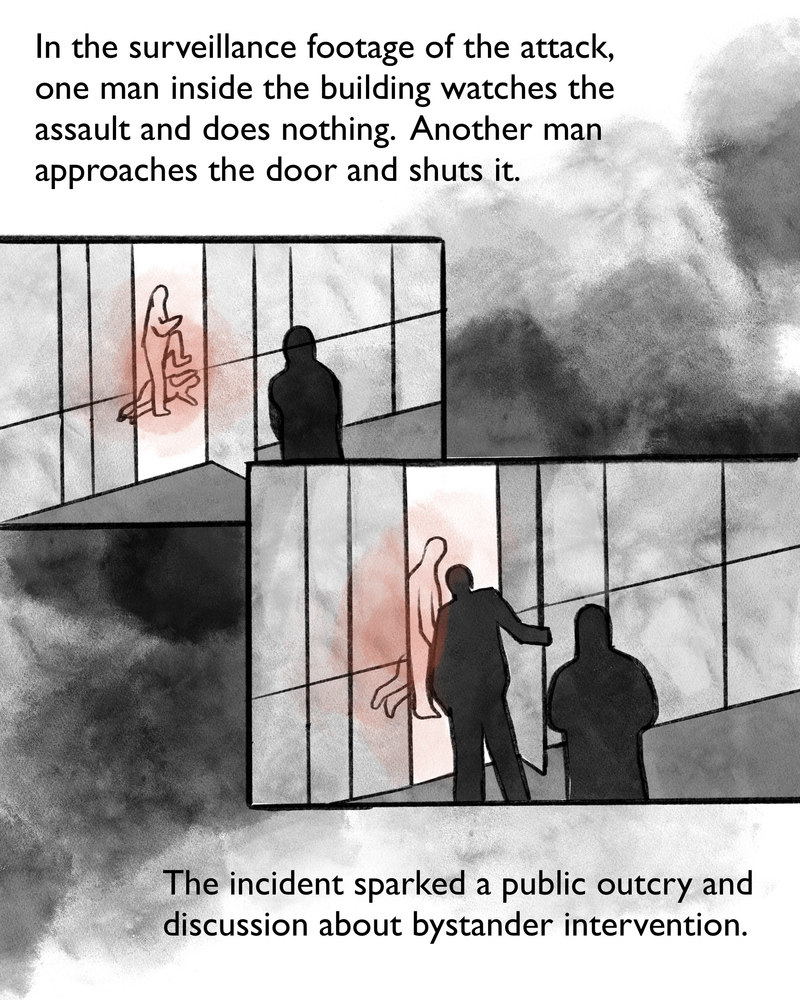
In surveillance footage of the attack, one man inside the building watches the assault and does nothing. Another man approaches the door and shuts it. The incident sparked a public outcry and discussion about bystander intervention.

If you see a similar situation, what are your options? Gabriela Mejia is a training and communications associate with Hollaback!, an organization seeking to end harassment in its many forms. She shared with Life Kit five options bystanders can take: distract, delegate, document, delay and direct.[Image description: Gabriela is an adult with long wavy hair wearing a dark sweater.]

Cause a distraction to make the person being harassed less of a target, like asking for directions or pretending to know them. [Image description: Gabriela models various scenarios, in one she asks, "Hey, do you know where I can find a bathroom?" while in another, she pretends to know the person being harassed. In a final example, she drops a cup of coffee, saying "Whoops, dropped my drink!"]

Ask for help from someone around you or an authority figure. But remember the presence of law enforcement doesn't always make people feel safer. Check with the person being harassed before calling the police in order to center their safety. [Image description: Speech bubble reading "Hey, can you help? This person is being harassed," is posed to security guards, a fellow commuter and a bus driver.]

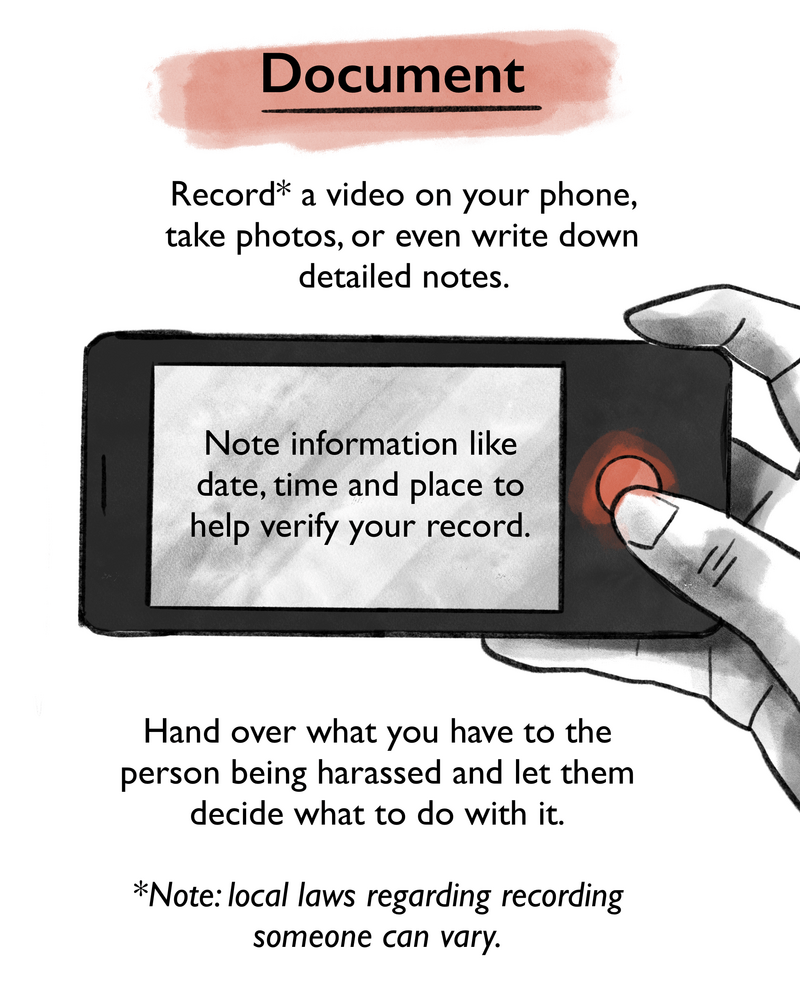
Record a video on your phone, take photos, or even write down detailed notes. Note information like date, time and place to help verify your record. Hand over what you have to the person being harassed and let them decide what to do with it. Note: local laws regarding recording someone can vary.

Debrief with the person being harassed after the situation is over. [Image description: Gabriela addresses an elderly man with concern, asking "Hi, I saw what happened. It was not okay. What can I do to help you feel safer?"]

If you feel safe doing so, talk directly to the harasser. Name what is happening and ask them to stop. [Image description: One person grabs the arm of someone else. Gabriela speaks up from behind them, saying "Hey, that's not okay! Let go of them."]

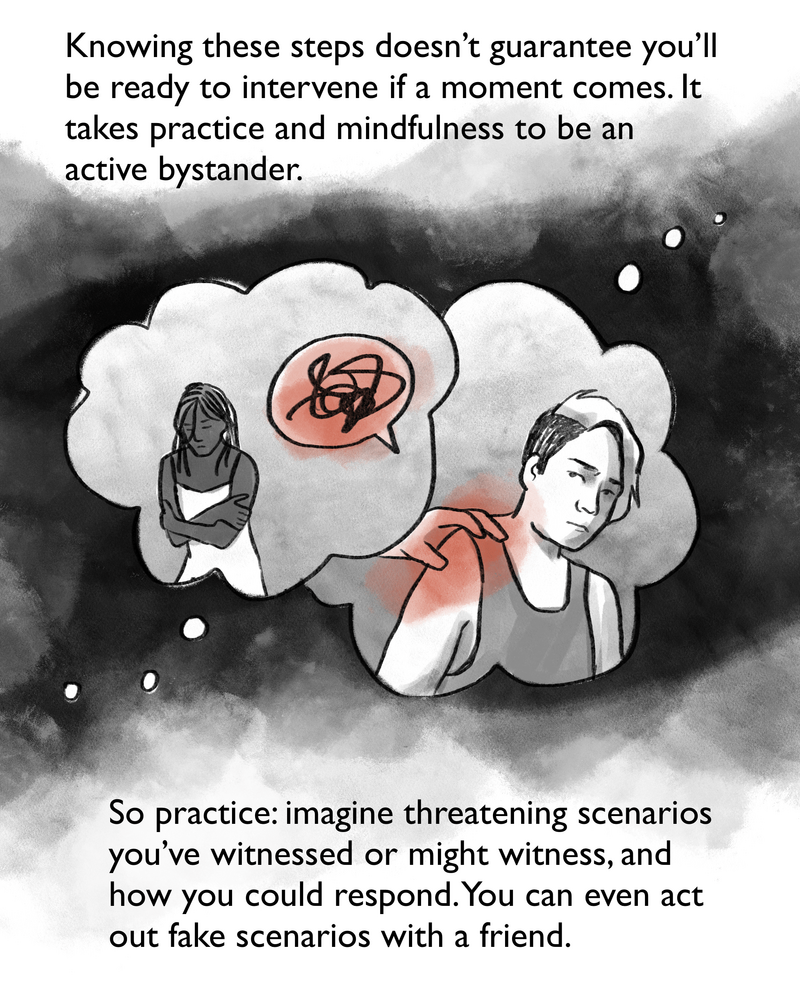
Knowing these steps doesn't guarantee you'll be ready to intervene if a moment comes. It takes practice and mindfulness to be an active bystander. So practice: imagine threatening scenarios you've witnessed or might witness, and how you could respond. You can even act out fake scenarios with a friend.

Always remember that your goal is to deescalate harm, not be the hero of the story. It should never be about you, but instead about how you can support the person being targeted. [Image description: Gabriela and an elderly man hug each other and look off into the distance.]

Connie Hanzhang Jin/NPR


This comic, illustrated by Connie Hanzhang Jin, is based on a Life Kit episode on the same topic. The podcast version is hosted by Ruth Tam and was produced by Clare Marie Schneider.

We’d love to hear from you. Leave us a voicemail at 202-216-9823, or email us at LifeKit@npr.org.

For more Life Kit, subscribe to our newsletter.

(Contributed by Michael Kelly, H.W.)

I love my body

I love my body. My body is perfect for me at this time. My body weight is also perfect. I am exactly where I choose to be. I am beautiful, and every day I become more attractive. This concept used to be very hard for me to accept, yet things are changing now that I am treating myself as if I were someone who was deeply loved. I’m learning to reward myself with healthy little treats and pleasures now and again. Little acts of love nurture me, doing things that I really like, such as a quiet walk in nature, a hot soothing bath, or anything that really gives me pleasure. I enjoy caring for myself. I believe it is okay to like myself and to be my own best friend. I know my body is filled with star light and that I sparkle and glow everywhere I go.

–Louise Hay

Louise Lynn Hay (October 8, 1926 – August 30, 2017) was an American motivational author and the founder of Hay House. She authored several New Thought self-help books, including the 1984 book You Can Heal Your Life. Wikipedia

(Courtesy of Heather Williams, H.W., M.)

What Carl Jung was really saying

Geoff Ward

Geoff Ward 2 days ago · Medium.com

Carl Gustav Jung (1875–1961).

‘What truly matters in Jung’s message is the understanding that we are ultimately grounded in something infinite and eternal, and that our lives as finite beings, illusory as they be, serve a divine purpose.’ Bernardo Kastrup

In the summer of 1940, despite the tribulations of the time, a meeting took place at Moscia, overlooking Lake Maggiore on the Swiss-Italian border, at which the depth psychologist Carl Gustav Jung gave a surprise extempore talk in response to the main speaker at the event, the Basel mathematician Andreas Speiser.

On this occasion, at the Eranos discussion group founded in 1933 for humanistic and spiritual studies, the subject was ‘the psychology of the Trinity’. Almost apologetically, Jung told his audience: ‘I can formulate my thoughts only as they break out of me. It is like a geyser. Those who come after me will have to put them in order.’

Of course, this remark can be taken with more than a grain of salt, for it belies the thoroughness, even pedantry, with which Jung (1875–1961) put together his material. Yet it does indicate some of the difficulties encountered in readings of his works, particularly those written towards the end of his life.

At that Eranos talk was Anelia Jaffé, who became secretary to the C G Jung Institute, as well as Jung’s personal secretary, and an analytical psychologist. She later wrote: ‘The very profusion of creative ideas and of the material discussed opens out endless vistas, and the spontaneity of his style leads to occasional obscurities.’ (The Myth of Meaning in the Work of C G Jung, 1967).

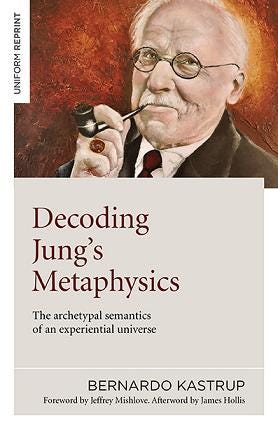
And now the philosopher-scientist Bernardo Kastrup, in his new book, Decoding Jung’s Metaphysics: The Archetypal Semantics of an Experiential Universe (Iff Books, UK £12.99 / US $19.95, February, 2021), becomes one of those envisaged as putting Jung’s thoughts ‘in order’, and Kastrup does this in a masterly manner. For anyone with an interest in Jung’s work, Decoding Jung’s Metaphysics is essential and inspiring reading.

Crucially and topically, for the contemporary culture, Kastrup reinterprets Jung’s message through the lens of metaphysical, or monistic, idealism which understands consciousness as primary and fundamental, regarding Jung’s body of work being the most psychologically sophisticated in the idealist tradition.

Thus Kastrup regards Jung as a ‘metaphysical monist’, contending there is no spirit separate from matter, no matter separate from psyche, and no scope left for dualism. For Jung, the external physical world and the collective unconscious are one and the same thing presenting itself to us in two different ways.

A complex system of metaphysical thought underlies Jung’s amazing body of work, but it’s an implied system because Jung, that secret metaphysician, sought to guard his scientific persona against accusations of philosophical speculation.

Primacy of mind

For Kastrup, Jung was the twentieth century’s greatest articulator of the primacy of mind in nature, indicating that mind and world are one and the same thing, that reality is fundamentally experiential, not material, that the psyche builds and maintains its body, not vice versa, and that the ultimate meaning of human life is to serve ‘God’ by providing ‘a reflecting mirror to God’s own instinctive mentation’.

I put ‘God’ in quotes, above, because the word needs careful usage due to its historical tradition and the baggage it carries. Kastrup has said elsewhere (The Mysteries of Reality: Dialogues with Visionary Scientists by Gayle Kimball, Iff Books, 2021) that he does not believe there is a God with a plan that knows what ‘it’s’ doing at a metacognitive level: God, as the underlying universal consciousness, is metacognitive perhaps only to the extent that we are aspects of it.

Explicit introspective awareness — to be meta-conscious, to know one is having experience — is part of the process of what Jung called individuation and which Kastrup sees as the ultimate goal not only of life but of the universe itself, through us. So, for him ‘God’ is a metonym.

Nevertheless, Kastrup states: ‘The universe is God’s dream and we are here to interpret it … At a time when culture and society are dominated by the simplistic, myopic worldview of metaphysical materialism — with its accompanying existential angst — Jung’s work offers us a renewed horizon of meaning and purpose: life is sacrificial in the noblest sense imaginable, in that we live and die to render an indispensable service to God. What a great honor and opportunity it is to live.’

In a phrase, ‘we help God become aware of itself’ — put another way, through our consciousness we help the universe to contemplate itself. This is what is known as Jung’s myth of meaning, equating to the ‘myth of consciousness’, to which Kastrup makes allusion at the very end of his book.

If Jung had become prominent in the first half of the twentieth century instead of Freud then I believe we would be living in a different world today. As the Copernican revolution brought acceptance that the Earth revolved around the Sun, not the Sun around the Earth, so the Jungian revolution was to propose that the ego revolved around the Self, not the other way round: the Self being an image of the personality as a whole, a central ordering principle embracing both conscious and unconscious.

And as Kastrup says, while Freud thought of the unconscious as merely a passive repository of forgotten or repressed contents of consciousness, Jung saw the unconscious as an active, creative matrix with a psychic life, will and language of its own, often at odds with our conscious dispositions, which is surely much closer to the truth.

Metaphysical significance

Such thinking led Jung ‘down avenues of empirical investigation and speculation rich with metaphysical significance’ which, says Kastrup, is what his new book is all about, together with the philosophical consequences. Jung himself admitted that his work had metaphysical implications, rejecting ‘mainstream metaphysical materialism’, the notion that physicality is all there is. One is thus justified to infer the metaphysical opinions Jung might have held covertly so as to keep up a ‘politically correct image of metaphysically agnostic scientist’.

In the Jungian sense, our metaphysical task is to maintain an ongoing expansion, or heightening, of consciousness; it’s consciousness that bestows meaning on our lives. But also accepting the existence of the unconscious, or obfuscated consciousness in Kastrup’s terms, one, in following Jung, can consider a transcendental meaning prevailing independently of ourselves, as manifested in synchronistic phenomena, in which Jung included, for example, extrasensory perception, premonitions and dreams that come true.

In synchronicity, the inner psychic image is the counterpart of a future or remote event imperceptible to the senses; they are linked not causally but by their meaning. Jung defined it as a ‘coincidence in time of two or more causally unrelated events which have the same or similar meaning’ (Synchronicity: an Acausal Connecting Principle, 1952), and suggested that it could be a fourth dimension added to space, time and causality.

Certainly, synchronicity, by its very nature, is a consciousness-raising experience: in it, we find ourselves part of a profoundly meaningful process which we can actually influence. It seems to arise spontaneously out of the harmony of natural processes.

Indeed, Kastrup asserts that the most significant metaphysical implication of Jung’s work stems from the theory of synchronicity: by saying that the physical world arranges itself to symbolically connote something, then psychic powers somehow control its behaviour. On some underlying immanent and metaphysical level there must be a transpersonal psychic layer, associated with the physical universe at large, performing the cognitive associations necessary for the universe to express meaning through its behaviour.

And in a remarkable insight, Kastrup goes further to conclude that it’s synchronicity that actually drives the universe, that makes it ‘work’, that synchronicity is the only metaphysically real ordering principle in nature.

Archetypal patterns

Jung claimed that synchronicities unfold according to archetypal patterns, implying that the collective unconscious underlies both consciousness and the physical world itself. Significantly, this would mean that physical events are orchestrated by the same a priori patterns that orchestrate events in consciousness.

One implication of this is that the collective unconscious and the physical world are related in effectively the same way as the collective unconscious and ego-consciousness. As Jung suggests that ego-consciousness arises out of the unconscious, it follows that the physical world must also arise from the collective unconscious, as another manifestation of it. So, logically, one must conclude that the physical world is as essentially experiential as the psyche.

Metaphysical idealism is arguably the only option left for making sense of the latest experimental results in fields such as quantum mechanics, Kastrup argues. Many physicists assume that quantum fluctuations at the foundation of our physical environment do not follow any global patterns.

But: ‘For all we know, instead of accidents, quantum events conform to subtle, non-local patterns of organisation corresponding to an as yet unacknowledged metaphysical ordering principle, different from causality.’

Perhaps if Jung had received a proper formulation of idealism that countered all criticisms made against it, Kastrup suggests, he would have allowed himself to express his metaphysical views more openly.

Bernardo Kastrup’s work is in the forefront of the contemporary renaissance of metaphysical idealism, the notion that reality is essentially mental. He has a PhD in philosophy (ontology, philosophy of mind) and a PhD in computer engineering (reconfigurable computing, artificial intelligence). As a scientist, he has worked for the European Organization for Nuclear Research (CERN) and the Philips Research Laboratories, where the ‘Casimir Effect’ of quantum field theory was discovered.

Formulated in detail in many academic papers and eight previous books, his ideas have been featured at Scientific Americanthe Institute of Art and Ideas, the Blog of the American Philosophical Association and Big Think, among others. For more information, freely downloadable papers, videos and so on, visit www.bernardokastrup.com

*** See also my article here at Medium, ‘A transformative idea of the world that seeks to bring truth and meaning to our lives’.

Book: “The Sickness Unto Death: A Christian Psychological Exposition for Upbuilding and Awakening”

The Sickness Unto Death: A Christian Psychological Exposition for Upbuilding and Awakening

The Sickness Unto Death: A Christian Psychological Exposition for Upbuilding and Awakening

by Søren KierkegaardEdna Hatlestad HongHoward Vincent Hong 

A companion piece to The Concept of Anxiety, this work continues Søren Kierkegaard’s radical and comprehensive analysis of human nature in a spectrum of possibilities of existence. Present here is a remarkable combination of the insight of the poet and the contemplation of the philosopher.

In The Sickness unto Death, Kierkegaard moves beyond anxiety on the mental-emotional level to the spiritual level, where — in contact with the eternal — anxiety becomes despair. Both anxiety and despair reflect the misrelation that arises in the self when the elements of the synthesis — the infinite and the finite — do not come into proper relation to each other. Despair is a deeper expression for anxiety and is a mark of the eternal, which is intended to penetrate temporal existence. 

(Goodreads.com)

Healing Trauma and Spiritual Growth: Peter Levine & Thomas Huebl

scienceandnonduality http://www.scienceandnonduality.com In this memorable conversation from SAND 18 Peter Levine, the father of trauma therapy work, and Thomas Huebl, a spiritual teacher known for his work integrating healing of collective trauma, discuss the relationship between healing trauma and spiritual growth. One theme that repeats throughout the discussion is that we are all connected through the traumatization of the world, and that the healing of trauma is a way of returning to the wholeness and fullness of living. For more information visit https://traumahealing.org and https://thomashuebl.com Science And NonDuality is a community inspired by timeless wisdom, informed by cutting-edge science, and grounded in personal experience. We come together in an openhearted exploration to further our individual and collective evolution. New ways of being emerge. We embody our interconnectedness and celebrate our humanity.

‘It Takes a Cosmos to Make a Human’

Last Updated: May 20, 2021 (onbeing.org)

The Search for Extraterrestrial Intelligence — or SETI — goes beyond hunting for E.T. and habitable planets. Scientists in the field are using telescopes and satellites looking for signs of outright civilizational intelligence. One of the founding pioneers in this search is astronomer Jill Tarter. She is a co-founder of the SETI Institute and was an inspiration for Jodie Foster’s character in the movie Contact, based on the novel by Carl Sagan. To speak with Tarter is to begin to grasp the creative majesty of SETI and what’s relevant now in the ancient question: “Are we alone in the universe?”

Image by Nathan Dumlao, © All Rights Reserved.

Guest

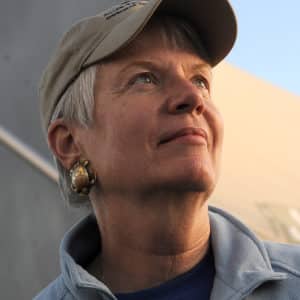
Image of Jill Tarter

Jill Tarter is the co-founder and chair emeritus for SETI Research at the SETI Institute in Mountain View, California. She currently serves on the management board for the Allen Telescope Array. She has been awarded two Exceptional Public Service medals from NASA and the Women in Aerospace Lifetime Achievement Award. In April of 2021, she was elected to the American Academy of Arts and Sciences.

China’s Mars rover touches ground on red planet

Nation/world. by: Associated Press Posted:  May 22, 2021

In this artist's rendering made available by the China National Space Administration (CNSA) on Saturday, May 22, 2021, China's Zhurong rover is depicted on the surface of Mars. China's first Mars rover has driven down from its landing platform and is now roaming the surface of the red planet, China's space administration said Saturday. (CNSA via AP)

China National Space Administration (CNSA) rendering Saturday, May 22, 2021, China’s Zhurong rover is depicted on the surface of Mars. China’s first Mars rover has driven down from its landing platform and is now roaming the surface of the red planet, China’s space administration said Saturday. (CNSA via AP)

China’s first Mars rover has driven down from its landing platform and is now roaming the surface of the red planet, China’s space administration said Saturday.

The solar-powered rover touched Martian soil at 10:40 a.m. Saturday Beijing time (0240 GMT), the China National Space Administration said.

China landed the spacecraft carrying the rover on Mars last Saturday, a technically challenging feat more difficult than a moon landing, in a first for the country. It is the second country to do so, after the United States.

Named after the Chinese god of fire, Zhurong, the rover has been running diagnostics tests for several days before it began its exploration today (Saturday). It is expected to be deployed for 90 days to search for evidence of life.

The U.S. also has an ongoing Mars mission, with the Perseverance rover and a tiny helicopter exploring the planet. NASA expects the rover to collect its first sample in July for return to Earth as early as 2031.

China has ambitious space plans that include launching a crewed orbital station and landing a human on the moon. China in 2019 became the first country to land a space probe on the little-explored far side of the moon, and in December returned lunar rocks to Earth for the first time since the 1970s.

(Contributed by William P. Chiles)

Consciousness, spirituality, biography, sexuality, androgyny, futurism, space, the arts, science, astrology, democracy, humor, books, movies and more