Bio: Teresa of Ávila

From Wikipedia, the free encyclopedia
Saint
Teresa of Ávila
O.Carm
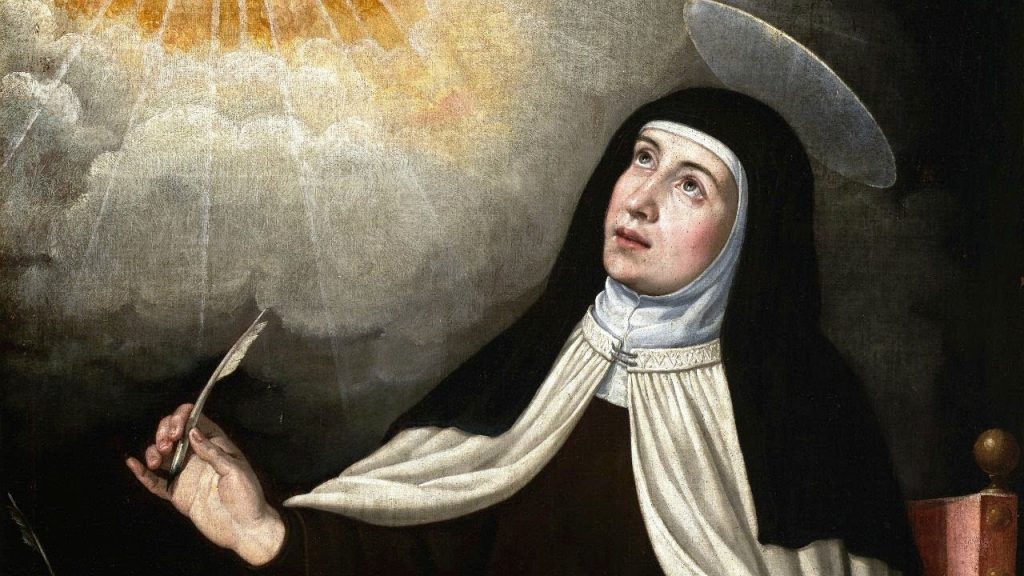
Saint Teresa of Ávila by Peter Paul Rubens
Teresa of Jesus, Reverend Mother, Prioress, Doctor of the Church
BornTeresa Sánchez de Cepeda y Ahumada
28 March 1515
ÁvilaCrown of Castile (today Spain)
Died4 or 15 October 1582 (aged 67)[a]
Alba de TormesSalamanca, Crown of Castile (today Spain)Theology career
Notable workCamino de Perfección
El Castillo Interior
Theological work
EraCatholic Reformation
Tradition or movementChristian mysticism
Main interestsTheology
Notable ideasMental prayerPrayer of Quiet
Venerated inRoman Catholic Church
Anglican Communion[1][2]
Lutheranism[3]
Beatified24 April 1614, Rome by Pope Paul V
Canonized12 March 1622, Rome by Pope Gregory XV
Major shrineConvent of the Annunciation, Alba de TormesSpain
Feast15 October
Attributesof Spanish-Jewish parentage, contemplativemysticecstatic, writer on mental prayerreligious reformeradministrator, prolific correspondent possibly temporal lobe epilepsy sufferer
PatronageSpain, sick people, people in religious orders, people ridiculed for their piety, lacemakers, PožegaCroatiaTalisay City, Cebu, Philippines
ControversyHer reforms met with determined opposition and interest from the Spanish Inquisition, but no charges were laid against her. Her order split as a result.
Part of a series on
Christian mysticism
showTheology · Philosophy
showPractices
showPeople (by era or century)
showLiterature · Media
vte

Teresa of Ávila, born Teresa Sánchez de Cepeda y Ahumada, also called Saint Teresa of Jesus (28 March 1515 – 4 or 15 October 1582[a]), was a Spanish noblewoman who felt called to convent life in the Catholic Church. A Carmelite nun, prominent Spanish mysticreligious reformer, author, theologian of the contemplative life and of mental prayer, she earned the rare distinction of being declared a Doctor of the Church, but not until over four centuries after her death.[b] Active during the Catholic Reformation, she reformed the Carmelite Orders of both women and men.[4] The movement she initiated was later joined by the younger Spanish Carmelite friar and mystic John of the Cross. It led eventually to the establishment of the Discalced Carmelites. A formal papal decree adopting the split from the old order was issued in 1580.[5]

Teresa, who had been a social celebrity in her home province, was dogged by early family losses and ill health. In her mature years, she became the central figure of a movement of spiritual and monastic renewal borne out of an inner conviction and honed by ascetic practice. She was also at the center of deep ecclesiastical controversy as she took on the pervasive laxity in her order against the background of the Protestant reformation sweeping over Europe and the Spanish Inquisition asserting church discipline in her home country. The consequences were to last well beyond her life. One papal legate described her as a “restless wanderer, disobedient, and stubborn femina who, under the title of devotion, invented bad doctrines, moving outside the cloister against the rules of the Council of Trent and her prelates; teaching as a master against Saint Paul‘s orders that women should not teach.”[6]

Her written contributions, which include her autobiography, The Life of Teresa of Jesus and her seminal work The Interior Castle, are today an integral part of Spanish Renaissance literature. Together with The Way of Perfection, her works form part of the literary canon of Christian mysticism and Christian meditation practice, and continue to attract interest from people both within and outside the Catholic Church.

Other associations with Teresa beyond her writings continue to exert a wide influence. A Santero image of the Immaculate Conception of El Viejo, said to have been sent by her with a brother emigrating to Peru, was canonically crowned by Pope John Paul II on 28 December 1989 at the Shrine of El Viejo in Nicaragua.[7] Another Catholic tradition holds that Saint Teresa is personally associated with devotion to the Infant Jesus of Prague, a statue she may have owned.[8] Since her death, her reputation has grown, leading to multiple portrayals. She continues to be widely noted as an inspiration to philosophers, theologians, historians, neurologists, fiction writers and artists, as well as to countless ordinary people interested in Christian spirituality and mysticism.

Forty years after her death, in 1622, Teresa was canonized by Pope Gregory XV. At the time she was considered a candidate for national patron saint of Spain, but this designation was awarded to St. James the Apostle. She has since become one of the patron saints of Spain. However, not until 27 September 1970 did Pope Paul VI proclaim Teresa the first female Doctor of the Church in recognition of her centuries-long spiritual legacy to Catholicism.[9][10]

Early life

Teresa Sánchez de Cepeda y Ahumada was born in 1515 in Ávila, Spain. Her paternal grandfather, Juan Sánchez de Toledo, was a marrano or Converso, a Jew forced to convert to Christianity or emigrate. When Teresa’s father was a child, Juan was condemned by the Spanish Inquisition for allegedly returning to the Jewish faith, but he was later able to assume a Catholic identity.[11] Her father, Alonso Sánchez de Cepeda, was a successful wool merchant and one of the wealthiest men in Ávila. He bought a knighthood and assimilated successfully into Christian society.Teresa of Ávila elopes to travel to Africa by Arnold van Westerhout

Previously married to Catalina del Peso y Henao, with whom he had three children, in 1509, Sánchez de Cepeda married Teresa’s mother, Beatriz de Ahumada y Cuevas, in Gotarrendura.[12]

Teresa’s mother brought her up as a dedicated Christian. Fascinated by accounts of the lives of the saints, she ran away from home at age seven, with her brother Rodrigo, to seek martyrdom in the fight against the Moors. Her uncle brought them home, when he spotted them just outside the town walls.[13]

When Teresa was eleven years old, her mother died, leaving her grief-stricken. This prompted her to embrace a deeper devotion to the Virgin Mary as her spiritual mother. Teresa was also enamored of popular fiction, which at the time consisted primarily of medieval tales of knighthood and works about fashion, gardens and flowers.[14][15] Teresa was sent to the Augustinian nuns’ school at Ávila.[16]

Entry into religious life

After completing her education, she initially resisted the idea of a religious vocation, but after a stay with her uncle and other relatives, she relented. In 1536, aged 20,[17] much to the disappointment of her pious and austere father, she decided to enter the local easy-going Carmelite Convent of the Incarnation, significantly built on top of land that had been used previously as a burial ground for Jews. She took up religious reading on contemplative prayer, especially Osuna’s Third Spiritual Alphabet (1527). Her zeal for mortification caused her to become ill again and she spent almost a year in bed, causing huge worry to her community and family. She nearly died but she recovered, attributing her recovery to the miraculous intercession of St. Joseph. She began to experience bouts of religious ecstasy.[12]

Foundations of spirituality

Her reading of the medieval mystics, consisted of guides to examination of conscience and spiritual exercises and inner contemplation known in mystical terms as oratio recollectionis or oratio mentalis. She also dipped into other mystical ascetical works such as the Tractatus de oratione et meditatione of Peter of Alcantara.

She reported that, during her illness, she had progressed from the lowest stage of “recollection”, to the “devotions of silence” and even to the “devotions of ecstasy”, which was one of perceived “perfect union with God” (see § Mysticism). During this final stage, she said she frequently experienced the rich “blessing of tears”. As the Catholic distinction between mortal and venial sin became clear to her, she came to understand the awful horror of sin and the inherent nature of original sin. She also became conscious of her own natural impotence in confronting sin and the need for absolute surrender to God.[citation needed]

Around the same time, she received a copy of the full Spanish translation of St. Augustine‘s autobiographical work Confessions, which helped her resolve and to tend to her own bouts of religious scruples. The text helped her realize that holiness was indeed possible and she found solace in the idea that such a great saint was once an inveterate sinner. In her autobiography, she wrote that she ‘was very fond of St. Augustine…for he was a sinner too.’[18]

Around 1556, friends suggested that her newfound knowledge could be of diabolical and not of divine origin. She had begun to inflict mortifications of the flesh upon herself. But her confessor, the Jesuit Francis Borgia, reassured her of the divine inspiration of her thoughts. On St. Peter’s Day in 1559, Teresa became firmly convinced that Jesus Christ had presented Himself to her in bodily form, though invisible. These visions lasted almost uninterruptedly for more than two years. In another vision, a seraph drove the fiery point of a golden lance repeatedly through her heart, causing her an ineffable spiritual and bodily pain:

I saw in his hand a long spear of gold, and at the point there seemed to be a little fire. He appeared to me to be thrusting it at times into my heart, and to pierce my very entrails; when he drew it out, he seemed to draw them out also, and to leave me all on fire with a great love of God. The pain was so great, that it made me moan; and yet so surpassing was the sweetness of this excessive pain, that I could not wish to be rid of it…[c]

The account of this vision was the inspiration for one of Bernini‘s most famous works, the Ecstasy of Saint Teresa at Santa Maria della Vittoria in Rome. Although based in part on Teresa’s description of her mystical transverberation in her autobiography, Bernini’s depiction of the event is considered by some to be highly eroticized, especially when compared to the entire preceding artistic Teresian tradition.[19]

The memory of this episode served as an inspiration throughout the rest of her life, and motivated her lifelong imitation of the life and suffering of Jesus, epitomized in the adage often associated with her: “Lord, either let me suffer or let me die.”[citation needed]

Embarrassment of raptures

Teresa, who became a celebrity in her town dispensing wisdom from behind the convent grille, was also known for her raptures, which sometimes involved levitation. It was a source of embarrassment to her and she bade her sisters hold her down when this occurred. Subsequently, historians, neurologists and psychiatrists like Peter Fenwick and Javier Alvarez-Rodriguez, among others, have taken an interest in her symptomatology. The fact that she wrote down virtually everything that happened to her during her religious life means that an invaluable and exceedingly rare medical record from the 16th century has been preserved. Examination of this record has led to the speculative conclusion that she may have suffered from temporal lobe epilepsy.[20][21]

Monastic reformer

Over time, Teresa found herself increasingly at odds with the spiritual malaise prevailing in her convent of the Incarnation. Among the 150 nuns living there, the observance of cloister, designed to protect and strengthen spiritual practice and prayer, became so lax that it appeared to lose its purpose. The daily invasion of visitors, many of high social and political rank, disturbed the atmosphere with frivolous concerns and vacuous conversation. Such intrusions in the solitude essential to develop and sustain contemplative prayer so grieved Teresa that she longed to intervene.[22]

The incentive to take the practical steps inspired by her inward motivation was supported by the Franciscan priest, Peter of Alcantara, who met her early in 1560 and became her spiritual adviser. She resolved to found a “reformed” Carmelite convent, correcting the laxity which she had found at the Incarnation convent and elsewhere besides. Guimara de Ulloa, a woman of wealth and a friend, supplied the funds for the project.[citation needed]

The abject poverty of the new convent, established in 1562 and named St. Joseph’s (San José), at first caused a scandal among the citizens and authorities of Ávila, and the small house with its chapel was in peril of suppression. However, powerful patrons, including the local bishop, coupled with the impression of well ordered subsistence and purpose, turned animosity into approval.[citation needed]

In March 1563, after Teresa had moved to the new convent house, she received papal sanction for her primary principles of absolute poverty and renunciation of ownership of property, which she proceeded to formulate into a “constitution”. Her plan was the revival of the earlier, stricter monastic rules, supplemented by new regulations including the three disciplines of ceremonial flagellation prescribed for the Divine Office every week, and the discalceation of the religious. For the first five years, Teresa remained in seclusion, mostly engaged in prayer and writing.[citation needed]Church window at the Convent of St Teresa

Extended travels

In 1567, Teresa received a patent from the Carmelite General, Rubeo de Ravenna, to establish further houses of the new order. This process required many visitations and long journeys across nearly all the provinces of Spain. She left a record of the arduous project in her Libro de las Fundaciones. Between 1567 and 1571, reformed convents were established at Medina del CampoMalagónValladolidToledoPastranaSalamanca, and Alba de Tormes.

As part of the original patent, Teresa was given permission to set up two houses for men who wished to adopt the reforms. She convinced two Carmelite friars, John of the Cross and Father Anthony of Jesus to help with this. They founded the first monastery of Discalced Carmelite brothers in November 1568 at Duruelo. Another friend of Teresa, Jerónimo Gracián, the Carmelite visitator of the older observance of Andalusia and apostolic commissioner, and later provincial of the Teresian order, gave her powerful support in founding monasteries at Segovia (1571), Beas de Segura (1574), Seville (1575), and Caravaca de la Cruz (Murcia, 1576). Meanwhile, John of the Cross promoted the inner life of the movement through his power as a teacher and preacher.[23]

Opposition to reforms

In 1576, unreformed members of the Carmelite order began to persecute Teresa, her supporters and her reforms. Following a number of resolutions adopted at the general chapter at Piacenza, the governing body of the order forbade all further founding of reformed convents. The general chapter instructed her to go into “voluntary” retirement at one of her institutions.[23] She obeyed and chose St. Joseph’s at Toledo. Meanwhile, her friends and associates were subjected to further attacks.[23]

Several years later, her appeals by letter to King Philip II of Spain secured relief. As a result, in 1579, the cases before the inquisition against her, Father Gracian and others, were dropped.[23] This allowed the reform to resume. An edict from Pope Gregory XIII allowed the appointment of a special provincial for the newer branch of the Carmelite religious, and a royal decree created a “protective” board of four assessors for the reform.[23]

During the last three years of her life, Teresa founded convents at Villanueva de la Jara in northern Andalusia (1580), Palencia (1580), Soria (1581), Burgos, and Granada (1582). In total, seventeen convents, all but one founded by her, and as many men’s monasteries, were owed to her reforms over twenty years.[24]

Last days

Her final illness overtook her on one of her journeys from Burgos to Alba de Tormes. She died in 1582, just as Catholic Europe was making the switch from the Julian to the Gregorian calendar, which required the excision of the dates of 5–14 October from the calendar. She died either before midnight of 4 October or early in the morning of 15 October, which is celebrated as her feast day. According to the liturgical calendar then in use, she died on the 15th in any case. Her last words were: “My Lord, it is time to move on. Well then, may your will be done. O my Lord and my Spouse, the hour that I have longed for has come. It is time to meet one another.”[25]Avila, Saint Theresa’s statue

Holy relics

This section needs additional citations for verification. Please help improve this article by adding citations to reliable sources. Unsourced material may be challenged and removed. (October 2020) (Learn how and when to remove this template message)

She was buried at the Convento de la Anunciación in Alba de Tormes. Nine months after her death the coffin was opened and her body was found to be intact but the clothing had rotted. Before the body was re-interred one of her hands was cut off, wrapped in a scarf and sent to Ávila. Father Gracián cut the little finger off the hand and – according to his own account – kept it with him until it was taken by the occupying Ottoman Turks, from whom he had to redeem it with a few rings and 20 reales. The body was exhumed again on 25 November 1585 to be moved to Ávila and found to be incorrupt. An arm was removed and left in Alba de Tormes at the nuns’ request, to compensate for losing the main relic of Teresa, but the rest of the body was reburied in the Discalced Carmelite chapter house in Ávila. The removal was done without the approval of the Duke of Alba de Tormes and he brought the body back in 1586, with Pope Sixtus V ordering that it remain in Alba de Tormes on pain of excommunication. A grander tomb on the original site was raised in 1598 and the body was moved to a new chapel in 1616.

The body still remains there, except for the following parts:

  • Rome – right foot and part of the upper jaw
  • Lisbon – left hand
  • Ronda, Spain – left eye and right hand (the latter was kept by Francisco Franco until his death after Francoist troops captured it from Republican troops during the Spanish Civil War)
  • Museum of the Church of the Annunciation, Alba de Tormes – left arm and heart
  • Church of Our Lady of Loreto, Paris, France – one finger
  • Sanlúcar de Barrameda – one finger

The Ecstasy of Saint Teresa by Bernini, Basilica of Santa Maria della Vittoria, Rome

Canonization

In 1622, forty years after her death, she was canonized by Pope Gregory XV. The Cortes exalted her to patroness of Spain in 1627. The University of Salamanca had granted her the title Doctor ecclesiae (Latin for “Doctor of the Church”) with a diploma in her lifetime,[dubious – discuss] but that title is distinct from the papal honour of Doctor of the Church, which is always conferred posthumously. The latter was finally bestowed upon her by Pope Paul VI on 27 September 1970,[9] along with Saint Catherine of Siena,[26] making them the first women to be awarded the distinction. Teresa is revered as the Doctor of Prayer. The mysticism in her works exerted a formative influence upon many theologians of the following centuries, such as Francis of SalesFénelon, and the Port-Royalists. In 1670, her coffin was plated in silver.

Teresa of Avila is remembered in the Church of England with a Lesser Festival on 15 October.[27]Statue of Saint Teresa of Ávila in Mafra National PalaceMafra

Mysticism

The ultimate preoccupation of Teresa’s mystical thought, as consistently reflected in her writings, is the ascent of the soul to God in four stages (see: The Autobiography Chs. 10–22):

  • The first, Devotion of the Heart, consists of mental prayer and contemplation. It means the withdrawal of the soul from without, penitence and especially the devout meditation on the passion of Christ (Autobiography 11.20).
  • The second, Devotion of Peace, is where human will is surrendered to God. This occurs by virtue of an uplifted awareness granted by God, while other faculties, such as memory, reason, and imagination, are not yet safe from worldly distraction. Although a partial distraction can happen, due to outer activity such as repetition of prayers or writing down spiritual things, the prevailing state is one of quietude (Autobiography 14.1).
  • The third, Devotion of Union, concerns the absorption-in-God. It is not only a heightened, but essentially, an ecstatic state. At this level, reason is also surrendered to God, and only the memory and imagination are left to ramble. This state is characterized by a blissful peace, a sweet slumber of at least the higher soul faculties, that is a consciousness of being enraptured by the love of God.
  • The fourth, Devotion of Ecstasy, is where the consciousness of being in the body disappears. Sensory faculties cease to operate. Memory and imagination also become absorbed in God, as though intoxicated. Body and spirit dwell in the throes of exquisite pain, alternating between a fearful fiery glow, in complete unconscious helplessness, and periods of apparent strangulation. Sometimes such ecstatic transports literally cause the body to be lifted into space.[28] This state may last as long as half an hour and tends to be followed by relaxation of a few hours of swoon-like weakness, attended by the absence of all faculties while in union with God. The subject awakens from this trance state in tears. It may be regarded as the culmination of mystical experience. Indeed, Teresa was said to have been observed levitating during Mass on more than one occasion.[28]

Teresa is regarded as one of the foremost writers on mental prayer, and her position among writers on mystical theology as unique. Her writings on this theme stem from her personal experiences, thereby manifesting considerable insight and analytical gifts. Her definitions have been used in the Catechism of the Catholic Church. Teresa states: “Contemplative prayer (oración mental), in my opinion is nothing other than a close sharing between friends. It means frequently taking time to be alone with Him whom we know loves us.”[29] Throughout her writings, Teresa returns to the image of watering one’s garden as a metaphor for mystical prayer.
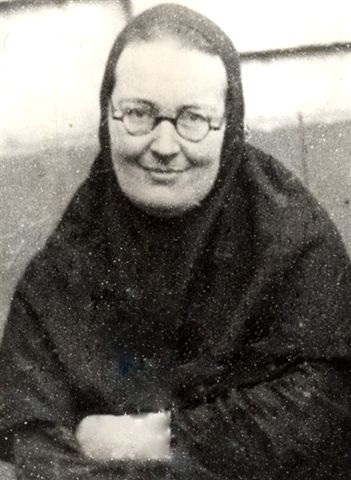
More at: https://en.wikipedia.org/wiki/Teresa_of_%C3%81vila

Bio: St. Mary of Paris

From Wikipedia, the free encyclopedia

Saint
Maria Skobtsova
Maria with Nikolai Berdyaev, 1930
BornElizaveta Yurievna Pilenko
20 December 1891
RigaRussian Empire (now Latvia)
Died31 March 1945 (aged 53)
Ravensbrück Concentration CampFürstenberg/HavelGermany
Cause of deathPoison gas
TitleMayor of Anapa
Political partySocialist-Revolutionary Party
ChildrenGaiana, Iuri, Anastasia
AwardsRighteous among the Nations
Saint
Mother Maria of Paris
Saint Maria Skobtsova of Paris
Righteous Martyr
BornElizaveta Pilenko
20 December 1891
RigaRussian Empire
Residence77, Rue de Lourmel, Grenelle15th Arrondissement of Paris
Died31 March 1945
Ravensbrück Concentration CampFürstenberg/HavelGermany
Venerated inEastern Orthodox Church
Canonized1 May 2004[1]Istanbul by the Ecumenical Patriarch of Constantinople.
Feast20 July[2]

Maria Skobtsova (20 [8 Old Calendar] December 1891 – 31 March 1945), known as Mother Maria (Russian: Мать Мария), Saint Mary (or Mother Maria) of Paris, born Elizaveta Yurievna Pilenko (Елизавета Юрьевна Пиленко), Kuzmina-Karavayeva (Кузьмина-Караваева) by her first marriage, Skobtsova (Скобцова) by her second marriage, was a Russian noblewomanpoetnun, and member of the French Resistance during World War II. She has been canonized a saint in the Eastern Orthodox Church.

Life

Maria Skobtsova Commemorative Plaque in Saint Petersburg

Born to an aristocratic family in 1891 in RigaRussian Empire (now Latvia). She was given the name Elizaveta Pilenko.[3] Her father died when she was a teenager, and she embraced atheism. In 1906 her mother moved the family to St. Petersburg, where she became involved in radical intellectual circles. In 1910 she married a Bolshevik by the name of Dmitriy Kuz’min-Karavaev. During this period of her life she was actively involved in literary circles and wrote much poetry. Her first book, Scythian Shards (Скифские черепки), was a collection of poetry from this period. By 1913 her marriage to Dimitriy had ended and the latter subsequently converted to Russian Catholicism and became a Russian Catholic Priest.[4]

Through a look at the humanity of Christ — “He also died. He sweated blood. They struck his face” — she began to be drawn back into Christianity. She moved—now with her daughter, Gaiana—to the south of Russia where her religious devotion increased.

Furious at Leon Trotsky for closing the Socialist-Revolutionary Party Congress, she planned his assassination, but was dissuaded by colleagues, who sent her to Anapa.[5] In 1918, after the Bolshevik Revolution, she was elected deputy mayor of Anapa in Southern Russia. When the anti-communist White Army took control of Anapa, the mayor fled and she became mayor of the town. The White Army put her on trial for being a Bolshevik. However, the judge was a former teacher of hers, Daniel Skobtsov, and she was acquitted. Soon the two fell in love and were married.

Soon, the political tide was turning again. In order to avoid danger, Elizaveta, Daniel, Gaiana, and Elizaveta’s mother Sophia fled the country. Elizaveta was pregnant with her second child. They traveled first to Georgia (where her son Yuri was born) and then to Yugoslavia (where her daughter Anastasia was born). Finally they arrived in Paris in 1923. Soon Elizaveta was dedicating herself to theological studies and social work.

In 1926, Anastasia died of influenza. Gaiana was sent away to Belgium to boarding school. Soon, Daniel and Elizaveta’s marriage was falling apart. Yuri ended up living with Daniel, and Elizaveta moved into central Paris to work more directly with those who were most in need.

Her bishop encouraged her to take vows as a nun, something she did only with the assurance that she would not have to live in a monastery, secluded from the world. In 1932, with Daniel Skobtov’s permission, an ecclesiastical divorce was granted, and she took monastic vows. She took the religious name “Maria”. Her confessor was Father Sergei Bulgakov. Later, Fr. Dmitri Klepinin would be sent to be the chaplain of the house.

Mother Maria made a rented house in Paris her “convent”. It was a place with an open door for refugees, the needy and the lonely. It also soon became a center for intellectual and theological discussion. In Mother Maria these two elements — service to the poor and theology — went hand-in-hand.

Death

After the Fall of France in 1940, Jews began approaching the house asking for baptismal certificates, which Father Dimitri would provide them. Many Jews came to stay with them. They provided shelter and helped many to flee the country. Eventually the house was closed down. Mother Maria, Fr. Dimitri, Yuri and Sophia were all arrested by the Gestapo. Fr. Dimitri and Yuri both died at the Dora concentration camp.

Mother Maria was sent to the Ravensbrück concentration camp. On Holy Saturday, 1945, she was sent to the gas chamber.

Canonization

Mother Maria was glorified (canonized a saint) by act of the Holy Synod of the Ecumenical Patriarchate on 16 January 2004. The glorification of Mother Maria, together with Fr. Dimitri, Yuri, and Ilya Fondaminsky took place at the Cathedral of Saint Alexander Nevsky in Paris on 1 and 2 May 2004. Their feast day is 20 July. [6]

Legacy

Her life is dramatized in a Soviet film starring Lyudmila Kasatkina.

According to Metropolitan Anthony (Bloom) of Sourozh: “Mother Maria is a saint of our day and for our day; a woman of flesh and blood possessed by the love of God, who stood face to face with the problems of this century.”

More at: https://en.wikipedia.org/wiki/Maria_Skobtsova

Why trees don’t ungrow

The cliché that life transcends the laws of thermodynamics is completely wrong. The truth is almost exactly the opposite

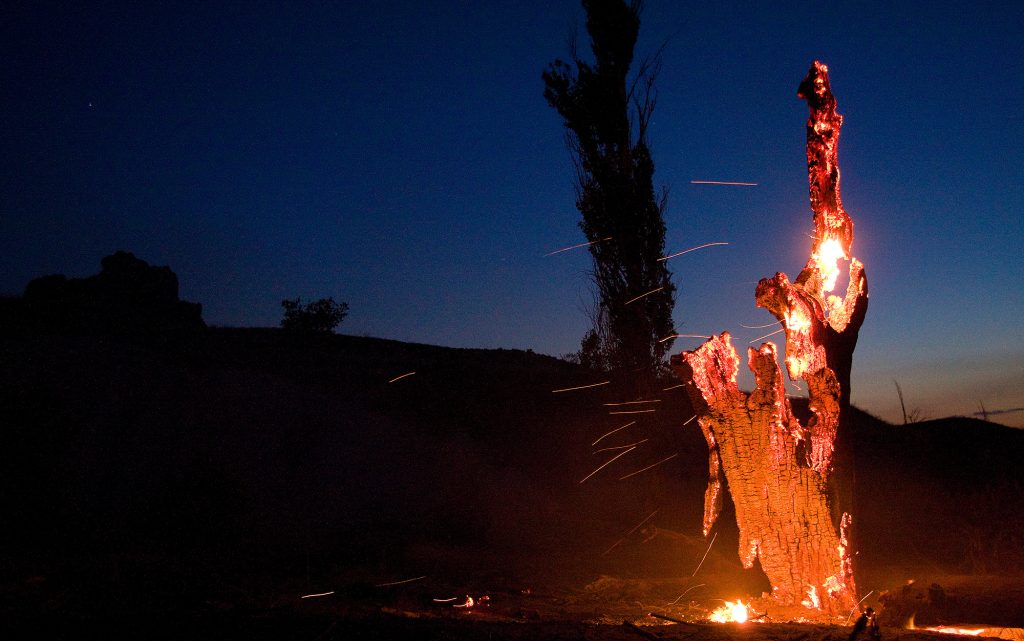
Photo by József L Szentpéteri/National Geographic

Jeremy England is associate professor of physics at Massachusetts Institute of Technology. His research has been published in Nature Nanotechnology and Proceedings to the National Academy of Sciences, among others. His work into the emergence of life-like behaviour has been profiled in Quanta Magazine and Nautilus.

1 November 2017 (aeon.co)

Edited by Sally Davies

Aeon for Friends

Living things are so impressive that they’ve earned their own branch of the natural sciences, called biology. From the perspective of a physicist, though, life isn’t different from non-life in any fundamental sense. Rocks and trees, cities and jungles, are all just collections of matter that move and change shape over time while exchanging energy with their surroundings. Does that mean physics has nothing to tell us about what life is and when it will appear? Or should we look forward to the day that an equation will finally leap off the page like a mathematical Frankenstein’s monster, and say, once and for all, that this is what it takes to make something live and breathe?

As a physicist, I prefer to chart a course between reductionism and defeat by thinking about the probability of matter becoming more life-like. The starting point is to see that there are many separate behaviours that seem to distinguish living things. They harvest energy from their surroundings and use it as fuel to make copies of themselves, for example. They also sense, and even predict things about the world they live in. Each of these behaviours is distinctive, yes, but also limited enough to be able to conceive of a non-living thing that accomplishes the same task. Although fire is not alive, it might be called a primitive self-replicator that ‘copies’ itself by spreading. Now the question becomes: can physics improve our understanding of these life-like behaviours? And, more intriguingly, can it tell us when and under what conditions we should expect them to emerge?

Increasingly, there’s reason to hope the answer might be yes. The theoretical research I do with my colleagues tries to comprehend a new aspect of life’s evolution by thinking of it in thermodynamic terms. When we conceive of an organism as just a bunch of molecules, which energy flows into, through and out of, we can use this information to build a probabilistic model of its behaviour. From this perspective, the extraordinary abilities of living things might turn out to be extreme outcomes of a much more widespread process going on all over the place, from turbulent fluids to vibrating crystals – a process by which dynamic, energy-consuming structures become fine-tuned or adapted to their environments. Far from being a freak event, finding something akin to evolving lifeforms might be quite likely in the kind of universe we inhabit – especially if we know how to look for it.

The understanding that life and heat are intertwined is very old knowledge. Moses, for one, was launched into his first encounter with the Creator of all life by the sight of a tree ablaze, burning with a marvellous fire that left the living organism unscathed.

In physics, heat is a form of energy, made up of the random movements and collisions of molecules as they bounce off each other at the nanoscale. Much of the world’s energy is tied up as heat. Although it sounds like something that just wobbles around in the background as other factors take centre stage, it actually plays a crucial role in making some of the most interesting kinds of behaviour possible. In particular, we’ll see that heat and time are bound together in an intricate dance, and the release of heat is what stops time going backwards.

Some things in the world seem reversible: I can kick a ball upward and it will rise, or I can drop a ball from a height, and it will fall. Putting it this way just seems like common sense, but it turns out that this pairing of dynamical trajectories, where one path looks like the time-reversed movie of the other, is a symmetry built into the basic mathematical structure of Newton’s laws. Anything that can go one way can go the other, if you just set it moving back the way it came. As a consequence, the most ‘normal’ thing in physics would be for events to be able to reverse themselves in time, just like the ball that goes up and then down.

We don’t immediately grasp the sweeping significance of time-reversal symmetry because a whole lot of what we see doesn’t seem to have this property. Little green shoots soak up the Sun and grow into mighty trees, but we never see a full-grown pine ‘ungrow’ itself into a cone buried in the dirt. Sandcastles disintegrate under the waves, but we never see them splash back together when the tide recedes. Countless examples of ordinary occurrences around us would look extraordinary if they happened in rewind. The ‘arrow of time’ seems to point in one direction, but there’s no obvious reason in principle to think it should. So what’s going on?

The short answer is that we’re not looking closely enough. When a piece of wood burns, an enormous amount of heat and chemical product is exchanged with the surrounding air. In order to run the tape backwards and spontaneously generate wood from ash and anti-flame, we’d have to somehow give every little molecule in the ash and atmosphere a backwards push to send it bouncing along the reverse track. That is not going to happen.

In a rigorous, quantitative sense, the dissipation of heat is the price we pay for the arrow of time

Many scientific commentators have noted the connection between heat and the arrow of time. However, only in the past 20 years or so have physicists developed a crisp, comprehensive formulation of the relationship. One of the most important contributions came from a theorist named Gavin Crooks, now at the Lawrence Berkeley National Lab in the United States. He asked the following question: given that I have a movie (say, of a piece of wood burning to ash or a plant growing) and the rewind version of that movie, how would I tell which one is more likely to happen?

By applying some basic assumptions, he was able to mathematically prove the following. If you have a system (a piece of wood or a plant, for example) surrounded by a ‘bath’ of randomly jiggling particles (say, the atmosphere), the more heat the system releases into its bath, the less likely it is to rewind itself. In a rigorous, quantitative sense, the dissipation of heat is the price we pay for the arrow of time.

Why? Another way of phrasing this insight is to note that the more a system increases the entropy of its surroundings, the more irreversible it becomes. Now, it must be said that in the grand contest for the most misunderstood idea in the history of physics, entropy is probably the winner. Even people who are normally averse to any mention of the natural sciences will sagely volunteer that entropy – read: messiness, dysfunction, chaos, disorder, who knows? – must increase, all the time. It’s the second law of thermodynamics, obviously. But this simple picture can’t be right. Living organisms, for one, seem to defy this misleading gloss on the second law. They take disorganised bits and pieces of matter, and put them together in fiendishly complex and refined ways.

Thankfully, the full story is substantially more nuanced. Connoisseurs use entropy in a technical, microscopic sense, as a statistical measure of the number of different ways the same kind of arrangement of matter can be constructed out of its constituent parts. For a room full of air, for example, it turns out there are just many, many more ways of spreading out the molecules uniformly than there are of squishing them into clumps. That’s why uniform air density wins the entropic game, and nature abhors a vacuum. The particles diffuse themselves evenly because that’s just the most likely thing to happen over time.

The connection between entropy and heat is more subtle. Remember that heat is energy diffused randomly among the particles in a substance. The more energy, the more ways of sharing it around; and the more ways of sharing the energy around, the higher the entropy. Back to Crooks’s example of a system in a bath, then, the more heat a system releases, the more it increases the entropy of its surroundings – and, as Crooks showed, the less likely it is that this sequence of events could rewind itself.

This is what the second law means: the reason a heat-producing movie is more likely than its heat-absorbing re-run has to do with the number of ways you can disperse that heat in the surrounding bath. The more heat you throw into the bath, the less hope you have of getting it back from a freak fluctuation, and the less likely it is that you will have the energy you need to retrace your steps once the movie has run forward. It’s like releasing a bagful of feathers into a gusting wind and hoping to catch them with a net. If you only release one feather, the gale might blow it back to you; but if you release hundreds or thousands, the chance of capturing them all is basically nil.

Now we can bring life into the picture. Living things clearly have energy to burn, and they get this energy from being worked on. Like heat, ‘work’ in thermodynamics involves units of energy. But instead of the uncoordinated wiggling of molecules, here it’s a measure of how much and how fast energy has been transferred to a system from its surroundings in a way that produces a change. There are a variety of versions, such as movement, volume change and chemical transformation. What unites these processes is that energy is being forced, pushed or driven into a system from the outside, in a way that modifies the system’s shape or location. When you hit a car, it might move, or you might dent it, or both. In any case, you’ve done work on it.

Life is superb at capturing energy through work. Growing a plant means doing work on it, no less than when we put shoulder to yoke and drag a cart up a hill. In these situations the conservation of energy required by Newton’s laws implies one of two things: either all the energy put in as work stays stored in the system, like the compressed spring in a Jack-in-the-box; or else it’s released into the surroundings as heat. Recall, too, what we said before about the release of heat and time-reversal symmetry. So the question of how much work gets done, and when, makes all the difference to which events are more or less likely in the movie we’re watching.

Now we know why mighty trees don’t ungrow themselves: because life produces heat. From a physics perspective, a tree harvests energy from its surroundings – work is done on it – and in the process, it dissipates energy to the surrounding air as heat. The differences in probability between forward and reverse in such cases are staggering. Even ungrowing a single photosynthetic bacterium is less likely than growing one by a factor of roughly 1050 billion! Suffice it to say, once the work gets flowing (and dissipating), backwards movies usually cease to be worth even talking about.

With a few tricks of algebra, you can use Crooks’s equation to compare the likelihoods of two future events in a system that’s being pushed by external forces and surrounded by a bath of randomly jiggling molecules. That includes the plant growing in the air, and anything that’s alive, in fact. So, if I zap a chemical mixture with electric shocks, or mechanically vibrate the container of a viscous fluid – does thinking about work and heat help me to predict if something resembling life might eventually emerge, after some energy has been allowed to flux through the system? Perhaps, but with a twist.

To probe the implications of work for how life (and evolution) evolved, a more versatile analogy is required. Let’s imagine a battery-powered car, exploring a rugged mountain range. Mathematically, the car’s location can be thought of as corresponding to the full microscopic configuration of a system composed of many different particles. Every spot on the terrain that the car might be, we can think of as a unique and different way of arranging all the molecular building blocks of some larger object. Accordingly, we have to think of the car not as having four cardinal directions to drive in, but rather, 1025 or more! And somewhere, out on that vast sierra, there’s a spot that represents a bacterium, a plant, a cat.

At any given moment, our car is furiously spinning its wheels, winding its way slowly up over a narrow pass, or bouncing rapidly down into another ravine. From time to time, the car randomly swerves and changes direction. This is a reasonable metaphor for a system that undergoes changes in energy, but doesn’t experience external drives that do work on it. Sometimes, the car goes uphill; this corresponds to our system absorbing heat and storing the energy, like the spring in a jack-in-the-box. Sometimes, the car goes downhill, which we’d liken to the clown popping out of the box as the spring is released.

So where does the exploring car end up? Both intuition and a more rigorous treatment of the physics tell us that two basic factors are going to affect what happens. First, the car is more likely to drive to places that are close to its starting point, and separated from that point by relatively flat terrain. Second, it will tend to go downhill more than it tends to go uphill. After a very long time, we might expect the car to wander so much that we’d have no idea where it was at the beginning – but its avoidance of hilltops and preference for valleys would probably remain.

Think of an opera singer who shatters a goblet with the perfect pitch of her song, due to a phenomenon known as resonance

To bring work into the picture, we just need to give the car a solar panel. This makes its wheels spin more vigorously when it’s positioned and angled so that the Sun is brightest. Now the rules of thumb for how the car explores are going to get dramatically more complicated. All things being equal, we’d still expect the car to stay close to home, go downhill, and avoid rugged terrain (at least until it gets stuck). In addition, we now have to think about the places and times that the car will get a power-boost from the Sun overhead. There are going to be cases where the car can more readily traverse a sunny hill than a shady plain, because of the extra help it gets by staying in the bright spots.

Given enough time, we can no longer be confident that we’ll find the car in some deep valley near home base; instead, we have to think about how far and how fast it might have travelled if it found a path on which the Sun kept shining. Described in this way, the vehicle’s dynamics are affected by a dizzying variety of factors, and there are many more possibilities for where the mountain-rover might go.

The solar-powered mountain-rover metaphor helps us to think about the evolution of a very diverse range of work-absorbing systems. Of course, the prospect of sifting through such a vast space of possibilities and landing on life at first seems hopeless. But things look different once we ask a simple question, namely: what determines which places are sunny, and which places aren’t?

At least part of the answer comes from the peculiarities of how a system’s structure allows it to connect with its surrounding energy source. Children often notice that a wineglass will ring at a different pitch depending on how much water is poured into it. A different, but related observation is that vessels made from the same amount of glass, and filled with the same amount of water, can ring at different pitches depending on their shape.

What this reveals is that the way matter is arranged can significantly affect how it tends to move and vibrate. Not only that, but the details of such an arrangement also change how matter absorbs work energy from its surroundings. Think of an opera singer who shatters a goblet with the perfect pitch of her song, due to a phenomenon known as resonance. Here, because the glass tends to vibrate at a frequency that is well-matched to the frequency of the sound, the oscillations in the glass produced by the energy in the sound waves are violent enough to break it.

We encounter the work-absorbing peculiarities of how matter is arranged all around us: from the ways pigment molecules absorb and scatter light so that we perceive them as having colours, to the fact that we can digest and be nourished by the starch in a potato more than by the cellulose in a bale of hay. From the perspective of chemical physics, a human being’s inability to eat grass is just about how the atoms that comprise a person’s digestive system are arranged. If these same carbons, nitrogens, oxygens and so on were re-fashioned into a cow stomach, the chemical work stored in grass would be ours for the taking.

It’s when we take this idea back to our solar-powered rover that things get interesting. Suppose we start with a collection of chemical building blocks in a thrown-together, uninteresting structure. That corresponds to parachuting the car into a randomly chosen starting location in the mountain range. But now, suppose that we subject these chemical building blocks to a challenging external environment – to a collection of energy sources that are accessible in principle, but only available in practice when the chemicals are arranged in rare, specially-matched shapes that happen to solve the problem of how to absorb work. For the rover, which we have said has unimaginably many possible directions to drive in, the challenging environment manifests as a landscape that’s mostly not very sunny, except when you are driving in just the right direction, in the right place, at the right time.

The system exhibits a self-reinforcing process that grows its ability to absorb work

Sure, it’s still not easy to tell where the rover must go in general. But there are particular scenarios where the matters become significantly clearer. We might think of a case in which the rover starts off in a sunny spot, spins its wheels furiously, and speeds to a new place in the shade, where its wheels grind mostly to a halt. Having been carried irreversibly to a new place by the absorption and dissipation of work, it then gets stuck in a shape that is bad at absorbing energy. That’s roughly equivalent to the opera singer shattering the goblet. At the beginning, the glass resonates and absorbs a lot of work from the song, which gets largely dissipated as heat when the glass shatters and settles into an inert heap of shards. Once in this state, the shards no longer resonate, and the rate of work absorption drops significantly.

We can also envision the opposite scenario. Suppose we have a single bacterium sitting in a big jar of food and oxygen. After 20 minutes or so, we should have two bacteria, and 20 minutes later gets us two more. What we expect to see, in the short term, is a process of exponential population growth. Individual bacteria harness the chemical work available in their surroundings, and pay the thermodynamic cost of making copies of themselves. Since the number of bacteria is growing, the rate of work absorption is also constantly increasing – at least until the food runs out and the party stops. We can liken this process to a rover that gets a bit of sunshine, which helps it edge its way a bit further out of the shade, so that its wheels speed up even more and carry it to an ever-sunnier location over time. The system in this case exhibits a sustained, self-reinforcing process that grows its ability to absorb work from the environment.

Note that there’s nothing in this thermodynamic description of reproduction that specifically picks out the notion of a discrete entity (such as a bacterium) reproducing itself. Rather, self-replication is just one example of a more general class of processes that exhibit what we call positive feedback. Positive feedback can happen whenever there’s a quantity in a system whose increase brings about a rise in its own rate of growth. In the case of self-replicating cells, the quantity in question is the number of cells itself: a larger number of cells can make more cells faster. However, one can also envision self-reinforcing behaviours that have to do with the shape or arrangement of a system as a whole; and in that case, the exploring rover story remains the same as ever. Looking at life this way allows us to recognise a similar feedback signature in cases where no self-copying self is apparent.

Just to recap where we’ve travelled. Living things manage not to fall apart as fast as they form because they constantly increase the entropy around them. They do this because their molecular structure lets them absorb energy as work and release it as heat. Under certain conditions, this ability to absorb work lets organisms (and other systems) refine their structure so as to absorb more work, and in the process, release more heat. It all adds up to a positive feedback loop that makes us appear to move forward in time, in accordance with the extended second law.

This process takes on a special significance in a setting like that of the vibrating glass. Here, the environmental energy source presents a particular challenge, such that the system (the glass) can only absorb energy if it adopts the right shapes. That’s equivalent to our rover finding that rare sliver of sunlight and managing to drive in just the right way to stay in the bright spots. If something about the system’s configuration lets it use the absorbed energy to power a feedback loop in a challenging scenario, you end up with a recipe for a system that evolves over time into more and more finely-tuned, specialised, energy-absorbing shapes. If you leave a lump of glass in the presence of a soprano for long enough, the shape it ultimately takes should depend on the precise pitch(es) she chooses to sing at.

In my research group’s first theoretical papers on this subject, we have referred to this mechanism of self-organisation as dissipative adaptation. Recently, we conducted two tests of the idea with computer simulations. In one study, we took a mixture of simple dots or points floating in viscous fluid. To make the environment more challenging, we imposed a simple rule: each pair of points was connected by a stretchy spring, which could randomly hook or unhook when close together. We then took one of the points amongst a group of 20 of them and pushed on it with an oscillating force of a single frequency.

What we saw next was intriguing. As the springs randomly hooked and unhooked, a specific network of tangled connections formed. These connections tended to vibrate at the frequency of the external force – hence they absorbed an exceptionally large amount of energy. Alternatively, when we engineered it so that the springs snapped more readily when stretched, we saw the opposite effect, like the opera singer’s shattered glass: a network formed that was attuned to not vibrate at that frequency. That is, the points adapted their shape to not absorbing energy.

The life-like specialness of organisms, which allows them to eat and survive and reproduce, might be recognisable in a broader physical class of systems

We got similar results in a second study. Here we put an initially randomly arranged collection of atoms in the presence of a rich but challenging source of energy that could only be accessed by a special combination of those atoms. After letting the atoms react for a long time, the composition of chemicals was biased to be either unusually bad or extremely good at extracting energy. In other words, the system exhibited a tendency to find and stay stuck in states that look adapted to their environment.

In both these cases, the point is not that all matter everywhere is trying to absorb and dissipate more energy all the time; nor is it that the second law of thermodynamics is magically guiding the discovery of organised structures that are better at increasing entropy. Rather, when particles interact under the challenging conditions created by an energy source, their resulting shapes tend to be fine-tuned to that energy source – even without the help of self-replication and natural selection.

As it happens, living things are both marvellously complex and breathtakingly good at meeting the challenges of their environments. We know this is because the life we see today has inherited many of the structural and behavioural adaptations that proved so useful to previous generations. In the biological context, ‘usefulness’ is that which enables survival and self-reproduction. But what’s beginning to emerge from some of this thermodynamic thinking – and what a few of us are eagerly exploring in simulation and experiment – is the possibility that some of the distinctively life-like specialness of how organisms are organised, and which allows them to eat and survive and reproduce, might be recognisable in a broader physical class of systems that do not contain self-copying selves. Instead, they are propelled towards strikingly special shapes by the thermodynamic laws governing positive feedback in the presence of a challenging energy source. This process might explain how evolution can get going in inert matter.

Whether this will ultimately make a big or small difference in how we understand living things at the microscopic level, we don’t know. There’s still more work to be done. But what our new vantage point on thermodynamics reveals is that a great many uncharted, and seemingly random, explorations of shape and form have a surprisingly good chance of ending up somewhere interesting – perhaps even the summit of the very distant mountaintop that we occupy on that unimaginably huge terrain, with a tiny flag reading ‘humanity’.

PhysicsBiologyEvolution

Elaine Pagels, “Why Religion?”

Politics and Prose Elaine Pagels discusses her book, “Why Religion?”, at Politics and Prose on 11/30/18. When Pagels, author of groundbreaking studies of the Gnostic Gospels, was asked, “Why religion?” she found that her own life illuminates both why she’s made a career of studying religious texts as well as why religion itself still exists in the supposedly secular 21st-century. The daughter and wife of scientists, Pagels was taught to trust the rational, but she found herself attracted to religious music and rituals for how they engaged the imagination. After the loss of her five-year-old son in 1987, followed by her husband’s death in an accident in 1988, Pagels turned to religion for help in facing her grief and anger. Interweaving the fascinating scholarship behind books such The Origin of Satan and Revelations with her own experiences, Pagels’s memoir is as emotionally affecting as it is thought-provoking. Pagels is in conversation with Dr. Eric Motley, executive vice president at the Aspen Institute and author of the memoir Madison Park. https://www.politics-prose.com/book/9… Elaine Pagels is a preeminent academic whose impressive scholarship has earned her international respect. The Harrington Spear Paine Professor of Religion at Princeton University, Pagels was awarded the Rockefeller, Guggenheim, and MacArthur Fellowships in three consecutive years. She is the author of The Gnostic Gospels, Beyond Belief, and Revelations. Founded by Carla Cohen and Barbara Meade in 1984, Politics and Prose Bookstore is Washington, D.C.’s premier independent bookstore and cultural hub, a gathering place for people interested in reading and discussing books. Politics and Prose offers superior service, unusual book choices, and a haven for book lovers in the store and online. Visit them on the web at http://www.politics-prose.com/ Produced by Tom Warren

The Beginnings of Anti-Semitism (Hint: it was in the Bible)

Kaufman Interfaith Institute On October 30, 2019, we hosted Dr. Elaine Pagels as the featured speaker at our annual interfaith academic conference. She gave two lectures, the first being “What do ‘secret gospels’ suggest about Jesus and his teaching?” (https://youtu.be/ZAQ8DsXDxQ) which was followed by a Panel discussion with Robert Van Voorst, Professor Emeritus of Western Theological Seminary, Sheldon Kopperl, Professor Emeritus, GVSU, Diane Madoush-Pitzer, Professor of Religious studies, GVSU with Douglas Kindschi, Kaufman Interfaith Institute’s director, moderating. The panel discussion is viewable here: https://youtu.be/3EC5WYiQ0_Q The evening session was a conversation between Dr. Pagels and Calvin University’s Frans van Liere which focused on her latest book, “Why Religion: A Personal Story” in which she reflects on the persistence and nature of belief and why religion matters in the wake of her own great personal tragedy: the death of her young son, followed a year later by the shocking loss of her husband. The evening session is available here: https://youtu.be/nROIfIK9csU Dr. Pagels is an American religion historian. She is the Harrington Spear Paine Professor of Religion at Princeton University. Pagels conducted extensive research into early Christianity and Gnosticism as a part of her graduate study at Harvard University. Her best-selling book The Gnostic Gospels examines the divisions in the early Christian church, and the way women were viewed throughout Jewish and Christian history. Modern Library named it as one of the 100 best books of the twentieth century. In 2001, Sylvia Kaufman brought together a group called the West Michigan Academic Consortium in order to extend the work of the West Shore Committee for Jewish-Christian Dialogue and the Kaufman Interfaith Institute. The mission of these groups is to provide programming that leads to greater interfaith understanding and mutual acceptance. The committee consists of representatives from Aquinas College, Calvin College, Calvin Theological Seminary, Cornerstone University, Grand Valley State University, Hope College, Kuyper College and Western Theological Seminary. They jointly choose the speakers and plan the conferences; the participating schools rotate hosting the conferences.

The Abusive Society

Why Abuse Seems to Reach Into Every Corner of Modern Life

umair haque · May 27 · May 2021

Image Credit: Allison Bailey on Twitter

I’d love to have kids. I don’t have kids. If I did, I’d be worried about them. Abuse, it seems, reaches crookedly into every tiny nook and cranny of life. We discovered that the hard way, from Weinstein to Spacey to Cosby to all the predators yet to be named. But what does that itself begin to hint at? An abusive society.

Let’s chart the journey of an average American. They’re born. Thanks to a deficient healthcare system, that costs around $20,000, where in most countries, this most basic of human rights, reproduction, is free. That tiny fact will play a theme in the story I’ll tell: the struggle to exist creates an abusive society, where people forever crave what they can never have. We’ll return to that.

Soon enough, our average American goes to school. Schools where rules about bullying and harassment simply don’t exist like they do in other rich countries, and even many poor ones. Schools where mass shootings and metal detectors are commonplace. Where disciplines like ethics and civics and economics and politics aren’t really taught, where the basics of science and art and literature must be fought over.

The child is taught in all these ways to feel afraid, hostile, anxious; to be confused, unsure, hesitant, about what it means to be a child, to be an adult, to be a person at all; that everything seems always to be a perpetual battle — not what a child should be taught, which is that his or her world is a gentle, safe, happy place, which can be explored and challenged and even upended, and things will still be alright.

He or she is left with a red-light sense of danger and caution. Here we begin to see the first great failure of American life: a failure to civilize, which we will pursue, but first let us discuss what it really means.

To mature and to become an individual the child must feel that the world is a safe place. Not a womb — but not a war zone either. But the world this child is in not a safe place. It is a jungle of thorns, which he or she cannot navigate. So the child remains stuck, at an infantile stage of development, and he or she will need constant approval and validation just to shore up a fragmented and weak sense of self, always now seeking a father or mother figure, his or her whole life long — and, because they themselves feel so weak inside, usually they will be drawn to the outwardly strongest, most bombastic, one they can find. This is the first of three great dilemmas of living in an abusive society, and it will set the stage for our average American’s life.

It’s time for college, for this average American. They don’t have rich parents, so immediately it costs them crippling lifelong debt. But that’s just the beginning. College life centers around fraternities and sororities, and to join one, one must be hazed, often viciously. Why do Americans need them? Because they are always seeking powerful, protective mother and father figures, craving safety, to make up for the basic absence of a safe world they have suffered from early childhood.

If you think I exaggerate, consider: this strange and costly structure, university life revolving around fraternities, simply doesn’t exist in any other society in the world, nor in history — it is as if one must be beaten into a gang simply to be educated. And yet, because it is centered on these organizations, which themselves center on politics, power, and parties, not education, college in the US is notably poor. Again, ethics, politics, economics, literature, and so on, simply aren’t part of most mandatory curricula — and so the failure to civilize, which produces a feeling of an unsafe world, continues.

Only now it’s growing: after being relentlessly hazed, bullied, and attacked, right from childhood into early adulthood, our average American is beginning to internalize all that abuse. What else can they do? A profound loss of the integrity of the self is what abuse genuinely is: the internalization of the harm that has one been done to one, over and over again, until one believes that one has deserved it, needed it, earned it.Abuse is a cycle, a burden passed down through the generations: no one is born an abuser. And so it’s at this moment, I’d guess, that the American psyche turns genuinely abusive. First, our average American needed safety in the arms of a father or mother figure, to make up for an unsafe world — and now they begin to believe that there exist good reasons that they needed to be abused, and thus, that they should and must behave abusively, too.

What are those reasons? Probably something like these. That to succeed, one must be more ruthless and merciless than the next person. That one’s suffering is a measure of one’s weakness, and therefore suffering must be erased and denied, not felt and understood. That one’s purpose in life is to amass power and privilege, no matter how barren or empty one feels inside. They are the prices one has learned that one must pay in an unsafe world, not for safety, warmth, security, which are by definition impossible to find, but just to exist at all, protected, at least, by their abusers.

And so now the second dilemma of the abusive society arises: one must abuse people to earn a sense of self, just to feel protected, but the price is happiness, because happiness comes from the strength and quality of one’s relationships, and in this mode of relating, one has no genuine relationships — only absences and emptinesses, voids and lacks of seeing and knowing people as people.

Let’s continue the story of our average American. If they’re lucky, they get some kind of professional job at a corporation. An accountant, a programmer, and so on. But what happens at these jobs? Well, the latest economic research tells us something very interesting: the jobs that contribute the least to society (that in fact destroy value, but we don’t need to gild the lily), like hedge fund managers, earn the most, and the jobs that contribute the most, like teachers, earn the least.

So now our American faces the third great dilemma of the abusive society: if they wish to earn a decent middle class living, they will have to seal a deal with the devil, and begin contributing less to society. But of course the price is that life loses meaning, because meaning is earned by what we give to people, not merely what we take from them. And so the price of this dilemma is that the world has finally been proven to be not just unsafe, but empty, hollow, a fraud: to earn protection, this time, he or she has had to give up on the point of life itself.

Now where is one to find the sense of meaning that one has lost? Where is one to find the sense of safety one has been craving all one’s life? Well, our average American is probably going to turn, now, in midlife, to religion. If relatively poor, perhaps a megachurch, if relatively well off, maybe Buddhism in designer yoga pants — maybe even QAnon. But religion is religion. And yet while religion does indeed give us meaning, again, this strikingly odd institutional structure — megachurches and corporate chains of yoga studios — simply doesn’t exist anywhere else in the world. It therefore tells us that something deeper is going on than religion. Our average American is still desperately seeking the sense of safety he or she has craved, and never found, since childhood.

Let’s take stock of the life of our average American now, at midlife, where I’ll end my essay. They began their life being failed in the most basic way: being stuck, trapped, imprisoned, as children, in an unsafe, precarious world. They then sought safety in the arms of mother and father figures their whole lives long. They sought it not in people, but in mega institutions, which at least gave them a basic sense of safety, if not actual security: first fraternities and sororities, universities, then mega corporations, and megachurches. All of these have served the same function, really: to make life in an abusive society not livable — for that it can never be — but at least tolerable.

But there is a strange and terrible social price: the need for protection in a world where one cannot have safety creates mega-institutions, but the men who control them are then free to become predators, voracious abusers. Just like mafia bosses, they turn protection into victimization. That is precisely what we see in America today.

Let’s put that in global perspective. At every stage of life, our average American has only been desperately craving safety, and safety only means this: that one has the right to exist. Americans don’t have any rights to exist: rights to healthcare, higher education, retirement, and so on, that the rest of the rich world does, enshrined in constitutions, safeguarded by institutions, like Britain’s National Health Service (which is now being gutted because of Britain’s own folly, but I digress). Who can blame them then for fleeing like the frightened little children they have always remained, into the arms of mega institutions, whether corporations or fraternities or churches?

A flight to mega-institutions is one solution to an abusive society. But it is a poor one, because it seeking the protection of one’s abusers, not from them, and thus licensing them. And so it can only ever be a palliative, like taking heroin for the pain of being abused all one’s life long. What Americans really need is to fix the cycles of abuse that have driven them to seek, and yet never find, safety in the unsafe world they themselves have created. To undo the predatory ways of being that they came to call wise and just and true, but in fact, were only ever the lament of the hurt child, begging, just for an instant, to be held, to be known, to be loved.

WRITTEN BY

umair haque

Eudaimonia and Co

Eudaimonia and Co

Eudaimonia & Co

This tiny minority of Iraqis follows an ancient Gnostic religion – and there’s a chance they could be your neighbors too

June 21, 2021 8.18am EDT (theconversation.com)

Author

  1. James F. McGrathProfessor of New Testament Language and Literature, Butler University, Butler University

Disclosure statement

James F. McGrath received funding from the National Endowment for the Humanities to support his work on the critical edition, translation, and commentary of the Mandaean Book of John referred to in this article.

Partners

View all partners

CC BY NDWe believe in the free flow of information
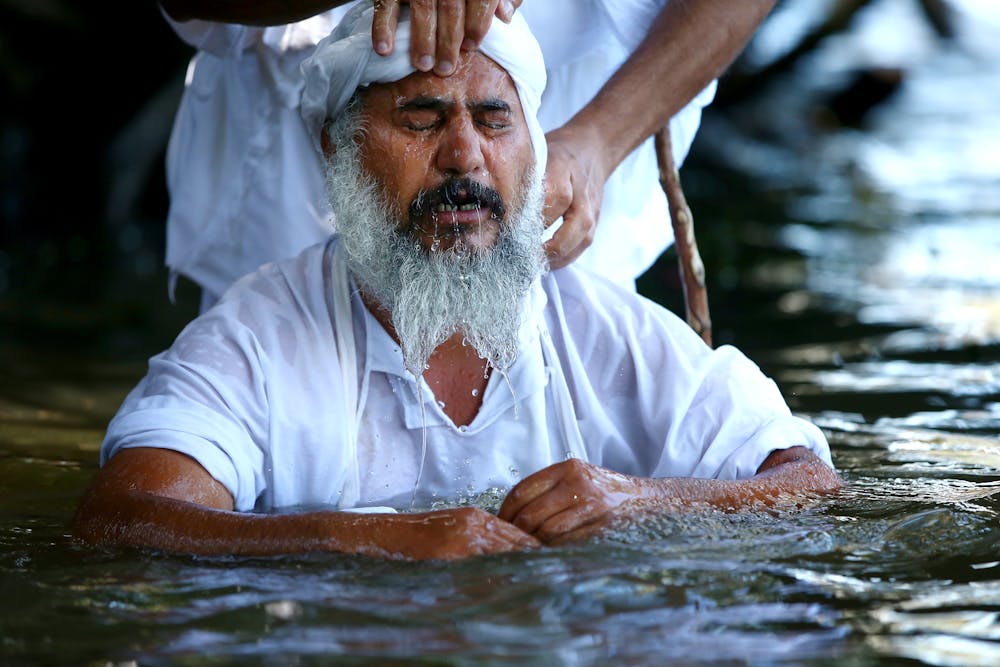
Followers of the Sabean Mandaeans faith, a pre-Christian sect that follows the teachings of the Bible's John the Baptist, perform their rituals in the Tigris River during a celebration marking "Banja" or Creation Feast, in central Baghdad, Iraq, Monday, March 15, 2021.
Like their ancient ancestors, contemporary Mandaeans revere John the Baptist and consider baptism the most important of their religious rituals. Hadi Mizban/AP

In March 2021 Pope Francis became the first leader of the Roman Catholic Church to visit Iraq. The number of Christians in Iraq has fallen sharply in the past two decades amid mass violence at the hands of the Islamic State group. Iraq stands today in the region of the ancient Babylonian Empire, generally understood as the homeland of the patriarch Abraham, the foundational figure shared by Judaism, Christianity and Islam – commonly called the “Abrahamic” religions.

As the pope met with local Christian and Muslim leaders, the names of other, smaller religious groups found in Iraq also made the news. One of these was likely unfamiliar to the majority of those in the English-speaking world: the Mandaeans. Also called Sabians, they are followers of the last Gnostic religion to survive continuously from ancient times down to the present day.

Gnostic religions view the material world as the product of a mistake in the heavenly realm, the creation of one or more inferior divine beings rather than the supreme God. Gnosticism also emphasizes that human beings can become aware of this and prepare their souls to escape from under the influence of the malevolent spiritual forces that created and rule this realm, so that when they die they can ascend to the good realm that lies beyond them.

As a scholar of religion, I’ve been involved in translating into English one of the Mandaeans’ sacred texts, known as the Mandaean Book of John. Working in this area has also connected me with the living tradition and persuaded me that more people need to know about Mandaeans.

Do experts have something to add to public debate?

We think so

The ancient roots of Gnosticism

Mandaeism, like other forms of Gnosticism, is an esoteric religion whose literature remains mostly in the hands of priestly families. Their sacred texts are written in a distinctive alphabet used only for that purpose. The contents and meaning of these works are largely unknown even to most Mandaeans, never mind others.

But the Mandeans’ alternative view has periodically attracted popular interest. In the 19th century, their most important sacred text, the Great Treasure or Ginza Rba, was translated into Latin. That is believed to have contributed to the heightened interest in esoteric mysticism and spirituality in that era. However, this was largely among people who had no contact with or real awareness of the Mandaeans in the present day.

Baptism: The core of Mandaean religion

A follower being baptised during a Mandaean baptism ceremony in the Nepean river at Emu Plains on October 26, 2014 in Sydney, Australia.
For Mandaeans, baptism is not a one-time action, but a repeated rite of of seeking forgiveness and cleansing any wrongdoing. Mark Kolbe/Getty Images

The Mandaeans’ central ritual is baptismimmersion in flowing water, which is referred to in Mandaic as “living water,” a phrase that appears in the Bible’s New Testament as well. Baptism in Mandaean faith is not a one-time action denoting conversion as in Christianity. Instead it is a repeated rite of seeking forgiveness and cleansing from wrongdoing, in preparation for the afterlife.

“Baptist” today usually denotes a form of Christianity, but Mandaeans aren’t Christians. They have a special place, however, for the individual who is said to have baptized Jesus, namely John the Baptist. The Mandaean Book of John, which I was involved in translating, tells stories about John the Baptist and attributes speeches to him containing various ethical teachings.

In the first half of the 20th century, the Mandaeans received significant attention from New Testament scholars who thought that their high view of John the Baptist might mean they were the descendants of his disciples. Many historians think that Jesus of Nazareth was a disciple of John the Baptist before breaking away to form his own movement, and I am inclined to agree.

Whatever tensions and competition there may have been among Mandaeans, Jews and Christians in Iraq in the past, today they seek to coexist amicably, finding themselves in a context in which all minority groups face much the same struggle to survive and maintain their identity.

[Over 100,000 readers rely on The Conversation’s newsletter to understand the world. Sign up today.]

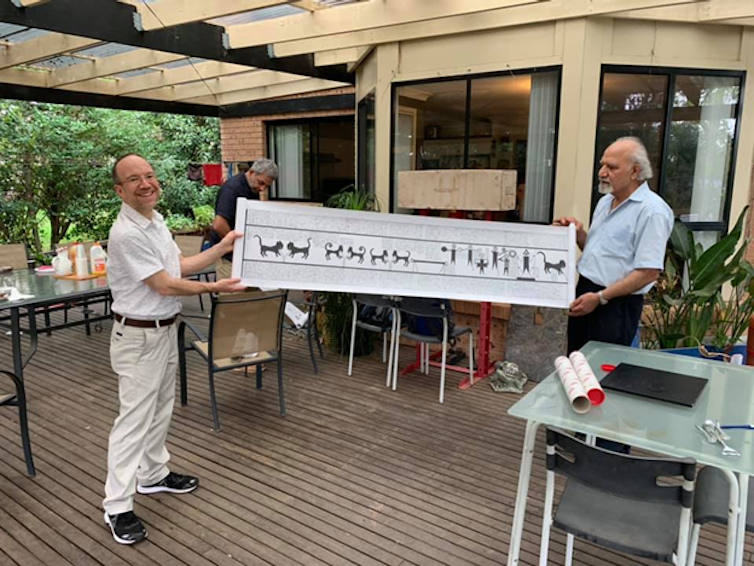
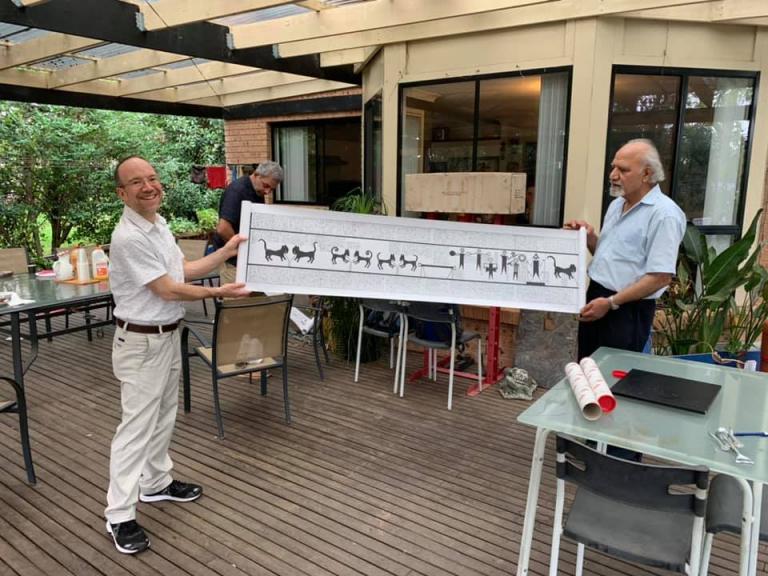
A number of Mandaean scrolls contain fascinating artwork and illustrations depicting varied images including the celestial figures mentioned in their texts, scenes from the afterlife, trees and animals. All are drawn in a style that isn’t quite like what one finds in the artwork or illustrated manuscripts of other religions. One of my favorite scenes in the scroll known as Diwan Abatur depicts people being tormented with trumpets and cymbals in purgatories through which souls are liable to pass. The point is most likely the loud noise such instruments can make, and not a negative statement about music in general.

The author holding a copy of an illustrated Mandaean scrollwork on the porch of a private residence in Australia.
James F. McGrath holds a copy of the Mandaean work known as the Diwan Abatur, together with the Mandaean who copied it, Majid al-Mubaraki. Courtesy of the author., Author provided

Mandaeism today

Estimates vary as to how many Mandaeans there are today. Some can still be found in their historic homelands in Iraq and Iran. However, persecution in those places has led to the creation of small but significant Mandaean diaspora communities in such places as Australia, Sweden and the U.S.

This scattering, combined with Mandaeans’ dwindling numbers, has made it much harder for them to preserve their identity and pass their traditions along to the next generation. Mandaeans do not accept converts or consider children of marriages with non-Mandaeans to be part of their religious community, which has also contributed to their dwindling population.

There is a reasonable chance that Mandaeans may be among your neighbors, whether you live in San Diego, San Antonio or Sydney. Look for them, and you may get a chance to do more than catch a glimpse of living history.

(Courtesy of Janet Cornwell, H.W,. m.)

Elaine Pagels – What do “secret gospels” suggest about Jesus and his teaching?

Kaufman Interfaith Institute On October 30, 2019, we hosted Dr. Elaine Pagels as the featured speaker at our annual interfaith academic conference. She gave two lectures, the first being “What do ‘secret gospels’ suggest about Jesus and his teaching?” (https://youtu.be/ZAQ8DsXDxQ) which was followed by a Panel discussion with Robert Van Voorst, Professor Emeritus of Western Theological Seminary, Sheldon Kopperl, Professor Emeritus, GVSU, Diane Madoush-Pitzer, Professor of Religious studies, GVSU with Douglas Kindschi, Kaufman Interfaith Institute’s director, moderating. The panel discussion is viewable here: https://youtu.be/3EC5WYiQ0_Q The evening session was a conversation between Dr. Pagels and Calvin University’s Frans van Liere which focused on her latest book, “Why Religion: A Personal Story” in which she reflects on the persistence and nature of belief and why religion matters in the wake of her own great personal tragedy: the death of her young son, followed a year later by the shocking loss of her husband. The evening session is available here: https://youtu.be/nROIfIK9csU Dr. Pagels is an American religion historian. She is the Harrington Spear Paine Professor of Religion at Princeton University. Pagels conducted extensive research into early Christianity and Gnosticism as a part of her graduate study at Harvard University. Her best-selling book The Gnostic Gospels examines the divisions in the early Christian church, and the way women were viewed throughout Jewish and Christian history. Modern Library named it as one of the 100 best books of the twentieth century. In 2001, Sylvia Kaufman brought together a group called the West Michigan Academic Consortium in order to extend the work of the West Shore Committee for Jewish-Christian Dialogue and the Kaufman Interfaith Institute. The mission of these groups is to provide programming that leads to greater interfaith understanding and mutual acceptance. The committee consists of representatives from Aquinas College, Calvin College, Calvin Theological Seminary, Cornerstone University, Grand Valley State University, Hope College, Kuyper College and Western Theological Seminary. They jointly choose the speakers and plan the conferences; the participating schools rotate hosting the conferences. Find out more at interfaithunderstanding.org

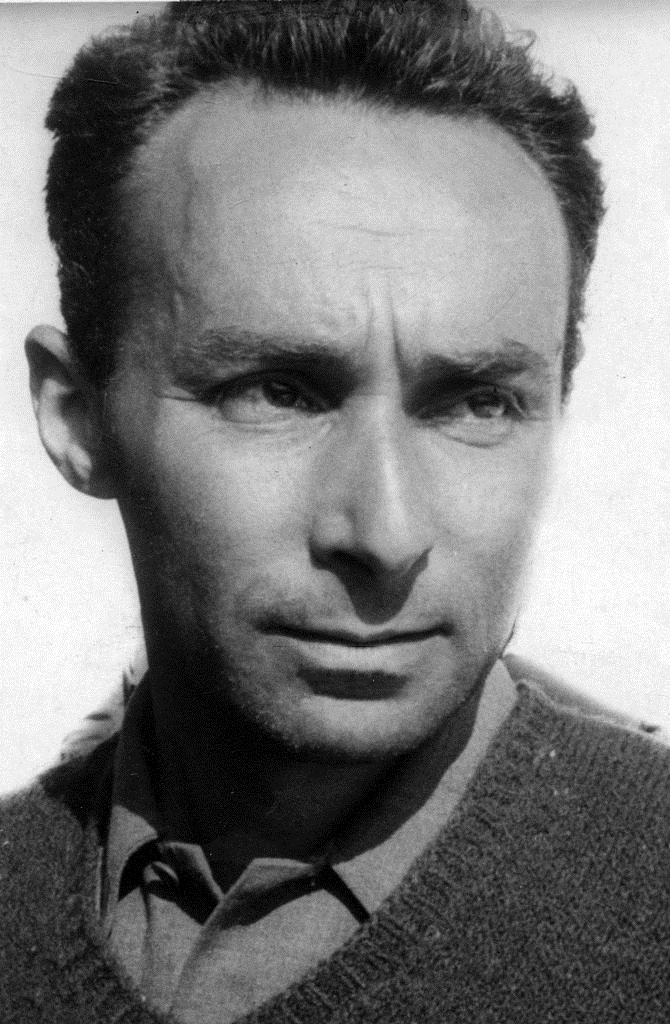
Bio: Primo Levi

From Wikipedia, the free encyclopedia

AA305971 cucina 254 388 300 3001 4584 Scala di grigio
Primo Levi
Born31 July 1919
TurinItaly
Died11 April 1987 (aged 67)
Turin, Italy
Pen nameDamiano Malabaila (used for some of his fictional works)
OccupationWriter, chemist
LanguageItalian
NationalityItalian
EducationDegree in chemistry
Alma materUniversity of Turin
Period1947–1986
GenreAutobiography, short story, essay
Notable worksIf This Is a ManThe Periodic Table
SpouseLucia Morpurgo (1920–2009)[1][2]
Children2

Primo Michele Levi[3][4] (Italian: [ˈpriːmo ˈlɛːvi]; 31 July 1919 – 11 April 1987) was an Italian Jewish chemist, partisanHolocaust survivor and writer. He was the author of several books, collections of short stories, essays, poems and one novel. His best-known works include If This Is a Man (1947, published as Survival in Auschwitz in the United States), his account of the year he spent as a prisoner in the Auschwitz concentration camp in Nazi-occupied Poland; and The Periodic Table (1975), linked to qualities of the elements, which the Royal Institution named the best science book ever written.[5]

Levi died in 1987 from injuries sustained in a fall from a third-story apartment landing. His death was officially ruled a suicide, but some, after careful consideration, have suggested that the fall was accidental because he left no suicide note, there were no witnesses, and he was on medication that could have affected his blood pressure and caused him to fall accidentally.[6][7]

Biography

Early life

Levi was born in 1919 in Turin, Italy, at Corso Re Umberto 75, into a liberal Jewish family. His father, Cesare, worked for the manufacturing firm Ganz and spent much of his time working abroad in Hungary, where Ganz was based. Cesare was an avid reader and autodidact. Levi’s mother, Ester, known to everyone as Rina, was well educated, having attended the Istituto Maria Letizia. She too was an avid reader, played the piano, and spoke fluent French.[8] The marriage between Rina and Cesare had been arranged by Rina’s father.[8] On their wedding day, Rina’s father, Cesare Luzzati, gave Rina the apartment at Corso Re Umberto, where Primo Levi lived for almost his entire life.Levi, ca. 1950s

In 1921 Anna Maria, Levi’s sister, was born; he remained close to her all her life. In 1925 he entered the Felice Rignon primary school in Turin. A thin and delicate child, he was shy and considered himself ugly; he excelled academically. His school record includes long periods of absence during which he was tutored at home, at first by Emilia Glauda and then by Marisa Zini, daughter of philosopher Zino Zini.[9] The children spent summers with their mother in the Waldensian valleys southwest of Turin, where Rina rented a farmhouse. His father remained in the city, partly because of his dislike of the rural life, but also because of his infidelities.[10]

In September 1930 Levi entered the Massimo d’Azeglio Royal Gymnasium a year ahead of normal entrance requirements.[11] In class he was the youngest, the shortest and the cleverest, as well as being the only Jew. Only two boys there bullied him for being Jewish, but their animosity was traumatic.[12] In August 1932, following two years attendance also at the Talmud Torah school in Turin to pick up the elements of doctrine and culture, he sang in the local synagogue for his Bar Mitzvah.[13] In 1933, as was expected of all young Italian schoolboys, he joined the Avanguardisti movement for young Fascists. He avoided rifle drill by joining the ski division, and spent every Saturday during the season on the slopes above Turin.[14] As a young boy Levi was plagued by illness, particularly chest infections, but he was keen to participate in physical activity. In his teens, Levi and a few friends would sneak into a disused sports stadium and conduct athletic competitions.

In July 1934 at the age of 14, he sat the exams for the Liceo Classico D’Azeglio, a Lyceum (sixth form or senior high school) specializing in the classics, and was admitted that year. The school was noted for its well-known anti-Fascist teachers, among them the philosopher Norberto Bobbio, and Cesare Pavese, who later became one of Italy’s best-known novelists.[15] Levi continued to be bullied during his time at the Lyceum, although six other Jews were in his class.[16] Upon reading Concerning the Nature of Things by Sir William Bragg, Levi decided that he wanted to be a chemist.[17]

In 1937, he was summoned before the War Ministry and accused of ignoring a draft notice from the Italian Royal Navy—one day before he was to write a final examination on Italy’s participation in the Spanish Civil War, based on a quote from Thucydides: “We have the singular merit of being brave to the utmost degree.” Distracted and terrified by the draft accusation, he failed the exam—the first poor grade of his life—and was devastated. His father was able to keep him out of the Navy by enrolling him in the Fascist militia (Milizia Volontaria per la Sicurezza Nazionale). He remained a member through his first year of university, until passage of the Italian Racial Laws of 1938 forced his expulsion. Levi later recounted this series of events in the short story “Fra Diavolo on the Po”.[18]

He retook and passed his final examinations, and in October enrolled at the University of Turin to study chemistry. As one of 80 candidates, he spent three months taking lectures, and in February, after passing his colloquio (oral examination), he was selected as one of 20 to move on to the full-time chemistry curriculum.

In the liberal period as well as in the first decade of the Fascist regime, Jews held many public positions, and were prominent in literature, science and politics.[19] In 1929 Mussolini signed an agreement with the Catholic Church, the Lateran Treaty, which established Catholicism as the State religion, allowed the Church to influence many sectors of education and public life, and relegated other religions to the status of “tolerated cults”. In 1936 Italy’s conquest of Ethiopia and the expansion of what the regime regarded as the Italian “colonial empire” brought the question of “race” to the forefront. In the context set by these events, and the 1940 alliance with Hitler’s Germany, the situation of the Jews of Italy changed radically.

In July 1938 a group of prominent Italian scientists and intellectuals published the “Manifesto of Race,” a mixture of racial and ideological antisemitic theories from ancient and modern sources. This treatise formed the basis for the Italian Racial Laws of October 1938. After its enactment Italian Jews lost their basic civil rights, positions in public offices, and their assets. Their books were prohibited: Jewish writers could no longer publish in magazines owned by Aryans. Jewish students who had begun their course of study were permitted to continue, but new Jewish students were barred from entering university. Levi had matriculated a year earlier than scheduled enabling him to take a degree.

In 1939 Levi began his love affair with hiking in the mountains.[20] A friend, Sandro Delmastro, taught him how to hike, and they spent many weekends in the mountains above Turin. Physical exertion, the risk, and the battle with the elements while following Sandro’s example enabled him to put out of his mind the nightmare situation precipitating all over Europe as, communing with the sky and earth, he managed to satisfy his desire for liberty realize fully his own strength, and the reasons behind his ardent need grasp the nature of things that had led him to study chemistry, as he later wrote in the chapter “Iron” of The Periodic Table (1975).[21] In June 1940 Italy declared war as an ally of Germany against Britain and France, and the first Allied air raids on Turin began two days later. Levi’s studies continued during the bombardments. The family suffered additional strain as his father became bedridden with bowel cancer.

Chemistry

Because of the new racial laws and the increasing intensity of prevalent fascism, Levi had difficulty finding a supervisor for his graduation thesis, which was on the subject of Walden inversion, a study of the asymmetry of the carbon atom. Eventually taken on by Dr. Nicolò Dallaporta, he graduated in mid-1941 with full marks and merit, having submitted additional theses on x-rays and electrostatic energy. His degree certificate bore the remark, “of Jewish race”. The racial laws prevented Levi from finding a suitable permanent job after graduation.

In December 1941 Levi received an informal job offer from an Italian officer to work as a chemist, under a clandestine identity, at an asbestos mine in San Vittore. The project was to extract nickel from the mine spoil, a challenge he accepted with pleasure. Levi later understood that, if successful, he would be aiding the German war effort, which was suffering nickel shortages in the production of armaments.[22] The job required Levi to work under a false name with false papers. Three months later, in March 1942, his father died. Levi left the mine in June to work in Milan. Recruited through a fellow student at Turin University, working for the Swiss firm of A Wander Ltd on a project to extract an anti-diabetic from vegetable matter, he took the job in a Swiss company to escape the race laws. It soon became clear that the project had no chance of succeeding, but it was in no one’s interest to say so.[23]

In July 1943, King Victor Emmanuel III deposed Mussolini and appointed a new government under Marshal Pietro Badoglio, prepared to sign the Armistice of Cassibile with the Allies. When the armistice was made public on 8 September, the Germans occupied northern and central Italy, liberated Mussolini from imprisonment and appointed him as head of the Italian Social Republic, a puppet state in German-occupied northern Italy. Levi returned to Turin to find his mother and sister in refuge in their holiday home ‘La Saccarello’ in the hills outside the city. The three embarked to Saint-Vincent in the Aosta Valley, where they could be hidden. Being pursued as Jews, many of whom had already been interned by the authorities, they moved up the hillside to Amay in the Col de Joux [it], a rebellious area highly suitable for guerilla activities.[24]

The Italian resistance movement became increasingly active in the German-occupied zone. Levi and some comrades took to the foothills of the Alps, and in October formed a partisan group in the hope of being affiliated to the liberal Giustizia e Libertà. Untrained for such a venture, he and his companions were arrested by the Fascist militia on 13 December 1943. When told he would be shot as an Italian partisan, Levi confessed to being Jewish. He was sent to the internment camp at Fossoli near Modena. He recalled that as long as Fossoli was under the control of the Italian Social Republic, rather than Nazi Germany, he was not harmed.

We were given, on a regular basis, a food ration destined for the soldiers”, Levi’s testimony stated, “and at the end of January 1944, we were taken to Fossoli on a passenger train. Our conditions in the camp were quite good. There was no talk of executions and the atmosphere was quite calm. We were allowed to keep the money we had brought with us and to receive money from the outside. We worked in the kitchen in turn and performed other services in the camp. We even prepared a dining room, a rather sparse one, I must admit.[25]

Auschwitz

IG Farben factory in Monowitz (near Auschwitz) 1941
50.036094°N 19.275534°ECoordinates50.036094°N 19.275534°EBuna WerkeMonowitz and subcamps

Fossoli was then taken over by the Nazis, who started arranging the deportations of the Jews to eastern concentration and death camps. On the second of these transports, on 21 February 1944, Levi and other inmates were transported in twelve cramped cattle trucks to Monowitz, one of the three main camps in the Auschwitz concentration camp complex. Levi (record number 174517) spent eleven months there before the camp was liberated by the Red Army on 27 January 1945. On their arrival, people were sorted according to whether they could work or not. An acquaintance said that it would make no difference, in the end, and declared he was unable to work and was killed immediately. Of the 650 Italian Jews in his transport, Levi was one of twenty who left the camps alive. The average life expectancy of a new entrant at the camp was three to four months.

Levi knew some German from reading German publications on chemistry; he worked to orient quickly to life in the camp without attracting the attention of the privileged inmates. He used bread to pay a more experienced Italian prisoner for German lessons and orientation in Auschwitz. He was given a smuggled soup ration each day by Lorenzo Perrone, an Italian civilian bricklayer working there as a forced labourer. Levi’s professional qualifications were useful: in mid-November 1944, he secured a position as an assistant in IG Farben‘s Buna Werke laboratory that was intended to produce synthetic rubber. By avoiding hard labour in freezing outdoor temperatures he was able to survive; also, by stealing materials from the laboratory and trading them for extra food.[26] Shortly before the camp was liberated by the Red Army, he fell ill with scarlet fever and was placed in the camp’s sanatorium (camp hospital). On 18 January 1945, the SS hurriedly evacuated the camp as the Red Army approached, forcing all but the gravely ill on a long death march to a site further from the front, which resulted in the deaths of the vast majority of the remaining prisoners on the march. Levi’s illness spared him this fate.

Although liberated on 27 January 1945, Levi did not reach Turin until 19 October 1945. After spending some time in a Soviet camp for former concentration camp inmates, he embarked on an arduous journey home in the company of former Italian prisoners of war who had been part of the Italian Army in Russia. His long railway journey home to Turin took him on a circuitous route from Poland, through Belarus, Ukraine, Romania, Hungary, Austria, and Germany. In later writings, he noted the millions of displaced people on the roads and trains throughout Europe in that period.

More at: https://en.wikipedia.org/wiki/Primo_Levi

The Wisdom of Trauma, Official Trailer

scienceandnonduality A feature-length documentary to be released in June 2021. If you would like to receive updates from us regarding the film, please go to: https://www.thewisdomoftrauma.com/ One in five Americans are diagnosed with mental illness in any given year. Suicide is the second most common cause of death in the US for youth aged 15-24. Depression kills over a million people a year globally and 50,000 in the USA. Drug overdoses kills 70,000 in the USA. The autoimmunity epidemic affects 23.5 – 50 million people in the US. What is going on? The interconnected epidemics of anxiety, chronic illness and substance abuse are, according to Dr Gabor Maté, normal. But not in the way you might think. “So much of what we call abnormality in this culture is actually normal responses to an abnormal culture. The abnormality does not reside in the pathology of individuals, but in the very culture that drives people into suffering and dysfunction.” — Gabor Maté In “The Wisdom of Trauma”, we travel alongside bestselling author and Order of Canada recipient Dr Gabor Maté to explore why our wester society is facing such epidemics. This is a journey alongside a man who has dedicated his life to understand the connection between illness, addiction, trauma, and society. “Trauma is not what happens to you. Trauma is what happens inside you, as a result of what happens to you.” — Dr. Gabor Maté Trauma is the invisible force that shapes our lives. It shapes the way we live, the way we love and the way we make sense of the world. It is the root of our deepest wounds. Dr. Maté gives us a new vision: a trauma-informed society in which parents, teachers, physicians, policy-makers and legal personnel are not concerned with fixing behaviors, making diagnoses, suppressing symptoms and judging, but seek instead to understand the sources from which troubling behaviors and diseases spring in the wounded human soul. Join us for this exploration this June! “The Wisdom of Trauma” a SAND production Directed by: Zaya and Maurizio Benazzo Director of photography: Caroline Harrison Editor: Kirk Demorest and Caroline Harrison

Consciousness, spirituality, biography, sexuality, androgyny, futurism, space, the arts, science, astrology, democracy, humor, books, movies and more