
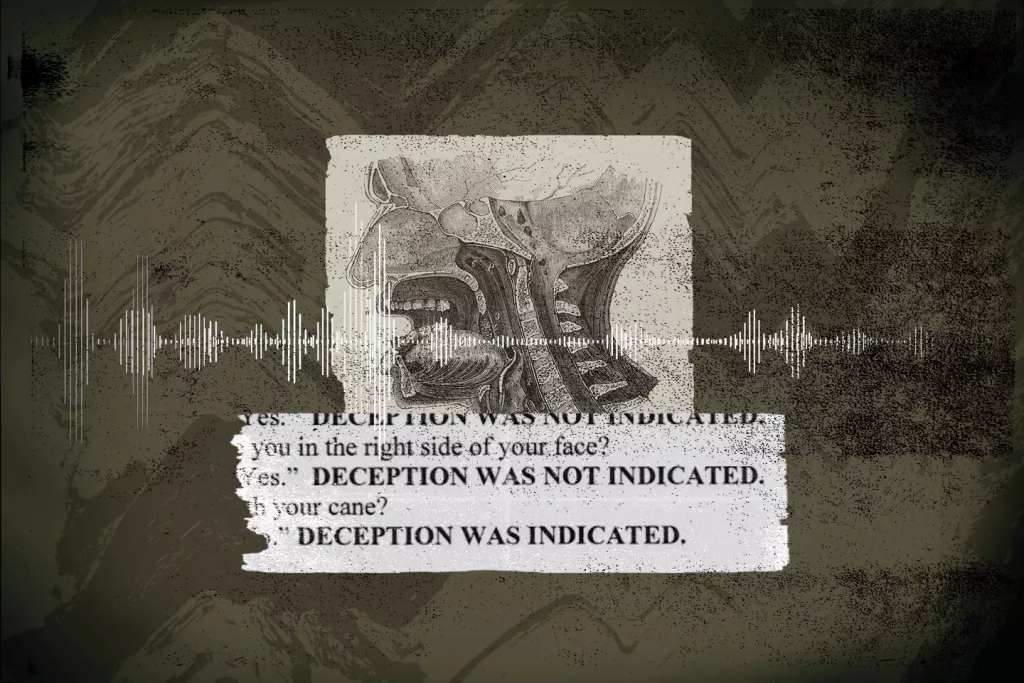
A pseudoscientific technology that purportedly detects lies through inaudible tremors in the voice has been used by California law enforcement agencies for years, a Chronicle investigation found. Chronicle photo illustration from documents and Getty Images elements
By Susie Neilson, Matthias Gafni
Updated June 4, 2024 (SFChronicle.com)
Raymond Whitall figured the technology could help him. It was September 2017, and the 58-year-old prisoner at Salinas Valley State Prison in Monterey County had accused guards of beating him without justification months earlier as he lay on the floor of the prison’s gym.
The guards said Whitall — who suffered from a chronic disease that affected his hearing and balance — had swung his cane, hitting one of their hands, and that three of them had to physically subdue him. But a prison investigator determined that Whitall’s injuries could not be explained by the guards’ account.
Then Whitall agreed to take an exam called a Computer Voice Stress Analyzer, or CVSA, that promised to analyze inaudible tremors in his voice and tell trained staff at the prison whether he was telling the truth. No one told Whitall that the device was junk science — no more accurate at lie detection than a coin flip, according to a litany of research and, at one point, its own inventor.
ADVERTISEMENT
Article continues below this ad
When Whitall’s vocal pattern indicated “deception,” the prison threw out his complaint.
For decades, the California Department of Corrections and Rehabilitation used a pseudoscientific technology to assess prisoners’ credibility during investigations, even after researchers debunked the CVSA and after its manufacturer, NITV Federal Services, admitted that it was not capable of detecting lies, a Chronicle investigation has found.
Additionally, the newspaper identified 13 other law enforcement agencies around California — including the Berkeley Police Department, the Alameda County Sheriff’s Office and the California Highway Patrol — that have used the CVSA to interview prospective officers as part of their hiring processes.
Three of those agencies have also used it in criminal investigations.
ADVERTISEMENT
Article continues below this ad
NITV Federal Services offers dozens of courses to law enforcement agencies each year and has sold its machines and training sessions to thousands of departments, billing the CVSA as a cheaper alternative to the polygraph test — another controversial lie-detector technology. Collectively, these California agencies have spent at least hundreds of thousands of taxpayer dollars on the CVSA since 2020, the Chronicle found.
Mary Xjimenez, a corrections department spokesperson, did not respond to reporters’ emailed questions about Whitall’s case. She said, “CVSA has not been used by CDCR to discredit an employee or incarcerated person.” Nevertheless, after months of questions from the Chronicle, Xjimenez said the agency was “moving forward with regulations to end the use of CVSA across offices and institutions.”
Berkeley Director of Police Accountability Hansel Alejandro Aguilar, who provides oversight of the city’s police department, said in an email that, “given the concerns about CVSA’s scientific validity,” the tool should be “re-evaluated to ensure that it meets rigorous standards of accuracy and effectiveness.” He added that his office would recommend a review of the police department’s policy “if warranted.”
The Chronicle’s reporting reveals through documents and interviews that law enforcement agencies’ use of the CVSA survived years of red flags raised about the tool’s effectiveness and fairness, including lawsuits and letters submitted to prison officials by a prominent civil rights law firm.
In recent years, law enforcement’s use of scientific-sounding technologies that aren’t supported by research has come under scrutiny. Judges and attorneys have asked federal officials to ban the use of 911 call analysis, an unverified system professing to use a person’s speech patterns to determine whether they committed the crime they’re calling about. And a recent federal study found that blood spatter analysis, a method of using bloodstain patterns to determine how a crime unfolded, regularly produces “erroneous” findings, with analysts often reaching opposing conclusions when examining the same bloodstains.
Prison officials did not respond to the Chronicle’s inquiries about when the department began using the CVSA and how many prisoners have submitted to the exam. Regardless, the newspaper identified at least five prisons — Salinas Valley, High Desert State Prison in Lassen County, California State Prison in Los Angeles County, San Quentin Rehabilitation Center in Marin County and Central California Women’s Facility in Madera County — that used the tool as far back as 2005.
Whitall, now 65, is suing Salinas Valley, where he remains incarcerated, as well as the guards he accused of beating him up. The prisoner spent four months in solitary confinement, he said, while prison staff faced no consequences. His civil trial is scheduled to begin in August.
“Nobody got punished,” Whitall told the Chronicle. “They said I did what I did, and that the officers were right, and that’s it. But I believe some justice will be done pretty soon.”
‘Not capable of lie detection’
The CVSA purportedly works by measuring inaudible changes to a person’s speech patterns. According to an early 2000s training manual obtained by the Chronicle, a person’s vocal cords are “subject to physiological tremors” that diminish when they are stressed. Thus, a stressed person’s speech patterns would have a different frequency, and a different shape when plotted on a graph, than an unstressed person.
Once used by U.S. military officials to interrogate terrorism suspects, the CVSA was abandoned by the Pentagon in the mid-2000s over concerns about its reliability, according to a 2006 ABC News investigation.
Numerous reports, including a 2008 study funded by the National Institute of Justice, the research arm of the U.S. Justice Department, have found the tool is no better than chance at detecting lies. In 2007, speech sound experts in Sweden observed that no studies have confirmed the human voice produces the “microtremors” that the CVSA supposedly measures.
CVSA results are generally not admissible in court, according to a series of federal rulings. Starting in 1923, the U.S. Supreme Court has ruled that lie-detector exams and other experimental investigative tools must be backed by “demonstrable” scientific evidence and have “gained general acceptance” before their findings can be introduced as evidence. In a 1976 decision by a Maryland appeals court, justices ruled that a Psychological Stress Evaluation, an early iteration of a voice-stress test, was not admissible. “A lie detector test by any other name is still a lie detector test,” the justices determined.
In 1998, the Supreme Court specifically barred lie detector exam results.
A few years later, in 2002, the technology’s parent company, NITV Federal Services, acknowledged in a court filing related to a San Diego homicide case that the CVSA was ineffective at separating fact from fiction. Three men had alleged police used the tool to interrogate them for hours until they falsely confessed to murdering a 12-year-old girl.
In his sworn declaration, David Hughes, executive director of the company then known as the National Institute for Truth Verification, wrote, “the CVSA is not capable of lie detection.” He continued, “NITV cautions all examiners and purchasers of the product that the CVSA should only be used as an investigative device” to measure what he called “brain stress activity.”
Reached for comment in March, NITV Federal Services claimed the science behind the tool was sound, and that research debunking it was part of a broad effort to discredit the CVSA by the polygraph industry.
“It seems quite surprising, actually silly, that for an instrument that is no better than chance, over 3,000 accredited law enforcement agencies now depend on the CVSA for their truth verification needs,” a company spokesperson told the Chronicle. “Why are they so afraid of it? It’s just another investigative tool to help guide investigations.”
The company did not respond to the Chronicle’s request for a list of its clients. On its website, however, NITV states that more than 2,700 law enforcement agencies across the country use the CVSA, including 270 in California. In addition, the company lists almost 400 other agencies that use its technology, including fire departments, jails and even airlines. The company says that officials in New Zealand, Nigeria and Pakistan also use the tool.
Xjimenez said the state prison agency had significantly narrowed its use of the CVSA in recent years and no longer employs it to assess allegations of guard abuse. Still, the department has declined to revisit past complaints like Whitall’s, and has continued to use the CVSA to “assist in determining an incarcerated person’s truthfulness” during a threat assessment, an investigation triggered by a possible threat made against prison staff, Xjimenez said.
Embraced by California police
The Chronicle identified 26 additional California law enforcement agencies that referenced using the CVSA in job listings or in other materials. Five of the agencies did not respond to a reporter’s repeated interview requests. Seven said they no longer use the tool or had never used it.
Ten agencies said they use the CVSA only to interview prospective officers as part of the hiring process. Law enforcement agencies that operate in the Bay Area, including the Berkeley Police Department, the Alameda County Sheriff’s Office and the California Highway Patrol, confirmed they use CVSA. But when the Chronicle asked for additional details about their use, they did not provide them.
The California Department of Justice’s law enforcement division uses the CVSA “for hiring purposes during the background process for Special Agent candidates,” a spokesperson for the attorney general’s office said. “The CVSA is not used during investigations.”
A spokesperson for the Tulare County Probation Department said, “We have not seen any recent research on the accuracy of the CVSA.” She added that results from CVSA exams are “never used to approve or disqualify a candidate.”
A representative for the California State Parks Department also said it has never used “deceptive” findings to eliminate a peace officer candidate from its job pool.
The Vacaville Police Department also uses the CVSA when hiring officers. Asked about studies debunking CVSA, Sgt. Robert Myers, a detective for the police department, said: “I’m aware.” He continued: “There’s experts for both sides, for and against it.”
Two agencies — the Kings County District Attorney’s Office and the Stanislaus County Sheriff’s Office — said they use the technology for criminal investigations, though when asked by reporters for specific cases and details, neither agency provided them. A third, the Fresno Police Department, said its investigators have used the device during criminal investigations in the past, but could not recall a time its officers had done so in at least two years.
One agency, the Monterey County Sheriff’s Office, hosted a CVSA training course this year, according to NITV, and the department said it plans to implement the technology in the future. The agency did not respond to a reporter’s repeated requests for more information.
Criminal psychology experts said that any use of the CVSA was inadvisable because the tool was not only ineffective and inadmissible in court, but could be used to pressure prisoners into making false confessions.
“It has no grounding in science whatsoever,” said Maria Hartwig, a professor at John Jay College of Criminal Justice in New York City and an expert on the psychology of deception. “It’s pure bulls—, in the technological and philosophical sense.”
Hartwig called the prison department’s use of the CVSA “entirely inconsistent with a commitment to actual fact-finding.”
Richard Leo, a University of San Francisco professor of law and psychology and expert on false confessions, called law enforcement use of CVSA “professional malpractice.”
“It’s like saying a ouija board or an astrological chart is an investigative tool,” said Leo, who wrote about the CVSA in his book, “Police Interrogation and American Justice.” Leo said he “praised” the state prison system for abandoning the technology.
‘Old pseudoscience’
The website for NITV Federal Services links to 10 studies or “study summaries” that the company claims “underpin the scientific validity” of the CVSA. But the majority of these studies are either decades old, don’t directly test the CVSA’s reliability as a lie detector or have not undergone peer review, considered an essential part of the scientific process that lets experts in a given field filter out poor quality research.
The website references a 2012 study purporting to verify the effectiveness of CVSA and billed as the “first peer reviewed” study on the device. But it was co-authored by James Chapman, then the director of the National Association of Computer Voice Stress Analysts, an arm of NITV.
NITV claimed the study was published in a journal called “Criminalistics and Court Expertise.” While there is no English-language journal by that name, the study’s other co-author, Marigo Stathis, provided the Chronicle with a link to an obscure journal published by Ukraine’s Ministry of Justice with a title that translates to “Criminalistics and Forensics.” Stathis also sent a PDF copy of the edition that published their study; at the time the journal’s title translated to “Criminology and Court Expertise.”
NITV Federal Services did not respond to Chronicle reporters’ questions about these studies or the journal.
The California Commission on Peace Officer Standards and Training, or POST, a government agency that sets statewide training and standards for law enforcement, says on its website that police officer candidates may be subject to voice stress analysis to verify the “truthfulness of information” during the hiring process.
Katie Strickland, a spokesperson for POST, said the organization has no authority to encourage or dissuade law enforcement agencies from using the CVSA. “The hiring authority and discretion falls to the individual agencies,” Strickland said.
Attorney Harry Stern, who frequently represents police officers, said none of his clients have lost employment opportunities over a failed CVSA exam. He said that, in his experience, most law enforcement agencies use polygraphs as part of the hiring process.
“In a general sense, I am wary of any technology that isn’t admissible in court,” Stern said. “There is a reason for that: It hasn’t passed objective scientific muster.”
On law enforcement Reddit forums, prospective police officers trade advice on how to pass voice stress background checks, while venting about the technology.
One poster called it “old pseudoscience poly(graph) bulls—.” Another said that “they just use these things to get rid of applicants they don’t really want.”
‘Heads I win, tails you lose’
Rita Lomio, a senior staff attorney at the Prison Law Office, a Berkeley-based nonprofit civil rights law firm, said she first became aware of California prison guards’ use of voice stress analysis in 2017.
As part of her work on Armstrong v. Newsom, a class action lawsuit filed by prisoners with disabilities against California, Lomio’s team spent a year investigating staff abuse at Salinas Valley State Prison. As they combed through prisoners’ complaints that the prison had dismissed due to lack of evidence, Lomio said in an interview, a pattern emerged: “CVSA was referenced in many of them.”
Lomio said her team identified several red flags in the way prison staff had used voice stress analyzers during misconduct investigations: Prison officials asked only incarcerated people to take the test, not officers accused of wrongdoing; they used it solely on prisoners who said they had witnessed abuse occur, not those who denied seeing anything; and they dismissed abuse complaints outright if a prisoner declined to be interviewed using a CVSA.
Yet if the test indicated a prisoner was being truthful, Lomio said, officers would often dismiss the complaint anyway.
“It really became a ‘heads I win, tails you lose,’ Orwellian technique,” she said.
The Chronicle requested records from the prison system documenting any investigations that included use of the CVSA and resulted in a finding that guards used excessive force, lied or engaged in sexual misconduct. Corrections department records officials initially denied that the terms “CVSA” or “voice stress” — or similar phrases — appeared in any documents related to such investigations.
When Chronicle reporters presented officials with at least one example that met this criteria, staff members said they would review their response. In March, a department spokesperson said the complaint provided by the Chronicle was the only one like it.
The agency is not required to disclose records involving investigations of guard misconduct in which a staff member is cleared. The department also said it could not tell reporters how many exams its staff had administered to prisoners since 2021, saying it “does not maintain its investigative records in a manner that would allow us to readily gather the data.”
At Salinas Valley, Lomio’s team found dozens of instances in which officers allegedly used voice stress tests to close out accusations of staff misconduct filed by prisoners with disabilities in a single year, 2017, she told the Chronicle.
In one case, two prisoners “reported being intimidated about the manner in which the CVSA was conducted,” according to a letter Lomio wrote to the prison agency’s Office of Legal Affairs. One prisoner said the voice test operator warned him he would “pursue him to the full extent of his ability” if he lied.
A tool for the prisons
During a separate investigation into the prison’s complaint review process by the California Office of the Inspector General, which monitors the corrections department, an incarcerated person alleged in 2018 that a guard made several derogatory comments about the prisoner’s sexual identity.
A second prisoner corroborated the account, but when investigators insisted the witness undergo a CVSA exam, he declined. The report did not indicate how that case ended.
“With this approach to collecting evidence, an inmate’s statements held no value as evidence unless it was validated by a machine,” OIG inspectors wrote in a 2019 report.
In 2017, after reviewing the Salinas Valley complaints, attorneys at the Prison Law Office wrote to the corrections department that the use of voice stress analysis was part of a pattern of “problematic interview techniques that indicated bias in favor of the staff member and hostility towards the complainant.”
The following year, Kathleen Allison, then-director of the corrections department’s Division of Adult Institutions, directed her staff to stop using CVSA exams when investigating prisoner complaints of staff misconduct, according to a copy of Allison’s memo.
CDCR began changing who investigates guard misconduct claims in 2022, in response to lawsuits filed by prisoners’ rights attorneys. As a result, all complaints of staff misconduct — including those filed by prisoners — are screened by the department’s Office of Internal Affairs and, if it is a complaint of serious staff misconduct, it is investigated further by internal affairs instead of prison staff.
Internal Affairs staff remained authorized to use the CVSA in staff misconduct investigations until last year, according to official guidance authored by the department to its Office of Internal Affairs division and released to the Chronicle by the prison agency as part of a public records request.
The office has administered three CVSA exams since 2021 and has three certified CVSA examiners on staff, according to information provided by the corrections department in response to a public records request. Prison officials did not share additional details about the role the exams played in their investigations nor what the investigations concerned.
The department also used voice stress analyzers on job applicants for at least seven years. From 2021 to early 2023, when they discontinued the test as part of the hiring process, prison staff administered 4,706 CVSA exams for this purpose.
As of 2023, new regulations allowed prison officials to use CVSA only in threat assessments. When the corrections department passed these regulations, one public commenter asked why the prison was using the technology at all, given that its findings were “not admissible in court due to significant doubts about its ultimate accuracy.”
Officials replied that while the results were not admissible, they still thought the tool was “useful,” and would be voluntary for prisoners, something Xjimenez also stressed in her communications with the Chronicle.
One reason that law enforcement might continue to use the CVSA despite research debunking it, Hartwig said, is that officers may believe people will be more likely to tell the truth with a so-called lie detector present. While there is some evidence to back up this idea, it’s not strong enough to justify departments’ use of the tool, she said.
“Does it increase honesty? Yes,” Hartwig said. “How much? Not enough to warrant its use.”
Deemed deceptive
In a series of interviews from prison, Whitall confirmed that he wasn’t forced to take the test. But he said he was not informed of its lack of scientific validity before consenting, either.
The episode began on Feb. 28, 2017. According to guard reports, Whitall was placed in a holding cell for being “disruptive” in the dining hall. When several guards went to release him, the guards said, Whitall suddenly swung his cane over his shoulder, striking an officer on his left shoulder and right hand. According to the report, it took three guards to wrestle Whitall to the ground, where they restrained him in handcuffs and chains.
Whitall denied hitting the officer. In legal documents and multiple prison phone interviews with the Chronicle, he said he had requested a replacement splint for his sprained finger and, in response, guards placed him in the holding cage for a strip search. Fifteen minutes after the search, he said, he began arguing with a guard over whether he had used the proper channels to request help for his finger sprain. Suddenly, Whitall said, four guards formed a semicircle around the cell.
“I knew something was gonna happen,” he said.
Whitall has Meniere’s disease, which causes vertigo. As the guards opened the cell and he walked out, he said he decided to pretend he was having an episode. He fell to the floor and lay still. The officer, Whitall said, warned him that if he did not get up, the officer would accuse him of attacking one of the guards.
Whitall said he stayed down, hoping to calm the situation, but the guards began kneeing and striking him in the face and around his head. One of the men said, “Stop resisting.” Whitall said he heard an officer reporting over the radio that a “battery on a peace officer” had occurred.
Medical staff in the prison’s health unit documented injuries on Whitall including a concussion and cuts and bruises around his eyes, along with the finger sprain that he said had started the situation. But only Whitall was punished. He spent four months in solitary confinement and lost his phone and other privileges.
Whitall shared his story with Prison Law Office attorneys, who raised it with prison staff. That July, five months after the alleged attack, the lieutenant in charge of investigating Whitall’s complaint concluded that Whitall’s injuries were not consistent with the guards’ story.
The investigating officer noted that, according to medical documents from 2016, Whitall had “bone-deep pain” and arthritis in both arms, which would have made it difficult for him to swing his cane in the manner described by the guards.
In photos taken immediately after the incident and obtained by the Chronicle, a close-up of the guard’s hand — the one he’d claimed Whitall struck and “reddened” with his cane — shows an ordinary hand, with no clear discoloration. Photos of Whitall, however, show a bruised and swollen face.
The officer recommended Whitall take a CVSA exam.
In September 2017, certified examiner Lt. D. Villegas asked Whitall six questions using the voice stress analyzer, and Whitall answered the first five without a problem. But on the sixth — “Did you batter staff with your cane?” — Whitall’s vocal patterns indicated “deception,” Villegas wrote in a memo, “which brings his reliability into question.”
On the form Whitall signed consenting to the CVSA, one paragraph reads: “The CVSA examination is completely optional and would have no effect on the resource team conducting a through (sic) inquiry into the allegation.”
But because of Villegas’ memo, investigators closed their inquiry into Whitall’s assault claims. The following February, the prison system also denied Whitall’s appeal to reopen the investigation, finding that his “allegations were appropriately reviewed and evaluated by administrative staff.”
Seven years later, Whitall said he was still haunted by the violence he experienced and the way prison staff wielded the CVSA against him.
After he was deemed deceptive, he said, the guards involved in the incident bullied him for months. One time, one of the officers grabbed Whitall’s apple from his lunch tray and threw it onto the floor, then slammed Whitall’s head into a door, the prisoner wrote in court documents.
Whitall said he still avoids the gym where the events took place and steers clear of guards standing in groups. When he has to recall the incident in preparation for his upcoming civil rights trial against the prison, he has to take frequent breaks — the events play back in a “loop,” he said.
“I think about this thing, and it still impacts me somehow,” he said. “You’d think I’d be over it by now, but I’m not.”
Reach Matthias Gafni: matthias.gafni@sfchronicle.com,Reach Susie Neilson: susan.neilson@sfchronicle.com
June 4, 2024|Updated June 4, 2024 4:25 p.m.
Susie Neilson
INVESTIGATIVE REPORTER
Susie Neilson is an investigative reporter for The San Francisco Chronicle. Previously, she spent three years on the Chronicle’s data team, where she covered topics including criminal justice and housing from a quantitative lens. She is a graduate of the UC Berkeley Graduate School of Journalism and Northwestern University.
Matthias Gafni
INVESTIGATIVE REPORTER
Matthias Gafni is an investigative reporter for the San Francisco Chronicle. He investigates stories on corruption, child and adult sexual abuse, criminal justice, aviation, healthcare and more. In 2017, Gafni won a Pulitzer Prize for breaking news for his work on the Ghost Ship fire. In 2018, he was named SPJ Reporter of the Year in Northern California. The following year, he was a finalist for a Pulitzer Prize for breaking news for his work covering the Camp Fire. In 2020, he won a Polk Award for military reporting of a COVID-infested aircraft carrier and in 2020 he won an IRE award for his coverage of an East Bay hospital. He was born and raised in the Bay Area and graduated from UC Davis.