
By G. Allen Johnson,Staff Writer
Aug 2, 2025 (SFChroncile.com)
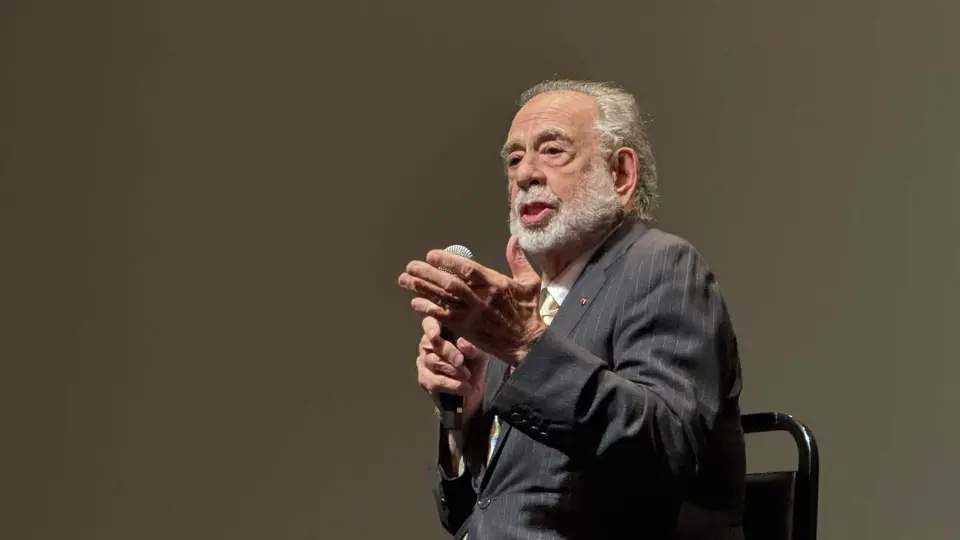
Film director Francis Ford Coppola talks during an appearance after a screening of “Megalopolis” at the Palace of Fine Arts in San Francisco on Friday, Aug. 1.G. Allen Johnson/S.F. Chronicle
Before he broke through with “American Graffiti,” before he became an instant legend with “Star Wars,” George Lucas became the unsung hero of another American classic that changed cinema history: “The Godfather.”
Or so claims Francis Ford Coppola, the director of that 1972 masterpiece.
“Everyone turned ‘The Godfather’ down, all the wonderful directors of the time,” the 86-year-old filmmaker told an enthusiastic crowd at the Palace of Fine Arts. “So they tried to hire me. Here was the logic: ‘One, he’s Italian American, so if it gets a lot of flack, they’ll blame him. Two, there’s a script that wasn’t very good, and he’s become a successful screenwriter, so he’ll rewrite the script. And three, he’s young and has two kids and a pregnant wife, so we can just push him around and order him to do everything we want.’”
Indeed, part of the lore of the “The Godfather” is that A-list Hollywood directors such as Otto Preminger, Sergio Leone, Arthur Penn and Peter Bogdanovich turned down the project, and producer Robert Evans then insisted that an Italian American direct. He offered it to Coppola, an independent filmmaker who had just won an Academy Award for writing the screenplay to the 1970 best picture winner “Patton,” directed by Franklin J. Schaffner, who won the Oscar for best director — and who also turned down “The Godfather.”
“Well, I turned it down,” Coppola recalled. “I had a young apprentice, and we had come together to start a company (San Francisco-based American Zoetrope). His name was George Lucas. He said, ‘We can’t turn it down, we have no money, the sheriff is going to chain our door because we haven’t made the taxes on the thing. You have to do it, we have no other alternatives.’ I said, ‘You’re right George.’”
Coppola and American Zoetrope went on to produce “American Graffiti,” filmed in Petaluma and San Rafael, sending Lucas on his way to his own groundbreaking career.
Billed as “An Evening with Francis Ford Coppola and ‘Megalopolis’ Screening,” the event in Coppola’s adopted hometown on Friday, Aug. 1, finished off a six-city tour designed to create more awareness and discussion of his 2024 $120 million self-financed dream project that tanked at the box office.
Coppola was certainly generous with his time. The event lasted nearly four hours, with a screening of the two-hour, 18-minute film followed by a 90-minute discussion with the filmmaker simply sitting in a chair pontificating on a wide range of issues while occasionally taking questions from the audience.
Topics included anthropology, history, societal evolution, and the philosophy of human innovation and creativity. “Megalopolis,” which likens the fall of Rome to the current state of American politics and culture, is informed by the development of human civilization over 300,000 years, noting that patriarchal societies began with the domestication of horses.
So, not your typical film discussion.
Still, the audience who paid prices ranging from $61-$205 and mostly filled the 1,000-seat venue were enthusiastic and attentive, giving the auteur standing ovations as he took the stage and as he left it. However, there was a small but steady stream of people who began leaving about 45 minutes in.
One topic that hits close to home for Coppola is homelessness in San Francisco. The director noted that he founded a nonprofit, North Beach Citizens, in 2001 to help the unhoused find housing, food and services because he felt the city wasn’t doing enough.
“I used to walk to work and see these homeless people sleeping, and people would call them human garbage. What, are we crazy?” said Coppola, who added that the solution to most of society’s problems has to be addressed first at the community level, inverting the top-down aspect of federal government.
Coppola gave insights about his films, from the two “Godfathers” to the San Francisco-shot, Watergate-era thriller “The Conversation” (1974); the troubled production of the Vietnam War movie “Apocalypse Now” (1979); and “Bram Stoker’s Dracula” (1992), his biggest non-”Godfather” box office hit.
And, of course, “Megalopolis.” Although he did not address various controversies about its production, including on-set inappropriate behavior (and no one asked about it, either), he believes it serves a warning about America and yet provides hope for the future.
America “will get out of this mess,” Coppola said, as today’s generation of children matures.
“Look at the world around us right now, wars all over the place, and the most horrible thing of all, children being killed,” Coppola said. “The kids being killed in Sudan or in the Middle East, someone was gonna find a cure for cancer or write the most gorgeous music ever been written or make a great film. So to me the children are precious. They are our future.”
For now, Coppola refuses to release “Megalopolis” digitally, content to tour with the movie for special one-off screenings. The film only made $14 million globally after its release in September. He did acknowledge there eventually will be a Blu-ray, and the man known for re-editing his past films teased the audience with an alternate cut of the film.
“Right now I’m working on ‘Megalopolis Unbound,’” he said to laughter, and ended the night.
Aug 2, 2025
STAFF WRITER
G. Allen Johnson is a San Francisco Chronicle staff writer.