“The world appears to us through the perceiving faculties of the body, so when the body dies, the appearance of the world disappears with it. However, its reality – infinite being – remains, and we are that.“
–Rupert Spira
Rupert Spira (born March 13, 1960) is an English spiritual teacher, philosopher and author of the Direct Path based in Oxford, UK. Wikipedia
Commonwealth C • May 1, 2023 • THE COMMONWEALTH CLUB For more information, visit: http://www.savingthecity.org/ Join us for a preview of Saving the City, an upcoming documentary series that highlights successful and unsuccessful examples of urban development throughout the United States and Canada in an effort to create better places. The opening two episodes, which look at how we have gone about remaking cities from the City Beautiful movement at the turn of the 19th century until today to provide context for the rest of the series, are expected to be released this Fall. The focus is on downtowns and nearby neighborhoods, the most visible and visited parts of our cities. After watching Saving the City, you will never look at cities the same way again. This program was originally scheduled for April 15, 2020, but was postponed due to the COVID pandemic.
New Thinking Allowed with Jeffrey Mishlove • May 9, 2023 Nancy du Tertre, JD, is a corporate lawyer specializing in securities litigation. She is also a psychic detective, spiritual medium, medical intuitive, and remote viewer. She is author of Psychic Intuition: Everything You Wanted to Ask But Were Afraid to Know. She has also written How to Talk to an Alien. In addition she is certified in the Intuitive Gestalt Dialogue Method. In this 2017 video, she describes a ten-year period during which Ingo Swann was her teacher and mentor, from 2003 until Swann’s death in 2013. Ingo Swann is generally credited as the inventor or discoverer of the clairvoyance protocol known as remote viewing. His work initiated a secret U.S. government program of research and application that lasted for twenty years from approximately 1976 to 1996. The discussion focuses on Swann’s personality and also on his interest in UFO phenomena. Edited subtitles for this video are available in Russian, Portuguese, Italian, German, French, and Spanish. New Thinking Allowed host, Jeffrey Mishlove, PhD, is author of The Roots of Consciousness, Psi Development Systems, and The PK Man. Between 1986 and 2002 he hosted and co-produced the original Thinking Allowed public television series. He is the recipient of the only doctoral diploma in “parapsychology” ever awarded by an accredited university (University of California, Berkeley, 1980). He is also the Grand Prize winner of the 2021 Bigelow Institute essay competition regarding the best evidence for survival of human consciousness after permanent bodily death. (Recorded October 11, 2017)
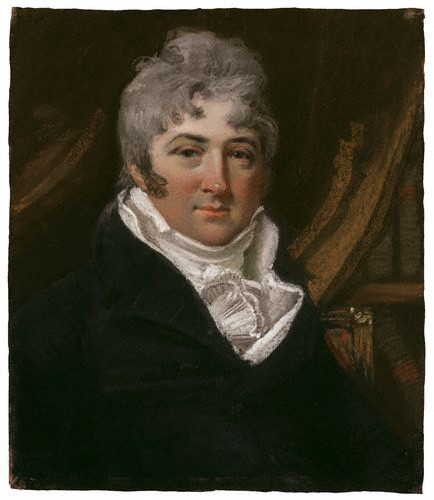
Thomas Morton (c. 1579–1647) was an early colonist in North America from Devon, England. He was a lawyer, writer, and social reformer known for studying American Indian culture, and he founded the colony of Merrymount, located in Quincy, Massachusetts.
Biography
Mount Wollaston
Morton took a three-month exploratory trip to America in 1622, but was back in England by early 1623 complaining of intolerance in certain elements of the Puritan community. He returned in 1624 as a senior partner in a Crown-sponsored trading venture aboard the ship Unity with his associate Captain Wollaston and 30 indentured young men. They began trading for furs on a spit of land belonging to the Algonquian tribes.
Morton immediately began selling liquor and firearms to the Indians, disregarding the laws of Plymouth Colony.[1] Morton and his cohorts attempted to establish their own colony which they called Mount Wollaston. Captain Wollaston moved to Virginia in 1626, leaving Morton in command of the colony, which was renamed Merrymount.
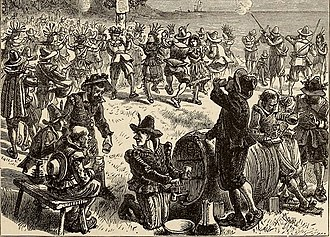
Mayday at Merrymount
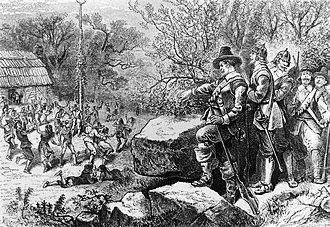
Maypole at Merrymount
Morton’s religious beliefs were criticized by the Puritans of nearby Plymouth Colony as little more than a thinly disguised form of heathenism. The leaders of Plymouth charged him with having sexual relations with local Indian women and drunken orgies in honor of Bacchus and Aphrodite
They … set up a May-pole, drinking and dancing about it many days together, inviting the Indian women for their consorts, dancing and frisking together (like so many fairies, or furies rather) and worse practices. As if they had anew revived & celebrated the feasts of ye Roman Goddess Flora, or ye beastly practices of ye mad Bacchanalians.
Banishment by the Puritans
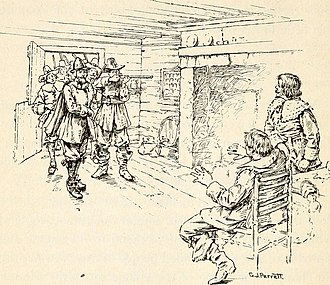
Arrest of Thomas Morton
Morton’s group performed a second Mayday ritual in 1628 by erecting an 80-foot (24 m) Maypole topped with deer antlers around which he and his followers caroused drunkenly. The Plymouth militia under Myles Standish took the town the following June with little resistance, chopped down the Maypole, and arrested Morton for supplying guns to the Indians.[2] He was given a trial in Plymouth, then marooned on the deserted Isles of Shoals off the coast of New Hampshire until an English ship could take him home. The Merrymount community survived without Morton for another year, but was renamed Mount Dagon by the Puritans, after the sea god of the Philistines.
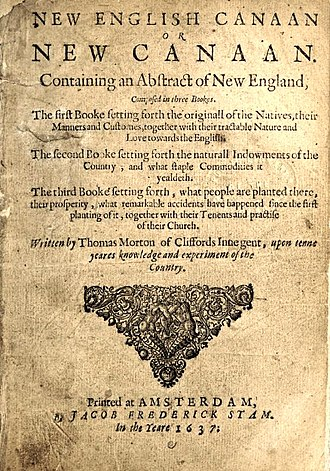
“New English Canaan”
New English Canaan’s title page
In 1637, Morton published his three-volume New English Canaan, a denunciation of Puritan government in the colonies and their policy of building forts to guard themselves against Indian attack. He described the Indians as a far nobler culture and a new Canaan under attack from the “New Israel” of the Puritans.[3]
Sedition trial and death
Morton returned to New England during the English Civil War where he was arrested for being a Royalist agitator. He was put on trial for his role in revoking the Plymouth Colony’s charter and on charges of sedition. By September, he was imprisoned in Boston. His trial was delayed through winter but his health began to fail, so the Puritans granted him clemency. He ended his days among the planters of Maine, and he died in 1647 at age 71.[citation needed]
Legacy
The English government destroyed the first edition of New English Canaan in 1637, with a small number of copies surviving in the Netherlands.[4] The Prince Society reprinted the original Amsterdam edition in 1883 with a foreword written by Charles Francis Adams Jr.[5] Jack Dempsey produced an edited edition of Morton’s book including a biography of Morton which was published in 1999.[6]
Evaluation
In 1628, Plymouth Colony Governor William Bradford famously declared Morton a “Lord of Misrule.[7]
The design of the Writer appears to have been to promote two Objects: 1. to Spread the fame and exaggerate the Advantages of New England 2. to destroy the Characters of the English Inhabitants, and excite the Government to Suppress the Puritans, and Send over Settlers in their Stead, from among the Royalists and the disciples of Archbishop Laud .[8]
Morton’s The New English Canaan has been described as “an important work of early American environmental writing”,[9] as well as the first book banned in America.[10][4] Harrison T. Meserole describes Morton as “America’s first rascal”.[11] Ed Simon argues that Morton “remains a powerful disruptive presence in the common founding myth of American identity.”[12]
New Thinking Allo • May 12, 2023 This video is a special release from the original Thinking Allowed series that ran on public television from 1986 until 2002. It was recorded in about 1990. Mental imagery, says physician Martin Rossman, can provide a valuable adjunct to traditional medicine, offering the opportunity for patients to discover the emotional stories behind their symptoms and helping mobilize the body’s healing resources. Dr. Rossman is founder and director of the Center for Collaborative Medicine and the author of Healing Yourself. Now you can watch all of the programs from the original Thinking Allowed Video Collection, hosted by Jeffrey Mishlove. Subscribe to the new Streaming Channel (https://thinkingallowed.vhx.tv/) and watch more than 350 programs now, with more, previously unreleased titles added weekly. New!! Free month of the classic Thinking Allowed streaming channel for New Thinking Allowed subscribers only. Use code THINKFREELY. Check out our new website for the New Thinking Allowed Foundation at http://www.newthinkingallowed.org. There you will find our incredible, searchable database as well as our new, FREE QUARTERLY MAGAZINE. Also, opportunities to shop and to support our video productions. There, you can also subscribe to our FREE, WEEKLY NEWSLETTER!
WISDOM FROM THE WOMEN HEALERS OF THE PSYCHEDELIC UNDERGROUND
The use of entheogens, or psychedelics, is out of the closet today. LSD, psilocybin, MDMA, and other medicines once associated only with the counterculture are now being legally studied for their healing properties. But as Rachel Harris shows, the underground use and study of psychedelics by women dates back to the Eleusinian Mysteries of ancient Greece.
Harris interviews the modern women elders carrying on this tradition to gather their hard-won wisdom of experience. Any reader interested in inspiration, healing, and enlightenment will find here a wonder-filled narrative packed with provocative and perhaps life-changing insight.
Tardigrades are microscopic eight-legged animals that are considered aquatic because they require a thin layer of water around their bodies to prevent dehydration. Tardigrades belong to an elite category of animals known as extremophiles. For instance, tardigrades can go up to 30 years without food or water. They can also live at temperatures as cold as absolute zero or above boiling, at pressures six times that of the ocean’s deepest trenches, and in the vacuum of space.
Jeffrey Mishlove and the New Thinking Allowed Foundation (jmishlove@newthinkingallowed.com)
“The mind will try to distract or manipulate, whereas the body only knows the truth. The body does not know how to lie, it is talking all the time. It talks through smell, taste, touch, action, withdrawal, anger, joy, so many ways…” — Atarangi Murupaenga
Around the world, people who work hard are often seen as morally good — even if they produce little to no results. Social psychologist Azim Shariff analyzes the roots of this belief and suggests a shift towards a more meaningful way to think about effort, rather than admiring work for work’s sake.