All posts by Mike Zonta

Chatbots Don’t Know What Stuff Isn’t

Today’s language models are more sophisticated than ever, but they still struggle with the concept of negation. That’s unlikely to change anytime soon.

Kouzou Sakai for Quanta Magazine

ByMax G. Levy

Contributing Writer


May 12, 2023 (quantamagazine.org)


Introduction

Nora Kassner suspected her computer wasn’t as smart as people thought. In October 2018, Google released a language model algorithm called BERT, which Kassner, a researcher in the same field, quickly loaded on her laptop. It was Google’s first language model that was self-taught on a massive volume of online data. Like her peers, Kassner was impressed that BERT could complete users’ sentences and answer simple questions. It seemed as if the large language model (LLM) could read text like a human (or better).

But Kassner, at the time a graduate student at Ludwig Maximilian University of Munich, remained skeptical. She felt LLMs should understand what their answers mean — and what they don’t mean. It’s one thing to know that a bird can fly. “A model should automatically also know that the negated statement — ‘a bird cannot fly’ — is false,” she said. But when she and her adviser, Hinrich Schütze, tested BERT and two other LLMs in 2019, they found that the models behaved as if words like “not” were invisible.

Since then, LLMs have skyrocketed in size and ability. “The algorithm itself is still similar to what we had before. But the scale and the performance is really astonishing,” said Ding Zhao, who leads the Safe Artificial Intelligence Lab at Carnegie Mellon University.

But while chatbots have improved their humanlike performances, they still have trouble with negation. They know what it means if a bird can’t fly, but they collapse when confronted with more complicated logic involving words like “not,” which is trivial to a human.

“Large language models work better than any system we have ever had before,” said Pascale Fung, an AI researcher at the Hong Kong University of Science and Technology. “Why do they struggle with something that’s seemingly simple while it’s demonstrating amazing power in other things that we don’t expect it to?” Recent studies have finally started to explain the difficulties, and what programmers can do to get around them. But researchers still don’t understand whether machines will ever truly know the word “no.”

Nora Kassner in a blue shirt against a black background.
Nora Kassner has tested popular chatbots and found they typically can’t understand the concept of negation.Courtesy of Nora Kassner

Making Connections

 It’s hard to coax a computer into reading and writing like a human. Machines excel at storing lots of data and blasting through complex calculations, so developers build LLMs as neural networks: statistical models that assess how objects (words, in this case) relate to one another. Each linguistic relationship carries some weight, and that weight — fine-tuned during training — codifies the relationship’s strength. For example, “rat” relates more to “rodent” than “pizza,” even if some rats have been known to enjoy a good slice.

In the same way that your smartphone’s keyboard learns that you follow “good” with “morning,” LLMs sequentially predict the next word in a block of text. The bigger the data set used to train them, the better the predictions, and as the amount of data used to train the models has increased enormously, dozens of emergent behaviors have bubbled up. Chatbots have learned style, syntax and tone, for example, all on their own. “An early problem was that they completely could not detect emotional language at all. And now they can,” said Kathleen Carley, a computer scientist at Carnegie Mellon. Carley uses LLMs for “sentiment analysis,” which is all about extracting emotional language from large data sets — an approach used for things like mining social media for opinions.

So new models should get the right answers more reliably. “But we’re not applying reasoning,” Carley said. “We’re just applying a kind of mathematical change.” And, unsurprisingly, experts are finding gaps where these models diverge from how humans read.

No Negatives

 Unlike humans, LLMs process language by turning it into math. This helps them excel at generating text — by predicting likely combinations of text — but it comes at a cost.

“The problem is that the task of prediction is not equivalent to the task of understanding,” said Allyson Ettinger, a computational linguist at the University of Chicago. Like Kassner, Ettinger tests how language models fare on tasks that seem easy to humans. In 2019, for example, Ettinger tested BERT with diagnostics pulled from experiments designed to test human language ability. The model’s abilities weren’t consistent. For example:

He caught the pass and scored another touchdown. There was nothing he enjoyed more than a good game of ____. (BERT correctly predicted “football.”)

The snow had piled up on the drive so high that they couldn’t get the car out. When Albert woke up, his father handed him a ____. (BERT incorrectly guessed “note,” “letter,” “gun.”)

And when it came to negation, BERT consistently struggled.

A robin is not a ____. (BERT predicted “robin,” and “bird.”)

On the one hand, it’s a reasonable mistake. “In very many contexts, ‘robin’ and ‘bird’ are going to be predictive of one another because they’re probably going to co-occur very frequently,” Ettinger said. On the other hand, any human can see it’s wrong.

Allyson Ettinger in a blue top in an outdoor photo.
“The task of prediction is not equivalent to the task of understanding,” said Allyson Ettinger, a computational linguist at the University of Chicago.John Zich

By 2023, OpenAI’s ChatGPT and Google’s bot, Bard, had improved enough to predict that Albert’s father had handed him a shovel instead of a gun. Again, this was likely the result of increased and improved data, which allowed for better mathematical predictions.

But the concept of negation still tripped up the chatbots. Consider the prompt, “What animals don’t have paws or lay eggs, but have wings?” Bard replied, “No animals.” ChatGPT correctly replied bats, but also included flying squirrels and flying lemurs, which do not have wings. In general, “negation [failures] tended to be fairly consistent as models got larger,” Ettinger said. “General world knowledge doesn’t help.”

Invisible Words

The obvious question becomes: Why don’t the phrases “do not” or “is not” simply prompt the machine to ignore the best predictions from “do” and “is”?

That failure is not an accident. Negations like “not,” “never” and “none” are known as stop words, which are functional rather than descriptive. Compare them to words like “bird” and “rat” that have clear meanings. Stop words, in contrast, don’t add content on their own. Other examples include “a,” “the” and “with.”

“Some models filter out stop words to increase the efficiency,” said Izunna Okpala, a doctoral candidate at the University of Cincinnati who works on perception analysis. Nixing every “a” and so on makes it easier to analyze a text’s descriptive content. You don’t lose meaning by dropping every “the.” But the process sweeps out negations as well, meaning most LLMs just ignore them.

So why can’t LLMs just learn what stop words mean? Ultimately, because “meaning” is something orthogonal to how these models work. Negations matter to us because we’re equipped to grasp what those words do. But models learn “meaning” from mathematical weights: “Rose” appears often with “flower,” “red” with “smell.” And it’s impossible to learn what “not” is this way.

Kassner says the training data is also to blame, and more of it won’t necessarily solve the problem. Models mainly train on affirmative sentences because that’s how people communicate most effectively. “If I say I’m born on a certain date, that automatically excludes all the other dates,” Kassner said. “I wouldn’t say ‘I’m not born on that date.’”

This dearth of negative statements undermines a model’s training. “It’s harder for models to generate factually correct negated sentences, because the models haven’t seen that many,” Kassner said.

Untangling the Not

If more training data isn’t the solution, what might work? Clues come from an analysis posted to arxiv.org in March, where Myeongjun Jang and Thomas Lukasiewicz, computer scientists at the University of Oxford (Lukasiewicz is also at the Vienna University of Technology), tested ChatGPT’s negation skills. They found that ChatGPT was a little better at negation than earlier LLMs, even though the way LLMs learned remained unchanged. “It is quite a surprising result,” Jang said. He believes the secret weapon was human feedback.

The ChatGPT algorithm had been fine-tuned with “human-in-the-loop” learning, where people validate responses and suggest improvements. So when users noticed ChatGPT floundering with simple negation, they reported that poor performance, allowing the algorithm to eventually get it right.

John Schulman, a developer of ChatGPT, described in a recent lecture how human feedback was also key to another improvement: getting ChatGPT to respond “I don’t know” when confused by a prompt, such as one involving negation. “Being able to abstain from answering is very important,” Kassner said. Sometimes “I don’t know” is the answer.

Pascale Fung in a blazer stands next to a blue wall with her university logo.
Pascale Fung points out that many large language models are hard to analyze directly, so while they show small signs of understanding negation, these improvements aren’t well understood.Courtesy of SENG

Yet even this approach leaves gaps. When Kassner prompted ChatGPT with “Alice is not born in Germany. Is Alice born in Hamburg?” the bot still replied that it didn’t know. She also noticed it fumbling with double negatives like “Alice does not know that she does not know the painter of the Mona Lisa.”

“It’s not a problem that is naturally solved by the way that learning works in language models,” Lukasiewicz said. “So the important thing is to find ways to solve that.”

 One option is to add an extra layer of language processing to negation. Okpala developed one such algorithm for sentiment analysis. His team’s paper, posted on arxiv.org in February, describes applying a library called WordHoard to catch and capture negation words like “not” and antonyms in general. It’s a simple algorithm that researchers can plug into their own tools and language models. “It proves to have higher accuracy compared to just doing sentiment analysis alone,” Okpala said. When he combined his code and WordHoard with three common sentiment analyzers, they all improved in accuracy in extracting opinions — the best one by 35%.

Another option is to modify the training data. When working with BERT, Kassner used texts with an equal number of affirmative and negated statements. The approach helped boost performance in simple cases where antonyms (“bad”) could replace negations (“not good”). But this is not a perfect fix, since “not good” doesn’t always mean “bad.” The space of “what’s not” is simply too big for machines to sift through. “It’s not interpretable,” Fung said. “You’re not me. You’re not shoes. You’re not an infinite amount of things.”

Illustration of cartoon characters working alongside a machine.

ARTIFICIAL INTELLIGENCE

Machines Beat Humans on a Reading Test. But Do They Understand?

OCTOBER 17, 2019

READ LATER

 Finally, since LLMs have surprised us with their abilities before, it’s possible even larger models with even more training will eventually learn to handle negation on their own. Jang and Lukasiewicz are hopeful that diverse training data, beyond just words, will help. “Language is not only described by text alone,” Lukasiewicz said. “Language describes anything. Vision, audio.” OpenAI’s new GPT-4 integrates text, audio and visuals, making it reportedly the largest “multimodal” LLM to date.

Future Not Clear

But while these techniques, together with greater processing and data, might lead to chatbots that can master negation, most researchers remain skeptical. “We can’t actually guarantee that that will happen,” Ettinger said. She suspects it’ll require a fundamental shift, moving language models away from their current objective of predicting words.

After all, when children learn language, they’re not attempting to predict words, they’re just mapping words to concepts. They’re “making judgments like ‘is this true’ or ‘is this not true’ about the world,” Ettinger said.

If an LLM could separate true from false this way, it would open the possibilities dramatically. “The negation problem might go away when the LLM models have a closer resemblance to humans,” Okpala said.

RELATED:


  1. The Computer Scientist Challenging AI to Learn Better
  2. The Unpredictable Abilities Emerging From Large AI Models
  3. Computers Evolve a New Path Toward Human Intelligence

Of course, this might just be switching one problem for another. “We need better theories of how humans recognize meaning and how people interpret texts,” Carley said. “There’s just a lot less money put into understanding how people think than there is to making better algorithms.”

And dissecting how LLMs fail is getting harder, too. State-of-the-art models aren’t as transparent as they used to be, so researchers evaluate them based on inputs and outputs, rather than on what happens in the middle. “It’s just proxy,” Fung said. “It’s not a theoretical proof.” So what progress we have seen isn’t even well understood.

And Kassner suspects that the rate of improvement will slow in the future. “I would have never imagined the breakthroughs and the gains we’ve seen in such a short amount of time,” she said. “I was always quite skeptical whether just scaling models and putting more and more data in it is enough. And I would still argue it’s not.”

(Contributed by Gwyllm Llwydd)

Beethoven’s “Ode to Joy” Brought to Life in a Spanish Flashmob of 100 Musicians

By Maria Popova (themarginalian.org)

Imagine what life would be like if lived, in May Sarton’s lovely phrase, with “joy instead of will.” That is what Beethoven imagined, and invited humanity to imagine, two centuries ago in the choral finale of his ninth and final symphony, known as “Ode to Joy” — an epochal hymn of the possible, half a lifetime in the making.

In the spring of 2012, the Spanish city of Sabadell set out to celebrate the 130th anniversary of its founding with a most unusual, electrifying, and touchingly human rendition of Beethoven’s masterpiece, performed by a flashmob of 100 musicians from the Vallès Symphony Orchestra, the Lieder, Amics de l’Òpera and Coral Belles Arts choirs. Watching the townspeople — children with kites, elders with walkers, couples holding hands — gather to savor the unbidden music in a succession of confusion, delight, and ecstasy is the stuff of goosebumps: living proof that “music so readily transports us from the present to the past, or from what is actual to what is possible.”

Couple with the remarkable story of the making of “Ode to Joy,” then revisit the neurophysiology of enchantment and how music casts its spell on us.

The Heart of Matter: Pierre Teilhard de Chardin on Bridging the Scientific and the Sacred

By Maria Popova (themarginalian.org

“Matter delights in music, and became Bach,” Ronald Johnson wrote in a stunning prose poem. How it did — how we became, in the poetic words of the physicist Richard Feynman, “atoms with consciousness… matter with curiosity” — may be the supreme mystery of existence. And yet here we are, each of us having triumphed over staggering odds in order to exist at all, all of us moving through the sliver of spacetime we have been allotted as material creatures animated by rich spiritual lives, governed by entropy, yearning for eternity.

Few people have given voice to this existential tension between our materiality and our spirituality more beautifully than the French paleontologist, Jesuit priest, and philosopher Pierre Teilhard de Chardin (May 1, 1881–April 10, 1955) — an uncommon bridge figure between the scientific and the sacred, who felt deeply at home in the world of gravity and gluons, and took part in the discovery of the Peking Man fossil that helped illuminate the evolutionary history of our species, but who also thought deeply and wrote beautifully about the most immaterial and transcendent regions of our experience.

Pierre Teilhard de Chardin

An epoch before the poetic physicist Alan Lightman introduced the notion of spiritual materialism, Teilhard de Chardin took up these questions in The Heart of Matter (public library), titled after his long autobiographical essay chronicling his spiritual awakening to the wonder of reality and materiality.

In language of ravishing vibrancy and vitality, he contours his offering:

I shall try… to show how, starting from the point at which a spark was first struck, a point that was built into me congenitally, the World gradually caught fire for me, burst into flames; how this happened all during my life, and as a result of my whole life, until it formed a great luminous mass, lit from within that surrounded me.

This becoming, he argues, is available to every person fully awake to their own life and the life of the Earth:

Within every being and every event there was a progressive expansion of a mysterious inner clarity which transfigured them… Crimson gleams of Matter, gliding imperceptibly into the gold of Spirit, ultimately to become transformed into the incandescence of a Universe that is Person… The Diaphany of the Divine at the heart of a glowing Universe, as I have experienced it through contact with the Earth — the Divine radiating from the depths of a blazing Matter.

Art by Francisco de Holanda, 1573. (Available as a print and as stationery cards.)

At the heart of this luminous totality, Teilhard de Chardin places what he calls “the sense of plentitude.” He writes:

To be completely at home and completely happy, there must be the knowledge that “Something, essential by nature” exists, to which everything else is no more than an accessory or perhaps an ornament… which it is impossible (once one has experienced it) to confuse with any other spiritual emotion, whether joy in knowledge or discovery, joy in creation or in loving: and this not so much because it is different from all those emotions, but because it belongs to a higher order and contains them all.

Looking back on the greatest discoveries of science — “the vast cosmic realities (Mass, Permeability, Radiation, Curvatures, and so on) through which the Stuff of Things is disclosed to our experience” — he sighs:

I find it difficult to express how much I feel at home in precisely this world of electrons, nuclei, waves, and what a sense of plentitude and comfort it gives me.

Observing that the culmination of the spiritual is to be found in “what is most tangible and most concrete in the Stuff of Things,” he reflects on his own awakening between the ages of thirty and fifty:

Even at the peak of my spiritual trajectory I as never to feel at home unless immersed in an Ocean of Matter.

[…]

Matter and Spirit: these were no longer two things, but two states or two aspects of one and the same cosmic Stuff, according to whether it was looked at or carried further in the direction in which…. it is becoming itself or in the direction in which it is disintegrating.

One of teenage artist Virginia Frances Sterrett’s 1920 illustrations for old French fairy tales. (Available as a print.)

Teilhard de Chardin closes his long reflection with a poetic “Hymn to Matter” — a kind of secular prayer for and to reality, in which he writes:

Blessed be you, harsh matter, barren soil, stubborn rock: you who yield only to violence, you who force us to work if we would eat.

Blessed be you, perilous matter, violent sea, untameable passion: you who unless we fetter you will devour us.

Blessed be you, mighty matter, irresistible march of evolution, reality ever new-born; you who, by constantly shattering our mental categories, force us to go ever further and further in our pursuit of the truth.

Blessed be you, universal matter, immeasurable time, boundless ether, triple abyss of stars and atoms and generations: you who by overflowing and dissolving our narrow standards or measurement reveal to us the dimensions of God.

Blessed be you, impenetrable matter: you who, interposed between our minds and the world of essences, cause us to languish with the desire to pierce through the seamless veil of phenomena.

Blessed be you, mortal matter: you who one day will undergo the process of dissolution within us and will thereby take us forcibly into the very heart of that which exists.

[…]

I bless you, matter, and you I acclaim… I acclaim you as the universal power which brings together and unites, through which the multitudinous monads are bound together and in which they all converge on the way of the Spirit.

[…]

This I now understand.

If we are ever to reach you, matter, we must, having first established contact with the totality of all that lives and moves here below, come little by little to feel that the individual shapes of all we have laid hold on are melting away in our hands, until finally we are at grips with the single essence of all consistencies and all unions.

[…]

Raise me up then, matter, to those heights, through struggle and separation and death; raise me up until, at long last, it becomes possible for me… to embrace the universe.

Complement The Heart of Matter with Leo Tolstoy on science, spirituality, and our search for meaning and John Burroughs’s splendid century-old manifesto for spirituality in the age of science, then revisit the pioneering neuroscientist Charles Scott Sherrington on wonder and the spirituality of nature.

How We Render Reality: Attention as an Instrument of Love

By Maria Popova (themarginalian.org)

Whatever fundamental reality might exist, we live out our lives in a subjective reality defined by what we agree to attend to. “An act of pure attention, if you are capable of it, will bring its own answer,” D.H. Lawrence wrote. But we live largely in the territory of the unanswerable because there is no pure attention — the aperture of our attention is constricted by myriad conditionings and focused by a brain honed on millions of years of evolutionary necessities, many of which we have long outgrown.

How the brain metes out attention and what that means for our intimacy with reality is what the philosophy-lensed British psychiatrist Iain McGilchrist takes up in his immense, in both senses of the word, book The Matter With Things: Our Brains, Our Delusions and the Unmaking of the World (public library) — an investigation of how “the very brain mechanisms which succeed in simplifying the world so as to subject it to our control militate against a true understanding of it,” and what a richer understanding of those mechanisms can do for living in closer and more felicitous communion with reality. At its heart is the recognition that “the whole is never the same as the sum of its ‘parts’” and that “there are in fact no ‘parts’ as such, but that they are an artefact of a certain way of looking at the world.”

Art by the Brothers Hilts from A Velocity of Being: Letters to a Young Reader.

Punctuating his ambitious 3,000-page effort to braid neuropsychology (the way our brains shape our impression of reality), epistemology (the way we come to know anything at all), and metaphysics (our yearning to wrest meaning from fundamental truth as we try to discern the nature of the universe) is an ongoing inquiry into our way of looking at the world — the lens of consciousness we call attention. He writes:

The world we know cannot be wholly mind-independent, and it cannot be wholly mind-dependent… What is required is an attentive response to something real and other than ourselves, of which we have only inklings at first, but which comes more and more into being through our response to it — if we are truly responsive to it. We nurture it into being; or not. In this it has something of the structure of love.

This property of reality is what Iris Murdoch had in view when she observed that “love is the extremely difficult realisation that something other than oneself is real,” and what the poet J.D. McClatchy captured in his insistence that “love is the quality of attention we pay to things.”

One of artist Margaret C. Cook’s rare 1913 illustrations for Leaves of Grass — Walt Whitman’s supreme serenade to the art of paying attention. (Available as a print.)

McGilchrist considers the way our attention constructs our reality and becomes the beating heart with which we love the world:

The whole illuminates the parts as much as the parts can illuminate the whole… The world we experience — which is the only one we can know — is affected by the kind of attention we pay to it.

Defining attention as “the manner in which our consciousness is disposed towards whatever else exists,” he writes:

The choice we make of how we dispose our consciousness is the ultimate creative act: it renders the world what it is. It is, therefore, a moral act: it has consequences.

A century-some after William James insisted that our experience is what we agree to attend to, and two generations after Simone Weil asserted that “attention is the rarest and purest form of generosity,” McGilchrist adds:

Attention changes the world. How you attend to it changes what it is you find there. What you find then governs the kind of attention you will think it appropriate to pay in the future. And so it is that the world you recognise (which will not be exactly the same as my world) is “firmed up” — and brought into being.

[…]

Attention is not just another “cognitive function”: it is… the disposition adopted by one’s consciousness towards the world. Absent, present, detached, engaged, alienated, empathic, broad or narrow, sustained or piecemeal, it therefore has the power to alter whatever it meets. Since our consciousness plays some part in what comes into being, the play of attention can both create and destroy, but it never leaves its object unchanged. So how you attend to something — or don’t attend to it — matters a very great deal.

In the vast remainder of The Matter With Things, McGilchrist goes on to explore how “the type, and extent, of attention we pay changes the nature of the world that we experience,” shaped largely by the difference between the way the brain’s two hemispheres pay attention — “narrow-beam, highly focussed attention” in the left, “broad, sustained vigilance” in the right. Complement this tiny fragment of it with Mary Oliver on attention and love, then revisit cognitive scientist Alexandra Horowitz’s wonderful field guide to eleven ways of paying attention to the everyday wonderland of life.

Jeanne Achterberg (1942-2012): Imagery in Healing

ThinkingAllowedTV Mar 10, 2012 This is part one of the full 90-minute DVD. https://thinkingallowed.com/2jachterb… We are sorry to announce the passing of Thinking Allowed guest Dr. Jeanne Achterberg. Imagery has been used in healing continuously since the times of ancient shamans. In the first part of this two-part program, the late Jeanne Achterberg discusses the holographic model of the brain and suggests that mental images mediate between our conscious intentions and our physiology. She cites a body of research indicating that the use of mental imagery can effect special body functioning — including that of the immune system. In part two of the full DVD, Dr. Achterberg expands her theoretical model of imagery in healing, by emphasizing the role of rituals and social reinforcement. She suggests that very precise forms of imagery can be developed to augment the body’s natural healing abilities. She discusses the procedure for working with imagery and presents a healing exercise using imagery. Jeanne Achterberg, Ph.D., was a past President of the Association for Transpersonal Psychology. Author of Imagery in Healing and Woman As Healer, she is on the faculty of the Institute for Transpersonal Psychology in Menlo Park, California, and the Saybrook Institute in San Francisco.

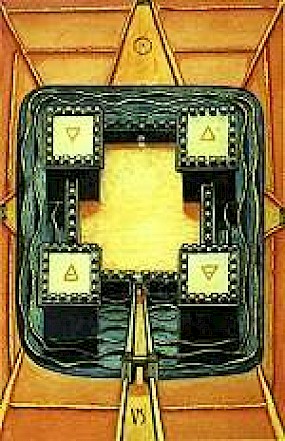
Tarot Card for May 15: The Four of Disks

The Four of Disks

The Lord of Power represents the time when we achieve a stable level of material balance – at least for that moment in time. At the purely mundane level, it might come up after we had settled into a new home, or undertaken major improvements. The card is, at this level, much concerned with asset security and material bounty.

One thing to bear in mind about attaining the mundane value of this card – though you have achieved one level of material stability, you cannot either cling to this, nor take it for granted. Become too smug and you’ll find yourself losing the sense of safety and balance which has occurred. The human being is not naturally given to stagnation…

On a more spiritual level this card holds sway over crystals and semi-precious stones – it might be hard to see the cross-reference to the asset security I mentioned in the previous paragraph – but on a mundane level, we’re often talking bricks-and-mortar and the security derived from being safe within our homes – at this more subtle level, we’re still talking rocks!! But this talking we’re relating to the amount of energy we can all gain from crystal-work.

Some crystals teach us calmness, or emotional balance, simply by giving off their unique energies. Other crystals can be programmed to assist us in various self-development tasks, and in protection, healing and cleansing. So if this card comes up in your reading with cards like the Hierophant, the Star, the Moon or the Priestess, consider that perhaps you’d help yourself with a little crystal work!

The Four of Disks

(via angelpaths.com and Alan Blackman)

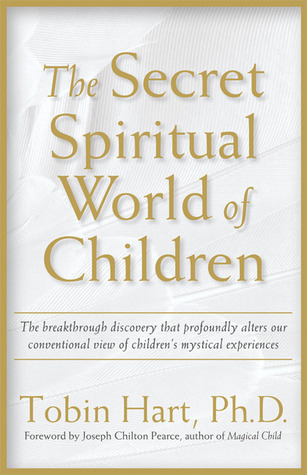
Book: “The Secret Spiritual World of Children: The Breakthrough Discovery that Profoundly Alters Our Conventional View of Children’s Mystical Experiences”

The Secret Spiritual World of Children: The Breakthrough Discovery that Profoundly Alters Our Conventional View of Children’s Mystical Experiences

Tobin HartJoseph Chilton Pearce (Foreword)

Many children experience some form of divine union, see visions, or have an inkling of ephemeral truth and wisdom—connections to the spiritual world that they often cannot articulate. If overlooked or ignored, a child’s spiritual development quickly fades or disappears entirely.

Tobin Hart, psychologist, professor, and pioneer of the ChildSpirit movement, explains how to recognize and identify children’s deep spiritual connections. Children’s spirituality is an important part of the development of identity and self-actualization, and recognizing and nurturing this growth process is critical for parents, educators, and therapists. Based on more than ten years of interviews, this book combines startling firsthand accounts of secret spiritual lives, including recollections from adults who have forgotten or repressed such childhood experiences. Dr. Hart’s exploration reveals the astonishing complexity of inner spirituality and exposes children’s innate ability to access wisdom and knowledge far beyond their years.

Nimbly interweaving insights and practical advice into a body of scientific study, The Secret Spiritual World of Children provides an entirely accessible and practical guide for nurturing the heightened spiritual sensitivity in children and reclaiming it as adults.

(Goodreads.com)

Psychedelics and the Soul with Rachel Harris

New Thinking Allowed with Jeffrey Mishlove • May 14, 2023 Rachel Harris, PhD, a psychologist, is author of Listening to Ayahuasca: New Hope for Depression, Addictions, PTSD, and Anxiety. Her newest book is Swimming in the Sacred: Wisdom from the Psychedelic Underground. Her website is http://www.swimminginthesacred.com In this interview she shares insights gleaned from interviews with fifteen women who serve as spiritual guides during psychedelic experiences. 00:00:00 Introduction 00:03:13 Fearlessness 00:11:59 Apprecticeship 00:28:35 The western mindset 00:41:07 Psychotherapeutic lineage 00:55:41 The underground 01:09:02 Conclusion Edited subtitles for this video are available in Russian, Portuguese, Italian, German, French, and Spanish. New Thinking Allowed host, Jeffrey Mishlove, PhD, is author of The Roots of Consciousness, Psi Development Systems, and The PK Man. Between 1986 and 2002 he hosted and co-produced the original Thinking Allowed public television series. He is the recipient of the only doctoral diploma in “parapsychology” ever awarded by an accredited university (University of California, Berkeley, 1980). He is also the Grand Prize winner of the 2021 Bigelow Institute essay competition regarding the best evidence for survival of human consciousness after permanent bodily death. (Recorded on May 5, 2023)

David Whyte: Preserving the Soul

ThinkingAllowedTV Jun 9, 2012 Great news!! Now watch every title and guest in the Thinking Allowed Collection, complete and commercial free. More than 350 programs now streaming. Visit our website at http://thinkingallowed.com or visit http://thinkingallowed.vhx.tv NOTE: This is an excerpt from the two-part, 60-minute DVD. http://www.thinkingallowed.com/2dwhyt… Poetry allows us to acknowledge the fullness of our being in ways that are often denied in daily life. This denial has often proved both injurious to the soul and bad for business. Poetry unites us with the soul of the world. David White is author of several books of poetry and a book of prose and poetry, The Heart Aroused. Whyte maintains that poetry provides a treasure of wisdom that gives guidance in times of crisis. The insights of poetry can facilitate an awakening of vision and a breakthrough from the paralysis caused by confusion, doubt and humdrum routine.

Sex? Sexual intercourse? Neither? Teens weigh in on evolving definitions — and habits

By JOCELYN GECKER May 11, 2023 (apnews.com)

A young couple sit on the beach in Huntington Beach, Calif., Monday, May 8, 2023. For years, studies have shown a decline in the rates of American high school students having sex. That trend continued, not surprisingly, in the first years of the pandemic, according to a recent survey by the Centers for Disease Control and Prevention. The study found that 30% of teens in 2021 said they had ever had sex, down from 38% in 2019 and a huge drop from three decades ago when more than half of teens reported having sex. (AP Photo/Jae C. Hong)

A young couple sit on the beach in Huntington Beach, Calif., Monday, May 8, 2023. For years, studies have shown a decline in the rates of American high school students having sex. That trend continued, not surprisingly, in the first years of the pandemic, according to a recent survey by the Centers for Disease Control and Prevention. The study found that 30% of teens in 2021 said they had ever had sex, down from 38% in 2019 and a huge drop from three decades ago when more than half of teens reported having sex. (AP Photo/Jae C. Hong)

SAN FRANCISCO (AP) — Situationships. “Sneaky links.” The “talking stage,” the flirtatious getting-to-know-you phase — typically done via text — that can lead to a hookup.

High school students are having less sexual intercourse. That’s what the studies say. But that doesn’t mean they’re having less sex.

The language of young love and lust, and the actions behind it, are evolving. And the shift is not being adequately captured in national studies, experts say.

RELATED COVERAGE

For years, studies have shown a decline in the rates of American high school students having sex. That trend continued, not surprisingly, in the first years of the pandemic, according to a recent survey by the Centers for Disease Control and Prevention. The study found that 30% of teens in 2021 said they had ever had sex, down from 38% in 2019 and a huge drop from three decades ago, when more than half of teens reported having sex.

The Associated Press took the findings to teenagers and experts around the country to ask for their interpretation. Parents: Some of the answers may surprise you.

THE MEANING OF SEX: DEPENDS WHO YOU ASK

For starters, what is the definition of sex?

“Hmm. That’s a good question,” says Rose, 17, a junior at a New England high school.

She thought about it for 20 seconds, then listed a range of possibilities for heterosexual sex, oral sex and relations between same-sex or LGBTQ partners. On her campus, short-term hookups — known as “situationships” — are typically low commitment and high risk from both health and emotional perspectives.

There are also “sneaky links” — when you hook up in secret and don’t tell your friends. “I have a feeling a lot more people are quote unquote having sex — just not necessarily between a man and a woman.”

For teens today, the conversation about sexuality is moving from a binary situation to a spectrum and so are the kinds of sex people are having. And while the vocabulary around sex is shifting, the main question on the CDC survey has been worded the same way since the government agency began its biannual study in 1991: Have you “ever had sexual intercourse?”

“Honestly, that question is a little laughable,” says Kay, 18, who identifies as queer and attends a public high school near Lansing, Michigan. “There’s probably a lot of teenagers who are like, ‘No, I’ve never had sexual intercourse, but I’ve had other kinds of sex.’”

The AP agreed to use teenagers’ first or middle names for this article because of a common concern they expressed about backlash at school, at home and on social media for speaking about their peers’ sex lives and LGBTQ+ relations.

SEXUAL IDENTITY IS EVOLVING

Several experts say the CDC findings could signal a shift in how teen sexuality is evolving, with gender fluidity becoming more common along with a decrease in stigma about identifying as not heterosexual.

They point to another finding in this year’s study that found the proportion of high school kids who identify as heterosexual dropped to about 75%, down from about 89% in 2015, when the CDC began asking about sexual orientation. Meanwhile, the share who identified as lesbian, gay or bisexual rose to 15%, up from 8% in 2015.

“I just wonder, if youth were in the room when the questions were being created, how they would be worded differently,” said Taryn Gal, executive director of the Michigan Organization on Adolescent Sexual Health.

Sex is just one of the topics covered by the CDC study, called the Youth Risk Behavior Survey. One of the main sources of national data about high school students on a range of behaviors, it is conducted every two years and asks about 100 questions on topics including smoking, drinking, drug use, bullying, carrying guns and sex. More than 17,000 students at 152 public and private high schools across the country responded to the 2021 survey.

“It’s a fine line we have to try to walk,” says Kathleen Ethier, director of the CDC’s Division of Adolescent and School Health, which leads the study.

From a methodological standpoint, changing a question would make it harder to compare trends over time. The goal is to take a national snapshot of teenage behavior, with the understanding that questions might not capture all the nuance. “It doesn’t allow us to go as in depth in some areas as we would like,” Ethier says.

The national survey, for example, does not ask about oral sex, which carries the risk of spreading sexually transmitted infections. As for “sexual intercourse,” Ethier says, “We try to use a term that we know young people understand, realizing that it may not encompass all the ways young people would define sex.”

IS LESS TEEN SEX GOOD NEWS?

Beyond semantics, there are a multitude of theories on why the reported rates of high school sex have steadily declined — and what it might say about American society.

“I imagine some parents are rejoicing and some are concerned, and I think there is probably good cause for both,” says Sharon Hoover, co-director of the National Center for School Mental Health at the University of Maryland. Health officials like to see trends that result in fewer teen pregnancies and sexually transmitted diseases.

“But what we don’t know is what this means for the trajectory of young people,” Hoover says.

RELATED COVERAGE

This year’s decrease, the sharpest drop ever recorded, clearly had a lot to do with the pandemic, which kept kids isolated, cut off from friends and immersed in social media. Even when life started returning to normal, many kids felt uncomfortable with face-to-face interaction and found their skills in verbal communication had declined, Hoover said.

The survey was conducted in the fall of 2021, just as many K-12 students returned to in-person classrooms after a year of online school.

Several teens interviewed said that when schools reopened, they returned with intense social anxiety compounded by fears of catching COVID. That added a new layer to pre-pandemic concerns about sexual relations like getting pregnant or catching STIs.

“I remember thinking, ‘What if I get sick? What if I get a disease? What if I don’t have the people skills for this?’” said Kay, the 18-year-old from Michigan. “All those ‘what ifs’ definitely affected my personal relationships, and how I interacted with strangers or personal partners.”

Another fear is the prying eyes of parents, says college student Abby Tow, who wonders if helicopter parenting has played a role in what she calls the “baby-fication of our generation.” A senior at the University of Oklahoma, Tow knows students in college whose parents monitor their whereabouts using tracking apps.

“Parents would get push notifications when their students left dorms and returned home to dorms,” says Tow, 22, majoring in social work and gender studies.

Tow also notices a “general sense of disillusionment” in her generation. She cites statistics that fewer teenagers today are getting driver’s licenses. “I think,” she says, “there is a correlation between students being able to drive and students having sex.”

Another cause for declining sex rates could be easy access to online porn, experts say. By the age of 17, three-quarters of teenagers have viewed pornography online, with the average age of first exposure at 12, according to a report earlier this year by Common Sense Media, a nonprofit child advocacy group.

“Porn is becoming sex ed for young people,” says Justine Fonte, a New York-based sex education teacher. She says pornography shapes and skews adolescent ideas about sexual acts, power and intimacy. “You can rewind, fast forward, play as much as you want. It doesn’t require you to think about how the person is feeling.”

IS THERE AN EVOLVING DEFINITION OF CONSENT?

Several experts said they hoped the decline could be partly attributed to a broader understanding of consent and an increase in “comprehensive” sex education being taught in many schools, which has become a target in ongoing culture wars.

Unlike abstinence-only programs, the lessons include discussion on understanding healthy relationships, gender identity, sexual orientation and preventing unplanned pregnancies and sexually transmitted infections. Contrary to what critics think, she said, young people are more likely to delay the onset of sexual activity if they have access to sex education.

Some schools and organizations supplement sex education with peer counseling, where teens are trained to speak to each other about relationships and other topics that young people might feel uncomfortable raising with adults.

Annika, 14, is a peer ambassador trained by Planned Parenthood and a high school freshman in Southern California. She’s offered guidance to friends in toxic relationships and worries about the ubiquity of porn among her peers, especially male friends. It’s clear to her that the pandemic stunted sex lives.

The CDC’s 2023 survey, which is currently underway, will show if the decline was temporary. Annika suspects it will show a spike. In her school, at least, students seem to be making up for lost time.

“People lost those two years so they’re craving it more,” she said. She has often been in a school bathroom where couples in stalls next to her are engaged in sexual activities.

Again, the definition of sex? “Any sexual act,” Annika says. “And sexual intercourse is one type of act.”

To get a truly accurate reading of teen sexuality, the evolution of language needs to be taken into account, says Dr. John Santelli, a Columbia University professor who specializes in adolescent sexuality.

“The word intercourse used to have another meaning,” he points out. “Intercourse used to just mean talking.”

___

Jocelyn Gecker is an education reporter for The Associated Press, based in San Francisco. Follow her on Twitter at http://twitter.com/jgecker

___

The AP education team receives support from the Carnegie Corporation of New York. The AP is solely responsible for all content.