
 |
| The Importance of Persistence In working with the techniques of Translation and Releasing the Hidden Splendour, we may get frustrated using the techniques, thinking they are too much work. Today’s talk is about the importance of persisting when the “going gets rough.”  SUNDAY MEETING 6/25/23 11:00 am Pacific JOIN the Meeting Everyone is welcome! By Contribution _______________________ |
| Copyright © 2023 The Prosperos, All rights reserved. You are receiving this email because you opted in via our website. Our mailing address is: The Prosperos P.O. Box 4969 Culver City, CA 90231 |
All posts by Mike Zonta
Ego sparring

How to solve the education crisis for boys and men
251,504 views | Richard Reeves • TED2023
While studying inequality and social mobility, Richard Reeves made a surprising discovery: in some countries, like the US and UK, boys are drastically lagging behind girls across many academic measures. He explains why these struggles in school are indicative of the larger crises facing boys and men — and outlines how society could thoughtfully tackle these challenges to work towards a more inclusive, equitable future. (Followed by a Q&A with head of TED Chris Anderson)
About the speaker
Social mobility scholarSee speaker profile
A scholar with a passion for social progress, Richard Reeves is tackling the complex and urgent crisis of boyhood and manhood.
Shams of Tabriz on love

“A life without love is of no account. Don’t ask yourself what kind of love you should seek, spiritual or material, divine or mundane, eastern or western…divisions only lead to more divisions. Love has no labels, no definitions. It is what it is, pure and simple. Love is the water of life. And a lover is a soul of fire! The universe turns differently when fire loves water.”
– Shams of Tabriz
Shams-i Tabrīzī or Shams al-Din Mohammad (1185 – 1248) was a Persian Shafi’ite poet, who is credited as the spiritual instructor of Mewlānā Jalāl ad-Dīn Muhammad Balkhi, also known as Rumi and is referenced with great reverence in Rumi’s poetic collection, in particular Diwan-i Shams-i Tabrīzī. Wikipedia
(Quote courtesy of Gwyllm Llwydd)
Very Rare Solstice Moon-Venus-Mars Conjunction!
Matthew Stelzner Jun 20, 2023 In this video I discuss a very special alignment that will be on display these next three nights, and especially on the night of the solstice, tomorrow night. This Wednesday, June 21st has both a rare astronomical event, and the potential for powerful astrological magic (with astrology being astronomy plus prayer and ritual). It is, of course, the Solstice, and either the longest day of the year if you’re in the northern hemisphere, or the shortest day of the year in the southern hemisphere. The Earth has moved into one of it’s extreme positions in its relationship with the Sun, and it represents a moment of extremes: longest day, shortest day, the beginning of either the hottest season, or the coldest. It is a moment when the Sun seems to sit still on the same part of the horizon for days, reminding us to pause and sit stationary, as we consciously move into a new season of our lives. It is a time to stop and reflect on your relationship with the Sun and recognize that you are a being who participates in seasonal change. What does it mean to be ending one season of your life, and about to begin another? What is your vision and intention for the coming season? This is a great day to ritualize the transition to a new season, and to pray for support in manifesting your vision. It is a moment to align your summer vision with the summer visions of those closest to you. Helping you in all of this will be one of the most beautiful astronomical events that you can witness, a Moon-Venus-Mars triple conjunction which will be on display in the western sky above the sunset. This will be visible starting about 20-30 minutes after sunset, and then for another 2 1/2 hours. The last time the Moon-Venus and Mars conjoined in the evening sky was July 11th 2021, but that alignment was much harder to see than this will be, with their brightness dimmer and their visibility much shorter. Venus is currently at peak brightness, approaching closer to the Earth each day, and though Mars is moving away from the Earth, it is still relatively bright. So this should be a very easy alignment to see if your weather is good. I encourage you to get out to one of your favorite spots to enjoy the sunset, and then wait 20-30 minutes for the Moon and Venus to appear out of the twilight, and then wait another 15-20 minutes for Mars to be clearly visible. The next time Venus and Mars will conjoin in the evening sky won’t be until November of 2027 (that one will be like the 2021 alignment, lower in the sky and less bright), so this is a truly rare opportunity for sky watching. The next time there will be a similarly dramatic Venus-Mars conjunction won’t be until they come together in the morning sky in 2028, and the next similarly bright evening apparition will not be until November of 2029. So let’s get out there people! To check out more of my work, see my blog, and get information about my intuitive readings, visit my website at: http://stelz.biz/
Tarot Card for June 21: The Wheel of Fortune
The Wheel of Fortune
The Wheel of Fortune is numbered ten and is usually shown as a great wheel. Sometimes Fortuna is seen, turning the wheel for all eternity. There are people or animals on the Wheel – some are falling off to be crushed, some are struggling to stay on, while a solitary figure makes no attempt to maintain its position but succeeds anyway.
Fortune is not the same as luck. We make our own luck and follow our own destiny. Good fortune comes from the still centre which contains the very heart of ourselves. The seasons will continue to wheel, the sun will rise and set, the planets will move in their allotted courses – with or without us.
If we struggle against the flow of life, we become those struggling to ascend the Wheel, or even one of those crushed beneath it. However, if we realise our own power to create a beneficial future and then trust in that vision, we shall become the still figure, master of our own universe.
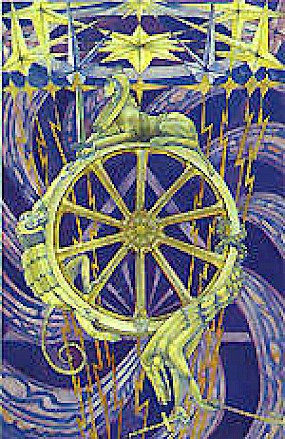
(via angalpaths.com and Alan Blackman)
Book: “Magical Child”
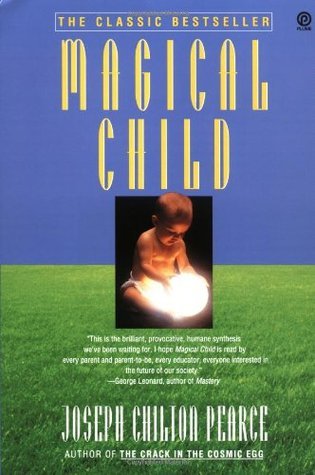
Magical Child
Joseph Chilton Pearce
“An innovative, philosophical restructuring of modern child psychology.”
Magical Child, a classic work, profoundly questioned the current thinking on childbirth pratices, parenting, and educating our children. Now its daring ideas about how Western society is damaging our children, and how we can better nurture them and oruselves, ring truer than ever. From the very instant of birth, says Joseph Chilton Pearce, the human child has only one concern: to learn all that there is to learn about the world. This planet is the child’s playground, and nothing should interfere with a child’s play. Raised this way, the Magical Child is a a happy genius, capable of anything, equipped to fulfill his amazing potential.
Expanding on the ideas of internationally acclaimed child psychologist Jean Piaget, Pearce traces the growth of the mind-brain from brith to adulthood. He connects the alarming rise in autism, hyperkinetic behavior, childhood schizophrenia, and adolescent suicide to the all too common errors we make in raising and educating our children. Then he shows how we can restore the astonishing wealth of creative intelligence that is the brithright of every human being. Pearce challenged all our notions about child rearing, and in the process challenges us to re-examine ourselves. Pearce’s message is simple: it is never too late to play, for we are all Magical Children.
(Goodreads.com)
Book: “The Conservative Mind: From Burke to Eliot”

The Conservative Mind: From Burke to Eliot
Russell Kirk
“It is inconceivable even to imagine, let alone hope for, a dominant conservative movement in America without Kirk’s labor.” — William F. Buckley, Jr.
Russell Kirk’s The Conservative Mind is one of the greatest contributions to twentieth-century American conservatism. Brilliant in every respect, from its conception to its choice of significant figures representing the history of intellectual conservatism, The Conservative Mind launched the modern American Conservative Movement when it was first published in 1953 and has become an enduring classic of political thought.
The seventh revised edition features the complete text and an introduction by publisher Henry Regency.
A must-read.
(Goodreads.com)
Bio: Jean-Michel Basquiat
From Wikipedia, the free encyclopedia
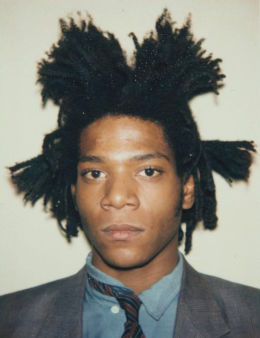
| Jean-Michel Basquiat | |
|---|---|
| Basquiat by Andy Warhol in 1982 | |
| Born | December 22, 1960 New York City, U.S. |
| Died | August 12, 1988 (aged 27) New York City, U.S. |
| Cause of death | Heroin overdose |
| Resting place | Green-Wood Cemetery, Brooklyn, New York City |
| Years active | 1978–1988 |
| Known for | Painting, drawing |
| Notable work | Irony of Negro Policeman (1981)Untitled (Skull) (1981)Untitled (1982)Boy and Dog in a Johnnypump (1982)Defacement (1983)Hollywood Africans (1983) |
| Style | Neo-expressionismGraffitistreet art |
| Movement | Neo-expressionism |
| Website | basquiat.com |

Jean-Michel Basquiat (French: [ʒɑ̃ miʃɛl baskja]; December 22, 1960 – August 12, 1988) was an American artist who rose to success during the 1980s as part of the Neo-expressionism movement.
Basquiat first achieved fame as part of the graffiti duo SAMO, alongside Al Diaz, writing enigmatic epigrams in the cultural hotbed of Manhattan‘s Lower East Side during the late 1970s, where rap, punk, and street art coalesced into early hip-hop music culture. By the early 1980s, his paintings were being exhibited in galleries and museums internationally. At 21, Basquiat became the youngest artist to ever take part in Documenta in Kassel, Germany. At 22, he was one of the youngest to exhibit at the Whitney Biennial in New York. The Whitney Museum of American Art held a retrospective of his artwork in 1992.
Basquiat’s art focused on dichotomies such as wealth versus poverty, integration versus segregation, and inner versus outer experience. He appropriated poetry, drawing, and painting, and married text and image, abstraction, figuration, and historical information mixed with contemporary critique. He used social commentary in his paintings as a tool for introspection and for identifying with his experiences in the black community, as well as attacks on power structures and systems of racism. His visual poetics were acutely political and direct in their criticism of colonialism and support for class struggle.
Since his death at the age of 27 in 1988, Basquiat’s work has steadily increased in value. In 2017, Untitled, a 1982 painting depicting a black skull with red and yellow rivulets, sold for a record-breaking $110.5 million, becoming one of the most expensive paintings ever purchased.
Biography
Early life: 1960–1977
Basquiat was born on December 22, 1960, in Park Slope, Brooklyn, New York City, the second of four children to Matilde Basquiat (née Andrades, 1934–2008) and Gérard Basquiat (1930–2013).[1] He had an older brother, Max, who died shortly before his birth, and two younger sisters, Lisane (b. 1964) and Jeanine (b. 1967).[2][3] His father was born in Port-au-Prince, Haiti and his mother was born in Brooklyn to Puerto Rican parents.[4] He was raised Catholic.[5]
Matilde instilled a love for art in her young son by taking him to local art museums and enrolling him as a junior member of the Brooklyn Museum of Art.[1][6] Basquiat was a precocious child who learned to read and write by the age of four.[7] His mother encouraged her son’s artistic talent and he often tried to draw his favorite cartoons.[8] In 1967, he started attending Saint Ann’s School, a private school.[9][10] There he met his friend Marc Prozzo and together they created a children’s book, written by Basquiat at the age of seven and illustrated by Prozzo.[8][11]
In 1968, Basquiat was hit by a car while playing in the street at the age of seven.[12] His arm was broken and he suffered several internal injuries, which required a splenectomy.[13] While he was hospitalized, his mother brought him a copy of Gray’s Anatomy to keep him occupied.[14] After his parents separated that year, Basquiat and his sisters were raised by their father.[1][14] His mother was committed to a psychiatric hospital when he was ten and thereafter spent her life in and out of institutions.[15] By the age of eleven, Basquiat was fluent in French, Spanish and English, and an avid reader of all three languages.[16]
Basquiat’s family resided in the Brooklyn neighborhood of Boerum Hill and then in 1974, moved to Miramar, Puerto Rico.[17][18] When they returned to Brooklyn in 1976, Basquiat attended Edward R. Murrow High School.[19] He struggled to deal with his mother’s instability and rebelled as a teenager.[20] He ran away from home at 15 when his father caught him smoking pot in his room.[21][1][14] He slept on park benches at Washington Square Park and took acid.[22][23] Eventually, his father spotted him with a shaved head and called the police to bring him home.[24]
In the 10th grade, he enrolled at City-As-School, an alternative high school in Manhattan, home to many artistic students who found conventional schooling difficult.[9] He would skip school with his friends, but still received encouragement from his teachers, and began to write and illustrate for the school newspaper.[25] He developed the character SAMO to endorse a faux religion.[26] The saying “SAMO” had started as a private joke between Basquiat and his schoolmate Al Diaz, as an abbreviation for the phrase “Same old shit.”[25] They drew a series of cartoons for their school paper before and after using SAMO©.[27]
Street art and Gray: 1978–1980
SAMO (for “same old”) marked the witty sayings of a precocious and worldly teenage mind that, even at that early juncture, saw the world in shades of gray, fearlessly juxtaposing corporate commodity structures with the social milieu he wished to enter: the predominantly white art world.
—Franklin Sirmans, In the Cipher: Basquiat and Hip Hop Culture[28]
In May 1978, Basquiat and Diaz began spray painting graffiti on buildings in Lower Manhattan.[27][29] Working under the pseudonym SAMO, they inscribed poetic and satirical advertising slogans such as “SAMO© AS AN ALTERNATIVE TO GOD.”[27] In June 1978, Basquiat was expelled from City-As-School for pieing the principal.[30] At 17, his father kicked him out of the house when he decided to drop out of school.[31] He worked for the Unique Clothing Warehouse in NoHo while continuing to create graffiti at night.[32][33] On December 11, 1978, The Village Voice published an article about the SAMO graffiti.[27]
In 1979, Basquiat appeared on the live public-access television show TV Party hosted by Glenn O’Brien.[34] Basquiat and O’Brien formed a friendship and he made regular appearances on the show over the next few years.[34] Eventually, he began spending time writing graffiti around the School of Visual Arts, where he befriended students John Sex, Kenny Scharf, and Keith Haring.[35]
In April 1979, Basquiat met Michael Holman at the Canal Zone Party and they founded the noise rock band Test Pattern, which was later renamed Gray.[36] Other members of Gray included Shannon Dawson, Nick Taylor, Wayne Clifford and Vincent Gallo. They performed at nightclubs such as Max’s Kansas City, CBGB, Hurrah and the Mudd Club.[36]
Around this time, Basquiat lived in the East Village with his friend Alexis Adler, a Barnard biology graduate.[37] He often copied diagrams of chemical compounds borrowed from Adler’s science textbooks. She documented Basquiat’s creative explorations as he transformed the floors, walls, doors and furniture into his artworks.[38] He also made postcards with his friend Jennifer Stein.[39] While selling postcards in SoHo, Basquiat spotted Andy Warhol at W.P.A. restaurant with art critic Henry Geldzahler.[14] He sold Warhol a postcard titled Stupid Games, Bad Ideas.[40]

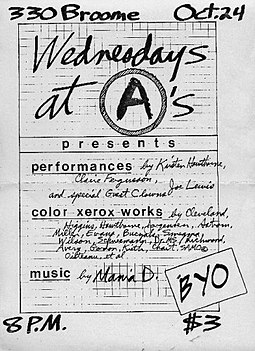
In October 1979, at Arleen Schloss‘s open space called A’s, Basquiat showed his SAMO montages using color Xerox copies of his works.[41] Schloss allowed Basquiat to use the space to create his “MAN MADE” clothing, which were painted upcycled garments.[42][43] In November 1979, costume designer Patricia Field carried his clothing line in her upscale boutique on 8th Street in the East Village. Field also displayed his sculptures in the store window.[44]
When Basquiat and Diaz had a falling out, he inscribed “SAMO IS DEAD” on the walls of SoHo buildings in 1980.[45] In June 1980, he appeared in High Times magazine, his first national publication, as part of an article titled “Graffiti ’80: The State of the Outlaw Art” by Glenn O’Brien.[46] Later that year, he began filming O’Brien’s independent film Downtown 81 (2000), originally titled New York Beat, which featured some of Gray’s recordings on its soundtrack.[47]
Rise to fame and success: 1980–1986
In June 1980, Basquiat participated in The Times Square Show, a multi-artist exhibition sponsored by Collaborative Projects Incorporated (Colab) and Fashion Moda.[48] He was noticed by various critics and curators, including Jeffrey Deitch, who mentioned him in an article titled “Report from Times Square” in the September 1980 issue of Art in America.[49][50] In February 1981, Basquiat participated in the New York/New Wave exhibition, curated by Diego Cortez at New York’s P.S.1.[51] Italian artist Sandro Chia recommended Basquiat’s work to Italian dealer Emilio Mazzoli, who promptly bought 10 paintings for Basquiat to have a show at his gallery in Modena, Italy in May 1981.[23][52] In December 1981, art critic Rene Ricard published “The Radiant Child” in Artforum magazine, the first extensive article on Basquiat.[53] During this period, Basquiat painted many pieces on objects he found in the streets, such as discarded doors.[54]
Basquiat sold his first painting, Cadillac Moon (1981), to Debbie Harry, lead singer of the punk rock band Blondie, for $200 after they had filmed Downtown 81 together.[55] He also appeared as a disc jockey in the 1981 Blondie music video “Rapture“, a role originally intended for Grandmaster Flash.[56] At the time, Basquiat was living with his girlfriend, Suzanne Mallouk, who financially supported him as a waitress.[20]
In September 1981, art dealer Annina Nosei invited Basquiat to join her gallery at the suggestion of Sandro Chia.[23] Soon after, he participated in her group show Public Address.[57] She provided him with materials and a space to work in the basement of her gallery.[30] In 1982, Nosei arranged for him to move into a loft which also served as a studio at 101 Crosby Street in SoHo.[58][59] He had his first American one-man show at the Annina Nosei Gallery in March 1982.[30] He also painted in Modena for his second Italian exhibition in March 1982.[60] Feeling exploited, that show was canceled because he was expected to make eight paintings in one week.[23]
By the summer of 1982, Basquiat had left the Annina Nosei Gallery and gallerist Bruno Bischofberger became his worldwide art dealer.[61] In June 1982, at 21, Basquiat became the youngest artist to ever take part in Documenta in Kassel, Germany.[31] His works were exhibited alongside Joseph Beuys, Anselm Kiefer, Gerhard Richter, Cy Twombly and Andy Warhol.[62] Bischofberger gave Basquiat a one-man show at his Zurich gallery in September 1982, and arranged for him to meet Warhol for lunch on October 4, 1982.[63] Warhol recalled, “I took a Polaroid and he went home and within two hours a painting was back, still wet, of him and me together.”[64] The painting, Dos Cabezas (1982), ignited a friendship between them.[65] Basquiat was photographed by James Van Der Zee for an interview with Henry Geldzahler published in the January 1983 issue of Warhol’s Interview magazine.[66]
_home_on_57_Great_Jones_Street.jpg)
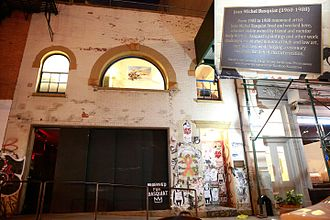
From 1983 to 1988 Basquiat lived at 57 Great Jones Street in NoHo, where he died. A plaque commemorating his life was placed outside the building in 2016.
In November 1982, Basquiat’s solo exhibition opened at the Fun Gallery in the East Village.[67] Among the works exhibited were A Panel of Experts (1982) and Equals Pi (1982).[68] In early December 1982,[69] Basquiat began working at the studio space art dealer Larry Gagosian had built below his Venice, California home.[70] There, he commenced a series of paintings for a March 1983 show, his second at the Gagosian Gallery in West Hollywood.[70] He was accompanied by his girlfriend, then-unknown singer Madonna.[71] Gagosian recalled: “Everything was going along fine. Jean-Michel was making paintings, I was selling them, and we were having a lot of fun. But then one day Jean-Michel said, ‘My girlfriend is coming to stay with me.’ … So I said, ‘Well, what’s she like?’ And he said, ‘Her name is Madonna and she’s going to be huge.’ I’ll never forget that he said that.”[72]
Basquiat took considerable interest in the work that artist Robert Rauschenberg was producing at Gemini G.E.L. in West Hollywood.[70] He visited him on several occasions and found inspiration in his accomplishments.[70] While in Los Angeles, Basquiat painted Hollywood Africans (1983), which portrays him with graffiti artists Toxic and Rammellzee.[73] He often painted portraits of other graffiti artists—and sometimes collaborators—in works such as Portrait of A-One A.K.A. King (1982), Toxic (1984), and ERO (1984).[74] In 1983, he produced the hip-hop record “Beat Bop” featuring Rammellzee and rapper K-Rob.[75] It was pressed in limited quantities on his Tartown Inc. imprint. He created the cover art for the single, making it highly desirable among both record and art collectors.[76]
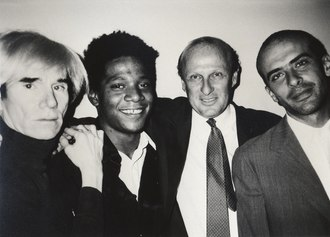
Andy Warhol, Jean-Michel Basquiat, Bruno Bischofberger, and Francesco Clemente in 1984
In March 1983, at 22 years old, Basquiat became one of the youngest artists to participate in the Whitney Biennial exhibition of contemporary art.[77][78] Paige Powell, an associate publisher for Interview magazine, organized a show of his work at her friend’s New York apartment in April 1983.[79][80] Shortly after, he began a relationship with Powell, who was instrumental in fostering his friendship with Warhol.[77] In August 1983, Basquiat moved into a loft owned by Warhol at 57 Great Jones Street in NoHo, which also served as a studio.[81]
In the summer of 1983, Basquiat invited Lee Jaffe, a former musician in Bob Marley‘s band, to join him on a trip throughout Asia and Europe.[82][83] On his return to New York, he was deeply affected by the death of Michael Stewart, an aspiring black artist in the downtown club scene who was killed by transit police in September 1983. He painted Defacement (The Death of Michael Stewart) (1983) in response to the incident.[84] He also participated in a Christmas benefit with various New York artists for the family of Michael Stewart in 1983.[85]
Having joined the Mary Boone‘s SoHo gallery in 1983, Basquiat had his first show there in May 1984.[86] A large number of photographs depict a collaboration between Warhol and Basquiat in 1984 and 1985.[87] When they collaborated, Warhol would start with something very concrete or a recognizable image and then Basquiat defaced it in his animated style.[88] They made an homage to the 1984 Summer Olympics with Olympics (1984). Other collaborations include Taxi, 45th/Broadway (1984–85) and Zenith (1985). Their joint exhibition, Paintings, at the Tony Shafrazi Gallery, caused a rift in their friendship after it was panned by critics, and Basquiat was called Warhol’s “mascot”.[64]
Basquiat often painted in expensive Armani suits and would appear in public in the same paint-splattered clothes.[89][90] He was a regular at the Area nightclub, where he sometimes worked the turntables as a DJ for fun.[91] He also painted murals for the Palladium nightclub in New York City.[92] His swift rise to fame was covered in the media. He appeared on the cover of the February 10, 1985, issue of The New York Times Magazine in a feature titled “New Art, New Money: The Marketing of an American Artist”.[23] His work appeared in GQ and Esquire, and he was interviewed for MTV‘s “Art Break” segment.[93][94] In 1985, he walked the runway for the Comme des Garçons Spring fashion show in New York.[95][96]
In the mid-1980s, Basquiat was earning $1.4 million a year and he was receiving lump sums of $40,000 from art dealers.[97] Despite his success, his emotional instability continued to haunt him. “The more money Basquiat made, the more paranoid and deeply involved with drugs he became,” wrote journalist Michael Shnayerson.[97] Basquiat’s cocaine use became so excessive that he blew a hole in his nasal septum.[30] A friend claimed that Basquiat confessed he was on heroin in late 1980.[30] Many of his peers speculated that his drug use was a means of coping with the demands of his newfound fame, the exploitative nature of the art industry, and the pressures of being a black man in the white-dominated art world.[98]
For what would be his last exhibition on the West Coast, Basquiat returned to Los Angeles for his show at the Gagosian Gallery in January 1986.[99] In February 1986, Basquiat traveled to Atlanta, Georgia for an exhibition of his drawings at Fay Gold Gallery.[100] That month, he participated in Limelight‘s Art Against Apartheid benefit.[101] In the summer, he had a solo exhibition at Galerie Thaddaeus Ropac in Salzburg.[99] He was also invited to walk the runway for Rei Kawakubo again, this time at the Comme des Garçons Homme Plus fashion show in Paris.[102][103] In October 1986, Basquiat flew to Ivory Coast for an exhibition of his work organized by Bruno Bischofberger at the French Cultural Institute in Abidjan.[99][104] He was accompanied by his girlfriend Jennifer Goode, who worked at his frequent hangout, Area nightclub.[105][106] In November 1986, at 25 years old, Basquiat became the youngest artist given an exhibition at Kestner-Gesellschaft in Hanover, Germany.[107]
Final years and death: 1986–1988
During their relationship, Goode began snorting heroin with Basquiat since drugs were at her disposal.[14] “He didn’t push it on me, but it was just there and I was so naïve,” she said.[14] In late 1986, she successfully got herself and Basquiat into a methadone program in Manhattan, but he quit after three weeks.[108] According to Goode, he didn’t start injecting heroin until after she ended their relationship.[14] In the last 18 months of his life, Basquiat became something of a recluse.[98] His continued drug use is thought to have been a way of coping after the death of his friend Andy Warhol in February 1987.[98][14]
In 1987, Basquiat had exhibitions at Galerie Daniel Templon in Paris, the Akira Ikeda Gallery in Tokyo, and the Tony Shafrazi Gallery in New York.[109] He designed a Ferris wheel for André Heller‘s Luna Luna, an ephemeral amusement park in Hamburg from June to August 1987 with rides designed by renowned contemporary artists.[110]
In January 1988, Basquiat traveled to Paris for his exhibition at the Yvon Lambert Gallery and to Düsseldorf for an exhibition at the Hans Mayer Gallery.[111] While in Paris, he befriended Ivorian artist Ouattara Watts.[112] They made plans to travel together to Watts’ birthplace, Korhogo, that summer.[111] Following his exhibition at the Vrej Baghoomian Gallery in New York in April 1988, Basquiat traveled to Maui in June to withdraw from drug use.[98][111] After returning to New York in July, Basquiat ran into Keith Haring on Broadway, who stated that this last encounter was the only time Basquiat ever discussed his drug problem with him.[113] Glenn O’Brien also recalled Basquiat calling him and telling him he was “feeling really good.”[114]
Despite attempts at sobriety, Basquiat died at the age of 27 of a heroin overdose at his home on Great Jones Street in Manhattan on August 12, 1988.[30][39] He had been found unresponsive in his bedroom by his girlfriend Kelle Inman and was taken to Cabrini Medical Center, where he was pronounced dead on arrival.[115][14]
Basquiat is buried at Brooklyn’s Green-Wood Cemetery.[116] A private funeral was held at Frank E. Campbell Funeral Chapel on August 17, 1988.[116] The funeral was attended by immediate family and close friends, including Keith Haring, Francesco Clemente, Glenn O’Brien, and Basquiat’s former girlfriend Paige Powell.[116][114] Art dealer Jeffrey Deitch delivered a eulogy.[49]
A public memorial was held at Saint Peter’s Church on November 3, 1988.[117] Among the speakers was Ingrid Sischy, who as the editor of Artforum got to know Basquiat well and commissioned a number of articles that introduced his work to the wider world.[118] Basquiat’s former girlfriend Suzanne Mallouk recited sections of A. R. Penck‘s “Poem for Basquiat” and his friend Fab 5 Freddy read a poem by Langston Hughes.[119] The 300 guests included musicians John Lurie and Arto Lindsay, Keith Haring, poet David Shapiro, Glenn O’Brien, and members of Basquiat’s former band Gray.[117]
In memory of the late artist, Keith Haring created the painting A Pile of Crowns for Jean-Michel Basquiat.[120] In the obituary Haring wrote for Vogue, he stated: “He truly created a lifetime of works in ten years. Greedily, we wonder what else he might have created, what masterpieces we have been cheated out of by his death, but the fact is that he has created enough work to intrigue generations to come. Only now will people begin to understand the magnitude of his contribution”.[121][122]
Artistry
See also: List of paintings by Jean-Michel Basquiat
Basquiat’s canon revolves around single heroic figures: athletes, prophets, warriors, cops, musicians, kings and the artist himself. In these images the head is often a central focus, topped by crowns, hats, and halos. In this way the intellect is emphasized, lifted up to notice, privileged over the body and the physicality of these figures (i.e. black men) commonly represent in the world.
—Kellie Jones, Lost in Translation: Jean-Michel in the (Re)Mix[123]
Art critic Franklin Sirmans analyzed that Basquiat appropriated poetry, drawing, and painting, and married text and image, abstraction, figuration, and historical information mixed with contemporary critique.[28] His social commentary were acutely political and direct in their criticism of colonialism and support for class struggle.[28] He also explored artistic legacies from wide sources, including an interrogation of the Classical tradition.[124] Art historian Fred Hoffman hypothesizes that the underlying of Basquiat’s self-identification as an artist was his “innate capacity to function as something like an oracle, distilling his perceptions of the outside world down to their essence and, in turn, projecting them outward through his creative act”,[125] and that his art focused on recurrent “suggestive dichotomies” such as wealth versus poverty, integration versus segregation, and inner versus outer experience.[125]
Before his career as a painter began, Basquiat produced punk-inspired postcards for sale on the street, and became known for his political–poetical graffiti under the name of SAMO.[40] He often drew on random objects and surfaces, including other people’s clothing.[37] The conjunction of various media is an integral element of his art. His paintings are typically covered with codes of all kinds: words, letters, numerals, pictograms, logos, map symbols, and diagrams.[126]
Basquiat primarily used texts as reference sources.[127] A few of the books he used were Gray’s Anatomy, Henry Dreyfuss’ Symbol Sourcebook, Leonardo da Vinci published by Reynal & Company, and Burchard Brentjes’ African Rock Art, Flash of the Spirit by Robert Farris Thompson.[128][129]
A middle period from late 1982 to 1985 featured multi-panel paintings and individual canvases with exposed stretcher bars, the surface dense with writing, collage and imagery. The years 1984 to 1985 were also the period of the Basquiat–Warhol collaborations.[130]
Drawings
_1982.jpeg)
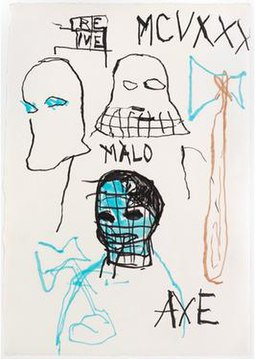
Basquiat drawing of the supportive art critic Rene Ricard, Untitled (Axe/Rene) (1984)
In his short but prolific career, Basquiat produced around 1,500 drawings, around 600 paintings, and many sculpture and mixed media works.[131] He drew constantly and often used objects around him as surfaces when paper was not immediately at hand.[132][133] Since childhood, he produced cartoon-inspired drawings when encouraged by his mother’s interest in art, and drawing became a part of his expression as an artist.[134] He drew in many different media, most commonly ink, pencil, felt-tip or marker, and oil-stick. He sometimes used Xerox copies of fragments of his drawings to paste onto the canvases of larger paintings.[135]
The first public showing of Basquiat’s paintings and drawings was in 1981 at the MoMA PS1 New York/New Wave exhibition. Rene Ricard’s article “Radiant Child” in Artforum magazine brought Basquiat to the attention of the art world.[136] Basquiat immortalized Ricard in two drawings, Untitled (Axe/Rene) (1984) and René Ricard (1984).[137]
A poet as well as an artist, words featured heavily in his drawings and paintings, with direct references to racism, slavery, the people and street scene of 1980s New York, black historical figures, famous musicians and athletes, as his notebooks and many important drawings demonstrate.[138][139] Often Basquiat’s drawings were untitled, and as such to differentiate works a word written within the drawing is commonly in parentheses after Untitled. After Basquiat died, his estate was controlled by his father Gérard Basquiat, who also oversaw the committee which authenticated artworks, and operated from 1994 to 2012 to review over 2000 works, the majority of which were drawings.[140]
Heroes and saints
A prominent theme in Basquiat’s work is the portrayal of historically prominent black figures, who were identified as heroes and saints. His early works often featured the iconographic depiction of crowns and halos to distinguish heroes and saints in his specially chosen pantheon.[31] “Jean-Michel’s crown has three peaks, for his three royal lineages: the poet, the musician, the great boxing champion. Jean measured his skill against all he deemed strong, without prejudice as to their taste or age,” said his friend and artist Francesco Clemente.[141] Reviewing Basquiat’s show at the Bilbao Guggenheim, Art Daily noted that “Basquiat’s crown is a changeable symbol: at times a halo and at others a crown of thorns, emphasizing the martyrdom that often goes hand in hand with sainthood. For Basquiat, these heroes and saints are warriors, occasionally rendered triumphant with arms raised in victory.”[142]
Basquiat was particularly a fan of bebop and cited saxophonist Charlie Parker as a hero.[23] He frequently referenced Parker and other jazz musicians in paintings such as Charles the First (1982) and Horn Players (1983), and King Zulu (1986).[55] “Basquiat looked to jazz music for inspiration and for instruction, much in the same way that he looked to the modern masters of painting,” said art historian Jordana Moore Saggese.[143]
Anatomy and heads

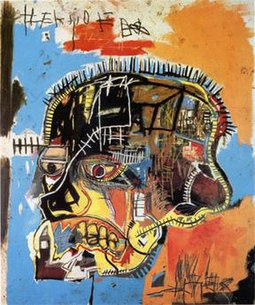
Untitled (Skull) (1981)
A major reference source used by Basquiat throughout his career was the book Gray’s Anatomy, which his mother had given him while he was in the hospital when he was seven.[13] It remained influential in his depictions of human anatomy, and in its mixture of image and text as seen in Flesh and Spirit (1982–83). Art historian Olivier Berggruen situates in Basquiat’s anatomical screen prints Anatomy (1982) an assertion of vulnerability, one which “creates an aesthetic of the body as damaged, scarred, fragmented, incomplete, or torn apart, once the organic whole has disappeared. Paradoxically, it is the very act of creating these representations that conjures a positive corporeal valence between the artist and his sense of self or identity.”[144]
Heads and skulls are significant focal points of many of Basquiat’s most seminal works.[145] Heads in works like Untitled (Two Heads on Gold) (1982) and Philistines (1982) are reminiscent of African masks, suggesting a cultural reclamation.[145] The skulls allude to Haitian Vodou, which is filled with skull symbolism; the paintings Red Skull (1982) and Untitled (1982) can be seen as primary examples.[146] In reference to the potent image depicted in Untitled (Skull) (1981), art historian Fred Hoffman writes that Basquiat was likely “caught off guard, possibly even frightened, by the power and energy emanating from this unexpected image.”[125] Further investigation by Hoffman in his book The Art of Jean-Michel Basquiat reveals a deeper interest in the artist’s fascination with heads that proves an evolution in the artist’s oeuvre from one of raw power to one of more refined cognizance.[147]
Heritage
Basquiat’s diverse cultural heritage was one of his many sources of inspiration. He often incorporated Spanish words into his artworks like Untitled (Pollo Frito) (1982) and Sabado por la Noche (1984). Basquiat’s La Hara (1981), a menacing portrait of a white police officer, combines the Nuyorican slang term for police (la jara) and the Irish surname O’Hara.[148] The black-hatted figure that appears in his paintings The Guilt of Gold Teeth (1982) and Despues De Un Pun (1987) is believed to represent Baron Samedi, the spirit of death and resurrection in Haitian Vodou.[149]
Basquiat has various works deriving from African-American history, namely Slave Auction (1982), Undiscovered Genius of the Mississippi Delta (1983), El Gran Espectaculo (The Nile) (1983), and Jim Crow (1986).[150] Another painting, Irony of Negro Policeman (1981), illustrates how African-Americans have been controlled by a predominantly Caucasian society. Basquiat sought to portray that African-Americans have become complicit with the “institutionalized forms of whiteness and corrupt white regimes of power” years after the Jim Crow era had ended.[151] This concept has been reiterated in additional Basquiat works, including Created Equal (1984).
In the essay “Lost in Translation: Jean-Michel in the (Re)Mix,” Kellie Jones posits that Basquiat’s “mischievous, complex, and neologistic side, with regard to the fashioning of modernity and the influence and effluence of black culture” are often elided by critics and viewers, and thus “lost in translation.”[123]
Jupiter Sextile Saturn – Follow The Crumb Trail
 | Astro Butterfly Jun 19, 2023 |
On June 19th, 2023, Jupiter (at 7° Taurus) is sextile Saturn (at 7° Pisces).
Jupiter sextile Saturn is one of the best transits of the season.
This sextile is especially important since it’s the first aspect of the famous Jupiter-Saturn cycle that started in December 2020 at 0° Aquarius. Back in 2020, an Aquarius seed has been planted somewhere in your chart.
However, when we have a conjunction, we don’t necessarily see anything concrete happening. A conjunction is like the dark New Moon – things are happening in the background, but we may not be aware yet of what’s going on.
Now with the sextile, a concrete opportunity will present itself. This is the first sextile of the 20-year-long, 2020-2040 Jupiter-Saturn cycle. This is our first step into the unknown. This is when we test the waters.

Jupiter And Saturn – Let’s Do It
There is a reason why the Jupiter-Saturn cycle has been the most important synodic cycle since astrology has basically been invented.
Jupiter and Saturn are the slower-moving visible planets in the sky. When Jupiter and Saturn meet, a new 20-year Jupiter-Saturn cycle begins, and that’s a big deal.
We have one Moon-Jupiter or one Moon-Saturn conjunction every month. We have one Venus-Jupiter or Venus-Saturn conjunction every year.
But we only have a Jupiter-Saturn conjunction every 20 years.
It is believed that the Star of Bethlehem was a Jupiter-Saturn conjunction. The Jupiter-Saturn cycle is THE most important planetary cycle because it speaks of long, 20-year-long projects that require a lot of time and energy to complete.
The typical person experiences 3 or 4 Saturn-Jupiter cycles in a lifetime. These are our big milestones in life. This is our life’s legacy.
When Jupiter and Saturn form an aspect, this marks an important milestone in our big, life’s legacy projects.
And while nothing concrete may happen on the day of the aspect – rest assured that things DO happen in the background. You may not be able to pinpoint anything in particular – but when you’ll look back some years from now, you will know that this was an important time in your life.
How do Jupiter and Saturn work? At first glance, Jupiter and Saturn are antithetic energies. Jupiter is about growth, Saturn is about contraction. Jupiter is abundant, Saturn is restrictive.
But Jupiter and Saturn have more in common than we might think.
Both Jupiter and Saturn are social planets that deal with groups of people and society as a whole. Jupiter has a more spiritual energy, Saturn a more concrete, material energy. With Jupiter, we dream big. With Saturn, we put in the work to achieve those dreams.
With Jupiter, we set an intention. With Saturn, we follow through. Jupiter is talking the talk, Saturn is walking the walk. Jupiter is what we believe in, our moral compass, Saturn is what we actually do – the step-by-step implementation.
To achieve our human potential and leave a legacy, we need to embrace both Jupiter and Saturn and find a balance between the two.
Think of Jupiter and Saturn as the tires of a car.
If it is too inflated, the tire can explode, and if there’s not enough air, the tire will wear badly and will possibly be damaged. That’s why we want to find a balance between expansion and contraction, between dreaming big and actually following through.
Jupiter Sextile Saturn – Follow The Crumb Trail
And to help us achieve these big, 20-year life legacy projects, Jupiter and Saturn dance together in the sky, forming different aspects, from conjunction, sextile, to square and opposition.
The good news is that Jupiter and Saturn are now sextiling each other.
The sextile is a supportive aspect – but unlike the trine, which brings things effortlessly (sometimes so effortlessly, that we don’t even notice them and we miss the boat), the sextile is the opportunities we consciously create.
There are 2 types of sextiles: opening sextiles (sextiles that happen just after the conjunction) and closing sextiles (sextiles that happen towards the end of the cycle, after the 2nd square).
Our current Jupiter-Saturn sextile is an opening sextile, because it’s the first Jupiter-Saturn aspect to happen after the Jupiter-Saturn 2020 conjunction. The opening sextiles are like the Moon’s crescent. This is when things get activated, this is when a new opportunity emerges.
The opening sextile has a 3rd house energy (unlike the closing sextile, which has an 11th house energy). So the opening sextile is really about venturing outside our comfort zone.
And when we do that, we need some assistance. We need some help from other people, or we need to put some systems in place so we can feel comfortable about our new endeavor.
When we go for the 1st time to a new city, we use a map or navigation. When we learn something new, we hire a teacher. The opening sextile is really about taking those first steps into the unknown.
The good news is that this new adventure doesn’t feel scary. The sextile is a friendly, supportive aspect. We feel excited about the new adventure. We are eager to explore.
We might not feel ready yet – and that’s the danger of the sextile aspect. A sextile is not a trine – is not that inner confidence that “I got this” or “I know what to do”.
With the sextile, we are not entirely sure about how we are going to go about things, yet we have that inner curiosity and excitement to try something new.
That’s why at this stage of the Jupiter and Saturn cycle – the opening sextile – it’s really important we actually say yes to the call, and go on a small adventure. We seek help. We reach out to others.
We follow the crumb trail.
This is a longer influence – Jupiter and Saturn will be in a sextile aspect for a few more weeks.
In the next couple of weeks, pay attention to any opportunities that come your way. If you read something interesting, follow through. If you get a phone call from an unknown number, answer. If opportunity knocks at your door, say YES.
Astro Butterfly
PS: if you have a friend who’d like to receive these emails, then can subscribe to our newsletter HERE