All posts by Mike Zonta

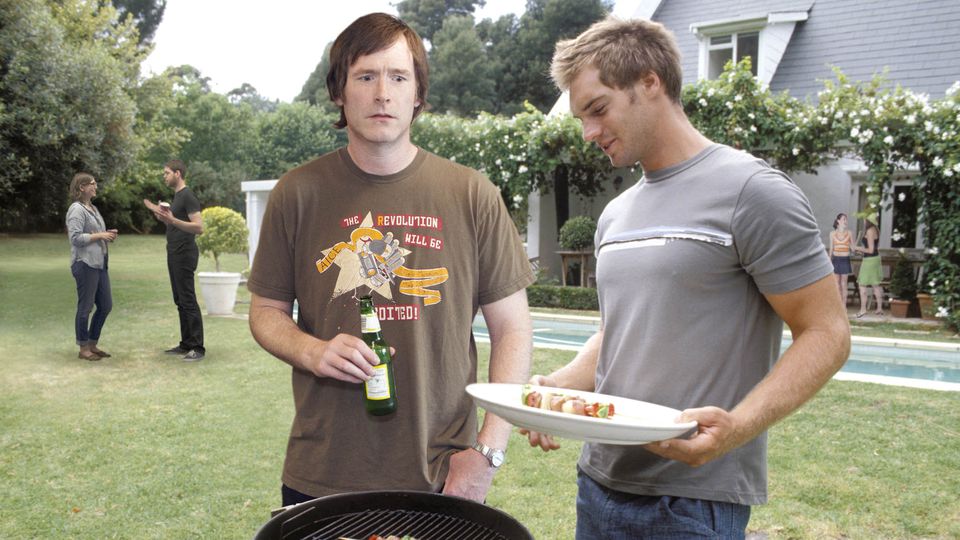
Man On Cusp Of Having Fun Suddenly Remembers Every Single One Of His Responsibilities

GAITHERSBURG, MD—Local man Marshall Platt, 34, came tantalizingly close to kicking back and having a good time while attending a friend’s barbeque last night before remembering each and every one of his professional and personal obligations, backyard sources confirmed.

While cracking open his second beer as he chatted with friends over a relaxed outdoor meal, Platt was reportedly seconds away from letting go and enjoying himself when he was suddenly crushed by the full weight of work emails that still needed to be dealt with, looming deadlines for projects that would take a great deal of time and energy to complete, an upcoming wedding he had yet to buy airfare for because of an unresolved issue with his Southwest Rapid Rewards account, and phone calls that needed to be returned.

“It’s great to see you guys,” said the man who had been teetering on the brink of actually having fun and was now mentally preparing for a presentation that he had to give on Friday and compiling a list of bills that needed to be paid before the 7th. “This is awesome.”

“Anyone want another beer?” continued Platt as he reminded himself to pick up his Zetonna prescription. “Think I’m gonna grab one.”

Platt, who reportedly sunk into a distracted haze after coming to the razor’s edge of experiencing genuine joy, fully intended to go through the motions of talking with friends and appearing to have a good time, all while he mentally shopped for a birthday present for his mother, wracked his brain to remember if he had turned in the itemized reimbursement form from his New York trip to HR on time, and made a silent note to call his bank about a mysterious recurring $19 monthly fee that he had recently discovered on his credit card statement.

“Everything’s fine,” said the tense, mentally absent man whose girlfriend asked him what was wrong after his near-giddy buzz vanished and he remembered that he hadn’t called his aunt yet to check up on her after her surgery. “I’m having fun.”

According to sources, Platt tried to put his responsibility-laden thoughts out of his mind and loosen up by opening another beer but suddenly remembered a magazine subscription that needed to be renewed by Friday, a medical bill he thought might now be overdue, and the fact that he needed to do laundry by tonight or he would run out of clean socks and underwear.

“Who made this guac?” said the man who almost let himself take pleasure in the beautiful evening with his closest friends before he let his brain become consumed with thoughts about how he needs to move on from his current job but is putting off the work necessary to make the transition. “It’s delicious.”

While the barbeque’s host chatted with Platt about how excited he was to see the upcoming Superman movie, sources confirmed that all Platt could think about was the fact that his recently married sister was coming to town next weekend and was supposed to stay with him, which reminded him that he needed to clean his apartment, which reminded him he needed to buy extra bedding for his sister to sleep on, which reminded him that he had to make an after-work trip to Bed Bath & Beyond, which reminded him that he would be tired after work and wouldn’t want to go to Bed Bath & Beyond, which reminded him that he also needed to go to the grocery store because his sister would think he’s irresponsible if she saw his empty refrigerator, which reminded him that he and his sister aren’t as close as he’d like, which reminded him that his parents already had a house and two cars by the time they were his age, which reminded him that he’s been with his girlfriend for over five years and that while everything was going fairly well, he felt overwhelmed by the prospect of marriage and the mounting pressure to propose.

“Yeah, Man Of Steel looks good,” said a smiling Platt, who was only thinking about how he graduated from college over 10 years ago and still owed $86,000 in student loans. “Can’t wait to see it.”

Accounts confirmed the man nearly convinced himself that all his responsibilities would be taken care of in due time and that he should just relax when a friend mentioned a recent road trip he had taken with his wife, which prompted Platt to mull over the fact that he still needed to renegotiate the lease terms of his 2010 Jetta, a task he was delaying until he had a fender bender repaired.

In addition, Platt began thinking about the number of opened envelopes on his kitchen table, some of the contents of which, he remembered, were actually important and should be rechecked before he throws them away.

“Hey, I have to get going,” said the man who could barely recall anything that anyone at the gathering had said the entire evening. “Just have a couple things I need to get to tonight.”

“This was great, though,” he added.

It’s a Great Time for Virgins: Here Are 5 Fine Alternatives to Sex

SEX & RELATIONSHIPS
Today’s virgins have more access to sexual satisfaction than ever before.

Photo Credit: CHAjAMP / Shutterstock

If you’re one of the many members of America’s youth desperate to ditch your virginity, you might want to rethink your priorities, because as some new research confirms, sex might not be as accessible for you as it was in years past.

According to a 2011 report issued by the Centers for Disease Control and Prevention’s National Center for Health Statistics, virginity is on the rise. Twenty-seven percent of men ages 15 to 24 years old have never had any form of sexual contact with another person—oral, vaginal or anal. That statistic is up from the 22 percent of self-reported virgins back in 2002.

A separate study published in the Archives of Sexual Behavior confirmed that millennials will have fewer sexual partners than the generations before them. A separate study conducted by online dating service Match found that 49 percent of 20-somethings have not had sex at all in the past year.

“This is a generation that has grown up with an awareness of HIV/AIDS,” Jeffrey Arnett, a research professor at Clark University and author of Adolescence and Emerging Adulthood, told Time. “When the boomers were in their heyday, that didn’t exist, and it seemed like free love was a good idea.” That’s not all bad, however. These days, young people are far more likely to use condoms than in generations past. Unsurprisingly, the teen pregnancy rate has decreased dramatically as well.

There’s also the added sexual hindrance of the commonality of young folks’ boomeranging back to their parents’ places. “You’re not going to bring a parade of partners through Mom’s basement,” Jean Twenge, a professor and researcher at San Diego State University, told Vice.

But if less sex sounds like a depressing stat, fear not. Because while it might not be the most popular trend, it could very well be the best time in history to not be having sex. Listed below are five fine alternatives to indulge in.

1. Outercourse

Conversations surrounding sex don’t begin and end at penetrative intercourse, not anymore at least. “Penetration of one’s body part into another’s body cavity is only one small part of being sexual,” Terri Vanderlinde, a board-certified practitioner in sexuality counseling, told AlterNet via email.

“Many people have fabulous and satisfying sexual encounters based on ‘outercourse.’” She also introduced us to the concept of “very erotic non-insertion sex,” abbreviated to VENIS. “Remember, ‘sex’ does not necessarily mean penetration, and ‘pleasure and satisfaction’ do not necessarily mean orgasm,” she added.

2. Masturbation

Adult industry marketing specialist Adella Curry reminds us that the conversation is starting to open itself up to everyone’s favorite alternative to partnered sex: masturbation. There are chatrooms, support groups, even advice columns on the subject, like Better Than The Hand. “Their mission is to de-shame male masturbation and create a safe place for guys to talk about what works and what doesn’t,” says Curry. Publications like Vice, Salon and AlterNet are here to offer detailed information on the subject.

Of course, we’ve got to give a nod to another masturbatory favorite: pornography. In 2015, Pornhub received 21.2 billion visits to its site. Its analytics team concluded that its audience spent a total of 4,392,486,580 hours watching porn. If sex isn’t on the table, you can always look to porn as an accessible alternative.

3. Virtual Relationships

Among the many bridges technology has helped gap, we can also thank it for introducing us to new forms of erotic entertainment. “You have people in their early 20s now, they grew up on the internet, and their first sexual experiences may have been virtual. Virtual sexuality is something they’re very well versed in,” says Stefan, owner of the camming social network MyGirlFund.

When we interviewed a woman named Stacy, a camming professional working on the site, she explained that many of her clients sign up to explore an otherwise embarrassing kink. Some do it to enjoy a no-strings-attached sexual relationship. And others, she says, do so by way of necessity. Stacy told us, “I think some of these guys are drawn into the digital relationship because they don’t feel comfortable with themselves. They don’t talk to women at all. This way, they get to.”

4. Virtual Sex

The virtual world has also begun to open itself up to new modes of sexuality. VR is becoming an increasingly popular porn niche where users can take claim in a sexuality that may not be “real” in the traditional sense, but sure enough feels like it.

“Sex is healthy, but sometimes the right partner is just not in your life for one reason or another,” says Daniel Peterson, the founder and CEO of VRPorn.com. “VR porn is the closest that technology has ever come to the real thing, and it gets better all the time. We hear many users commenting on the unexpected intimacy that they feel with the actors.”

5. Sex Toys… and Robots

Long gone are the days where masturbation was an activity accompanied only by some lotion and a box of tissues. Today’s sex toy market has ballooned into a multibillion-dollar industry. Blow job machines, iPod vibrators and full-blown sex robots are all on the menu. And while some of these toys may lean toward indulgence, many are designed for the sole purpose of bringing more orgasms into the bedroom.

Some sex therapists have even started prescribing vibrator u sage to women who have difficulty achieving orgasm. The new products on the market are increasingly targeted toward exploring new forms of sexual pleasure (more notably, in the realm of anal play), be it with a partner or on your own.

****

For those who aren’t satisfied with the new options available, hang tight. If you really want to have sex, you’ll get there, eventually. Life has a harsh way of reminding us that we don’t always get to call the shots. Sex will happen; you might just have to wait around until the opportunity presents itself.

Carrie Weisman is an AlterNet staff writer who focuses on sex, relationships and culture. Got tips, ideas or a first-person story? Email her.

SETI Investigates Unusual Radio Signal From Space

SETI

Follows close on mysterious discovery regarding fast radio bursts

by Tara MacIsaac, Epoch Times (August 29, 2016)

The Search for Extraterrestrial Intelligence (SETI) institute announced Monday that it considers a radio signal detected by Russian astronomers a potential sign of intelligent inhabitants in a star system 94 light-years away.

“There are many other plausible explanations for this claimed transmission—including terrestrial interference. Without a confirmation of this signal, we can only say that it’s ‘interesting,’” wrote Seth Shostak, a senior astronomer for SETI, in a technical analysis.

Nonetheless, Shostak considered the possibility of intelligent extraterrestrial origin. Analyzing the strength of the signal, he said it would have to have been sent by a civilization capable of generating at least a trillion watts in one shot. That’s comparable to the total energy consumption of humankind.

The signal seems to be coming from the star system HD 164595, which centers on a star of comparable size and brightness to our sun. It is known to have a Neptune-sized planet, though its tight orbit makes it unlikely to host life. But, Shostak noted, more habitable planets may yet be found in HD 164595.

The signal was picked up by the RATAN-600 radio telescope in Zelenchukskaya, at the northern foot of the Caucasus Mountains. SETI will continue to monitor the star system with its Allen Telescope Array to see if there is any repeat of the signal.

It lasted longer than so-called “fast radio bursts” (FRBs), which last mere milliseconds. A total of 17 FRBs have been detected in the past eight years, though their origin also remains unknown.

A study published in the journal Nature in March by an international team of scientists revealed that FRBs are more mysterious than previously thought.

Previously, the bursts had been detected as single, non-repeating events coming from outside our galaxy. This led to the hypothesis that they originate in cataclysmic events, such as the collision of neutron stars, which would send shock-waves through space.

The researchers found, however, that 10 additional bursts followed FRB 121102 from the same location. The study states: “This unambiguously identifies FRB 121102 as repeating and demonstrates that its source survives the energetic events that cause the bursts.”

The study speculates that the source may be a young neutron star, but Shami Chatterjee, a Cornell University senior researcher who contributed to the study,said in a news release: “It seems we’ve broken this enigmatic phenomenon wide open.”

Follow @TaraMacIsaac on Twitter, visit the Epoch Times Beyond Science page on Facebook, and subscribe to the Beyond Science newsletter to continue exploring the new frontiers of science!

8 Scientists Contemplate Place of Human Consciousness in Science

By , Epoch Times

The founders of quantum physics contemplated the philosophical implications of their findings. They were astounded that the thoughts of the observer seemed to influence the matter being observed. Principles believed to stabilize physical reality didn’t seem to apply.

The power of the human mind to influence physical reality has been recognized in various fields. For example, the effectiveness of placebo treatments has brought the role of human consciousness to bear on conventional modern medicine.

Dr. Robert Jahn served as an engineering dean at Princeton University while studying for decades the impact of human thought on the functioning of mechanical devices. In his book “Margins of Reality,” he reopens the questions once raised by Max Planck, Erwin Schrödinger, and other influential scientists—questions of human consciousness, which Jahn says modern students seem to pay less attention to than the physical data collected by these science greats.

Jahn, Planck, and Schrödinger are not the only scientists to have contemplated the role of human consciousness in science. Many have suggested that scientists must face the enigma and challenges of understanding consciousness for science to make it’s next big leap. Here are the views of eight scientists.

1. Max Planck, Founding Father of Quantum Mechanics

Max Planck
German physicist Max Planck, c. 1930. (Wikimedia Commons)

Planck is regarded as one of the founders of quantum mechanics. He was awarded the Nobel Prize in Physics in 1918 for “the services he rendered to the advancement of Physics by his discovery of energy quanta,” according to the Nobel Prize website.

In “A Survey of Physical Theory,” Planck wrote: “All ideas we form of the outer world are ultimately only reflections of our own perceptions. Can we logically set up against our self-consciousness a ‘Nature’ independent of it? Are not all so-called natural laws really nothing more or less than expedient rules with which we associate the run of our perceptions as exactly and conveniently as possible?”

2. Erwin Schrödinger, Nobel Prize Winning Physicist

Erwin Schrödinger, 1933. (Nobel Foundation)

Erwin Schrödinger was a physicist and theoretical biologist. He won the Nobel Prize in Physics in 1933 with Paul Adrien Maurice Dirac “for the discovery of new productive forms of atomic theory,” according to the Nobel Prize website.

Jahn quotes Schrödinger: “Consciousness is that by which this world first becomes manifest, by which indeed, we can quite calmly say, it first becomes present; that the world consists of the elements of consciousness.”

3. Robert G. Jahn, Princeton Engineering Dean

Professor of aerospace science and dean emeritus of the School of Engineering and Applied Science at Princeton University Robert G. Jahn began studying psychic phenomena some 30 years ago.

Jahn suggested in “Margins of Reality” that the study of consciousness may start by quantifying consciousness in statistical form. He has conducted many experiments on the ability of the mind to influence machines. We will give a very simplified overview of his experiments to illustrate:

He used a random event generator (REG) that can produce bits representing either 0 or 1. Study participants would try to influence the REG either way, toward 0 or toward 1. If the events showed a significant favor in the direction of the person’s will above what chance would dictate, it suggested the person’s will influenced the machine. Human intent was thus boiled down to a measurable, binary form. With many tests, Jahn built up a mass of results that could then become reliable statistics.

He noted, however, “Since most established behavior in consciousness-related domains can only be quantitatively represented in statistical terms, and since all statistical formats are themselves constructions of consciousness, it follows that the validity and limitations of the statistical representations must themselves be well defined and well understood before an anomaly can be claimed.”

4. David Chalmers, Cognitive Scientist and Philosopher at NYU

Chalmers is a philosophy professor and head of consciousness studies at the Australian National University and at New York University.

In a TED Talk earlier this year, he said science is at a sort of impasse in its study of consciousness, and “radical ideas may be needed,” to move forward. “I think that we may need one or two ideas that may initially seem crazy.”

In the past, physics had to incorporate newly discovered fundamental building blocks, such as electromagnetism, that were unexplained by more basic principles. He wonders whether consciousness is another such building block.
“Physics is curiously abstract,” he said. “It describes the structure of reality using a bunch of equations, but it doesn’t tell us about the reality that underlies it.” He quoted a question posed by Stephen Hawking: “What puts the fire into the equations?”

Maybe consciousness puts the fire into the equations, Chalmers said. The equations stay as they are, but we see them as means for describing the flux of consciousness.

“Consciousness doesn’t dangle outside the physical world as some kind of extra, it’s there right at its heart,” he said.

5. Imants Barušs, Psychologist, Member of Society for Consciousness Studies

Dr. Imants Barušs is a psychology professor at the University of Western Ontario in Canada, who teaches courses on consciousness. He studied engineering as an undergraduate student and completed a masters degree in mathematics before receiving his Ph.D. in psychology. 

At the inaugural meeting of the Society for Consciousness Studies at The California Institute of Integral Studies on May 31, Barušs presented a paper outlining his vision for consciousness studies and his reasons for supporting it.

He highlighted the importance of such research, and even a paradigm shift, by arguing that strictly materialist science is contributing to mental health problems among youth. Many depressed teens who hurt themselves don’t possess the “hallmarks of a psychiatric disorder,” wrote Baruss, quoting a Toronto Star article titled “Psychiatrists see rise in suicidal teenagers.” “Instead they seem to be suffering an existential crisis that is sort of ‘I’m empty, I don’t know who I am, I don’t know where I’m going, I don’t have any grounding and I don’t know how to manage my negative feelings.’”

Barušs wrote: “Scientific materialism assures us that reality is a meaningless, incidental, mechanistic, collocation of improbable events.”

He summarized some of the ways in which the materialist interpretation of reality has already broken down: quantum events are seen to be non-deterministic; time is no longer linear, as effects have been shown to precede their causes; particles change position depending on where one looks or what one decides to measure.

Finally, he said, “Materialism cannot explain … the sense of existence that people have for themselves.”

He hopes the Society for Consciousness Studies can promote open inquiry. Collectively, scientists interested in this line of inquiry could work to find funding or support those who are censured by their colleagues or employers.

6. William Tiller, Professor Emeritus at Stanford University

Tiller is a fellow at the American Academy for the Advancement of Science, and professor emeritus of materials science at Stanford University.

Tiller has discovered a new level of substance in the empty space between the fundamental electric particles that make up our normal electric atoms and molecules, in the vacuum. This kind of substance is usually invisible to us, and to our measurement devices.

But, he has discovered that human intention can affect this substance in such a way that it interacts with the substances we can see or that we are able to measure.

“Consciousness lifts the higher thermodynamic free energy state [of the vacuum level], then we can access the physics of the vacuum,” Tiller says. “Accessing that new physics allows intention to bring forth effects you wouldn’t imagine.”

The consciousness can, in a way, affect or interact with a power greater than anything conventional instruments have been able to measure thus far.

7. Bernard Beitman, Psychiatrist, University of Virginia

Dr. Bernard Beitman
Dr. Bernard Beitman (Courtesy of Dr. Beitman)

Beitman is a psychiatrist forging the emerging discipline of Coincidence Studies. He is a graduate of Yale and Stanford and is the former chair of psychiatry at the University of Missouri–Columbia.

In a 2011 paper, Beitman wrote: “One of the biggest challenges in the development of the new discipline of Coincidence Studies is providing a systematic place in scientific research for subjectivity and for human consciousness. Meaningful coincidences depend upon the mind of the observer. The question of how to develop methods and an accompanying technical language that includes and respects the subjective element built into the fabric of coincidence needs to be answered.”

8. Henry P. Stapp, Physicist Specializing in Quantum Mechanics, University of California–Berkeley

Stapp is a theoretical physicist at the University of California–Berkeley who worked with some of the founding fathers of quantum mechanics.

In a paper titled “Compatibility of Contemporary Physical Theory With Personality Survival,” Stapp looked at how the mind may exist separately from the brain.

A scientist physically affects quantum systems by choosing which properties to study. Similarly, an observer can hold in place a chosen brain activity that would otherwise be fleeting. This shows, said Stapp, that the mind and brain may not be one and the same.

He said scientists should regard “the physical effects of consciousness as a physical problem that needs to be answered in dynamical terms.”

*Image of human consciousness via Shutterstock

Sunday Night Translation Group

Translation is a 5-step process using syllogistic reasoning to transform man and the universe back into Being. Being is the perfect, essential nature of all, and through the process of Translation, Reality is uncovered and thus revealed. Through word tracking, getting to the essence of the words we use to express our current view of reality, we are uncovering Essence, which is the only true reality.

Sunday Night Translation Group:

Sense testimony:  Aging causes deterioration and weight gain.

Conclusions:
1) Truth is the timeless, unshakeable participant in everything.
2) I AM I innate integrity consciousness eternal life being.

Gibbons on Muhammed’s Penis

Muhammed
The Prophet Muhammad

Abu al-Fida (1273 – 1331 AD) was a Muslim geographer and historian. He relates that Muhammad suffered from a death erection. From Edward Gibbon’s “The Decline and Fall of the Roman Empire”:

Sibi robur ad generationem, quantum triginta viri habent, inesse jactaret; ita ut unicâ horâ posset undecim feminis satisfacere, ut ex Arabum libris refert Stus Petrus Paschasius, c. 2 (Maracci, Prodromus Alcoran, p. iv. p. 55. See likewise Observations de Belon, l. iii. c. 10, fol. 179, recto). Al Jannabi (Gagmer, tom. iii. p. 487) records his own testimony that he surpassed all men in conjugal vigour; and Abulfeda mentions the exclamation of Ali, who washed his body after his death, “O propheta, certe penis tuus cælum versus erectus est” (in Vit. Mohammed. p. 140).

In English, Ali had exclaimed, “O prophet, thy penis is erect unto the sky!

(from WikiIslam.net)

God Announces Successful Test Of First Category 7 Hurricane

HurricaneGod
NEWS IN BRIEF

THE HEAVENS—Calling the powerful tropical cyclone one of His greatest meteorological feats to date, God Almighty, Creator of Heaven and Earth, announced Thursday the first successful test of a Category 7 hurricane. “I’d been tinkering with the idea of a Category 7 for a while and the trial run went off without a hitch, so I’m quite pleased with the results,” said Our Lord and Heavenly Father, describing how the unprecedented 2,000-mile-wide storm gathered strength for 15 days over the warm waters of the Pacific before making landfall on the Marshall Islands test site, battering the small country with 300-mile-per-hour winds and storm surges that raised the water level by 80 feet. “Given how well the test case performed, I’m definitely going to start using these a lot more often. Hopefully, if there aren’t any major setbacks, I’ll roll out several Category 7 hurricanes in the Atlantic and the Gulf of Mexico by the end of the month.” At press time, God abandoned plans for an experimental earthquake that registers 12 on the Richter scale after the prototype cracked Venus in half.

Biography: Charles Perrault

CharlesPerrault

Charles Perrault (12 January 1628 – 16 May 1703) was a French author and member of the Académie Française. He laid the foundations for a new literary genre, the fairy tale, with his works derived from pre-existing folk tales. The best known of his tales include Le Petit Chaperon Rouge (Little Red Riding Hood), Cendrillon (Cinderella), Le Chat Botté (Puss in Boots), La Belle au bois Dormant (The Sleeping Beauty), and Barbe Bleue (Bluebeard). Some of Perrault’s versions of old stories may have influenced the German versions published by the Brothers Grimm more than 100 years later. The stories continue to be printed and have been adapted to opera, ballet (such asTchaikovsky‘s The Sleeping Beauty), theatre, and film. Perrault was an influential figure in the 17th-century French literary scene, and was the leader of the Modern faction during the Quarrel of the Ancients and the Moderns.

“National Anthem Is a Celebration of Slavery” by Jon Schwarz

ColinK

August 28, 2016 (TheIntercept.com)

Before a Preseason game on Friday, San Francisco 49ers quarterback Colin Kaepernick refused to stand for the playing of “The Star-Spangled Banner.” When he explained why, he only spoke about the present: “I am not going to stand up to show pride in a flag for a country that oppresses black people and people of color. … There are bodies in the street and people getting paid leave and getting away with murder.”

Twitter then went predictably nuts, with at least one 49ers fan burning Kaepernick’s jersey.

Almost no one seems to be aware that even if the U.S. were a perfect country today, it would be bizarre to expect African-American players to stand for “The Star-Spangled Banner.” Why? Because it literally celebrates the murder of African-Americans.

Few people know this because we only ever sing the first verse. But read the end of the third verse and you’ll see why “The Star-Spangled Banner” is not just a musical atrocity, it’s an intellectual and moral one, too:

No refuge could save the hireling and slave
From the terror of flight or the gloom of the grave,
And the star-spangled banner in triumph doth wave
O’er the land of the free and the home of the brave.

“The Star-Spangled Banner,” Americans hazily remember, was written by Francis Scott Key about the Battle of Fort McHenry in Baltimore during the War of 1812. But we don’t ever talk about how the War of 1812 was a war of aggression that began with an attempt by the U.S. to grab Canada from the British Empire.

However, we’d wildly overestimated the strength of the U.S. military. By the time of the Battle of Fort McHenry in 1814, the British had counterattacked and overrun Washington, D.C., setting fire to the White House.

And one of the key tactics behind the British military’s success was its active recruitment of American slaves. As a detailed 2014 article in Harper’s explains, the orders given to the Royal Navy’s Admiral Sir George Cockburn read:

Let the landings you make be more for the protection of the desertion of the Black Population than with a view to any other advantage. … The great point to be attained is the cordial Support of the Black population. With them properly armed & backed with 20,000 British Troops, Mr. Madison will be hurled from his throne.

Whole families found their way to the ships of the British, who accepted everyone and pledged no one would be given back to their “owners.” Adult men were trained to create a regiment called the Colonial Marines, who participated in many of the most important battles, including the August 1814 raid on Washington.

Then on the night of September 13, 1814, the British bombarded Fort McHenry. Key, seeing the fort’s flag the next morning, was inspired to write the lyrics for “The Star-Spangled Banner.”

So when Key penned “No refuge could save the hireling and slave / From the terror of flight or the gloom of the grave,” he was taking great satisfaction in the death of slaves who’d freed themselves. His perspective may have been affected by the fact he owned several slaves himself.

With that in mind, think again about the next two lines: “And the star-spangled banner in triumph doth wave / O’er the land of the free and the home of the brave.”

The reality is that there were human beings fighting for freedom with incredible bravery during the War of 1812. However, “The Star-Spangled Banner” glorifies America’s “triumph” over them — and then turns that reality completely upside down, transforming their killers into the courageous freedom fighters.

After the U.S. and the British signed a peace treaty at the end of 1814, the U.S. government demanded the return of American “property,” which by that point numbered about 6,000 people. The British refused. Most of the 6,000 eventually settled in Canada, with some going to Trinidad, where their descendants are still known as “Merikins.”

Furthermore, if those leading the backlash against Kaepernick need more inspiration, they can get it from Francis Scott Key’s later life.

By 1833, Key was a district attorney for Washington, D.C. As described in a book called Snowstorm in August by formerWashington Post reporter Jefferson Morley, the police were notorious thieves, frequently stealing free blacks’ possessions with impunity. One night, one of the constables tried to attack a woman who escaped and ran away — until she fell off a bridge across the Potomac and drowned.

“There is neither mercy nor justice for colored people in this district,” an abolitionist paper wrote. “No fuss or stir was made about it. She was got out of the river, and was buried, and there the matter ended.”

Key was furious and indicted the newspaper for intending “to injure, oppress, aggrieve & vilify the good name, fame, credit & reputation of the Magistrates & constables of Washington County.”

You can decide for yourself whether there’s some connection between what happened 200 years ago and what Colin Kaepernick is angry about today. Maybe it’s all ancient, meaningless history. Or maybe it’s not, and Kaepernick is right, and we really need a new national anthem.