All posts by Mike Zonta

Book: “Small is Beautiful”

Small Is Beautiful: Economics as if People Mattered

Small Is Beautiful: Economics as if People Mattered

by Ernst F. Schumacher

“Nothing less than a full-scale assault on conventional economic wisdom.” —Newsweek

One the 100 most influential books published since World War II — The Times Literary Supplement

Hailed as an “eco-bible” by Time magazine, E.F. Schumacher’s riveting, richly researched statement on sustainability has become more relevant and vital with each year since its initial groundbreaking publication during the 1973 energy crisis. A landmark statement against “bigger is better” industrialism, Schumacher’s Small Is Beautiful paved the way for twenty-first century books on environmentalism and economics, like Jeffrey Sachs’s The End of Poverty, Paul Hawken’s Natural Capitalism, Mohammad Yunis’s Banker to the Poor, and Bill McKibben’s Deep Economy. This timely reissue offers a crucial message for the modern world struggling to balance economic growth with the human costs of globalization.

(Goodreads.com)

Ceremony, Relationships And Communal Living | Shaman Wendy Mandy & Russell Brand


Russell Brand
Published on Apr 7, 2019

For over 30 years Wendy Mandy has been practicing ancient shaman rituals and healing. She was bestowed all her knowledge by Indigenous Tribes in Africa and South America. We talk about how to maintain healthy relationships, the importance of ceremony and the power of plant medicine! This is the first time Wendy Many has spoken publicly about what she does.

Subscribe to my channel here: http://tinyurl.com/opragcg
(make sure to hit the BELL icon to be notified of new videos!)

You can get my new book Mentors here (and as an audiobook!): https://amzn.to/2t0Zu9U

Book: God-Link Book I: “The Gathering” the Prophetic Autobiography of a Marine Combat Survivor

*
God-Link Book I: “The Gathering” the Prophetic Autobiography of a Marine Combat Survivor. (Hardcover) 550 pgs
by Wm “Pila” Chiles (Author)
Price + Shipping
Condition (Learn more)
Delivery
Seller Information
Buying Options
$869.56!!!
+ $3.99 shipping
Used – Acceptable
This purchase helps support a small business! This is a used item… » Read more
<div class=”comments”> This purchase helps support a small business! This is a used item and will not likely include any cd or access code that may have originally come with the book. May be Ex-Library Book condition will be in listed condition or better. Satisfaction guarantee! </div>
  • Arrives between April 12-19. 
  • Want it delivered Tuesday, April 16? Choose Expedited Shipping at checkout.
  • Shipping rates and return policy.
4.5 out of 5 stars
91% positive over the past 12 months. (5,137 total ratings) 
Add to cart
from seller Full Harvest and price $869.56
$899.99!!!
+ $4.49 shipping
Used – Very Good
Over 1 Million Satisfied Customers. Buy With Confidence! Used ite… » Read more
<div class=”comments”> Over 1 Million Satisfied Customers. Buy With Confidence! Used items may contain, highlighting, writing, and other previous signs of use. Used items may not contain CD’s. access codes and other accompanying items when applicable. </div>
4.5 out of 5 stars
87% positive over the past 12 months. (69,892 total ratings) 

“New Notices in All French Churches”

(Courtesy of Mark Victor and Bill Chiles)

 “En entrant dans cette église, il est possible que vous entendiez l’appel de Dieu. Par contre, il n’est pas susceptible de vous contacter par téléphone. Merci d’avoir éteint votre téléphone. Si vous souhaitez parler à Dieu, entrez, choisissez un endroit tranquille et parle lui. Si vous souhaitez le voir, envoyez-lui un SMS en conduisant.”
 
Translation: 
 
“It is possible that upon entering this church, you may hear the Call of God. On the other hand, it is not likely He will contact you by phone. Thank you for turning off your phone. If you would like to talk to God, come in, choose a quiet place, and talk to him. If you would like to see him, send him a text while driving.”

TRANSLATION ADVENTURE – 4/7/19

Translators: Alex Gambeau, Brian Wallenstein, Heather Williams

SENSE TESTIMONY: Moving is stirring creativity

  1. Creativity, The I AM I, is animating The Soul to transcend beyond all knowledge.
  2. One Infinite Formless Source is creatively animating the Oneness I AM.
  3. Truth is omnipresent omniscient thus Eternally dilating its awareness of its infinite self being the only motive, creative force gracefully, safely in its infinite unfolding viewpoint.

Lori Lightfoot, Chicago’s first openly gay, black female mayor

03/04/2019 – france24.com

Text by:Rachel HOLMAN

Kamil Krzaczynski, AFP | Chicago mayor-elect Lori Lightfoot (L) celebrates her win with wife Amy Eshleman after speaking at an election night party in Chicago, Illinois, on April 2.

Lori Lightfoot made history on April 2 when she became the first openly gay black woman to be elected mayor of Chicago. A political newcomer, her progressive policies, personal history and status as an outsider appealed to voters.

When Lightfoot first entered the mayoral race, many considered her a fringe candidate. The 56-year-old had never held elected office, and was going up against political heavyweights such as her main opponent, Illinois’ Cook County board president and Democratic Party chairman Toni Preckwinkle.

Yet in the end, it was her progressive policies and her status as a political outsider that carried her across the finish line to defeat Preckwinkle easily. A reformist, she has pledged to bring greater transparency to City Hall and the Chicago police department. She has also advocated raising revenue by legalising marijuana and gambling in the city.

Lightfoot has largely attributed her upbringing in a working-class home, her experiences as an LGBT woman of colour, and longstanding career working with the criminal justice system for shaping many of the political views that resonated with voters.

Her victory marks two firsts for Chicago, which has elected its first black female mayor and the first who is openly gay.

‘Get on the right foot with Lightfoot’

Lightfoot was born on August 4, 1962, in Massillon, an industrial town in northern Ohio, to humble beginnings. The youngest of four children, she has spoken often of the sacrifices her working-class parents made for the family.

In the years before Lightfoot’s birth, her father Elijah was left deaf in both ears after falling into a coma for nearly a year. Yet despite his disability, he often worked two, sometimes three jobs – as a janitor, barber or handyman – to keep his family afloat.

“He had a very hard life,” Lightfoot told the Chicago Sun-Times in an article published last month.

Her mother Ann, meanwhile, held a number of low-paying positions in mental hospitals and nursing homes, eventually becoming a home healthcare aide.

It was Ann who pushed Lightfoot to do well at school, stressing the importance of a good education. As a student at Massillon’s Washington High School – which was predominantly white – Lightfoot was very active: she played point guard for the girls’ basketball team and was voted class president three years running on the slogan, “Get on the right foot with Lightfoot”.

Coming out

In 1980 she enrolled at the University of Michigan, where she majored in political science. To pay for her studies, she took out student loans and worked odd jobs. After graduating, she moved to Washington, D.C., where she delved into politics working as a congressional aide for Republican Ralph Regula (from her home district in Ohio) and then Democrat Barbara Mikulski of Maryland.

These experiences led her to apply to the University of Chicago Law School, where she was accepted on a full scholarship. In 1986 she packed her bags and moved to Chicago, where she has lived ever since.

While at law school, Lightfoot came out to her family. She had hesitated for a long time, believing she might lose them – her parents were churchgoers from a fairly conservative part of the country. But their reaction surprised her.

“When I came out, it wasn’t a big formal conversation like in the movies. I just started living as my true and authentic self and opened up my life to my parents – sharing who I was, and bringing a girlfriend when I came home for a visit,” Lightfoot wrote in an article published by Essence Magazine in October.

“To my great surprise, my parents accepted me for who I was and have supported me since.”

Policing the police

After law school she was hired by the firm Mayer Brown, where she has worked on and off throughout her career and is now a partner. Her record as a lawyer, however, has led some to question her credentials as a progressive. While at Mayer Brown, she argued against congressional redistricting in two cases brought by powerful Republicans. She later left the practice during the 1990s to become an assistant US attorney, prosecuting cases involving drug conspiracies, political corruption and bankruptcy fraud.

In 2002 the superintendent of the Chicago police department chose her to investigate complaints made against officers as the new chief administrator of the office of professional standards. Over the next many years, Lightfoot was appointed to a number of public positions, all of which involved working directly with the police or local communities.

After a stint as president of the Chicago police board – a civilian body that decides disciplinary action over matters of police misconduct – in 2015, she was named head of a police accountability task force by outgoing Chicago mayor Rahm Emanuel. Emanuel formed the task force amid public outcry over the death of Laquan McDonald, a 17-year-old black youth who was filmed by police dash cameras walking away from officers when he was shot 16 times. Under Lightfoot, the task force published a scathing report in 2016 detailing racism and other systemic failures within the Chicago police department.

Mayoral run

It was while working for Emanuel that Lightfoot first began contemplating a run for mayor.

“I came to be very committed to the fact he could not have a third term,” she told the Chicago Sun-Times. “Because I felt that there were way too many black and brown people, particularly young men, who were going to be left behind and never, ever have a shot, an opportunity, the thing that really transformed my life.”

“And when nobody else would stand up, and I started looking at the people early announcing they were going to run against him, I didn’t think those people were ever going to address the issues that I thought had to be addressed or in the way I knew they had to be addressed,” she continued. “That’s what got me really started thinking about this.”

With more than a dozen candidates in the race, few initially gave Lightfoot any serious thought. But her promise to “Bring in the light” to City Hall and reform the police department appealed to voters who have grown weary of the status quo.

Her campaign got a further boost in February after the Chicago Sun-Times endorsed her candidacy.

“We sense that a palpable wave of moral disgust has presented Chicago with a rare opportunity to elect a mayor who will confront our city’s most intractable problems in ways that, finally, pull every Chicagoan along,” the newspaper wrote. “For us, that person is Lori Lightfoot.”

It would appear the vast majority of voters in Chicago agreed.

“It’s refreshing to see somebody who is different, hopefully,” said Chicago native Andrew Tabor, 61, in comments to Reuters.

Why We Fall in Love: The Paradoxical Psychology of Romance and Why Frustration Is Necessary for Satisfaction

“All love stories are frustration stories… To fall in love is to be reminded of a frustration that you didn’t know you had.”

Adrienne Rich, in contemplating how love refines our truths, wrote: “An honorable human relationship — that is, one in which two people have the right to use the word ‘love’ — is a process, delicate, violent, often terrifying to both persons involved, a process of refining the truths they can tell each other.” But among the dualities that lend love both its electricity and its exasperation — the interplay of thrill and terror, desire and disappointment, longing and anticipatory loss — is also the fact that our pathway to this mutually refining truth must pass through a necessary fiction: We fall in love not just with a person wholly external to us but with a fantasy of how that person can fill what is missing from our interior lives.

Psychoanalyst Adam Phillips addresses this central paradox with uncommon clarity and elegance in Missing Out: In Praise of the Unlived Life (public library).

Illustration from An ABZ of Love, Kurt Vonnegut’s favorite vintage Danish guide to sexuality

Phillips writes:

All love stories are frustration stories… To fall in love is to be reminded of a frustration that you didn’t know you had (of one’s formative frustrations, and of one’s attempted self-cures for them); you wanted someone, you felt deprived of something, and then it seems to be there. And what is renewed in that experience is an intensity of frustration, and an intensity of satisfaction. It is as if, oddly, you were waiting for someone but you didn’t know who they were until they arrived. Whether or not you were aware that there was something missing in your life, you will be when you meet the person you want. What psychoanalysis will add to this love story is that the person you fall in love with really is the man or woman of your dreams; that you have dreamed them up before you met them; not out of nothing — nothing comes of nothing — but out of prior experience, both real and wished for. You recognize them with such certainty because you already, in a certain sense, know them; and because you have quite literally been expecting them, you feel as though you have known them for ever, and yet, at the same time, they are quite foreign to you. They are familiar foreign bodies.

Art from The Missing Piece Meets the Big O, Shel Silverstein’s allegory of falling in love

This duality of the familiar and the foreign is mirrored in the osmotic relationship between presence and absence, with which every infatuated lover is intimately acquainted — that parallel intensity of longing for our lover’s presence and anguishing in her absence. Phillips writes:

However much you have been wanting and hoping and dreaming of meeting the person of your dreams, it is only when you meet them that you will start missing them. It seems that the presence of an object is required to make its absence felt (or to make the absence of something felt). A kind of longing may have preceded their arrival, but you have to meet in order to feel the full force of your frustration in their absence.

[…]

Falling in love, finding your passion, are attempts to locate, to picture, to represent what you unconsciously feel frustrated about, and by.

Missing Out, previously discussed here, is a magnificent read in its totality. Complement this particular portion with Stendhal on the seven stages of romance, Susan Sontag on the messiness of love, and the great Zen teacher Thich Nhat Hahn on how to love, then revisit Phillips on balancethe essential capacity for “fertile solitude,” and how kindness became our guilty pleasure.

Stress and the Social Self: How Relationships Affect Our Immune System

By Maria Popova (brainpickings.org)

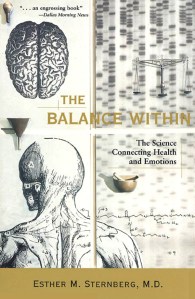
thebalancewithin_sternberg.jpg?w=195Relationships, Adrienne Rich argued in her magnificent meditation on love, refine our truths. But they also, it turns out, refine our immune systems. That’s what pioneering immunologist Esther Sternberg examines in The Balance Within: The Science Connecting Health and Emotions (public library) — a revelatory inquiry into how emotional stress affects our susceptibility to burnout and disease.

As just about every socialized human being can attest, interpersonal relationships play a significant role in our experience of stress — either contributing to it and or alleviating it. And the way we connect — something psychologist Barbara Fredrickson has termed “positivity resonance” — is deeply patterned through our earliest experiences of bonding, which train our limbic pathways. Sternberg traces the cognitive origin of these formative patterns:

2e292385-dc1c-4cfe-b95e-845f6f98c2ec.pngSomewhere in our brains we carry a map of our relationships. It is our mother’s lap, our best friend’s holding hand, our lover’s embrace — all these we carry within ourselves when we are alone. Just knowing that these are there to hold us if we fall gives us a sense of peace. “Cradled,” “rooted,” “connected” are words we use to describe the feeling that comes of this knowledge; social psychologists call this sense embeddedness. The opposite is perhaps a more familiar term — we call it loneliness.
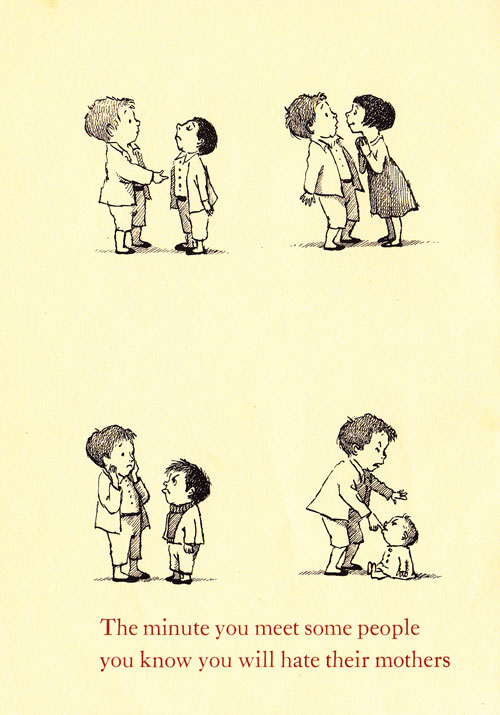
Thus a person, sitting by herself in a room, may appear to others to be quite alone; but that person, if embedded, will have a world of relationships mapped inside her mind — a map that will lead to those who can be called on for nurture and support in time of need. But others, the Gatsbys among us, might be among a crowd of dozens and yet feel very much alone. Many pieces of great literature have in fact tapped into this sense of disconnectedness. Our sense that powerful forces beyond our bodies link us to others is so ingrained that we use phrases such as “times that bind,” “family dyes,” and “bonding,” to describe those intangible connections. And the emotions they evoke are among the greatest forces that affect our hormonal, our nerve chemical, and our immune responses — and through these, our health and our resistance to disease.

openhouseforbutterflies2.jpg

Illustration by Maurice Sendak for ‘Open House for Butterflies’ by Ruth Krauss. Click image for more.

We encode these emotions early and carry them forward through symbol and ritual, using physical experiences and objects as memory-anchors. Sternberg captures the enduring echoes of these primal patterns:

2e292385-dc1c-4cfe-b95e-845f6f98c2ec.pngA very young child will carry a physical reminder of mother’s embrace: a security blanket, a favorite toy, something soaked with all the smells of home and love… The engagement ring and wedding band have the power in an ounce of gold to evoke the memory of the beloved… We are all tethered to our social worlds by invisible but steel strong wires.

And yet, however deeply engrained these patterns may be, relationships are also inherently alive — they grow, change, and invariably become what Leo “Dr. Love” Buscaglia memorably termed a process of “dynamic interaction.” In a passage that calls to mind David Whyte’s wisdom on endings and beginnings, Sternberg examines the often inevitable evolution — and sometimes revolution — of relationships:

2e292385-dc1c-4cfe-b95e-845f6f98c2ec.pngA relationship is built of strings of moments that our mind has pulled out from where they were stored in memory, moments and memories that come with emotions attached. Memories, spliced together like this in a seamless thread, make a relationship seem continuous and whole. So, after not seeing a childhood friend for years, we can pick up where we left off, as if no time at all had intervened. In this way, too, relationships can be sustained in thought during long absences — parents away from adult children, long-distance lovers, commuting husbands and wives. But the same capacity of the brain to forge this chain of memory can lead to difficulties in a relationship if one member evolves past where the other’s memory left off. So, a child leaving home for college, who left still on the verge of adulthood and returns an independent adult, will encounter a parent’s resistance when the person who steps back into the parent’s memory is not the same as the one who left. It takes a period of adjustment on both sides to set the chain evolving back on a new course.

[…]

At times, one small corner of that map can swell and grow, reverberate and suddenly seem to take over our entire world: we fall in love; we are abandoned; we become envious; we hate. The persons who are the object of such feelings can take on gigantic proportions in our minds and dominate our whole social and emotional outlook, coloring every corner of our lives, until, through monumental effort, or simply through gradual erosion of time, they recede again to their rightful place and size.

grimm_zipes_dezso6.jpg

Art by Andrea Dezsö for a special edition of the Brothers Grimm fairy tales. Click image for more.

These fluid social dynamics, Sternberg points out, permeate our culture well beyond our immediate individual experience:

2e292385-dc1c-4cfe-b95e-845f6f98c2ec.pngThe social world can activate the stress response, or it can tone it down. The effects of these personal connections can be more soothing than an hour of meditation. They can also be as stressful, and more long-lived, as running at top speed for twenty minutes on a treadmill. In fact, of all the sensory signals that impinge on us from moment to moment throughout the day, it is the ones connected in some way to another person that can trigger our emotions most intensely. If emotions are really meant to move us, it is these bonds toward which they push or from which they pull. Whole industries are based on the power of such social bonds: romance novels, movies, cosmetics, fashion, advertising, popular songs. In one way or another, the whole of our popular culture strives toward sealing or healing these social connections.

And heal we must, for the social self is central to our neurobiological experience of stress:

2e292385-dc1c-4cfe-b95e-845f6f98c2ec.pngIt seems that social conflict brings out an additional and unique hormonal response that is not stimulated by other forms of stress. This unique pattern of hormonal stress response predisposes socially stressed mice to herpes infection. The hormone that does this, which is secreted in saliva, is called nerve growth factor. Those who are prone to herpes virus “cold sores” will find this situation all too familiar. It is exactly when we are stressed — perhaps with lack of sleep and too much work, but especially with prolonged anxiety over personal or workplace situations — that we invariably get a cold sore.

In the remainder of the wholly illuminating The Balance Within, Sternberg goes on to explore the neurobiological underpinnings of this emotional machinery, the role of our psychological patterning in our physiological predisposition to disease, and how we can begin to rewire our response to stress. Complement it with Naomi Wolf on the psychology of stress, orgasm, and creativity and Adam Phillips on why frustration is essential for satisfaction in love.

Metonymy Translation

By William Fennie, H.W., M.

The Metonymy Translation class recently held in Hawaii is is the first version of this class as a full two-day event. It was given once before as a one-day event, in Los Angeles in 2007. Various lessons associated with MTR have been presented at Prosperos assemblies as they’ve been developed. Over the years I have assembled a variety of related information, and when Al Haferkamp asked me to present a full version of the class I felt the time was right, and that I was ready.

Hawaii was chosen for a very practical reason : Irene Stewart and her sister Bridget were joining us from Australia, and it seemed only fair to meet them halfway. For this class we had four students who were relatively new to The Prosperos instruction. The rest of the group was made up of students (and old friends) who have long experience with our methods of Translation, Releasing the Hidden Splendour, and all the other tools.

I felt that a small, face-to-face group would be best for working to develop the material. Through Maureen Malanaphy we were able to arrange to use a retreat center on the Windward side of O’ahu (Kaaawa). Given the limited space, and limited local accommodations otherwise, it was decided that this class would be promoted almost entirely by word-of-mouth. Moreover, because we had three full days together following the class presentation it was possible to do daily check-ins about using the technique : were there difficulties? what kind of experiences did people have? and so on. This worked out as well as I could have wished for.

As expected, some Hawaiian students got wind of the event and decided to come. Canda Bloir opened the class with a very moving Hawaiian ‘oli. I was happy to meet Brian Malanaphy (again) after many years, and he joined HughJohn and Maureen in the class. In fact, we had a Malanaphy micro-reunion on Wednesday night when Liam, Kevin, and Kathleen all joined us during our farewell meal ! Canda’s grandson (!) Keoni also visited for a while and we discovered that his Maori connections were familiar to Irene and Bridget.

Alex Gambeau, a member of the audio study group where this idea was born, unfortunately was not able to make it. Also, Pam Rodolph and Ragin from Oklahoma made all the arrangements to come and then got shut down by a renegade snowstorm that closed the Denver airport.

I am deeply grateful to Al Haferkamp, who managed many of the logistical issues around a venture of this magnitude, leaving me free to compose the final lessons and prepare myself for delivering the material. In this I feel very privileged – not many of our instructors get that kind of support these days. Alana had her hand very much in those tasks as well. Jim Renza joined Alana and me on the trip from the East Coast – which was a loooooong haul – and was wonderfully helpful with managing the food presentation and other details. HughJohn Malanaphy took responsibility for running the video camera on short notice and also engineered an alternative audio recording which will be of higher quality than what we could get from the camera. And Maureen Malanaphy, as I mentioned, provided crucial support during the run-up to class and a wonderful welcoming dinner feast on Friday night.

I’m deeply appreciative of everyone who participated in this class experience. Whatever comes out of it very much belongs to them.