All posts by Mike Zonta

First-ever image of black hole released in astrophysics breakthrough

The first direct visual evidence of the supermassive black hole in the centre of Messier 87 and its shadow. The shadow of a black hole seen here is the closest we can come to an image of the black hole itself, a completely dark object from which light cannot escape. (EHT Collaboration)

PUBLISHED: 

By Will Dunham

WASHINGTON, April 10 (Reuters) – An international scientific team on Wednesday announced a milestone in astrophysics: the first-ever photo of a black hole.

The project used a global network of telescopes to gain insight into black holes, celestial objects with gravitational fields so strong no matter or light can escape.

The team’s observations of the black hole at the center of Messier 87, a massive galaxy in the nearby Virgo galaxy cluster, lend strong support to the theory of general relativity put forward in 1915 by physicist Albert Einstein to explain the laws of gravity and their relation to other natural forces.

The research was conducted by the Event Horizon Telescope project, an international collaboration begun in 2012 to try to directly observe the immediate environment of a black hole using a global network of Earth-based telescopes. The announcement was made in simultaneous news conferences in Washington, Brussels, Santiago, Shanghai, Taipei and Tokyo.

“We have achieved something presumed to be impossible just a generation ago,” said astrophysicist Sheperd Doeleman, director of the Event Horizon Telescope at the Center for Astrophysics, Harvard & Smithsonian.

This black hole resides about 54 million light-years from Earth. A light year is the distance light travels in a year, 5.88 trillion miles.

Black holes, phenomenally dense celestial entities, are extraordinarily difficult to observe despite their great mass. A black hole’s event horizon is the point of no return, beyond which anything — stars, planets, gas, dust and all forms of electromagnetic radiation — gets swallowed into oblivion.

“This is a huge day in astrophysics,” said U.S. National Science Foundation Director France Córdova. “We’re seeing the unseeable.”

The fact that black holes do not allow light to escape makes viewing them difficult. The scientists look for a ring of light — disrupted matter and radiation circling at tremendous speed at the edge of the event horizon — around a region of darkness representing the actual black hole. This is known as the black hole’s shadow or silhouette.

Astrophysicist Dimitrios Psaltis of the University of Arizona, the EHT project scientist, said, “The size and shape of the shadow matches the precise predictions of Einstein’s general theory of relativity, increasing our confidence in this century-old theory.”

“Imaging a black hole is just the beginning of our effort to develop new tools that will enable us to interpret the massively complex data that nature gives us,” Psaltis added.

The project’s researchers obtained the first data in April 2017 using telescopes in the U.S. states of Arizona and Hawaii as well as in Mexico, Chile, Spain and Antarctica. Since then, telescopes in France and Greenland have been added to the global network. The global network of telescopes has essentially created a planet-sized observational dish.

Your Horoscopes — Week Of April 9, 2019

April 9, 2019 (theonion.com)

Aries | March 21 to April 19

An in-depth study will reveal that, contrary to popular belief, bedbugs are great and you are the problem.

Taurus | April 20 to May 20

Nothing of note will happen to you this week, as the dozens of people you’ll tell about it will be able to attest.

Gemini | May 21 to June 20

The universal redshift indicates that the stars are flying away from us at astounding velocities. Perhaps it is more accurate to say “from you.”

Cancer | June 21 to July 22

Venus rising in your sign sounds like a welcome harbinger of romantic good tidings, but the zodiac assures you it’s merely decorative.

Leo | July 23 to Aug. 22

Somehow, it just seems unfair that several famous people will make hundreds of dollars after picking you in next week’s Mundane Individual Dead Pool.

Virgo | Aug. 23 to Sept. 22

The largest meteorite ever to hit a person was about 45 pounds, making you a posthumous shoo-in for the record next Wednesday.

Libra | Sept. 23 to Oct. 22

You’ve never claimed to be a genius, but you have a nagging suspicion that you should have known sheets could be changed.

Scorpio | Oct. 23 to Nov. 21

Your drug experimentation enters an exciting new phase when you find one that makes the throbbing pain in your head subside almost completely.

Sagittarius | Nov. 22 to Dec. 21

You will find precious little to live for now that the age of the extended synthesizer jam is well and truly over.

Capricorn | Dec. 22 to Jan. 19

You can’t understand why people keep telling you they’re tired of your act. Why, the costume changes alone are nothing short of breathtaking.

Aquarius | Jan. 20 to Feb. 18

The stars are tired of politely nodding when you say you’re single because you’re “too picky.”

Pisces | Feb. 19 to March 20

They say God never gives us more than we can handle, which must mean He knows a way you can handle a swarm of hyper-aggressive bees.

Literary Hangover – ‘The Soul of Man under Socialism’ by Oscar Wilde (1891)


This is the free Literary Hangover feed. To support the show and get occasional premium content, become a member at patreon.com/LiteraryHangover.

Today, joining Matt (@MattLech) and Alex (@Alecks_Guns) is David Griscom (@DavidGriscom) of The Michael Brooks Show and sinthome.com. We’re discussing Oscar Wilde’s 1891 essay, ‘The Soul of Man under Socialism’ and it’s continued, though submerged, relevance. How earnest is Oscar Wilde’s socialism? Oscar Wilde’s mother as a revolutionary poet in Dublin during the great famine. Wilde’s opposition to private property. Private property vs. Personal property. William Morris and a brief look into the socialistic/medieval nostalgic Arts & Crafts movement. Matt misuses the word “triage.” Oscar Wilde, a fully-automated luxury space communist? Oscar Wilde’s criminal justice bona fides. What’s the role of the state in Wilde’s anarcho-socialism?

Sources: Full audiobook: https://librivox.org/the-soul-of-man-by-oscar-wilde/ ‘Some Notes on Wilde’s Socialism,’ Peter van de Kamp and Patrick Leahy. The Crane Bag, Vol. 7, No. 1, Socialism & Culture (1983), pp. 141-150 O’Sullivan, Emer. 2016. The Fall of the House of Wilde: Oscar Wilde and his Family.

San Francisco Ballet’s ‘Your Flesh Shall Be a Great Poem’ stuns with gorgeous dancing, impressive visuals

SAN FRANCISCO BALLET/COURTESY

On March 27, San Francisco Ballet opened its fifth program of the 2019 season. “Lyric Voices” contains a total of three ballets, each as stunning as the last. The segments emphasize different themes and radiate unique atmospheres, yet their combination is fantastic. Sporting minimalistic set design and magnificent lighting throughout, “Lyric Voices” takes the audience on trips to outer space, the glowing world of technology and a geometric interpretation of opera.

The first act, “Your Flesh Shall Be a Great Poem,” captures dynamism within delicacy exceptionally. In order to accentuate the essence of the characters onstage and their anatomy, the stage is stripped completely bare. The dramatic use of lighting (James F. Ingalls) heightens the audience’s senses and effectively focuses all attention on the dancers. It is clear that fluidity of the body and graceful movements (as choreographed by Trey McIntyre) are of utmost importance in this set — even as the dancers jump, their landings are breathtakingly silent. This overwhelming quiet actually accentuates the few times when the dancers intentionally fall hard, making it impactful. Their glides are silky smooth, and the way their flesh seems to meld together at times is impossible to ignore.

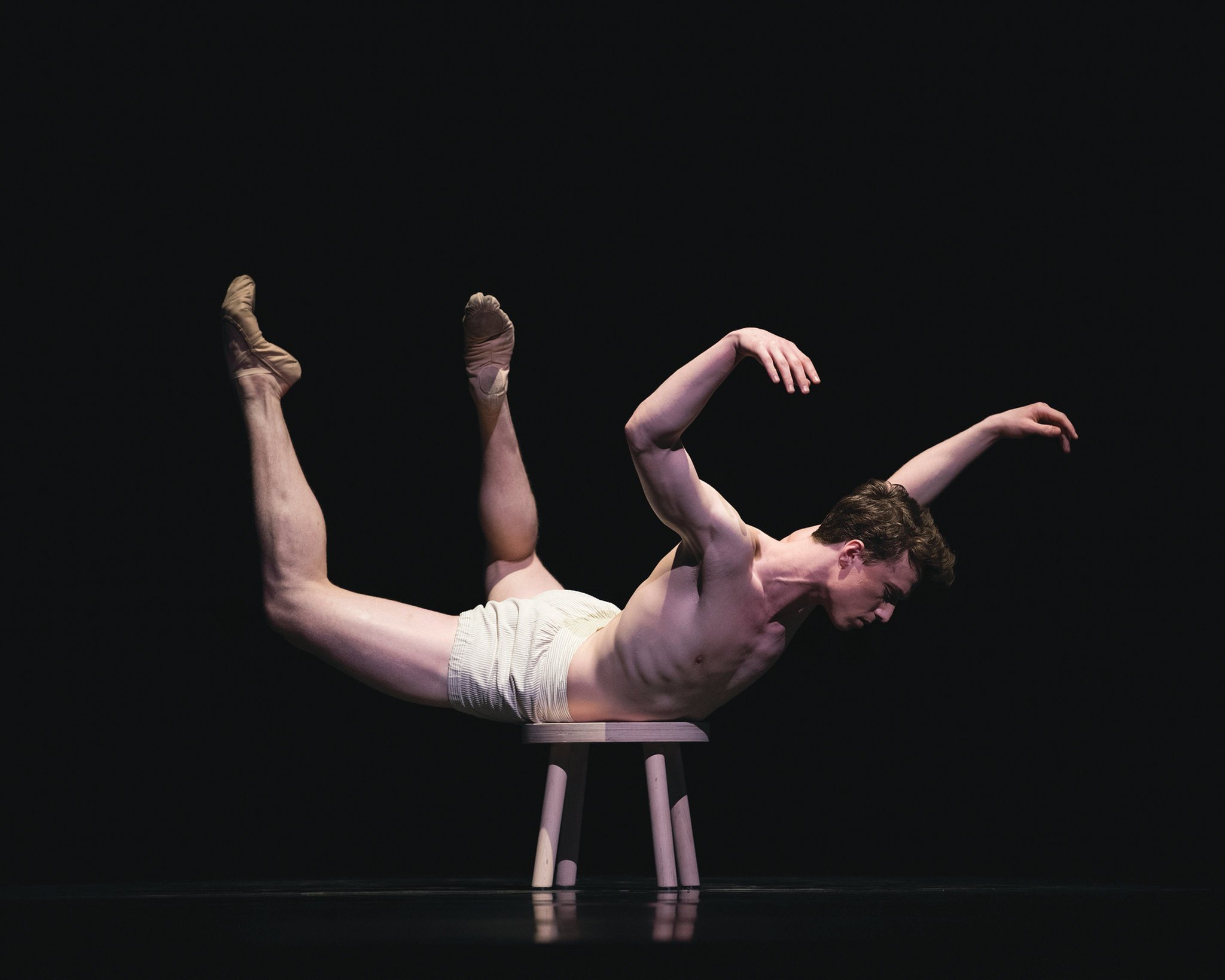
During soloist Benjamin Freemantle’s performance in “Your Flesh Shall Be a Great Poem,” dark spherical planets and solar eclipses are projected onto the backdrop, intensifying the sense of solitude in a vast world. Accompanying Freemantle on the stage is a short step stool; rather than dancing with a partner, Freemantle incorporates this unconventional prop into his dancing, highlighting his loneliness. It is rather impressive that such a stiff object — one that is notorious for making loud screeches when pulled across hard floors — glides effortlessly along his skin and spins on the stage without a noise.

Midway through intermission, the stage curtain rises to reveal a screen. Gradually, random letters and symbols — including the Apple logo — start to accumulate on this screen, filling it to the brim with blinking flashes of green. By the time the second act begins, the stage looks like a screening of “The Matrix.” The title, “Bound To,” flickers in the middle, and the dancers’ faces appear in the exaggerated light of their smartphones. As the dancers twitch with the music like they are computer glitches, blue letters trickle down in a transparent sheen in front of them.

The mere staging and framing of this segment are spectacular to behold, and the incorporation of smartphones and selfie lights is unbelievably creative. The set (Jean-Marc Puissant) is clearly designed to make a social commentary — especially since it uses tracks titled “Remember When We Used to Talk” and “Remember When We Used to Play.”

At the same time, the act does not forget to incite laughter. At one point, principal dancer Yuan Yuan Tan crosses the stage, not looking up from her phone until another dancer snatches it away pointedly, causing the audience to chuckle at her surprised expression.

While “Bound To” is a contemporary imagining of ballet, an art form dating back to the 15th century, “…two united in a single soul…” contains music and choreography that are more traditional. The set is entirely made up of geometric shapes, such as sharp-angled stairs and a large silver sphere. This sphere is later creatively utilized to reflect a skull that is projected onto the stage floor during a solo performance. The dancers often line up in a row and execute a waterfall of the same movement, a marvelous sequence to witness. The costumes (Christopher Read) stress bright blues and rich purples that match flawlessly with the dreamy glow of the set. Opera by 17th-century Baroque composer George Frideric Handel is also utilized to stress the piece’s classical orientation.

San Francisco Ballet has once again presented a truly magical evening full of dynamic movement and delicate details. The themes explored in “Lyric Voices” such as loneliness, connection and unity are extremely relevant in today’s rapidly evolving society. Manifesting these difficult and mature themes into a refined and abstract art form proves the expertise and prowess of SF Ballet and its many artists.

“Lyric Voices” will be running at San Francisco Ballet through April 7.

Contact Sophie Kim at sophiekim@dailycal.org.

Love, Pain, and Growth: 19th-Century Philosopher, Poet, and Pioneering LGBT Rights Activist Edward Carpenter on How to Survive the Agony of Falling in Love

By Maria Popova (brainpickings.org)

marriageinfreesociety_carpenter.jpg?fit=320%2C472

“Loving anybody and being loved by anybody is a tremendous danger, a tremendous responsibility,” James Baldwin reflected in his final interview. “An honorable human relationship — that is, one in which two people have the right to use the word ‘love’ — is a process, delicate, violent, often terrifying to both persons involved, a process of refining the truths they can tell each other,” Adrienne Rich wrote in her superb meditation on the dignity of love. Both the danger and the responsibility of love lie in this refining of truth, which is at bottom a refining of self, for we are the sum total of the truths by which we live. In love — in the beauty and brutality of it — we can come completely undone. But we can also make and remake ourselves. From our formative attachments to our great loves, relationship is the seedbed of our becoming, the laboratory of our self-invention and reinvention.

Nearly a century before Rich and Baldwin, the English philosopher, poet, and early LGBT rights activist Edward Carpenter (August 29, 1844–June 28, 1929) examined this eternal question of how we grow and refine ourselves through the turbulent process of love in his uncommonly insightful 1894 book Marriage in Free Society (free ebook | public library).

A correspondent of Gandhi’s and a close friend of the Indian poet and philosopher Rabindranath Tagore — the first non-European to win the Nobel Prize, who also believed that “relationship is the fundamental truth of this world of appearance” — Carpenter was one of the first Western thinkers to incorporate ancient Eastern philosophy into his moral universe. Entwined in mutual admiration with Walt Whitman, he went on to influence writers like D.H. Lawrence and E.M. Forster.

Carpenter composed his treatise on love — a century ahead of its time in myriad ways — shortly after he met his own great love, George Merrill, at the ripe age of fifty. They would spend the remaining three decades of life together. Several months after Merrill’s death, Carpenter suffered a paralytic stroke. He died a year later and was buried next to his beloved.

edwardcarpenter.jpg?resize=680%2C721

Edward Carpenter, 1900

Our first experience of great love, Carpenter observes, always shocks and unsteadies us, for universal as the experience may be, it “cannot very well be described in advance, or put into terms of reasonable and well-conducted words.” (In that sense, perhaps, love shares a great deal with loss — we can never prepare for either, and each snatches the reins of our psyche to govern us on its own non-negotiable terms.) He paints the delicious and disorienting madness familiar to anyone who has ever fallen in love:

2e292385-dc1c-4cfe-b95e-845f6f98c2ec.pngTo feel — for instance — one’s whole internal economy in process of being melted out and removed to a distance, as it were into the keeping of some one else, is in itself a strange physiological or psychological experience… To lose consciousness never for a moment of the painful void so created — a void and a hunger which permeates all the arteries and organs, and every cranny of the body and the mind, and which seems to rob the organism of its strength, sometimes even to threaten it with ruin; to forego all interest in life, except in one thing — and that thing a person; to be aware, on the other hand, with strange elation and joy, that this new person or presence is infusing itself into one’s most intimate being — pervading all the channels, with promise [of] new life to every minutest cell, and causing 25 wonderful upheavals and transformations in tissue and fluids; to find in the mind all objects of perception to be changed and different from what they were before; and to be dimly conscious that the reason why they are so is because the background and constitution of the perceiving mind is itself changed — that, as it were, there is another person beholding them as well as oneself– all this defies description in words, or any possibility of exact statement beforehand; and yet the actual fact when it arrives is overwhelming in solid force and reality. If, besides, to the insurgence of these strange emotions we add — in the earliest stages of love at least — their bewildering fluctuation, from the deeps of vain longing and desire to the confident and ecstatic heights of expectation or fulfilment — the very joys of heaven and pangs of hell in swift and tantalizing alternation — the whole new experience is so extraordinary, so unrelated to ordinary work-a-day life, that to recite it is often only to raise a smile of dismissal of the subject — as it were into the land of dreams.

And yet, as we have indicated, the thing, whatever it is, is certainly by no means insubstantial and unreal. Nothing seems indeed more certain than that in this strange revolution in the relations of two people to each other — called “falling in love” — and behind all the illusions connected with it, something is happening, something very real, very important.

thewellofbeing_weill0.jpg?w=680

Art by Jean-Pierre Weill from The Well of Being.

Carpenter then makes an astute point that remains thoroughly countercultural in the context of our rather limited and limiting romantic mythologies: He argues that whatever the outcome of a great love, whatever its duration, it is still a triumph and a transformation to be celebrated.

In Figuring, reflecting on Margaret Fuller’s remark at the end of a significant love affair that “the union of two natures for a time is so great,” I wrote:

2e292385-dc1c-4cfe-b95e-845f6f98c2ec.pngAre we to despair or rejoice over the fact that even the greatest loves exist only ‘for a time’? The time scales are elastic, contracting and expanding with the depth and magnitude of each love, but they are always finite — like books, like lives, like the universe itself. The triumph of love is in the courage and integrity with which we inhabit the transcendent transience that binds two people for the time it binds them, before letting go with equal courage and integrity.

I find such consonant consolation in Carpenter’s words:

2e292385-dc1c-4cfe-b95e-845f6f98c2ec.pngThe falling-in-love may be reciprocal, or it may be onesided; it may be successful, or it may be unsuccessful; it may be only a surface indication of other and very different events; but anyhow, deep down in the sub-conscious world, something is happening. It may be that two unseen and only dimly suspected existences are becoming really and permanently united; it may be that for a certain period, or (what perhaps comes to the same thing) that to a certain depth, they are transfusing and profoundly modifying each other; it may be that the mingling of elements and the transformation is taking place almost entirely in one person, and only to a slight degree or hardly at all in the other; yet in all these cases — beneath the illusions, the misapprehensions, the mirage and the maya, the surface satisfactions and the internal disappointments — something very real is happening, an important growth and evolution is taking place.

Noting that understanding this bewildering phenomenon, having even the slightest sense of “the points of the compass by which to steer over this exceedingly troubled sea,” is an operative imperative for any human being’s personal maturation, Carpenter adds:

2e292385-dc1c-4cfe-b95e-845f6f98c2ec.pngLove is concerned with growth and evolution. It is — though as yet hardly acknowledged in that connection — a root-factor of ordinary human growth; for in so far as it is a hunger of the individual, the satisfaction of that hunger is necessary for individual growth — necessary (in its various forms) for physical, mental and spiritual nourishment, for health, mental energy, large affectional capacity, and so forth. And it is — though this too is not sufficiently acknowledged — a root-factor of the Evolution process. For in so far as it represents and gives rise to the union of two beings in a new form, it plainly represents a step in Evolution, and plainly suggests that the direction of that step will somehow depend upon the character and quality of the love concerned.

abzlove19.jpg

Illustration from An ABZ of Love

One of our greatest misunderstandings about love, and mispractices of it, is the tendency to focus on only those aspects of the other that rivet us most intensely — only the physical in an attraction dominated by lust, only the mental in an intellectual crush, only the emotional in a romantic infatuation. Cautioning against such fragmentary simulacra of love, Carpenter writes:

2e292385-dc1c-4cfe-b95e-845f6f98c2ec.pngLove is a complex of human relations — physical, mental, emotional, spiritual, and so forth — all more or less necessary. And though seldom realized complete, it is felt, and feels itself, to be imperfect without some representation of every side. To limit it to the expression of one particular aspect would be totally inadequate, if not absurd and impossible. A merely physical love, for instance, on the sexual plane, is an absurdity, a dead letter — the enjoyment and fruition of the physical depending so much on the feeling expressed, that without the latter there is next to no satisfaction. At best there is merely a negative pleasure, a relief, arising from the solution of a previous state of corporeal tension. And in such cases intercourse is easily followed by depression and disappointment. For if there is not enough of the more subtle and durable elements in love, to remain after the physical has been satisfied, and to hold the two parties close together, why, the last state may well be worse than the first!

But equally absurd is any attempt to limit, for instance, to the mental plane, and to make love a matter of affectionate letter-writing merely, or of concordant views on political economy; or again, to confine it to the emotional plane, and the region of more or less sloppy sentiment; or to the spiritual, with a somewhat lofty contempt of the material — in which case it tends… to become too like trying to paint a picture without the use of pigments.

margaretcook_leavesofgrass17.jpg

Art by Margaret C. Cook from a rare 1913 edition of Walt Whitman’s Leaves of Grass

He notes the necessary complementarity of these elements in a truly satisfying love — a simple and rather obvious point, yet one to which we so readily turn a willfully blind eye when governed by a strong attraction:

2e292385-dc1c-4cfe-b95e-845f6f98c2ec.pngThe physical is desirable, for many very obvious reasons — including corporeal needs and health, and perhaps especially because it acts in the way of removal of barriers, and so opens the path to other intimacies. The mental is desirable, to give form and outline to the relation; the emotional, to provide the something to be expressed; and the spiritual to give permanence and absolute solidity to the whole structure.

More than a century before the great Zen teacher Thich Nhat Hanh asserted that “to love without knowing how to love wounds the person we love,” Carpenter argues that love is not merely an internal state — it is also an outward practice, to be mastered and refined by engaging every aspect of oneself and the beloved:

2e292385-dc1c-4cfe-b95e-845f6f98c2ec.pngLove has its two sides — its instantaneous inner side, and its complex outer side of innumerable detail. In consciousness it tends to appear in a flash — simple, unique, and unchangeable; but in experience it has to be worked out with much labor. All the elementshave to come into operation, and to contribute their respective quota to the total result… Love searches the heart, drags every element of the inner nature forward from its lurking-place, gives it definition and shape, and somehow insists on it being represented.

If this holistic satisfaction of the soul is the one leg on which love stands, time is the other. In a sentiment that calls to mind John Steinbeck’s beautiful letter of advice to his lovestruck teenage son — “If it is right, it happens,” the Nobel laureate wrote. “The main thing is not to hurry. Nothing good gets away.” — Carpenter urges:

2e292385-dc1c-4cfe-b95e-845f6f98c2ec.pngFor any big relationship plenty of time has to be allowed. Whichever side of the nature — mental, emotional, physical, and so forth — may have happened to take the lead, it must not and cannot monopolize the affair. It must drag the other sides in and give them their place. And this means time, and temporary bewilderment and confusion.

lovefound6.jpg

Art by Jennifer Orkin Lewis from Love Found: 50 Classic Poems of Desire, Longing, and Devotion

A century before the Lebanese-American poet and philosopher Kahlil Gibran contemplated the courage to weather the uncertainties of love, Carpenter adds:

2e292385-dc1c-4cfe-b95e-845f6f98c2ec.pngFor the complete action of that creative and organizing force plentiful time must be given; and the two lovers must possess their souls in patience till it has had its full and perfect work… A long foreground of approach, time and tact, diffusion of magnetism, mergence in one another, suffering, and even pain — all these must be expected and allowed for — though the best after all, in this as in other things, is often the unexpected and the unprepared.

A century earlier, the philosopher William Godwin had written in his stunning love letters to the philosopher and feminism founding mother Mary Wollstonecraft as the two were forging the first true marriage of equals in the history of letters: “We love… to multiply our consciousness… even at the hazard… of opening new avenues for pain and misery to attack us.” Carpenter examines this most bewildering aspect of the experience — the curious interdependence between love and pain, which seems to be an inevitable function of the growth process love effects:

2e292385-dc1c-4cfe-b95e-845f6f98c2ec.pngLove, if worth anything, seems to demand pain and strain in order to prove itself, and is not satisfied with an easy attainment. How indeed should one know the great heights except by the rocks and escarpments? And pain often in some strange way seems to be the measure of love — the measure by which we are assured that love is true and real; and so (which is one of the mysteries) it becomes transformed into a great joy.

[…]

Pain and suffering… have something surely to do with the inner realities of the affair, with the moulding or hammering or welding process whereby union is effected and, in some sense, a new being created. It seems as if when two naked souls approach, or come anywhere near contact with each other, the one inevitably burns or scorches the other. The intense chemistry of the psychic elements produces something like an actual flame. A fresh combination is entered into, profound transformations are effected, strange forces liberated, and a new personality perhaps created; and the accomplishment and evidence of the whole process is by no means only joy, but agony also, even as childbirth is.

margaretcook_leavesofgrass6.jpg

Art by Margaret C. Cook from a rare 1913 edition of Walt Whitman’s Leaves of Grass

In a passage evocative of Charlotte Brontë’s lament, penned in the grip of an unrequited love, that “when one does not complain… one pays for outward calm with an almost unbearable inner struggle,” Carpenter counsels the love-anguished:

2e292385-dc1c-4cfe-b95e-845f6f98c2ec.pngAll one can reasonably do is to endure. It is no good making a fuss. In affairs of the heart what we call suffering corresponds to what we call labor or effort in affairs of the body. When you put your shoulder to the cart-wheel you feel the pain and pressure of the effort, but that assures you that you are exercising a force, that something is being done; so suffering of the heart assures you that something is being done in that other and less tangible world. To 46 scold and scowl and blame your loved one is the stupidest thing you can do. And worse than stupid, it is useless. For it can only alienate. Probably that other one is suffering as well as you — possibly more than you, possibly a good deal less. What does it matter? The suffering is there and must be borne; the work, whatever it is, is being done; the transformation is being effected. Do you want your beloved to suffer instead of you, or simply because you are suffering? Or is it Pity you desire rather than Love.

As useless as the protesting and complaining, Carpenter argues, is any effort to put into words the density and magnitude of one’s feelings — an experience this vast must only be expressed in the language of life itself. More than half a century before the German humanistic philosopher and psychologist Erich Fromm published his influential book The Art of Loving, Carpenter writes:

2e292385-dc1c-4cfe-b95e-845f6f98c2ec.pngLove is an art… As no mere talk can convey the meaning of a piece of music or a beautiful poem, so no verbal declaration can come anywhere near expressing what the lover wants to say. And for one very good and sufficient reason (among others) — namely, that he does not know himself! Under these circumstances to say anything is almost certainly to say something misleading or false. And the decent lover knows this and holds his tongue. To talk about your devotion is to kill it — moreover, it is to render it banal and suspect in the eyes of your beloved.

Nevertheless though he cannot describe or explain what he wants to say, the lover can feel it — is feeling it all the time; and this feeling, like other feelings, he can express by indirections — by symbols, by actions, by the alphabet of deed and gesture, and all the hieroglyphics of Life and Art.

[…]

Love can only say what it wants by the language of life, action, song, sacrifice, ravishment, death, and the great panorama of creation.

poem_fish4.jpg

Art by Olivier Tallec from This Is a Poem That Heals Fish by Jean-Pierre Simeón.

Carpenter insists that in the experience of love, however imperfect and tortuous, we learn more about ourselves and the world than any didactic form can teach us:

2e292385-dc1c-4cfe-b95e-845f6f98c2ec.pngLove — even rude and rampant and outrageous love — does more for the moralizing of poor humanity than a hundred thousand Sunday schools. It cleans the little human soul from the clustered lies in which it has nested itself — from the petty conceits and deceits and cowardices and covert meannesses.

In fact, he argues, the teachings of our civilization have been detrimental to our mastery of love. In a sentiment that calls to mind E.E. Cummings’s assertion that “the Artist is no other than he who unlearns what he has learned, in order to know himself,” Carpenter writes of the art of love:

2e292385-dc1c-4cfe-b95e-845f6f98c2ec.pngSelf-consciousness is fatal to love. The self-conscious lover never ‘arrives.’ … And so too the whole modern period of commercial civilization and Christianity has been fatal to love… They have bred the self-regarding consciousness in the highest degree; and so — though they may have had their uses and their parts to play in the history of mankind, they have been fatal to the communal spirit in society, and they have been fatal to the glad expression of the soul in private life.

Self-consciousness is fatal to love, which is the true expression of the soul.

In the remainder of Marriage in Free Society, Carpenter goes on to examine what it takes to make love last over the long arc of a shared life, unwearied by friction and unblunted by habit. Complement it with Hannah Arendt on how to love despite the fundamental fear of loss, Rilke on the difficult art of giving space in love, and Jane Welsh Carlyle on loving vs. being in love, then revisit Carpenter’s contemporary Anna Dostoyevskaya on the secret to a happy marriage.

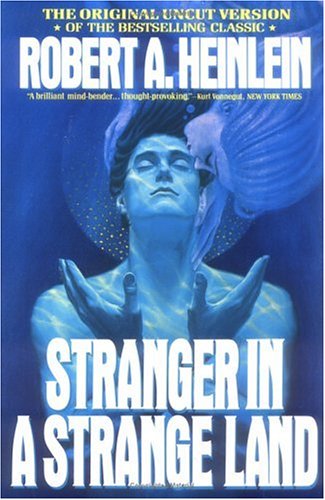
Book: “Stranger in a Strange Land”

Stranger in a Strange Land

Stranger in a Strange Land

NAME: Valentine Michael Smith
ANCESTRY: Human
ORIGIN: Mars

Valentine Michael Smith is a human being raised on Mars, newly returned to Earth. Among his people for the first time, he struggles to understand the social mores and prejudices of human nature that are so alien to him, while teaching them his own fundamental beliefs in grokking, watersharing, and love.‘

(Submitted by Hanz Bolen, H.W., M.)

Brunei Stoning Punishment for Gay Sex and Adultery Takes Effect Despite International Outcry

By Iliana Magra (NYTimes.com)

A harsh new criminal law in Brunei — which includes death by stoning for sex between men or for adultery, and amputation of limbs for theft — went into effect on Wednesday, despite an international outcry from other countries, rights groups, celebrities and students.

Brunei, a tiny monarchy on the island of Borneo in Southeast Asia, based its new penal code on Shariah, Islamic law based on the Quran and other writings, though interpretations of Shariah can vary widely.

“Brunei’s new penal code is barbaric to the core, imposing archaic punishments for acts that shouldn’t even be crimes,” Phil Robertson, the deputy Asia director of Human Rights Watch, a nongovernmental organization, said in a statement on Wednesday.

He called on the nation’s ruler, Sultan Hassanal Bolkiah, to “immediately suspend amputations, stoning, and all other rights-abusing provisions and punishments.”

Brunei has a population of just 430,000 but tremendous oil wealth, which has made the sultan, ruler since 1967, one of the wealthiest people on earth, said to own the world’s largest home and the biggest collection of rare cars.

The sultan, 72, is also the prime minister and holds several other titles. He first introduced the draconian version of Shariah in 2013, as part of a long-term project to impose a restrictive form of Islam on his country, which is majority Muslim.

A mosque in Bandar Seri Begawan, Brunei. The country’s new penal code is “barbaric to the core, imposing archaic punishments for acts that shouldn’t even be crimes,” the deputy Asia director of Human Rights Watch said.CreditAgence France-Presse — Getty Images


International protest delayed its implementation at the time, but in deciding recently to put the law into effect, with some revisions, Brunei has stood defiant.

Brunei “is a sovereign Islamic and fully independent country and, like all other independent countries, enforces its own rule of laws,” the prime minister’s office said in a statement on Saturday.

Shariah, “apart from criminalizing and deterring acts that are against the teachings of Islam,” the statement added, “also aims to educate, respect and protect the legitimate rights of all individuals, society or nationality of any faiths and race.”

Rachel Chhoa-Howard, a Brunei researcher at Amnesty International, said in a statement that the country “must immediately halt its plans to implement these vicious punishments, and revise its penal code in compliance with its human rights obligations.”

Beginning on Wednesday, extramarital sex, anal sex, and abortion are to be punished by death by stoning. The death penalty will also be required for some other offenses, including rape and some forms of blasphemy or heresy, like ridiculing the Quran or insulting the Prophet Muhammad.

The law requires amputation of a hand or foot for some crimes, and whipping for others. The punishment for lesbian sex, previously imprisonment and a fine, is now to be 40 lashes.

In some cases, the harshest penalties apply only to Muslims; in other cases, they apply regardless of faith.

Hotel Bel-Air in Los Angeles, which is owned by the Brunei government. Celebrities including George Clooney, Ellen DeGeneres, and Elton John have called for a boycott of the country’s interests.CreditFrederic J. Brown/Agence France-Presse — Getty Images


The punishments apply to many people who would be considered minors in the West. Anyone who has reached puberty is treated as an adult — while younger children who are old enough to understand right and wrong may be flogged.

Human Rights Watch suggested on Wednesday that Brunei’s new penal code violated global prohibitions against torture and other mistreatment, adding that adultery and homosexuality were protected against the death penalty by international law.

Michelle Bachelet, the high commissioner for human rights for the United Nations, also weighed in.

“In reality, no judiciary in the world can claim to be mistake-free, and evidence shows that the death penalty is disproportionately applied against people who are already vulnerable, with a high risk of miscarriages of justice,” she said in a statement on Monday. She urged Brunei to “maintain its de facto moratorium on the use of capital punishment.”

The death penalty is a legal form of punishment in Brunei, but the last execution was carried out in 1957. However, a defendant was sentenced to death in 2017, according to Amnesty International.

View image on Twitter

Andrew Stroehlein

@astroehlein

Under this new law, Brunei will brutally torture people to death.

“This kind of law doesn’t belong in the 21st century.” ~ @Reaproy http://bit.ly/2YMnlbV 

269 people are talking about this

On Tuesday, the United States joined other countries including Britain, France and Germany in condemning the new penalties.

“The United States strongly opposes violence, criminalization, and discrimination targeting vulnerable groups, including women at risk of violence, religious and ethnic minorities, and lesbian, gay, bisexual, transgender and intersex persons,” Robert Palladino, deputy spokesman for the State Department, said in a statement.

High-profile celebrities such as George Clooney, Ellen DeGeneres, and Elton John have called for a boycott of luxury hotels owned by Brunei, including the Beverly Hills Hotel and the Hotel Bel-Air in Los Angeles, and the Dorchester in London.

Ellen DeGeneres

@TheEllenShow

Tomorrow, the country of will start stoning gay people to death. We need to do something now. Please boycott these hotels owned by the Sultan of Brunei. Raise your voices now. Spread the word. Rise up.

127K people are talking about this

“On this particular April 3rd, the nation of Brunei will begin stoning and whipping to death any of its citizens that are proved to be gay,” Mr. Clooney wrote in an opinion piece published by Deadline last week. “Let that sink in.”

Correction: 

An earlier version of this article misstated the punishment for lesbian sex under the new law. It is 40 lashes, not 100.

Follow Iliana Magra on Twitter: @Magraki.

A version of this article appears in print on , on Page A6 of the New York edition with the headline: ‘Barbaric’ Penalties in Brunei: Stoning for Gay Sex and Amputation for Theft. Order Reprints | Today’s Paper | Subscribe

At 71, She’s Never Felt Pain or Anxiety. Now Scientists Know Why.

Jo Cameron, 71, has a rare genetic mutation that keeps her from feeling pain or anxiety, according to a new scientific report. Researchers hope the finding can help develop more effective treatments for pain.CreditCreditMary Turner for The New York Times

She’d been told that childbirth was going to be painful. But as the hours wore on, nothing bothered her — even without an epidural.

“I could feel that my body was changing, but it didn’t hurt me,” recalled the woman, Jo Cameron, who is now 71. She likened it to “a tickle.” Later, she would tell prospective mothers, “Don’t worry, it’s not as bad as people say it is.”

It was only recently — more than four decades later — that she learned her friends were not exaggerating.

Rather, there was something different about the way her body experienced pain: For the most part, it didn’t.

Scientists believe they now understand why. In a paper published Thursday in The British Journal of Anaesthesia, researchers attributed Ms. Cameron’s virtually pain-free life to a mutation in a previously unidentified gene. The hope, they say, is that the finding could eventually contribute to the development of a novel pain treatment. They believe this mutation may also be connected to why Ms. Cameron has felt little anxiety or fear throughout her life and why her body heals quickly.

“We’ve never come across a patient like this,” said John Wood, the head of the Molecular Nociception Group at University College London.

[Read more about how pain tolerance and anxiety may be connected.]

Scientists have been documenting case studies of individuals who experience little or no pain for nearly 100 years. But the genetic mutation that seems to be responsible for Ms. Cameron’s virtual painlessness had not been previously identified.

The study emerged amid major developments in the emotionally charged debate over how to responsibly treat pain. On Thursday, New York State filed one of the most sweeping legal cases yet against the Sackler family, which owns Purdue Pharma, the maker of the opioid OxyContin.

And it was yet another reminder that we need less addictive alternatives for chronic pain, said Dr. Stephen G. Waxman, a neurologist at Yale and the author of “Chasing Men on Fire: The Story of the Search for a Pain Gene.” Dr. Waxman was not involved in the recent paper but he also studies people who have rare mutations that alter their experience of pain.

“Each of these mutations teach us something, and point to a particular gene as a potential target for new and more effective pain medications,” he said.

The sequence of events that led scientists to investigate Ms. Cameron’s genes began about five years ago. She was living a happy, ordinary life on the banks of Loch Ness in Scotland with her husband, she said. After a hand operation, a doctor seemed perplexed that she was not experiencing any pain and did not want painkillers.

Image
Because she doesn’t feel pain, Ms. Cameron burns herself quite frequently. The scars tend to go away quickly, she said, something else scientists are planning to investigate.CreditMary Turner for The New York Times

“I guarantee I won’t need anything,” Ms. Cameron recalled telling Dr. Devjit Srivastava, a consultant in anesthesia and pain medicine at a National Health Service hospital in northern Scotland and one of the authors of the paper.

A few follow-up questions revealed that Ms. Cameron was unusual. At 65, she’d needed to have her hip replaced. Because it had not caused her pain, she had not noticed anything was amiss until it was severely degenerated. Cuts, burns, fractures — these did not hurt either. In fact, it often took the smell of burning flesh or her husband identifying blood for her to notice something wrong. She also reported that eating Scotch bonnet chili peppers left only a “pleasant glow.”

Dr. Srivastava referred her to University College London’s Molecular Nociception Group, a team focused on genetic approaches to understanding the biology of pain and touch. They had some clues for her. In recent decades, scientists have identified dozens of other people who process pain in unusual ways. But when Dr. James Cox, a senior lecturer with that group and another author of the new paper, inspected her genetic profile, it did not resemble that of others known to live without pain.

Eventually he found what he was looking for on a gene the scientists call FAAH-OUT. All of us have this gene. But in Ms. Cameron’s, “the patient has a deletion that removes the front of the gene,” he said. Additional blood work confirmed this hypothesis, he said.

Ms. Cameron said she had been shocked by the interest in her case. Until her conversation with Dr. Srivastava, pain was not something she thought about. Perhaps it helped that even though she burned and cut herself quite often, her injuries rarely left scars — something else that scientists believe is connected to the mutation.

number of articles have been written about parents of children with similar conditions. Many live in fear that without pain, their children won’t learn how to avoid hurting themselves. Her parents never made it an issue, she said. She suspects this may be because she inherited the mutation from her father.

“I can’t remember him needing any painkillers,” she said. “I think that’s why I didn’t find it odd.”

Unfortunately, because he died before the discovery, it will remain unknown whether he carried the mutation. Her mother does not share it. Neither does her daughter. Her son “has the same microdeletion in FAAH-OUT, but does not have the other mutation that confers reduced FAAH function,” Dr. Cox said.

In other words, her son shares some, but not all, of her pain insensitivity.

Scientists are also intrigued by Ms. Cameron’s extraordinarily low anxiety level. On an anxiety disorder questionnaire, she scored zero out of 21. She cannot recall ever having felt depressed or scared.

“I am very happy,” she said.

In retrospect, she sees how her genetic disposition may have aided her at work. After years as a primary-school teacher, she retrained to work with people with severe mental disabilities. Erratic, aggressive behavior never riled her, she said.

But though having this mutation may sound like a dream, there are downsides. One is that she is quite forgetful; prone to losing her keys and her train of thought midsentence. The other is that she’s never felt the “adrenaline rush” that other people talk about, she said.

The researchers said they would now focus on trying to better understand how FAAH-OUT works so that they can design a gene therapy or other pain intervention around it. Turning a discovery of this sort into an actual pain or anxiety treatment requires many steps, many years and many millions of dollars. It’s rare for a product to emerge.

But it’s not unprecedented, Dr. Waxman said. As a reminder of how an individual with an unusual genetic makeup can shape the future of medicine, he pointed to statin drugs.

“They were developed largely on the basis and discovery of incredibly rare families where everyone was having heart attacks in their 20s,” he said. Whether it will be Ms. Cameron’s mutation or another individual’s mutation that directs the future of painkillers, it’s too early to say.

“But I’m reasonably confident that the lessons we are learning from the genes involved in pain will lead to the development of an entirely new class of pain medications,” he said.

A version of this article appears in print on , on Page A7 of the New York edition with the headline: A Woman, 71, Doesn’t Feel Pain. Now, Scientists Know Why: A Mutation.. Order Reprints | Today’s Paper | Subscribe

SUNDAY NIGHT TRANSLATION GROUP – 4/7/19

Translators:  Melissa Goodnight, Richard Branam, Mike Zonta, Hanz Bolen, Alex Gambeau

SENSE TESTIMONY:  Filter function of the liver may get overburdened by toxicity and result in cirrhosis.

5th Step Conclusions:

1)  Truth, Life unending, always functions at the level of appropriate ability to fulfill its purpose of pristine health and immunity from error.

2)  Infinite Consciousness Beingness is the absolute power performing every vitally essential function, with the immaculate purity of Divine Design — which is totally free and unencumbered, to always promote perfect well-being, and that constantly generates and regenerates sustaining renewal.

3)  Truth is the original Creator and Thinker, Whole, Sound animating Loving Force.

4)  The Results’ of Truths’ Omniscience, Omnipotence, Omnipresence is this Driven Resilience, the leaping Salutations. the Gushing Forth of Divine Infinite Goodness Being Consciousness Aware I Am Thou, Totally Complete Androgynous Identity.

5)  The Presence of Well Being Sustains, the knowing of clear Truth expresses, the Power of Universal Integrity is the only ability and Good Ness the only Identity of all there is. All I AM.

Consciousness, sexuality, androgyny, futurism, space, the arts, science, astrology, democracy, humor, books, movies and more