All posts by Mike Zonta

‘I feel like I’ve lost him’: The families torn apart by conspiracy theories

Issued on: 01/10/2021 – France24.com

A protester yells over a bullhorn in front of the Ohio Statehouse in Columbus during a January 2021 rally in support of former US president Donald Trump's unfounded claims of electoral fraud.
A protester yells over a bullhorn in front of the Ohio Statehouse in Columbus during a January 2021 rally in support of former US president Donald Trump’s unfounded claims of electoral fraud. © Stephen Zenner, AFP

Text by: Louise NORDSTROM

For almost as long as he can remember, Mathieu’s father had been a provocateur, with a penchant for inappropriate jokes and borderline remarks. But when he started dipping his toes into conspiracy theories, things quickly got out of hand.ADVERTISING

“When he told me to ‘look out for the FBI report’ proving Hillary Clinton tortured babies and drank their blood to live forever, I knew with 200 percent certainty that I had lost him,” Mathieu* recalled. “It was finished. I would never again see the person he was before.” 

As is often the case, the father’s cross over to “the other side” occurred at a particularly vulnerable moment in his life: his finances had collapsed, he had lost his home and, as a final kick in the stomach, he was diagnosed with a serious, and often terminal, illness. It didn’t help that he was retired and didn’t have many friends.

“I feel kind of responsible because a lot of people fall into these situations when they are isolated,” said Mathieu, who has turned into somewhat of an expert on conspiracy theories since his father began embracing the QAnon movement, whose members believe the world is run by a cabal of Satan-worshipping paedophiles. 

“I feel guilty in almost the same way you do when you hear that someone close to you has committed suicide, you feel like you should have been there more,” Mathieu said. 

The transformation happened fast, starting with the sharing of a few QAnon-related links on Facebook. “Then he started sending me links via private message too, saying that climate change was a hoax and stuff.” 

Then, his public posts grew both cruder and more violent. “Really hardcore. He was posting pictures of politicians with a rope around their neck and really defaming people, saying Michelle Obama was a transsexual, etc.” 

>> ‘Stakes are high’ as QAnon conspiracy phenomenon emerges in France

In March 2020, at the beginning of the pandemic, Mathieu fell ill with what he was “99 percent certain” was Covid-19. When he later complained to his father about his many lingering symptoms, he was shocked at his father’s reaction: “Oh, you’re talking about that ‘flu’ you had?”

At that point, Mathieu’s father had become a QAnon “super spreader”, furiously pushing out conspiracy theories and sharing misinformation related to Covid-19, face masks and vaccines.

That’s when Mathieu finally decided to unfriend his father on Facebook. “I just couldn’t take it anymore.” 

Mathieu still speaks to his father, but keeps the communication to a minimum, and makes sure to steer clear of any topic even remotely related to his father’s conspiracy theory beliefs. “We’re still in contact because he is sick you know, but it’s probably just a matter of time before I’ll never speak to him again. I feel like I’ve lost him.”    

In mourning’ 

“Lost” is a term often used by friends and family members whose loved ones disappear in the murky waters of conspiracy theories. 

“Not long ago, a mother told me she was ‘in mourning’ over her son, even though he is still alive. It’s so sad,” said Pascale Duval, the spokeswoman for French support group UNADFI, which helps the victims of sects and conspiracy theories as well as their families. 

“The families go through enormous pain and they are the first to suffer when someone falls into conspiracy theories,” she said, noting they currently represent 70 percent of the people reaching out to UNADFI.  

“It’s parents, children, spouses, siblings, friends, you name it. When they contact us, they say things like, ‘I don’t know what to do anymore’, ‘He’s broken off contact with me’, ‘We can’t communicate anymore’, ‘It’s not the same person anymore’. They’re really desperate for help.” 

One recent example of the type of complaints UNADFI receives was from a woman whose sister and mother had begun watching unhealthy quantities of anti-vaccine videos on social media. “She’s going to get married soon, and now her mother and sister refuse to come to the wedding,” Duval said. Covid-19 vaccine fears stoke conspiracy theories in France

01:47

Since the start of the Covid-19 pandemic, the number of people contacting UNADFI has skyrocketed. “Last year, we received 4,323 requests for help, 12 percent more than the year before.” 

For Duval, conspiracy theories are clearly to blame for this steep increase.

“We’ve always seen a rise in these kinds of beliefs when there’s any kind of large-scale catastrophe,” she said, referring to other conspiracy theory-prone issues such as climate change and terrorist attacks. This is because people are scared or frustrated and have a hard time accepting reality, Duval said. So they look for alternative – or more “credible” – ways to explain the catastrophe or someone to blame it on. 

>> Conspiracy theories fuel French opposition to Covid-19 ‘health pass’

Once a person begins visiting conspiracy sites and pages, she said, the beliefs often multiply, as the person’s openness to the irrational, coupled with Internet algorithms, will keep feeding them more resources and theories. “It’s like a snowball effect.” 

Duval also said conspiracy theories were no different from sects in the way they isolate, manipulate and ultimately control their victims. 

“What we always see in these situations, whether it’s a sectarian movement or a conspiracy theory, is this breaking off of contact. It’s constant and systematic and completely tears these families apart.” 

Extremely difficult to reach 

The European Commission recently set up a platform dedicated to identifying, debunking and countering the conspiracy theories surrounding Covid-19. “The coronavirus pandemic has seen a rise in harmful and misleading conspiracy theories, mostly spreading online,” it states on its website. The site also offers advice for people on how to deal with friends or family members who have bought into these theories. But, it warns, “people who firmly believe in conspiracy theories are extremely difficult to reach”.  

Last month Mike Kropveld, the founder and director of the Montreal-based non-profit organisation Info-Secte and who once helped rescue a friend from a religious sect, launched a new support group for people with friends, spouses or family members who have become extreme proponents of conspiracy theories and other fringe beliefs or groups.   

“Emotionally and psychologically, these situations can be very draining for a family member and they need to talk with people who are in similar situations,” he said. “The pandemic just increased the need because we got more and more calls.”

The support group includes volunteer psychologists and other healthcare professionals. Their aim is to help families and friends deal with what they often feel is a “hopeless” situation. 

“Bringing someone back to how they were before is a long process, if at all possible,” Kropveld said, noting the conspiracy theorists are so “emotionally tied” to their beliefs that any attempt to try to prove them wrong is likely to backfire and may instead aggravate the situation. 

“Let’s say you have a new boyfriend that you have fallen in love with and I come and tell you he is out to manipulate you and exploit you […]. It is highly unlikely you are going to say, ‘Thanks, I didn’t know that’ and say, ‘I am going to dump him and get a new boyfriend’. It is more likely you are going to close off to me instead,” he explained. “It is important to recall the expression, ‘Love is blind’.”

Duval agreed: “It’s very rare for someone to ‘wake up’ because of what someone on the outside says or does. It has to come from them.” 

Early warning signs 

Kropveld said that although there was no “one-size-fits-all” profile for potential conspiracy theorists, there are some traits and behaviours to look out for. 

“In some cases, they already have a level of distrust in the political system, and may already believe in ideas that are outside of the mainstream,” he said, adding that a difficult life situation can then add fuel to the fire. 

Daily newsletterReceive essential international news every morningSubscribe

“Obviously if someone is feeling isolated and alone, and may have lost their job, it could be a potential indicator that the person might be more open to look for solutions or simple answers to what’s going on.”  

Kropveld said that the best thing a person can do in this situation is to remain non-confrontational and keep a constant and open line of communication with them. “Because if the outside is no longer there if they decide to come back, they’re basically locked [into] the environment they’re in, and it´s obviously going to be much harder to leave.”  

Although Mathieu no longer harbours much hope to win his father back from QAnon, he said he would never again miss the early warning signs of someone slipping into conspiracy theories. 

“As soon as someone posts something [conspiratorial] saying: ‘I don’t agree with everything he says, but…’, that’s a sign that it’s almost already too late.”  

*The name has been changed to protect the person’s identity

Every Book is a Failure – George Orwell on Truth in Writing

Vanessa Able (thedewdrop.org)

“One can write nothing readable unless one constantly struggles to efface one’s own personality. Good prose is like a window pane.”

– George Orwell


In his 1946 essay, Why I Write, George Orwell set out what he saw as the main motivators for writing: they were, sheer egotism, esthetic enthusiasm, historical impulse and political purpose. He recounts how, under different circumstances, the fourth reason might not have been so compelling to him, but the way that his life unfolded (serving with the Imperial Police in Burma; witnessing the rise of fascism under Adolf Hitler and reporting on the Spanish Civil War), he found himself becoming more politically engaged in his writing. We should be clear, he says, about the position of our political biases, and we should acknowledge when they can no longer be omitted from the work we create, while still working towards self-effacement as an author. Read other posts about writing from Natalie GoldbergNorman Fischer and Ray Bradbury, as well as The Dewdrop’s own Why I Write series.


The Spanish war and other events in 1936–7 turned the scale and thereafter I knew where I stood. Every line of serious work that I have written since 1936 has been written, directly or indirectly, against totalitarianism and for democratic socialism, as I understand it. It seems to me nonsense, in a period like our own, to think that one can avoid writing of such subjects. Everyone writes of them in one guise or another. It is simply a question of which side one takes and what approach one follows. And the more one is conscious of one’s political bias, the more chance one has of acting politically without sacrificing one’s esthetic and intellectual integrity.

What I have most wanted to do throughout the past ten years is to make political writing into an art. My Starting point is always a feeling of partisanship, a sense of injustice. When I sit down to write a book, I do not say to myself, “I am going to produce a work of art.” I write it because there is some lie that I want to expose, some fact to which I want to draw attention, and my initial concern is to get a hearing. But I could not do the work of writing a book, or even a long magazine article, if it were not also an esthetic experience.

“The more one is conscious of one’s political bias, the more chance one has of acting politically without sacrificing one’s esthetic and intellectual integrity.”

Anyone who cares to examine my work will see that even when it is downright propaganda it contains much that a full-time politician would consider irrelevant. I am not able, and I do not want, completely to abandon the world-view that I acquired in childhood. So long as I remain alive and well I shall continue to feel strongly about prose style, to love the surface of the earth, and to take a pleasure in solid objects and scraps of useless information. It is no use trying to suppress that side of myself. The job is to reconcile my ingrained likes and dislikes with the essentially public, non-individual activities that this age forces on all of us.

It is not easy. It raises problems of construction and of language, and it raises in a new way the problem of truthfulness. Let me give just one example of the cruder kind of difficulty that arises. My book about the Spanish civil war, Homage to Catalonia, is, of course, a frankly political book, but in the main it is written with a certain detachment and regard for form. I did try very hard in it to tell the whole truth without violating my literary instincts.

“I find that by the time you have perfected any style of writing, you have always outgrown it.”

But among other things it contains a long chapter, full of newspaper quotations and the like, defending the Trotskyists who were accused of plotting with Franco. Clearly such a chapter, which after a year or two would lose its interest for any ordinary reader, must ruin the book. A critic whom I respect read me a lecture about it. “Why did you put in all that stuff?” he said. “You’ve turned what might have been a good book into journalism.” What he said was true, but I could not have done otherwise. I happened to know, what very few people in England had been allowed to know, that innocent men were being falsely accused. If I had not been angry about that I should never have written the book.

In one form or another this problem comes up again. The problem of language is subtler and would take too long to discuss. I will only say that of late years I have tried to write less picturesquely and more exactly. In any case I find that by the time you have perfected any style of writing, you have always outgrown it. Animal Farm was the first book in which I tried, with full consciousness of what I was doing, to fuse political purpose and artistic purpose into one whole. I have not written a novel for seven years, but I hope to write another fairly soon. It is bound to be a failure, every book is a failure, but I do know with some clarity what kind of book I want to write.

“Writing a book is a horrible, exhausting struggle, like a long bout of some painful illness.”

Looking back through the last page or two, I see that I have made it appear as though my motives in writing were wholly public-spirited. I don’t want to leave that as the final impression. All writers are vain, selfish and lazy, and at the very bottom of their motives there lies a mystery. Writing a book is a horrible, exhausting struggle, like a long bout of some painful illness. One would never undertake such a thing if one were not driven on by some demon whom one can neither resist nor understand. For all one knows that demon is simply the same instinct that makes a baby squall for attention. And yet it is also true that one can write nothing readable unless one constantly struggles to efface one’s own personality. Good prose is like a window pane. I cannot say with certainty which of my motives are the strongest, but I know which of them deserve to be followed. And looking back through my work, I see that it is invariably where I lacked a political purpose that I wrote lifeless books and was betrayed into purple passages, sentences without meaning, decorative adjectives and humbug generally.

George Orwell (1903-1950)
From: A Collection of Essays

What is love?

What is love? | Aeon

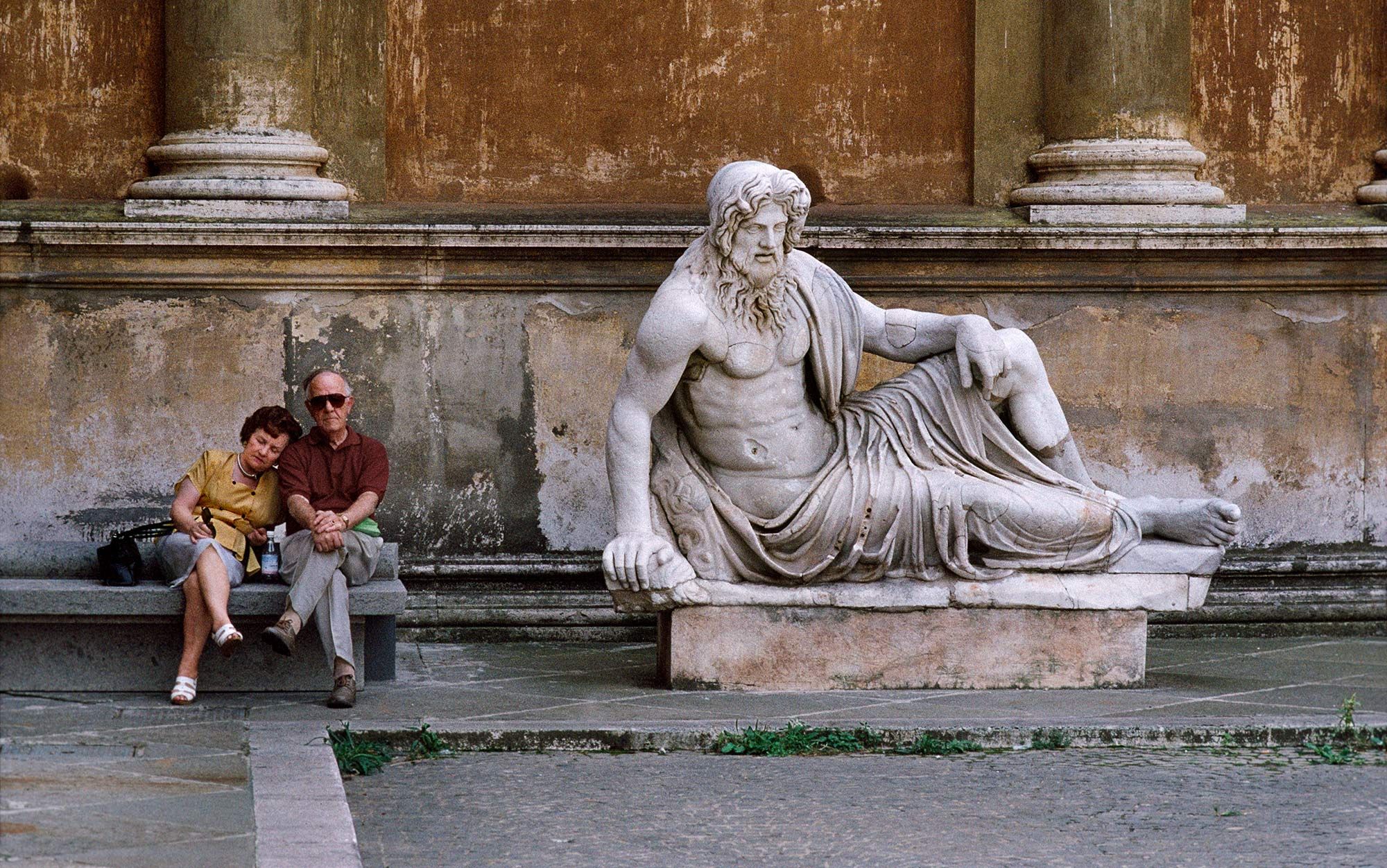
Forget the modern romantic notion of ‘the one’. True love means looking beyond the couple and out towards lifeTrue love: more made than found. Rome, 1994. Photo by Steve McCurry/Magnum

Mark Vernon is a psychotherapist and writer, and works with the research group Perspectiva. He has a PhD in ancient Greek philosophy, and degrees in theology and physics. He is the author of A Secret History of Christianity: Jesus, the Last Inkling, and the Evolution of Consciousness (2019) and Dante’s Divine Comedy: A Guide for the Spiritual Journey (forthcoming, September 2021). He lives in London.

Edited by Lizzie Kirkwood

13 February 2013 (aeon.co)

Love Aeon?

Support our workDONATE

It is a telling statistic that the ­most frequently ‘what is…?’ question typed into Google last year was: what is love? This fact probably reveals more about the society that asks an internet search engine such a thing, than any answer reveals about the nature of love. But if not Google, then where else can we look to understand love? The fantasy-making machines of Hollywood and Bollywood insist that there is only one answer worth indulging: the romantic kind. Most people, it would seem, agree, if only by default. They are dragged into seeking the person who will make them ‘whole’ via a dating website, or by a less tangible, though no less keenly felt urge cultivated by the same, dominant culture that insists we must find ‘the one’. Not that its origins are modern. Ever since the poet Sappho wrote, in the seventh century BCE, of love rippling under her skin like wind through trees, romantic love has been imagined as irresistible, a crucial experience that marks the peak of human existence.

Yet, the Google stats suggest that there is also a silent global search underway — many of us are clearly not satisfied with romance as an answer. The real problem, then, might be that contemporary culture leaves us unprepared for thinking about love in anything other than a one-dimensional mode. Just as marriage has seized the monopoly on public affirmations of love, so a notion of romance has restricted what we can imagine as a loving relationship.

The ancient Greeks, unlike us, did not have a single word for love but many. As is often noted, they had philia (friendship) and eros (desire), storge (affection) and agape (unconditional love). Perhaps that is another part of our problem. Our language invites us to think of love as a single, unified thing, when it is nothing of the sort. I suspect that words are not enough to address this modern deficiency. What we need is a new sense of the variety of love’s experiences. Fortunately there is another storehouse we can draw on from our ancient forebears: and it is not their words, but their myths that can enlighten us.

In a sense, we are lumbered with the dominance of romantic love; it can’t simply be sidestepped in favour of friendship, for example. That would never work: the erotic is simply too powerful. But the ancient myths can help us realise why romance is such a successful sell, if short-lived. Perhaps the myth that best captures the allure of romance is Aristophanes’ idea about soulmates, from Plato’s Symposium The story goes that human beings originally had two heads, four arms and four legs. We were shaped like round balls and tumbled across the face of the Earth at great speed. The gods grew alarmed at this display of power. So Zeus hatched a plan. He would cut human beings in half, leaving each with just one head, two arms and two legs.

These mutilated halflings were a pathetic sight. In particular, they developed the habit of devoting considerable amounts of their now limited energy searching for their lost halves. The desire to find the missing other was irresistible. Individuals sustained the search in spite of repeated break-ups and romantic disasters in the indefatigable belief that the right person — ‘the one’ — was out there. The promise of love, they felt, was nothing less than wholeness.

The myth has had a long life, accurately describing to this day the inner experience of those who feel life is incomplete without such love. In fact, it wasn’t until the 18th century that Aristophanes’ way of thinking about love reached its logical conclusion, when Jean-Jacques Rousseau wrote of how he fell in love as a young man. Only after that experience, he mused, could he be sure that he had genuinely lived. The upshot was that romantic love had become the goal in its own right. It matters not who you fall in love with, so long as you have fallen in love. The experiential ideal usurps the complex personal reality. That is why romance has us so much in its grip and empties us out in the process. It is the same with the dogmatic pursuit of happiness.

Crucially, however, Plato’s original myth about soulmates ends not with an elusive, illusory happiness, but with a twist. And here it might have something to teach us, suggesting an escape hatch out of the romantic stronghold. Zeus takes pity on the halved humans. He moves their genitals round so that when they meet they can embrace and find a little release for their passion. Sex is a temporary taste of unity, and it helps, though only to a degree. So when Hephaestus, the god of craftsmen, passes by and promises the couples a wish, these tragic figures speak with one voice. Weld us together, they cry: melt us one into the other!

For love to have a future, couples need to be able to move from falling in love to standing in love

Hephaestus obliges. The two become one. And the new situation reveals another way in which love gets stuck. Glued together, gazing only into each other’s eyes, the lovers lose touch with the rest of life. Not caring for anything else, death takes on an attractive hue, and they dream of sharing a last single breath together — a fantasy that lives on in the French euphemism, la petite mort, and in the romantic climax to Romeo and Juliet. But as the psychologist Erich Fromm put it in The Art of Loving (1956), for love to have a future, couples need to be able to move from falling in love to standing in love. Lovers must learn to embrace what lies outside their cosy twosome in order to survive. As Freud made explicit, dyadic love can be nurturing, but can equally be claustrophobic and alienating, and Aristophanes’ tale suggest it must be transcended.

The question is, how? How can the energy that romantic desire releases be directed outwards so that it feeds a passion not just for life together, but for life itself, led together. An answer is given by another ancient myth, one that is almost forgotten today. It concerns the infant god of love, familiar to us as Eros, but it also introduces us to another, less familiar figure, his brother.

Eros was born to Aphrodite and at first all seemed well. But then, Aphrodite noticed something that disturbed her. The child was not growing. His wings stayed as buds. His chubby flesh failed to develop muscles. It was as if he was possessed by a spirit that clung to infancy, refusing to step into maturity. Aphrodite became anxious and consulted her sister, the wise Themis. The goddess of good counsel (whose name translates literally as ‘what works’ ) advised her to have another child, this time by Ares, the brave god of war. Themis instructed that the second infant be called Anteros — he would be the equal of Eros. Aphrodite did as her sister said, and it worked. The two sons were rivals. They joshed and scrapped and fought, yet loved one another, too, and, as long as they played side by side, Eros developed normally. Yet, when they were apart, Aphrodite noticed that Eros would regress.

What Anteros brings is difficulty, a romantic equivalent to the sibling rivalry that young children hate so much in their jostling for a parent’s attention even though, like the tensions in an adult relationship, it can be the making of them, when sensitively handled. Anteros brings the courage required to resist the oceanic fantasy of disappearing into another’s arms, and instead embarks on the difficult process of making a life out of love. What he stands for, we might say, is the healthy spiritedness that lies behind lovers’ tiffs and rows which, if they can be reflected on and learnt from, make for maturity. The 16th-century proverb conveys this Anterotic dynamic: ‘The quarrel of lovers is the renewal of love’. If Eros is the god of love who shoots people with his arrows and turns them mad with desire, Anteros is the god of love who opposes the madness with a mix of his aunt’s pragmatism and his father’s strength.

To onlookers, it is unclear whether the two are making love or locked in some form of mutual violation

But the myth tells us more. Anteros’ aunt Themis was also known for her skill in bringing conflicting energies into a healing alignment. Today, her successors are couples’ therapists: they tend to be more interested in how troubled couples handle the emotions unleashed by their rows, rather than how to avoid rows in the first place. The anger and hate, fear and vulnerability of difficult relationships can be an opportunity. This is not your lost half, the therapist implies, but it is someone with whom you might find more integration and wholeness for yourself. Life is not perfected through love, as the romantic fantasy implies, but through love you can find more of life. Conversely, an inability to handle conflict is a good predictor of divorce.

It’s worth reflecting on the detail that Anteros helped his brother only while they played together. When they were apart, Eros regressed. Perhaps this conveys the value of commitment in relationships, a commitment that provides a container for the ups and downs, allowing them to be worked through. There is no static ‘happily ever after’, but a continuing need to play together. It suggests that a good relationship comes from the future, not the past, as Aristophanes’ myth implies. Love is more made than found.

In his book Anteros: A Forgotten Myth (2011), Craig Stephenson gathers evidence that Eros’ brother might not have vanished after all. He discusses Dante Gabriel Rossetti’s poem, ‘Hero’s Lamp’ (1875), which speaks of a lamp that is dedicated to Anteros and can only be lit when a love lasts a lifetime — unlike the mad love Leander had for Hero, which led him to attempt to cross the sea to reach her too many times and drown.

Meanwhile, the famous wrestling scene in DH Lawrence’s novel, Women in Love, can be read, Stephenson argues, as a depiction of the rivalry between Eros and Anteros. Rupert Birkin and Gerald Crich wrestle ‘swiftly, rapturously, intent and mindless at last’. Birkin learns from the aggression, safely but fully expressed in the fight: his marriage to Ursula Brangwen will have to combine elements of unity and adversity to work. Separateness in union can be achieved only by holding opposites in tension, as the critic Frank Kermode has read into Lawrence. Lovers must reach ‘an equilibrium beyond the ordinary notion of sexual love’.

Fundamentally, the myth of Eros and Anteros is about a triangular form of love. The brothers fight as siblings, vying for the attention of Aphrodite. It is this kind of love that is life-giving, because Eros and Anteros can desire something outside their immediate dyadic concerns. Their love is triangular: it is fired by someone or something beyond their love for each other. Their rivalry draws them towards external elements in life — which is to say, life itself. Hence, Eros matures.

Plato built the myth of Anteros into one of his dialogues. The triangular element it seems, particularly interested him. In the Phaedrus dialogue, he describes what happens when individuals fall in love (this much is familiar): romantic urges compel them to rush together, propelled by desire. To onlookers, it is unclear whether the two are making love or locked in some form of mutual violation. But some lovers are blessed by what Plato calls an Anterotic dynamic. It is as if they are able to prise themselves apart from one another, stand back a little, and observe what is going on. A third space opens up between them. It brings an essential capacity for self-awareness.

A couple can work out not only how to live together but how to live well together

This gap has a dramatic effect on the relationship. No longer are they just driven by their lust for one another. Instead, in time, a more expansive intimacy develops, which has a quality akin to friendship. The words of the French writer and poet Antoine de Saint-Exupéry come to mind: ‘Experience shows us that love does not consist in gazing at each other but in looking together in the same direction.’ As lovers, two people look only into each other’s eyes; as friends, they can look ahead together. They begin to see a life that lies beyond them and, supported by one another — now standing in love — they have the resources to step into the future together.

What is interesting about Plato’s account is that he believes this life-enhancing friendship is the result of erotic love. His philosophy is not a denial of eros, but its skilful channelling, tricky as that is to pull off. This explains the original meaning of the phrase ‘Platonic friendship’ — not that the erotic was never to be felt between such friends (an idea that would have been regarded by Plato as a form of denial), but rather that the sexual expression of the romantic element is incorporated and transcended. In Freudian terms, the erotic instinct is sublimated. Its energy becomes available for the passionate pursuit of philosophy — an attractive possibility given that, for Plato, philosophy meant the cultivation of a life that makes for flourishing. To capture the same sentiment in a less highfalutin way, such a couple can work out not only how to live together but how to live well together.

Triangular love, where space is made in a relationship for life (and love) beyond the confines of the couple, is the highest form of human love because it makes a good life possible. As the philosopher Anthony Price puts it in Love and Friendship in Plato and Aristotle (1989), ‘in a promising soul well prompted, it is receptive of, and responsive to, the opening of new vistas’. It is a less fearful and self-obsessed love than that of Narcissus, and has space for others unlike Aristophanes’ glued-together lovers. To use Iris Murdoch’s phrase in her reading of Plato, this love has ‘an increased awareness of, sensibility to, the world beyond the self’.

But this raises an important question. If we want a way out of romantic confines, where can we pay homage to Anteros today? Craig Stephenson points out that what we popularly call the statue of Eros on the Shaftesbury memorial fountain in Piccadilly is actually Anteros. It was made in 1893 by the sculptor Alfred Gilbert who felt his own life mirrored the struggles of the rival brothers of love. Gilbert saw a reflection of his impulsive character in Eros and longed to know for himself more of the realism associated with Anteros. He must have felt that Anteros was the more suitable god to invoke in the heart of that romantic part of London. Personally, I offer Anteros a surreptitious, reverent bow each time I pass. It is in cautious thanks for the tricky side of love.

History of ideas

Colin Wilson: Existentialism Meets the Occult with Gary Lachman

New Thinking Allowed with Jeffrey Mishlove Gary Lachman is the author of twenty-one books on topics ranging from the evolution of consciousness to literary suicides, popular culture and the history of the occult. He has written a rock and roll memoir of the 1970s, biographies of Aleister Crowley, Rudolf Steiner, C. G. Jung, Helena Petrovna Blavatsky, Emanuel Swedenborg, P. D. Ouspensky, and Colin Wilson, histories of Hermeticism and the Western Inner Tradition, studies in existentialism and the philosophy of consciousness, and about the influence of esotericism on politics and society. Here he shares his passion and personal interest in the life and work of Colin Wilson, who achieved worldwide fame at the age of 24 with the release of his first book, The Outsider. He was regarded as England’s “homegrown existentialist”. Subsequently, Wilson wrote over 100 books. His massive analysis, The Occult, received international acclaim and was followed by many other titles dealing with esoteric topics. This lengthy interview is peppered with descriptions of philosophical, literary, psychological and occult personalities. Lachman also shares several personal stories about his relationship with Colin Wilson. New Thinking Allowed host, Jeffrey Mishlove, PhD, is author of The Roots of Consciousness, Psi Development Systems, and The PK Man. Between 1986 and 2002 he hosted and co-produced the original Thinking Allowed public television series. He is the recipient of the only doctoral diploma in “parapsychology” ever awarded by an accredited university (University of California, Berkeley, 1980). (Recorded on December 18, 2018) For a complete, updated list with links to all of our videos, see https://newthinkingallowed.com/Listin…. For opportunities to engage with and support the New Thinking Allowed video channel — please visit the New Thinking Allowed Foundation at http://www.newthinkingallowed.org. To join the NTA Psi Experience Community on Facebook, see https://www.facebook.com/groups/19530… To download and listen to audio versions of the New Thinking Allowed videos, please visit our new podcast at https://itunes.apple.com/us/podcast/n… You can help support our ongoing video productions while enjoying Gary Lachman’s book. To order Beyond the Robot: The Life and Work of Colin Wilson, click here: https://amzn.to/2BX3MDa.

Book: “Walk Through Walls: A Memoir”

Walk Through Walls: A Memoir

Walk Through Walls: A Memoir

by Marina AbramovićJames Kaplan (Ghostwriter) 

“I had experienced absolute freedom—I had felt that my body was without boundaries, limitless; that pain didn’t matter, that nothing mattered at all—and it intoxicated me.”

In 2010, more than 750,000 people stood in line at Marina Abramović’s MoMA retrospective for the chance to sit across from her and communicate with her nonverbally in an unprecedented durational performance that lasted more than 700 hours. This celebration of nearly fifty years of groundbreaking performance art demonstrated once again that Marina Abramović is truly a force of nature.

The child of Communist war-hero parents under Tito’s regime in postwar Yugoslavia, she was raised with a relentless work ethic. Even as she was beginning to build an international artistic career, Marina lived at home under her mother’s abusive control, strictly obeying a 10 p.m. curfew. But nothing could quell her insatiable curiosity, her desire to connect with people, or her distinctly Balkan sense of humor—all of which informs her art and her life. The beating heart of Walk Through Walls is an operatic love story—a twelve-year collaboration with fellow performance artist Ulay, much of which was spent penniless in a van traveling across Europe—a relationship that began to unravel and came to a dramatic end atop the Great Wall of China.

Marina’s story, by turns moving, epic, and dryly funny, informs an incomparable artistic career that involves pushing her body past the limits of fear, pain, exhaustion, and danger in an uncompromising quest for emotional and spiritual transformation. A remarkable work of performance in its own right, Walk Through Walls is a vivid and powerful rendering of the unparalleled life of an extraordinary artist.

(Contrbuted by Heather Williams, H.W., M.)

(Goodreads.com)

Wisdom of Trauma event starts in JUST 24 Hours!


We are excited to start the Wisdom of Trauma Part 2 event in just 24 hours.

Each day you will receive an email with the schedule of talks and events of the day. 

During the event you will be able to access the following:

Daily Expert Talks and Panels: 17 NEW conversations with Dr. Gabor Maté and 33+ expertsIntegration Practices and Circles: a daily LIVE session to integrate and ground, in community, with trained facilitators.Artistic Offerings: special offering from artists, poets and musicians Movie Showing: watch The Wisdom of Trauma movie
You can watch these offerings LIVE and for 24 hours after each broadcast. If you wish to upgrade to the All-Access Pass, all the 17 new expert talks and conversations in addition to over 50 hrs of material and a course with Dr. Gabor Mate will be available to you to be watched and downloaded at any time. 

Click here to learn how to become a Supporter or All-Access Holder →

Help us further by inviting your friends via one of the following social media links here: 
    Here is a complete list of the LIVE schedule for the event. All times are listed in Pacific Daylight Time.  

Monday, October 4
The Wisdom of Trauma movie will be available to view starting at 05:00 PDT.  You will have access to the movie until Sunday, October 10, 2021at 11:59 pm

8:00am – 9:00am Integration Circle: Tapping into the Body’s Genius for Integration w/Philip Shepherd

Tuesday, October 5
8:00am – 8:30am Integration Circle: Deepening into Our True Self w/ Judith Blackstone
9:00am – 10:00am Kick-Off Introduction w/ Dr. Gabor Maté, Zaya & Maurizio Benazzo 
10:30am – 11:45am Politics of Trauma and the Trauma of Politics w/ Dr. Gabor Maté, 
Marianne Williamson, Staci K Haines, Prentis Hemphill & Rupa Marya,MD

12:30pm – 2:00pm Integration Circle: Reaching Our Center w/ Holistic Resistance 
2:30pm – 3:30pm Climate Crisis, Fragmentation and Collective Trauma w/ Dr. Gabor Maté, Angaangaq Angakkorsuaq, Bayo Akomolafe & Eriel Tchekwie Deranger
5:00pm Artistic Offerings: Poetry w/ Eriel Tchekwie Deranger 
                          Music w/ Rupa & the April Fishes

Wednesday, October 6
8:00am – 9:30am Integration Circle: Coming Home Together w/ Gail Brenner, PhD
9:30am – 10:30am Rising Consciousness of Trauma in Society w/ Dr. Gabor Maté, Bessel van der Kolk, MD
11:00am – 12:00pm Never Broken w/ Dr. Gabor Maté & Jewel
1:00pm – 2:15pm Women, Trauma & the Patriarchy w/ Dr. Gabor Maté, Jamie Lee Curtis, Elisa Hallerman PhD, JD, Ashley Judd, Mona Haydar
5:00pm Artistic Offerings: Music w/ Sea Stars 


Thursday, October 7
8:00am – 8:45am Coming Back to Yourself with Breath & Movement w/ Betsy Polatin 
9:00am – 10:15am Child-rearing That Does Not Traumatize w/ Dr. Gabor Maté, Darcia Narvaez, Gordon Neufeld, PhD & Kate Silverton
1:00pm – 2:15pm Addiction, Trauma & Healing w/ Dr. Gabor Maté, Richard Schwartz, PhD, Guy Felicella, Nikki Myers & Tommy Rosen
3:00 -4:00pm Finding Wholeness Through our Broken Places w/ Dr. Gabor Maté, Tara Brach, PhD & Jack Kornfield PhD
5:00pm Artistic Offerings: Poetry w/Vimalasara,  Music w/Mona Haydar 

Friday, October 8
8:00am – 9:30am Integration Circle: Coming Home Together w/ Gail Brenner, PhD 
9:30am – 10:30am Chronic Pain and Trauma-informed Healing w/ Dr. Gabor Maté, Steve Ozanich, Howard Schubiner, MD, Jennifer Wallin & Tommy Rosen
11:00am – 12:00am Trauma and Spirituality w/ Dr. Gabor Maté, Rabbi Dr. Tirzah Firestone, Sharon Salzberg & Henry Shukman
1:00pm – 2:15pm How Trauma Literacy Can Transform Medicine w/ Dr. Gabor Maté, Rupa Marya MD, Pamela Wible, MD, Will Van Derveer, MD & Jeffrey Rediger, MD, MDiv
3:00pm – 4:00pm Integration Circle: Reaching Our Center w/ Holistic Resistance 
5:00pm Artistic Offerings: Music w/ Jewel

Saturday, October 9
8:00am – 8:45am Meditation: Mindfulness & Wise Self-Compassion w/ Fresh Lev White
9:00am – 10:15am Indigenous Resilience: Healing Trauma Through Tradition and Resistance w/ Dr. Gabor Maté, Jesse Thistle, Tiokasin Ghosthorse & Dr. Ruby Gibson
10:30am – 11:45am Identity Marginalization & Trauma w/ Dr. Gabor Maté, Vimalasara (Valerie) Mason-John, Dylan Wilder Quinn,  & Kai Cheng Thom, MSc
12:00pm – 1:30pm Integration Circle: Coming Home Together w/ Gail Brenner, PhD 
2:00pm – 3:15pm Healing Trauma with Traditional Medicine w/ Dr. Gabor Maté, Mee Ok Icaro, Amanda Feilding, Tim McCarty & Mellody R Hayes, MD
5:00pm Artistic Offerings: Music w/ Holistic Resistance

Sunday, October 10
8:00am – 8:45am Meditation: Being Presenter with Intergenerational Suffering and Strength w/ Kaira Jewel Lingo
9:00am – 10:30am From Incarceration to Compassion w/ Fritzi Horstman & TBA
11:00am – 12:30am Integration Circle: Reaching Our Center w/ Holistic Resistance 
1:00pm Closing

We invite you to become a Supporter or to Upgrade to All-Access here:

Click here to learn how to become a Supporter or All-Access Holder → 

Thank you for being in our community! Looking forward to sharing this rich program with you.

With love,

Zaya and Maurizio

(Contributed by Ned Henry, H.W.)

The Astrology Of October 2021 – Time For Action

by Astro Butterfly (astrobutterfly.com)

The latest James Bond movie “No time to die” was initially scheduled to be released in April 2020. But March 2020 happened, cinemas closed, and the movie was withdrawn from release.

On September 30th, 2021 the ultimate action hero is back – and even if I am not a big action movies fan, I definitely see this as a good omen.

Does the astrology of the month reflect this? Yes it does. Mars is the star planet of the month – not only does it play the lead role in both lunations (New Moon and Full Moon) but it ALSO starts its next 2-year cycle around the Sun.

When the Sun meets Mars for a new hero’s journey, there is a recalibration of spirit (Sun) with the principle of action (Mars).

Sun is the divine purpose and Mars is how we operate this purpose in the 3rd world, how we make things happen. Something new is lit inside of us. Since Mars is burned by the Sun, our renewed intentions may not be very clear just yet, however rest assured that the seed is being planted.

In October we ALSO have a record of 4 planets resuming direct motion. Mercury is still retrograde in the first half of the month, but the good news is that Pluto, Saturn and Jupiter all go direct this month.Things will become clearer as we move through the month, and a veil is lifted when Mercury goes direct on October 18th, bringing a sense of clarity and relief.

Retrogrades are important, because they are our opportunities to recalibrate… but there comes a time when analyzing and introspecting have run their course, meaning it is now time for ACTION.

Let’s take a look at the most important transits of the month:

October 1st-October 3rd, 2021 – Sun And Mars Opposite Chiron

From October 1st to October 3rd, 2021 Sun and Mars in Libra oppose Chiron (at 10° Aries). Hard aspects between the Sun, Mars and Chiron trigger our feelings of inadequacy, and may challenge the expression of our yang energy.

We may feel unworthy, crippled and exposed – as if there is something wrong about who we are (Sun), what drives us and what we want (Mars).

Of course, like with any Chiron transit, this is also our opportunity to transcend these wounds. Who we are matters, since we can only be here for a reason. What we want matters, otherwise the seed wouldn’t be planted.

But we have to come to terms with the possible rejection that may result from putting ourselves out there, and being vulnerable.

October 6th, 2021 – New Moon In Libra

On October 6th, 2021 we have a New Moon at 13° Libra. The New Moon is conjunct Mars.

This is a very intentional New Moon, and even if Mars in Libra is still interested in a win-win outcome, Mars will spend less time thinking things through and he will just go for it – “it” being whatever you want to manifest.

This can be something connected to the area of your life (house) where the New Moon happens in your chart. Make sure you take advantage of this very potent, manifesting energy.

October 6th, 2021 – Pluto Goes Direct

On October 6th, 2021 Pluto goes direct at 24° Capricorn. If in the last 5 months Pluto retrograde gave us the opportunity to work in the shadow of our subconscious, when Pluto goes direct we want to bring this awareness of our inner transformation into the outer realm as well.

October 7th, 2021 – Venus Enters Sagittarius

On October 7th, 2021 Venus leaves Scorpio and enters Sagittarius. This transition from Scorpio to Venus is the transition from digging a whole in the ground, to seeing the light at the end of the tunnel.

Venus in Scorpio has been an excellent opportunity to work with our feelings at a more subconscious level and do some uncomfortable, but necessary, shadow work.

But as much as there is great value in understanding what’s in the empty part of the glass, acknowledging that the glass is never really empty comes to give a whole new meaning to our existence – Venus in Sagittarius will propel us to hope, dream big, and get us out there into the wild wild world.

October 9th, 2021 – Sun Conjunct Mercury Conjunct Mars

On October 9th, the Sun is conjunct Mercury and Mars at 16° Libra, so we have a triple Sun-Mercury-Mars conjunction. While it is not that rare to have 3 personal planets in the same sign, to have them all meet at the same degree is indeed significant.

This is a very important alignment that not only marks the beginning of the upcoming 116 day Mercury-Sun cycle and 2-year Sun-Mars cycle, but the beginning of a special alignment between the Sun, Mercury, and Mars.

When these Sun cycles begin (Sun conjunct a 2nd planet, e.g. Sun conjunct Mercury) we get the opportunity to work with 1 area of our psyche – for example our thinking (Mercury), feelings (Venus), actions (Mars) etc.

But when our thoughts (Mercury) also align with our actions (Mars) a very potent manifesting energy is put into motion. We become intentional about what we want to create. We walk the talk.

October 10th, 2021 – Saturn Goes Direct

On October 10th, 2021 Saturn goes direct at 6° Aquarius. Now that we have understood what is no longer working in our life, Saturn’s direct motion is our opportunity to make the necessary adjustments.

The change in motion itself is very catarchic, and will help us get unstuck in the areas of our life ruled by Saturn – that’s the houses where we have Capricorn and Aquarius on the cusp.

October 18th, 2021 – Jupiter Goes Direct

Good news! On October 18th, 2021 Jupiter goes direct at 22° Aquarius. Jupiter will be spending a few more months in Aquarius, before moving (for good) into Pisces. This is our chance to “get it right” and find the driving purpose behind the area of our life (house) where Aquarius sits in our chart.

October 18th, 2021 – Mercury Goes Direct

… and the really good news, Mercury goes direct as well on October 18th, at 10° Libra.

Both Mercury and Jupiter rule our thinking processes – both Mercury and Jupiter turning direct on the same day is quite something – so you can definitely expect clarity and answers. A veil will be lifted and it will become clear where you stand.

October 20th, 2021 – Full Moon In Aries

Continuing the theme of action initiated by the New Moon in Libra, our October Full Moon at 27° Aries is as fiery and as cardinal as it can be. The Full Moon in Aries is opposite Mars and square Pluto, so it’s an explosive one for sure.

Whatever has been brewing in the first 2 weeks of the lunar cycle will reach a climax. This Full Moon will shake us to the core – and (especially if you have planets in the last decan of cardinal signs) you want to be very mindful of what you do with what emerges from this.

October 23th, 2021 – Sun Enters Scorpio

Welcome to the Scorpio season! The Scorpio season is our yearly opportunity to get in touch with the powerful Scorpionic energy of renewal and transformation.

We all have areas of life that need pruning or reinventing – and when the Sun is in Scorpio we can become intentional about what we want to change in our lives – and then take the necessary action.

October 30th, 2021 – Mars In Scorpio

Speaking about taking the necessary action. October saved us the best for last. On October 30th, Mars enters its domicile sign, Scorpio. Mars is the planet of action, and Scorpio gives it the depth and drive to conduct this Martian impulse to achieve whatever we set our sights on.

Join The Age Of Aquarius

Join hundreds of members in the Age Of Aquarius Community! Age Of Aquarius is not only your monthly dose of quality astrology content – but also the place where you can make new friends.

Our members ravish about the depth and quality in the forum discussions, so if you’re looking to make authentic connections with kindred spirits, this is the place to be.

We are happy to offer a 3-day $1 trial, so you can look around and see if the Community is a good fit for you. As an Age of Aquarius member, you automatically get a $200 discount for all our flagship programs, so if you missed out on the registration for Astro Butterfly Wings and want to join us next year, this is another reason to join Age Of Aquarius.

Here is the registration link:

Join The Age Of Aquarius Community

Book: “Interior Castle”

Interior Castle

Interior Castle

by Teresa de Jesús 

A cornerstone book on mystical theology, Interior Castle describes the seven stages of union with God. Using everyday language to explain difficult theological concepts, Teresa of Avila compares the contemplative life to a castle with seven chambers. Tracing the passage of the soul through each successive chamber, she draws a powerful picture of the path toward spiritual perfection. It is the most sublime and mature of Teresa’s works, offering profound and inspiring reflections on such subjects as self-knowledge, humility, detachment, and suffering.

One of the most celebrated works on mystical theology in existence, as timely today as when St. Teresa of Avila wrote it centuries ago, this is a treasury of unforgettable maxims on self-knowledge and fulfillment. 

(Goodreads.com)

How cannabis can affect your body and brain

October 1, 2021 (news@nova.wgbh.org)

The cannabis industry has flowered into a billion-dollar industry in the last decade. Now, cannabis is easier than ever to legally access for medical and recreational use in the majority of U.S. states. But does legalization mean that cannabis is actually safe to use?After all, cannabis is still federally classified as a Schedule 1 controlled substance, defined by the Drug Enforcement Administration as a substance with “no currently accepted medical use and a high potential for abuse.” (Though the Senate’s Cannabis Administration and Opportunity Act proposes to end cannabis’s federal prohibition.) But even under current restrictions, some researchers have interrogated assumptions about the addictive potential of cannabinoids, the chemical compounds of the cannabis plant, and investigated their therapeutic properties. 
 
With the help of leading cannabis researchers, NOVA Now host Dr. Alok Patel explores current studies to find out what science can tell us about the therapeutic potential, risks, and long-term effects of cannabis on your body and brain.
VIA NOVA NOW

CANNABIS: DISCOVERING ITS EFFECTS ON THE BODY & BRAIN

Does cannabis’s ubiquity and legalization at the state level mean it’s safe for consumer use?

LISTEN NOW

Mars Update and Mercury Retrograde: Feeling Encouraged and Finding Your Voice

Matthew Stelzner In this video I discuss a number of things. We are currently experiencing a Sun-Mars conjunction (through early November), and Mercury retrograde (until October 18th). The way this is lining up is that as Mercury continues retrograde it moves towards a tight triple conjunction with the Sun and Mars that lasts on and off into November. Mercury is also currently square to Pluto and trine to Jupiter, so these are both super potent Mercury times and super potent Mars times as well. It is also worth noting that the Moon comes into a rare quadruple conjunction on 10/5 -10/7 when these energies are likely to be even stronger. So what does it mean? Well, I hope you’ll watch the video, but let me summarize some of the main themes that I explore in it. On the one hand this is a very strong time for Mars, and I think it is an important time for finding your courage and feeling encouraged. I discuss how this is time to remember that Mars has your back, Mars is in your corner, and they are encouraging you and reminding you of all your skills. It’s a time to find that strong inner coach that brings out your best abilities and self-confidence. With Mercury conjunct Mars for at least 36 days over the next couple of months, this is a very important time for developing strong mind states that are able to get strong results. It’s a time of potent thought forms with the potential to hit the target and manifest with vivid results. It’s a time to find your words and speak your mind, but also a time to watch the potential for angry loud words that attack rather than assert. If you can correct for that (and it helps that these alignments are happening in the sign Libra), then this can be a great time for finding encouraging self-talk that leads to strong results as you build up your strength everyday and keep that mind razor sharp. One more thing I touch on in the video is the fact that in 2022 we have a very special conjunction of Jupiter and Neptune which only happens every 13 years. It represents a time when it is easier to tune into a hopeful vision for the future, to tune into the happier timelines that are available to you, and dream your big dreams into being. It will be a chance to catch a big positive wave that carries you to a positive destiny. The transits that I have discussed here in this video are excellent for positioning yourself well to catch that wave as it arrives in the first months of next year. If you use the strong energies of the coming weeks well, you will be able to paddle out to the right place in the lineup to catch that perfect wave. To check out more of my work, see my blog, and get information about my intuitive readings, visit my website at: http://stelz.biz/ I have an equinox promotion with discounts on my readings available through this Friday the 1st. In order to be eligible for the promotion you will need to be on my email list. Link below. Sign up for my mailing list here: http://stelz.biz/register-for-my-emai… If you sign up for my mailing list you will also receive my newsletter and special promotions. Check me out on Instagram where you will find unique content that is not shared here: @tarot_and_lola