“Love is responsibility of an I for a You: in this consists what cannot consist in any feeling – the equality of all lovers.”
~ Martin Buber
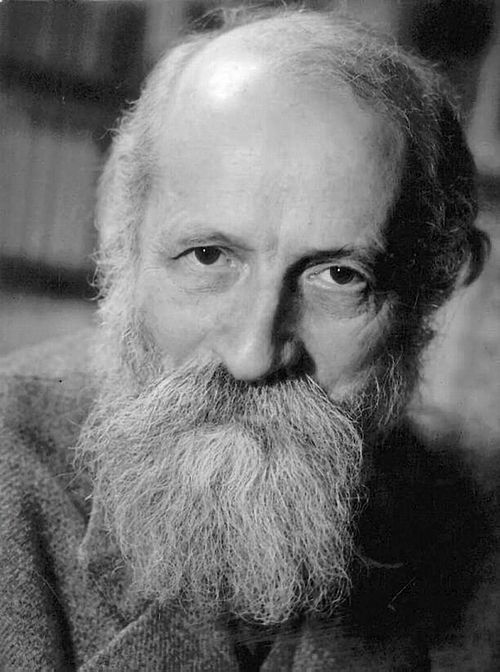
Martin Buber was an Austrian-Israeli philosopher best known for his philosophy of dialogue, a form of existentialism centered on the distinction between the I–Thou relationship and the I–It relationship. Wikipedia
A self is a story of why you are you — a selective retelling of the myriad chance events between the birth of the universe and this moment: atoms bonding one way and not another, parents bonding with one partner and not another, values binding you to one culture and not another. Against this utter choicelessness in the variables we each drew from the cosmic lottery — our pigments, our neurotransmitters, our outpost in space and in time — it becomes downright absurd to grow attached to the story and its byproducts: opinions, identities, absolutisms. It is a salutary thought experiment to go through a single day imagining any one of those variables having fallen one one-thousandth of a degree elsewhere on the plane of possibility — suddenly, the person going through your day is not you.
The self, the place where we live, is a place of illusion. Goodness is connected with the attempt to see the unself… to pierce the veil of selfish consciousness and join the world as it really is.
For millennia, the whole of Eastern philosophy and myriad other ancient traditions have made the dissolution of that illusion — painful, perplexing, disorienting dissolution — the great achievement of existence. For those of who chanced by birth into the modern West, where the self roils with its grandiose claims of authorship, to keep questioning the story of who we are — this handful of unchosen stardust on short-term loan from the universe — is an act of countercultural courage requiring exceptional devotion and discipline.
Long before probability theory, before the discovery of gravity and genetics and general relativity, before the overwhelm of two trillion galaxies housing innumerable worlds, the visionary Blaise Pascal, who didn’t live past forty but touched the epochs with his clarity of thought, modeled that courage by cutting through the veil of illusion with uncommon precision:
When I consider the short duration of my life, swallowed up in the eternity before and after, the little space that I occupy, and even that which I see, engulfed in the infinite immensity of spaces of which I know nothing and which know nothing of me, I am terrified, and am amazed that I am here rather than there, for there is no reason why here rather than there, why now rather than then.
There is no reason for you to be here, to be you. But perhaps what is left in the wake of reason is love — the matter, the substance of us that over and over outweighs the antimatter of chance to make life tremble with aliveness. Like life itself, love is an affirmation of the improbable nested, always nested, in the possible.
“What will survive of us is love,” wrote Philip Larkin.
No — love is simply how we survive the cosmic helplessness of being born ourselves.
Language is not the content of thought but the vessel into which we pour the ambivalences and contradictions of our thinking, afloat on the current of feeling and time. When the vessel becomes too small to hold what we pour into it, language spills into poetry.
In this respect, poetry serves the same function as prayer: to give shape and voice to our unspoken and often unspeakable hopes, fears, and inner tremblings — the tenderest substance of our lives, to be held between the palms and passed from hand to compassionate hand. Poetry thus becomes an instrument of self-transcendence — an instrument that, in Adrienne Rich’s abiding words, “can break open locked chambers of possibility, restore numbed zones to feeling, recharge desire.”
That function of poetry as the language of the unsaid is what the Canadian poet and Native American culture scholar Robert Bringhurst explores in the final pages of his altogether fascinating book The Tree of Meaning: Language, Mind and Ecology (public library).
A century after William James placed the ineffable atop his list of the four features of transcendence, Bringhurst reflects on the differences between English and the native language of the Haida people of British Columbia, and writes:
It is not necessary that the same things should be ineffable in all languages. It is only necessary that in each language plenty of things should be so: unsayable, or, at the very least, unsaid.
It seems to me that a kind of speechlessness — the inability to say a quite significant number of things — is actually built into every language. But language itself is a self-transcending mechanism. It tries, and lets us try, to say what it can’t. The survival of poetry depends on the failure of language. The reason language exists, it seems to me, is that poetry — the resonance of being — needs it. If you live in a place that hasn’t been pillaged and ruined, the silence of language’s failure, and of poetry’s success, is present and vivid almost everywhere you listen, almost everywhere you look.
Traversal broadens and deepens the questions raised in Figuring, the questions we live with: the relationship between chance and choice in becoming who we are, between chemistry and consciousness in being what we are, the tension between our love of truth and our lust for power, the restlessness of our longings and the redemption of our losses.
Our various instruments of reckoning with these questions — telescopes and treatises, postulates and poems — are revealed in their power and limitation through the intertwined lives, loves, and legacies of visionaries both celebrated and sidelined by history, people born into the margins of their time and place who lived to write the future: Mary Shelley, Walt Whitman, Frederick Douglass, Fanny Wright, Dorothy Crowfoot Hodgkin, Marie Tharp, Alfred Wagener, Humphry Davy, Ruth Benedict, and Margaret Mead. Woven throughout their stories are other threads — the world’s first global scientific collaboration, the Irish potato famine, the decoding of the insulin molecule, the invention of the bicycle, how nature creates blue — to make the tapestry of meaning more elaborate yet more clarifying as the book advances, converging on the ultimate question of what makes life alive and worth living.
Here is the prelude, Chapter 0, as it appears in the book, framing the 565 pages to come:
Bigger than Manhattan, Earth’s largest living organism sways in the surf south of Australia: Posidonia australis — a species of seagrass that, unable to flower, clones itself. Older than mathematics and the written word, it has been cloning itself since before the pyramids were built — a kind of immortality. And while I kiss my lover on the fresh-cut grass under the Manhattan Bridge, it goes on cloning itself as we go on dying and passing between our lips the heat of our mortality.
Between the scale of atoms and the scale of stars, between the time of mayflies and the time of mountains, we exist as proteins lit up with purpose, matter yearning for meaning on a planet capable of trees and tenderness, a world on which every living thing abides by the same dumb resilience through which we rose from the oceans to compose the Benedictus and to build the bomb.
All of our models and our maps, all of our poems and our love songs, all the conjectures chalked on the blackboard of the mind in theorems and scriptures, spring from the same elemental restlessness to locate ourselves in the cosmos of being, to know reality and to know ourselves. Across the abyss between one consciousness and another, between one frame of reference and another, we go on searching for an organizing principle to fathom the ultimate questions:
What is life?
What is death?
What makes a body a person?
What makes a planet a world?
Over and over, we discover that it is all one question, that there might just be a single answer: love. Our love of knowledge. Our love of mystery. Our love of beauty transcending the vanity of ambition. Our love of truth prevailing over the howling hunger for power. Our love for each other — each of us a festival of particles and probabilities, a living question, a perishable miracle composed of chemistry and culture, of passion and chance.
Traversal is out in the U.S. on February 17 from FSG and in the U.K. on March 12 from Canongate. Boundless gratitude to James Gleick for persuading me to publish it, to Eric Chinski for making that a joy, and to Sarah McNally for cross-pollinating that joy.
In an old city in ancient Japan there once lived a prostitute and a monk. They didn’t know each other. They weren’t even acquaintances. Yet each of them was deeply influenced by the other. Their lives were closely connected.
Every evening as the prostitute left her home on the way to earn a night’s wage, she would pass by the Buddhist temple where this monk lived. And every evening the young monk would be seated outside in the temple garden doing meditation.
As the young prostitute passed by the temple, she would see the monk seated in meditation and would think to herself, “What an amazing young man. What a noble life he is leading. Such a pure existence, untainted by the worries and concerns of this world. How rare and how wonderful!”
These thoughts sustained the young woman and gave her strength to endure her life. Just to know that someone was leading such a pure life gave her both hope and encouragement, even though she knew that such purity could never be her own. She always felt blessed just walking by the temple and being in the presence of such sacred energy.
The monk, although supposedly seated in deep meditation couldn’t help but notice the woman as well. Every evening as the young woman passed by the temple, the monk would become distracted and think to himself, “What an immoral woman. How could she make a living doing what she does? Where is her self-respect and dignity?”
Author Unknown
AN OPPORTUNITY FOR DAILY REFLECTION BROUGHT TO YOU BY THE SCHOOL OF PRACTICAL PHILOSOPHY
Ruth Gordon and Bud Cort in “Harold and Maude”Courtesy Everett Collection
Bud Cort, who personified the role of Harold in the 1971 Hal Ashby classic “Harold and Maude,” died Wednesday in Connecticut after a long illness. He was 77.
His longtime friend Dorian Hannaway reported his death.
Cort also starred in Robert Altman’s “Brewster McCloud” and had roles in numerous other films and TV shows.
In “Harold and Maude,” which became a beloved and enduring cult classic despite a rocky start at the box office, Cort played a 20-year old man obsessed by thoughts of suicide whose life changes when he meets Maude, a 79-year-old Holocaust survivor played by Ruth Gordon.
Born Walter Edward Cox in Rye, N.Y., he changed his name to avoid confusion with character actor Wally Cox. He went to school in New Rochelle, N.Y. and enjoyed going to Broadway shows.
Popular on Variety
“I was only fourteen when I met Bud at the backstage door at my sister’s play,” Roslyn Kind recalled in a statement. “He was majoring in art at the time in high school. We became close friends who shared our interest in entertainment. When I got married, Bud and our songwriter friend, Bruce Roberts, wrote a special song that was performed at the ceremony. His unique spirit will always be with me.”
Cort moved to Los Angeles to work in film, and was cast by Altman in a small part in “MASH.” Altman then selected his to star in the quirky “Brewster McCloud” about a young man who yearns to fly, with Sally Kellerman as a guardian angel.
“We were in the line for lunch when I spotted him,” she later recalled. “Although I didn’t know who he was, I said ‘Oh, boy. We’re going to be best friends.’”
His chemistry with Gordon while auditioning for the part of Harold convinced Ashby and writer Colin Higgins to cast him in “Harold and Maude,” which has endured as a repertory screening favorite for more than 50 years. He was nominated for a BAFTA award as most promising newcomer and for a Golden Globe for best actor in a musical or comedy.
“A young man obsessed with death falls in love with an old woman obsessed with life. She dies and teaches the kid how to live,” Cameron Crowe described it for AFI in 2011. “And it’s done with music [by Cat Stevens] that scratches at your soul. . . . that movie holds up — to this minute.”
His other roles included films “She Dances Alone,” “Electric Dreams” and “The Life Aquatic,” as well as “Heat,” “Dogma,” “Coyote Ugly” and “Pollock.”
He also voiced the character Toyman in “Superman: The Animated Series,” “Static Shock” and “Justic League Unlimited.” He co-wrote, starred in and directed the 1991 film “Ted and Venus.”
In 1979, Cort narrowly survived a devastating car accident, which necessitated numerous surgeries and affected his career.
He is survived by his brother Joseph Cox and his sister-in-law Vickie and their daughters, Meave, Brytnn, and Jesse of Rye, N.Y.; his sister Kerry Cox of Larchmont, N.Y.; his sister and brother-in-law, Tracy Cox Berkman and Edward Berkman, and their sons, Daniel and Peter. He is also survived by his sister, Shelly Cox Dufour and brother-in-law Robert Dufour, and nieces Madeline and Lucie.
A memorial will be held at a future date in Los Angeles.
The beautiful practicality of her teaching has made Pema Chödrön one of the most beloved of contemporary American spiritual authors among Buddhists and non-Buddhists alike. A collection of talks she gave between 1987 and 1994, the book is a treasury of wisdom for going on living when we are overcome by pain and difficulties. Chödrön discusses:
• Using painful emotions to cultivate wisdom, compassion, and courage • Communicating so as to encourage others to open up rather than shut down • Practices for reversing habitual patterns • Methods for working with chaotic situations • Ways for creating effective social action
Ani Pema Chödrön (Deirdre Blomfield-Brown) is an American Buddhist nun in the Tibetan tradition, closely associated with the Kagyu school and the Shambhala lineage.
She attended Miss Porter’s School in Connecticut and graduated from the University of California at Berkeley. She taught as an elementary school teacher for many years in both New Mexico and California. Pema has two children and three grandchildren.
While in her mid-thirties, she traveled to the French Alps and encountered Lama Chime Rinpoche, with whom she studied for several years. She became a novice nun in 1974 while studying with Lama Chime in London. His Holiness the Sixteenth Karmapa came to England at that time, and Ani Pema received her ordination from him.
Ani Pema first met her root guru, Chögyam Trungpa Rinpoche, in 1972. Lama Chime encouraged her to work with Trungpa, and it was with him that she ultimately made her most profound connection, studying with him from 1974 until his death in 1987. At the request of the Sixteenth Karmapa, she received the full bikshuni ordination in the Chinese lineage of Buddhism in 1981 in Hong Kong.
Ani Pema served as the director of the Karma Dzong, in Boulder, CO, until moving in 1984 to rural Cape Breton, Nova Scotia to be the director of Gampo Abbey. Chögyam Trungpa Rinpoche gave her explicit instructions on establishing this monastery for western monks and nuns.
Ani Pema currently teaches in the United States and Canada and plans for an increased amount of time in solitary retreat under the guidance of Venerable Dzigar Kongtrul Rinpoche.
“Human potential at its best is to transform a tragedy into a personal triumph, to turn one’s predicament into a human achievement.”
~ Victor Frankl
Viktor Emil Frankl was an Austrian neurologist, psychiatrist, philosopher, and Holocaust survivor, who founded logotherapy, a school of psychotherapy that describes a search for a life’s meaning as the central human motivational force. Logotherapy is part of existential and humanistic psychology theories. Wikipedia
Trump’s Big Government Came for the Sick and the Compliant / Citizens Dragged From Cars, Detainees Shackled to Hospital Beds, as Government Databased are Wiped Clean
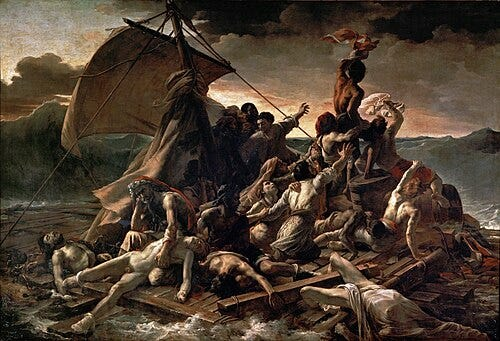
Indifference to human life, rendered at monumental scale. The Raft of the Medusa, Théodore Géricault, 1818–1819, oil on canvas, Louvre Museum, Paris
The administration has built a detention system so opaque that families and lawyers are routinely denied the most basic information, including confirmation that a person in government custody remains alive.
On February 3, 2025, Franco Caraballo walked into an ICE office in Dallas for a mandatory asylum check-in. After months of compliance, he was detained on the spot and transferred to a federal facility in Texas. Weeks later, on a Friday night in March, he called his wife, Johanny Sánchez, crying and panicked, saying agents had handcuffed him and put him on a plane without disclosing where he was being taken.
Within twenty-four hours, his name vanished from ICE’s online detainee locator. Sánchez later learned her husband was among more than two hundred Venezuelan immigrants flown to El Salvador’s maximum security CECOT prison, accused of gang membership despite having no criminal record in either country. He was taken at a scheduled appointment, held for weeks, erased from the government’s own tracking system, and transferred to a foreign prison where communication and visitation are forbidden, a sequence that now defines standard practice.
That progression repeated nationwide throughout 2025 and into 2026. People entered federal custody, brief contact followed, and the they vanished. Attorneys searched databases that no longer returned a name, and public locator tools were of no help.
Detention now outpaces documentation. Transfers accelerate while records fail, medical removals cut contact, and removal flights depart beyond the reach of tracking systems, leaving no record for accountability. When a person disappears inside government detention, legal representation ends, medical advocacy becomes unreachable, families lose the ability to intervene, and oversight is nonexistent.
That failure begins at entry points engineered to look routine while concealing what follows, including scheduled check ins, workplace raids, courthouse pickups, and traffic stops that end in federal handoff. Detainees surface briefly in public locator systems just long enough to project accountability before rapid transfers permutant erase their names, a pattern Minnesota attorneys described after preparing consultations only to learn their clients had been moved across state lines without notice, discovering the transfer only after being told the client was already gone despite formal notification requirements.
People move through the system faster than any mechanism meant to track them, as transfers across facilities and state lines occur without warning, hearings disappear from calendars, filings stall, and due process erodes when physical movement consistently outruns recordkeeping.
Hospitalization accelerates disappearance by design. Hospitals employ blackout procedures that register detained patients under pseudonyms and refuse to confirm presence even to counsel, a practice physician has described as institutional compliance with erasure.
When Julio César Peña suffered a ministroke after detention in Glendale, California, in December 2025, his lawyer contacted the hospital and was met with a categorical refusal to confirm admission. Days later, Peña’s family found him unconscious, shackled hand and foot to a hospital bed, after learning for the first time that he had suffered a seizure that no one had disclosed.
In Minneapolis, the pattern became undeniable. An immigration attorney stood outside the attorney visitation room at the Bishop Henry Whipple Federal Building for four hours trying to reach a client held for days, a client with severe medical conditions who depended on specific medications to survive. Family members attempted to deliver prescriptions without any confirmation the medication reached him. After telling agents directly that confirmation of life was required, the attorney received the same five-word response stating that attorney visitation was not conducted. Other attorneys reported identical denials at the same facility, paired with shifting explanations that clients had not requested counsel by name or that the building lacked capacity for legal visits, excuses without any basis in law. Carmen Iguina González described a national reality in which attorneys cannot locate clients or reach them without phones or visitation rooms and lose access entirely as transfers or deportations permanently sever contact.
The system exploits the narrow space between custody and death through practices that erase fatalities from official counts. ICE has released people from custody shortly before death, prompting litigation over concealed fatalities. In New Mexico, a transgender asylum seeker was handed parole papers from a hospital bed after weeks without medical care at the Otero Processing Center. Agency protocol requires death notification within 12 hours and public disclosure within two business days, yet deaths are relabeled when possible and bodies are moved.
After the El Paso County medical examiner ruled Geraldo Lunas Campos’s death a homicide by asphyxiation, directly contradicting ICE’s suicide claim, the next detainee to die at Camp East Montana, Victor Manuel Diaz, was never sent to the county examiner. His body was routed to a military hospital on Fort Bliss, bypassing the independent office that had exposed the agency’s false account. Yorlan Diaz rejected the government’s explanation of his brother’s death, saying his brother sought a better life and wanted to support their mother.
Isolation operates as policy at the Everglades detention site known as Alligator Alcatraz. Attorneys reported restricted access to counsel and interference with confidential communication, while detainees vanished from public tracking systems despite remaining in government custody. During a July 2025 visit, the president enthusiastically praised the surrounding alligators as guards who did not need to be paid and signaled his intent to replicate the model nationwide. Homeland Security officials labeled detainees “some of the worst scumbags” without a shred of evidence who entered the United States, language devoted to confinement and disappearance rather than survival.
The same gaps now extend nationwide. Migrants transferred to Guantanamo faced severe barriers to attorney access and family contact, forcing litigation simply to determine detention location and conditions. The detained population climbed from under 40,000 in January 2025 to more than 73,000 by January 2026, the highest level in the agency’s history.
The administration sold this buildup as a crackdown on violent criminals, yet the data shows that only 5 percent of detainees had violent crime convictions while nearly three quarters had no criminal conviction at all. The number of people with no criminal record held in ICE detention surged by 2,450 percent in a single year, revealing a system built to remove those deemed by the administration undesirable rather than deliver public safety.
American citizens have been pulled into this intentionally opaque machinery. At least 170 US citizens were detained by immigration agents through October 2025, a figure that understates the scale because the federal government does not track how often citizens are seized. ICE admitted in court records that agents detained people without verifying citizenship, and more than 20 citizens were held for at least a full day without access to a lawyer or a phone call.
Aliya Rahman was dragged from her car by ICE agents, forced to the ground, and taken to the Whipple Federal Building, where she asked for medical care for more than an hour before losing consciousness and waking in a hospital with a concussion. George Retes, an American military veteran, was detained during a raid despite agents knowing his citizenship, leaving his family searching for days before locating him, after which he described institutional indifference from the agents. In January 2026, a 5-year-old American citizen was deported to Honduras with her mother under a deportation order issued a year before the child was born.
The detention apparatus continues expanding without any connection to public safety. ICE added more than 100 detention facilities in 2025 alone, while 45 billion dollars in new funding arrived through the One Big Beautiful Bill, enough to operate 135,000 beds through fiscal year 2029. The administration set a standing goal of 100,000 bodies in detention at any given time and began converting warehouses into dentation centers while constructing tent camps on military bases, including Camp East Montana at Fort Bliss, where 3 detainees died within 44 days.
People are getting sick and dying inside these facilities beyond the reach of outside intervention. 32 people died in ICE custody in 2025, the highest number in 20 years, followed by at least 6 more deaths in the first 3 weeks of 2026 alone. A Senate investigation documented more than 1,000 credible reports of abuse in a single year, including medical neglect, physical and sexual abuse, and the mistreatment of children, while internal documents described an absolute emergency after ICE stopped paying for 3rd-party medical treatment, cutting off dialysis to the chronically disabled, prenatal care, prescribed medication, and cancer treatment across facilities holding more than 73,000 people.
History shows the consequences when disappearance becomes administrative routine. In Nazi Germany, people vanished into a vast camp network while families received silence or were told falsehoods, death certificates listed fabricated causes, bodies were cremated before notification, and records were destroyed to erase evidence.
A detention system that allows people to disappear from records while remaining in government custody recreates that danger inside a vast American bureaucracy, as any government that cannot account for where it holds someone forfeits any credible claim to safety or care.
Congress has funded a detention system that treats disappearance as a feature. What began as improvisation has developed into policy as capacity rapidly expands, with success measured in bodies processed and beds filled rather than lives preserved, while the sick, the disabled, and the elderly are reduced to surplus instead of recognized as humans entitled to protection.
The population inside these facilities exposes the lie used to justify their existence. Cells are filled with people who complied, reported for appointments, went to work, drove to the store, aged into vulnerability, lived with physical or intellectual disability including American citizens.
President Trump has shown open contempt for human life unless it benefits him directly, particularly toward those he frames as burdens rather than contributors, and that disdain does not stop at citizenship or ability. A government willing to erase an innocent human from a database will erase a disabled resident, an elderly patient, or a citizen with the same indifference, because the governing logic recognizes only usefulness and discards those deemed expendable.
Vladimir Lenin warned that capitalists would sell the rope with which they would be hanged. Congress has already delivered the symbolic rope by passing the One Big Beautiful Bill and financing a detention system that, this far, has functioned as a clandestine prepaid mechanism of disappearance and preventable death. A nation that budgets for erasure has already decided whose lives matter, excluding the disabled, the elderly, and the inconvenient.
Out of nearly 8K subscribers, only 3% are paid supporters, while the reporting, research, and infrastructure carry real expenses. This work is not sustainable without more readers choosing to upgrade. Choose annual and, for a limited time, save 20% compared to monthly. Thank you for being here; it matters more than you know.
Associated Press / PBS NewsHour, “Families Search for Loved Ones After Hundreds Taken on U.S. Immigration Flights Disappear from Online Locator,” March 18, 2025 https://www.pbs.org/newshour/politics/families-search-for-loved-ones-after-hundreds-taken-on-u-s-immigration-flights-disappear-from-online-locator
KFF Health News / Associated Press, “’I Can’t Tell You’: Attorneys, Relatives Struggle to Find Hospitalized ICE Detainees,” January 30, 2026 https://kffhealthnews.org/news/article/ice-immigrants-hospitals-detainees-patients-rights-family-blackout-policies-california/
Miami Herald, “Hundreds of Alligator Alcatraz Detainees Drop Off the Grid After Leaving Site,” September 16, 2025 https://www.miamiherald.com/news/local/immigration/article312042943.html
American Immigration Council, “Immigration Detention Is Harsher and Less Accountable Than Ever,” February 2026 https://www.americanimmigrationcouncil.org/press-release/report-trump-immigration-detention-2026/
American Immigration Council, “6 Deaths in ICE Custody and 2 Fatal Shootings: A Horrific Start to 2026,” February 11, 2026 https://www.americanimmigrationcouncil.org/blog/ice-deaths-shootings-2026/
Senator Jon Ossoff, U.S. Immigration Detention Oversight, January 2026 https://www.ossoff.senate.gov/wp-content/uploads/2026/01/260114_Report_Patterns_v5.pdf
Cato Institute, “5% of People Detained by ICE Have Violent Convictions, 73% No Convictions,” November 26, 2025 https://www.cato.org/blog/5-ice-detainees-have-violent-convictions-73-no-convictions
ProPublica, “We Found That More Than 170 U.S. Citizens Have Been Held by Immigration Agents,” October 2025 https://www.propublica.org/article/immigration-dhs-american-citizens-arrested-detained-against-will
Associated Press, “ACLU Sues for Access to Migrants Flown to Guantanamo,” February 12, 2025 https://www.usnews.com/news/world/articles/2025-02-12/aclu-sues-for-access-to-migrants-sent-to-guantanamo-bay
Auschwitz-Birkenau Memorial and Museum, “Falsifying the Hospital Records,” accessed 2026 https://www.auschwitz.org/en/history/camp-hospitals/falsifying-the-hospital-records/
Flatwater Free Press, “As Minnesota ICE Crackdown Continues, Detainees Quietly Transferred to Nebraska Jails,” February 2026 https://flatwaterfreepress.org/as-minnesota-ice-crackdown-continues-detainees-quietly-transferred-to-nebraska-jails/
ABC News, “Lawyers Allege Dept. of Homeland Security Is Denying Legal Counsel to Minnesota Detainees,” January 2026 https://abcnews.com/US/lawyers-allege-dept-homeland-security-denying-legal-counsel/story?id=129335914
Bloomberg Law, “Lawyers Fight ICE for Access: ‘I Want to Hear My Client’s Voice,’” January 30, 2026 https://news.bloomberglaw.com/litigation/lawyers-fight-ice-for-access-i-want-to-hear-my-clients-voice
Texas Tribune, “ICE Bypasses El Paso Medical Examiner for Autopsy on Migrant,” February 3, 2026 https://www.texastribune.org/2026/02/03/texas-ice-detention-deaths-autopsy-el-paso/
Al Jazeera, “US Witnessed Many ICE-Related Deaths in 2026. Here Are Their Stories,” January 27, 2026 https://www.aljazeera.com/news/2026/1/27/us-witnessed-many-ice-related-deaths-in-2026-here-are-their-stories
ACLU of Southern California, “ACLU Files Lawsuit Against ICE for Withholding Documents Related to Practice of Releasing People from Custody Prior to Imminent Death,” July 12, 2022 https://www.aclusocal.org/en/press-releases/aclu-files-lawsuit-against-ice-withholding-documents-related-practice-releasing
Consciousness, spirituality, biography, sexuality, androgyny, futurism, space, the arts, science, astrology, democracy, humor, books, movies and more

 The self, the place where we live, is a place of illusion. Goodness is connected with the attempt to see the unself… to pierce the veil of selfish consciousness and join the world as it really is.