
From Wikipedia, the free encyclopedia
“…all reality is one, change is impossible, and existence is timeless, uniform, and necessary.. In “the way of opinion”, Parmenides explains the world of appearances, in which one’s sensory faculties lead to conceptions which are false and deceitful.”
| Parmenides | |
|---|---|
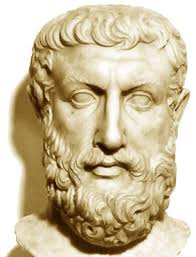
| Bust of Parmenides discovered at Velia, thought to have been partially modeled on a Metrodorus bust.[1] | |
| Born | c. 515 BC Elea, Magna Graecia |
| Era | Pre-Socratic philosophy |
| Region | Western philosophy |
| School | Eleatic school |
| Notable students | Zeno of Elea |
| Main interests | OntologyCosmology |
| Notable ideas | MonismBeingAletheia |
| showInfluences | |
| showInfluenced |

Parmenides of Elea (/pɑːrˈmɛnɪdiːz … ˈɛliə/; Greek: Παρμενίδης ὁ Ἐλεάτης; fl. late sixth or early fifth century BC) was a pre-Socratic Greek philosopher from Elea in Magna Graecia.
Parmenides has been considered the founder of ontology or metaphysics and has influenced the whole history of Western philosophy.[2] He was the founder of the Eleatic school of philosophy, which also included Zeno of Elea and Melissus of Samos. Zeno’s paradoxes of motion were to defend Parmenides’ view. The single known work by Parmenides is a poem whose original title is unknown but which is often referred to as On Nature. Only fragments of it survive, but its importance lies in the fact that it contains the first sustained argument in the history of Western philosophy. In his poem, Parmenides prescribes two views of reality. In “the way of truth” (a part of the poem), he explains how all reality is one, change is impossible, and existence is timeless, uniform, and necessary (a philosophy of time now known as eternalism). In “the way of opinion”, Parmenides explains the world of appearances, in which one’s sensory faculties lead to conceptions which are false and deceitful, yet he does offer a cosmology.
Parmenides’ views have remained relevant in philosophy, even thousands of years after his death. The rivalry between Heraclitus and Parmenides has also been re-introduced in debates in the philosophy of time between A theory and B theory.
Biography
Parmenides was born in the Greek colony of Elea (now Ascea), which, according to Herodotus,[a] had been founded shortly before 535 BC[better source needed]. He was descended from a wealthy and illustrious family.[b] It was said that he had written the laws of the city.[c]
His dates are uncertain; according to doxographer Diogenes Laërtius, he flourished just before 500 BC,[d] which would put his year of birth near 540 BC, but in the dialogue Parmenides Plato has him visiting Athens at the age of 65, when Socrates was a young man, c. 450 BC,[e] which, if true, suggests a year of birth of c. 515 BC.[3] He is thought to have been in his prime (or “floruit“) around 475 BC. While Diogenes Laertius places Parmenides’ floruit in 504-501 BC, we know that when he visited Athens and met Socrates while the latter was still very young, he himself was around sixty-five years old. If Socrates was about twenty at the time of their meeting, this would suggest that the meeting took place about 450 BC, making Parmenides’ floruit 475 BC.[4]
Parmenides was the founder of the School of Elea, which also included Zeno of Elea and Melissus of Samos. His most important pupil was Zeno, who according to Plato was 25 years his junior, and was regarded as his eromenos.[g]
Influences
He was said to have been a pupil of Xenophanes,[h] and regardless of whether they actually knew each other, Xenophanes’ philosophy is the most obvious influence on Parmenides.[i] Eusebius quoting Aristocles of Messene says that Parmenides was part of a line of philosophy that culminated in Pyrrhonism. This line begins with Xenophanes and goes through Parmenides, Melissus of Samos, Zeno of Elea, Leucippus, Democritus, Protagoras, Nessas of Chios, Metrodorus of Chios, Diogenes of Smyrna, Anaxarchus, and finally Pyrrho.[j][better source needed]
Though there are no obvious Pythagorean elements in his thought[clarification needed], Diogenes Laërtius describes Parmenides as a disciple of “Ameinias, son of Diochaites, the Pythagorean”. According to Sir William Smith, in Dictionary of Greek and Roman Biography and Mythology (1870): “Others content themselves with reckoning Parmenides as well as Zeno as belonging to the Pythagorean school, or with speaking of a Parmenidean life, in the same way as a Pythagorean life is spoken of.”[5]
The first purported hero cult of a philosopher we know of was Parmenides’ dedication of a heroon to his Ameinias in Elea.[6]
Philosophy
Parmenides is one of the most significant of the pre-Socratic philosophers[citation needed]. Parmenides’ philosophy has been explained[who?] with the slogan “whatever is is, and what is not cannot be”. He is also credited with the phrase “out of nothing nothing comes”[citation needed]. He argues that “A is not” can never be thought or said truthfully, and thus despite appearances everything exists as one, giant, unchanging thing[citation needed]. This is generally considered one of the first digressions into the philosophical concept of being[citation needed], and has been contrasted with Heraclitus‘s statement that “No man ever steps into the same river twice” as one of the first digressions into the philosophical concept of becoming[citation needed]. Scholars[who?] have generally believed that either Parmenides was responding to Heraclitus, or Heraclitus to Parmenides.
Writings
His single known work, a poem later titled On Nature, has survived only in fragments. Approximately 160 verses remain today from an original total that was probably near 800.[2] The poem was originally divided into three parts: An introductory proem[k] which explains the purpose of the work, a former section known as “The Way of Truth” (aletheia, ἀλήθεια), and a latter section known as “The Way of Appearance/Opinion” (doxa, δόξα). Despite the poem’s fragmentary nature, the general plan of both the proem and the first part, “The Way of Truth” have been ascertained by modern scholars, thanks to large excerpts made by Sextus Empiricus[l] and Simplicius of Cilicia[m] that have been preserved.[2] Unfortunately, the second part, “The Way of Opinion” only survives in small fragments and prose periphrases.
The introductory proem describes the narrator’s journey to receive a revelation from an unnamed goddess[n] on the nature of reality.
Introduction
In the introductory proem to the poem, Parmenides describes the journey of the poet, escorted by maidens (“the daughters of the Sun made haste to escort me, having left the halls of Night for the light”),[7] from the ordinary daytime world to a strange destination, outside our human paths.[8] Carried in a whirling chariot, and attended by the daughters of Helios the Sun, the man reaches a temple sacred to an unnamed goddess [o], by whom the rest of the poem is spoken. The goddess resides in a well-known[citation needed] mythological space: where Night and Day have their meeting place[clarification needed]. Its essential character is that here all opposites are undivided, or one.[9] He must learn all things, she tells him – both truth, which is certain, and human opinions, which are uncertain – for though one cannot rely on human opinions, they represent an aspect of the whole truth.
Welcome, youth, who come attended by immortal charioteers and mares which bear you on your journey to our dwelling. For it is no evil fate that has set you to travel on this road, far from the beaten paths of men, but right and justice. It is meet that you learn all things — both the unshakable heart of well-rounded truth and the opinions of mortals in which there is not true belief. [p]
The remainder of the work is then presented as the spoken revelation of the goddess without any accompanying narrative.
The Way of Truth
In the Way of Truth, an estimated 90% of which has survived,[2] Parmenides distinguishes between the unity of nature and its variety, insisting in the Way of Truth upon the reality of its unity, which is therefore the object of knowledge, and upon the unreality of its variety, which is therefore the object, not of knowledge, but of opinion[citation needed]. This contrasts with the argument in the section called “the way of opinion,” which discusses that which is illusory.
Under the “way of truth,” Parmenides stated that there are two ways of inquiry: that it is, on the one side, and that it is not on the other side.[q]
He said that the latter argument is never feasible because there is no thing that can not be: “For never shall this prevail, that things that are not, are.”[r]
Thinking and the thought that it is are the same; for you will not find thinking apart from what is, in relation to which it is uttered. [s]
It is all one to me where I begin; for I shall come back again there.[t]
It is necessary to speak and to think what is; for being is, but nothing is not.[u]
Helplessness guides the wandering thought in their breasts; they are carried along deaf and blind alike, dazed, beasts without judgment, convinced that to be and not to be are the same and not the same, and that the road of all things is a backward-turning one. [v]
Only one thing exists, which is timeless, uniform, and unchanging:
How could what is perish? How could it have come to be? For if it came into being, it is not; nor is it if ever it is going to be. Thus coming into being is extinguished, and destruction unknown. [w]
Nor was [it] once, nor will [it] be, since [it] is, now, all together, / One, continuous; for what coming-to-be of it will you seek? / In what way, whence, did [it] grow? Neither from what-is-not shall I allow / You to say or think; for it is not to be said or thought / That [it] is not. And what need could have impelled it to grow / Later or sooner, if it began from nothing? Thus [it] must either be completely or not at all.[x]
[What exists] is now, all at once, one and continuous… Nor is it divisible, since it is all alike; nor is there any more or less of it in one place which might prevent it from holding together, but all is full of what is.[y]
And it is all one to me / Where I am to begin; for I shall return there again.[z]
Parmenides claimed that there is no truth in the opinions of the mortals. Genesis-and-destruction, as Parmenides emphasizes, is a false opinion, because to be means to be completely, once and for all. What exists can in no way not exist.
For this view, that That Which Is Not exists, can never predominate. You must debar your thought from this way of search, nor let ordinary experience in its variety force you along this way, (namely, that of allowing) the eye, sightless as it is, and the ear, full of sound, and the tongue, to rule; but (you must) judge by means of the Reason (Logos) the much-contested proof which is expounded by me. (B 7.1–8.2)
The Way of Opinion
In the significantly longer, but far worse preserved latter section of the poem, Way of Opinion, he propounds a theory of the world of seeming and its development, pointing out, however, that, in accordance with the principles already laid down, these cosmological speculations do not pretend to anything more than mere appearance. After the exposition of the arche (ἀρχή), i.e. the origin, the necessary part of reality that is understood through reason or logos (that [it] Is), in the next section, the Way of Appearance/Opinion/Seeming, Parmenides gives a cosmology. He proceeds to explain the structure of the becoming cosmos (which is an illusion, of course) that comes from this origin.
The structure of the cosmos is a fundamental binary principle that governs the manifestations of all the particulars: “the aether fire of flame” (B 8.56), which is gentle, mild, soft, thin and clear, and self-identical, and the other is “ignorant night”, body thick and heavy.
The mortals lay down and decided well to name two forms (i.e. the flaming light and obscure darkness of night), out of which it is necessary not to make one, and in this they are led astray. (B 8.53–4)
The structure of the cosmos then generated is recollected by Aetius (II, 7, 1):
For Parmenides says that there are circular bands wound round one upon the other, one made of the rare, the other of the dense; and others between these mixed of light and darkness. What surrounds them all is solid like a wall. Beneath it is a fiery band, and what is in the very middle of them all is solid, around which again is a fiery band. The most central of the mixed bands is for them all the origin and cause of motion and becoming, which he also calls steering goddess and key-holder and Justice and Necessity. The air has been separated off from the earth, vapourized by its more violent condensation, and the sun and the circle of the Milky Way are exhalations of fire. The moon is a mixture of both earth and fire. The aether lies around above all else, and beneath it is ranged that fiery part which we call heaven, beneath which are the regions around the earth.[aa][10]
Cosmology originally comprised the greater part of his poem, him explaining the world’s origins and operations. Some idea of the sphericity of the Earth seems to have been known to Parmenides.[11]
Smith stated:[5]
Of the cosmogony of Parmenides, which was carried out very much in detail, we possess only a few fragments and notices, which are difficult to understand, according to which, with an approach to the doctrines of the Pythagoreans, he conceived the spherical mundane system, surrounded by a circle of the pure light (Olympus, Uranus); in the centre of this mundane system the solid earth, and between the two the circle of the milky way, of the morning or evening star, of the sun, the planets, and the moon; which circle he regarded as a mixture of the two primordial elements.
The fragments read:
You will know the aether’s nature, and in the aether all the/ signs, and the unseen works of the pure torch/ of the brilliant sun, and from whence they came to be,/ and you will learn the wandering works of the round-eyed moon/ and its nature, and you will know too the surrounding heaven,/ both whence it grew and how Necessity directing it bound it/ to furnish the limits of the stars.[ab][2] …how the earth and sun and moon/ and the shared aether and the heavenly milk and Olympos/ outermost and the hot might of the stars began/ to come to be. [ac]
Interpretations
Being according to Parmenides is like a sphere[citation needed].
The traditional interpretation of Parmenides’ work is that he argued that the every-day perception of reality of the physical world (as described in doxa) is mistaken, and that the reality of the world is ‘One Being’ (as described in aletheia): an unchanging, ungenerated, indestructible whole[citation needed].
Under the Way of Opinion, Parmenides set out a contrasting but more conventional view of the world, thereby becoming an early exponent of the duality of appearance and reality. For him and his pupils, the phenomena of movement and change are simply appearances of a changeless, eternal reality.
Parmenides was not struggling to formulate the laws of conservation of mass and conservation of energy; he was struggling with the metaphysics of change, which is still a relevant philosophical topic today[citation needed]. Moreover, he argued that movement was impossible because it requires moving into “the void“[citation needed], and Parmenides identified “the void” with nothing, and therefore (by definition) it does not exist. That which does exist is The Parmenidean One.
Since existence is an immediately intuited fact[citation needed], non-existence is the wrong path because a thing cannot disappear, just as something cannot originate from nothing[citation needed]. In such mystical experience (unio mystica), however, the distinction between subject and object disappears along with the distinctions between objects, in addition to the fact that if nothing cannot be, it cannot be the object of thought either.
William Smith also wrote in Dictionary of Greek and Roman Biography and Mythology:
On the former reason is our guide; on the latter the eye that does not catch the object and re-echoing hearing. On the former path we convince ourselves that the existent neither has come into being, nor is perishable, and is entirely of one sort, without change and limit, neither past nor future, entirely included in the present. For it is as impossible that it can become and grow out of the existent, as that it could do so out of the non-existent; since the latter, non-existence, is absolutely inconceivable, and the former cannot precede itself; and every coming into existence presupposes a non-existence. By similar arguments divisibility, motion or change, as also infinity, are shut out from the absolutely existent, and the latter is represented as shut up in itself, so that it may be compared to a well-rounded ball; while thought is appropriated to it as its only positive definition. Thought and that which is thought of (Object) coinciding; the corresponding passages of Plato, Aristotle, Theophrastus, and others, which authenticate this view of his theory.[5]
The religious/mystical context of the poem has caused recent generations of scholars such as Peter Kingsley and Maria Laura Gemelli Marciano [de] to call parts of the traditional, rational logical/philosophical interpretation of Parmenides into question (Kingsley in particular stating that Parmenides practised iatromancy). The philosophy was, he says, given to him by a goddess. It has been claimed that previous scholars placed too little emphasis on the apocalyptic context in which Parmenides frames his revelation. As a result, traditional interpretations have put Parmenidean philosophy into a more modern, metaphysical context to which it is not necessarily well suited, which has led to misunderstanding of the true meaning and intention of Parmenides’ message. The obscurity and fragmentary state of the text, however, renders almost every claim that can be made about Parmenides extremely contentious, and the traditional interpretation has by no means been abandoned. The “mythological” details in Parmenides’ poem do not bear any close correspondence to anything known from traditional Greek mythology.
Terminology and Issues with Translation
One difficulty with interpreting Parmenides’ work is the grammatical ambiguity in some of the terms he uses. Parmenides’ alleged refutation of perception may be an issue of translation[citation needed]. The verb noein, used frequently by Parmenides, could better be translated as ‘to be aware of’ than as ‘to think’.
Another difficulty is Parmenides’ use of the terms “that Is” (ὅπως ἐστίν) and “that Not-Is” (ὡς οὐκ ἐστίν) (B 2.3 and 2.5). In Ancient Greek, which does not always require the presence of a subject for a verb, “is” functions as a grammatically complete sentence[citation needed]. Much debate has been focused on where and what the subject is. The simplest explanation as to why there is no subject here is that Parmenides wishes to express the simple, bare fact of existence in his mystical experience without the ordinary distinctions, just as the Latin “pluit” and the Greek huei (ὕει “rains”) mean “it rains”; there is no subject for these impersonal verbs because they express the simple fact of raining without specifying what is doing the raining.[12] Many scholars still reject this explanation and have produced more complex metaphysical explanations.
Legacy
Parmenides. Detail from The School of Athens by Raphael.
John Anderson Palmer notes “Parmenides’ distinction among the principal modes of being and his derivation of the attributes that must belong to what must be, simply as such, qualify him to be seen as the founder of metaphysics or ontology as a domain of inquiry distinct from theology.”[2]
Parmenides is credited with a great deal of influence as the author of this “Eleatic challenge” or “Parmenides problem” that determined the course of subsequent philosophers’ inquiries. For example, the ideas of Empedocles, Anaxagoras, Leucippus, and Democritus have been seen as in response to Parmenides’ arguments and conclusions.[ad] According to Aristotle, Democritus and Leucippus, and many other physicists,[ae] proposed the atomic theory, which supposes that everything in the universe is either atoms or voids, specifically to contradict Parmenides’ argument.[ag] Karl Popper wrote:
So what was really new in Parmenides was his axiomatic-deductive method, which Leucippus and Democritus turned into a hypothetical-deductive method, and thus made part of scientific methodology.[14]
Parmenides’ considerable influence on the thinking of Plato is undeniable, and in this respect, Parmenides has influenced the whole history of Western philosophy, and is often seen as its grandfather. In Plato‘s dialogue, the Sophist, the main speaker (an unnamed character from Parmenides’ hometown, Elea) refers to the work of “our Father Parmenides” as something to be taken very seriously and treated with respect.[ah] In the Parmenides, Parmenides and Socrates argue about dialectic. In the Theaetetus, Socrates says that Parmenides alone among the wise (Protagoras, Heraclitus, Empedocles, Epicharmus, and Homer) denied that everything is change and motion.[ai] “Even the censorious Timon allows Parmenides to have been a high-minded man; while Plato speaks of him with veneration, and Aristotle and others give him an unqualified preference over the rest of the Eleatics.”[5]
His proto-monism of the One also influenced Plotinus and Neoplatonism against the third century AD background of Hellenistic philosophy, thus influencing many later Jewish, Christian, and Muslim thinkers of the Middle Ages as well.
Alexius Meinong, much like Parmenides, believed that while anything which can be spoken of meaningfully may not “exist”, it must still “subsist” and therefore have being. Bertrand Russell famously responded to this view when he proposed a solution to the problem of negative existentials in “On Denoting“, as did W.V.O. Quine in his “On What There Is”.
A view analogous to Parmenides with respect to time can be seen in the B theory of time and the concept of Block time, which considers existence to consist of past, present, and future, and the flow of time to be illusory. In his critique of this idea, Popper called Einstein “Parmenides”.[15]