
Beauty as A Universal Need of Humans
Harry J. Stead 2 days ago · Medium.com
For three years I lived in the city of York as a student, and I soon hope to return and live there again. This historic city, so beautiful in every season and every weather, so small and yet so compact with more details and stories than most. The well-preserved and powerful Roman walls, the narrow, cobbled streets flanked by overhanging old, timber-framed buildings, the ancient churches with stained glass windows, the quirky boutiques, the endless museums, pubs, tourists, lovers, cafes, ghosts, gardens, galleries, the history — gosh, the history! Just walking around these streets is an entire education itself — two thousand years and more, Roman, Viking and Anglo-Saxon, Norman, Medieval, Georgian, the Industrial Revolution, the history of England, each forgotten century built on top of the previous so seamlessly, a natural and honest process from one to the other, as if there was an agreement between ancestors to honour each other’s work.
Spectacles are everywhere in every corner. By far the greatest, of course, is the Minster. Walking up from King’s Square to Low Petergate, turn right and then the eyes are drawn upwards to a magnificent sight between a narrow and short street. At once you are impressed and almost overwhelmed by its structure and gothic beauty. It still astonishes me every time I see it. I was all the more astonished to learn that it was built over 257 years. I wonder, do we today have the mind and patience, the sense of permanence, to build something similar? Construction began in 1215, ordered by the Archbishop of York, Walter De Gray, and was finally finished in 1472. Since then it has been looted and besieged during the English Reformation, and set on fire, once on purpose in 1829, and twice accidentally in 1840 and 1984. Today it is rare to see the Minster without any scaffolding as constant restoration and maintenance is required at the cost of millions of pounds each year.
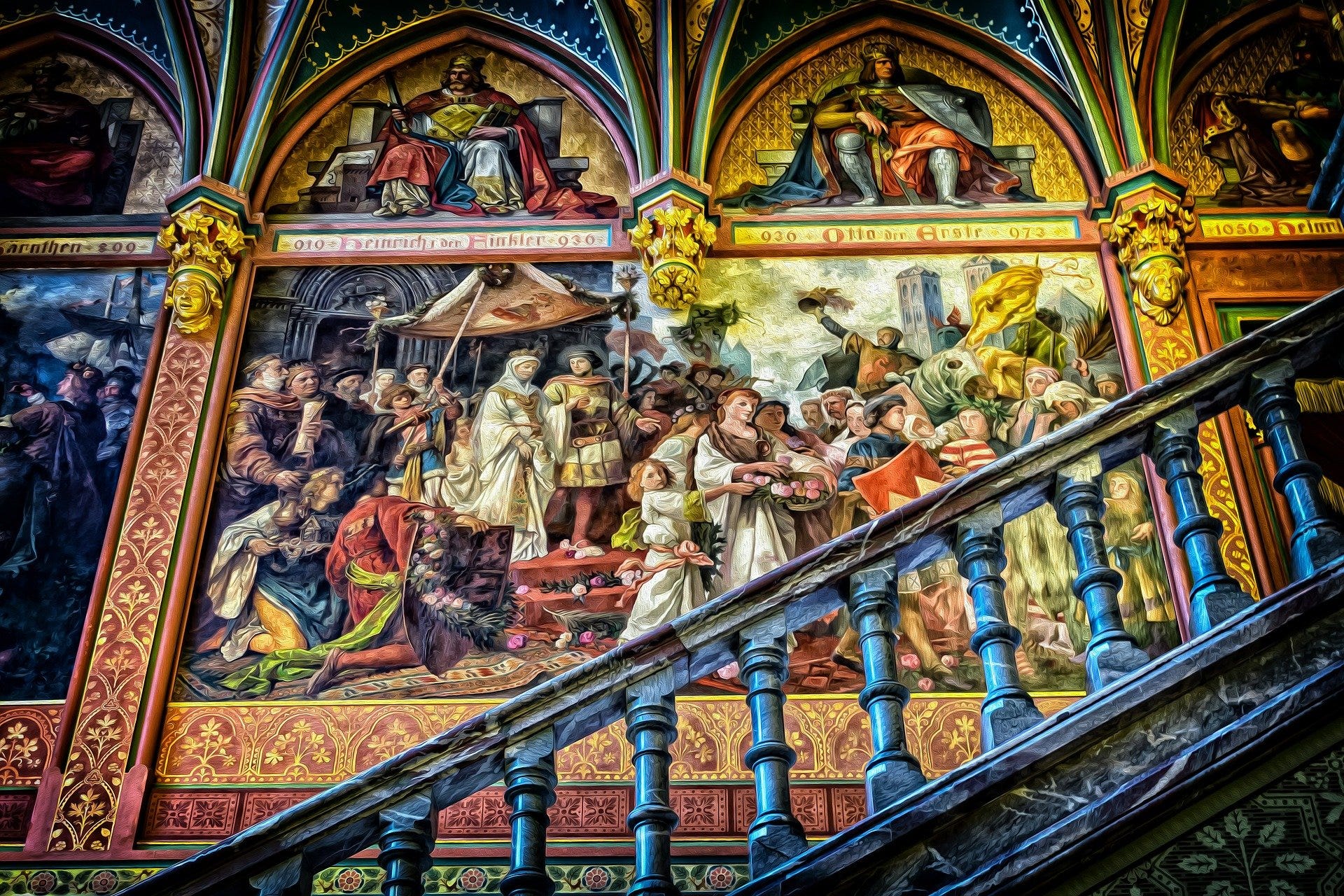
And the public unanimously feels it is worth it. But why? Because it is beautiful, that’s why. Beauty as the sole reason, the ultimate value and guiding principle. One of the most disagreeable tendencies of our age is to judge everything in terms of how useful and efficient it is. If it does not save money or time or make things easier or comfortable then it means nothing and has no benefit. But what is the use of beauty? It seemingly has none. And yet people are committed to paying for its protection and endurance. It is quite remarkable, and points to something deep within us which our heart feels, a spiritual and primal need, a necessity to be surrounded by the beautiful and elegant, to have inspiration everywhere in the form of images of nature and divinity. It’s nice to know that this instinct for beauty, which directed and compelled our ancestors, is still somewhere within us, suppressed and unconscious perhaps, but nevertheless alive.
In beautiful art of all kinds we see the real in the light of the ideal, a delicate balance, such that the ideal does not completely devour reality and become an entity in itself — but instead lightly brushes the subject to highlight and enliven its features, like sunlight shining over a garden. This light is reflected from the canvas and brightens our ordinary and oftentimes sorrowful lives; it provides a snapshot, a momentary particle of heaven, perfection, which raises us to a higher spiritual plain and more positive thoughts and emotions. Beauty illuminates the beautiful within ourselves, reveals our soul, and reminds us again that there is something greater than this limited and imperfect world, something transcendental, divine, which we can aspire towards. Indeed, beauty might even be viewed as one pathway towards God. Art thus is a consolation, sometimes even a medicine, which can comfort us by its discovery of beauty and meaning even in our darkness, sadness and decay.
Beauty matters immensely. Pretending it doesn’t matter, pretending that we are merely driven by appetite can only lead to an emptiness, a spiritual hunger. For our minds are finite and limited, caught in never-ending stress, bound by ignorance, and beautiful art raises us above our minds, above our personal life and speaks to our spirit and heart, and for a moment we feel peace. So on an individual level I think there is purpose and health in working to make daily life more beautiful. It can be quite a simple thing, and not in any way pretentious. As simple as tidying a room, buying flowers, creating a piece of art, poetry, painting, watching the sunset, visiting a national park, listening to music or reading a book. Goethe once wrote:
“A man should hear a little music, read a little poetry, and see a fine picture every day of his life, in order that worldly cares may not obliterate the sense of the beautiful which God has implanted in the human soul.”
Johann Wolfgang von Goethe, Wilhelm Meister’s Apprenticeship
The point I think is to be conscious of our experience and to want to uplift our mind beyond the monotony of daily existence. This requires an opening of the heart, a willingness to be vulnerable and sensitive to the outer world, so that we are available to love deeply and recognise affection in each moment. Beauty then becomes a constant experience. It’s everywhere in the people we meet, the ancient trees, the falling leaves, the vast fields and hedgerows. Once we recognise or create one thing which in our eyes and to our taste is beautiful, we establish a relationship to beauty which can expand and grow as our awareness develops. And then we become more and more nourished until eventually beauty permeates our whole being.