

Geoff Ward 2 days ago · Medium.com

‘What truly matters in Jung’s message is the understanding that we are ultimately grounded in something infinite and eternal, and that our lives as finite beings, illusory as they be, serve a divine purpose.’ Bernardo Kastrup
In the summer of 1940, despite the tribulations of the time, a meeting took place at Moscia, overlooking Lake Maggiore on the Swiss-Italian border, at which the depth psychologist Carl Gustav Jung gave a surprise extempore talk in response to the main speaker at the event, the Basel mathematician Andreas Speiser.
On this occasion, at the Eranos discussion group founded in 1933 for humanistic and spiritual studies, the subject was ‘the psychology of the Trinity’. Almost apologetically, Jung told his audience: ‘I can formulate my thoughts only as they break out of me. It is like a geyser. Those who come after me will have to put them in order.’
Of course, this remark can be taken with more than a grain of salt, for it belies the thoroughness, even pedantry, with which Jung (1875–1961) put together his material. Yet it does indicate some of the difficulties encountered in readings of his works, particularly those written towards the end of his life.
At that Eranos talk was Anelia Jaffé, who became secretary to the C G Jung Institute, as well as Jung’s personal secretary, and an analytical psychologist. She later wrote: ‘The very profusion of creative ideas and of the material discussed opens out endless vistas, and the spontaneity of his style leads to occasional obscurities.’ (The Myth of Meaning in the Work of C G Jung, 1967).
And now the philosopher-scientist Bernardo Kastrup, in his new book, Decoding Jung’s Metaphysics: The Archetypal Semantics of an Experiential Universe (Iff Books, UK £12.99 / US $19.95, February, 2021), becomes one of those envisaged as putting Jung’s thoughts ‘in order’, and Kastrup does this in a masterly manner. For anyone with an interest in Jung’s work, Decoding Jung’s Metaphysics is essential and inspiring reading.
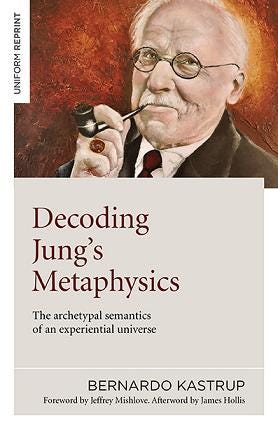
Crucially and topically, for the contemporary culture, Kastrup reinterprets Jung’s message through the lens of metaphysical, or monistic, idealism which understands consciousness as primary and fundamental, regarding Jung’s body of work being the most psychologically sophisticated in the idealist tradition.
Thus Kastrup regards Jung as a ‘metaphysical monist’, contending there is no spirit separate from matter, no matter separate from psyche, and no scope left for dualism. For Jung, the external physical world and the collective unconscious are one and the same thing presenting itself to us in two different ways.
A complex system of metaphysical thought underlies Jung’s amazing body of work, but it’s an implied system because Jung, that secret metaphysician, sought to guard his scientific persona against accusations of philosophical speculation.
Primacy of mind
For Kastrup, Jung was the twentieth century’s greatest articulator of the primacy of mind in nature, indicating that mind and world are one and the same thing, that reality is fundamentally experiential, not material, that the psyche builds and maintains its body, not vice versa, and that the ultimate meaning of human life is to serve ‘God’ by providing ‘a reflecting mirror to God’s own instinctive mentation’.
I put ‘God’ in quotes, above, because the word needs careful usage due to its historical tradition and the baggage it carries. Kastrup has said elsewhere (The Mysteries of Reality: Dialogues with Visionary Scientists by Gayle Kimball, Iff Books, 2021) that he does not believe there is a God with a plan that knows what ‘it’s’ doing at a metacognitive level: God, as the underlying universal consciousness, is metacognitive perhaps only to the extent that we are aspects of it.
Explicit introspective awareness — to be meta-conscious, to know one is having experience — is part of the process of what Jung called individuation and which Kastrup sees as the ultimate goal not only of life but of the universe itself, through us. So, for him ‘God’ is a metonym.
Nevertheless, Kastrup states: ‘The universe is God’s dream and we are here to interpret it … At a time when culture and society are dominated by the simplistic, myopic worldview of metaphysical materialism — with its accompanying existential angst — Jung’s work offers us a renewed horizon of meaning and purpose: life is sacrificial in the noblest sense imaginable, in that we live and die to render an indispensable service to God. What a great honor and opportunity it is to live.’
In a phrase, ‘we help God become aware of itself’ — put another way, through our consciousness we help the universe to contemplate itself. This is what is known as Jung’s myth of meaning, equating to the ‘myth of consciousness’, to which Kastrup makes allusion at the very end of his book.
If Jung had become prominent in the first half of the twentieth century instead of Freud then I believe we would be living in a different world today. As the Copernican revolution brought acceptance that the Earth revolved around the Sun, not the Sun around the Earth, so the Jungian revolution was to propose that the ego revolved around the Self, not the other way round: the Self being an image of the personality as a whole, a central ordering principle embracing both conscious and unconscious.
And as Kastrup says, while Freud thought of the unconscious as merely a passive repository of forgotten or repressed contents of consciousness, Jung saw the unconscious as an active, creative matrix with a psychic life, will and language of its own, often at odds with our conscious dispositions, which is surely much closer to the truth.
Metaphysical significance
Such thinking led Jung ‘down avenues of empirical investigation and speculation rich with metaphysical significance’ which, says Kastrup, is what his new book is all about, together with the philosophical consequences. Jung himself admitted that his work had metaphysical implications, rejecting ‘mainstream metaphysical materialism’, the notion that physicality is all there is. One is thus justified to infer the metaphysical opinions Jung might have held covertly so as to keep up a ‘politically correct image of metaphysically agnostic scientist’.

In the Jungian sense, our metaphysical task is to maintain an ongoing expansion, or heightening, of consciousness; it’s consciousness that bestows meaning on our lives. But also accepting the existence of the unconscious, or obfuscated consciousness in Kastrup’s terms, one, in following Jung, can consider a transcendental meaning prevailing independently of ourselves, as manifested in synchronistic phenomena, in which Jung included, for example, extrasensory perception, premonitions and dreams that come true.
In synchronicity, the inner psychic image is the counterpart of a future or remote event imperceptible to the senses; they are linked not causally but by their meaning. Jung defined it as a ‘coincidence in time of two or more causally unrelated events which have the same or similar meaning’ (Synchronicity: an Acausal Connecting Principle, 1952), and suggested that it could be a fourth dimension added to space, time and causality.
Certainly, synchronicity, by its very nature, is a consciousness-raising experience: in it, we find ourselves part of a profoundly meaningful process which we can actually influence. It seems to arise spontaneously out of the harmony of natural processes.
Indeed, Kastrup asserts that the most significant metaphysical implication of Jung’s work stems from the theory of synchronicity: by saying that the physical world arranges itself to symbolically connote something, then psychic powers somehow control its behaviour. On some underlying immanent and metaphysical level there must be a transpersonal psychic layer, associated with the physical universe at large, performing the cognitive associations necessary for the universe to express meaning through its behaviour.
And in a remarkable insight, Kastrup goes further to conclude that it’s synchronicity that actually drives the universe, that makes it ‘work’, that synchronicity is the only metaphysically real ordering principle in nature.
Archetypal patterns
Jung claimed that synchronicities unfold according to archetypal patterns, implying that the collective unconscious underlies both consciousness and the physical world itself. Significantly, this would mean that physical events are orchestrated by the same a priori patterns that orchestrate events in consciousness.
One implication of this is that the collective unconscious and the physical world are related in effectively the same way as the collective unconscious and ego-consciousness. As Jung suggests that ego-consciousness arises out of the unconscious, it follows that the physical world must also arise from the collective unconscious, as another manifestation of it. So, logically, one must conclude that the physical world is as essentially experiential as the psyche.
Metaphysical idealism is arguably the only option left for making sense of the latest experimental results in fields such as quantum mechanics, Kastrup argues. Many physicists assume that quantum fluctuations at the foundation of our physical environment do not follow any global patterns.
But: ‘For all we know, instead of accidents, quantum events conform to subtle, non-local patterns of organisation corresponding to an as yet unacknowledged metaphysical ordering principle, different from causality.’
Perhaps if Jung had received a proper formulation of idealism that countered all criticisms made against it, Kastrup suggests, he would have allowed himself to express his metaphysical views more openly.
Bernardo Kastrup’s work is in the forefront of the contemporary renaissance of metaphysical idealism, the notion that reality is essentially mental. He has a PhD in philosophy (ontology, philosophy of mind) and a PhD in computer engineering (reconfigurable computing, artificial intelligence). As a scientist, he has worked for the European Organization for Nuclear Research (CERN) and the Philips Research Laboratories, where the ‘Casimir Effect’ of quantum field theory was discovered.
Formulated in detail in many academic papers and eight previous books, his ideas have been featured at Scientific American, the Institute of Art and Ideas, the Blog of the American Philosophical Association and Big Think, among others. For more information, freely downloadable papers, videos and so on, visit www.bernardokastrup.com
*** See also my article here at Medium, ‘A transformative idea of the world that seeks to bring truth and meaning to our lives’.