A ‘Pro-Billionaire’ March and Rally Is Coming to SF Saturday, and Apparently This Is Not a Joke

2 February 2026/SF Politics/Joe Kukura (SFist.com)

A group claiming that “Vilifying billionaires is popular. Losing them is expensive” is holding a March for Billionaires in SF on Saturday, seemingly hoping to tap some silent majority that actually loves the billionaire class.

In the age of an affordability crisis for most of us, and corrupt crypto scams making the mega-rich even mega-richer, there has been a recent surge of interest in a proposed California billionaire tax that may or may not appear on a statewide 2026 California ballot measure. The measure has not made the ballot, nor has it even collected any signatures to do so. But a wild overreaction by several high-profile billionaires has bought this little-known proposed ballot measure a ton of free publicity, and early polling indicates that as things stand now, the billionaire tax would pass.  

Image: March for Billionaires


So at group of people who are apparently sympathetic to the “long-suffering” billionaire class is organizing a March for Billionaires this coming Saturday, as Mission Local reported over the weekend. From all appearances, this is not satire, but a real, organized march by those who would genuinely hate to see the billionaire class taxed at a higher rate.

“Most made their fortunes building companies that employ thousands and solve real problems. Their wealth is largely stock in those companies, not vaults of cash,” the March for Billionaires website declares. “The Billionaire Tax Act has already pushed the founders of Google to leave the state, taking their economic contributions with them. By taxing unrealized gains and voting shares, the act would make it difficult for founders to retain control of their startups.”

X post: https://x.com/ProBillionaires/status/2018064469033935108?ref_src=twsrc%5Etfw%7Ctwcamp%5Etweetembed%7Ctwterm%5E2018064469033935108%7Ctwgr%5E8471578e3d339464ff6a0c20bf471aeb6e7ec94a%7Ctwcon%5Es1_c10&ref_url=https%3A%2F%2Fsfist.com%2F2026%2F02%2F02%2Fa-pro-billionaire-march-and-rally-is-coming-to-sf-saturday-and-apparently-this-is-not-a-joke%2F

Mission Local managed to get a statement out of these (anonymous) March for Billionaires organizers, and they appear to be dead serious, and not ironic or sarcastic.

“We sincerely believe what we’re saying,” organizers told Mission Local. “We think most American billionaires have had greatly positive societal impacts, directly and indirectly. We support wealth creation and oppose rent-seeking/extraction, anticompetitive practices, and regulatory capture.”

They also claimed they were remaining anonymous because of “some threats” online, and insist they are not funded by billionaires or “outside groups.”

Image: March for Billionaires

For what it’s worth, the March for Billionaires is scheduled for this Saturday, February 7 (the day before the Super Bowl) starting in Pac Heights’ Alta Plaza Park at 11 am, then proceeding down Fillmore Street, and supposedly ending with a 12:30 pm rally at Civic Center Plaza. We would think this is certain to attract more counterprotesters than actual marchers, but who knows, and we do imagine they’ll get a fair amount of media attention.

Related: Billionaires Going Berserk on Twitter Over Proposed California Billionaire Tax [SFist]

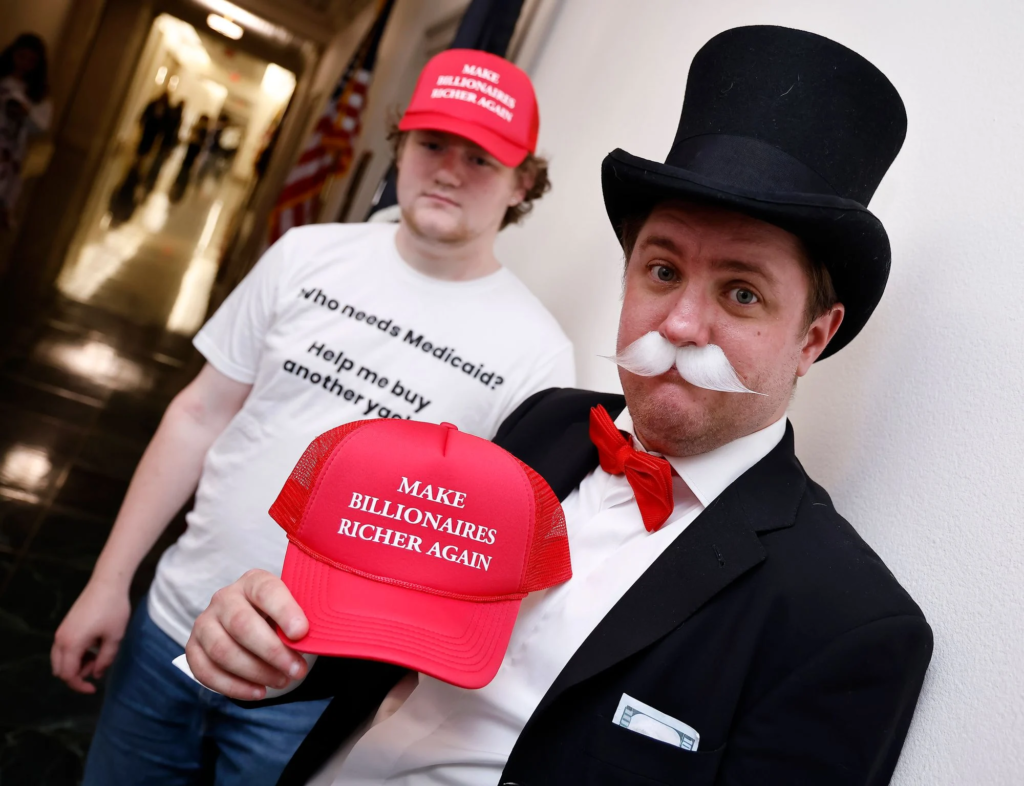
Image: WASHINGTON, DC – MAY 13: Advocates pose as Monopoly men and wealthy DOGE supporters while protesting tax breaks for billionaires and the Republican tax plan, inside and outside the Ways & Means Full Committee Markup to advance the legislation in the Longworth House Office Building on May 13, 2025 in Washington, DC. (Photo by Paul Morigi/Getty Images for Stop Billionaires Tax Cuts Campaign)
What Did Childhood Teach Us Before Productivity Trained It Out of Us?

How growing up becomes a process of abandoning wonder—and why that loss leaves many adults feeling empty.

Thom Hartmann Feb 4, 2026 (wisdomschool.com)

Share

Childhood understands something that adulthood works very hard to forget.

Children don’t move through the world with a checklist: they wander, pause, and often fixate on odd details. They follow curiosity without asking whether it’ll be useful later. Time stretches for them not because they’re inefficient, but because they’re present.

Our modern productivity culture, driven by the demands of our economic overlords and media, teaches us to see this as waste.

Very early, we begin training children out of their natural rhythms. We reward sitting still over moving, answers over questions, and speed over exploration. We praise them for finishing quickly and gently shame them for drifting off. Daydreaming becomes a problem to solve or medicate into non-existence as wandering attention becomes something to correct.

By adulthood, most of us have internalized this terrible lesson. We measure our days by our outputs. We evaluate our worth by what we’ve completed, not by what we’ve noticed or experienced. We feel vaguely guilty when we’re not producing something that can be pointed to, counted, or justified.

In the process, something essential gets eroded.

Children approach the world as a place to be explored, not conquered. They touch things, dismantle things, ask questions that don’t lead anywhere obvious. They aren’t interested in optimization. They are, instead, interested in understanding. When they repeat an action again and again, it’s rarely because they’re trying to perfect it. It’s because repetition itself is teaching them something they can’t yet name.

This mode of engagement builds a different kind of intelligence. It cultivates intuition, pattern recognition, emotional attunement, and a sense of connection that doesn’t depend on achievement. It allows meaning to emerge rather than be extracted.

Productivity, by contrast, is goal-driven. It asks what something is for before it asks what it is. It prioritizes efficiency over intimacy. It encourages us to skim rather than sink in, to move on quickly once a task is complete.

This has its place, of course. Societies need people who can build, maintain, and execute. But when productivity becomes the dominant lens through which all activity is judged, it begins to hollow people out.

Reading becomes skimming for takeaways. Conversation becomes networking. Rest becomes recovery in service of future work. Even leisure is evaluated by whether it made us more effective afterward.

Children don’t live this way, at least not until after they’re acculturated. They play without outcome. They tell stories that go nowhere. They stop mid-sentence because a cloud caught their attention. They understand, intuitively, that being alive isn’t a problem to be solved.

As adults, we often dismiss this as immaturity. But what if it isn’t something to outgrow, but something to integrate?

Many of the qualities we later call wisdom are extensions of childhood capacities that were never fully extinguished: The ability to sit with uncertainty. The willingness to explore without guarantee. The patience to stay with a question longer than is comfortable. The capacity to be moved by small things.

When these qualities are lost, adulthood becomes brittle. People grow efficient but shallow, busy but disconnected. They don’t lack intelligence, they lack spaciousness and depth.

This is why so many adults feel a vague grief they can’t explain. They sense that something essential has been traded away, but they can’t remember when the exchange happened. They just know that life feels narrower than it once did, even as it’s grown more crowded.

Reclaiming what childhood teaches doesn’t mean abandoning responsibility or pretending the world has no demands. It means, instead, loosening the grip of constant optimization. It means allowing parts of life to be unproductive on purpose.

This might show up as walking without tracking steps, reading without highlighting, or sitting outside without a podcast. Letting a thought wander without dragging it back to “usefulness.” Giving attention to something simply because it’s interesting, not because it advances some goal.

At first, this can feel uncomfortable. The productivity reflex kicks in and the urge to justify arises. But over time, another rhythm returns.

You begin to notice more. You feel less fragmented. Questions become richer. Creativity feels less forced. Life regains the texture when we were young.

Children remind us that meaning isn’t always something we manufacture. Often it’s something we allow. It shows up when we stop trying to extract value from every moment and start inhabiting, living within those moments instead.

The tragedy isn’t that we grow up; it’s that we forget what growing was like.

Wisdom doesn’t require us to become children again. Instead, it asks us to remember what we knew before we were taught to forget.

And to let that remembering quietly reshape the way we live.

Remote Viewing the Lottery, Plus Karl Marx and Psi with Jon Knowles

New Thinking Allowed with Jeffrey Mishlove Feb 3, 2026 Jon Knowles, MA, is a remote viewer, analyst, project manager, instructor, author, and long-time political organizer with over two decades of experience in applied precognition and remote viewing. He is the author of Remote Viewing from the Ground Up and co-author of Associative Remote Viewing. Knowles has been deeply involved in progressive and Marxist political organizing for decades and is the author of MarxPsi, a free & comprehensive sourcebook examining Marxism, materialism, consciousness, and their relationship to psi phenomena. This interview brings together Jon Knowles and NTA guest host Debra Lynne Katz, PhD, coauthors of Associative Remote Viewing: The Art & Science of Predicting Outcomes for Sports, Financials, Elections, and the Lottery, for a wide-ranging conversation on the theory and practice of associative remote viewing and its real-world applications. They discuss practical strategies used in predictive remote viewing, including lottery and numeriogram approaches, best practices for managing viewer fatigue, and how to structure and run reliable remote viewing experiments. The discussion also explores deeper philosophical and political themes such as how materialist frameworks may influence or limit our understanding of psi phenomena. 00:07:03 Betting and winning: Jon’s strategies 00:08:26 Three strategies for viewing the lottery: numeriograms 00:12:35 Taking breaks and limiting weekly sessions 00:21:16 Remote viewing and AI technology 00:28:15 Conference update: State of the world & UAP 00:31:34 Should we embrace AI or return to nature? 00:41:37 Is materialism dead? Is consciousness truly fundamental? 00:55:43 Marx and psi 01:10:19 The future of remote viewing — breakthroughs 01:21:02 How to run a remote viewing experiment Debra Lynne Katz, PhD, is the founder and Director of the International School of Clairvoyance and the author of numerous books on intuition and psi, including You Are Psychic: The Art of Clairvoyant Reading and Healing, Extraordinary Psychic, Freeing the Genie Within, The Complete Clairvoyant, and The Popular Psychology Controversy. She is also the former President of the International Remote Viewing Association (IRVA), and an instructor at the California Institute for Human Science. She is co-author of Associative Remote Viewing: The Art & Science of Predicting Outcomes for Sports, Financials, Elections, and the Lottery. Website: https://www.debrakatz.com (Recorded on December 20, 2025)

Hazrat Inayat Khan on the voice of everything

“There is nothing in the world that does not speak to us.  Everything and everybody reveals its own nature continuously.  The more open our inner senses, the more we understand the voice of everything.”

Hazrat Inayat Khan (1882-1927)
Indian Sufi Teacher
AN OPPORTUNITY FOR DAILY REFLECTION BROUGHT TO YOU BY THE SCHOOL OF PRACTICAL PHILOSOPHY

Victor Frankl on love

Frankl in 1965

“Love is the only way to grasp another human being in the innermost core of his personality. No one can become fully aware of the very essence of another human being unless he loves him.”

~ Frankl

Viktor Emil Frankl was an Austrian neurologist, psychiatrist, philosopher, and Holocaust survivor, who founded logotherapy, a school of psychotherapy that describes a search for a life’s meaning as the central human motivational force. Logotherapy is part of existential and humanistic psychology theories. Wikipedia

Born: March 26, 1905, Leopoldstadt, Vienna, Austria

Died: September 2, 1997 

SF exhibit focuses on LGBTQ psychiatry history

  • by Matthew S. Bajko, Assistant Editor 
  • Wednesday, January 28, 2026 (ebar.com)

Kinsey Institute curator Rebecca Fasman stood in front of displays for the new exhibit “Desire on the Couch” in the Desai | Matta Gallery at the California Institute of Integral Studies.

Photo: Matthew S. Bajko

Beginning in the 1930s Louise Lawrence began clipping out news articles about transsexuals, cross dressing, and other aspects about the lives of gender-nonconforming people for a scrapbook she was creating. The San Francisco resident also compiled a second scrapbook about her own transition as a self-identified male-to-female cross-dressing activist in the 1940s.
 
A third scrapbook she put together contained the ephemera Lawrence collected about female impersonation and drag shows. Lawrence, who died in 1976 in her mid-60s, had also befriended the acclaimed sex researcher Alfred C. Kinsey, Ph.D., a professor of zoology based at Indiana University, and corresponded with him throughout the 1940s and 1950s.
 
In one letter dated September 21, 1950, she detailed receiving a visit from a friend in Los Angeles who showed her his own collection of clippings and photos documenting female impersonators and transvestism.
 
“He had well over one hundred photos of fellows in drag. Some were professional impersonators but the bulk of them were what I would call transvestites,” wrote Lawrence. “I certainly wish that you could see them for it is truly a marvelous collection and one that I would give anything to own.”
 
One letter dated July 11, 1951 from Kinsey, five years prior to his death at the age of 62, thanks Lawrence for “all the good help” she provided him when he came to San Francisco to visit.
 
“As I bring together all of the material that you have contributed it begins to make a marvelous assemblage of data,” he wrote.
 
Their correspondence and digitized copies of Lawrence’s scrapbooks are now on view in San Francisco at the new exhibition “Desire on the Couch” that opened Wednesday in the Desai | Matta Gallery at the California Institute of Integral Studies (CIIS). It is a joint exhibition between the school and the Kinsey Institute based at IU’s Bloomington, Indiana campus.
 
Some of the letters between Lawrence and Kinsey can be perused in one of the six glass vitrines for the exhibit mounted to the walls of the gallery space in the lobby of CIIS’ building at 1453 Mission Street near 11th Street. A monitor provides attendees a way to flip through Lawrence’s scrapbooks.
 
They are “a cool archive within our collection of transgender life in the 1940s, especially in California as well as across the U.S. and the world,” said Rebecca Fasman, who co-curated the exhibit with CIIS Chair of Research Psychology Christopher Walling, Ph.D.
 
Fasman, who is queer and lives in Washington, D.C., has been the curator for the Kinsey Institute for close to a decade. She provided the Bay Area Reporter a sneak peek of the exhibit Monday as she was working on its final installation.
 
One item in the exhibit she is particularly excited for people to see is an April 9, 1935, letter Sigmund Freud sent to an American mom of a gay son who had written to him for advice. Writing in English the Austrian neurologist credited with founding psychoanalysis told her that homosexuality was “nothing to be ashamed of” and should not be classified as “an illness.”
 
He notes “many highly respected individuals” such as Plato, Michelangelo, and Leonardo da Vinci were gay. Freud added, “It is a great injustice to persecute homosexuality as a crime and a cruelty too.”
 
Freud “was an outlier” in such thinking during his time, noted Fasman, pointing to how homosexuality was included in psychiatry’s diagnostic manual, Diagnostic and Statistical Manual of Mental Disorders, known as the DSM for short. It wouldn’t be until 1973 that it was removed from what is basically the bible of the field.
 
Despite Freud’s stance, that was a difficult fight waged by LGBTQ advocates and members of the field in conjunction with their straight allies, said Fasman.
 
“He very clearly made his opinion known, and he helped create the field,” she said. “It was something he knew to be true and sexual researchers like Kinsey knew to be true.”
 

Sigmund Freud sent a letter in 1935 to an American mom who had written to the neurologist about her gay son.    Photo: Matthew S. Bajko

‘Exhibition about change’
Through its rarely-seen letters, photographs, and archival materials the exhibition “aims to reveal how ideas about sexuality and desire have long been argued over, resisted, and reimagined,” according to the curators. As the introductory sentence for it declares, “This is an exhibition about change.”
 
It marks the first time since Fasman joined Kinsey in 2015, initially hired as its manager for traveling exhibitions, that it has mounted an exhibit in San Francisco. It came about due to Walling being selected for one of the institute’s fellowships and bringing up using Kinsey’s archive of more than 600,000 materials to examine the fight over delisting homosexuality in the DSM. Fasman suggested using that topic as a jumping off point to examine how “knowledge production involves multiple voices and perspectives” from inside and outside academia and scientific fields.
 
As he was traveling out of the country ahead of the exhibit opening, Walling told the B.A.R. in an emailed reply that it is debuting amid public debate about sexual orientation and gender identity in the country’s political, scientific, and cultural circles that mirrors those reflected in the more than 70 items he and Fasman selected to put on display.
 
“This exhibit is opening at a moment when conversations about desire, sexuality, gender, and the body are once again being constrained politically, culturally, and sometimes even clinically. ‘Desire on the Couch’ reminds us that psychoanalysis and sexology were born out of a radical willingness to look directly at what society often prefers to repress or moralize,” wrote Walling. “At a time when sexual knowledge is increasingly polarized, simplified, or weaponized, this exhibit offers historical depth and nuance. It shows that rigorous, compassionate inquiry into desire has long been central to understanding psychic life, trauma, creativity, and freedom.”
 
And opening it at this time, added Walling, “is a way of reclaiming complexity and curiosity in a cultural climate that often resists both.”
 
He also pointed to Freud’s letter as one of his favorite items on display, not simply due to its historical import but because of its contemporaneous feeling.
 
“As a psychoanalyst myself, I read that letter and can almost imagine Freud writing it to my own mother back in Kentucky in the 1990s – despite the fact that it was written at the very beginning of the 20th century. His tone is humane, non-pathologizing, and deeply respectful; he speaks to a parent’s fear with clarity and compassion rather than judgment,” wrote Walling, himself a gay man. “That letter reminds us that within psychoanalysis, there has always been a strand of thought that recognized sexual difference not as an illness to be cured, but as a variation of human love and desire. Seeing it here collapses time in a powerful way and makes the history feel personal, lived, and still urgently relevant.”
 
The exhibit is “text heavy” because of its focus on letters and other correspondence, acknowledged Fasman. They did purposefully look to include more visual material to help break up the exhibit, such as a selection of homoerotic black-and-white drawings created by Andrey Avinoff, a gay man who was the director of the Carnegie Museum of Natural History for two decades in the first half of the 1900s.
 
A renowned expert on Asiatic butterflies, he struck up a correspondence with Kinsey and was working with him on a book of erotic art they were unable to finish before Avinoff’s death in 1949. Also featured in the exhibit are four black-and-white male nude photos taken by George Platt Lynes along with correspondence between him and Kinsey.
 
A gay man who was Vogue magazine’s first staff photographer and also struck up a friendship with Kinsey, Platt Lynes donated roughly 2,300 negatives to the Institute for Sex Research now known as the Kinsey Institute. In a May 15, 1950, note of thanks Kinsey remarked the material from Platt Lynes was “excellent” and “the best nude photography that we have in our collection.”
 
Also on display are items related to pioneering LGBTQ rights groups such as the Gay Liberation Front and the Daughters of Bilitis founded by the late San Francisco couple Phyllis Lyon and Del Martin. Walling hopes the exhibit will inspire a sense of personal curiosity in attendees and illustrate for them the wide-reaching impact cultural forces can have on their lives.
 
“I hope visitors leave with a deeper appreciation that desire is not something to be reduced to pathology, identitarian labels, or moral judgments. Desire is relational, embodied, historically shaped, and deeply human,” wrote Walling. “I want people to understand that psychoanalysis and sexology – at their best – are not about fixing or normalizing people, but about expanding our capacity to tolerate complexity, difference, and ambiguity. If visitors walk away feeling more curious about their own inner lives, more compassionate toward others, and more aware of how cultural forces shape what we are allowed to want or say, then the exhibit has done its work.”
 
Fasman told the B.A.R. she hopes it is illustrative of how connected Kinsey was with others throughout his life, from colleagues in his fields of study to community activists and artists, all of whom helped to shape his thinking about human desire, sexuality, and other topics he researched and wrote about. It speaks to the importance of hearing from multiple perspectives in the pursuit of societal change, she said.
 
“There are multiple voices and methods required to make substantive change in society. There is not just one way,” said Fasman.
 
The exhibit’s opening is timed with the American Psychoanalytic Association’s annual meeting in San Francisco running through Friday. Tickets on those days cost $27.24, with Fasman and Walling providing guided tours periodically throughout the day, on a first come, first served basis, and can be purchased online.

Starting on February 6 tickets will cost $21.99 for self-guided viewing and can be bought online.
 
It closes on March 14, and two days prior, Walling will be in conversation with Kinsey Institute Executive Director Justin Garcia, Ph.D., about the exhibit and Garcia’s book “The Intimate Animal.” Tickets for in-person or online access cost $11.49 to $32.49 and can be purchased online.

This 3-page court opinion releasing Liam Ramos is one of the best ever written!

Dean Obeidallah

Feb 02, 2026 (deanobeidallah@substack.com)

We have seen countless federal district judges–including ones appointed by Republican Presidents–stand up to Donald Trump’s unconstitutional and lawless actions. While it’s true the corrupt GOP Supreme Court has ruled in the favor of Trump in about 90% of the 25 cases they considered, these trial judges have been a bulwark in effectively delaying Trump’s actions and proposed executive orders in more than 150 cases.

Many of these great decisions have been laid out by judges in long, very detailed opinions. But the most compelling and moving judicial opinion in the second term of Trump might just be the less than three page one rendered Saturday night in the case of 5 year-old Liam Ramos and his father Conejo Arias.

This case made headlines when on Jan. 20, Trump’s ICE thugs arrested Mr. Arias and Liam in their suburban Minneapolis neighborhood. Just to be clear, Arias and his family entered the nation legally from Ecuador in accordance with the legal guidelines for asylum. As the family lawyer stated to the media, the family has been “following all the established protocols pursuing their claim for asylum, showing up for their court hearings and pose no safety, no flight risk, and never should have been detained.” But the Trump regime doesn’t care if people are following the asylum procedures, they will still abduct and deport you.

That is what happened. Mr. Arias and Liam were returning home from Liam’s school when ICE grabbed the father. Trump regime officials claim the mother who was in the house would not take Liam—a claim refuted by School board member Mary Granlund who was at the scene. In fact, Granlund personally offered to take custody of Liam but ICE agents rejected that offer and instead arrested the little boy.

ICE has detained countless children but in the case, the photo of Liam wearing a Spider-Man backpack and an oversize fluffy blue winter hat standing out in the cold went viral causing a massive backlash.

The family’s lawyers quickly filed a lawsuit that brings to the must read court decision written by Judge Fred Biery. The judge’s anger and contempt for the Trump regime’s conduct in this case was on display for all to see. The decision began by noting the father and son have a pending asylum application. The judge then noted, “The case has its genesis in the ill-conceived and incompetently-implemented government pursuit of daily deportation quotas, apparently even if it requires traumatizing children.”

From there, the judge slammed the Trump regime for not grasping what makes America, America. Judge Biery wrote, “Apparent also is the government’s ignorance of an American historical document called the Declaration of Independence.”

He then added these powerful lines:

“Thirty-three-year-old Thomas Jefferson enumerated grievances against a would-be authoritarian king over our nascent nation. Among others were:

1. “He has sent hither Swarms of Officers to harass our People.”

2. “He has excited domestic Insurrection among us.”

3. “For quartering large Bodies of Armed Troops among us.”

4. “He has kept among us, in Times of Peace, Standing Armies without the consent of our Legislatures.”

The judge then added this haunting line, “We the people” are hearing echoes of that history.”

Yes, there is no doubt we are a similar place as the founders of this nation who were then faced with a cruel, tyrant in King George. Indeed, the judge—after slamming the unconstitutionality of the Trump regime using administrative warrants to arrest people signed by Trump officials and not judges—he delivered a line that sounded like something Alexander Hamilton may have written.

Observing human behavior confirms that for some among us, the perfidious lust for unbridled power and the imposition of cruelty in its quest know no bounds and are bereft of human decency. And the rule of law be damned.”

A federal judge is warning the nation that the Trump regime has a corrupt lust for “unbridled power” and enjoys “the imposition of cruelty,” as they act with zero regard for “human decency” and in total disregard of our laws. In other words, Trump is a vicious, cruel tyrant. And the judge is 100% correct.

The judge was not done, though. He added this famous quote from 1787 when Benjamin Franklin was asked about what type of government had the drafters of the new Constitution had voted for. “Well, Dr. Franklin, what do we have?” “A republic, if you can keep it.”

What a great lesson for us today. Our Republic is under attack by a rogue, cruel, corrupt President in ways we’ve never seen. The question is up to us if we can keep this Republic.

The judge then concluded his short opinion with two very memorable comments. The first was this thought-provoking remark above his signature line ordering the release of the child and father, “With a judicial finger in the constitutional dike.” Again, the judge is raising alarm bells about how precarious of a place we find ourselves.

Then the judge did something I’ve never seen in any of the countless number of opinions I read since my days in law schools decades ago until today. Below you will see image from opinion of his signature line that then included the famous photo of Liam with his Spiderman backpack standing in the cold with a citation to two passages from the Bible, “Matthew 19:14” and “John 11:35.” The judge didn’t include what the verses stated—leaving that investigation up to each of us to do on our own.

The first, Matthew 19:14, tell us these moving words, “Jesus said, “Let the little children come to me, and do not hinder them, for the kingdom of heaven belongs to such as these.”

While the second, John 11:35, provides us these two simple, yet powerful words, “Jesus wept.”

All of this from laying out the law to citing Thomas Jefferson, Benjamin Franklin’s words to the Bible were all contained in an opinion less than three pages—double spaced I should add. But this opinion offers us so much—from warnings to a sense of history to much needed hope!

X post: https://x.com/Joseph_Fasano_/status/2017783661156864135?s=20