“It is naively assumed that the fact that the majority of people share certain ideas or feelings proves the validity of these ideas and feelings. Nothing is further from the truth. Consensual validation as such has no bearing on reason or mental health. Just as there is a “folie a deux” there is a folie a millions. The fact that millions of people share the same vices does not make these vices virtues, the fact that they share so many errors does not make the errors to be truths, and the fact that millions of people share the same forms of mental pathology does not make these people sane.”
“Illumination isn’t solely ‘seeing the light,’ seeing the darkness is an illumination, too.”
–Paul Levy in Awakened by Darkness
Paul Levy is a creative artist, a pioneer in the field of spiritual emergence, and a Tibetan Buddhist practitioner for more than 35 years. He is the founder of the Awaken in the Dream Community and the author of several books, including Wetiko and Dispelling Wetiko. He lives in Portland, Oregon.
First published in 1974, this groundbreaking volume relates field theory of altered states of consciousness and compares the surprisingly similar views of mediums, mystics, and physicists. When renowned psychologist Lawrence LeShan first explored clairvoyance and precognition it shook his belief in everyday reality. As a result, it led him to postulate other states of consciousness, which he calls “Clairvoyant Reality” and “Transpsychic Reality.” Although LeShan was trained in the traditional scientific method, he discovered that these altered realities—including the knowledge of future events, the ability to heal from great distances, and other paranormal phenomena—operated according to their own laws. Filled with mesmerizing case examples, quotations, and observations from LeShan’s own personal experience, The Medium, the Mystic, and the Physicist includes LeShan’s essay, “Human Survival on Biological Death,” where he brings a fresh perspective to the theory of the afterlife. A classic guide for the study of parapsychology, readers will be intrigued by this collection of unique ideas. • A classic in the field, often thought of as the author’s best work • Author is renowned as a psychologist and a leader in the modern study of mind-body interaction
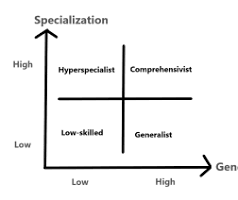
A comprehensivist is an individual who adopts a holistic approach to problem-solving by combining broad, interdisciplinary knowledge with deep, specialized insights. Often described as “polymaths” or “generalist-specialists,” they connect disparate fields to see the “bigger picture,” functioning as versatile thinkers capable of navigating complex, project-based tasks.
Key Characteristics of a Comprehensivist:
Interdisciplinary Knowledge: They connect insights across varied domains rather than focusing on a single niche.
Systems Thinking: They possess the ability to “connect the dots,” recognizing how different systems, technologies, and perspectives interact.
Project-Based Focus: They excel at taking on comprehensive projects that require a wide breadth of expertise.
Buckminster Fuller Origin: The term is rooted in the philosophy of R. Buckminster Fuller, who encouraged “comprehensive, anticipatory design science” to address complex global challenges.
Contextual Definitions:
In Business/Creativity: A comprehensivist is a professional who excels by combining skills over time, often finding innovative solutions that specialists miss (via StartGainingMomentum).
In Healthcare: A “comprehensivist” (or comprehensive care physician) is a medical specialist focused on managing the care of chronically ill, frequently hospitalized patients across both hospital and clinic settings (via University of Chicago News).
Contrast with Specialists: While a specialist gains profound knowledge in one narrow area, a comprehensivist excels by synthesizing multiple areas of knowledge, making them highly effective at solving complex, multifaceted problems.
The word “sex” is derived from the Latin sexus (meaning gender, state of being male/female) and is closely connected to the Latin verb secāre, which means “to cut, sever, or divide”. It signifies the division of the human race (or species) into two, male and female, representing a “section” or “half” of the whole.
Key details regarding the etymology of “sex”:
Root Connection: The root sek- (to cut) is shared with words like section, bisect, sector, and scissors.
Latin Origin: It originated from Latin sexus, with some theories suggesting it is derived from an earlier form, secus.
Historical Understanding: It reflects an ancient understanding of gender as a division or separation, conceptually splitting a whole into two parts.
Uncertainty: While commonly associated with secāre (to cut), some scholars note the exact morphological link between sexus and secāre is not fully solidified, though it is the accepted etymological connection.
There’s a paradox at the heart of healing work: The people who might benefit most from transformation are sometimes unable to receive it.
Some of us are in so much pain, are so overwhelmed by our suffering, that it’s hard to be aware of, let alone welcome, certain blessings and healings that may be nearby and available.
I’m not judging these suffering souls in the least. When a person’s entire nervous system is screaming with distress, the subtle frequencies of possibility may become imperceptible.
Pain creates its own gravitational field. It bends reality around itself, narrowing the aperture of perception until all someone can see is the hurt and the impossibility of things ever being different.
This is an understandable response to being overwhelmed. The body and psyche have protective mechanisms that sometimes work too well, sealing us off not just from further harm but from healing itself.
+
UNFORCED HEALING
I want to be a source of blessing and healing for anyone in pain who is drawn to my work. At the same time, I never want to force my blessings and healings on anyone.
This ethical principle matters deeply to me. I’ve seen spiritual teachers, self-help gurus, and well-meaning healers who operate with an evangelical fervor that disregards consent. They believe so fervently in their medicine that they forget healing, like love, has to be chosen rather than imposed.
I respect that some people aren’t ready for help; I honor their free will about what influence or inspiration they want to take in. My respect for their autonomy is an acknowledgment of the truth that timing is everything in transformation.
The same teaching that might illuminate someone’s path at one moment could feel like a violation at another. The blessing offered too soon can feel like pressure or judgment, like a reminder of how far a person is from wholeness.
There’s also the fact that what looks like resistance to healing may be a different kind of wisdom. Sometimes the soul knows it needs to stay in the crucible a while longer.
The pain may still be offering essential teachings. Or it’s possible there’s healing work to unfold that doesn’t match the shape of what we healers are offering, no matter how sincerely we offer it.
+
THE CRACKS ARE WHERE THE LIGHT GETS IN
With those caveats, I pray to my spirit allies to help me find ways to gently crack open a willingness to be blessed and healed in anyone who is ready for such gifts.
Notice that phrase: “anyone who is ready.” The prayer isn’t about breaking down doors. It’s about finding the hairline fractures where light might seep through.
My aspiration is to locate the moments of receptivity, those precious instants when the pain loosens its grip just enough for another influence to enter.
Key factor: Again and again, I have seen healing arrive disguised. It might come wrapped in humor when solemnity would be rejected. It might arrive as a sideways glance, an unexpected metaphor, or a seemingly unrelated story.
The “gentle crack” is crucial. Not a violent rupture or a forceful intervention, but a subtle opening. A crack that opens possibility without demanding it. A gap through which grace might slip, if the person is ready to notice it.
There’s an art to planting seeds without demanding they sprout according to the healer’s timeline. The most powerful workings are often gentle. They work with the grain of reality rather than against it.
HOW TO BE READY?
Readiness isn’t always logical. Someone might be in tremendous pain and suddenly, mysteriously, become permeable to healing. Another person with seemingly lesser challenges may remain sealed shut. The factors that determine receptivity are complex.
I’ve seen situations where readiness has come from hitting bottom. That’s the moment when the old strategies have so completely failed that anything else seems worth trying.
Or readiness may arrive through grace: an inexplicable shift in consciousness where a previously impossible intervention becomes imaginable in an unexpected way.
Sometimes readiness is catalyzed by love: being seen and being reminded of our fundamental worthiness despite everything. Or it may emerge from rage — from the refusal to let pain have the final word. Now and then, I see it sneak in through dreams, the messages from the unconscious that bypass our defensive mechanisms.
+
MORE BLESSINGS ARE AVAILABLE THAN WE REALIZE
I believe that healing and blessing are more abundant than we typically recognize. They’re woven into the fabric of reality. The universe is constantly offering us opportunities for transformation, redemption, and renewal.
But these gifts can only be received, not forced. And reception requires a certain quality of attention and openness that pain may make impossible.
That’s why I pray to my spirit allies for help in creating those gentle openings. Not because I think I can save anyone; I can’t. But because I can maybe help create conditions where someone might become aware of resources they didn’t know existed and remember their own capacity for healing.
My life and work have taught me that reality is more malleable than consensus consciousness admits. Small shifts in perception can catalyze enormous changes. A single word at the right moment can reorient an entire destiny. A metaphor can unlock a door that logic couldn’t budge.
+
WHAT IF MORE HEALING IS AVAILABLE THAN YOU IMAGINE?
Whoever is reading this: I hope that you can and will feel how much you are loved—and how much healing and how many blessings may be available to you.
I don’t know what pain or burdens you might be carrying. But I know this: You are more loved than you realize. You’re more supported than you recognize. You have more resources, both internal and external, than you’re currently aware of.
These aren’t empty platitudes. They’re statements about the nature of reality as I’ve come to understand it through decades of spiritual practice, chaos magick, dreamwork, and communion with spirits who understand subtle truths I’m only beginning to grasp.
You don’t have to take my word for it. But I invite you to consider the possibility. What if it were true? What if healing were more available than you thought? What if blessings were closer than you imagined?
What would change if you allowed yourself to be open to receiving help? What might become possible if you loosened your grip on certainty about how bad things are, how limited your options are, or how impossible transformation is?
I’m not asking you to abandon healthy skepticism or ignore genuine challenges. I’m simply suggesting that alongside the legitimate difficulties you face, there might also be resources you haven’t yet discovered. Alongside the real pain, there might also be real possibility. • • • • • • • • • • • • • • • • • • • • • • • • • • • • • • • • • • • • • •
Meme words by Anna Goldstein. Art by Lily Seika Jones
Stephan: Tyrant Trump is now openly demanding that American democracy, as defined by the Constiution, end, and that the federal government, through the MAGAT (formerly Republican) Party should authorize the take over of the 2026 election
President Trump suggested in an interview with former FBI Deputy Director Dan Bongino on Monday that Republicans should “take over” the voting process in more than a dozen states ahead of the November midterms.
“The Republicans should say, ‘We want to take over — we should take over the voting — the voting in at least many, 15 places,’” Trump told Bongino in the interview. “The Republicans ought to nationalize the voting.”
The president also reiterated false claims that he won the 2020 election and said that “we have states that I won that show I didn’t win.”
White House spokesperson Abigail Jackson said in a statement when asked about the president’s comments that Trump “cares deeply about the safety and security of our elections.”
“That’s why he’s urged Congress to pass the SAVE Act and other legislative proposals that would establish a uniform standard of photo ID for voting, prohibit no-excuse mail-in voting, and end the practice of ballot harvesting,” she said, referring to legislation that would require proof of citizenship in order to register to vote.
The Trump administration has sought to nationalize some aspects of the […]
Berliners stand atop the Berlin Wall as it opens on November 9, 1989, marking the collapse of an authoritarian barrier that once defined a divided Europe and signaling the rapid unraveling of a system that could no longer sustain institutional control. Photo credit: AP Photo
We Have 10 Years. Here’s What Happens If We Fail.
Substack preview hooks Most dictatorships fall quickly. A small number survive long enough to bind state systems to power preservation. The difference comes down to the moment resistance ends and preservation begins.
America is crossing the critical threshold separating dictatorships that fall quickly from dictatorships that last generations. The November election will determine whether your children grow up in a democracy or inherit a system that takes decades to dismantle.
Most authoritarian systems fail within their first decade. Elite fracture breaks these systems, military loyalty erodes their foundations, succession crises destabilize their grip on power. But a small number survive that critical window. When they do, they persist for generations.
The difference between failure and persistence comes down to whether the system crosses a specific threshold before resistance can prevent consolidation. Nazi Germany lasted twelve years, Fascist Italy persisted for twenty-one, but Cuba has endured since 1959. North Korea has maintained control since 1948, Russia has operated under consolidated authoritarian rule for more than two decades with no vulnerability.
We are watching that fatal threshold gets tested right now.
Donald Trump raises a clenched fist before a crowd framed by American flags, projecting dominance and grievance as political loyalty is transformed into mass choreography rather than unity. Photo credit: AP Photo
Four Actions That Pushed America Over the Critical Threshold
In February 2026, four separate actions moved the United States from democratic stress testing to authoritarian consolidation. These are documented government actions matching the exact pattern authoritarian systems follow when converting temporary power into permanent control.
Don Lemon was arrested. A prominent journalist critical of the administration was taken into custody. Regardless of stated justification, arresting a high-profile media figure for speech-related activity crosses the boundary from press criticism to press prosecution. Every journalist covering this administration now calculates legal risk before publishing. The calculation happens in the pause before hitting send, in the choice between accurate reporting and personal safety.
Heavily armed law enforcement advances alongside riot police with ballistic shields as citizens exercise their First Amendment rights to free speech and peaceful assembly, reflecting a crowd control posture in which constitutional expression is met with militarized force rather than civic engagement. Photo credit: Reuters
Trump shut down the Kennedy Center for two years. A major cultural institution operating since 1971 as a living memorial with independent management was closed by executive decision. Your access to independent cultural spaces now depends on whether they criticize the administration. When the curtain falls at the Kennedy Center, the principle that public institutions serve the public rather than the president falls with it.
Trump is suing the federal government for $10 million over IRS actions. The sitting president uses personal litigation to target the federal agency that disclosed his tax returns, an agency he now controls. The distinction between your personal legal disputes with federal enforcement collapses when the president erases that boundary. He sues the government he runs, the government he runs will decide his lawsuit.
Trump threatened to have Republicans take over state election administration. The president publicly stated his intent to federalize or control state-run elections through party mechanisms. Whether your vote gets counted now depends on federal approval of the outcome. Elections become auditions where results must satisfy the audience in power.
All four occurred within weeks of each other in early 2026, thirteen months into the administration. This pattern defines authoritarian threshold crossing.
Russia Wrote the Modern Playbook, America Just Followed It
Russia shows the contemporary route to authoritarian persistence. This model matters most right now because the approach requires neither revolution, military coup, nor constitutional crisis but only systematic pressure applied to the right institutional boundaries at the right moment.
After a fragile democratic opening in the 1990s, consolidation proceeded through capture rather than outright abolition. Courts were subordinated without being eliminated; they continued to function while judicial independence eroded until verdicts aligned with executive preference. Independent media was not banned but marginalized, purchased, or subjected to selective prosecution until coverage became predictably compliant. Regional autonomy was not abolished but administratively neutered until local governance served central power. Elections continued but stopped functioning as accountability mechanisms, began operating as performance legitimacy. Russians still vote, the votes still get counted, but the counts stopped mattering.
The decisive variable is whether governance serves power preservation rather than public function.
This approach does not announce itself or produce a dramatic moment of visible takeover. The system shifts in increments, each one defensible in isolation, justified by crisis, efficiency, or national interest. Small adjustments compound; the ratchet only turns in one direction.
Russia has operated under consolidated authoritarian rule for more than two decades, placing it well beyond the historical norm for authoritarian persistence, firmly in the territory of generational entrenchment.
Russia executed these exact mechanisms between 2000 to 2004. The United States just executed all four in less than a month.
You are watching the final threshold test.
Why Saying We Are Not a Dictatorship Yet No Longer Applies
The most common response to threshold analysis has been that we are not yet in a dictatorship, making these concerns alarmist. That response died in February 2026.
The United States in February 2026 has not fully consolidated, but the decisive threshold has been crossed. The mechanisms that prevent authoritarian control are being systematically dismantled rather than stressed. Stress testing finds weak points; dismantling removes the structure entirely.
History shows that once this boundary is crossed, reversal depends on whether institutional resistance breaks or holds in the immediate window that follows. That window closes at the 2026 midterm elections, now nine months away.
What Is Happening Right Now: The Markers Beyond the Big Four
The four threshold-crossing actions form part of a documented pattern of boundary elimination.
Inspectors general across multiple federal agencies were removed, replaced starting in January 2025 at rates exceeding any previous administration (seventeen watchdogs fired in a single night). Federal judges face public attacks for rulings against executive actions. Journalists covering immigration enforcement, federal operations, executive misconduct receive subpoenas, investigation threats. Business leaders who initially expressed concern about executive overreach have gone quiet. Corporate criticism has become rare. The silence spreads like a stain.
The 2026 midterm elections are the last checkpoint where electoral correction through normal democratic processes remains possible.
Dictatorships Either Fail in the First Decade or Last Generations
Across modern history, dictatorships follow two distinct paths. Many emerge during crisis, dissolve within a short period, while others bind state systems to power preservation, persist for decades.
Short-lived dictatorships rely on coercion without durable alignment. They fail when elite cohesion breaks, armed forces withdraw support, or succession becomes unstable. These systems commonly persist for fewer than ten years before internal contradictions destroy coherence. The center cannot hold; things fall apart.
Enduring authoritarian systems follow a different route. Personal authority converts into administrative obedience, courts lose independence, media becomes compliant or marginalized, elections continue but corrective power disappears. Once governance itself serves power continuity, removal becomes rare, often requires external force. The system no longer needs the strongman because the strongman becomes the system.
Dictatorships do not unwind gradually; they either fail in the first decade or they last generations.
Why Nazi Germany Lasted Only 12 Years
Nazi Germany consolidated power rapidly after 1933 but lasted only twelve years. During that time, the regime murdered six million Jews in the Holocaust, killed millions more through war, genocide, systematic atrocities. The ruling order tied its survival to expansionary war, its defeat followed military defeat rather than internal reform. The brevity of Nazi rule does not diminish its catastrophic human cost but shows that even short-lived dictatorships can inflict generational trauma. Twelve years sufficed to destroy a continent, murder millions, proving that duration does not determine devastation.
The Two That Did Not Fall: What Cuba and North Korea Did Differently
Cuba has remained under authoritarian rule since 1959. Its persistence rests on early elimination of political pluralism, centralized economic control, party penetration of state institutions. North Korea embodies near-total entrenchment. Since the late 1940s, authority has passed within a single family, reinforced by comprehensive information control, pervasive surveillance, total isolation from external influence. No competing institutions exist, no alternative legitimate sources survive.
Both systems exceed historical averages because reversal became improbable within their first decade of consolidation.
Why the 2026 Midterms Matter More Than Any Election in Your Lifetime
The decisive variable is whether governance serves power preservation rather than public accountability. Once that boundary is crossed, time favors the authoritarian system. Every day that passes without reversal strengthens the new order.
The historical window for authoritarian consolidation runs roughly 18 to 24 months from the moment power becomes centralized. The 2026 midterm elections fall at month 22 of the current administration. That timing represents the last moment where electoral correction remains possible through normal democratic processes. After that window closes, reversal requires force.
If the midterms function as accountability mechanisms, removing enough members of the governing coalition to force institutional correction, then reversal remains possible through constitutional procedures. If they fail to function this way (either because election administration has been sufficiently compromised or because capture is sufficiently complete that electoral results cannot produce governance changes), then reversal will require external force of the kind that takes generations to organize, execute. The velvet revolution gives way to the long defeat.
What happens between now and November 2026 determines whether your children inherit a democracy under repair or a dictatorship that outlasts their entire lifetimes.
What to Do Right Now: Actions That Can Reverse Consolidation Before November 2026
The threshold has been crossed. The question now is whether consolidation completes or whether coordinated resistance forces reversal. Here are the specific actions that can prevent permanent authoritarian entrenchment before the November 2026 midterms:
Apply economic pressure to silent corporations. Identify companies whose leaders have retreated after initially criticizing executive overreach. Organize targeted boycotts. Flood shareholder meetings with resolutions demanding public statements on the four threshold violations. Money talks, so make it scream.
Coordinate social media campaigns around specific officials. Target secretaries of state, governors, election administrators in swing states with pressure campaigns demanding public refusal of federal election takeover. Make their inboxes burn, make their phones ring, make silence more costly than speech.
Fund legal defense for targeted journalists with institutions. Direct resources to press freedom organizations, legal defense funds for journalists facing prosecution, and institutions resisting executive closure. The Committee to Protect Journalists, Reporters Committee for Freedom of the Press, similar organizations need immediate funding increases. Money buys lawyers, lawyers buy time, time buys survival.
Organize coordinated work stoppages at critical moments. General strikes remain one of the few tools that force elite attention when institutional mechanisms fail. Identify key pressure points: major court rulings, election certification moments, inspector general confirmations. The economy stops when workers stop, nothing else gets attention like an empty factory floor.
Mobilize international democratic pressure. Allied democracies have leverage through trade relationships, diplomatic channels, international institutions. Coordinate campaigns demanding that European Union leadership, Commonwealth nations, other democratic allies publicly condemn the four violations, threaten economic consequences. Shame works, but sanctions work better.
Support primary challenges to complicit legislators. The 2026 midterms represent the last electoral checkpoint. Identify members of Congress who have remained silent on or actively supported these threshold crossings, then fund primary challengers. Replace the complicit with the resistant.
Create parallel information infrastructure. If press prosecution continues accelerating, independent media needs alternative distribution channels, funding models, legal protection mechanisms. Invest in decentralized platforms, encrypted communication tools, international hosting for investigative journalism. Build the underground before the crackdown forces you underground.
Pressure judges through public attention without threats. When courts rule on the Lemon arrest, Kennedy Center closure, IRS lawsuit, or election federalization threats, organize mass public observation of hearings, coordinate legal expert commentary amplifying constitutional violations. Judges rule differently when the gallery is full, the cameras are running.
Authoritarian consolidation depends on elite compliance with public passivity. Break either one, the system becomes unstable.
These actions represent documented resistance patterns that either trigger early authoritarian failure or prevent consolidation from becoming permanent. History shows that coordinated economic disruption combined with elite fracture creates the conditions for reversal. Nothing else has worked consistently.
The 2026 midterms will determine which outcome occurs, but what happens between now and November depends on whether resistance becomes sustained, economically disruptive enough to force elite fracture.
The critical threshold was crossed in February. The next nine months will determine whether consolidation becomes permanent.
This is the first in a series tracking the specific markers that indicate whether American democracy can reverse authoritarian consolidation or whether the system converts into something that requires generations to dismantle.
Follow me on Substack for more: Glass Empires
We study the foundations of influence with control: how private motives shape public empires, how individual psychology scales to collective behavior, how power preserves itself once it takes root.