In astrology, a “point of coincidence” generally refers to an instance where two or more distinct elements in a birth chart, such as planets, aspects, or Arabian Parts, converge or align in a meaningful way. When focusing on Mars, Uranus, and the rising sign (also known as the ascendant), a “point of coincidence” might manifest in a few different ways:
1. Mars or Uranus conjunct the Rising Sign: * Conjunction: This is when Mars or Uranus are in the same zodiac sign and very close in degrees to the rising sign, or even exactly on the ascendant. * Interpretation: A planet closely conjunct the rising sign in a birth chart significantly impacts the person’s personality and how they present themselves to the world. The influence of the planet becomes vitally important, potentially being as significant as the sun sign. * Mars conjunct Rising Sign: Can indicate an assertive, energetic, and potentially impulsive individual who is driven to take action and pursue their desires. * Uranus conjunct Rising Sign: Suggests a need for freedom and individuality, potentially leading to a unique or unconventional self-expression.
2. Mars and Uranus in a strong aspect to the Rising Sign: * Strong aspects: Aspects like the conjunction, square, or opposition involving Mars, Uranus, and the rising sign are considered strong influences. * Interpretation: These aspects suggest a powerful connection between one’s actions (Mars), drive for individuality and freedom (Uranus), and their external self (rising sign). * Mars-Uranus aspects: These aspects can signify a connection between the need to get what one wants and the need for freedom. Challenging aspects like squares or oppositions might indicate struggles in balancing these desires, potentially leading to impulsive actions or conflicts. Harmonious aspects like trines or sextiles suggest an ability to exercise free will in a balanced way.
3. Arabian Points involving Mars, Uranus, and the Rising Sign: * Arabic Parts: These are calculated points in a birth chart based on mathematical formulas involving the positions of planets and other points like the ascendant. * Significance: While the text provided does not mention specific Arabian Points that involve Mars, Uranus, and the rising sign together, the existence of such points is a possibility within Arabian astrology. Their interpretation would depend on the specific formula used and the resulting sign and house placement in the chart.
In summary:
When considering a “point of coincidence” involving Mars, Uranus, and the rising sign in a birth chart, it’s about examining how these elements interact and influence one another. A close conjunction of Mars or Uranus to the rising sign indicates a strong impact on personality and self-expression. Aspects between Mars, Uranus, and the rising sign further refine this influence, highlighting how an individual balances their actions, desire for freedom, and presentation to the world. While the research doesn’t detail specific Arabian Points combining these elements, the concept of Arabian Parts suggests the possibility of calculated points that could offer deeper insights into their combined influence. Astrologers would consider the specific degrees, signs, houses, and other aspects involved in a person’s birth chart for a more comprehensive interpretation.
The Black Sun is a powerful and enigmatic symbol that has captivated the imagination of occultists, mystics, and historians alike. Its meaning is as multifaceted as its appearance, ranging from an alchemical symbol of inner transformation to its more controversial appropriation in neo-Nazi circles. The true power of the Black Sun lies not only in its historical applications but also in its metaphysical significance, representing the dark, hidden forces within the universe and the self.
Origins of the Black Sun Symbol
The concept of the Black Sun finds its roots in esoteric traditions and is closely tied to the idea of the sol niger, or “black sun,” a metaphor for the dark phase of alchemical transformation. In alchemy, as C.G. Jung described in his works, the Black Sun represents the nigredo, the first stage in the process of inner transformation. This “blackness” is symbolic of the dissolution of the old self, a confrontation with the shadow, and the necessary step before spiritual rebirth. Jung referred to the Black Sun as a crucial symbol in the journey of individuation, where the soul confronts its unconscious darkness to achieve enlightenment (Jung, C.G. Jung Speaking).
The nigredo parallels modern psychological theories like Dabrowski’s “positive disintegration,” which sees the breakdown of the ego as a pathway to higher personal development (Dabrowski, Theory of Positive Disintegration). The darkness of the Black Sun, rather than a purely destructive force, contains within it the potential for transformation and rebirth.
The Black Sun in Nazi Esotericism
The Black Sun gained significant attention during the Third Reich, specifically within Heinrich Himmler’s occult pursuits at Wewelsburg Castle, the SS’s ideological center. The infamous sunwheel mosaic found in the “Obergruppenführer” Hall is often linked to this Black Sun symbol. Although the symbol itself is older and can be traced to Germanic and ancient symbology, its association with Nazi ideology has left a lasting and contentious legacy (Goodrick-Clarke, Black Sun: Aryan Cults, Esoteric Nazism and the Politics of Identity).
While the Nazi connection has cast a shadow over the symbol, occult circles argue that the Black Sun’s meaning transcends political misappropriations. It represents deeper, esoteric truths about hidden knowledge, inner illumination, and the occult forces that govern both nature and the cosmos (Wilberg, Black Sun: The Occult Power Within All That Is).
Metaphysical and Gnostic Interpretations
In Gnostic traditions, the Black Sun represents an inner power, a luminary of the hidden spiritual realm often referred to as lumen naturae (Wilberg). Rather than viewing darkness as the absence of light, the Black Sun is considered a source of invisible light — metaphysical in nature and often inaccessible to the uninitiated. Helena Blavatsky, in her work The Secret Doctrine, touches upon the concept of the “Central Sun,” which echoes the symbolism of the Black Sun as the ultimate source of creative power, both invisible and cosmic.
This esoteric tradition perceives the Black Sun as part of the eternal cycle of light and dark, creation and destruction. It is not a symbol of malevolence but of the hidden processes of life and death that underlie the universe itself. Similarly, Peter Wilberg expands on this by suggesting that the Black Sun is the source of all occult power, influencing both inner transformation and outer realities (Wilberg, Black Sun).
The Black Sun in Modern Culture
Beyond its historical and metaphysical implications, the Black Sun has appeared in contemporary culture, music, literature, and media. From its references in Gnostic and Nazi esotericism to its inclusion in pop culture, the Black Sun remains a symbol of mystery and power. Bands like Death in June and Coil have invoked its imagery, and the symbol has appeared in works of fiction like James Twining’s The Black Sun and video games such as Wolfenstein (Goodrick-Clarke).
Conclusion
The Black Sun, despite its controversial associations, remains a potent symbol in both occult and modern contexts. Its true significance lies beyond the political sphere, residing in the realm of the mystical and metaphysical. Whether as a representation of the unconscious shadow in Jungian psychology or the source of hidden cosmic power in Gnostic teachings, the Black Sun invites us to explore the depths of inner transformation, the mystery of the cosmos, and the esoteric forces that lie beyond the veil of the visible world.
References
Jung, C.G. C.G. Jung Speaking. Princeton University Press, 1977.
Goodrick-Clarke, Nicholas. Black Sun: Aryan Cults, Esoteric Nazism and the Politics of Identity. NYU Press, 2002.
Wilberg, Peter. Black Sun: The Occult Power Within All That Is. PDF, 2015.
Blavatsky, H.P. The Secret Doctrine. Theosophical Publishing House, 1888.
Dabrowski, Kazimierz. Theory of Positive Disintegration. Little Brown & Co, 1964.
Tens of thousands marched in Budapest Saturday, boldly defying a new law by Prime Minister Viktor Orban’s ruling coalition that bans Hungary’s annual Pride celebrations. The revellers kicked off the march in festive style at the opposition-run city hall, staging a direct challenge to the nationalist prime minister.
Issued on: 28/06/2025 – 09:43Modified: 28/06/2025 – 17:06
To display this content from YouTube, you must enable advertisement tracking and audience measurement.AcceptManage my choices
With rainbow flags flying high, tens of thousands of people began marching Saturday for the Budapest Pride parade, defying a government ban that marks a major pushback against LGBTQ rights in the European Union.
Organisers expect a record turnout of more than 35,000 people for the 30th edition of the Pride march in the Hungarian capital, despite a police ban imposed by Prime Minister Viktor Orban’s nationalist government.
To display this content from YouTube, you must enable advertisement tracking and audience measurement.AcceptManage my choices
“Many, many tens of thousands” are participating, organisers said on social media after the march started, as AFP journalists saw the festive crowd filling squares and streets along the route.
“I am proud to be gay… and I am very scared that the government wants to bring us down. I am very surprised that there are so many people, I want to cry,” a 66-year-old participant, who gave only his first name, Zoltan, told AFP.
Orban’s governing coalition amended laws and the constitution this year to prohibit the annual celebration, justifying his years-long clampdown on LGBTQ rights on “child protection” grounds.
Orban said Friday that while police would not “break up” the Pride march, those who took part should be aware of “legal consequences”.
Parade organisers risk up to a year in prison, and attendees can face fines up to 500 euros ($590).
The latest legal changes also empower the authorities to use facial-recognition technology to identify those who take part, and newly installed cameras have appeared on lamp posts along the parade route.
But participants were defiant as the march began chaotically under a scorching sun.
Marchers repeatedly had to pause to wait for police to stop traffic, according to AFP journalists at the scene.
Akos Horvath, an 18-year-old student who came to Budapest from a city in southern Hungary, said it was “of symbolic importance to come”.
“It’s not just about representing gay people, but about standing up for the rights of the Hungarian people,” he told AFP on his way to the march.
Dozens of European lawmakers also attended in defiance of the ban.
“Freedom and love can’t be banned,” read one huge poster put up near city hall, the gathering point for the march.
Earlier this week, EU chief Ursula von der Leyen called on the Hungarian authorities to reverse the ban, while EU equalities commissioner Hadja Lahbib travelled to Hungary and spoke in support of the parade on Friday.
Thirty-three nations, including most EU countries, have also released a statement in support of the march.
At a press conference Saturday, several French MEPs called on the EU to take tougher measures against Orban’s government over the crackdown on civil rights and other rule of law issues.
Budapest’s opposition mayor Gergely Karacsony has insisted that no attendee should face any reprisals as the march is a municipal event that does not require police approval.
Some people also gathered along the route to protest against LGBTQ rights at the urging of far-right groups, including by putting up a wooden cross adorned with protest messages.
A woman who gave only her first name, Katalin, told AFP she agreed with the ban though she hoped there would be no clashes.
“Disgusting… it’s become a fad to show off ourselves,” she said.
Since Orban’s return to power in 2010, the country of 9.6 million people has been steadily rolling back LGBTQ rights.
But it is the first to ban a Pride march, with Orban saying he has been emboldened by the anti-diversity push by US President Donald Trump.
“Orban is employing a tried-and-tested recipe ahead of next year’s election by generating a conflict,” political analyst Daniel Mikecz told AFP, saying that Orban was “polarising society”.
Yes, research from Michigan State University indicates that dogs often develop personality traits similar to their owners. This phenomenon is likely due to a combination of factors, including owners choosing dogs that align with their personalities, shared environments, and the influence of daily interactions.
Here’s a more detailed explanation:
Owner Selection:People often choose dogs that have personality traits they find appealing or compatible with their own.
Shared Environment:Dogs and their owners spend a lot of time together, and the dog’s environment, including its interactions with the owner, can shape its personality over time.
Daily Interactions:Owners’ behaviors and interactions with their dogs can influence the dog’s personality, and the dog’s personality can, in turn, influence the owner’s behavior and perception of the dog.
Personality Similarities:Studies show that extroverted owners tend to rate their dogs as more excitable and active, while owners who experience more negative emotions may rate their dogs as more fearful or less responsive to training.
Personality Changes:Like humans, dogs can experience personality changes throughout their lives, and their owners can play a role in these changes.
In 1934, at the foot of Northern California’s towering Mount Shasta, a geologist named J.C. Brown started telling a captivating story to anyone who would listen.
He spoke of an 11-mile tunnel filled with gold and giant skeletons, and said it led straight to the heart of Mount Shasta, an active volcano. Lots of people believed Brown, and soon, he was organizing an expedition into the tunnel.
But it never happened. Instead, mere days before the expedition was scheduled to depart, Brown mysteriously disappeared without a trace.
His story of the treasure-filled tunnel, however, has endured. Because like any good urban legend, it was just close enough to the truth to make it believable.
A time of discovery
Back in 1934, finding treasure inside a mountain was in style.
British archaeologists had discovered the tomb of Egyptian pharaoh Tutankhamun just a decade earlier, setting off a series of similar expeditions. King Tut’s tomb contained chambers filled with chariots, thrones, statues and jewelry, and of course, a golden burial mask. Pictures of the latter were shared across the globe.
Several books, including “The Lost Continent of Mu” by James Churchward and “Lemuria: The Lost Continent of the Pacific” by Wishar S. Cerve, popularized the idea that the West Coast of the U.S. was actually the remains of the continent of Lemuria. “Even disbelievers cannot dispute the fact that the mountainous terrain on the west coast is indeed different,” writes Emilie A. Frank, in her 1998 book, “Mt. Shasta: California’s Mystic Mountain.”
Frank told the tale of a “cataclysmic action” that supposedly caused Lemuria to sink.
And although that “action” has never been explained, it apparently prompted North America to rise from Lemuria’s “partially submerged state,” joining the two to form the region we know today. Cerve’s book — “very widely read,” according to Frank — took it a step further, claiming that Mount Shasta was the last refuge for the Lemurians who survived the destruction of their continent.
Cerve even wrote that the Lemurians at one time kept their village hidden on the interior of Mount Shasta and accessed it through a tunnel on the eastern side of the mountain.
People were riveted by the story.
They came from all over the world to find Lemurians at Mount Shasta. Some reported strange lights on the mountain at night. Others even claimed to have met Lemurians. There are still people, to this day, who believe in Lemurians.
“The Lemurians were very tall,” said Jennifer Bryan, a volunteer at the Siskiyou County Historical Society. “They apparently had long arms [and] big heads. No one could ever say they saw them. Supposedly, they came into the communities and traded gold for supplies. Everybody from all over Siskiyou County had heard those stories.”
Separately, Native Americans in the region had long told stories of a giant race of people that once roamed the Earth. Passed down through the Shasta Indian Nation, the Wintu Tribe of Northern California and the Karuk Tribe, some of those stories have included depictions of “mean and fierce” giants known to squeeze people to death. Hoaxes leveraging those beliefs had been perpetrated for years, even at Yosemite National Park.
“People like the mystery of it,” Bryan said. “It’s almost spiritual. They like the feeling that the mountain is spiritual. The Native Americans certainly feel that way.”
A convergence of these discoveries, beliefs and stories was perhaps inevitable.
‘Stories can change’
For Brown, a British geologist seeking his fortune near Shasta, the shoe fit.
When Brown came along in 1934 with a fantastic tale about a tunnel that led him to rooms of copper and gold, statues, hieroglyphics and 27 giant skeletons, ranging from 6 feet, 6 inches to more than 10 feet tall, it quickly gained traction. The geologist claimed he was in the area prospecting for gold at the time of the discovery.
Brown reportedly noticed an unnatural section of rock on a cliff face, which gave way to a cave “that curved downward into the mountain,” Frank wrote. After days of exploring and cataloging, Brown “cleverly concealed the entrance of the tunnel” and left, Frank explained.
“It would be one thing if it was a room full of gold, but the fact that he adds that there were giant Egyptian sarcophagi is another thing,” said filmmaker Michael Flanagan. “That really was believable back then.” That, the location and the presence of giant skeletons were also a dog whistle for anything relating to Lemurians.
Flanagan’s “The Mysteries of Mount Shasta,” based on a book by D.W. Naef, dives into the legends associated with the area, including Brown’s story. But verifying Brown’s claims proved difficult for Flanagan, who found himself relying on old stories, urban myths and scant writings about the alleged tunnel to create a narrative.
“The hard part about old history is that it’s kind of written by the survivors,” Flanagan told SFGATE in a phone interview. “We don’t have a way to ask everyone that was around in 1934. Stories can change over time.”
The weird thing was Brown claimed to have discovered the tunnel in 1904, some three decades before he told the story publicly.
What he did during those 30 years remains up for debate, though most agree he “disappeared here and there” and was mostly off the radar, Flanagan said. He also reportedly told his story to anyone that would listen in bars around Sacramento.
According to Flanagan, it’s believed Brown may have told a few friends and relatives his story, and was thought to visit the tunnel frequently. According to Frank, Brown surfaced in 1934 to advertise a trip to the alleged tunnel and invited more than 80 people from Stockton to tag along.
The group, which met nightly for six weeks to plan the trip, included a museum curator, newspaper editor and a number of scientists, Frank wrote.
“He wasn’t really asking for money,” Flanagan said. “He was telling people that they could have the stuff in two of the rooms, and he basically just wanted what was in one room.” And, after decades of apparently studying Lemurians, Brown also told the group “the antiquities in the cavernous rooms inside Mount Shasta were those of the Lemurians or their descendants,” according to Frank’s research.
The group was scheduled to leave for the tunnel on June 19, 1934.
But that never happened, because Brown never showed. No one from the traveling party ever saw him again. Completely “bewildered,” concerned members of the group even filed a police report, though many still believed there was a tunnel into Mount Shasta, Frank said.
“There are some accusations that some members of the group had something to do with his disappearance,” Flanagan said. “He maybe oversold it or something like that.”
Of course, Brown never revealed the exact location of the tunnel to anyone before his vanishing act.
Years later, researchers would claim Brown’s identity was an alias. Brown — or someone who claimed to be him — is reportedly buried in a Nevada desert, according to Frank’s book. In the decades following his disappearance, there have been a few small expeditions to try and find the tunnel, though “nothing major,” Flanagan said.
Detecting lies
It begs the question: Why?
John Petrocelli has a hunch.
“People are horrible at detecting BS,” he told SFGATE.
The professor of psychology at Wake Forest University is the author of “The Life-Changing Science of Detecting Bulls—t,” a book that explores the causes, behavior and understanding of false information and delusional thinking.
“I would imagine the education level of the average individual in the United States in the 1930s was well below what it is today,” he said. “People’s knowledge of basic science and critical thinking, and at minimum their awareness of it, I think would probably go further today.”
People are usually motivated to make up stories to impress or persuade others, or to support some kind of cultural value like politics, Petrocelli added. “Maybe my friends and family and neighbors will vote for something that they wouldn’t otherwise or maybe they’ll join the gang that’s going to go search for this hidden cave,” he said.
It’s also possible that Brown conflated two experiences, Petrocelli said.
But evidence of a hidden village inside Mount Shasta is lacking.
“You can blame it on Indiana Jones,” Flanagan said of the myth’s persistence. “That movie series brought back a good adventure. Everyone likes a treasure hunt. With the advent of the internet and social media and people not fact-checking things, it’s very easy for stuff to get out there like Bigfoot and UFOs.”
Easy, indeed. Particularly if the story is close enough to the truth — or some version of it — to be believable.
Eric Brooks is a multimedia journalist with over a decade of experience in radio and digital storytelling. He hails from the Midwest and now proudly calls the Bay Area home.
At the end of her trailblazing life, having swung open the gate of the possible for women in science with her famous comet discovery, astronomer Maria Mitchell confided in one of her Vassar students that she would rather have authored a great poem than discovered a comet.
A century later, a little girl named Vera had a flash of illumination while reading a children’s book about Maria Mitchell: her nightly pastime of gazing wondersmitten at the stars outside her bedroom window could become a life’s work, work that would culminate in one of the greatest revelations in the history of science.
Vera Rubin confirmed the existence of dark matter by studying the rotation of galaxies. “I sometimes ask myself whether I would be studying galaxies if they were ugly,” she reflected in her most personal interview — a playful echo of Keats’s poignant postulate that “beauty is truth, truth beauty.”
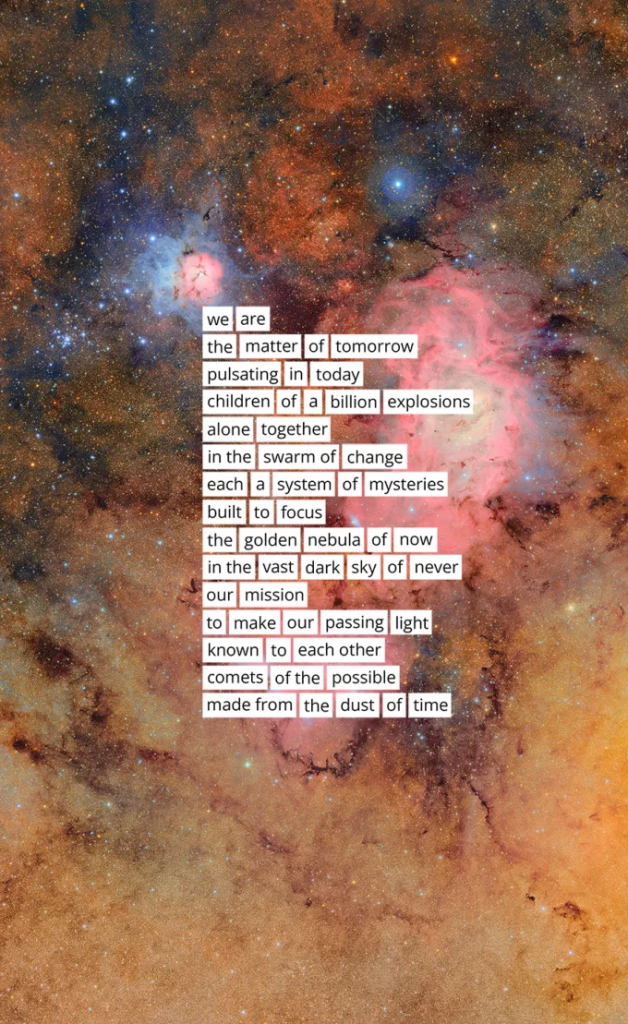
A decade after Vera Rubin returned her borrowed stardust to the universe, the observatory named in her honor opens its oracle eye to the cosmos and blinks back at us the mysteries of ten million bright galaxies. Atop one of the first images captured by the VRO’s 8.4-meter telescope — 678 exposures of the Trifid and Lagoon Nebulae taken over the course of seven hours, two trillion pixels of cosmic truth combined into a single gasp of beauty — I have remixed the text of the National Science Foundation press release into a poem using my bird divination process:
Rising forty feet above the rocky cliffs of Carmel is a great poem of gravity and granite that Robinson Jeffers (January 10, 1887–January 20, 1962), poet laureate of the co-creation of time and mind, composed with his wife Una and their twin sons.
A decade before Carl Jung built his famous stone tower in Zurich and conceptualized the realized self as an elemental stone, Jeffers apprenticed himself to a local stonemason to build Tor House and Hawk Tower. As this rocky planet was being unworlded by its first world war, he set about making “stone love stone.”
Seeing stonecutters as “foredefeated challengers of oblivion” and poets as stonecutters of the psyche, he went on hauling enormous slabs of granite up from the shore, carrying time itself, cupping its twelve consolations in his mortal hands, writing about what he touched and what touched him.
Hawk Tower
OH, LOVELY ROCK by Robinson Jeffers
We stayed the night in the pathless gorge of Ventana Creek, up the east fork. The rock walls and the mountain ridges hung forest on forest above our heads, maple and redwood, Laurel, oak, madrone, up to the high and slender Santa Lucian firs that stare up the cataracts Of slide-rock to the star-color precipices.
We lay on gravel and kept a little camp-fire for warmth. Past midnight only two or three coals glowed red in the cooling darkness; I laid a clutch of dead bay-leaves On the ember ends and felted dry sticks across them and lay down again. The revived flame Lighted my sleeping son’s face and his companion’s, and the vertical face of the great gorge-wall Across the stream. Light leaves overhead danced in the fire’s breath, tree-trunks were seen: it was the rock wall That fascinated my eyes and mind. Nothing strange: light-gray diorite with two or three slanting seams in it, Smooth-polished by the endless attrition of slides and floods; no fern nor lichen, pure naked rock…as if I were Seeing rock for the first time. As if I were seeing through the flame-lit surface into the real and bodily And living rock. Nothing strange… I cannot Tell you how strange: the silent passion, the deep nobility and childlike loveliness: this fate going on Outside our fates. It is here in the mountain like a grave smiling child. I shall die, and my boys Will live and die, our world will go on through its rapid agonies of change and discovery; this age will die, And wolves have howled in the snow around a new Bethlehem: this rock will be here, grave, earnest, not passive: the energies That are its atoms will still be bearing the whole mountain above: and I, many packed centuries ago, Felt its intense reality with love and wonder, this lonely rock.
A generation later, another great poet displaced from the bedrock of belonging by another world war tried to make sense of being human by turning to stone:
STONE by Charles Simic
Go inside a stone That would be my way. Let somebody else become a dove Or gnash with a tiger’s tooth. I am happy to be a stone.
From the outside the stone is a riddle: No one knows how to answer it. Yet within, it must be cool and quiet Even though a cow steps on it full weight, Even though a child throws it in a river, The stone sinks, slow, unperturbed To the river bottom Where the fishes come to knock on it And listen.
I have seen sparks fly out When two stones are rubbed. So perhaps it is not dark inside after all; Perhaps there is a moon shining From somewhere, as though behind a hill — Just enough light to make out The strange writings, the star charts On the inner walls.
And although we are “creatures shaped by the planet’s rocky logic,” we are also creatures shaped by the myriad mercies of time, saved over and over by the leap beyond logic that is trusting time.
FORGIVENESS by Maria Popova
May the tide never tire of its tender toil how over and over it forgives the Moon the daily exile and returns to turn mountains into sand as if to say, you too can have this homecoming you too possess this elemental power of turning the stone in the heart into golden dust.
Every day at sundown I would hear him, the invisible shepherd singing on the other side of the ridge, his song filling the gloaming with the sound of the centuries — the same song his father had sung on that same mountain, and his father’s father, and the generations of shepherds before him, their lives wool on the loom of time weaving the story of a place that is a scale model of the world.
The Bulgaria I grew up in was the poorest country in Europe and the most biodiverse per square kilometer. I spent much of my childhood in its remotest mountains, where my grandparents worked as government-deployed elementary school teachers in largely illiterate villages. My grandmother, now ninety, had grown up in those mountains herself, sharing a single straw bed with her three siblings and a three-room house with her trigenerational family of twelve. There were always animals around — pigs and chickens and goat and cows and oh so many sheep — their rhythms, their needs, their moods intertwined with our own. I feel their absence today and in it a reminder that the world we live in — a world of skyscrapers and screens, sterilized of the nonhuman — is unnatural, impoverished, lonely.
After coming of age in New Zealand and living in Scotland, poet and novelist Kapka Kassabova returned to Bulgaria, where she was born a decade before me, to live in its mountains with the nomadic Karakachan shepherds and their ancient breed of dogs in a remote village brought back from the brink of oblivion by a small retinue of young idealists. The modest life of physical toil and privation recompenses her with a new understanding of the tessellated meanings of loyalty, courage, and love, of what it means to be human and how, once we strip the constellation of complexities and artifices that is the modern self, we can begin to see the world as a whole simpler than its parts, unfinished yet complete. Pouring from the pages of Anima: A Wild Pastoral (public library) — one of those books that leave you taking fuller breaths of life — is an elixir to lift the spell that has us entranced by the cult of more, languishing with the loneliness of not enough in a civilization obsessed with scaling business models, having forgotten that the only thing worth scaling is a mountain. It is a love letter to the Karakachan way of being — to the shepherds who in a lifetime of walking with the animals circumambulate the world more than once with their combined footfall, and to their guard dogs who look part wolf and part teddy bear, their growl a volcano erupting in space, their eyes earnest and knowing; it is a love letter to life itself, to the soul of the world coursing through us, the soul beneath the self.
Kassabova writes:
This job requires three things: liking your own company, liking the animals and liking the outdoors, plus not being afraid of anything.
[…]
We have forgotten that this too is something we can do… walk with animals, live with animals, care for animals and be cared for by them. Even make a living from it. Today, it is just as difficult to make a living from pastoral farming as it is from making noncommercial art, music or literature. You must be fuelled by a devotion that can’t be dampened by rain or burned up by fire.
Those who are willing to live such a life are rewarded with a singular sense of purpose, more transcendence than teleology — a kind of repatriation into the family of things, a benediction of time and a consecration of presence:
It was a soothing monastic monotony, a balm for troubled souls, to know your purpose, follow an itinerary and bring the gang back, tired and satisfied after another day of fulfilling your mission. The days were beads in a rosary that passed through your fingers and you felt their texture and shape. The same, but different.
Morning prayer: milk the sheep and take the flock to pasture. Midday prayer: pladnina. Evening vespers: bring the flock home, feed the dogs. Have a humble supper, lie on your hard bed, then rise early and morning prayer.
Drink your coffee, lace up your shoes, strap on your rucksack, take your stick and in sickness and in health, in rain and sunshine, go. The dogs are waiting. The flock is waiting. The hills are waiting. You are needed.
Karakachan dogs guarding their flock
She comes to contact the life-force of water in Black River and the consolation of stone in Thunder Peak. In that way we have of calling love the longing for our own missing pieces — those parts of ourselves we have repressed or abandoned that another embodies — she falls in love with one of the young shepherds, only to discover alongside his extraordinary vitality the self-abandonment of addiction. She wanders the last indigenous pine forests of the Balkans, slakes her soul on a river so icy blue and clean it feels “like the dawn of the earth,” eats with elders who know the real meaning of might: “There are hundred-year-old trees,” say the Karakachans, “but there is no hundred-year-old power.”
You go up, always up. There is something higher, brighter, more saturated in colour, more perfect in shape, different from yesterday, although it’s the same mountain every day. The dogs are by your side, they too are astonished by this moving picture and sometimes when you walk, you feel so light that your feet barely touch the ground, and you realise that these are some of the happiest days of your life.
One of the hardest things to learn in this life — in this epoch, in this civilization — is that all true happiness is the work of unselfing, the kind of surrender to the will of being that some find in a monastery and some in a mountain. Two centuries after Margaret Fuller’s encountered transcendence on a hilltop, Kassabova recounts a moment of pure presence pulsating with the essence of anima — the Latin root of “animal,” meaning “soul,” which the Karakachans believe is embodied by the wind, the breath of life:
I have no face or body when I lie like this on the boundless bed of the hills, I have nothing at all. I am a vessel through which passes the breath of the world.
[…]
The wind is a messenger travelling from afar and I try to catch the message. Like a word that’s not a word, it is a continuous movement of grass and light, of animals and the sun’s orbit. The wind is alive like a being. The wind is the world’s soul passing over me and its message is this, the world’s soul. Anima.
It passes over us when we lie down with the animals. It touches us and moves on. I don’t know where it goes but one day, I will go with it and not wake up anymore.
Such glimpses of the fathomless totality beyond this boundary of skin and story that we call a self wake us up from the illusion we live with. There are infinitely many peepholes into that grander reality, the smallest flower as good as the largest telescope, a hare as good as a hummingbird. Kassabova reflects on hers:
To keep up with the goats required surrender and a suspension of self, at least self in the modern sense, the self that demands to be at the centre of things and not a companion to a bunch of other animals. But maybe the modern self is not quite real. Maybe its understanding of centre and periphery is an illusion. Maybe it wouldn’t be that difficult to give it up. It might be a relief.
She finds this unselfing to be an exponential surrender — to the mountain, to its time and its timefulness:
The higher you went, the harder physical survival became, the more equal you felt to everything. Personas disappeared and essence remained. There is just one essence in all of life. Anima.
[…]
All our lives, we try to arrive somewhere. Where are my ambitions now? I can’t find them. They were never real. How can something unreal take up so much of my time on earth when the only thing that’s real is this mountain? I can’t fathom it. Pirin was named after the old divinity of thunder and fertility, Perun, who is covered in dragon scales. I can see why humans worshipped mountains when they wandered over nine mountains with their flocks. Thunder Peak is the original cathedral. When Notre Dame burns, Thunder Peak is here every morning.
In the end, she discovers what we all do if we live long enough and deep enough — that it is not what we search for but what finds us, what comes unbidden through the side door of our expectations, through the cracks in our plans, that most rewilds our lives with meaning. And that meaning is always inarticulable, something glowing in the abyss between one consciousness and another, something on which language can only shine a sidewise gleam.
I open my laptop and my fingers struggle to type. They are too thick and have almost forgotten their way around the keyboard. Must I squeeze my experiences into such a small space when they are so much larger? As large and layered as the mountain. I look the same as ever, but I feel like a giant. Something has expanded. I don’t know how to explain this. Between the lower world and the upper world there is a problem of language.
And all the time, the earth is trying to make contact.
[…]
The milk, the blood, the rain. All our lives we perform tasks while waiting for something to click into place. For somewhere to put our love.
[…]
Now… I understand what it’s like to have seen something so true and beautiful, you want everyone to be touched by it. Saved, even.
Researchers are investigating medicines that selectively kill decrepit cells to promote healthy aging — but more work is needed before declaring them a fountain of youth
James Kirkland started his career in 1982 as a geriatrician, treating aging patients. But he found himself dissatisfied with what he could offer them.
“I got tired of prescribing wheelchairs, walkers and incontinence devices,” recalls Kirkland, now at the Mayo Clinic in Rochester, Minnesota. He knew that aging is considered the biggest risk factor for chronic illness, but he was frustrated by his inability to do anything about it. So Kirkland went back to school to learn the skills he’d need to tackle aging head-on, earning a PhD in biochemistry at the University of Toronto. Today, he and his colleague Tamara Tchkonia, a molecular biologist at the Mayo Clinic, are leaders in a growing movement to halt chronic disease by protecting brains and bodies from the biological fallout of aging.
If these researchers are successful, they’ll have no shortage of customers: People are living longer, and the number of Americans age 65 and older is expected to double, to 80 million, by 2040. While researchers like Kirkland don’t expect to extend lifespan, they hope to lengthen “health span,” the time that a person lives free of disease.
One of their targets is decrepit cells that build up in tissues as people age. These “senescent” cells have reached a point — due to damage, stress or just time — when they stop dividing, but don’t die. While senescent cells typically make up only a small fraction of the overall cell population, they accounted for up to 36 percent of cells in some organs in aging mice, one study showed. And they don’t just sit there quietly. Senescent cells can release a slew of compounds that create a toxic, inflamed environment that primes tissues for chronic illness. Senescent cells have been linked to diabetes, stroke, osteoporosis and several other conditions of aging.
These noxious cells, along with the idea that getting rid of them could mitigate chronic illnesses and the discomforts of aging, are getting serious attention. The US National Institutes of Health is investing $125 million in a new research effort, called SenNet, that aims to identify and map senescent cells in the human body as well as in mice over the natural lifespan. And the National Institute on Aging has put up more than $3 million over four years for the Translational Geroscience Network multicenter team led by Kirkland that is running preliminary clinical trials of potential antiaging treatments. Drugs that kill senescent cells — called senolytics — are among the top candidates. Small-scale trials of these are already underway in people with conditions including Alzheimer’s, osteoarthritis and kidney disease.
“It’s an emerging and incredibly exciting, and maybe even game-changing, area,” says John Varga, chief of rheumatology at the University of Michigan Medical School in Ann Arbor, who isn’t part of the TGN.
But he and others sound a note of caution as well, and some scientists think the field’s potential has been overblown. “There’s a lot of hype,” says Varga. “I do have, I would say, a very healthy skepticism.” He warns his patients of the many unknowns and tells them that trying senolytic supplementation on their own could be dangerous.
Researchers are still untangling the biology of senescent cells, not only in aging animals but in younger ones too — even in embryos, where the aging out of certain cells is crucial for proper development. So far, evidence that destroying senescent cells helps to improve health span mostly comes from laboratory mice. Only a couple of preliminary human trials have been completed, with hints of promise but far from blockbuster results.
Even so, Kirkland and Tchkonia speculate that senolytics might eventually help not only with aging but also with conditions suffered by younger people due to injury or medical treatments such as chemotherapy. “There may be applications all over the place,” muses Kirkland.
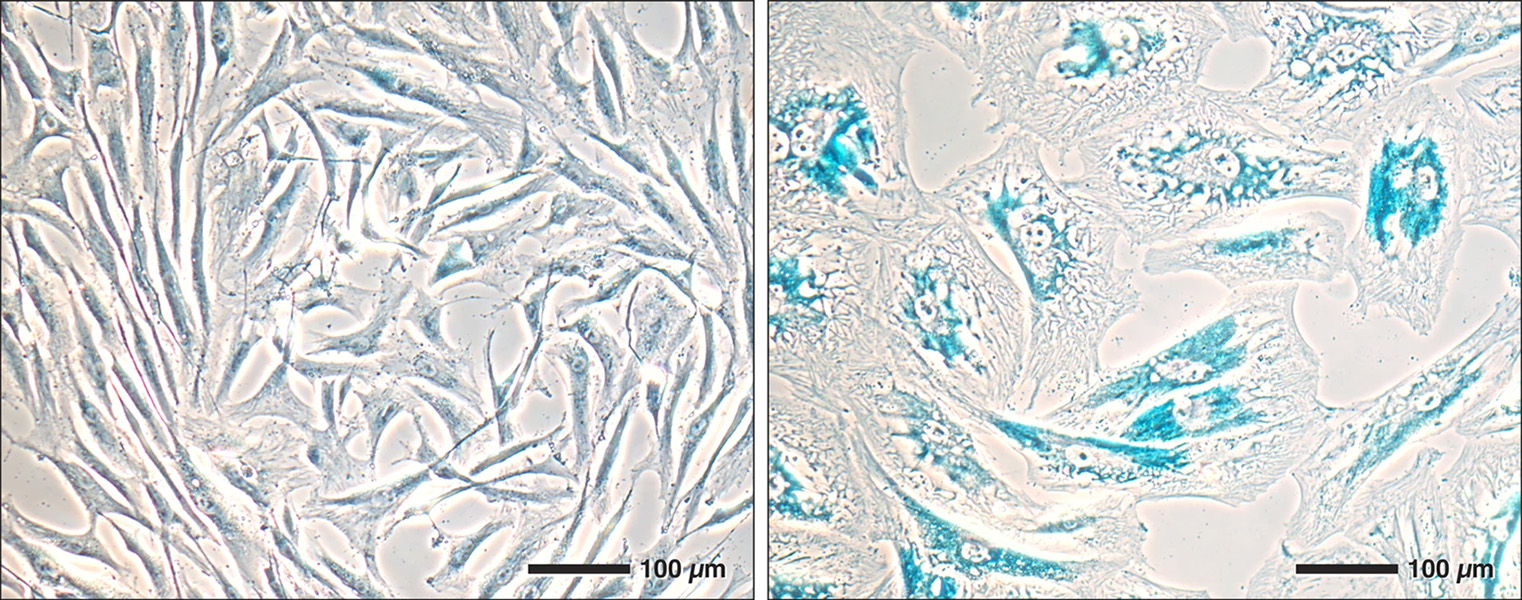
Changes in older cells allow scientists to identify them. As lab-grown cells age (right), they grow larger than young cells (left). Senescent cells produce more of an enzyme, beta-galactosidase, that scientists can stain blue.CREDIT: N. SCHMID ET AL / SCIENTIFIC REPORTS 2019
Good cells gone bad
Biologists first noticed senescence when they began growing cells in lab dishes more than 60 years ago. After about 50 cycles of cells first growing, then dividing, the rate of cell division slows and ultimately ceases. When cells reach this state of senescence, they grow larger and start exhibiting a variety of genetic abnormalities. They also accumulate extra lysosomes, baglike organelles that destroy cellular waste. Scientists have found a handy way to identify many senescent cells by using stains that turn blue in the presence of a lysosome enzyme, called beta-galactosidase, that’s often overactive in these cells.
Scientists have also discovered hundreds of genes that senescent cells activate to shut down the cell’s replication cycle, change their biology and block natural self-destruct mechanisms. Some of these genes produce a suite of immune molecules, growth factors and other compounds. The fact that specific genes consistently turn on in senescent cells indicates there may be more to senescence than just cells running out of steam. It suggests that senescence is a cellular program that evolved for some purpose in healthy bodies. Hints at that purpose have emerged from studies of creatures far earlier in their lifespan — even before birth.
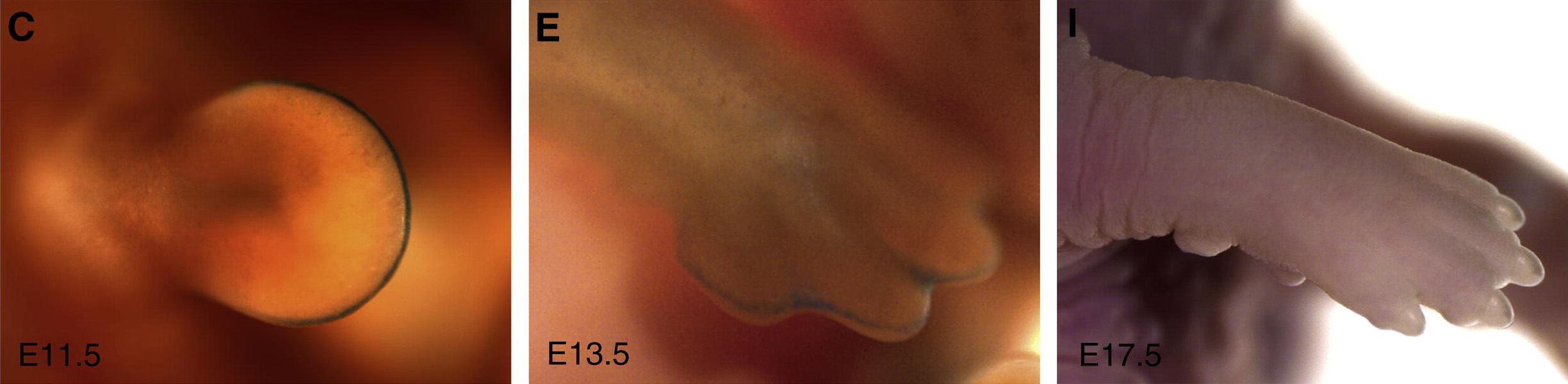
Cell biologist Bill Keyes was working on senescence in embryos back in the early 2000s. When he stained healthy mouse and chick embryos to look for beta-galactosidase, little blue spots lit up in certain tissues. He soon met up with Manuel Serrano, a cell biologist at the Institute for Research in Biomedicine in Barcelona, who’d noticed the same thing. Cells with signs of senescence turned up in the developing brain, ear and limbs, Keyes and Serrano reported in 2013.
Keyes, now at the Institute of Genetics and Molecular and Cellular Biology in Strasbourg, France, focused on mouse and chick embryonic limbs, where a thread of temporary tissue forms across the future toe-tips. Unlike most embryonic cells, the cells in this thread of tissue disappear before the animal is born. They release chemicals that help the limb develop, and once their work is done, they die. At a molecular level, they look a lot like senescent cells.
Senescent cells play a key role in early development, helping to sculpt limbs. This series of images shows the paw of an embryonic mouse as it develops from a round bud (left) to a mittenlike limb (center) to a complete foot (right). Senescent cells, stained blue, rim the tip of the developing paw in the first two panels, but disappear in the third as the animal nears birth.CREDIT: M. STORER ET AL / CELL 2013
Serrano, meanwhile, looked at cells in an organ that exists only in embryos: a temporary kidney, called the mesonephros, that forms near the heart. Once the final kidneys develop, the mesonephros disappears. Here too, beta-galactosidase and other compounds linked to senescence appeared in mouse embryos.
The cells in these temporary tissues probably disappear because they are senescent. Certain compounds made by senescent cells call out to the immune system to come in and destroy the cells once their work is done. Scientists think the short-term but crucial jobs these cells perform could be the reason senescence evolved in the first place.
Other studies suggest that senescent cells may also promote health in adult animals. Judith Campisi, a cell biologist at the Buck Institute for Research on Aging in Novato, California, and others have found senescent cells in adult mice, where they participate in wound healing. Connective-tissue cells called fibroblasts fill in a wound, but if they stick around, they form abnormal scar tissue. During normal wound healing, they turn senescent, releasing compounds that both promote repair of the tissue and call immune cells to come in and destroy them.
In other words, the emergence of senescent cells in aging people isn’t necessarily a problem in and of itself. The problem seems to be that they hang around for too long. Serrano suspects this happens because the immune system in aging individuals isn’t up to the task of eliminating them all. And when senescent cells stay put, the cocktail of molecules they produce, and the ongoing immune response, can damage surrounding tissues.
Senescence can also contribute to cancer, as Campisi has described in the Annual Review of Physiology, but the relationship is multifaceted. Senescence itself is a great defense against cancer — cells that don’t divide don’t form tumors. On the other hand, the molecules senescent cells emit can create an inflamed, cancer-promoting environment. So if a senescent cell arises near a cell that’s on its way to becoming cancerous, it might alter the locale enough to push that neighbor cell over the edge. In fact, Campisi reported in 2001 that injecting mice with senescent cells made tumors grow bigger faster.
Stay in the Know Sign up for the Knowable Magazine newsletter today
Mighty mice
If senescent cells in an aging body are bad, removing them should be good. To test this idea, Darren Baker, a molecular cell biologist at the Mayo Clinic, devised a way to kill senescent cells in mice. Baker genetically engineered mice so that when their cells turned senescent, those cells became susceptible to a certain drug. The researchers began injecting the drug twice a week once the mice turned one year old — that’s about middle age for a lab mouse.
Treated mice maintained healthier kidney, heart, muscle and fat tissue compared with untreated mice, and though they were still susceptible to cancer, tumors appeared later in life, the researchers reported in studies in 2011 and 2016. The rodents also lived, on average, five or six months longer.
These results generated plenty of interest, Baker recalls, and set senescence biology on the path toward clinical research. “That was the boom — a new era for cellular senescence,” says Viviana Perez, former program officer for the SenNet consortium at the National Institute on Aging.
Baker followed up with a study of mice that had been genetically modified to develop characteristics of Alzheimer’s. Getting rid of senescent cells staved off the buildup of toxic proteins in the brain, he reported, and seemed to help the mice to retain mental acuity, as measured by their ability to remember a new smell.
Of course, geriatricians can’t go about genetically engineering retirees, so Kirkland, Tchkonia and colleagues went hunting for senolytic drugs that would kill senescent cells while leaving their healthy neighbors untouched. They reasoned that since senescent cells appear to be resistant to a process called apoptosis, or programmed cell death, medicines that unblock that process might have senolytic properties.
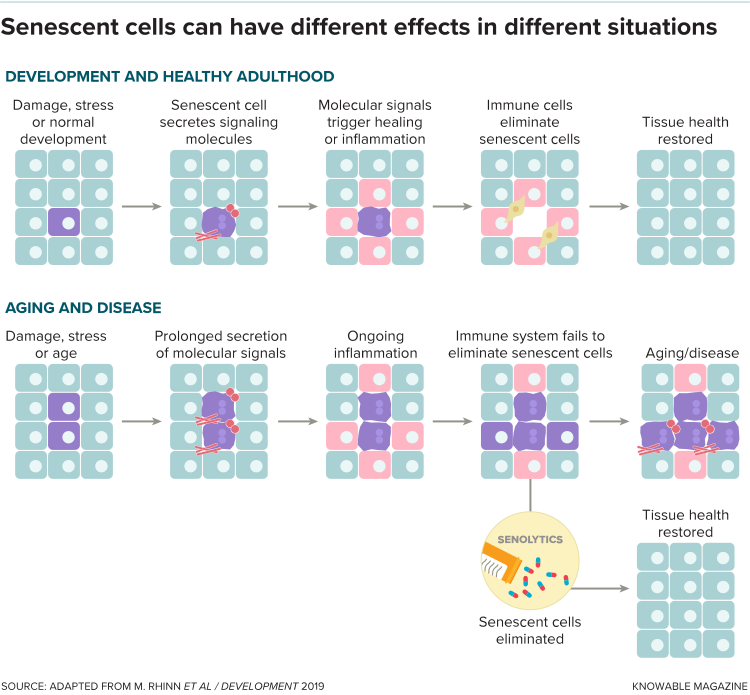
Senescent cells (purple) and the molecules they secrete (red) are beneficial when present for a short time in healthy tissues. These molecules influence the cells around them (pink) in ways that can influence development or promote healing, before being eliminated by immune cells (yellow). However, senescent cells can be harmful when chronically present in aged or damaged tissues. Removing them with senolytic drugs may be a strategy for restoring tissue health.
Some cancer drugs do this, and the researchers included several of these in a screen of 46 compounds they tested on senescent cells grown in lab dishes. The study turned up two major winners: One was the cancer drug dasatinib, an inhibitor of several natural enzymes that appears to make it possible for the senescent cells to self-destruct. The other was quercetin, a natural antioxidant that’s responsible for the bitter flavor of apple peels and that also inhibits several cellular enzymes. Each drug worked best on senescent cells from different tissues, the scientists found, so they decided to use them both, in a combo called D+Q, in studies with mice.
In one study, Tchkonia and Kirkland gave D+Q to 20-month-old mice and found that the combination improved the rodents’ walking speed and endurance in lab tests, as well as their grip strength. And treating two-year-old mice — the equivalent of a 75- to 90-year-old human — with D+Q every other week extended their remaining lifespan by about 36 percent, compared with mice that didn’t receive senolytics, the researchers reported in 2018. Tchkonia, Kirkland and Baker all hold patents related to treating diseases by eliminating senescent cells.
To the clinic
Scientists have since discovered several other medications with senolytic effects, though D+Q remains a favorite pairing. Further studies from several research groups reported that senolytics appear to protect mice against a variety of conditions of aging, including the metabolic dysfunction associated with obesity, vascular problems associated with atherosclerosis, and bone loss akin to osteoporosis.
“That’s a big deal, collectively,” says Laura Niedernhofer, a biochemist at the University of Minnesota Medical School in Minneapolis who is a collaborator on some of these studies and a member of the TGN clinical trials collaboration. “It would be a shame not to test them in humans.”
A few small human trials have been completed. The first, published in 2019, addressed idiopathic pulmonary fibrosis, a fatal condition in which the lungs fill up with thick scar tissue that interferes with breathing. It’s most common in people 60 or older, and there’s no cure. In a small pilot study, Kirkland, Tchkonia and collaborators administered D+Q to 14 people with the condition, three times a week for three weeks. They reported notable improvement in the ability of participants to stand up from a chair and to walk for six minutes. But the study had significant caveats: In addition to its small size and short duration, there was no control group, and every participant knew they’d received D+Q. Moreover, the patients’ lung function didn’t improve, nor did their frailty or overall health.
Niedernhofer, who wasn’t involved in the trial, calls the results a “soft landing”: There seemed to be something there, but no major benefits emerged. She says she would have been more impressed with the results if the treatment had reduced the scarring in the lungs.
Senolytics are being tested to treat a wide variety of conditions in people as part of the Translational Geroscience Network. Dasatinib is a cancer drug, and quercetin and fisetin are natural antioxidants.
Tchkonia and Kirkland are also investigating how space radiation affects indications of senescence in the blood and urine of astronauts, in conjunction with two companies, SpaceX and Axiom Space. They hypothesize that participants in future long-term missions to Mars might have to monitor their bodies for senescence or pack senolytics to stave off accelerated cellular aging caused by extended exposure to radiation.
Kirkland is also collaborating with researchers who are investigating the use of senolytics to expand the pool of available transplant organs. Despite desperate need, about 24,000 organs from older donors are left out of the system every year because the rate of rejection is higher for these than for younger organs, says Stefan Tullius, chief of transplant surgery at Brigham and Women’s Hospital in Boston. In heart transplant experiments with mice, he reported that pretreating older donor mice with D+Q before transplant into younger recipients resulted in the donor organs working “as well or slightly better” than hearts from young donors.
“That was huge,” says Tullius. He hopes to be doing clinical trials in people within three years.
“I think we just don’t know enough about the right drug, the right delivery, the right patient, the right biomarker,” says the University of Michigan’s Varga, who is not involved with Unity. More recently, however, the company reported progress in slowing diabetic macular edema, a form of swelling in the back of the eye due to high blood sugar.
Despite the excitement, senolytic research remains in preliminary stages. Even if the data from TGN’s initial, small trials look good, they won’t be conclusive, says network member Robbins — who nonetheless thinks positive results would be a “big deal.” Success in a small study would suggest it’s worth investing in larger studies, and in the development of drugs that are more potent or specific for senescent cells.
“I’m urging extreme caution,” says Campisi — who is herself a cofounder of Unity and holds several patents related to anti-senescence treatments. She’s optimistic about the potential for research on aging to improve health, but worries that moving senolytics quickly into human trials, as some groups are doing, could set the whole field back. That’s what happened with gene therapy in the late 1990s when an experimental treatment killed a study volunteer. “I hope they don’t kill anyone, seriously,” she says.
Side effects are an ongoing concern. For example, dasatinib (the D in D+Q) has a host of side effects ranging from nosebleeds to fainting to paralysis.
But Kirkland thinks that may not be an insurmountable problem. He notes that these side effects show up only in cancer patients taking the drug regularly for months at a time, whereas anti-senescence treatments might not need to be taken so often — once every two or three months might be enough to keep the population of senescent cells under control.
Another way to reduce the risks would be to make drugs that target senescent cells in specific tissues, Niedernhofer and Robbins note in the Annual Review of Pharmacology and Toxicology. For example, if a person has senescent cells in their heart, they could take a medicine that targets only those cells, leaving any other senescent cells in the body — which still might be doing some good — alone.
For that strategy to work, though, doctors would need better ways to map senescent cells in living people. While identifying such biomarkers is a major goal for SenNet, Campisi suspects it will be hard to find good ones. “It’s not a simple problem,” she says.
A lot of basic and clinical research must happen first, but if everything goes right, senolytics might someday be part of a personalized medicine plan: The right drugs, at the right time, could help keep aging bodies healthy and nimble. It may be a long shot, but to many researchers, the possibility of nixing walkers and wheelchairs for many patients makes it one worth taking.
10.1146/knowable-122122-1
Amber Dance, a contributing writer at Knowable Magazine, looks forward to a long, healthy retirement punctuated by regular anti-senescence treatments.
In “Deep House,” Jeremy Atherton Lin uses the story of his own life as a catalyst for a kaleidoscopic survey of legal flash points regarding gay rights and immigration.
Juan A. Ramírez is a writer and critic who covers arts and culture. His work has appeared in The Times, Vogue, Vanity Fair, GQ, Theatrely and Interview magazine.
June 4, 2025 BUY BOOK ▾ ( NYTimes.com)
When you purchase an independently reviewed book through our site, we earn an affiliate commission.
DEEP HOUSE: The Gayest Love Story Ever Told, by Jeremy Atherton Lin
As with his excellent debut, “Gay Bar: Why We Went Out,” Jeremy Atherton Lin’s sophomore book, “Deep House: The Gayest Love Story Ever Told,” is a fabulously riveting hybrid memoir and queer history lesson. In his first book, Atherton Lin mapped his coming-of-age onto a chronicle of disappearing gay bars around the world. In this new offering, the American writer shares the story of his relationship with his British partner, who remains unnamed, and uses it as a catalyst for a kaleidoscopic survey of legal flash points regarding gay rights and immigration.
“Deep House” focuses on the challenges faced by transnational queer couples before marriage equality. Not only were such couples denied the ability to wed, but with differing citizenships, they also lost a critical pathway to legally reside together in the same country. Atherton Lin situates these couples at the forefront of the fight for gay rights.
He and his partner became one such couple in 1999. The two had met in London three years prior, their immediate attraction intensifying into trans-Atlantic correspondence and eagerly awaited visits across England and Atherton Lin’s native California. During one of their stints in the United States, his partner began feeling, with his trip back to London imminent, that he had “nothing to return to, and everything to stay for,” so he overstayed his tourist visa, and the two began an illicit domesticity in San Francisco.
If the travelogue-style “Gay Bar” prowls through clubs and adventures with thrill-seeking horniness, “Deep House” is denser and written from a quieter space of contemplation. “I want to learn how we arrived here together and find out who traveled first,” Atherton Lin writes. “Allow me to shuffle the cards that were stacked against us.”
That shuffling is free-associative and anecdotal, and allows Atherton Lin a flexibility in his storytelling. He bounces between yarns from his own life, capturing his and his partner’s days living in basement apartments, working video-store jobs and flirting with polygamy, to surfacing tales of the queer people who came before him, including the committed, American-Mexican couple who had to cross the border to Mexico and back every three months to stay in the United States in the 1970s and the drunk Texas horndogs who accidentally toppled the country’s anti-sodomy laws in 2003.
Epochal legal decisions aren’t introduced from a detached, academic perspective, but arise in connection to Atherton Lin’s own life, shared like gossip through the community grapevine. “At the end of April 1997, just after I returned to the States, boyfriends Mark Watson and Ander Da Silva received surprising news,” is how he begins a passage about a British immigration officer who granted his Brazilian lover unauthorized permission to stay in the U.K.
The book juggles an impressive amount of material, though it can sometimes feel uneven, and the memoir passages can verge into indulgence. But that muchness is excused by what emerges to be the author’s larger project: Atherton Lin writes knowing that the history of queer people, as is the case for most marginalized groups, exists between the lines. That, because queerness has been so often and systematically criminalized, queer lives, queer struggles and queer culture are documented furtively or euphemistically, if at all. Backed by a formidable array of sources, he combines the rigorously researched and the deeply personal to implode that gap and fill it with as much detail as possible.
Though it foregrounds L.G.B.T.Q.+ issues in charting his and his partner’s journey, “Deep House” acknowledges that they’ve not been alone in the fight for domestic peace, finding kinship with those affected by interracial restrictions, and even with elders from his Chinese grandparents’ generation, who experienced arranged marriages. Submitting his story to this larger record, he elicits from these anecdotes a human element of randomness; none of these figures chose to make history, but were rather recruited into it.
DEEP HOUSE: The Gayest Love Story Ever Told | By Jeremy Atherton Lin | Little, Brown | 401 pp. | $29
A version of this article appears in print on June 29, 2025, Page 14 of the Sunday Book Review with the headline: Destination Wedding. Order Reprints | Today’s Paper | Subscribe
Explore More in Books
Want to know about the best books to read and the latest news? Start here.
Books Times Readers Are Excited About: Thrillers, literary fiction, history, memoirs and more: Here are the books you’ve saved most to your summer reading lists.



 OH, LOVELY ROCK