“Not knowing what one is doing is no prohibition on doing it. We all grope ahead. ”
–ANNE CARSON
Anne Patricia Carson (born June 21, 1950) is a Canadian poet, essayist, translator, classicist, and professor. Trained at the University of Toronto, Carson has taught classics, comparative literature, and creative writing at universities across the United States and Canada since 1979, including McGill, Michigan, NYU, and Princeton. Wikipedia
“A poet’s work is to name the unnamable, to point at frauds, to take sides, start arguments, shape the world, and stop it going to sleep.”
–SALMAN RUSHDIE
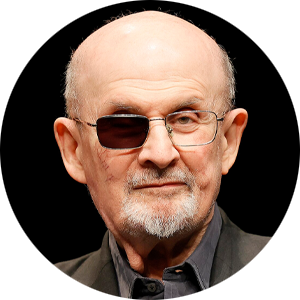
Sir Ahmed Salman Rushdie (born June 19,1947) is an Indian-born British and American novelist. His work often combines magic realism with historical fiction and primarily deals with connections, disruptions, and migrations between Eastern and Western civilizations, typically set on the Indian subcontinent. Wikipedia
The best and the worst of who we are on fully display
JUN 15,2025
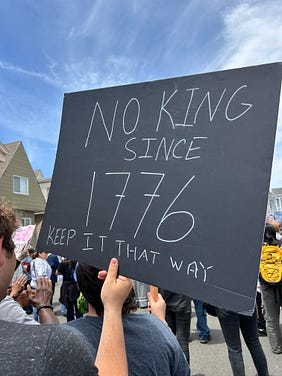
Massive crowds turned up for the NO KINGS DAY rallies around the country on Saturday, while the military parade in Washington was a rained out show that was little more than a $45M ego trip. A parade to celebrate 250 years of the US military as well as Flag Day could have been a very powerful, positive thing – don’t get me wrong. But just parading a bunch of army tanks was not that. It could have been a deep bow of appreciation for the men and women who have served in our military over the last 250 years, and an appropriate celebration of people in uniform today as well as veterans.
But this parade was little more than a gargantuan car show. Trucks, tanks, all sorts of heavy military equipment – see what we got?
Let’s remember that President Trump, when visiting the cemetery of fallen American soldiers at Normandy, was heard to utter, “What was in it for them?” That’s how little appreciation he has for anyone sacrificing their life for the cause of freedom. And how little appreciation he has for freedom itself.
But that was just one of the major events of the weekend.
Around the country, an estimated over ten million people took to the streets to celebrate NO KINGS DAY. That was the true spirit of America on display. Trumpworld’s authoritarian incursion into the sinews of our nation has been deep, from the demolition of important governmental functions and federal agencies to the inhumane treatment of undocumented immigrants. But NO KINGS DAY, regardless how much Trumpworld might try to diminish its significance, was a rousing expression of just what it says: we do have a king, we do not want a king, and we will not be quiet when an American President acts like one.
The spirit of America lay dormant for a long time. No longer.
I’ve been saying for a while that we should not underestimate – not that I think anyone has – the damage this administration has done to the functioning of the U.S. government and the psyche of the country. A disturbing number of people have seemed almost to surrender in advance, saying things like “There’s nothing we can do” or “Well, life went on during the fall of Rome.” That is not the kind of thinking we can afford to indulge right now.
Yes, it’s true that Trumpworld came on strong in those first hundred days. It’s also true that people took a bit of time to process what was going on here. I’ve always said Americans are slow to wake up sometimes. But when we do wake up, we slam it like nobody’s business. And yesterday was a hard slam. It didn’t have to be violent to make its point, and thank God it wasn’t. But it showed Steven Miller and Kristi Noem and the rest of the regime that millions of Americans are watching, and we are not pleased. The Trump gang can pretend not to care about all those rallies, but trust me they do. They had the military on alert should people have given them the slightest opportunity to come in with soldiers to “liberate” the town. There is probably even some level of disappointment that we did not.
But yesterday was just one day. To me, it signified that the resistance has a stronghold. We’re still far from the 2026 midterms, but anything and everything we do to gum the works of an authoritarian regime is an advance. And we cannot let up. As Churchill so famously said, “This is not the end. It’s not even the beginning of the end. But it is, perhaps, the end of the beginning.” Those who organized the NO KINGS DAY protests deserve kudos and gratitude. They made the military birthday party look like the insignificant thing that it was, by the way. And so much for getting rid of waste. That $45M could have provided food for the hungry and healthcare for the sick, but hey, who’s looking?
This weekend also saw tragic events in Minnesota, neither the horror nor the significance of which should be ignored or glossed over. The Democratic former leader of the Minnesota Senate Melissa Hortman and her husband Mark were killed, and State Senator Jerome Hoffman and his wife were shot multiple times but survived. The alleged gunman left behind a kill list of 70 other Democrats he felt should be marked for execution.
So it is in America today.
And here we are. Whether political violence comes from the left or from the right, it is antithetical to everything that as human beings we should tolerate. In the words of Martin Luther King, Jr.,”Silence in the face of evil is itself evil.” We should recognize the danger of these times and commit ourselves to being part of the solution. To do that, we must cultivate a culture of non-violence and love. We must dedicate our lives to the challenge of this moment, participating in every way possible in the creation of a light so great that all darkness shall be cast from our midst.
The spirit of our country took a long nap, but it is dormant no longer. Something important has been activated in America. There are no quick solutions or easy answers. But there are millions of mature and emotionally sober Americans who are willing to go deep, to think about issues we have left too often in the hands of others, to atone in our hearts for the compromise of our own principles that led us to the state we are in today, and to pray with our feet for a reborn and more beautiful America.
It’s not a quick process, but I feel in my heart that it’s begun.
New Thinking Allowed with Jeffrey Mishlove Jun 11, 2025 Peter B. Todd, MAPS, a psychotherapist with a Jungian orientation, is author of The Individuation of God: Integrating Science and Religion. He experienced clinical death, during cardiac surgery, in 2005, and was subsequently revived. He was also a gold medalist at the 1982 Gay Games in San Francisco. In this conversation, rebooted from 2019, he describes the numinous qualities associated with his death experience in 2005. Prior to that experience, he had been at the deathbeds of hundreds of AIDS victims, both in the United States and Australia. At that time, he was already well-versed in the theories of both Carl G. Jung and Pierre Teilhard de Chardin. Therefore, he was already well-prepared for his own death experience. That profound experience awakened in him a desire to serve as an activist for a new theology for the third millennium that would integrate science and religion. New Thinking Allowed host, Jeffrey Mishlove, PhD, is author of The Roots of Consciousness, Psi Development Systems, and The PK Man. Between 1986 and 2002 he hosted and co-produced the original Thinking Allowed public television series. He is the recipient of the only doctoral diploma in “parapsychology” ever awarded by an accredited university (University of California, Berkeley, 1980). He is also the Grand Prize winner of the 2021 Bigelow Institute essay competition regarding the best evidence for survival of human consciousness after permanent bodily death. He is Co-Director of Parapsychology Education at the California Institute for Human Science. (Recorded on September 6, 2019)
These are just some of them. But before we can define what Anarchism is we have to address what people often wrongly think it is.
What Anarchism Is Not
Anarchism Is Not Chaos. It’s not people running around with no clue what to do, although that is an option for you if you really want to. In fact one of the complaints Anarchists have about Anarchism is that it can easily become over-organised and be too obsessed with meetings, discussion and agreements. Oh the horror!
Anarchism Is Not Violent. Really! However, this admittedly one takes a bit of qualification. Yes some individual Anarchists have seen themselves as soldiers in wars against oppressors, and some fascists have literally gone to war against Anarchists and they have defended themselves, the Spanish Civil War being an example of this. So there can be violence in protecting yourself, and there can be violence involved in bringing down dictators, but there are also pacifist Anarchists, and the most radical Anarchists prefer to focus on building a peaceful world, if only they’d be allowed to do so.
Anarchism Is Not Punk Music. It’s not mandatory – especially the Sex Pistols (they didn’t even know what the word meant when they sang Anarchy in the UK), whereas the song Mack The Knife was written by an Anarchist (Berthold Brecht). So crooners can be Anarchists too.
Anarchism Is Not Veganism. Although Anarchist do tend to spend time thinking about the ethics of their actions and what the most moral choices to make are, so they have a higher than average number of vegans and vegetarians amongst them – but there certainly are carnivores among its numbers too.
Anarchists are like you and me, well at least like me, because I’m an Anarchist2. They might be your doctor, teacher, mechanic, or favourite author. For some reason there are a lot of Anarchist sci-fi authors.3
Anarchists You Might Know
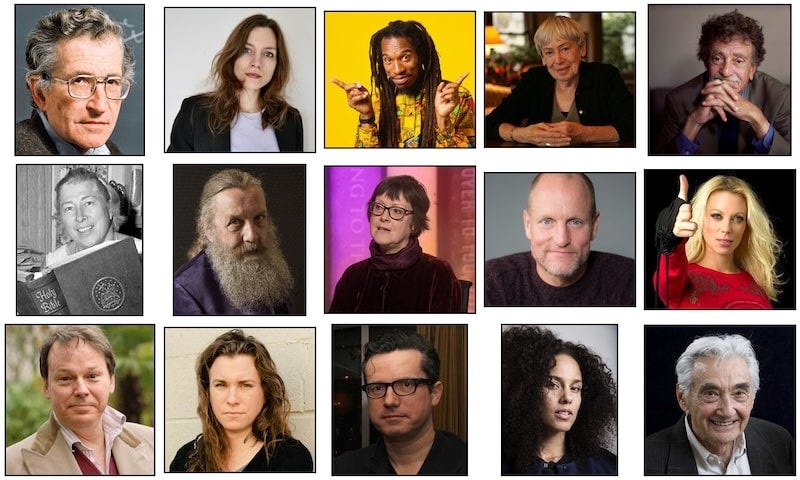
Like me Anarchists come in all kinds, shades and sizes. Here are some more contemporary Anarchist, a few of whom you may be familiar with:4
20th-21st Century Anarchists
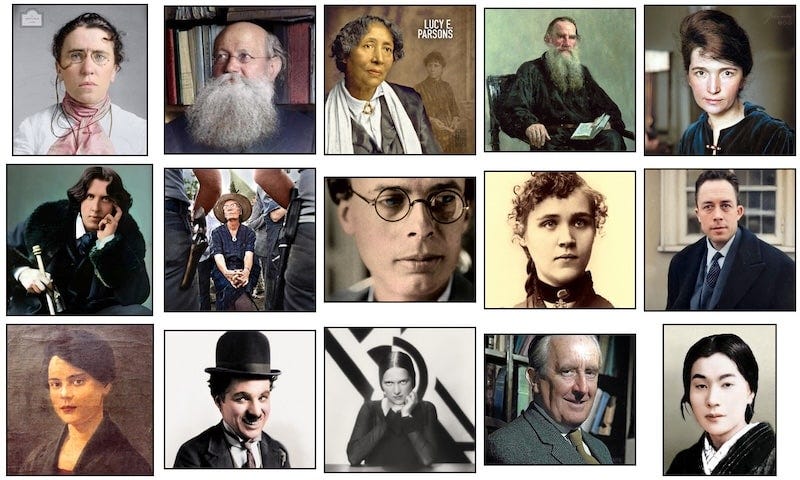
See, they really do look like the rest of us. Some well known real-life Anarchists of the past include:5
19th-20th Century Anarchists
But to Anarchists these are just other Anarchists. None of them hold any special position, even if some are admired for their contributions.
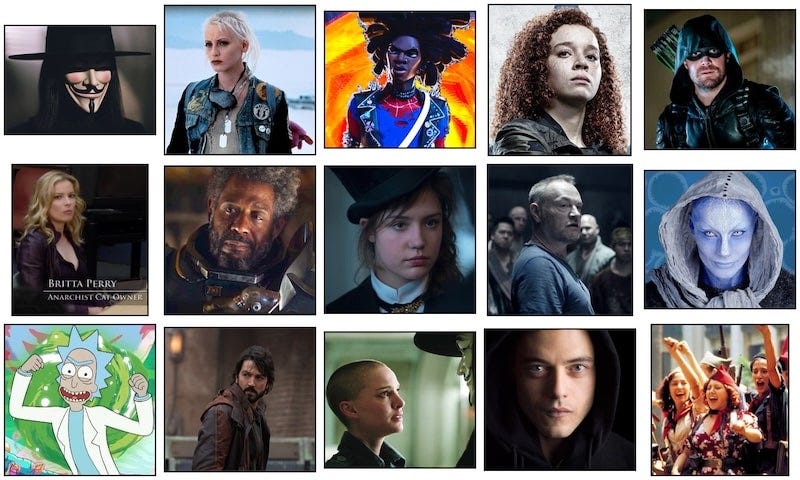
Anarchists are also often portrayed in movies and television as the bad guys, but not always:6
Fictional characters are not always the best examples, and the point of Anarchy is to not be ruled or defined by others. However, I thought it would be useful to show (mostly) positively portrayed anarchists as well as some real examples to help dispel the negative images some have about Anarchists.
What Anarchism Is
David Graeber argued that if we took seriously the advice our mothers gave us that ‘two wrongs don’t make a right’ then we’d all inevitably become Anarchists. In Fact You Might Already Be An Anarchist!
One of the earliest definer of Anarchism called it the marriage of liberty and equality. I myself have argued Anarchism Is Love … in action, love given freely – but I realise it isn’t a broadly accepted definition.
So what is Anarchism then?
Anarchism is people making voluntary choices without coercion or fear of violence.
Anarchism is people associating and organising with others freely – or not.
Anarchism is free choices without compulsion or coercion – Anarchist are fundamentally against using force to make people do things.
Some positive phrases you might associate with Anarchism include:
Mutual Aid
Food Not Bombs
A Better World Is Possible
Free Association
Solarpunk
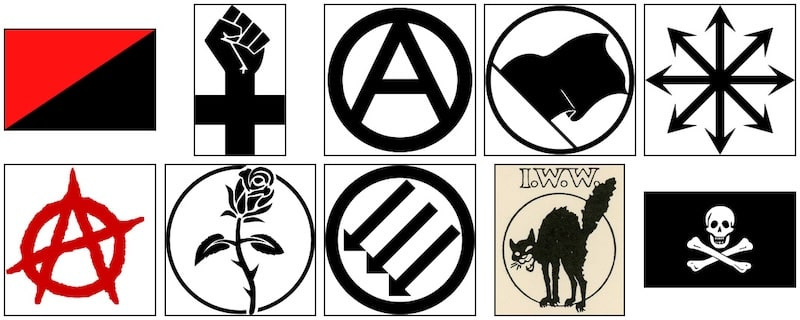
Some symbols you may associate with it include:
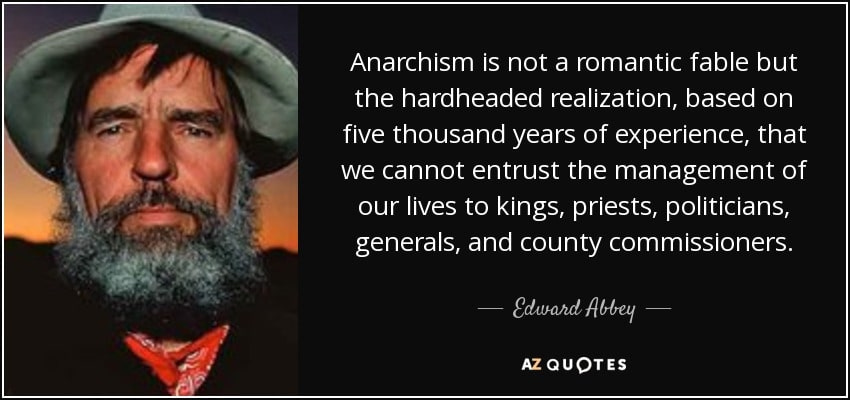
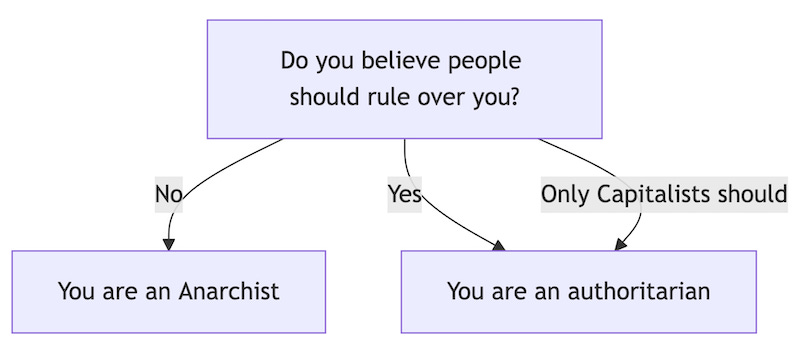
When it comes down to it there’s one definition of Anarchism all Anarchists and their detractors agree on: Anarchism is anti-hierarchy – it’s in the meaning of the word.
Anarchists don’t want to be forced to do things or force other people to do things.
Anarchists don’t want to rule over others or be ruled over by others.
Anarchists don’t want people to suffer unnecessarily or to be deprived possible opportunities.
This is why Anarchists reject all enforced domination – whether it be the kind exercised by Kings, Presidents, Prime Ministers or Popes, or the kind that comes from Bosses, Landlords or anyone you have to please, appease or pay to survive or thrive.
Political Or Not?
This is why Anarchism is anti-state. Far from being representatives of us, politicians end up being mini-rulers looking after the interests of their corporate sponsors, they draw up artificial lines called borders and keep us within them, under their power to decide laws for us, and to order others to enforce them, even when those laws are not in our interests.
Just as politicians always end up serving money, so do the rest of us in order to survive, which is why Anarchists are also anti-Capitalist – they don’t believe meeting peoples needs should be based on affording food or housing, or that others should be able to decide if you eat based on you working for them. That doesn’t mean Anarchists want to sit around and do nothing, only that they don’t want to be forced by fear of hunger or homelessness to work for someone who takes away the value of most of what they produce and uses that wealth to rule over them.
Why do Anarchists hate Capitalism so much? Well, really they’d just like it to be irrelevant – they don’t want people’s worth judged by their monetary value, or peoples needs to be placed behind paywalls – especially as there is enough for all, but as we are likely to destroy the world if we keep up this Capitalism experiment it is about time we found an alternative.
Anti-Politics
So Is Anarchism a political ideology then?
If you see politics as being about political parties and governments running things then Anarchism is anti-political. However, if you see politics as being about fighting for your rights to party, or anything else you want to do, then it is extremely political.
So where does Anarchism sit in the Left right political spectrum?
Well that depends on how you define the Left and Right. The traditional left / right line had slave owning aristocrats on the furthest right, conservatives next to them, liberals around the middle, Social Democrats then Socialists to the left, followed by Anarchists, not that many of them were involved in state politics. Note: Some Anarchists like Post-Left-Anarchists or Anarchist-Without-Adjectives reject the Left-Right spectrum altogether.
On the political compass Anarchist are in the bottom-left as far as you can go, because they want the most freedom with the least authoritarianism. Their mortal enemies are fascists, although they don’t get on with authoritarians (such as Stalinists also known as Tankies) because authoritarians like to kill Anarchists, and thats usually not a recipe for a good friendship.
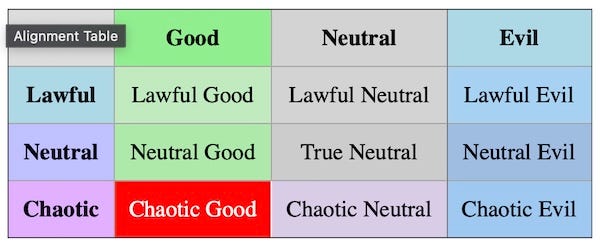
The real question for our more geeky readers is where Anarchism fits in the Dungeons & Dragons character alignment chart?
Anarchist wizards and warriors would be classed as Chaotic Good – us Anarchists – even mythological ones – might baulk at the use of the word chaotic, but the last thing Anarchists want to be called is Neutral.
The Impossible Dream?
But isn’t Anarchism impossible? A world without rulers? How would that work?
In this area Anarchists have history on their side, the majority of human history, and some specific civilisations of millions of people that lasted longer than Capitalism has or is likely to. It has worked quite well, and it still does in many places. In fact you are probably already practising it in your personal life at least in some areas. Your friendships and relationships aren’t based on hierarchy, but free association and mutual aid to one another
Some Historical Examples of non-hierarchal societies include:
Medieval Iceland’s Commonwealth (930-1262) – decentralised law without state.
Pre-colonial Indigenous American societies (Haudenosaunee Confederacy, 1142-1450) – consensus democracy.
The Hutterites (1528-present) have maintained successful communal living with shared property and technological adaptation across five centuries and multiple countries, with hundreds of colonies still thriving today.
Revolutionary Catalonia (1936-1939) – worker self-management in Revolutionary Spain.
Free Territory of Ukraine (1918-1921) – an anarchist society opposed by the Soviet Union.
Some Current Examples Include:
Zapatista communities (Chiapas, Mexico, 1994-present) – an autonomous self-governing region.
Rojava (Northern Syria, 2012-present) – democratic confederalist region.
Marinaleda (Spain, 1979-present) – co-operative village economy.
Twin Oaks (USA, 1967-present) – income-sharing commune.
What does Anarchism offer the world? A world in which everyone eats, sleeps with a roof over their head, works a hell of a lot less, and has far less reason or incentive to kill eachother, or themselves for that matter. A Better World Is Possible.
Anarchist Utopias
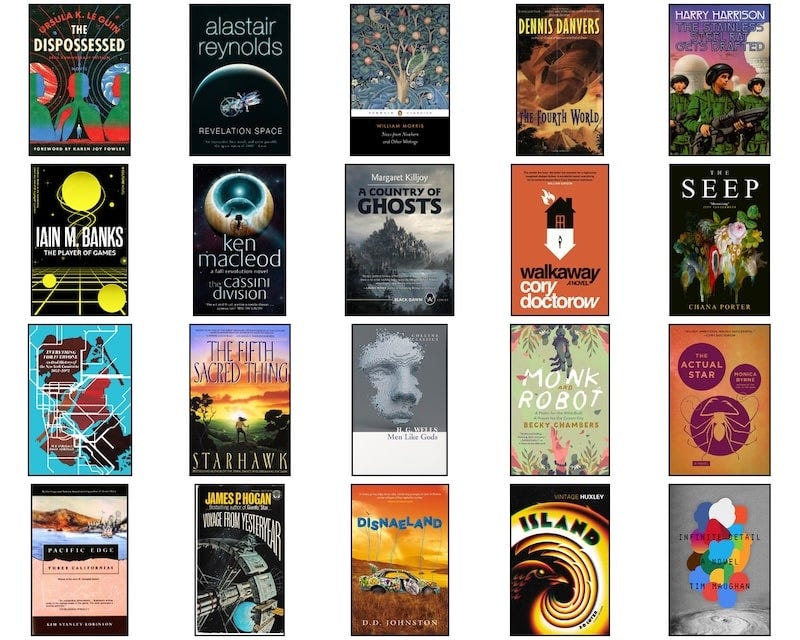
Find it hard to imagine? There are many famous science fiction novels which look at future Anarchist possibilities from the days of H.G. Wells up to more modern award-winning authors like Becky Chambers:7
Anarchist Utopian novels
Revolution Now (Or Eventually)
So when will this Anarchist utopia happen?
If I was a betting man I’d bet it will happen either in the next five years or the next five hundred. Major rapid social upheaval and revolutionary change can happen quickly, other changes often happen at a more gradual, evolutionary pace.
But one thing seems certain – we are running out of time to do it the ‘easy’ way, the earth isn’t going to put up with us destroying nature indefinitely. Maybe it will be easier to build in the ruins of a wrecked earth, but I’d rather there be a nice peaceful transition in the shorter term. However it happens, there are a lot of ideas on that.
Anarchism is useful now. It helps us to examine our relationship to power and how power is used in our lives and relationships, it helps us to see possibilities outside of treating things and people as capital, and helps us to build something better in the here and now with those who share this vision. After all, what is the worst that could happen if you try and live a life free from domination and capitalism as much as possible, you might just make some friends, show and receive some kindness, and be more at peace. That doesn’t sound so bad does it?
Anarchism In Other Words
But if you wanted to avoid the Anarchist label there is no compulsion for you to call yourself that. Here are a few other suggestions:
Acracian – It sounds like an inhabitant of a mythical land, Acracia comes from the Greek: ‘a’ = without, ‘kratos’ = rule, or hierarchal authority.
Solidarityist – Because people can only have true solidarity if they are equal in liberty and equality with each other.
Eutopianist – From the latin ‘Eu’ meaning good – literally a belief in a Good Place.
Equitarian – A believe not just in equality but in fairness.
Liberationist – I heard this used recently and it has become one of my favourites. It fits well because Anarchists want people to be liberated from every form of oppression and domination.
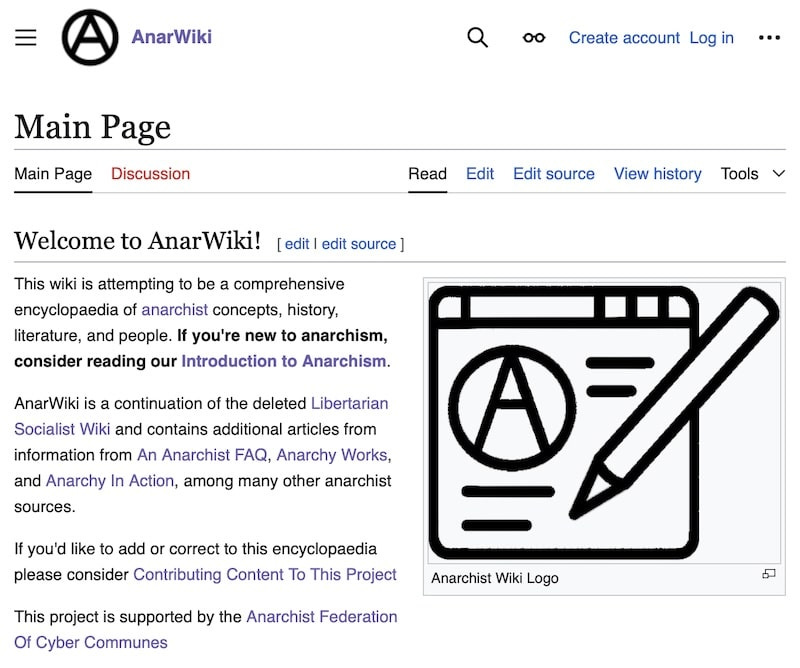
AnarWiki
Want to learn more?
Theres a new Wiki in town – AnarWiki – the Anarchist Wiki – it is still in it’s early stages, but already has a few hundred articles that may be of interest.
Anarchists were so crafty they stole the word ‘Libertarian’ about 150 years before the right-wing pro-Capitalist Libertarian party used it – I guess they must have had a time machine or could look into the future, if only they’d trademarked it back then! Modern-day right-wing pro-capitalist so called Libertarians are not Anarchists, Most of them are Minarchists at best, that is a believer in a minimal state, because they believe in some form of capital hierarchy and are often willing to accept some power hierarchies to protect their capital.
I’m also a Socialist and a Communist. Anarchism is a form of Libertarian Socialism because (stateless) Socialism is workers organising themselves and working for themselves and each other. Anarchism is also (usually) a form of Communism because Communism – despite what you’ve been told – is stateless, it has no nations, rulers or borders. So most (but certainly not all) Anarchists believe in a form of Anarcho-Communism.
I’d argue it’s because imagination breeds compassion, and compassion breeds empathy, and empathy breeds a desire for equality, and every other system puts qualifications and limits on the extent of that compassion and equality.
Noam Chomsky, Sophie Scott-Brown, Benjamin Zephaniah, Ursula K. Le Guin, Kurt Vonnegut, Madeline Maury O’Hair, Alan Moore, Ruth Kinna, Woody Harrelson, Angela Gossow, David Graever, Laura Jane Grace, Ross Carne, Alicia Keys, Howard Zinn.
Emma Goldman, Peter Kropotkin, Lucy Parsons, Leo Tolstoy, Margaret Sanger, Oscar Wilde, Dorothy Day, Aldous Huxley, Voltairine De Cleyre, Albert Camus, Virgilia-Dandrea, Charlie Chaplin, Ethel Mannin, J.R.R. Tolkien, Itō Noe. I meant to add Berthold Brecht and George Orwell too.
V (V For Vendetta), Tank Girl, Hobie Brown / Spider Punk (Into The Spider-Verse), Flag Smasher (Marvel), Green Arrow (D.C.), Britta Perry (Community), Saw Gerrera (Andor), Judith Lorillard (The Anarchists), Anderson Dawes (The Expanse), Pa’u Zotoh Zhaan (Farscape), Rick Sanchez (Rick & Morty), Cassian Andor (Rogue One), Evey Hammond (V For Vendetta), Elliot Alderson (Mr. Robot), Libertarias. I also meant to include forgot to include the Fraggles from Fraggle Rock, Takeshi Kovacs from Altered Carbon, and Cosmo from Sneakers. Note: I’m not saying all of these are accurate or positive portrayals of Anarchists or Anarchism, but I thought they would be faces some who watch movies and television might be familiar with that they didn’t realise were meant to be Anarchists.
The Dispossessed by Ursula K. Le Guin, Revelation Space by Alastair Reynolds, News From Nowhere by William Morris, The Fourth World by Dennis Danvers, The Stainless Steal Rat Gets Drafted by Harry Harrison, The Culture Series by Iain M. Banks, The Cassini Division by Ken MacCleod, A Country Of Ghost by Margaret Killjoy, Walkaway by Cory Doctorow, The Seep by Chana Porter, Everything For Everyone by Monia Byrne, The Fifth Sacred Thing by Starhawk, Men Like Gods by H.G. Wells, Monk & Robot by Becky Chambers, The Actual Star by, Pacific Edge by Kim Stanley Robinson, Voyage From Yesteryear by James P. Hogan, Disnaeland by D.D. Johnston, Island by Aldous Huxley, Infinite Detail by Tim Maughan.
The world is facing a catastrophic mental health crisis. From the boardroom to the school yard, mental health is spiraling out of control with a record number of mental issues being reported. The Silent Pandemic offers new solutions including tapping into our spirituality and innate creative potential.
An impressive collection of international contributors address altered states of consciousness from the perspectives of history, evolution, psychology, culture, literature, human biology, contemporary science, and society, seeking to illuminate the causes, effects, and meanings of altered consciousness.
The Edgar Cayce material offers a fresh and fascinating perspective on the supernatural realms and its inhabitants, exploring angels, brownies, fairies, dark forces and more. Van Auken’s easy-to-read writing style draws you in.
Chasing the Cure tells the story of how Dr. Bengston discovered and developed his healing talent; how he pursued it through laboratory research despite the heated skepticism of scientists who dismissed his results as “too good to be true;” and how he began to gather high-level support. It also contains a teaching supplement, describing Dr. Bengston’s healing methods.
If you find yourself in an unexpected extreme situation—while wilderness camping, hiking or adventuring off the beaten path—a fundamental understanding of your surroundings can make the difference between life and death. By harnessing the powers of nature, the ninja built a legendary reputation as survivalists with an ability to thrive in even the most inhospitable situations. By studying their ancient philosophy and techniques, alongside modern science, you can prepare yourself to survive in any outdoor environment.
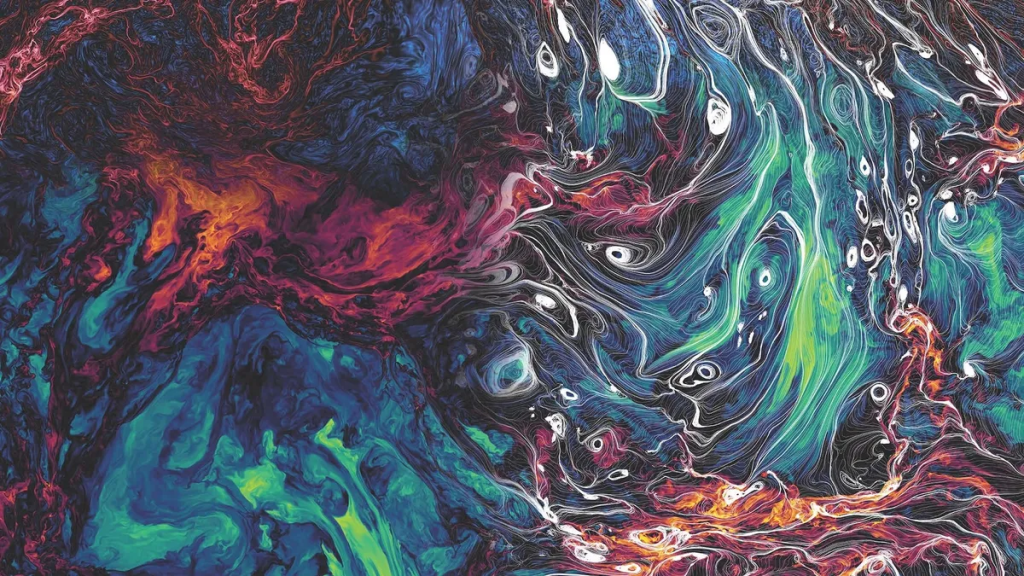
Turbulence, also known as plasma turbulence in space, is a chaotic state of motion within the interstellar medium (ISM), the space between stars. This turbulence, driven by Alfven waves (named after the Swedish, Nobel laureate plasma physicist), is a major factor in shaping star formation, the behavior of magnetic fields, and the structure of galaxies. This image shows that even so-called empty space is incredibly dynamic. (From New Thinking Allowed)
Jun 12, 2025David Sudbury spent his entire childhood living in fear. Today, he is a Jammies Survivor. Become an Onion member while it’s still optional. https://membership.theonion.com/?camp…
The best measure of serenity may be our distance from the self — getting far enough to dim the glare of ego and quiet the din of the mind, with all its ruminations and antagonisms, in order to see the world more clearly, in order to hear more clearly our own inner voice, the voice that only ever speak of love.
It is difficult to achieve this in society, where the wanting monster is always roaring and the tyranny of should reigns supreme.
The great paradox of our time is that the more they seem like a luxury in a world of war and want, the more of a necessity they become to the survival of our souls.
Pico Iyer, that untiring steward of the human soul, liberates the possibility imprisoned in the paradox with his slender and splendid book Aflame: Learning from Silence (public library) — a reckoning with the meaning of life drawn from his time spent in a Benedictine monastery on a journey toward inner stillness and silence, along which his path crosses those of those of fellow travelers in search of unselfing: a 100-year-old Japanese monk and a young Peruvian woman with a love of Wittgenstein (who worked as a gardener in a monastery himself), the Dalai Lama and Leonard Cohen, a middle-aged corporate refugee “red-cheeked and glowing with life” and a white-haired French-Canadian widow with a spirit that “keeps shining, like a candle in the fog.”
He paints the portal through which he enters what is both an enchantment and an annealing of reality:
The road looks milky in the moonlight. The globe feels rounded as I’ve never seen it elsewhere. Stars stream down as if shaken from a tumbler. Somewhere, a dog is barking. Taillights disappear around the turns twelve miles to the south. Strange, how rich it feels to be cleansed of all chatter. That argument I was conducting with myself on the drive up, that deadline next week, the worries about my sweetheart in Japan: gone, all gone. It’s not a feeling but a knowing; in the emptiness I can be filled by everything around me.
To contact that emptiness is to realize that we spend our lives trying to find ourselves, only to discover that the self is precisely what stands between us and being fully alive, what severs our consanguinity with star and stone, with mycelium and mourning dove. This is why an “occasion for unselfing,” in Iris Murdoch’s lovely term, is no small gift — one only ever conferred upon us not by seeking and striving but, in Jeanette Winterson’s lovely term, “active surrender.” We may come to it (in art, in music, in nature), or it may come to us (in cataclysm, in love, in death). Iyer comes to it in the silence of the monastery — which is “not like that of a deep forest or mountaintop” but “active and thrumming, almost palpable” — and it comes to him redoubled:
Why am I exultant to find myself in the silence of this Catholic monastery? Maybe because there’s no “I” to get in the way of the exultancy. Only the brightness of the blue above and below. That red-tailed hawk circling, the bees busy in the lavender. It’s as if a lens cap has come off and once the self is gone, the world can come flooding in, in all its wild immediacy.
[…]
Such a simple revolution: Yesterday I thought myself at the center of the world. Now the world seems to sit at the center of me.
And then the world intrudes — his mother is felled by stroke, a fire consumes his home, a pandemic engulfs the globe. But what silence and solitude end up teaching him, end up teaching anyone who enters them, is that what seems like an assault on our best laid plans, an obstacle along the way of life, is the way itself: experiences that wake us up from “sleepwalking through life” and bring us closer not only to ourselves but to each other. Iyer writes:
In the solitude of my cell, I often feel closer to the people I care for than when they’re in the same room, reminded in the sharpest way of why I love them.
[…]
As the days mount in silence, I’m quickly freed of most of my preconceptions. A monk, I see, is not someone who wishes to live peacefully and alone; in truth, he exists in a communal web of obligations as unyielding as in any workplace, and continuing till his final breath.
In the fathoming of silence, he learns that “the best in us lies deeper than our words.” In the austerity of the monastic life, he learns that “luxury is defined by all you don’t need to long for,” that retreat “is not so much about escape as redirection and recollection.” He reflects:
One kind of asceticism comes in the letting go of certainties, and of any notion that you know more than life does.
There is but one possible action out of that realization: surrender, which he discovers it the only point of being there — “simply, systematically picking apart every inconstancy to remind us that we cannot count on anything other than a mind that is prepared to live calmly with all that it cannot control.”
In the end, we are reminded that to be in silence, to be in solitude, to be in surrender amid a fragile world is not defeatism but an act of courage and resistance, not escapism but the widest-eyed realism we have:
Some nights, of course, I still wake up in the dark, unable to sleep… Chaos and suffering seem endless. Then I recall the sun burning on the water far below and feel part of something larger in which nothing is absolute or final.
[…]
I watch the golden light of early morning irradiate the hills, while valleys remain in deepest shadow. I turn to see the sun scintillant on the ocean in the distance, the sky so sharp and blue I can make out the ridges in the islands far beyond.
Born in present-day Iran (then Persia) months after the end of the First World War and raised on a farm in present-day Zimbabwe (then Rhodesia), Doris Lessing (October 22, 1919–November 17, 2013) was fourteen when she dropped out of school and eighty-eight when she won the Nobel Prize for Literature, her long life spent writing keys to “the prisons we choose to live inside.”
In 1957 — the year the British government decided to continue its hydrogen bomb tests, the year the pioneering Quaker X-ray crystallographer Kathleen Lonsdale composed her short, superb insistence on the possibility of peace — Lessing examined the responsibility of the writer in a precarious and fragile world menaced by dark forces, a world in eternal need of those lighthouses we call artists.
Doris Lessing
In what would become the title essay of her collection A Small Personal Voice (public library) — an out-of-print treasure I chanced upon at a used bookstore in Alaska — she writes:
Once a writer has a feeling of responsibility, as a human being, for the other human beings he influences, it seems to me he must become a humanist, and must feel himself as an instrument of change for good or for bad… an architect of the soul…
But if one is going to be an architect, one must have a vision to build towards, and that vision must spring from the nature of the world we live in.
In a passage speaking of her time and speaking to ours, evocative of what James Baldwin so astutely observed in his magnificent essay on Shakespeare (“It is said that his time was easier than ours, but I doubt it — no time can be easy if one is living through it.”), she adds:
We are living at a time which is so dangerous, violent, explosive, and precarious that it is in question whether soon there will be people left alive to write books and to read them. It is a question of life and death for all of us… We are living at one of the great turning points in history… Yesterday, we split the atom. We assaulted that colossal citadel of power, the tiny unit of the substance of the universe. And because of this, the great dream and the great nightmare of centuries of human thought have taken flesh and walk beside us all, day and night. Artists are the traditional interpreters of dreams and nightmares and this is no time to turn our backs on our chosen responsibilities, which is what we should be doing if we refused to share in the deep anxieties, terrors, and hopes of human beings everywhere.
She distills the essence of our task in troubled times:
The choice before us… is not merely a question of preventing an evil, but of strengthening a vision of good which may defeat evil.
[…]
There are only two choices: that we force ourselves into the effort of imagination necessary to become what we are capable of being; or that we submit to being ruled by the office boys of big business, or the socialist bureaucrats who have forgotten that socialism means a desire for goodness and compassion — and the end of submission is that we shall blow ourselves up.
Although the looming apocalypse of Lessing’s time was nuclear and that of ours is ecological, the experience she describes is familiar to anyone alive today and awake enough to the world we live in:
Everyone in the world now has moments when he throws down a newspaper, turns off the radio, shuts his ears to the man on the platform, and holds out his hand and looks at it, shaken with terror… We look at our working hands, brown and white, and then at the flat surface of a wall, the cold material of a city pavement, at breathing soil, tres, flowers, growing corn. We think: the tiny units of matter of my hand, my flesh, are shared with walls, tables, pavements, tress, flowers, soil… and suddenly, and at any moment, a madman may throw a switch and flesh and soil and leaves may begin to dance together in a flame of destruction. We are all of us made kin with each other and with everything in the world because of the kinship of possible destruction.
Noting that history has rendered not only plausible but real “the possibility of a madman in a position of power,” she holds up a clarifying mirror:
We are all of us, at times, this madman. Most of us have said, at some time or another, exhausted with the pressure of living, “Oh for God’s sake, press down the button, turn down the switch, we’ve all had enough.” Because we can understand the madman, since he is part of us, we can deal with him.
Observing that we will never be safe until we bridge the gap between public and private conscience, she returns to the role of the artist in a world haunted by the madman’s hand on the button:
The nature of that gap… is that we have been so preoccupied with death and fear that we have not tried to imagine what living might be without the pressure of suffering. And the artists have been so busy with the nightmare they have had no time to rewrite the old utopias. All our nobilities are those of the victories over suffering. We are soaked in the grandeur of suffering; and can imagine happiness only as the yawn of a suburban Sunday afternoon.
Indicting as cowardice our reflexive ways of confronting the gap — by indulging in “the pleasurable luxury of despair,” or with hollow manifestos and platitudes that “produce art so intolerably dull and false that one reads it yawning and returns to Tolstoy” — Lessing locates between them the still point of courage:
Somewhere between these two, I believe, is a resting point, a place of decision, hard to reach and precariously balanced. It is a balance which must be continuously tested and reaffirmed. Living in the midst of this whirlwind of change, it is impossible to make final judgments or absolute statements of value. The point of rest should be the writer’s recognition of man, the responsible individual, voluntarily submitting his will to the collective, but never finally; and insisting on making his own personal and private judgments before every act of submission.
[…]
We are all of us, directly or indirectly, caught up in a great whirlwind of change; and I believe that if an artist has once felt this, in himself, and felt himself as part of it; if he has once made the effort of imagination necessary to comprehend it, it is an end of despair, and the aridity of self-pity. It is the beginning of something else which I think is the minimum act of humility for a writer: to know that one is a writer at all because one represents, makes articulate, is continuously and invisibly fed by, numbers of people who are inarticulate, to whom one belongs, to whom one is responsible.
Noting that the artist — unlike the propagandist, unlike the journalist, unlike the politician — is always communicating “as an individual to individuals, in a small personal voice,” she prophecies the age of Substack:
People may begin to feel again a need for the small personal voice; and this will feed confidence into writers and, with confidence because of the knowledge of being needed, the warmth and humanity and love of people which is essential for a great age of literature.
If you are here at all, reading this, you are feeding the confidence of this one small personal voice while also feeding that part of you refusing the conformity and commodified despair of the stories sold by those who make themselves rich by impoverishing our imagination of the possible.
Consciousness, spirituality, biography, sexuality, androgyny, futurism, space, the arts, science, astrology, democracy, humor, books, movies and more







 The road looks milky in the moonlight. The globe feels rounded as I’ve never seen it elsewhere. Stars stream down as if shaken from a tumbler. Somewhere, a dog is barking. Taillights disappear around the turns twelve miles to the south. Strange, how rich it feels to be cleansed of all chatter. That argument I was conducting with myself on the drive up, that deadline next week, the worries about my sweetheart in Japan: gone, all gone. It’s not a feeling but a knowing; in the emptiness I can be filled by everything around me.
