How America Can Avoid Becoming Russia

Political pressure must be brought to bear—through the courts, the press, and the states, but also applied to legislators while they still have any power left.
By Garry Kasparov

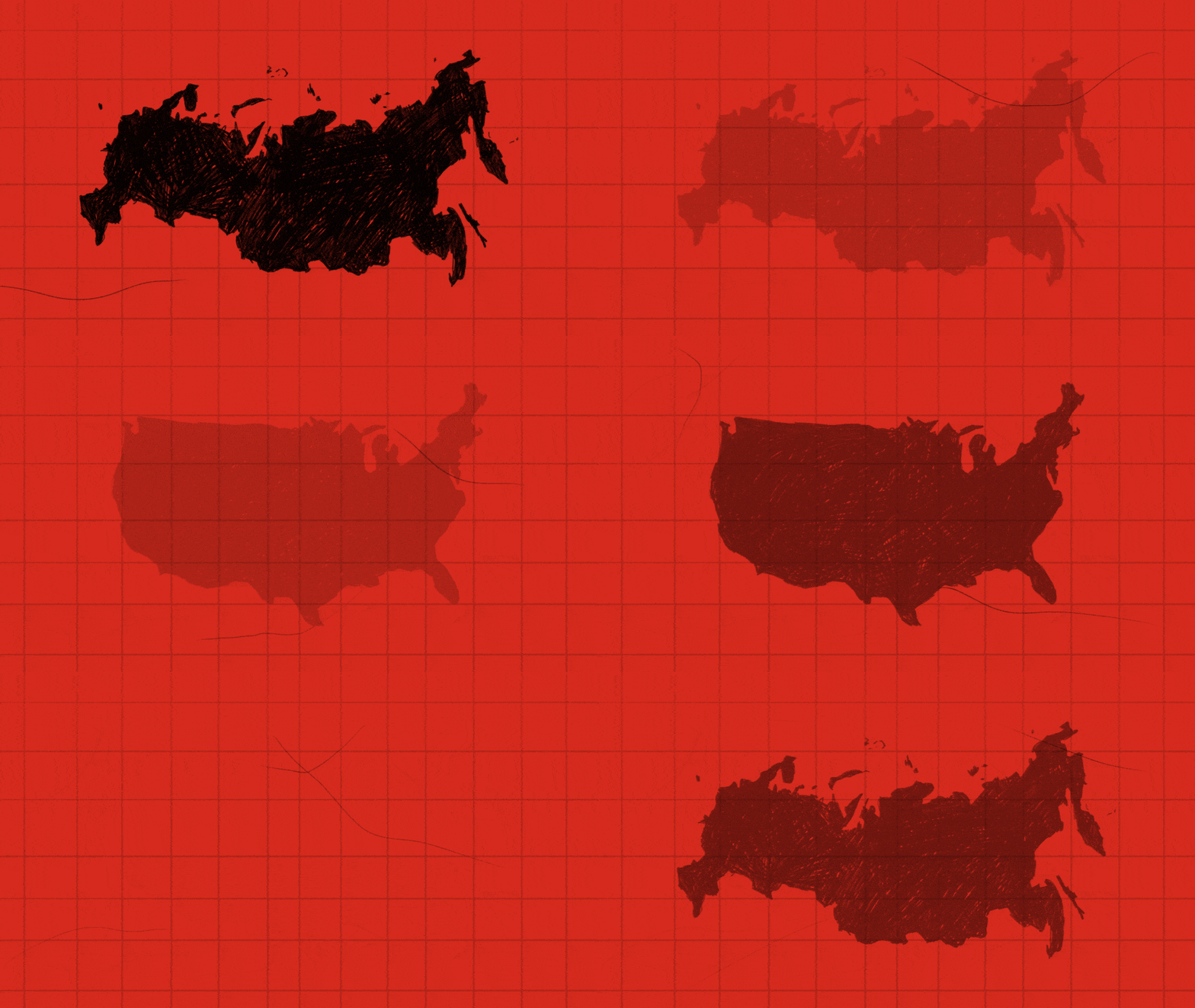
An image of America fading into an image of Russia
Illustration by Akshita Chandra / The Atlantic

APRIL 17, 2025 (theatlantic.com)

Produced by ElevenLabs and News Over Audio (Noa) using AI narration. Listen to more stories on the Noa app.

Based on pollselection results, and the markets, Americans seem to be awakening, if only slowly, to the magnitude and nature of the threat they face. President Donald Trump and his allies in power are trying to erect an authoritarian Mafia state like the one Vladimir Putin and his cronies established in Russia. The American opposition talks of “undermining democracy” and “constitutional crisis”—but for the most part, its legislators, activists, and political strategists are pursuing politics as usual. They shouldn’t be.

If this sounds alarmist, forgive me for not caring. Exactly 20 years ago, I retired from professional chess to help Russia resist Putin’s budding dictatorship. People were slow to grasp what was happening there too: Putin’s bad, but surely he’ll stop short of—and you can fill in the blank with a dozen things he did to destroy Russia’s fragile democracy and civil society, many of which Trump is doing or attempting to do in America today.

ENJOY A YEAR OF UNLIMITED ACCESS TO THE ATLANTIC—INCLUDING EVERY STORY ON OUR SITE AND APP, SUBSCRIBER NEWSLETTERS, AND MORE.Become a Subscriber

Attacking the press as fake news and the enemy of the state? Check. Delegitimizing the judiciary, the last constitutional brake when the legislature is co-opted and feckless? Check. Expanding influence over the economy by threatening businesses and using tariffs to introduce a crisis and a spoils system? Check. Creating a culture of fear by persecuting unpopular individuals and groups? Been there, done all of that.

Putin is still in the Kremlin, and I’m writing this from New York City—my family has made its home there, as well as in Croatia, since we were forced to leave Russia in 2013. America’s institutions and democratic sentiment are far stronger than in the flawed, fragile state Putin took over from Boris Yeltsin 25 years ago. Russia was a mere eight years removed from Soviet totalitarianism when it elected a KGB lieutenant colonel who restored the Soviet anthem and called the fall of the U.S.S.R. the “greatest geopolitical catastrophe” of the 20th century.

Americans, by contrast, have a well-stocked toolbox with which to defend their democratic institutions, if only they would use it. The press is still free; its only limitations are self-imposed. The economy is strong, even though Trump is working hard to put a stop to that. (People who feel economically insecure, or who depend on the government for their daily bread, don’t often rise up against it. Instilling a feeling of helplessness, a lack of control, is a key ingredient of authoritarianism. For example, the uncertainty created by Trump’s tariff flip-flops are anathema to consumer and business confidence, but uncertain citizens are more likely to follow a strongman.) American federalism and the separation of powers are not trivial for a would-be autocrat to overcome. Political pressure must be brought to bear—through the courts, the press, and the states, but also applied to legislators while they still have any power left.

The american opposition should spend less time criticizing the content of the administration’s executive actions—eliciting sympathy for a deported individual, say, or decrying the impact of Trump’s tariffs on 401(k) plans—than focusing on its suspect methods. The real crisis is the lack of due process in the deportations, to take the first example, and the president’s assumption of Congress’s power to levy taxes, to take the second. Sure, Trump loves tariffs, in other words—but he mostly loves exercising power, and his slate of arbitrary levies, unilaterally imposed by the executive, is a power grab.

RECOMMENDED READING

Never lose sight of the fact that the Trump administration’s aim is to weaken and devalue the machinery of government, on one hand, and privatize the levers of power on the other. It is accomplishing all of this at a breakneck pace. Supporting a would-be autocrat because you like his policies (say, on DEI or transgender athletes) is a terrible trap, because soon enough, your opinions and support won’t matter at all. But making opposition to the policies the centerpiece of resistance also risks missing the point. America is hurtling toward the loss of its democratic institutions and the establishment of an authoritarian state where there will be no civil discussion of these issues at all: That’s what a principled opposition must fight with its full might.

Spelling out these stakes every day, like Senator Cory Booker did in his record-breaking 25-hour speech at the beginning of the month, is vital. Call hearings, press conferences, protests—everything that can be done to draw attention to the attacks on institutions. Explain due process, and contrast it with illegal or incorrect deportations, as families are torn apart. Don’t let Elon Musk and his vandals pretend that what they are doing is about efficiency when their actions are a rounding error at best in the budget.

Here is another tactic that makes sense for political give-and-take within a democracy, but not as a means of fighting for democracy’s life: picking your battles. Senate Minority Leader Chuck Schumer may have thought he was doing exactly that when he caved to Republican pressure to pass the budget. He had a legal means of countering Trump’s autocratic agenda—rallying his party to refuse to advance the Republican spending bill—but he declined to use it. In regular democratic politics, passing on one battle to fight again another day is normal. But when fighting for democracy, you never know if there will be another day. Fight everywhere you can, always, or you will soon be as irrelevant as the Russian Duma became under Putin’s centralized executive authority.

MAKE YOUR INBOX MORE INTERESTING WITH NEWSLETTERS FROM YOUR FAVORITE ATLANTIC WRITERS.Browse Newsletters

Another recommendation: Attacking Trump’s character, however abhorrent critics may find it, is futile. The president is not acting alone. In contrast to his bumbling first term, he now has a professional script, stage managers, and a plan. Project 2025 is the product of political machinery that has sprung up around Trump that seeks to tear out the roots of American democracy and then salt the ground. To accomplish this, the Trump administration, much like Putin’s team in Russia, focuses on fear and enemies, not on constructing a brighter future. It will never be tempted to reconcile or coaxed by bipartisan outreach. So set aside the specifics of Trump’s agenda and your distaste for him as a person. Resist on every level, at every opportunity, instead of picking this or that battle. Shout from the rooftops about the attacks on process and democracy, not just the policy content.

Since trump’s inauguration, Americans have filed numerous legal complaints challenging specific cuts or orders that Musk and his so-called Department of Government Efficiency have made. After all, what authority does Musk, as a private individual, have to collect government data, decide which federal officials to fire, or allocate resources as he sees fit? Musk and Trump have turned their fire on judges who reject the legality of their actions.

Taking DOGE to court is necessary work—by all means, throw sand in the gears at every opportunity—but it’s not sufficient. That’s because Musk, like Russian oligarchs, has proximity to power, but he doesn’t actually have legal authority. To eject his influence means bringing the fight not just to him, but to the elected offices where power still resides.

Americans had probably better get used to learning Russian, so I’ll offer a political term from our lexicon: понятиеponyatie (pon-YAH-tee-yeh), which doesn’t quite have an English equivalent but can be translated roughly as “an understanding.” The understanding of most citizens is that proximity to power is itself a form of power, that “we all know who is really calling the shots.” What we are seeing with DOGE is an example of this phenomenon—the ponyatie that Musk, as a rich man who exercises great influence over Trump, wields tremendous governmental authority despite not having an official title or a constitutional role. The ponyatie that state power can be marshaled against his critics and rivals, while he is immune to it himself. Acquiescence to that kind of thinking must be stopped before it is allowed to permeate the American political system.

To that end, Americans should invest their time and money fighting in the arena where political power still lies: with the American people and in Washington, D.C., with the handful of Republican representatives who could put a stop to the power grab. Go after the weakest links and call them out. Promise to support them against Musk’s threats to fund primary challenges if they defy him—and to raise millions against them if they don’t. Don’t give up on the levers of political power prematurely. Use them, or they will disappear, and marching in the street will be the only recourse—one that I can tell you from painful personal experience doesn’t always work out.

The trump administration has been cunning in choosing its first targets. Deporting supposed gang members and Hamas supporters without due process may violate any number of statutes, but forcing oppositionists to defend these people’s rights allows the administration to paint them as defending their ideas. Not every battle will be as favorable as standing up for cancer research or veterans’ benefits.

This is why the resistance must center the principles at stake. Does America have rule of law or not? The first line in defense of an incipient police state is: “You don’t have anything to fear if you’ve done nothing wrong.” This fallacy is soon replaced by: “It could happen to anybody,” as the regime sees the value of using arbitrary persecution to spread fear. Again, fear is the autocrat’s goal, as is simply doing many things every day. Even if you don’t like him or his policies, the longer he is there, doing things, the more the autocrat starts to feel inevitable, like the sun rising each morning.

In politics, as in physics, force is mass times acceleration. The administration is mounting a barrage of attacks, with great urgency, to break through the resistance of American legal structures, sometimes by using legal and relatively popular policies (deporting convicted criminals, for example) as cover for likely illegal and relatively unpopular policies (deporting immigrants without due process). The fabricated urgency is a tell: No war, no terrible crisis, compels the president to violate the Constitution. But the administration is breaking down norms and setting precedents faster than judges can stop it. Of course, ignoring judges is also part of the plan.

To fight this onslaught means staying focused. Skip the culture wars, where the ground can easily tilt to favor the MAGA faithful. Concentrate instead on defending American rights and values against billionaires and autocrats who want to take them away. Just because you can’t compete with Trump on populism doesn’t mean you can’t be popular, and polls already suggest that the public believes the president should obey court orders and give Ukraine more aid.

The opposition needs to proudly defend the value system and ingenious framework that made this country great. This may sound corny to cynical Americans who have taken democracy for granted for most of their lives, but it matters. The leaders of the resistance, if such can be found, must serve as spokespeople and examples of these values and institutions if they are to provide a genuine counter to Trumpism.

Rallying to the defense of American constitutional democracy has become alarmingly difficult after years of insistence, from both the far left and the far right, that the system is irreparably broken. The good news is that Trump and Musk may be reminding Americans about what they stand to lose, and to whom, as was evident in the gloating response of Democrats to the Wisconsin Supreme Court election, which Musk’s preferred candidate lost.

Americans can just look to their leaders’ avowed models should they wonder whether things could be worse. The GOP has moved so far to the right that it’s ideologically aligned with Turkey and Russia. The Trump administration’s refusal to criticize Putin may well owe to its hopes to emulate him, much as Putin’s rehabilitation of Stalin’s legacy tracked with policies that duplicated the Soviet dictator’s. And Musk has expressed admiration for Xi Jinping’s China, a repressive one-party state where he has business interests.

Four votes in the Senate. Three votes in the House. That’s all it takes. Find the weakest links. Go after them, democratically. Fundraise for them if they stand up, or against them if they don’t. The two-party system in America right now is Traitors versus Losers. Playing to win means asking every red-state legislator if they are fine with being in the Traitor Caucus.

ABOUT THE AUTHOR

Garry Kasparov

Garry Kasparov is the chairman of the Renew Democracy Initiative and a vice president of the World Liberty Congress, and he was the 13th world chess champion.

Elvis Presley and the Paranormal with Miguel Conner

New Thinkin • Apr 20, 2025 Miguel Conner is host of the Aeon Byte Gnostic Radio podcast. He has authored two books of interviews about gnosticism, and also four novels. His newest book is The Occult Elvis: The Mystical and Magical Life of the King. Here he characterizes Elvis as a wounded healer or shaman. He provides many details concerning Elvis’ interests in yoga, western occultism, Theosophy, and metaphysics. He also offers examples of Elvis’ ability to perform dramatic healings, and even to seemingly control the weather. He points out that Elvis was also a catalyst for generational change in America. 00:00 Introduction 07:42 Elvis as a tragic figure 11:00 The circumstances of Elvis’ birth 13:59 Elvis’ spiritual interests 19:17 Elvis’ healing abilities 23:52 Premonitions of an early death 26:00 Elvis’ overly possessive mother 28:56 Elvis’ death 33:19 Elvis’ influence and charisma 43:50 Conclusion New Thinking Allowed host, Jeffrey Mishlove, PhD, is author of The Roots of Consciousness, Psi Development Systems, and The PK Man. Between 1986 and 2002 he hosted and co-produced the original Thinking Allowed public television series. He is the recipient of the only doctoral diploma in “parapsychology” ever awarded by an accredited university (University of California, Berkeley, 1980). He is also the Grand Prize winner of the 2021 Bigelow Institute essay competition regarding the best evidence for survival of human consciousness after permanent bodily death. He is Co-Director of Parapsychology Education at the California Institute for Human Science. (Recorded on April 1, 2025)

Tesla Regret Syndrome PSA

Troublemakers • Apr 15, 2025 • TRS is a condition affecting millions of people. Are you one of them? Find out more about symptoms and solutions here. Find out more at www.teslaregretsyndrome.com About the Filmmakers Megan Griffiths Director, Co-writer Megan Griffiths is a writer/director working in film and television. She has made eight features (including Lucky Them, Sadie, and the upcoming Year of the Fox) and is an alum of Sundance, Toronto, South by Southwest, and Tribeca, as well as being a member of the director’s branch of the Academy of Motion Picture Arts & Sciences. Griffiths has directed shows for HBO, EPIX, TNT, Hulu, USA, Fox, Netflix, and served as the producing director for Amazon’s “The Summer I Turned Pretty.” Griffiths has received a Stranger Genius Award and Seattle Mayor’s Award for Film, and she serves on the board of Northwest Film Forum. Lacey Leavitt Gray Producer, Co-writer Lacey Leavitt Gray is a Seattle producer whose film and television producing credits include Megan Griffiths’ Year of the Fox, I’ll Show You Mine, Sadie, Lucky Them, and The Off Hours, Colin Trevorrow’s Safety Not Guaranteed, Lynn Shelton’s Outside In, Touchy Feely, and Laggies, Todd Rohal’s The Catechism Cataclysm as well as his adult swim projects “Hunky Boys Go Ding-Dong” and “M.O.P.Z.” Lacey was also a producer on the adult swim series Three Busy Debras, executive produced by Amy Poehler, and she co-wrote and produced the immersive 360 project Museum of Masters: Claude Monet, created for Vulcan’s Holodome and premiering at TED2019. Lacey is an alum of the Sundance Creative Producing Lab. Cast Narrator – Alex Winter Ethan – Ray Tagavilla Leo – Lowell Deo Annie – Annette Toutonghi Judgy Driver – Kevin Seal Angry Driver – Nuk Suwanchote Worried Partner – Kate Bayley Dog Walker – Rebecca M. Davis Tow Truck Driver – Tony Doupe Crew Producer – Lacey Leavitt Gray Director – Megan Griffiths Director of Photography – Nathan M. Miller Production Designer – Erin O. Kay Editor – Celia Beasley Assistant Director – Scott Larkin Locations – Dave Drummond Gaffer – Matthew Rush Key Grips – Lucas Chapel, Morgan Hendrickson Production Sound – Zoey May Boom Operator – Jasira Andrus Media Manager/Assistant Editor – Kirstin Small VO Recording – Griffith James Sound Design & Mix – Vinny Smith Production Assistant – Quinn Marshall

Some quotes from “The Inner Reaches of Outer Space” by Joseph Campbell

(Imge from Goodreads.com)

Turning and turning in the widening gyre   
The falcon cannot hear the falconer;
Things fall apart; the centre cannot hold;
Mere anarchy is loosed upon the world,
The blood-dimmed tide is loosed, and everywhere   
The ceremony of innocence is drowned;
The best lack all conviction, while the worst   
Are full of passionate intensity.

Surely some revelation is at hand;
Surely the Second Coming is at hand.   
The Second Coming! Hardly are those words out   
When a vast image out of Spiritus Mundi
Troubles my sight: somewhere in sands of the desert   
A shape with lion body and the head of a man,   
A gaze blank and pitiless as the sun,   
Is moving its slow thighs, while all about it   
Reel shadows of the indignant desert birds.   
The darkness drops again; but now I know   
That twenty centuries of stony sleep
Were vexed to nightmare by a rocking cradle,   
And what rough beast, its hour come round at last,   
Slouches towards Bethlehem to be born?

–William Butler Yeats, The Second Coming

“But the kingdom of God is within you and it is without you. If you know yourselves, then you will be known. and you will know that you are the son of the Living Father. But if you do not know yourselves, then you are in poverty. and you are poverty.”

–Jesus

‘I am the universal âtman, I am the ALL! I am transcendent, nondual, unrelated, infinite knowledge. Sheer bliss am I, indivisible.”

–disciple of Shankara

“You pervade the universe and the universe exists in you. You are by nature Pure Consciousness. Do not be small-minded.”

–Ashtravakra

“Carl Jung has written somewhere that the function of religion is to protect us from an experience of God.”

–Joseph Campbell in The Inner Reaches of Outer Space: Metaphor as Myth and Religion

“All things are fair and good and right, but men hold some things right and some things wrong.”

–Heraclitus

The Manosphere

Andrew Tate speaking to reporters in Bucharest after returning from a trip to the US last month (BBC.co.uk)

From Wikipedia, the free encyclopedia

The manosphere is a varied collection of websites, blogs, and online forums promoting masculinitymisogyny, and opposition to feminism.[1] Communities within the manosphere include men’s rights activists (MRAs),[2] incels (involuntary celibates),[3] Men Going Their Own Way (MGTOW),[4] pick-up artists (PUA),[5] and fathers’ rights groups.[6] While the specifics of each group’s beliefs sometimes conflict, they are generally united in the belief that society is biased against men due to the influence of feminism, and that feminists promote misandry (hatred of men).[7] Acceptance of these ideas is described as “taking the red pill“, a metaphor borrowed from the film The Matrix.[8]

The manosphere overlaps with the far-right and alt-right communities.[9] It has also been associated with online harassment and has been implicated in radicalizing men into misogynist beliefs and the glorification of violence against women.[10] Some sources have associated manosphere-based radicalization with mass shootings motivated by misogyny.[11] The manosphere received significant media coverage following the 2014 Isla Vista killings in California, the 2015 Umpqua Community College shooting in Oregon, and the 2018 Toronto van attack, as well as the online harassment campaign against women in the video game industry known as GamerGate.[12]

Major figures within the movement include various social media influencers, including Andrew TateAmrou “Myron Gaines” FudlAdin RossRoosh VCarl Benjamin and Jordan Peterson.

History

The roots of the manosphere lie in the men’s liberation movement of the 1970s and 80s,[13] which began as a critique of the limiting nature of traditional male gender roles.[14] However, in the 1970s the nascent men’s rights movement began to attribute men’s problems to feminism and female empowerment.[14] Media scholar Debbie Ging posits that the growth of the World Wide Web has enabled the spread of “virulent” anti-feminism, misogyny, and associated violent rhetoric.[14]

The term “manosphere”, a play on the word “blogosphere“, is believed to have first appeared on Blogspot in 2009.[15] It was subsequently popularized by Ian Ironwood, a pornography marketer who collected a variety of blogs and forums in book form as The Manosphere: A New Hope For Masculinity.[16] The term entered the popular lexicon when news media began to use it in stories about men who had committed acts of misogynist violence, sexual assault, and online harassment.[17]

Journalist Emma A. Jane identifies the late 2000s–early 2010s as a “tipping point” when manosphere communities moved from the fringes of the Internet towards the mainstream. She hypothesizes this was related to the advent of Web 2.0 and the rise of social media, in combination with ongoing systemic misogyny within a patriarchal culture. Jane writes that the manosphere was well established by the time of the GamerGate controversy in 2014, and misogynistic language such as graphic rape threats against women had entered mainstream discourse, being deployed by men not necessarily identified with any specific manosphere group.[18]

Following Donald Trump‘s victory in the 2024 United States presidential election, The Associated Press reported that an “emboldened” manopshere used Trump’s win “to justify and amplify misogynistic derision and threats online” and that it was no longer an online-only phenomenon. It highlighted the phrase “Your body, my choice” being used against women coined by Nick Fuentes, along with the phrases “Get back in the kitchen” and “Repeal the 19th” receiving millions of views on X. It also reported that the phrases had moved offline, “with boys chanting it in middle schools or men directing it at women on college campuses”[clarification needed], and highlighted a man holding a sign that read “Women Are Property” at Texas State University.[19]

Themes and ideology

The manosphere is a varied group of online communities[20] that includes men’s-rights activists (MRAs),[2] incels (involuntary celibates),[3] Men Going Their Own Way (MGTOW),[4] pick-up artists (PUAs),[5] and fathers’ rights groups.[6] Some groups within the manosphere have adversarial relationships with one another.[21] Ging writes that subgroups such as MRAs and PUAs “exaggerate their differences in displays of infight posturing, in spite of the fact that their philosophies are almost identical”.[22]

While the specifics of each group’s beliefs sometimes conflict, the general ideology of manosphere groups centers on the promotion of masculinityantifeminism, and misogyny.[23] In particular, feminists are portrayed as ignoring male victims of sexual assault and encouraging false rape accusations against men.[24] Journalist Caitlin Dewey argues that the main tenets of the manosphere can be reduced to (1) the corruption of modern society by feminism, in violation of inherent sex differences between men and women; and (2) the ability of men to save society or achieve sexual prowess by adopting a hyper-masculine role and forcing women to submit to them.[25] Criminologist Lisa Sugiura writes that disparate groups within the manosphere are “united by the central belief that feminine values, propelled by feminism, dominate society and promote a ‘misandrist’ ideology that needs to be overthrown”.[16]

Jargon

The manosphere has its own distinct jargon.[26] The idea of misandry (hatred of or prejudice against men) is commonly invoked, both as an equivalent to misogyny and a way to deny the existence of institutionalized sexism.[27] However, Sugiura writes that “there is little evidence to show that misandry is an issue affecting men’s lives”.[28] Both male and female homicide victims are more likely to have been killed by a man, rather than by a woman. Although feminism is described within the manosphere as a misandrist movement, there are no significant feminist groups dedicated to espousing hatred of men or encouraging female violence against men.[28]

A central tenet of the manosphere is the concept of the red pill, a metaphor borrowed from the film The Matrix. It concerns awakening men to the supposed reality that society is dominated by feminism and biased against men.[29] Manospherians believe that feminists and political correctness obscure this reality, and that men are victims who must fight to protect themselves.[30] Accepting the manosphere’s ideology is equated with “taking the red pill” (sometimes abbreviated TRP), and those who do not are seen as “blue pilled” or as having “taken the blue pill”.[31] Such terminology originated on the antifeminist subreddit /r/TheRedPill and was later taken up by men’s rights and MGTOW sites.[32] Donna Zuckerberg writes, “The Red Pill represents a new phase in online misogyny. Its members not only mock and belittle women; they also believe that in our society, men are oppressed by women.”[33]

Men are commonly divided into “alpha” and “beta” males[34] within an evolutionary-psychology framework, where “alphas” are seen as sexually dominant and attractive to women, who are hardwired to want sex with alphas but will pair with “beta” males for financial benefits. Among MRAs and PUAs this argument is known as “alpha fux beta bux”.[35]

Associated movements

The manosphere overlaps with white-supremacist and far-right ideologies,[16] including the neoreactionarywhite-nationalist alt-right movement.[9] Zuckerberg writes that many alt-right members are either pick-up artists or MGTOW, and “the policing of white female sexuality is a major concern” of the alt-right.[36] The severity of the antifeminism espoused within these communities varies, with some espousing fairly mild sexism and others glorifying extreme misogyny.[37] Racism and xenophobia are also common among groups in the manosphere, and perceived threats against Western civilization are a popular topic.[38] Tracie Farrell of Open University and colleagues write that in addition to the “angry white men” associated with the alt-right, the manosphere also contains “men of colour, struggling with systemic racism that extends to beauty ideals and status”.[39]

Radicalization and violence

The manosphere has been associated with online harassment, radicalizing men into misogynist beliefs and the glorification of violence against women.[10] Some sources have associated manosphere-based radicalization with mass shootings motivated by misogyny.[11] Robin Mamié of École Polytechnique Fédérale de Lausanne and colleagues associate radicalization into far-right ideologies via the manosphere with the idea of the alt-right pipeline.[40]

Internet influence

The manosphere comprises various websites, blogs, and online forums.[26] Noted sites include /r/TheRedPillReturn of Kings, and A Voice for Men, as well as (the now-defunct) PUAHate and SlutHate.[41]

Reddit has been a popular gathering place for manosphere supporters, and several forums on the site are geared toward its ideas.[42] However, in the late 2010s and 2020s Reddit began to take steps to discourage more extreme manosphere subreddits. Some were banned, such as /r/incels (banned in 2017), its successor /r/braincels (banned in 2018), and /r/MGTOW (banned in August 2021[43]); other subreddits such as /r/TheRedPill have been “quarantined”, meaning that a warning is displayed to users about the content of the subreddit and users must sign in before they’re allowed to enter.[44] As a result, some of these communities have found new homes on websites that are more welcoming of extreme content, such as Gab.[45]

Major figures within the movement include various social media influencers, including Andrew TateAmrou “Myron Gaines” FudlAdin RossRoosh VCarl Benjamin and Jordan Peterson.[46][47][48] Some women have also lent credibility to the movement, including Hannah Pearl Davis.[49][50]

Public perception

This section contains too many or overly lengthy quotations. Please help summarize the quotations. Consider transferring direct quotations to Wikiquote or excerpts to Wikisource(September 2022) (Learn how and when to remove this message)

The manosphere has received significant coverage in the media from its association with high-profile violent attacks including the 2014 Isla Vista killings in California, the 2015 Umpqua Community College shooting in Oregon, and the 2018 Toronto van attack, as well as phenomena such as the sustained online abuse towards female members of the video game community that came to be known as GamerGate.[51] Following the Isla Vista shooting, the killer Elliot Rodger was found to have been an active participant on the PUAHate manosphere forum.[52] Following the attack, Dewey wrote that, while the manosphere was not to blame for Rodger’s attack, “Rodger’s misogynistic rhetoric seems undeniably influenced by the manosphere”.[53] The sociologist Michael Kimmel argued “it would be facile to argue the manosphere … urged [Rodger] to do this. I think those places are kind of a solace … They provide a kind of locker room, a place where guys can gripe about all the bad things that are being done to them by women”.[54]

Arthur Goldwag described the manosphere in the Spring 2012 edition of the Southern Poverty Law Center’s Intelligence Report as an “underworld of misogynists, woman-haters whose fury goes well beyond criticism of the family court system, domestic violence laws, and false rape accusations… [who are] devoted to attacking virtually all women (or, at least, Westernized ones).”[55] He added a caveat later that year, saying, “It should be mentioned that the SPLC did not label MRAs as members of a hate movement; nor did our article claim that the grievances they air on their websites – false rape accusations, ruinous divorce settlements and the like – are all without merit. But we did call out specific examples of misogyny and the threat, overt or implicit, of violence.”[56] In 2018, the SPLC added male supremacy as a category they track on their list of hate groups.[57] The British anti-extremism group Hope not Hate included the manosphere in its 2019 State of Hate report.[37]

More at: https://en.wikipedia.org/wiki/Manosphere

Saturn Conjunct North Node In Pisces – It Ends With Us

(Astrobutterfly.com)

On April 21st, 2025, Saturn conjuncts the North Node in the last sign of the zodiac.

The conjunction happens at 26° Pisces, very close to Venus (at 25° Pisces) and Neptune (at 0° Aries).

This is the very same area of the sky where, in the past weeks, Venus and Mercury turned direct – a sacred activation point that speaks of so much more than Saturn and the North Node as individual energies.

There is a higher, karmic orchestration at play – a soul-level invitation where Saturn and the North Node act like an architect and a compass, unlocking a deep message buried in the bones of our becoming.

Something old and deeply embedded – perhaps as old as the soul itself – is slowly morphing (Pisces) into something else. Unfinished stories are being reinvented, and soul contracts are being re-written.

We are at the threshold between the alpha and the omega – a liminal zone where, whether you are aware of it or not, an entire mythos is rising from the depths.

The ‘Atlantis’ part of your psyche is stirring – awakened by memory, longing, and the need to finally move forward.

Saturn, North Node, And Neptune – The Bigger Picture 

Saturn and the North Node are both slow-moving, so we have been already feeling the influence of this transit for a while now. Again, we are talking about a broader theme that also involves Neptune – which also conjuncted the North Node in February 2025.

Speaking in metaphors – and how else could we speak in the sign of Pisces – the Neptune/North Node conjunction echoed the energy of One Hundred Years of Solitudea metaphor for the inescapable cycles and repetitions we experience during transits in the last sign of the zodiac.

However, within these seemingly endless repetition loops, we now have Saturn – a much more tangible, accessible energy.

Saturn is NOT elusive. Unlike Neptune, Saturn is visible with the naked eye. Saturn adds a sense of form, boundary, and concreteness to our journey. 

With Saturn, it’s now clear what needs to be done – the task is visible, and the next step is within reach.

saturn conjunct north node

Saturn Conjunct North Node In Pisces – It Ends With Us

The metaphor for the Saturn-North Node conjunction in Pisces is It Ends With Us. 

‘It Ends With Us’ is a romantic novel – and more recently, a movie adaptation – where a cycle of domestic abuse ends with the conscious decision of the protagonist to make different choices, break the cycle, and rewrite the narrative for the next generation.

Let’s see how this translates symbolically and astrologically into our Saturn-North Node transit.

In astrology, the Lunar Nodes are almost synonymous with ‘karma’. 

Lunar Nodes aspects often show up between family members, suggesting shared or intergenerational life lessons. Lunar Node transits bring these karmic themes to the surface – ‘what has been passed down’ – so they can be acknowledged, integrated, or released.

The Lunar Nodes, often depicted as a serpent or snake-like curve, also resemble the structure of our DNA – an inherent design that is passed down to us from previous generations.

Just like nature continuously evolves, this design – this cosmic DNA – is not set in stone. There are moments of transformation, spontaneous shifts, or symbolic mutations (like blue eyes are one of the most famous genetic mutations) that can rewire this cosmic DNA.

The Lunar Nodes have 2 distinct expressions: The South Node (the downward energy) represents the release or completion of karmic/energetic material that no longer serves us.

The North Node (the upward energy) is not necessarily about dissolution; it’s more like a gene mutation. The initial design is altered; new information is introduced, a new trajectory is set. This doesn’t necessarily mean we abandon the past – but we choose to do things differently going forward.

When the North Node meets Saturn, we have a unique opportunity to rewrite a script and take our life on a new path. 

Saturn is the rules. The framework. The laws. We follow the laws because laws give us a sense of order, structure, and predictability. The world functions based on Saturnian laws.

Laws are not mere limitations. They are also opportunities – opportunities to ‘frame’ what we want, to give specs, to set the playground – to give context to our choices, desires, and actions. 

Rules are not only meant to be followed – but also created. 

In this sense, the Saturn-North Node conjunction in Pisces is an opportunity to rewrite a fundamental law – a core narrative – deeply embedded in the energetic design of our life.

We are bound to repeat the same patterns not because it’s inherently difficult to change (watch someone under real, time-bound pressure to do something – they do it immediately) – but because we don’t know any better. 

The way our brain works is pretty much monkey see, monkey do. We don’t even consider questioning the status quo – it doesn’t even cross our mind – why would it? The narrative becomes a form of unconscious blindness.

And there’s nothing wrong with this approach – in fact, following the script is the evolutionary way we learn to function in the world.

Saturn Conjunct North Node In Pisces – Drawing The Line

That is, of course, unless the ‘laws’ we follow don’t do us any good – like in It Ends With Us, when Lily is by default following the domestic violence ‘program’ – what she unconsciously absorbed growing up.

And here comes the beauty of this Saturn-North Node transit. From time to time – not always (it would be exhausting) – the universe aligns in special ways to give us the opportunity to ‘change the script’ and build a life on our own terms.

Saturn is the planet of maturity and carving one’s path. Associated with the Midheaven – the highest point in the sky – it represents our direction, our contribution, our greatest potential. This is opposite the IC, which is our roots and foundation. If the IC is our origin, the MC (and Saturn) represent where we are heading.

Saturn transits always call us to ‘do better,’ ‘adult up,’ and grow into the most capable, intentional version of ourselves.

And paired with the North Node, we now truly have an opportunity to rewrite that script. We no longer have to stay trapped in the loop of repetitions, inherited patterns, and unconscious conditioning. We can break the cycle.

At the Saturn-South Node conjunction, let’s reflect: 

“What do I choose to no longer carry forward? What needs to end with me?” 

“What’s changing? What do I need to do to become more fully myself – to carve my own path, not one inherited or assumed?”

At the Saturn-North Node conjunction, it starts with us.

Hypnosis and Childbirth with David Cheek (1912 – 1996)

New Thinkin • Apr 18, 2025 • Archival Video RecordingsThis video is a special release from the original Thinking Allowed series that ran on public television from 1986 until 2002. It was recorded in about 1995. It will remain public for only one week.  David Cheek was a founding member of the American Society for Clinical Hypnosis, a past president of the San Francisco Academy of Clinical Hypnosis, a diplomate of the American Board of Obstetrics and Gynecology, a fellow of the American College of Surgeons and of the American College of Obstetricians and Gynecologists, and a member of the Association for Pre- and Perinatal Psychology and Health. He wrote extensively on psychosomatic medicine. His last book, Hypnosis: the Application of Ideomotor Techniques, was published in 1994. Watch more than 350 programs now, with more, previously unreleased titles added weekly.) and wahttps://thinkingallowed.vhx.tv/ Video Collection, hosted by Jeffrey Mishlove. Subscribe to the new Streaming Channel (Thinking AllowedNow you can watch all of the programs from the original  Free month of the classic Thinking Allowed streaming channel for New Thinking Allowed subscribers only. Use code THINKFREELY.

Featured Books from New Thinking Allowed

Read the real stories of the American and Soviet/Russian ESP programs and how ESP was used in intelligence gathering and other applications. Learn the greater story of why these major powers saw fit to put stock in something so many academics dismiss out of turn and what practical value was found for Military and Intelligence operations. 


Writer and researcher Miguel Conner reveals how Elvis was a profound mystic, occultist, and shaman. Beginning with the unusual circumstances of his birth—and his stillborn twin brother—Conner traces the diverse thread of mysticism that runs through Elvis Presley’s life, drawing on firsthand accounts from the people closest to him. Conner argues that Elvis was well-versed in the esoteric practices of sex magic, meditation, astrology, and numerology and had a deep familiarity with Kabbalah, Gnosticism, Theosophy, and Eastern traditions. He also reveals how Elvis was a natural healer, telekinetic, psychic, and astral traveler who had significant mystical experiences and UFO encounters.


With unresolved trauma, the past is always present and the experience of overwhelming life events can alter our perceptions of both time and space. A fractal vision of trauma views our individual human experiences, relationships and families as an integral part of a much greater whole which includes nature, culture and historical context. We live in a fractal universe and time itself is a fractal phenomenon.


In this book, Imants Barušs and Julia Mossbridge utilize findings from quantum mechanics, special relativity, philosophy, and paranormal psychology to build a rigorous, scientific investigation into the origins and nature of human consciousness. Along the way, they examine the scientific literature on concepts such as mediumship, out-of-body and near-death experiences, telekinesis, “apparent” vs. “deep time,” and mind-to-mind communication, and introduce eye-opening ideas about our shared reality. The result is a revelatory tour of the “post-materialist” world—and a roadmap for consciousness research in the twenty-first century.


A History of USOs: Unidentified Submerged Objects (Volume 1: From the Beginning to 1969) by Richard M. Dolan is the first installment in a groundbreaking three-volume series that explores the fascinating and often unexplained phenomenon of USOs—Unidentified Submerged Objects. This meticulously researched book delves into the earliest reported sightings of mysterious objects observed in oceans, lakes, and rivers, spanning centuries and covering 178 carefully documented cases up to 1969.