
Monthly Archives: April 2025

Tarot card for April 11: Love
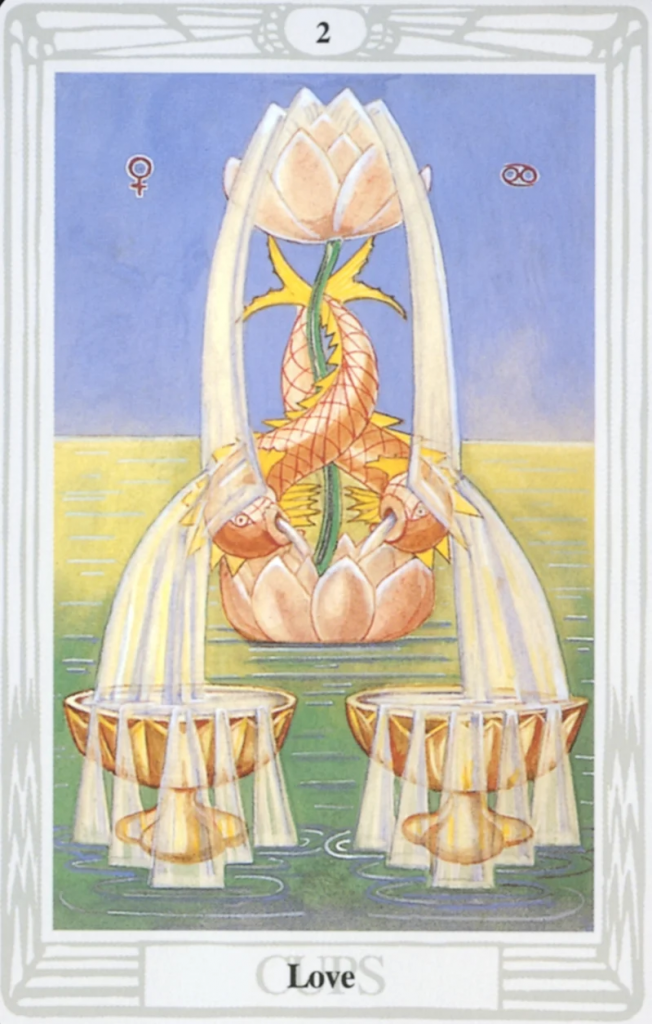
| The Two of Cups As I said when defining this card, the most important aspect of the Lord of Love is that we learn to develop self-love, self-trust and self- reliance. Hopefully there are many of you who can think, with confidence, I’ve done this.And for those of you who can, a day ruled by the Two of Cups is a day to count those you love, and those who love you. It is a day to be deeply grateful that you have such abundance and bounty in your life. There is no greater wealth we can aspire to than a wealth of love.For those people who have not yet managed to achieve real self-love, this is a day to work on it. Throughout a day ruled by the Lord of Love, try to be conscious of your feelings toward yourself. Look carefully at the ways you choose to describe yourself. Examine how you feel when dealing with other people.Try to see yourself and your actions without standing in judgement on them. Often it is the obsession with judging ourselves (often through our interpretation of how others see us) that stops us from seeing ourselves as loving and loveable. So put a hold on your judgement on this day.Simply observe what you do, what you think, how you feel. If you discover that you are putting yourself down, then decide that, at least for today, you will stop. After all, if you get so much out of doing this, you can always start again tomorrow ;-)Instead, say your affirmation, tell that judgmental little gremlin that it can have the day off, and allow the world to reflect you back to yourself. You might just get a big surprise! Affirmation: “Love flows into my life in an endless stream.” |
(Angelpaths.com)
Weekly Invitational Translation: The unconscious mind sometimes guards its secrets very carefully
Translation is a 5-step process of “straight thinking in the abstract” comparing and contrasting what seems to be truth with what you can syllogistically, axiomatically and mathematically (using word equations) prove is the truth. It is not an effort to change, alter or heal anything.
The claims in a Translation may seem outrageous, but they are always (or should always be) based on self-evident syllogistic reasoning. Here is one Translation from this week.
1) Truth is that which is so. That which is not truth is not so. Therefore Truth is all there is. Truth being all is therefore total, therefore whole, therefore complete, therefore otherless, therefore one, therefore atoned. I think, therefore I am. Since I am and since Truth is all that is, therefore I, being, am Truth. Since I, being, am Truth, therefore I, being, have all the attributes of Truth. Therefore I, being, am total, whole, complete. otherless, one, atoned. Since I am mind (self-evident) and since I (being) am Truth. Therefore Truth is Mind. (Two things being equal to a third thing are equal to each other.) Since Truth is Mind, therefore Mind has all the attributes of Truth. Therefore Mind is total, whole, complete, otherless, one, atoned.
2) The unconscious mind sometimes guards its secrets very carefully.
Word-tracking:
unconscious: asleep, unaware, unintentional, the part of the mind that contains memories, thoughts, feelings, ideas that the person is not generally aware of but that manifest themselves in dreams and dissociative acts
dissociate: to treat as distinct or separate
guard: ward, protect, prevent from escape
secret: separate, hidden
3) Mind being one, cannot be separated (hidden, secreted) as well, therefore there are no secrets in Mind. Truth being all, there is no escaping all, therefore there is no escaping Truth. Truth being one, there is nothing other than truth to try to protect truth, therefore Truth is unprotected. Since Truth is one, there is no distinction (separateness) from one, therefore there is no distinction in Truth. The unconscious mind is that part of the mind that we are usually unaware of. But to be unaware of awareness is a double negative, an oxymoron. Therefore there is no unconscious consciousness.
4) There are no secrets in Mind.
There is no escaping Truth.
Truth is unprotected.
There is no distinction in Truth.
There is no unconscious consciousness.
5) It is an inescapable fact that there is no unconscious consciousness.
Weekly Invitational Translation Group invites your participation. If you would like to submit a Translation on any subject, feel free to send your weekly Translation to zonta1111@aol.com and we will anonymously post it on the Bathtub Bulletin on Friday.
For information about Translation or other Prosperos classes go to: https://www.theprosperos.org/teaching.
Inside the Princeton Engineering Anomalies Research Lab with Brenda Dunne (1944 – 2022)
New Thinking • Apr 10, 2025 Brenda Dunne served for 28 years as laboratory manager of the Princeton Engineering Anomalies Research (PEAR) program. With Robert G. Jahn, she is coauthor of Margins of Reality: The Role of Consciousness in the Physical World, Consciousness and the Source of Reality: The PEAR Odyssey, Quirks of the Quantum Mind, and Molecular Memories. She also served as coeditor of Filters and Reflections: Perspectives on Reality and Being and Biology: Is Consciousness the Life-Force. In this interview, rebooted from 2019, she describes details of the laboratory operations at the Princeton Engineering Anomalies Research program. A range of devices were studied. Differential effects were observed between male and female operators. Operators generally reported the greatest successes occurred when they were able to enter into a state of “resonance” with the devices. She also describes the academic politics at Princeton limiting the laboratory’s activities, as well as how the lab dealt with critical detractors. New Thinking Allowed host, Jeffrey Mishlove, PhD, is author of The Roots of Consciousness, Psi Development Systems, and The PK Man. Between 1986 and 2002 he hosted and co-produced the original Thinking Allowed public television series. He is the recipient of the only doctoral diploma in “parapsychology” ever awarded by an accredited university (University of California, Berkeley, 1980). He is also the Grand Prize winner of the 2021 Bigelow Institute essay competition regarding the best evidence for survival of human consciousness after permanent bodily death. He is Co-Director of Parapsychology Education at the California Institute for Human Science. (Recorded on June 3, 2019)
Imprinting Reality: The Mystery of Mental Influence
Exploring the science behind how consciousness might affect physical systems

APR 09, 2025 (wisdomschool.com)
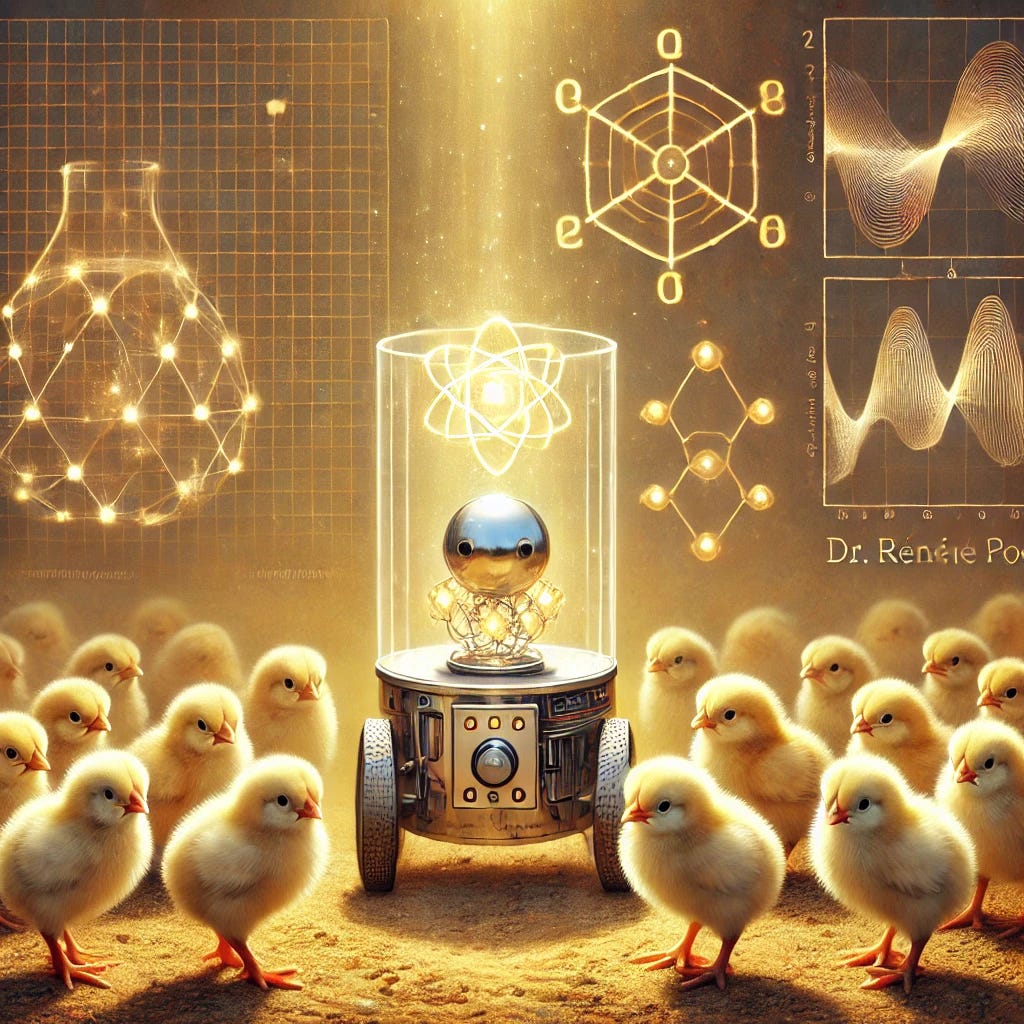
The power of the human mind to influence the physical world has been a topic of fascination for centuries. In recent years, scientific experiments have begun to explore whether thoughts and intentions can genuinely affect matter.
One intriguing study, conducted by Dr. Renée Poec’h and her colleagues, provides compelling evidence that the mind—or in this case, even the consciousness of animals—might influence physical systems in surprising ways. This groundbreaking research involved baby chicks, a simple robot, and a device called a random number generator.
Before diving into the experiment, let’s understand some basic concepts. When baby chicks hatch, they instinctively bond with and follow the first moving object they see, a behavior called “imprinting.” In nature, this object is usually their mother, but in laboratory settings, it can be anything—a human, a ball, or even a robot. Imprinting is crucial for a chick’s survival, ensuring that it stays close to its source of protection and food.
The second concept, a random number generator, might sound complex, but it’s essentially a machine designed to produce unpredictable sequences of numbers. Think of it like flipping a coin repeatedly, with each flip being completely independent of the last. In this experiment, the random number generator determined how a small robot moved.
If the generator produced certain numbers, the robot would turn left; if it produced others, it would turn right. Over time, you’d expect the robot’s movements to balance out, spending equal time moving in all directions, unless influenced by something external.
Dr. Poec’h’s team asked a fascinating question: Could the baby chicks’ desire to be close to the robot influence its random movements? To test this, they designed a controlled experiment.
First, they allowed a group of newly hatched chicks to imprint on a small, mobile robot, which became their “parent.” These chicks would naturally want to stay close to the robot, following it around if they could. Once the imprinting phase was complete, the robot was placed in an enclosed area where it could move freely. However, the chicks were separated from the robot by a transparent barrier. They could see it but couldn’t physically reach it.
Here’s where the random number generator came into play. The robot’s movements were entirely dictated by the generator, ensuring that its path should be completely random and unbiased.
Over time, if left to chance, the robot would spend roughly equal amounts of time in all parts of the enclosure. But something extraordinary happened.
When the chicks, longing for the robot to be near them, were placed outside the enclosure, the robot spent significantly more time in the areas closest to the chicks. Analysis showed that the robot moved toward the chicks about 70 percent of the time—far more often than the expected 50 percent.
This result suggested that the chicks’ strong desire to be near the robot might have influenced the random number generator controlling its movements. In essence, the chicks’ minds seemed to be affecting the physical system.
While this idea might seem far-fetched, the experiment’s design ruled out many alternative explanations. The robot’s movements were entirely random when the chicks weren’t present. It was only when the chicks were visibly yearning for the robot that its behavior deviated from randomness.
What does this mean? The findings challenge our understanding of the relationship between mind and matter. For most of modern science, the mind has been treated as separate from the physical world—a phenomenon arising from the brain but unable to influence physical systems directly.
Yet, Dr. Poec’h’s experiment suggests that intention or desire might have tangible effects. This aligns with other studies in fields like parapsychology, where researchers have observed small but statistically significant effects of human intention on random number generators and other physical systems.
Skeptics often argue that such results could be due to flaws in the experimental design, statistical anomalies, or wishful thinking. However, the rigor of this study makes it difficult to dismiss.
The robot’s movements were controlled by a well-established mechanism—a random number generator—and the conditions were carefully controlled to eliminate bias. The only variable was the presence of the chicks and their desire to be close to the robot.
What makes this experiment particularly intriguing is that it doesn’t involve humans, who might bring subconscious biases or complex intentions into the mix. The chicks’ desire to be near the robot was simple and instinctual, yet it appeared to have a profound effect. This simplicity strengthens the case that some fundamental aspect of consciousness, even in its most basic form, might influence the physical world.
Critics might still question the mechanism behind such an influence. How could the chicks’ longing affect a machine? One possibility is that the mind interacts with the underlying probabilities of physical systems, subtly nudging outcomes in a desired direction.
This idea isn’t entirely new; it echoes theories from quantum mechanics, where the act of observation can influence the behavior of particles.
While the connection between quantum mechanics and consciousness remains speculative, studies like Dr. Poec’h’s suggest that the relationship between mind and matter might be more intertwined than we currently understand.
The implications of this research are profound. If minds—human or animal—can influence physical systems, it opens the door to new ways of thinking about everything from healing and well-being to technology and artificial intelligence.
It suggests that our intentions and desires might play a more active role in shaping our reality than we’ve previously believed. It also raises philosophical questions about the nature of consciousness and its place in the universe. Are we merely passive observers of a predetermined world, or do our thoughts and intentions actively shape the fabric of reality?
While more research is needed to confirm and expand upon these findings, the study by Dr. Poec’h and her colleagues offers a fascinating glimpse into the potential power of the mind.
It challenges us to rethink the boundaries between the mental and physical worlds and to consider the possibility that consciousness is not just a byproduct of the brain but a fundamental force with the ability to influence matter itself.
For the baby chicks in this experiment, their simple desire to be near their “parent” robot might have revealed one of the universe’s most profound mysteries: the power of intention to shape reality.
Artificial thinking imperils actual thinking
- By Troy Wolverton | Examiner staff writer |
- Apr 9, 2025 (SFExaminer.com)
Since the launch of ChatGPT more than two years ago, researchers have highlighted a growing number of drawbacks of generative artificial intelligence, including its negative effects on the environment, its tendency to make up responses whole cloth and its ability to be used to spread disinformation.
You can add another concern to the list: its effect on users’ critical thinking skills.
A pair of recent research studies — one of which was authored by researchers at a company that has, so far, invested billions in the nascent technology — indicate that the more people use AI tools and the more confidence and trust they place in those tools, the less likely they are to engage in critical thinking.
The danger is not only that users won’t catch AI-generated errors, misinformation or the technology just telling them what they want to hear, but that they either won’t be developing those skills or they will see the skills they have deteriorate, analysts say.
“It’s actually very difficult to use [AI] in the proper way, not to offload the thinking process and not to rely too much on it,” said Michael Gerlich, the author of one of the recent studies and a professor at SBS Swiss Business School in Zurich.
“The more you rely on it, so the more it produces a positive result, the more you trust AI, and the more you trust AI, the more you offload the thinking process, so you let it think for you,” Gerlich said.


How AI is being used and whether or not it will be a net benefit to society has big implications for San Francisco. The City is home to OpenAI and Anthropic, the two largest generative-AI startups, and it has drawn the lion’s share of the billions of dollars in venture funding that have flowed into the sector in recent years. Many in San Francisco are hoping the booming industry will help The City’s economy rebound from the downturn sparked by the COVID-19 pandemic.
In his study, published in January in the journal Societies, Gerlich surveyed 666 people in the United Kingdom. He queried them about their use of AI tools, the extent to which they engaged in so-called cognitive offloading by relying on other digital devices and services such as Google to remember things or help them solve problems, and the degree to which they scrutinized or evaluated the information they received from AI tools and elsewhere.
Gerlich then followed up with in-depth interviews with 50 of the participants to learn more about their use of AI tools and the impact on their critical thinking.
The study indicated that the more frequently people used AI tools, the more likely they were to engage in cognitive offloading — and the less likely they were to exercise critical thinking.
One of the limitations of Gerlich’s study is that it relied on participants to evaluate their own critical-thinking practices, rather than having a third party observe them or doing some kind of standard assessment. But when people evaluate themselves, they tend to paint themselves in a positive light, he said.
Given that, participants — particularly those who frequently used AI tools — could have overstated the degree to which they engaged in critical thinking, he said.
“The real results could actually be a lot worse,” Gerlich said.
Even so, many of those interviewed for Gerlich’s study expressed concern about how their use of AI was affecting their thinking, according to his report. Many said they’d become dependent on such tools, using them for everyday tasks. Some worried their use of AI tools was reducing their opportunities to exercise their own judgment and thought, according to the report.
“The more I use AI, the less I feel the need to problem-solve on my own,” one of Gerlich’s study participants said. “It’s like I’m losing my ability to think critically.”
A younger participant in the survey noted how easy it is to find information using AI, but was concerned about the downside of that.
“I sometimes worry that I’m not really learning or retaining anything,” they said. “I rely so much on AI that I don’t think I’d know how to solve certain problems without it.”


The other study, conducted by researchers at Carnegie Mellon University and Microsoft and set to be presented at an Association of Computing Machinery conference in Japan later this month, raised similar concerns. It found that the more people — even those employed in jobs that require honed critical thinking skills — trust generative AI systems, the less likely they were to actually engage in critical thinking.
Microsoft has been one of the biggest supporters of generative AI to date. The software giant invested in OpenAI early on, then committed $10 billion to the startup soon after it launched ChatGPT. Microsoft has incorporated generative AI into its Bing search results and its Office software suite, and it offers access to OpenAI’s models to customers of its Azure cloud-computing services.
For their study, the Carnegie Mellon and Microsoft researchers surveyed 319 so-called knowledge workers — people who work in careers in which analysis and problem solving are integral to their jobs. The survey consisted of a mix of open-ended and multiple-choice questions, as well as ones for which they could select more than one answer or were asked to rate things on a scale.
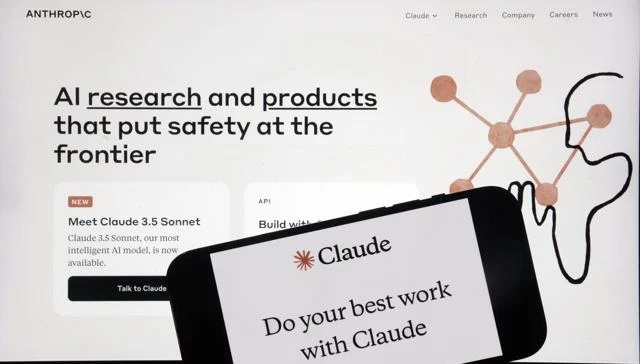
The questions asked participants about their use of generative AI tools, such as ChatGPT and Claude from San Francisco’s OpenAI and Anthropic, respectively. It asked them what tools they used, how they used those tools, the extent to which they applied critical thinking while using generative AI and how they used critical thinking. It also asked them to evaluate how much they trust or rely on such tools.
In analyzing participants’ responses, the researchers divvied up critical-thinking tasks into six categories — the acquisition of knowledge, comprehension, application of knowledge to solve problems, analysis, synthesizing information to form something new, and evaluation.
The study found that the more confident participants were in AI’s outputs, the less likely they were to not only engage in critical thinking overall, but also in everything but comprehension.
Many of those surveyed said they just generally trust the generative AI tools they use, according to the researchers’ report. One participant who uses ChatGPT said they used it to make their writing sound professional.
“It’s a simple task, and I knew ChatGPT could do it without difficulty, so I just never thought about it, as critical thinking didn’t feel relevant,” the participant said in the survey.
But others said they weren’t applying critical thinking, such as by evaluating what the generative AI tools produced, because they were short for time or doing so was someone else’s job.
“In sales, I must reach a certain quota daily or risk losing my job,” said one participant. “Ergo, I use AI to save time and don’t have much room to ponder over the result.”
Others told the researchers they simply didn’t know enough to evaluate whether the answers they got from generative AI were accurate or how to polish them. One participant’s colleagues criticized a document ChatGPT helped write, for example.
But, the participant told the researcher, “I’m not sure how I could have improved the text.”

The Carnegie Mellon researcher involved in the study did not respond to a request for comment. The Microsoft researchers were not available for comment, according to a company representative.
But in an emailed statement, Lev Tankelevitch, a senior researcher at Microsoft who was a co-author of the study, said AI works best when people use it as a “thought partner,” encouraging them to engage with it critically.
“All of the research underway to understand AI’s impact on cognition is essential to helping us design tools that promote critical thinking,” Tankelevitch said.
The problem, Gerlich and other researchers say, is that AI tools — at least as they exist today — don’t necessarily encourage that.
Instead, those tools make it easy for users to avoid “effortful thinking,” said Benjamin Riley, the founder of Cognitive Resonance, a think tank focused on generative AI and understanding human cognition.
While people have been able to use older tools, such as calculators or online search engines, to do some of their thinking for them, generative AI stands apart, Riley said.
“We’ve never before had a tool that was free and readily available that could essentially create something new … just by prompting it with whatever you want,” he said.
The danger — as even the researchers on the Microsoft study acknowledge in their report — is that because it’s so easy to use, people can become overreliant on AI and lose their ability to think critically about what it’s producing. That’s of particular concern when it comes to students, who are already widely adopting such tools, Riley said.
One of the promises of AI is that it will take on mundane, repetitive tasks. But it’s often through doing analytical tasks over and over that people hone their critical thinking, researchers say.
“While GenAI can improve worker efficiency, it can inhibit critical engagement with work and can potentially lead to long-term overreliance on the tool and diminished skill for independent problem-solving,” the Microsoft researchers said in their report.

The two studies did offer some hope. Gerlich’s study found that the more education people had, the more likely they were to engage in critical thinking. It also indicated that education tended to counteract some of the effect of AI use on such thinking; even among people who used AI tools a lot, people with more education tended to use critical thinking more often.
Similarly, the Microsoft study found that the more confident people were in themselves and being able to scrutinize AI’s output, the more likely they were to engage in critical thinking — particularly in making use of and evaluating what the tools generated. Many such people did so even though it required more time and effort.
The key thing in terms of how AI affects critical thinking, is how people approach and use it, Gerlich said. Tempting as it might be, it’s important not to simply offload all thinking to such tools, but instead to be thoughtful about how to use them and about what they produce, he said.
“We have to learn how to use it properly,” Gerlich said.
If you have a tip about tech, startups or the venture industry, contact Troy Wolverton at twolverton@sfexaminer.com or via text or Signal at 415.515.5594.
Magnolias and the Meaning of Life: Science, Poetry, Existentialism
By Maria Popova (themarginalian.org)
Pastel-colored apparitions of tenderness, magnolias are titans of resilience. They have been consecrating Earth with their beauty since the time dinosaurs roamed it, long before bees evolved to give our planet its colors, pioneering the exquisitely orchestrated pollination strategies by which perfect flowers survive.
Today, for a precious week in spring, they bloom to remind us that life is livable, then die to remind us that it must be lived.
Magnolia under a dawn redwood in Downtown Brooklyn
When Western botanists first encountered these ravishing flowering trees on an island in the West Indies, they named them after the trailblazing French botanist Pierre Magnol — originator of the concept of plant families and the first person to devise a system of natural classification, a century ahead of Linnaeus. The word magnolia was heartily adopted, so that by the time Linnaeus published his Species Plantarum, introducing his revolutionary binomial naming system, the magnolia appeared in it as a single species. Today, we know there to be hundreds, some of them deciduous and some evergreen, with the American evergreen species Magnolia grandiflora the most widely recognizable.

Magnolias have a long history of enchanting humanity with their splendor and symbolic intimations. As early as the year 650, Buddhist monks in China made of the wild magnolia a garden deity, planting a white-blooming Magnolia denudata at their temple as a symbol of purity. The magnolia planted at the White House from a Tennessee sprout in the 1820s lived through thirty-nine presidencies and came to grace the back of the $20 bill for seven decades. Magnolia sieboldii is the national flower of North Korea, and Magnolia grandiflora the state flower of both Mississippi and Louisiana.

Magnolias have long figured in our efforts to mediate between the body and the mind — the mediation we call medicine. In the early nineteenth century, American physicians began using the dried bark of Magnolia virginiana, Magnolia acuminata, and Magnolia tripetala to treat malaria, rheumatism, and gout. For millennia, Chinese medicine has been transmuting the bark of Magnolia officinalis into a tonic known as hou-phu, used for treating neurological and gastric disorders. Twentieth-century science isolated from it the compounds magnolol and honokio — sedatives with relaxant effects on the central nervous system, found to help reduce tremors in Parkinson’s patients. Throughout Asia, the common drug hsin-i, made of the flowering buds of several magnolia species, is used to treat headaches, fever, allergies, and respiratory disorders.
Humans are not the only animals to wrest vitality from magnolias. Migrating songbirds relish them, drawn to the bright seeds and nourished by their unusually high fat content of 40% — more than twice that of the avocado, Earth’s most nutritious fruit. Squirrels, raccoons, and possums also savor them. Their leaves are a favorite food for the larvae of the giant leopard moth — one of Earth’s most majestic and resplendent insects.
Humans, too, have feasted on the magnolia — in rural England, the petals of Magnolia grandiflora are used to spice stews, in Japan the young leaves and buds of Magnolia hypoleuca are broiled as a vegetable, and in other Asian cuisines the flower buds of various magnolia species are used to scent tea and flavor rice. The aromatic hoba miso is made with magnolia.

To me, magnolias are the most existential of trees, their weeklong bloom an open-mouth scream of exhilaration at the transient miracle of being alive. There is cruelty to beauty so fierce and so fleeting. “Blossoms on our magnolia ignite the morning with their murderous five days’ white,” Robert Lowell wrote in a poem. But there is also kindness in its gentle reminder not to squander a single moment of living. In five days, a whole life can spin on its axis.
Brian goes on a time travel to stop Jesus from starting Christianity
Psychokinesis (PK) with Loyd Auerbach
New Thinking • Apr 9, 2025 Loyd Auerbach, MS, received his masters’ degree in parapsychology from John F. Kennedy University. He is author of Mind Over Matter; ESP, Hauntings, and Poltergeists: A Parapsychologist’s Handbook; Reincarnation, Channeling, and Possession; Psychic Dreaming; A Paranormal Casebook; and Ghost Hunting: How to Investigate the Paranormal. He is co-author (with Ed May, Joseph McMoneagle, and Victor Rubel) of ESP Wars: East and West. He is the Director of the Office of Paranormal Investigations. He also serves on the Board of Directors of the Rhine Research Center. In this interview, rebooted from 2019, he suggests that the principles of sports psychology also apply to the cultivation of psychokinesis. He maintains that we ultimately use PK to control our own bodies. The wide-ranging discussion that follows covers spoon-bending, poltergeists, martial arts, magical illusions, seances, as well as apports and disappearances. Considerable emphasis is placed on overcoming the psychological resistance to either witnessing or practicing psychokinesis. New Thinking Allowed host, Jeffrey Mishlove, PhD, is author of The Roots of Consciousness, Psi Development Systems, and The PK Man. Between 1986 and 2002 he hosted and co-produced the original Thinking Allowed public television series. He is the recipient of the only doctoral diploma in “parapsychology” ever awarded by an accredited university (University of California, Berkeley, 1980). He is also the Grand Prize winner of the 2021 Bigelow Institute essay competition regarding the best evidence for survival of human consciousness after permanent bodily death. He is Co-Director of Parapsychology Education at the California Institute for Human Science. (Recorded on April 11, 2019)
Free Will Astrology: Week of April 10, 2025
BY ROB BREZSNY | APRIL 8, 2025


ARIES (March 21-April 19): Life is asking you to be a source of generosity and strength for the people and animals in your sphere. I hope you will exude maximum amounts of your natural charisma as you bestow maximum blessings. Soak up the admiration and affection you deserve, too, as you convey admiration and affection to others. Here’s a secret: The more you share your resources, help and intelligence, the more of that good stuff will flow back your way.
TAURUS (April 20-May 20): Ceramicist Jun Hamada says that trying to force harmony into her art leads to sterile work. “The most beautiful pieces come from the moments I stop trying to make them beautiful,” she notes. “They emerge from embracing the clay’s natural tendencies, even when they seem to fight against my intentions.” I recommend her approach to you in the coming weeks. Your best results may emerge as you allow supposed flaws and glitches to play an unexpected part in the process. Alliances might benefit, even deepen, through honest friction rather than imposed peace. What will happen when you loosen your attachment to enforced harmony and let life’s natural tensions gyrate?
GEMINI (May 21-June 20): Gemini-born Frank Lloyd Wright (1867–1959) was a prolific architect who orchestrated many daring designs. Among his most audacious experiments was a project to build a house over a waterfall in Pennsylvania. “It can’t be done!” experts said. But he did it. Before he was ready to accomplish the impossible, though, he had to spend months studying the site’s natural patterns. I bring this to your attention, Gemini, because I believe you are ready to consider your own equivalent of constructing a house over a waterfall. Prepare well! Do your homework!
CANCER (June 21-July 22): In the early phase of his illustrious career as a photographer, Edward Weston (1886–1958) cultivated a soft-focus, romantic style. But he ultimately converted to stark, uncompromising realism. “The camera,” he said, “should be used for recording life, for rendering the very substance and quintessence of the thing itself.” If there is anything about you that prefers warm, fuzzy illusions over objective, detailed truth, I suggest you switch emphasis for a while. If you like, you can return to the soft-focus approach in June. But for now, a gritty, unsentimental attitude will be essential to your well-being.
LEO (July 23-Aug. 22): Here’s my mini-manifesto about change, just in time for a phase when change is most necessary and possible for you. 1. Real change is often a slow and subtle process. There may be rare dramatic shifts, but mostly the process is gradual and incremental. 2. Instead of pushing hard for a short time, you’re more likely to change things by persistently pushing with modest strength for a sustained time. 3. Rather than trying to confront and wrestle with a big problem exactly as it is, it’s often more effective to break the seemingly insurmountable challenge into small, manageable pieces that can be solved one at a time through simple efforts.
VIRGO (Aug. 23-Sept. 22): Textile artist Mei Zhang wondered if the synthetic dyes she used on her fabrics were limited. Might there be a wider variety of colors she could use in her creations? She discovered that her grandmother, using age-old techniques, had produced hues that modern dyes couldn’t replicate. “The most sustainable path forward,” Zhang concluded, “often involves rediscovering what we’ve forgotten rather than inventing something entirely new.” I recommend that counsel to you, Virgo. The solution to a current challenge might come from looking back instead of pushing forward. Consider what old approaches or traditional wisdom you might call on to generate novelty. Weave together fresh applications with timeless principles.
LIBRA (Sept. 23-Oct. 22): The moon rises about fifty minutes later every day, and always at a slightly different place on the horizon. The amount of light it shows us is also constantly in flux. And yet where and how it will appear tomorrow or ten years from today is completely predictable. Its ever-changing nature follows a rhythmic pattern. I believe the same is true about our emotions and feelings, which in astrology are ruled by the moon. They are forever shifting, and yet if we survey the big picture of how they arise, we will see their overall flow has distinct patterns. Now would be a good time for you to get to know your flow better. See if you can detect recurring motifs. Try to develop more objectivity about how your precious emotions and feelings really work. If you do this correctly, you will deepen and enhance the guiding power of your precious emotions and feelings.
SCORPIO (Oct. 23-Nov. 21): Research reveals that interludes of productive uncertainty may strengthen our brain’s neural pathways—even more so than if we consistently leap to immediate comprehension. The key modifier to this fortifying uncertainty is “productive.” We must be willing to dwell with poise in our puzzlement, even welcome and enjoy the fertile mystery it invokes in us. Neurobiologist Aiden Chen says, “Confusion, when properly supported, isn’t an obstacle to learning but a catalyst for understanding.” These ideas will be good medicine in the coming weeks, dear Scorpio.
SAGITTARIUS (Nov. 22-Dec. 21): Persian American author Haleh Liza Gafori translates the poetry of thirteenth-century Sufi mystic Rumi. One of their joint books is titled “Gold.” She writes, “Rumi’s gold is not the precious metal, but a feeling-state arrived at through the alchemical process of burning through layers of self, greed, pettiness, calculation, doctrine—all of it. The prayer of Sufism is ‘teach me to love more deeply.’ Gold is the deepest love.” That’s the gold I hope you aspire to embody in the coming weeks, Sagittarius. You are in a resplendently golden phase when you have more power than usual to create, find and commune with Rumi’s type of gold.
CAPRICORN (Dec. 22-Jan. 19): The coming weeks will be an excellent time to reframe the meaning of “emptiness” in your life. To launch your quest, I will remind you that quiet interludes and gaps in your schedule can be rejuvenating. Sitting still and doing nothing in particular may be a good way to recharge your spiritual batteries. Relieving yourself of the pressure to be endlessly active could be just what you need to open up space for fresh possibilities.
AQUARIUS (Jan. 20-Feb. 18): There was a time, many years ago, when I consulted a divinatory oracle every day of my life. Sometimes it was the Tarot or the I Ching. I threw the Norse runes, did automatic writing, used a pendulum, or tried bibliomancy. Astrology was always in the mix, too, of course. Looking back on those days, I am amused at my obsession with scrying the future and uncovering subconscious currents. But employing these aids had a wonderful result: It helped me develop and fine-tune my intuition and psychic powers—which, after all, are the ultimate divination strategy. I bring this to your attention, Aquarius, because I believe you now have an enhanced power to cultivate and strengthen your intuition and psychic powers.
PISCES (Feb. 19-March 20): The fovea is the part of the eye that enables sharp vision. Humans have just one kind of fovea, which gives them the ability to see clearly straight ahead. Eagles have both a central and peripheral fovea. The latter gives them an amazing visual acuity for things at a distance. This extra asset also attunes them to accurately detect very slow movements. I suspect you will have a metaphorical semblance of the eagle’s perceptual capacity in the coming weeks, Pisces. You will be able to see things you wouldn’t normally see and things that other people can’t see. Take full advantage of this superpower! Find what you didn’t even know you were looking for.
Homework: Which of your previous bests are you primed to surpass? Newsletter.FreeWillAstrology.com