
New Thinking Allowed with Jeffrey Mishlove • Jan 28, 2025 Stephan A. Schwartz is a Distinguished Associated Scholar of the California Institute for Human Science, H is also a columnist for the journal Explore, and editor of the daily web publication Schwartzreport.net in both of which he covers trends that are affecting the future. He is one of the small group that created modern remote viewing, including several now standard protocols. In addition to his non-fiction books and novels, he is the author of more than 250 technical reports, papers, academic book chapters, prefaces, and introductions. He is the recipient of the Parapsychological Association Outstanding Contribution Award, and he was featured in Germany’s OOOM Magazine’s list of 100 Most Inspiring People in the World. His books include The Secret Vaults of Time, Opening to the Infinite, The Alexandria Project, and The Eight Laws of Change. He also edited the volume, Is Consciousness Primary? His websites are https://stephanaschwartz.com/, www.schwartzreport.net, and / @schwartzreportnet Here he argues that humanity, as a whole, is experiencing a subconscious precognition concerning the massive impact of climate change and species extinction. He maintains that this vague fear of an uncertain future is driving the worldwide trend toward authoritarian regimes. He also claims that there will be a massive disruption of human culture between 2040 and 2045. 00:00 Introduction 04:12 The trend away from democracy 12:19 Presentiment research 19:07 Non-human consciousness 24:36 Predicting the future 34:28 Unconscious precognition 40:59 The extinction of species 47:50 Potential future catastrophes 54:13 Conclusion New Thinking Allowed host, Jeffrey Mishlove, PhD, is author of The Roots of Consciousness, Psi Development Systems, and The PK Man. Between 1986 and 2002 he hosted and co-produced the original Thinking Allowed public television series. He is the recipient of the only doctoral diploma in “parapsychology” ever awarded by an accredited university (University of California, Berkeley, 1980). He is also the Grand Prize winner of the 2021 Bigelow Institute essay competition regarding the best evidence for survival of human consciousness after permanent bodily death. He is Co-Director of Parapsychology Education at the California Institute for Human Science. (Recorded on January 8, 2024)
Monthly Archives: January 2025
Two Bible quotes, one from the Old and one from the New

New Moon in Aquarius January 29
Pam Gregory • Jan 14, 2025 Pam talks about the second half of January and the New Moon in Aquarius on the 29th. What does this mean for you? You can download a free birthchart from my website www.pamgregory.com, then purchase this two-part tutorial video series that explains how to find these points in your chart and what it means for you: https://gumroad.com/l/FHjOZ.
(Contributed by Zoë Robinson, H.W., M.)
Story: Broken Agreement
| Broken Agreement |
 A boy and a girl were playing together. The boy had a collection of marbles and the girl had some sweets. The boy told the girl that he would give her all his marbles in exchange for all her sweets, and the girl agreed. However, the boy kept the most beautiful and the biggest marbles with him and gave her the remaining marbles. The girl gave him all her sweets as she promised. That night, the girl slept peacefully. The boy could not sleep, as he kept wondering if the girl had hidden some sweets from him, the way he had hidden the best marbles from her. Author Unknown AN OPPORTUNITY FOR DAILY REFLECTION BROUGHT TO YOU BY THE SCHOOL OF PRACTICAL PHILOSOPHY |
The liberation of Auschwitz: What the Soviets discovered on January 27, 1945
EUROPE
Eighty years ago on January 27, 1945, soldiers from Russia’s Red Army entered the gates of Auschwitz-Birkenau in Poland and were the first to discover the horrors of the concentration camp where more than a million people, most of them Jews, had been murdered. They found just a few thousand survivors in a sprawling complex where the SS had tried to erase all traces of their crimes.
Issued on: 27/01/2025 – France24.com

In his Holocaust memoir, “The Truce”, Italian prisoner Primo Levi recounted his first contact with the Red Army soldiers when Auschwitz-Birkenau concentration camp was liberated.
“The first Russian patrol came in sight of the camp about midday on 27 January 1945,” he wrote. “They were four young soldiers on horseback, who advanced along the road that marked the limits of the camp, cautiously holding their sten-guns. When they reached the barbed wire, they stopped to look, exchanging a few timid words, and throwing strangely embarrassed glances at the sprawling bodies, at the battered huts and at us few still alive.”
Imprisoned since February 1944 in Monowitz, one of the three camps located in the sprawling concentration camp grounds, Levi witnessed the men’s unease as they caught sight of a place that has since become a symbol of Nazi brutality.
“They did not greet us, nor did they smile; they seemed oppressed not only by compassion but by a confused restraint, which sealed their lips and bound their eyes to the funeral scene.”
Facing the ‘unimaginable’
On January 27, 1945, these Soviet soldiers witnessed the unimaginable.
“They were contingents from the first Ukrainian front. The Red Army stumbled upon this site by chance. Going into Auschwitz wasn’t a war goal. You can imagine these people’s astonishment as they discovered one concentration camp after another,” said historian Alexandre Bande, a Holocaust specialist.

In his latest book, Auschwitz 1945, Bande has tried to shed light on what happened that historic day and in the weeks that followed.
While many books have focused on the workings of Auschwitz-Birkenau, with its selections and extermination process, Bande chose to look at the gaps in the story of its liberation.
“What happened on this site has left such a profound imprint on people’s minds that historians, the general public and eye witnesses have been more interested in what occurred during (the liberation) rather than what happened afterwards.”
On the morning of the liberation at the end of January, the Soviet soldiers encountered fierce resistance from German troops. Intense fighting took place on the outskirts of the camp. Once they had overpowered these enemy soldiers, the Red Army discovered a handful of survivors: some 7,000 to 8,000 people. “They were mainly men, women and children who were deemed too incapacitated to be moved,” Bande said.
‘The snow was red with blood’
Just a few days earlier, on January 17, the Germans had begun evacuating Auschwitz-Birkenau. Hitler had ordered that no prisoner should fall into enemy hands alive. Nearly 60,000 people were dragged off in rags onto the roads in the middle of winter, heading west in what became known as the notorious death marches.
“We left in columns of 500. We walked for practically three days and three nights,” Raphaël Esrail, who was deported by convoy no. 67, told FRANCE 24 in 2020.
“What I remember most, and can’t forget, are those men and women on the side of the road who had died. They’d been shot in the head by an SS man, or had to walk barefoot for hours. They had fallen as if in prayer, their legs frozen,” he said, recounting the transfer to the Gross-Rosen camp.
“I never expected this. The death marches were harrowing. The snow was red with blood. We were surrounded every 50 metres by the SS,” Léa Schwartzmann, a prisoner on the same convoy who was evacuated to the Ravensbrück camp, said in an interview in 2016.
Before dragging prisoners onto death marches, the SS tried to destroy as much evidence of their crimes as possible. As early as autumn 1944, Nazi authorities were making preparations to abandon Auschwitz-Birkenau. Pits containing the ashes of victims were liquidated, while the crematoria and gas chambers were demolished. When the Soviets entered the camp, however, much of the physical evidence remained.
“When they arrived at the barracks where the bags full of hair were stored, they understood that these were human remains. But it took them some time to understand the reality of the murders of hundreds of thousands of people,” Bande said.
Reconstructing the past
Evidence of the atrocities was captured in pictures by photographers attached to the Red Army. They photographed or filmed the dying in the barracks, the piled-up corpses and the 40,000 pairs of spectacles and 50,000 hairbrushes in storage.

“The first series of images taken in the immediate aftermath were of poor quality, due to the lighting conditions and the equipment used,” Bande explained.
“The second set of images is more recognisable. You can see, for example, prisoners falling into the arms of soldiers, but these are reconstructions. They were made by the Soviets in the weeks that followed. The idea was not to dwell on the suffering of the prisoners, but to highlight the heroism of the soldiers of the glorious Red Army.”
For some survivors, liberation did not end the suffering. As Albert Grinholtz, deported on convoy no. 4, recalled in 1991: “The soldiers, shocked by our starvation and skeletal bodies, immediately prepared soup in a wheelbarrow. (…) Closing my eyes, I remember this scene, the first bit of nourishment after so much deprivation and suffering. It caused many casualties among our comrades, who were unable to resist so much food, it was too rich.”

Symbolic of the Holocaust
Survivors took weeks, sometimes months, to return to their home town or country. Of the almost 69,000 people transported from France to Auschwitz-Birkenau, only 3% ever returned home. In the aftermath of the liberation, the Auschwitz-Birkenau concentration camp was repurposed. The Soviets interned German prisoners of war and Poles suspected of collaboration there, while locals scoured the many barracks that were torn down salvaging scraps of timber. Trials and executions were also held at Auschwitz, including that of former camp commander Rudolf Höss.
In 1947, a memorial museum was finally opened to “protect the site and ensure knowledge is passed down of the crimes committed there”. Eighty years on, Auschwitz-Birkenau has become an important place of remembrance, symbolic of the Holocaust. Last year, it welcomed 1.83 million visitors.
“It’s a symbol, especially in France, because the majority of Jewish deportees died there, but also because it’s one of the best-preserved sites. It’s more difficult attracting hundreds of thousands of tourists to a simple monument or memorial,” Bande explained.
“Auschwitz allows us to show the magnitude of the atrocities.”
This article has been translated from the original in French by Nicole Trian.
Tarot Card for January 28: Lord of Happiness
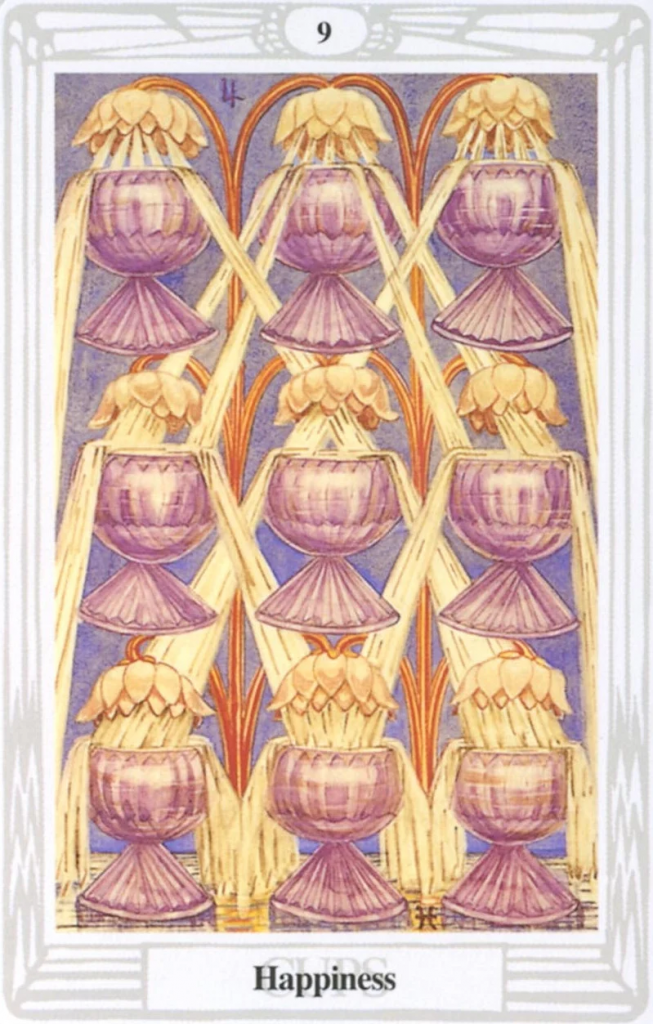
| The Nine of Cups On a day which is ruled by the Lord of Happiness, we need only open ourselves to the infinite blessings of the Universe, and we will be surrounded by warm happy loving energy. At its highest level, this card reminds us of the completely inexhaustible supply of love that flows continuously about us, and tells us to simply step forward and enjoy!In the hurly burly of modern life it’s easy to forget to count our blessings. And in so doing, we lose sight of a very basic spiritual truth – love IS all around us. Beauty springs up in the most unexpected places. Radiance and wonder abound in this world of ours.Yes – sure, there’s a lot of pain out there too. Sure, not everything may be as we wish it to be. Sure, we might hear a news report that does not fill us with faith and belief in the race.But we can look up to the sky… and there (no matter what the weather) we will see an image of pure perfection. We can study a flower, and we will see a miracle. We can look at our lives and be thankful for all the things that we’re glad are present in it.And we can do this with an open heart – no doubts, no yes-buts, no compromises. When we do this, we fill our souls with the colour of wonder. We touch the dreaming parts of us. And once filled, those secret silent places can feed us strength when we confront ugliness or cruelty.All it takes to see the brightness of life is our willingness to look – without reservation. And when we see brightness, and we allow it to enter inside us, we become brighter, and hope is an easier emotion.So on a Lord of Happiness day, do these things – look until you find something perfect; seek till you discover something beautiful; contemplate until you find something to be grateful for. And having done those things, draw that beauty, that perfection, that gratitude inside you. And live the rest of the day in accordance with what you have discovered. You’ll make miracles!! I promise! Affirmation: “Life fills me with wonder and light” |
(Angelpaths.com)
Fritz Thyssen on Hitler

(Image from Goodreads.com)
“Hitler had an unprecedented opportunity … to create something new. However, besides the fact that he knows absolutely nothing about matters economic, he cannot even fully understand his economic advisers. He is impulsive and always follows his last impressions, but he is not energetic. His contant worry has ever been to keep himself in power. In addition to this, he believes that he alone is a great man, and all others non-entities.” (p. 135)
“It has come to the point where even Hitler is afraid of the Gestapo. These scoundrels know how to turn this to their profit. They constantly tell him that they must protect him, and they protect him so well that he is almost their prisoner.” (pp. 137-138)
“Four months before the war one of Hitler’s privy councillors, Secretary of State Wilhelm Keppler, after a dinner given by the President of the Reichsbank, said in my presence,”It is in our interest to maintain maximum disorder in Europe.” This, as a principle of diplomacy, is monstrous. Leaders who are prepared to allow the policy of a great country to be guided by this principle are madmen and criminals and deserve to be placed in a position where they can do no further harm.” (p. 251)
–Quotes from I Paid Hitler by Fritz Thyssen
Pentagon Warns China Developing Love, The Greatest Weapon Of All

Published: January 27, 2025 (TheOnion.com)
ARLINGTON, VA—In a high-level alert that revealed a geo-political rival of the United States could soon become the first nation capable of wielding the most powerful force in the universe, the Pentagon warned Friday that China was actively developing love, the greatest weapon of all.
The alert, issued to the American public and top U.S. allies, stated that China had made significant advances in love, a transcendent source of strength that ultimately triumphs over any defenses an enemy might try to erect against it. Weapons experts confirmed that if it were unleashed, the all-consuming feeling could strike the hearts of billions throughout Asia and the Pacific, even reaching the West Coast of the United States.
“Our assessments indicate love is stronger than any technology possessed by the U.S. military,” said Defense Secretary Lloyd Austin, pledging to work with Japan, South Korea, Australia, and other regional partners to stop China from harnessing the invincible cosmic force that always emerges victorious. “Intelligence estimates suggest the program is in its final stages, so we must act quickly or love will overwhelm us and we will feel compelled to surrender to it.”
“If China succeeds, it will have the power to remake the global order by spreading universal love and understanding to every corner of the world,” Austin added.

Nations have vied for years to develop love, knowing it would provide their arsenals with a weapon that could overcome anyone or anything it encountered. According to sources within the Pentagon who spoke on condition of anonymity, the Defense Department’s own 10-year, $750 billion effort has failed to produce an abundance of love, bringing it no closer than it was a decade ago to equipping the military with a profound sense of devotion to one’s fellow human beings.
China is believed to have put similar resources into its far more successful program, with surveillance reports indicating that by 2030 the nation will have obtained an emotion that can create a profound sense of oneness with the universe. Previously, U.S. military analysts had questioned whether China possessed the emotional vulnerability necessary to develop love, believing it was still several decades away from acquiring a feeling so expansive it knows no bounds and flows outward into every aspect of existence.
In 2019, the U.N. issued sanctions after it found evidence of China’s intent to open itself up to love’s embrace, but inspectors reportedly underestimated just how quickly the smallest seed of tenderness could flourish into a garden of eternal love. Today, international observers expressed concerns that if the weapon were used, the world would see a fallout of hundreds or even thousands of years in which love would endure all things.
“It is clearly a show of strength by China to love like its heart has never been broken,” said Daniel Feng, an expert on Sino-American relations at Georgetown University, noting that China’s ultimate goal was to assert its right as a sovereign nation to love freely and unselfishly by letting go of fears and expectations. “Quite frankly, no one can escape the power of love, and China knows it. By putting their hearts on the line, they are signaling that at any given moment they could shower the United States with a love so fierce it would leave their international rival unrecognizable afterward.”
“So what should the Pentagon do now?” he continued. “With new theories suggesting it has the potential to be far, far stronger than love, America’s best strategy may be developing the technology to harness the power of mild annoyance.”
Yuga Shift: The End of the Age & the Impending Planetary Transformation

From New Dawn Special Issue Vol 18 No 1 (Feb 2024) (newdawnmagazine.com)
In the years leading up to 2012, when there was considerable global consternation over the approaching end of the Mayan Calendar, I became interested in the Yuga Cycle doctrine of ancient India.
I decided to take a closer look at the available data and philosophical speculations to determine the possible ending of the Kali Yuga or Iron Age – the current age of greed and lies, discord and violence, that we live in.
When I dove into the details, however, I realised that a few errors and omissions had crept into the ancient texts over time during our long passage through the darkness of the Kali Yuga. The original formulation of the Yuga Cycle was completely forgotten.
Most ancient cultures subscribed to the belief that human civilisation and consciousness move in grand cycles, from the Golden Ages of illumination and harmony to the Dark Ages of ignorance and strife.
The guiding principle that I adopted to help me work out the Yuga Cycle framework was that there could not have been different Yuga Cycles for different cultures. There was only one Yuga Cycle for the entire world that governed the periodic rise and fall of consciousness. To stitch together the original framework, delineating the common threads that run through the different traditions was of utmost importance. I also figured that I needed to keep tabs on the latest archaeological, anthropological and historical findings, for any Yuga Cycle framework needs to be backed up with as much scientific data as possible.
In July 2012, I published an article in which I put forward what, in my opinion, was the original Yuga Cycle timeline, that indicated the Kali Yuga was due to end in 2025. I discussed the rationale for the proposed timeline in the article, and I have treated the matter with a lot more rigour in my new book.
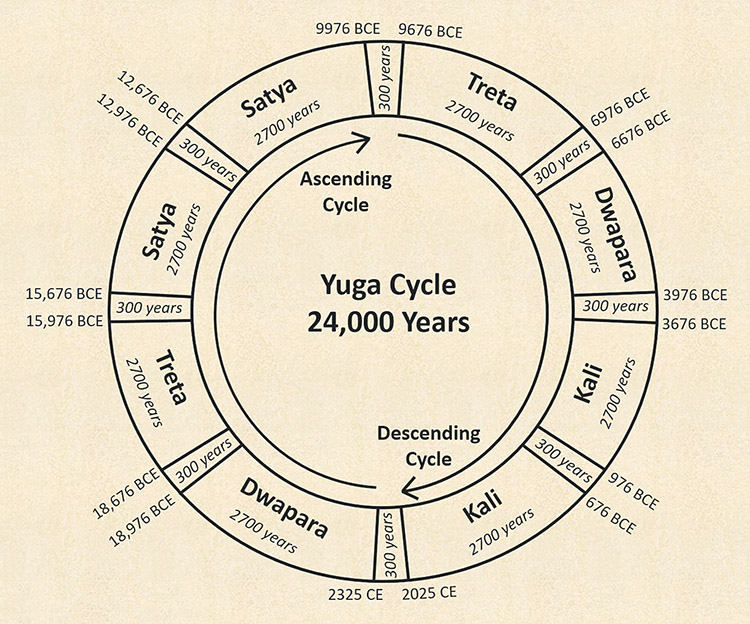
Without going into the nitty-gritty, let me present some of the essential building blocks of this framework.
- The complete Yuga Cycle is 24,000 years in duration and is comprised of an ascending cycle of 12,000 years, when human consciousness, in tandem with our lifespan and physical size, gradually increases, followed by a descending cycle of 12,000 years when such qualities gradually diminish.
- Each 12,000-year half-cycle is comprised of four Yugas of equal duration of 3,000-years each. The actual duration of a Yuga is 2,700 years, and it is followed by a transitional period of 300 years before the qualities of the subsequent Yuga are manifested. The Yuga Cycle was tracked using the “Calendar of the Seven Sages” or “Saptarshi Calendar” of ancient India, which has a 2,700-year cycle called a “Saptarshi Yuga.”
- As per the historical records, one of the starting points of the Saptarshi Calendar was in 6676 BCE, which denotes the beginning of the Dwapara Yuga (Bronze Age) in the descending cycle. Using this date as an anchor point, the entire Yuga Cycle timeline gets unravelled, as shown below. For those who are not familiar with the Sanskrit terms: Satya Yuga is Golden Age, Treta Yuga is Silver Age, Dwapara Yuga is Bronze Age and Kali Yuga is Iron Age.
The Yuga Cycle framework reveals that the descending cycle of consciousness began in 9676 BCE, around the same time that the last Ice Age came to a rather abrupt end. The same date has been indicated in the ancient texts as the time when Atlantis sank into the ocean, and Ahura Mazda re-created the world and initiated the World Cycle of 12,000 years. Over the past 5,700-odd years, we have been living in two back-to-back Kali Yugas – the descending Kali Yuga followed by the ascending Kali Yuga. These two Yugas of ignorance and discord span most of recorded history, starting with the Bronze Age civilisations in Egypt, Mesopotamia and the Indus Valley.
We now approach the end of ascending Kali Yuga in the year 2025. The term “ascending” tends to convey the wrong impression that we are in a “higher Yuga,” and that our civilisation may be on an upward trajectory of virtue and progress. Far from it. In the ascending Kali Yuga, only the material circumstances of life begin to improve, along with an increase in our lifespan and physical stature, but the degradation of human consciousness and the proliferation of vices in society continues unabated throughout the entire duration of the Kali Yuga.
This is why we have ended up with an out-of-balance society characterised by a massive “matter-spirit gap” that is highly destabilising and responsible for much of the misery and injustices we see around us. The need of the hour is to reduce our attachment to material acquisitions and focus our energies on the other dimensions of life, particularly on cultivating mental and spiritual awareness to restore the much-needed balance, harmony and sanity in our lives.
There is no doubt that we are living in times of momentous changes, which will begin to unfold as we get closer to 2025 and enter the period of transition. Not only are we about to emerge from the dense, materialistic vibrations of the Kali Yuga, but we are also at the cusp of the entire descending cycle of consciousness that began in 9676 BCE.
The events of the past few years have revealed that human consciousness has plunged into utter depravity, and all means, however despicable, are now considered legitimate for the acquisition of money and influence and the enslavement of the people. The spectre of hatred, war and unrestrained violence is spreading across the world, while the frequency and ferocity of extreme weather phenomena such as floods, landslides and wildfires have dramatically increased over the past few years. All of these are precursors of the planetary-scale changes that lie ahead of us.
Every time we go through the periods of transition between the Yugas, there is a cataclysmic obliteration of the existing civilisations (pralaya, in Sanskrit), which is followed by the re-emergence of a new wave of civilisations with different artistic, technological and cultural traits. The purging events purify our consciousness and restore all of nature to its original pristine state to support another round of evolution. The archaeological and geological evidence shows that every 3,000-odd years, a new wave of civilisations appears to miraculously emerge all over the world, built on the ashes of the previous civilisations.
It happened in c.9600 BCE, with the establishment of the settlements at Gobekli Tepe. We can be quite certain that similar settlements were springing up elsewhere at the same time, the evidence of which we have yet to uncover. In c.6500 BCE, new settlements emerged in Anatolia and Southeastern Europe with distinct cultural traits, but we don’t have much of an idea about what was happening in other parts of the world then. In c.3600 BCE, a bunch of new civilisations arose almost simultaneously in Egypt, Mesopotamia, India, Malta, and other places, while in c.600 BCE, the Iron Age cultures emerged at around the same time in the Eastern Mediterranean region, Persia, India, Mesoamerica etc.

The trend is distinct and unmistakable. The Yuga Cycle is not an article of faith but an important scientific doctrine that captures the cyclical nature of human civilisation. Not only does it give us a clear perspective of what had happened in the past, but it also tells us where our own decadent civilisation of the Kali Yuga is headed. In my new book, I take a closer look at the events of the last four Yuga-transitional periods, revealing that comet and meteor impacts inevitably play a crucial role in the periodic process of destruction and renewal.
The Degradation of the Human Race
One of the important topics I explore is an important tenet of the Yuga cycle doctrine. In tandem with the decline in our consciousness in the descending cycle, our lifespan and physical size also decline, and the environment becomes less favourable to us. You may be surprised to know that a host of scientific data published in reputed academic journals supports all of these contentions! Yet, how many times have you heard about this ongoing degradation of the human race being talked about in mainstream media?
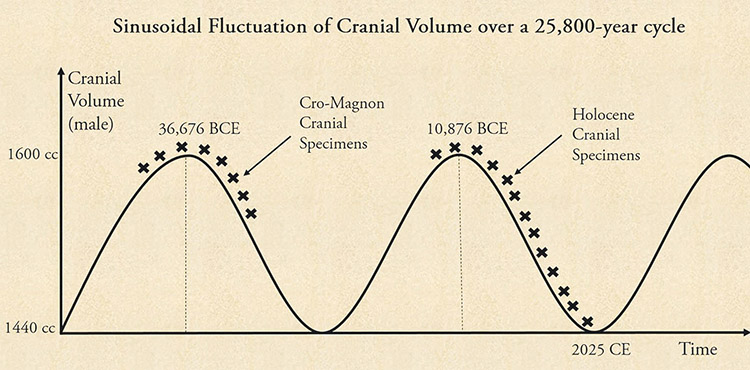
On average, humans today are roughly 10% smaller than their Golden Age counterparts who lived in the late Palaeolithic period. Scientific studies reveal there was no food scarcity or diseases in the late Palaeolithic period (i.e. Golden Age), but throughout the Holocene period (i.e. descending Yuga Cycle), sources of food became increasingly scarce, many kinds of diseases became endemic, and incidences of violent deaths increased significantly.1
In addition, all over the world, human beings have lost nearly 10% of their cranial volume over the past 12,000-odd years, which is equivalent to the difference between the average cranial volume of Homo erectus and Homo sapiens!2 How do you explain that? When science writer Kathleen McAuliffe spoke to Christopher Stringer, a palaeoanthropologist at the Natural History Museum in London, about the 10% reduction in our cranial volume since the late Palaeolithic period, Stringer told her something quite stunning: “Scientists haven’t given the matter the attention it deserves. Many ignore it or consider it an insignificant detail.”3
Can you imagine that? This absolutely jaw-dropping piece of scientific data, which turns the Darwinian theory of gradual evolution on its head, is treated as an “insignificant detail.” If this is insignificant, what really is significant? Have our cranial volumes shrunk so much that we can no longer distinguish between what is truly important and what is not? That, unfortunately, is precisely what seems to be going on. Because of our declining cranial volume, most of us can no longer discriminate between the truth and the lies or determine what is harmful to us and what truly serves our evolution and happiness. Our declining cranial volume is the primary cause of the misery, injustices and violence of the Kali Yuga.
Population geneticists tell us that the progressive degeneration of the human race is happening due to the accumulation of harmful genetic mutations over the past 10,000-odd years. My proposition is that the Darwinian theory of linear evolution is patently wrong, and what is really happening is that both our physical size and cranial volume are fluctuating in a sinusoidal manner over the 25,800-year precession cycle or Yuga Cycle. This is why the cranial specimens of the Cro-Magnon, who had extremely large cranial volumes paralleling those of our Golden Age ancestors, straddle the peak of an earlier Golden Age at around 36,676 BCE!
Even though genetic mutations seem to be driving the sinusoidal fluctuation in physical size and cranial volume in tandem with the earth’s precession cycle, there must be an external electromagnetic source behind this, which is triggering the harmful and advantageous genetic mutations in a cyclical manner. What could be this source?
I tried to ascertain what Sri Yukteswar really meant when he wrote in The Holy Science that it is the creative power “Brahma” – located at the grand centre called “Vishnunabhi,” around which our sun revolves – who regulates the fluctuation of dharma or virtue in the course of the Yuga Cycle. Interestingly, the Buddhist and Chaldean philosophers of antiquity spoke of the “Great Central Sun” or “Hypercosmic Sun” located beyond the circle of fixed stars, which radiated “intellectual light” or “Inner Light.”
WATCH OUT! The Taurid Meteor Stream
Finally, I come to the big question, and that is, what causes the cataclysmic obliteration of civilisation during the periods of Yuga transition? My study of the ancient texts and investigations into the events of the last four Yuga-transitions had already alerted me to the role played by comet and meteor impacts in the periodic reboot of civilisation. The work of astronomers Clube, Napier, Steel and their colleagues indicate that the Yuga-ending catastrophes, which occur like clockwork every 2,700 years, are caused by the passage of the earth through the “dense core” of the Taurid meteor stream – known as the “Taurid Resonant Swarm” – which contains a number of massive, dormant, comets and full-size asteroids, formed from the break-up of the Taurid progenitor comet. In an article in National Geographic, Australian astronomer Duncan Steel was quoted saying something that really made me sit up and take notice:
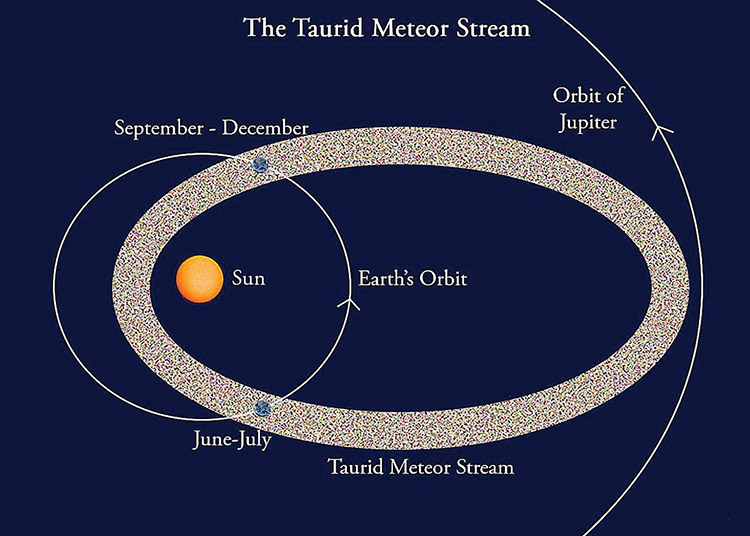
Every 2,500 to 3,000 years or so, the core of the Taurid stream passes near Earth and produces much more intense meteor showers for a few centuries…. A gap of a few centuries separates the era of intensity between Northern Taurids and Southern Taurids.4
This is an almost perfect explanation for the periodic Yuga-ending cataclysms! What I found most astonishing is that two of the giant comets hidden within the Taurid Resonant Swarm were known to the ancients and revered by them as the messengers or animal mounts (vahanas in Sanskrit) of their gods. The sacred texts and symbols of our ancestors provide specific information about the location, structure, and function of these two comets! The ancients seemed to believe that this periodic destruction and renewal of civilisation does not occur randomly but is divinely guided by inter-dimensional beings whom they regarded as their gods.
Since the Earth is due to pass through the centre of the Taurid Resonant Swarm in the years 2032 and 2036, it has ominous implications for our civilisation. These are likely to be events that finally pull down the curtains on the Kali Yuga.

Without going into too many details, let me just say there are strong indications that the years from 2025 to 2040 are the “end-times” the ancient texts tell us of. We are living in times of the fulfilment of the prophecies when our reality will be drastically altered, and we will be forced to introspect about our patterns of thought and our way of life.
We are standing at the doorstep of an extraordinary transformation that will change our life and our planet beyond our wildest imagination. The writing is on the wall: the Kali Yuga party is over and we need to sober up. The old ways will not work anymore, and the planetary vibrations are going to change very quickly post-2025.
As the Kali Yuga energies wane after 2025, the tyrants who control the affairs of the world may begin to find that their evil plans are no longer coming to fruition as easily as before, and they may face increasing opposition from people around the world. Humanity may become more polarised than ever before, leading to greater social and economic instability, taking us closer to the next World War. An eruption of insanity and large-scale violence typically happens during a Yuga-ending period, and it is unlikely to be any different this time. In tandem with the outbreak of wars and revolutions on a global scale, the intensity of various natural catastrophes – floods, cyclones, landslides, wildfires, earthquakes, tsunamis, volcanic eruptions etc. – may also increase exponentially.
So, it’s not just one thing that we have to reckon with, but a dreadful cocktail of wars, environmental catastrophes and comet impacts, all dished out to us while the fabric of society is torn apart by tyrannical governments and mega corporations bent on global enslavement, propped up by relentless media propaganda designed to brainwash the masses.
It’s going to be a tough challenge for any person to retain his sanity in the midst of this unfolding. But, if we reorient our thoughts and lifestyle and keep our psyche rooted in our soul vibrations, we can protect ourselves from the greatest suffering. In my new book, I share some thoughts on how we can deal with and navigate the chaos of the end times, although this is something that will probably become clearer with time as more and more people realise the enormity of the changes that are on the way and chime in with their intuitive feelings.
YUGA SHIFT: The End of the Kali Yuga & the Impending Planetary Transformation provides much-needed clarity and guidance to those who already sense this momentous shift. I trust you will join me on this epic journey across time and space to understand the significance of the Yuga Cycle and the coming Shift in the Ages – and how we can prepare for it.
Bibhu Dev Misra’s important book, YUGA SHIFT: The End of the Kali Yuga & the Impending Planetary Transformation, is available on Amazon.com in Kindle and paperback editions.
This article was published in New Dawn Special Issue Vol 18 No 1.
If you appreciate this article, please consider subscribing to help maintain this website.
Footnotes
1. Michael Hermanussen, “Stature of early Europeans”, Hormones, 2003, Vol.2, No.3, 175-178, hormones.gr/pdf/Stature_europeans.pdf
2. Maciej Henneberg, “Decrease of Human Skull Size in the Holocene”, Human Biology, June 1988, Vol.60, No.3, 395-405, digitalcommons.wayne.edu/humbiol/vol60/iss3/5/
3. Kathleen McAuliffe, “If Modern Humans Are So Smart, Why Are Our Brains Shrinking?” Discover Magazine, 20 January 2011, discovermagazine.com/the-sciences/if-modern-humans-are-so-smart-why-are-our-brains-shrinking
4. John Roach, “Meteor Shower Promises Seven Shooting Stars an Hour”, National Geographic News, 7 November 2003, news.nationalgeographic.com/news/2003/11/1107_031107_taurids.html
© New Dawn Magazine and the respective author.
For our reproduction notice, click here.
Support New Dawn
Minimal Ads, No Paywall, No Clickbait – help us
keep this website free with new articles regularly posted.
Show your appreciation & gratitude.
About the Author

Bibhu Dev Misra is a graduate of the Indian Institute of Technology and the Indian Institute of Management, and works as an Information Technology consultant. He is an independent researcher and writer on ancient civilisations, myths, symbols, science and religion. His articles have appeared in journals, magazines and websites including New Dawn, Science to Sage, Comsomath, Graham Hancock Forum, Viewzone, Esamskriti and others. He can be contacted at bibhumisra@gmail.com and via his personal blog www.bibhudevmisra.com.
© Copyright New Dawn Magazine, www.newdawnmagazine.com. Permission granted to freely distribute this article for non-commercial purposes if unedited and copied in full, including this notice.
The Light in the Abyss Between Us
By Maria Popova (themarginalian.org)
Bless consciousness, for making blue different to me than it is to you.
I remember the moment a friend’s son came home from school to recount with something between shock and exhilaration how he realized while talking to a classmate that the notion of a mental image is not merely a metaphor, that other people can conjure up in their minds things not before their eyes. And the moment another friend discovered that the inner stream of language with which most of us narrate our lives courses through neither his mother’s nor his sister’s mind. And always the moment I waded into the winter ocean with someone with whom I thought I shared uncommon understanding, and I exclaimed “Those needles!” as the icy water stabbed at my flesh, and she stared at me blankly, and when I asked what her sensation was, she took a long pause, then said: “Pressure.” Two bodies so seemingly similar, sharing 99.9% of their genome and 100% of their trust, immersed in the exact same environment, governed by consciousnesses so invisibly different as to render the contact between self and world sharp for one and blunt for the other.
Art by Giuliano Cucco from Before I Grew Up — a lyrical picture-book about the artist within
Moments like these jolt us awake from the dream of perfect understanding, stagger us with the realization that no one ever really knows what it is like to be somebody else, that between one consciousness and another there always gapes an abyss black as the inside of a skull, and though we may try to reach each other with love and reason, they twine but a tenuous footbridge across it. The best we can do is hold on to the ropes and hope that they will not fray before we reach the rim of understanding, the outer edge of the other, which is all we can ever touch — and still it is enough, this sliver of salvation from the loneliness of being ourselves, this outstretched hand across the icy blue.
Anne Enright faces this abyss in her lyrical novel The Wren, the Wren (public library), drawing from it not a point of despair but portal of possibility.
She writes:

Looking back on viewing empathy “like it’s the solution (and it is! it is!) to pretty much everything,” the protagonist reflects:
And yet, she comes to see, we struggle to do this, for it is at bottom a profoundly complicated thing. But perhaps we struggle because we have the wrong goal in mind — merging, in the end, is not the measure of closeness, of understanding, of the proximity between consciousnesses in the icy waters of being. Enright writes:
Given the co-evolution of vision and consciousness, this gap in how we perceive the world is reflected in our actual sight — we each see the same photons differently due to variations in how our eyes and brains process light. While science is not there to furnish us with metaphors — its task is truth — we are creatures of meaning who cannot help but turn to metaphor as our best footbridge between truth and meaning. Enright’s protagonist reflects:
Perhaps, in the end, the measure of understanding — which is “love’s other name” — is not seeing the same light but seeing the light in each other, the shy light shimmering over the ocean of our singularity.
Card from An Almanac of Birds: 100 Divinations for Uncertain Days, also available as a stand-alone print and as stationery cards.