Discomfort is a part of life. Whether we like it or not, sometimes we’re faced with uncomfortable, painful situations that can trigger negative emotions and physical symptoms. Major life disruptions like losing a job, going through a breakup or fighting with a friend can leave us anxious, fatigued and unable to focus and sleep well.
But there’s a difference between discomfort and distress, says Dr. Kali Cyrus, a Washington, D.C.-based psychiatrist. Distress occurs when you experience stress and “discomfort at extreme levels” over a long period of time, to the point that it negatively affects your everyday life.
You can prevent this emotion, says Cyrus, by paying more attention to your body and mind — and learning how to be OK with being uncomfortable.
How to prevent discomfort from escalating into distress
? Change the scene. If you catch yourself spiraling — you can’t seem to catch your breath, you’re feeling anxious or you’re having trouble focusing — find a way to snap out of it. “Go outside, go to the bathroom, call a friend, take a few deep breaths,” says Cyrus.
Your nervous system is being flooded with stress hormones, making it hard to calm down or see things clearly. So you need to interrupt the feelings that are overwhelming you by changing your environment, she adds.
? Recount what happened. Go over the situation again and create a narrative, says Cyrus. This can help pinpoint what is giving you distress and jog your memory of details you may have overlooked that can add levity to the situation. Do this with a friend, a family member, a therapist — or even yourself, by journaling or “talking out loud as you walk your dog,” says Cyrus, as she likes to do.
? Name your emotions. As you describe what happened, name your emotions, she adds. She recommends using the feelings wheel, a tool that can help you express your emotions more specifically (for example, instead of saying you simply feel “bad,” maybe you actually feel “indifferent.”)
‼️ Identify your triggers. Examine what gives you discomfort. For example, if you have terrible road rage, Cyrus says to have a conversation with yourself about it. You might ask yourself: Why am I prone to being so angry on the road? Is it because I am in a rush? Or is it because I hate sitting in traffic?
Then, find ways to alleviate the situation. To avoid being rushed, maybe leave the house a half hour early. To avoid traffic, ask your boss if you can work from home a couple times a week.
SAN FRANCISCO—In an astounding medical breakthrough for the brain microchip company, Neuralink researchers confirmed Wednesday that the first brain implant recipient had successfully performed depraved sexual acts on Elon Musk. “Although the patient is still recovering from the procedure, they are doing well and have already brought Mr. Musk to orgasm dozens of times,” said neurosurgeon Nicholas McGregor, who excitedly announced that company researchers had observed the patient servicing Musk in a multitude of outright filthy ways they would have never agreed to otherwise. “By sending just a few electrical signals to the patient’s brain, we were able to get them to stand up, zip themselves up into a latex suit, and immediately begin going to town on Mr. Musk’s testicles. Soon, the way billionaires are pleasured could change forever. This is made all the more promising after our limited success with monkeys.” At press time, Neuralink had released a somber statement confirming the patient had died while defecating on Musk’s chest.
Grace Powell was 12 or 13 when she discovered she could be a boy.
Growing up in a relatively conservative community in Grand Rapids, Mich., Powell, like many teenagers, didn’t feel comfortable in her own skin. She was unpopular and frequently bullied. Puberty made everything worse. She suffered from depression and was in and out of therapy.
“I felt so detached from my body, and the way it was developing felt hostile to me,” Powell told me. It was classic gender dysphoria, a feeling of discomfort with your sex.
Reading about transgender people online, Powell believed that the reason she didn’t feel comfortable in her body was that she was in the wrong body. Transitioning seemed like the obvious solution. The narrative she had heard and absorbed was that if you don’t transition, you’ll kill yourself.
At 17, desperate to begin hormone therapy, Powell broke the news to her parents. They sent her to a gender specialist to make sure she was serious. In the fall of her senior year of high school, she started cross-sex hormones. She had a double mastectomy the summer before college, then went off as a transgender man named Grayson to Sarah Lawrence College, where she was paired with a male roommate on a men’s floor. At 5-foot-3, she felt she came across as a very effeminate gay man.
At no point during her medical or surgical transition, Powell says, did anyone ask her about the reasons behind her gender dysphoria or her depression. At no point was she asked about her sexual orientation. And at no point was she asked about any previous trauma, and so neither the therapists nor the doctors ever learned that she’d been sexually abused as a child.
“I wish there had been more open conversations,” Powell, now 23 and detransitioned, told me. “But I was told there is one cure and one thing to do if this is your problem, and this will help you.”
Progressives often portray the heated debate over childhood transgender care as a clash between those who are trying to help growing numbers of children express what they believe their genders to be and conservative politicians who won’t let kids be themselves.
But right-wing demagogues are not the only ones who have inflamed this debate. Transgender activists have pushed their own ideological extremism, especially by pressing for a treatment orthodoxy that has faced increasedscrutiny in recent years. Under that model of care, clinicians are expected to affirm a young person’s assertion of gender identity and even provide medical treatment before, or even without, exploring other possible sources of distress.
Many who think there needs to be a more cautious approach — including well-meaning liberal parents, doctors and people who have undergone gender transition and subsequently regretted their procedures — have been attacked as anti-trans and intimidated into silencing their concerns.
And while Donald Trump denounces “left-wing gender insanity” and many trans activists describe any opposition as transphobic, parents in America’s vast ideological middle can find little dispassionate discussion of the genuine risks or trade-offs involved in what proponents call gender-affirming care.
Powell’s story shows how easy it is for young people to get caught up by the pull of ideology in this atmosphere.
“What should be a medical and psychological issue has been morphed into a political one,” Powell lamented during our conversation. “It’s a mess.”
A New and Growing Group of Patients
Many transgender adults are happy with their transitions and, whether they began to transition as adults or adolescents, feel it was life changing, even lifesaving. The small but rapidly growing number of children who express gender dysphoria and who transition at an early age, according to clinicians, is a recent and more controversial phenomenon.
Laura Edwards-Leeper, the founding psychologist of the first pediatric gender clinic in the United States, said that when she started her practice in 2007, most of her patients had longstanding and deep-seated gender dysphoria. Transitioning clearly made sense for almost all of them, and any mental health issues they had were generally resolved through gender transition.
“But that is just not the case anymore,” she told me recently. While she doesn’t regret transitioning the earlier cohort of patients and opposes government bans on transgender medical care, she said, “As far as I can tell, there are no professional organizations who are stepping in to regulate what’s going on.”
Laura Edwards-LeeperCredit…Kristina Barker for The New York Times
Most of her patients now, she said, have no history of childhood gender dysphoria. Others refer to this phenomenon, with some controversy, as rapid onset gender dysphoria, in which adolescents, particularly tween and teenage girls, express gender dysphoria despite never having done so when they were younger. Frequently, they have mental health issues unrelated to gender. While professional associations say there is a lack of quality research on rapid onset gender dysphoria, severalresearchershave documented the phenomenon, and many health care providers have seen evidence of it in their practices.
“The population has changed drastically,” said Edwards-Leeper, a former head of the Child and Adolescent Committee for the World Professional Association for Transgender Health, the organization responsible for setting gender transition guidelines for medical professionals.
For these young people, she told me, “you have to take time to really assess what’s going on and hear the timeline and get the parents’ perspective in order to create an individualized treatment plan. Many providers are completely missing that step.”
Yet those health care professionals and scientists who do not think clinicians should automatically agree to a young person’s self-diagnosis are often afraid to speak out. A report commissioned by the National Health Service about Britain’s Tavistock gender clinic, which, until it was ordered to be shut down, was the country’s only health center dedicated to gender identity, noted that “primary and secondary care staff have told us that they feel under pressure to adopt an unquestioning affirmative approach and that this is at odds with the standard process of clinical assessment and diagnosis that they have been trained to undertake in all other clinical encounters.”
Of the dozens of students she’s trained as psychologists, Edwards-Leeper said, few still seem to be providing gender-related care. While her students have left the field for various reasons, “some have told me that they didn’t feel they could continue because of the pushback, the accusations of being transphobic, from being pro-assessment and wanting a more thorough process,” she said.
They have good reasons to be wary. Stephanie Winn, a licensed marriage and family therapist in Oregon, was trained in gender-affirming care and treated multiple transgender patients. But in 2020, after coming across detransition videos online, she began to doubt the gender-affirming model. In 2021 she spoke out in favor of approaching gender dysphoria in a more considered way, urging others in the field to pay attention to detransitioners, people who no longer consider themselves transgender after undergoing medical or surgical interventions. She has since been attacked by transgender activists. Some threatened to send complaints to her licensing board saying that she was trying to make trans kids change their minds through conversion therapy.
In April 2022, the Oregon Board of Licensed Professional Counselors and Therapists told Winn that she was under investigation. Her case was ultimately dismissed, but Winn no longer treats minors and practices only online, where many of her patients are worried parents of trans-identifying children.
“I don’t feel safe having a location where people can find me,” she said.
Detransitioners say that only conservative media outlets seem interested in telling their stories, which has left them open to attacks as hapless tools of the right, something that frustrated and dismayed every detransitioner I interviewed. These are people who were once the trans-identified kids that so many organizations say they’re trying to protect — but when they change their minds, they say, they feel abandoned.
Most parents and clinicians are simply trying to do what they think is best for the children involved. But parents with qualms about the current model of care are frustrated by what they see as a lack of options.
Parents told me it was a struggle to balance the desire to compassionately support a child with gender dysphoria while seeking the best psychological and medical care. Many believed their kids were gay or dealing with an array of complicated issues. But all said they felt compelled by gender clinicians, doctors, schools and social pressure to accede to their child’s declared gender identity even if they had serious doubts. They feared it would tear apart their family if they didn’t unquestioningly support social transition and medical treatment. All asked to speak anonymously, so desperate were they to maintain or repair any relationship with their children, some of whom were currently estranged.
Several of those who questioned their child’s self-diagnosis told me it had ruined their relationship. A few parents said simply, “I feel like I’ve lost my daughter.”
One mother described a meeting with 12 other parents in a support group for relatives of trans-identified youth where all of the participants described their children as autistic or otherwise neurodivergent. To all questions, the woman running the meeting replied, “Just let them transition.” The mother left in shock. How would hormones help a child with obsessive-compulsive disorder or depression? she wondered.
Some parents have found refuge in anonymous online support groups. There, people share tips on finding caregivers who will explore the causes of their children’s distress or tend to their overall emotional and developmental health and well-being without automatically acceding to their children’s self-diagnosis.
Many parents of kids who consider themselves trans say their children were introduced to transgender influencers on YouTube or TikTok, a phenomenon intensified for some by the isolation and online cocoon of Covid. Others say their kids learned these ideas in the classroom, as early as elementary school, often in child-friendly ways through curriculums supplied by trans rights organizations, with concepts like the gender unicorn or the Genderbread person.
‘Do You Want a Dead Son or a Live Daughter?’
After Kathleen’s 15-year-old son, whom she described as an obsessive child, abruptly told his parents he was trans, the doctor who was going to assess whether he had A.D.H.D. referred him instead to someone who specialized in both A.D.H.D. and gender. Kathleen, who asked to be identified only by her first name to protect her son’s privacy, assumed that the specialist would do some kind of evaluation or assessment. That was not the case.
The meeting was brief and began on a shocking note. “In front of my son, the therapist said, ‘Do you want a dead son or a live daughter?’” Kathleen recounted.
Parents are routinely warned that to pursue any path outside of agreeing with a child’s self-declared gender identity is to put a gender dysphoric youth at risk for suicide, which feels to many people like emotional blackmail. Proponents of the gender-affirming model have citedstudies showing an association between that standard of care and a lower risk of suicide. But those studies were found to have methodological flaws or have been deemed not entirely conclusive. A survey of studies on the psychological effects of cross-sex hormones, published three years ago in The Journal of the Endocrine Society, the professional organization for hormone specialists, found it “could not draw any conclusions about death by suicide.” In a letter to The Wall Street Journal last year, 21 experts from nine countries said that survey was one reason they believed there was “no reliable evidence to suggest that hormonal transition is an effective suicide prevention measure.”
Moreover, the incidence of suicidal thoughts and attempts among gender dysphoric youth is complicated by the high incidence of accompanying conditions, such as autism spectrum disorder. As one systematic overview put it, “Children with gender dysphoria often experience a range of psychiatric comorbidities, with a high prevalence of mood and anxiety disorders, trauma, eating disorders and autism spectrum conditions, suicidality and self-harm.”
But rather than being treated as patients who deserve unbiased professional help, children with gender dysphoria often become political pawns.
Conservative lawmakers are working to ban access to gender care for minors and occasionally for adults as well. On the other side, however, many medical and mental health practitioners feel their hands have been tied by activist pressure and organizational capture. They say that it has become difficult to practice responsible mental health care or medicine for these young people.
In 2021, Aaron Kimberly, a 50-year-old trans man and registered nurse, left the clinic in British Columbia where his job focused on the intake and assessment of gender-dysphoric youth. Kimberly received a comprehensive screening when he embarked on his own successful transition at age 33, which resolved the gender dysphoria he experienced from an early age.
But when the gender-affirming model was introduced at his clinic, he was instructed to support the initiation of hormone treatment for incoming patients regardless of whether they had complex mental problems, experiences with trauma or were otherwise “severely unwell,” Kimberly said. When he referred patients for further mental health care rather than immediate hormone treatment, he said he was accused of what they called gatekeeping and had to change jobs.
Aaron KimberlyCredit…Tim Smith for The New York Times
Gay men and women often told me they fear that same-sex-attracted kids, especially effeminate boys and tomboy girls who are gender nonconforming, will be transitioned during a normal phase of childhood and before sexual maturation — and that gender ideology can mask and even abet homophobia.
As one detransitioned man, now in a gay relationship, put it, “I was a gay man pumped up to look like a woman and dated a lesbian who was pumped up to look like a man. If that’s not conversion therapy, I don’t know what is.”
“I transitioned because I didn’t want to be gay,” Kasey Emerick, a 23-year-old woman and detransitioner from Pennsylvania, told me. Raised in a conservative Christian church, she said, “I believed homosexuality was a sin.”
When she was 15, Emerick confessed her homosexuality to her mother. Her mother attributed her sexual orientation to trauma — Emerick’s father was convicted of raping and assaulting her repeatedly when she was between the ages of 4 and 7 — but after catching Emerick texting with another girl at age 16, she took away her phone. When Emerick melted down, her mother admitted her to a psychiatric hospital. While there, Emerick told herself, “If I was a boy, none of this would have happened.”
In May 2017, Emerick began searching “gender” online and encountered trans advocacy websites. After realizing she could “pick the other side,” she told her mother, “I’m sick of being called a dyke and not a real girl.” If she were a man, she’d be free to pursue relationships with women.
That September, she and her mother met with a licensed professional counselor for the first of two 90-minute consultations. She told the counselor that she had wished to be a Boy Scout rather than a Girl Scout. She said she didn’t like being gay or a butch lesbian. She also told the counselor that she had suffered from anxiety, depression and suicidal ideation. The clinic recommended testosterone, which was prescribed by a nearby L.G.B.T.Q. health clinic. Shortly thereafter, she was also diagnosed with A.D.H.D. She developed panic attacks. At age 17, she was cleared for a double mastectomy.
“I’m thinking, ‘Oh my God, I’m having my breasts removed. I’m 17. I’m too young for this,’” she recalled. But she went ahead with the operation.
“Transition felt like a way to control something when I couldn’t control anything in my life,” Emerick explained. But after living as a trans man for five years, Emerick realized her mental health symptoms were only getting worse. In the fall of 2022, she came out as a detransitioner on Twitter and was immediately attacked. Transgender influencers told her she was bald and ugly. She received multiple threats.
“I thought my life was over,” she said. “I realized that I had lived a lie for over five years.”
Kasey EmerickCredit…Tanyth Berkeley for The New York Times
Once, after she recounted her story to a therapist, the therapist tried to reassure her. If it’s any consolation, the therapist remarked, “I would never have guessed that you were once a trans woman.” Emerick replied, “Wait, what sex do you think I am?”
To the trans activist dictum that children know their gender best, it is important to add something all parents know from experience: Children change their minds all the time. One mother told me that after her teenage son desisted — pulled back from a trans identity before any irreversible medical procedures — he explained, “I was just rebelling. I look at it like a subculture, like being goth.”
“The job of children and adolescents is to experiment and explore where they fit into the world, and a big part of that exploration, especially during adolescence, is around their sense of identity,” Sasha Ayad, a licensed professional counselor based in Phoenix, told me. “Children at that age often present with a great deal of certainty and urgency about who they believe they are at the time and things they would like to do in order to enact that sense of identity.”
Ayad, a co-author of “When Kids Say They’re Trans: A Guide for Thoughtful Parents,” advises parents to be wary of the gender affirmation model. “We’ve always known that adolescents are particularly malleable in relationship to their peers and their social context and that exploration is often an attempt to navigate difficulties of that stage, such as puberty, coming to terms with the responsibilities and complications of young adulthood, romance and solidifying their sexual orientation,” she told me. For providing this kind of exploratory approach in her own practice with gender dysphoric youth, Ayad has had her license challenged twice, both times by adults who were not her patients. Both times, the charges were dismissed.
Proponents of early social transition and medical interventions for gender dysphoric youth cite a 2022 study showing that 98 percent of children who took both puberty blockers and cross-sex hormones continued treatment for short periods, and another study that tracked 317 children who socially transitioned between the ages of 3 and 12, which found that 94 percent of them still identified as transgender five years later. But such early interventions may cement children’s self-conceptions without giving them time to think or sexually mature.
‘The Process of Transition Didn’t Make Me Feel Better’
At the end of her freshman year of college, Grace Powell, horrifically depressed, began dissociating, feeling detached from her body and from reality, which had never happened to her before. Ultimately, she said, “the process of transition didn’t make me feel better. It magnified what I found was wrong with myself.”
“I expected it to change everything, but I was just me, with a slightly deeper voice,” she added. “It took me two years to start detransitioning and living as Grace again.”
She tried in vain to find a therapist who would treat her underlying issues, but they kept asking her: How do you want to be seen? Do you want to be nonbinary? Powell wanted to talk about her trauma, not her identity or her gender presentation. She ended up getting online therapy from a former employee of the Tavistock clinic in Britain. This therapist, a woman who has broken from the gender-affirming model, talked Grace through what she sees as her failure to launch and her efforts to reset. The therapist asked questions like: Who is Grace? What do you want from your life? For the first time, Powell felt someone was seeing and helping her as a person, not simply looking to slot her into an identity category.
Many detransitioners say they face ostracism and silencing because of the toxic politics around transgender issues.
“It is extraordinarily frustrating to feel that something I am is inherently political,” Powell told me. “I’ve been accused multiple times that I’m some right-winger who’s making a fake narrative to discredit transgender people, which is just crazy.”
While she believes there are people who benefit from transitioning, “I wish more people would understand that there’s not a one-size-fits-all solution,” she said. “I wish we could have that conversation.”
In a recent study in The Archives of Sexual Behavior, about 40 young detransitioners out of 78 surveyed said they had suffered from rapid onset gender dysphoria. Trans activists have fought hard to suppress any discussion of rapid onset gender dysphoria, despite evidence that the condition is real. In its guide for journalists, the activist organization GLAAD warns the media against using the term, as it is not “a formal condition or diagnosis.” Human Rights Campaign, another activist group, calls it “a right-wing theory.” A group of professional organizations put out a statement urging clinicians to eliminate the term from use.
Nobody knows how many young people desist after social, medical or surgical transitions. Trans activists often cite low regret rates for gender transition, along with low figures for detransition. But those studies, which often rely on self-reported cases to gender clinics, likely understate the actual numbers. None of the seven detransitioners I interviewed, for instance, even considered reporting back to the gender clinics that prescribed them medication they now consider to have been a mistake. Nor did they know any other detransitioners who had done so.
As Americans furiously debate the basis of transgender care, a numberof advances in understanding have taken place in Europe, where the early Dutchstudies that became the underpinning of gender-affirming care have been broadly questioned and criticized. Unlike some of the current population of gender dysphoric youth, the Dutch study participants had no serious psychological conditions. Those studies were riddled with methodological flaws and weaknesses. There was no evidence that any intervention was lifesaving. There was no long-term follow-up with any of the study’s 55 participants or the 15 who dropped out. A British effort to replicate the study said that it “identified no changes in psychological function” and that more studies were needed.
In countries like Sweden, Norway, France, the Netherlands and Britain — long considered exemplars of gender progress — medical professionals have recognized that early research on medical interventions for childhood gender dysphoria was either faulty or incomplete. Last month, the World Health Organization, in explaining why it is developing “a guideline on the health of trans and gender diverse people,” said it will cover only adults because “the evidence base for children and adolescents is limited and variable regarding the longer-term outcomes of gender-affirming care for children and adolescents.”
But in America, and Canada, the results of those widely criticized Dutch studies are falsely presented to the public as settled science.
Other countries have recently halted or limited the medical and surgical treatment of gender dysphoric youth, pending further study. Britain’s Tavistock clinic was ordered to be shut down next month, after a National Health Service-commissioned investigation found deficiencies in service and “a lack of consensus and open discussion about the nature of gender dysphoria and therefore about the appropriate clinical response.”
Meanwhile, the American medical establishment has hunkered down, stuck in an outdated model of gender affirmation. The American Academy of Pediatrics only recently agreed to conduct more research in response to yearslong efforts by dissenting experts, including Dr. Julia Mason, a self-described “bleeding-heart liberal.”
The larger threat to transgender people comes from Republicans who wish to deny them rights and protections. But the doctrinal rigidity of the progressive wing of the Democratic Party is disappointing, frustrating and counterproductive.
“I was always a liberal Democrat,” one woman whose son desisted after social transition and hormone therapy told me. “Now I feel politically homeless.”
She noted that the Biden administration has “unequivocally” supported gender-affirming care for minors, in cases in which it deems it “medically appropriate and necessary.” Rachel Levine, the assistant secretary for health at the U.S. Department of Health and Human Services, told NPR in 2022 that “there is no argument among medical professionals — pediatricians, pediatric endocrinologists, adolescent medicine physicians, adolescent psychiatrists, psychologists, et cetera — about the value and the importance of gender-affirming care.”
Of course, politics should not influence medical practice, whether the issue is birth control, abortion or gender medicine. But unfortunately, politics has gotten in the way of progress. Last year The Economist published a thorough investigation into America’s approach to gender medicine. Zanny Minton Beddoes, the editor, put the issue into political context. “If you look internationally at countries in Europe, the U.K. included, their medical establishments are much more concerned,” Beddoes told Vanity Fair. “But here — in part because this has become wrapped up in the culture wars where you have, you know, crazy extremes from the Republican right — if you want to be an upstanding liberal, you feel like you can’t say anything.”
Some people are trying to open up that dialogue, or at least provide outlets for kids and families to seek a more therapeutic approach to gender dysphoria.
Paul Garcia-Ryan is a psychotherapist in New York who cares for kids and families seeking holistic, exploratory care for gender dysphoria. He is also a detransitioner who from ages 15 to 30 fully believed he was a woman.
Garcia-Ryan is gay, but as a boy, he said, “it was much less threatening to my psyche to think that I was a straight girl born into the wrong body — that I had a medical condition that could be tended to.” When he visited a clinic at 15, the clinician immediately affirmed he was female, and rather than explore the reasons for his mental distress, simply confirmed Garcia-Ryan’s belief that he was not meant to be a man.
Once in college, he began medically transitioning and eventually had surgery on his genitals. Severe medical complications from both the surgery and hormone medication led him to reconsider what he had done, and to detransition. He also reconsidered the basis of gender affirmation, which, as a licensed clinical social worker at a gender clinic, he had been trained in and provided to clients.
“You’re made to believe these slogans,” he said. “Evidence-based, lifesaving care, safe and effective, medically necessary, the science is settled — and none of that is evidence based.”
Paul Garcia-RyanCredit…Janick Gilpin for The New York Times
Garcia-Ryan, 32, is now the board president of Therapy First, an organization that supports therapists who do not agree with the gender affirmation model. He thinks transition can help some people manage the symptoms of gender dysphoria but no longer believes anyone under 25 should socially, medically or surgically transition without exploratory psychotherapy first.
“When a professional affirms a gender identity for a younger person, what they are doing is implementing a psychological intervention that narrows a person’s sense of self and closes off their options for considering what’s possible for them,” Garcia-Ryan told me.
Instead of promoting unproven treatments for children, which surveys show many Americans are uncomfortable with, transgender activists would be more effective if they focused on a shared agenda. Most Americans across the political spectrum can agree on the need for legal protections for transgender adults. They would also probably support additional research on the needs of young people reporting gender dysphoria so that kids could get the best treatment possible.
A shift in this direction would model tolerance and acceptance. It would prioritize compassion over demonization. It would require rising above culture-war politics and returning to reason. It would be the most humane path forward. And it would be the right thing to do.
If you are having thoughts of suicide, call or text 988 to reach the 988 Suicide and Crisis Lifeline or go to SpeakingOfSuicide.com/resources for a list of additional resources.
Pamela Paul is an Opinion columnist at The Times, writing about culture, politics, ideas and the way we live now.
A version of this article appears in print on Feb. 4, 2024, Section SR, Page 8 of the New York edition with the headline: Gender Dysphoric Kids Deserve Better Care. Order Reprints | Today’s Paper | Subscribe
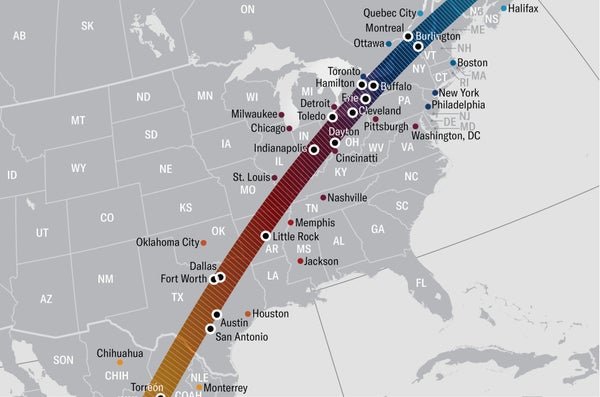
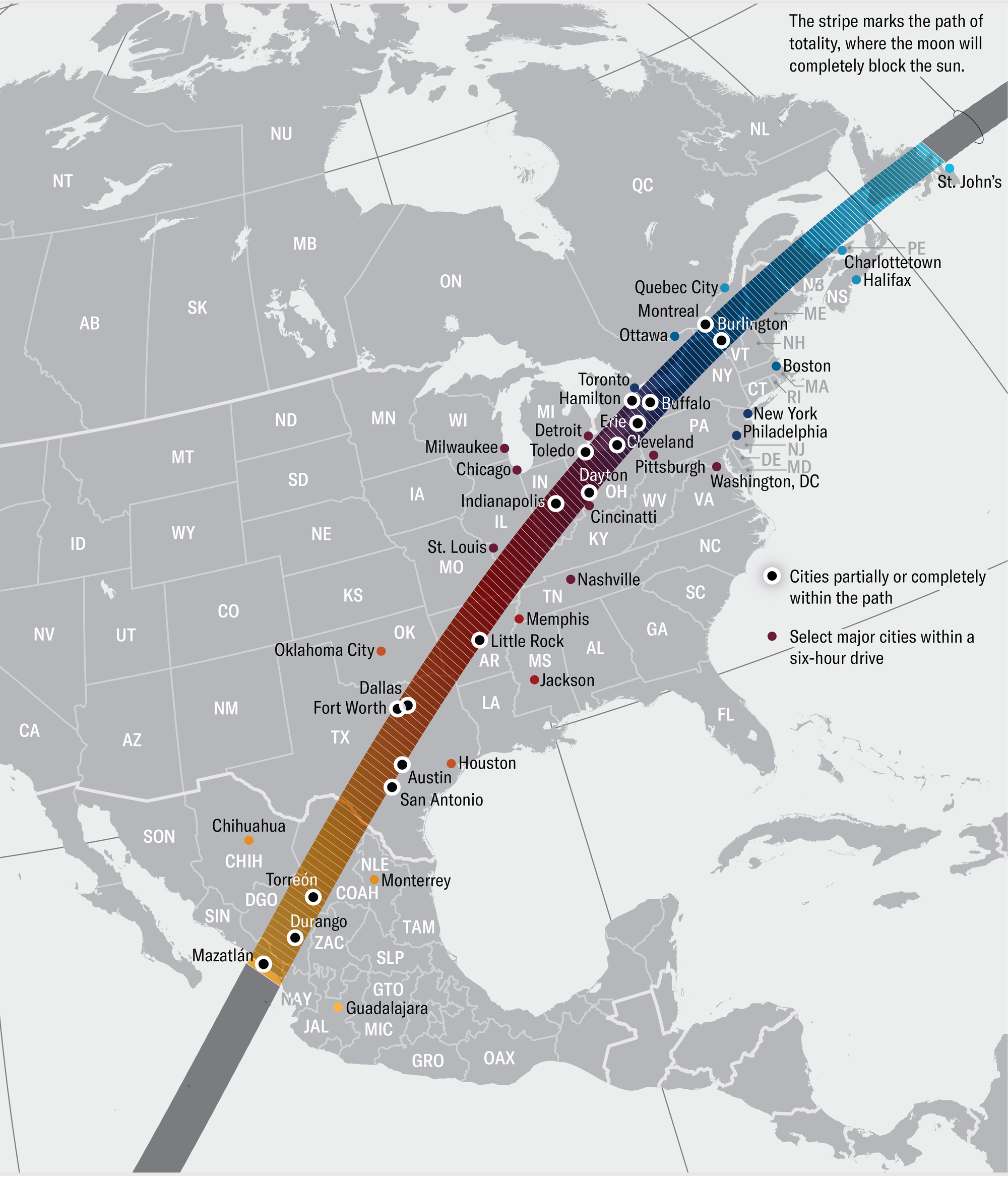
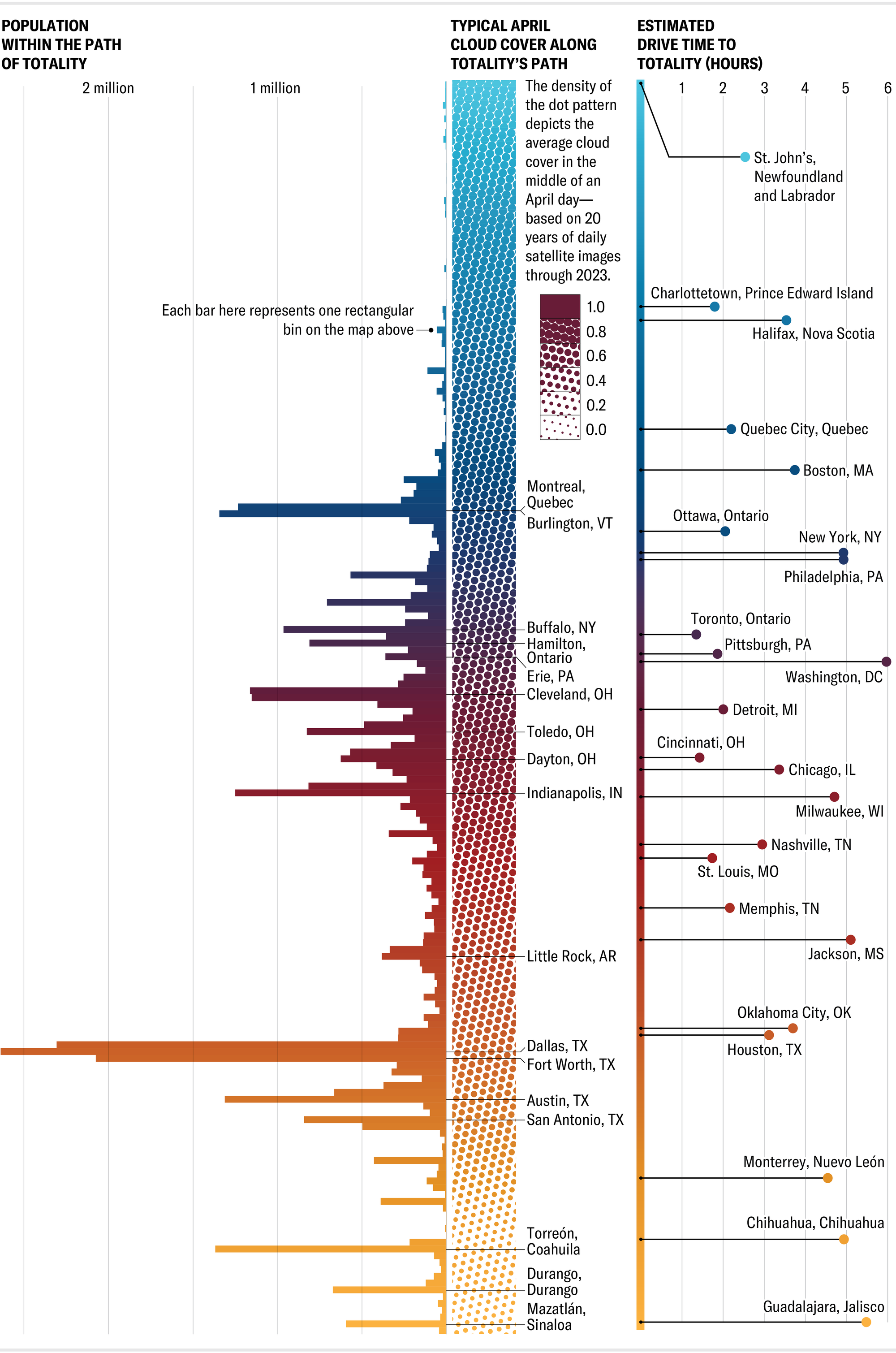
The sun is 400 times bigger than the moon, but it’s also 400 times farther away from us—a glorious cosmic coincidence that has the moon precisely covering the sun’s face when the two align. The result is a total solar eclipse. The alignment is visible only within a narrow band, the path of totality, which will arc across North America on April 8. (The last total eclipse on the continent was in August 2017.) More than 40 million people live within the totality path, and millions more are a few hours away. Spring weather will affect visibility; much of the northeastern U.S. and maritime Canada tends to be cloudy this time of year. If you aim to see the spectacle, keep an eye on the weather and try to stay mobile, recommends Michael Zeiler, an eclipse cartographer who runs the Great American Eclipse website. (The April event will be the 12th he will witness.) Zeiler guarantees that “no one who has ever traveled to see totality has regretted the effort.”
PATH OF TOTALITY
The moon’s shadow hits land in Sinaloa, Mexico, and runs up to Labrador, Canada, crossing the continent in just an hour and 35 minutes. Within the shaded region, totality lasts longest at the centerline, reaching four and a half minutes in some places.
Credit: Katie Peek; Source: NASA (eclipse track data)
UMBRA OR BUST
A partial eclipse is cool—the sunlight thins, and shadows take on a crescent shape—but for seasoned eclipse chasers, the umbra is the only game in town. Within the umbral shadow, the moon covers the sun completely. The sky darkens to a twilight blue, with sunset oranges at the horizon. The faint plasma of the sun’s corona is visible, stretching across the sky.
Credit: Katie Peek; Source: Gridded Population of the World v4, SEDAC (population data); NASA MODIS/Aqua satellite (cloud data); Google Distance Matrix API (drive times)
KATIE PEEK is a science journalist and data-visualization designer with degrees in astrophysics and journalism. She is a contributing artist for Scientific American.
“There are periods in the life of humanity, which generally coincide with the beginning and the fall of cultures and civilizations, when the masses irretrievably lose their reason and begin to destroy everything that has been created by centuries and millenniums of culture. Such periods of mass madness, often coinciding with geological cataclysms, climactic changes, and similar phenomena of a planetary character, release a very great quantity of the matter of knowledge. This, in turn, necessitates the work of collecting this matter of knowledge which would otherwise be lost. Thus the work of collecting scattered matter of knowledge frequently coincides with the beginning of the destruction and fall of cultures and civilizations”.
–P.D. Ouspensky quoting Gurdjieff in In Search o f the Miraculous
G.I. Gurdjieff
“People are machines. Machines have to be blind and unconscious, they cannot be otherwise, and all their actions have to correspond to their nature. Everything happens. No one does anything. ‘Progress’ and ‘civilization,’ in the real meaning of these words, can appear only as the result of conscious efforts. They cannot appear as the result of unconscious mechanical actions.And what conscious effort can there be in machines? And if one machine is unconscious, then a hundred machines are unconscious, and so are a thousand machines, or a hundred thousand, or a million. And the unconscious activity of a million machines must necessarily result in destruction and extermination. It is precisely in unconscious involuntary manifestations that all evil lies. You do not yet understand and cannot imagine all the results of this evil. But the time will come when you will understand.”
–P.D. Ouspensky quoting Gurdjieff in In Search o f the Miraculous
Translation is a 5-step process of “straight thinking in the abstract.” The first step is an ontological statement of being beginning with the syllogism: “Truth is that which is so. That which is not truth is not so. Therefore Truth is all there is.” The second step is the sense testimony (what the senses tell us about anything). The third step is the argument between the absolute abstract nature of truth from the first step and the relative specific truth of experience from the second step. The fourth step is filtering out the conclusions you have arrived at in the third step. The fifth step is your overall conclusion.
The claims in a Translation may seem outrageous, but they are always (or should always) be based on self-evident syllogistic reasoning. Here is one Translation from this week.
1) Truth is that which is so. That which is not truth is not so. Therefore Truth is all there is. Truth being all is exclusive of that which is not truth. Therefore Truth is pure, unmitigated being. I think, therefore I am. Since I am and since Truth is all that is, therefore I, being, am Truth. Since I, being, am Truth, therefore I, being, have all the attributes of Truth. Therefore I, being, am exclusive of all that is not Truth. Therefore I, being, am pure. Therefore I, being, am unmitigated being. Since I, being, am Truth and since I, being, am mind. Therefore Truth is Mind (Consciousness).
2) Items of value can be lost or misplaced. Word-tracking: item: a single thing, entity thing: entity value: worth, power power: potent, the ability to be lost: gone, missing, absent possess: to have, own, master, occupy
3) Truth being all that is, therefore Truth masters all, Truth occupies all, Truth possesses all. Truth being all that is, there is no being other than Truth, therefore Truth is the only Possessor/the only Possession. Truth being all that is is therefore all that is present. Truth being all that is present cannot at the same time be partially lost or missing. Therefore Truth is wholly present. Truth being all that is and power being the ability to be, therefore Truth is unlimited power, unlimited value, unlimited worth. Truth being all that is, there can be no entity other than Truth, therefore Truth is the only Thing.
4) Truth masters all, Truth occupies all, Truth possesses all. Truth is the only Possessor/the only Possession. Truth is wholly present (OR Truth is the Holy present) Truth is unlimited power, unlimited value, unlimited worth. Truth is the only Thing.
5) Truth si the only Possessor, the only Thing Possessed.
New Thinking • Feb 2, 2024 This video is a special release from the original Thinking Allowed series that ran on public television from 1986 until 2002. It was recorded in about 1994. It will remain public for only one week. According to Buddhist philosophy, compulsive and addictive behavior is common to all “normal” individuals. Shinzen Young is a Buddhist monk and director of the Community Meditation Center of Los Angeles. He is author of The Science of Enlightenment: How Meditation Works and other titles. Through meditation, says Young, one learns to recognize the root cause of addiction as a lack of mindfulness. Gradually, through increased awareness, the compulsive impulse looses its grip on the individual. Now you can watch all of the programs from the original Thinking Allowed Video Collection, hosted by Jeffrey Mishlove. Subscribe to the new Streaming Channel (https://thinkingallowed.vhx.tv/) and watch more than 350 programs now, with more, previously unreleased titles added weekly. Free month of the classic Thinking Allowed streaming channel for New Thinking Allowed subscribers only. Use code THINKFREELY.
February 2024 is marked by a rare Chiron-North Node conjunction and a heightened Aquarius energy. The emphasis on Chiron and Aquarius makes February a very interesting month.
Aquarius is Prometheus who stole the fire from the Gods and gave it to humanity. The fire is a metaphor for the light of knowledge and awareness.
The gods decided to punish Prometheus for stealing the fires. Zeus chained Prometheus to a rock where an eagle slowly ate his liver. Prometheus was immortal, he couldn’t die, so the ordeal would repeat every day, for eternity.
His salvation came from Chiron. Chiron traded his own immortality to save Prometheus.
What’s interesting is that Chiron orbits between Saturn and Uranus (Aquarius). Chiron is the bridge between the two, serving as a catalyst for freedom and liberation.
The myth is a metaphor for the healing work we need to do to transcend the pain of separation and find true freedom. Chiron was a half-man, half-horse, which is a metaphor for the dual nature of our existence. We are 50% matter, 50% spirit.
When we fail to integrate our primal and divine aspects, we feel isolated and disconnected. This leads to the polarization and judgment of what we perceive as good and bad.
But when we integrate this duality, when we recognize that all these qualities can all be found within ourselves – both positive and negative – we find wholeness, and witness humanity: in ourselves and others.
Chiron is ‘the missing link’. If you’ve been feeling alienated – from yourself and from the world at large – Chiron will reunite you with your essence and the collective whole.
But how do we find healing? How do we do the “Chiron” work? Here is where the Chiron-North Node conjunction comes into play.
Pay attention to any insights and downloads that come to you around February 19th, when Chiron is exactly conjunct the North Node.
While nothing concrete may happen right away, the transit will awaken something inside of you, something that will become obvious in March-April, when we have an Aries stellium (including an Eclipse conjunct Chiron).
But let’s take a look at the most important transits of the month:
February 9th, 2024 – New Moon In Aquarius
On February 9th, 2024 we have a New Moon at 20° Aquarius. The New Moon is square Uranus, its ruler. There is a huge pull to break free from the past and reinvent ourselves.
Uranus in Taurus will point to the ‘missing element’ – what’s preventing us from finding freedom and embracing change. The New Moon in Aquarius will help us define our personal idea of freedom vs. what society tells us that freedom is.
February 13th, 2024 – Mars Enters Aquarius
On February 13th, 2024, Mars enters Aquarius. Mars is our personal will, is what we do to affirm ourselves, and get our needs met. Aquarius, on the other hand, is the sign of the collective.
The Mars in Aquarius transit will help us see that we’re all in this together. When we focus on our humanity, we automatically make decisions that contribute to our greatest collective good.
February 14th, 2024 – Mars Conjunct Pluto
On February 14th, 2024 we have a V-day with fireworks. Mars is conjunct Pluto at 0° Aquarius!
Birthdays, anniversaries, or celebrations can be times of great joy, or on the contrary, of great challenge. If our life in general, or more specifically, what happens on that special day, does not fit our ideal expectations, we may become frustrated or disappointed.
If you’re not in a place where you want to be, remind yourself that February 14th is just another day. It does not define you, or your life.
Pluto will most certainly push Mars’ buttons. We have a choice – we can use this tremendous energy to fuel conflict OR to align our actions with our circumstances.
When we are closed off, we live in a bubble and are disconnected from reality. This disconnection is what creates suffering. When instead we are fully aware of what’s happening around us, we pick up on subtle clues, we align ourselves with the flow of life and we just ‘know’ what to do.
February 16th, 2024 – Venus Enters Aquarius
On February 16th, 2024, Venus enters Aquarius. The planet of love often feels strange in the unconventional sign of Aquarius. But it serves as a reminder that love is about embracing our humanity.
People are strange – but that’s what makes them unique. “Don’t hate what you don’t understand” – instead, appreciate the diversity and individuality that each person brings to the table.
February 19th, 2024 – North Node Conjunct Chiron
On February 19th, 2024 the North Node is conjunct Chiron at 16° Aries.
Chiron is our deepest wound, and also the gift that emerges when this wound is embraced and alchemised.
North Node is a karmic energy – but not the type of “resurfacing of old patterns”- that’s the South Node; the North Node is the opportunity to change our karma, and rewrite our destiny.
Our ‘deepest wound’ is rarely something we are aware of (at least fully). Our deepest wound is subtle. We were born with it. In most cases, it can be traced generations back.
So when the North Node meets Chiron, we have a unique opportunity to look at this wound from a different angle, and re-write our karmic patterns. This time we can truly break the cycle.
February 19th, 2024 – Sun Enters Pisces
On February 19th, 2024, Sun enters Pisces. Happy birthday to all Pisces out there!
Pisces is the last sign of the zodiac. The Pisces season is when we complete the 12-month cycle, or one astrological year.
The Pisces season (the time before Aries, when we start a new 1-year cycle) has always been a good time to declutter the house, the body, the mind and the soul.
During the Pisces season, take some time to reflect on what this astrological cycle has meant for you, and what you are moving towards or inviting in the next one.
February 19th, 2024 – Venus Conjunct Mars
On February 19th, 2024 Venus is conjunct Mars at 6° Aquarius. Venus-Mars conjunctions are in general very sought-after especially for relationships or romance. What’s interesting is that we had another Venus-Mars conjunction (at 0° Aquarius) in March 2022, so this is like a sequel to that one.
This time, we have Pluto at 0° Aquarius – setting the collective agenda, while Venus and Mars at 6° Aquarius – will reveal the individual role we will play in this new 2-decade chapter of our life.
February 24th, 2024 – Full Moon In Virgo
On February 24th, 2024 we have a Full Moon at 5° Virgo. The Full Moon in Virgo is opposite Saturn in Pisces. This Full Moon has a heavy energy.
We may work very hard but still not be where we want to be. At the Full Moon in Virgo, you may have an aha moment about why your efforts don’t yield the expected results. The answer is not always “work harder”. Sometimes it’s the little things that lead to massive improvements.
The Full Moon in Virgo will remind us that focusing on efficiency and the finer details can be as impactful as sheer effort.
February 28th, 2024 – Sun Conjunct Saturn
On February 28th, 2024, the Sun is conjunct Saturn at 9 Pisces. Sun-Saturn transits are rather sobering.
It’s akin to the moment when your manager calls you into their office. You always kind of know why they are calling you. If you’ve been late with your projects… well, that might not be very good news. If instead you’ve done a great job, you may be up for a raise or a promotion.
Sun conjunct Saturn is a reality check, asking us to evaluate if we are on track with our goals. Are we living up to our potential?
PS: I will write a report about the North Node-Chiron conjunction closer to the date. Until then, have a great February!
Dr. Joost Vervoort is an Associate Professor of Transformative Imagination at Utrecht University. His work focuses on connecting games and creative practices, politics and action to create better futures. Email: j.m.vervoort@uu.nl Twitter: @Vervoort_Joost
I was playing arcane tarot-based game The Cosmic Wheel Sisterhood on a Sunday evening when a Buddha statue suddenly fell from my bookcase and smashed into my laptop screen. This gave birth to a new genre of art that could be called ‘jumping Buddha vaporwave’. Quite pretty. The image on my desktop background is by Japanese artist Hirō Isono, as part of a beautiful series of images for the game Secret of Mana (see more below).
It is easy to forget how profoundly strange it is to be alive. To be a consciousness. To be in connection with others and the world.
And it’s so easy to slip back into the sleepwalking, the role playing game.
In a time of profound and multidimensional crisis, the need for action coming from a deep appreciation of the mystery of life is more urgent than ever. But it seems like so much of the world is set against us engaging with that deep reality. Elaborate systems are designed to draw away our attention, to capture it and frame it in specific contexts. So many people are under tremendous, absurd pressures from many directions. At the same time, more knowledge, more approaches and opportunities are available than ever.
Many factors can be expected to limit or enable people’s access to a sense of mystery. Health, physical and political safety, time, career opportunities, loving connections and relationships and more play a big role. So does access to ideas, practices, spaces, specific resources.
What would happen if we see opportunities for experiencing life as a deep mystery as a common good? If we see the structural conditions for such experiences as something to cultivate, fight for, and to protect, just like public health care or educational systems?
Many people have some personal relationship with the mystery and the wonder of life. I think it’s crucially important that this relationship can mean many things — but that it can include a deeply felt sense of being connected to life; a sense of the sacredness of life, a sense of wonder about how strange it is to be alive and how mysterious consciousness itself is. People access the mystery through love and relationships, connections to the natural world, some kind of spiritual or embodied practice, music and other arts, experiences with psychedelics, and so on.
Whether it’s an occasional glimpse or a deeply lived reality, it seems that these experiences are often central to people’s individual and collective senses of meaning — no matter how few opportunities we may find to talk about it with others at work and other ‘normal’ settings.
New approaches to mental health like internal family systems therapy see a sense of life’s mystery as core to healing and growing processes, both individually and relationally, as it provides space for a compassionate engagement with challenges in ourselves and in our contexts. The ability to engage with your circumstances with hope, autonomy and a sense of possibilities are tied to a sense of being at home in the world, of being connected to life, an experience of wonder and openness about the experience of being alive. This is reflected in what are called the ‘8 Cs of Self’ in IFS: compassion, creativity, curiosity, confidence, courage, calm, connectedness, and clarity.
This means that being able to touch the mystery of life in whatever way works for you not only benefits societal mental health — it can benefit broader social flourishing and opening up other possibilities for better futures.
In the last year or two I have, along with many colleagues, explored the notion of imagination infrastructures — a term developed by UK systems innovator Cassie Robinson. Since many of us work on societal imagination and ideas about the future, this has been a powerful concept that has helped us ask questions about the structural conditions that make the collective imagining of better futures possible.
While I am excited about the possibilities opened up by investigating imagination infrastructures, I have also felt the desire to take on another lens that helps us ask questions about the structural conditions that allow for access to the mysterious and nurturing depth of life.
Let’s call them infrastructures of mystery. Such infrastructures are, of course, closely connected to the question of imagination and futures. But they also connect directly to what makes life worth living now, in the present moment. So what happens when we turn this infrastructural lens on people’s access to mystery instead of on imaginative capacities only?
I think it’s important to note that the recognition of experiences of mystery as an important common societal force for good is a potentially powerful frame in itself. Mystery entails not knowing. It can help inoculate against dogmatic and restrictive truth claims about reality by religions or by specific philosophies. It keeps things open.
I think a very pluralistic understanding of what the mystery of life means for people is needed. This could be a starting point to understand what they need to encounter, experience, and embody the mystery their own way. What if we had extensive insights on this, and what if this understanding was informing our policies around wellbeing, health care, social cohesion, and so on?
More amazing art by Hirō Isono for Secret of Mana
So let’s take an advance on what the infrastructures of mystery might be like. These might be resources, rules, physical and digital locations, information systems, knowledge repositories, protective measures and more. They would allow for the time, space, knowledge, financial means, accessibility for connections to mystery. Safe containers where people can really and truly let their guard down are considered very important in many mystery-focused practices. Let’s take this further and not just provide safety in the moment, during the retreat, in the building and so on — but actually create the deep structural safety people need to make encounters with mystery a key part of their lives. Health, financial and social stability, time, protection, appreciation and respect. Many societal features that have been degraded in recent years.
Let’s talk about some more concrete examples in different spaces and domains and how these might be transformed by infrastructuring for mystery:
Religious institutions: The first thing that comes to mind is that of course religions and religious institutions can be understood as infrastructures of mystery. I think this is true in an important sense — but religious institutions serve many other functions of social power and organization, and they can be used to stifle or make exclusive our access to mystery. Recognizing the infrastructural function of organized religion as a space to encounter mystery helps highlight the societal value of religious practices, while also encouraging an openness and accessibility to the mystery and ‘not-knowing’ aspects of religions — perhaps by religious organizations themselves.
Westernized spiritual practices: Ironically, it appears that many of the most powerful practices originating in religious and spiritual contexts run the risk of being stripped of their potential for encountering mystery. Meditation/mindfulness and yoga are often framed in very dry rationalist contexts to help fit them in, and make them respectable as ways to ‘reduce stress’ or ‘improve mental health’. A societal recognition of the deep value of meeting mystery and the unknown would help unlock resources and possibilities for the mystery aspects of these practices.
Psychedelics: interest in psychedelics has seen a massive upswing in recent years. The mental health benefits of psychedelics-assisted treatments are being researched widely. Many people report profound mystical experiences in such treatments and as a result of their own use. These mystical experiences are understood to be of key importance to the beneficial effects of psychedelics. What would happen if we would recognize that these encounters with mystery are, as my friend philosopher Aidan Lyon writes, valuable to society in ways that should not be limited to any one domain? Psychedelics are at risk of becoming hyper-commercialized. What would public policies look like that would secure broad and responsible access and the time and space for psychedelic practice? How might such policies facilitate spaces, train expertise, support taking time off from work to trip, and so on?
The arts: artistic fields have long struggled with justifying their societal value in more limited terms. The question of evaluating artistic work for societal impact and the limitations of this impact view were the focus of a multi-year research project, CreaTures, that I was involved in. We argued in CreaTures that a core benefit of artistic practice is that it engages with the unknown and can lead to unexpected outcomes. Many people understand, I think, that encounter with mystery is an important part of artistic practice in some way. But sometimes art that enables a deep sense of mystery is harder to ‘sell’ to funders. What if this was recognized more explicitly? I’m very interested in this question, in particular in terms of the two types of art I engage with the most actively: music and game design. As part of the black metal band Terzij de Horde I’ve had a lot of moments of deep connection with our music and our audiences — it’s a style that pretty much formed to fuse metal with a sense of the mystical. Certain games have a real power to elicit mystery experiences — see for instance this article about Dark Souls: no mastery without mystery. My friend and collaborator Meghna Jayanth and I share a fascination with games as mystical experiences and using it to infuse our game design discussions. With my friend Rosa Lewiswe engage with films as if they were dreams or psychedelic experiences. I also think of future-oriented fiction — a genre like Lunarpunk comes to mind as a type of setting that explicitly engages with the mystical.
Care work and communities: I have been reading Erika Summers-Effler’s wonderful book ‘Laughing Saints and Righteous Heroes’ which dives deep into two cases of struggling organizations around social action and care. One of the two groups, a Catholic care organization, has an explicitly spiritual background, and people describe mystical experiences that they have in their connecting with and caring for others. What would it look like if there were better infrastructures for experiencing care as mystery? Moreover, what if this was an explicit part of mainstream care systems such as hospitals? Or what if there was more societal encouragement for people to make time to go help in health care a way to touch the deep mystery of interdependence?
Nature: What if encounters with nature would be more explicitly valued as an important mode of encountering the mystery? How would this shift of framing from a rather bland understanding that green spaces are good for mental health or for the value of property impact the management of nature? Imagine natural sites as sites of mystery. How would they be maintained, financed, treated? There is already an increase of rivers, forests and so on gaining protection because of their sacred status. What would happen when a more open understanding of the possibility to encounter life’s mystery would inform environmental and spatial policies?
Education: What would happen if educational systems, spaces and organizations would create more active support for encounters with life’s mystery? Mystery is, in a way, at the heart of science and of many disciplines. What would happen if the deep curiosity, wonderment, not-knowing associated with encountering mystery would be allowed and supported to play a more prominent role in education, from elementary schools to graduate programs?
I think this perspective on infrastructures of mystery raises many exciting and interesting questions and possibilities for action. One that I am interested in, as a researcher, is mapping the diversity and plurality of how people encounter or even embody mystery, and what infrastructures they think would support them in these encounters and expressions. MSc student Shreeya Patangay is doing a research project with me on how climate activists draw on their encounters with life’s depth and mystery to motivate them. So watch this space for her future insights. I would love to also just create more spaces for people to talk about their experiences of mystery. I was at a wonderful workshop on the science and practice of psychedelics and mystical experience recently by researchers Aidan Lyon, Michiel van Elk and Anya Farennikova that brought together researchers and practitioners. Here therapist and yoga teacher Ida Stuij and philosopher and theoretical physicist Erik Curiel guided a session where people shared their encounters with mystery, from the beautiful to the sometimes terrifying or disconcerting. It was a real joy to hear all that diversity and richness.
Untitled, by Hirō Isono
What would it be like to have an appreciation of life’s mystery inform governance processes themselves? I’ve been thinking about what I would call ‘psychedelic governance’, the idea that collective governance processes might be informed by insights derived through the use of psychedelics. MSc student Alexis Beaudoin is working on an MSc project with me on the link between psychedelic experiences and relationships to sustainability and ecology, both at individual and collective levels. This includes sometimes long existing processes from different cultural contexts around the world. I also want to mention the work by colleague Timothy Stacey who looks at how the tools and rituals of religious practice might support sustainability efforts — and how many seemingly secural activities can be understood as religious repertoires.
Finally, just a personal note on what it has been like to engage with this concept. I have a long history with practices that engage mystery — in Zen Buddhism and imaginal practice, all mixed together in my meditation group the Dharmagarage, with psychedelics, music with Terzij de Horde,painting, and other contexts. But at the same time, a lot of my work has focused on generating, imagining, planning, strategy, the future. I’ve noticed an increased resistance in myself to only engaging with the world through this sense of generative forward momentum.
Working on the idea of infrastructuring for mystery — and the focus on openness, peace, curiosity and the richness of the present and relationality that this entails — has created more direct engagement with the mystery in my moment to moment experience, and has led to an increased sense of peace and care. I wonder if that it going to resonate with others when we work on this subject matter.
Anticiplay is an NWO Vidi-funded research project that aims to establish a new design paradigm for the gaming sector in collaboration with CreaTures EU. You can find our mission statement here! In short: we’re all about Games For Better Futures and Futures for Better Games. Follow us @anticiplay on Twitter, and feel free to engage us with any questions, games that you think are inspiring, and anything else!
An NWO Vidi research project • Exploring how games can help imagine & realize sustainable futures • Games For Better Futures & Futures For Better Games ?
Consciousness, spirituality, biography, sexuality, androgyny, futurism, space, the arts, science, astrology, democracy, humor, books, movies and more