The Power of a Thin Skin

By Maria Popova (themarginalian.org)

Yes, we spend our lives trying to discern where we end and the rest of the world begins. The boundary is so difficult to discern because, when all the stories fall away, there is no boundary — only a fluid, permeable membrane that is constantly shifting depending on the stories we tell ourselves about what we are and where we belong. Lynn Margulis captured this in ecological and evolutionary terms when she observed that “life is a unitary phenomenon, no matter how we express that fact.” Dr. King captured the sociological equivalent in his insistence that “we are caught in an inescapable network of mutuality.” Whitman captured its most elemental and most existential dimensions in that immortal line: “Every atom belonging to me as good belongs to you.”

When we fail to see the connections between things, we fail to anticipate the consequences of any one thing. A century before we began slaying entire ecosystems with pesticides meant to eradicate individual species, before we began tinkering with individual genes in the complex cathedral of the genome, the naturalist John Muir exulted that “when we try to pick out anything by itself, we find it hitched to everything else in the universe” — an exultation that now reads as an admonition.

How to unblind ourselves to this cosmos of connection and its attendant forcefield of consequence is what Jenn Shapland explores in her essay collection Thin Skin (public library) — “a corporeal account of how thin the membrane is between each of us and one another, between each of us and the world outside,” fomented by the medical reality of her epidermis missing a layer: a diagnosis of literally thin skin.

Art by Lia Halloran for The Universe in Verse.

With an eye to the embodied metaphor of her condition, Shapland writes:

There is no “outside”… The world is a part of our cellular makeup… we impact it with every tiny choice we make.

[…]

I began to see what I now think of as literalized metaphors for my entanglement, my complicity, all over my life: in my dermatological diagnosis of “thin skin,” in my friends’ having babies as the world burned, in the crystals cropping up everywhere to heal us of something, in my own sense of vulnerability and my desire to feel safe. I began to question the idea of myself as a being in need of protection, indeed as something that could be protected. Nothing can protect us… It struck me as I wrote that I was utterly vulnerable to every other person, every other creature on Earth, and they were also vulnerable to me… I began to seek other ways of understanding the self that might be more useful than this shivering, weak thing we must shore up against the world.

And yet out of that singular vulnerability comes a singular strength — liberated from the standard boundaries between self and world, which serve as culture’s safety valve constricting what is possible and permissible, one is free to imagine “alternatives to our limited narratives about family, love, labor, longing, pleasure, safety, and legacy.” A century after D.H. Lawrence reverenced the strength of sensitivity, Shapland writes:

To be thin-skinned is to feel keenly, to perceive things that might go unseen, unnoticed, that others might prefer not to notice.

What she notices above all are the connections between things, the Rube Goldberg machine of consequences that binds past and future, self and other, here and everywhere else. She writes about Los Alamos and Rachel Carson, about the traps of parenthood and the paradoxes of self-compassion, about mending clothes and mending hearts. Emerging from the essays is a reminder, both haunting and assuring, that in this increasingly fractured and fragmented world, life remains defiantly indivisible.

Art by Violeta Lópiz from At the Drop of a Cat

There is power in such porousness — a heightened ability to question the structures that make for fragmentation, perhaps none more tyrannical than the idea that the nuclear family is the optimal unit of belonging and connection, an idea rooted in our touching yearning for immortality despite our creaturely finitude: passing on our genes and values as a way of perpetuating ourselves beyond our mortal limits. Watching her friends freeze their eggs and go through rounds of IVF, Shapland reflects:

If we extend our idea of family beyond the individual to the wider world of creatures and ecosystems, we can begin to ask what we want for them. From them. We can begin to see ourselves in relation. Acknowledging and reckoning with death — with the limit on our existence, with the fact that we are temporary — can reframe what it means to live. What do we want to leave behind? What do we want to support, maintain, in the limited time we are here?

A beautiful answer comes from Shapland’s conversation with Marian Naranjo — a Native antinuclear activist from Santa Clara Pueblo, a stone’s throw from the birthplace of the atomic bomb. With an eye to the ancestral knowledge of how to live in peace and harmony — knowledge that has suffered the erasures of colonialism and capitalism — Naranjo envisions a new epoch of remembering what we have forgotten: how to be caretakers of connection. Sitting across from Shapland in the embodied space of mutuality, she echoes Ursula K. Le Guin’s passionate case for the transformative power of real human conversation and reflects:

That’s the next circle, that circle of balance. Where we do put back our heaven and earth, our heaven back on earth. Get it back. How do we do that? It’s this, it’s talking face-to-face. It’s doing more of this.

But somewhere along the arc of so-called progress, we forgot what indigenous cultures have known for millennia: that truth is a tapestry, no single thread of which can survive the wear and tear of reality in isolation, the reality against which truth must be continually tested in order to be true. This damaging isolationism haunts even the history of our understanding of the basic building blocks of life — the chemical elements that compose it, or discompose it.

The Radium Dance, 1904.

With an eye to the discovery of radioactivity and Marie Curie’s epochal work on radium, Shapland writes:

Soon after its discovery, radium became a multimillion-dollar business. For four decades, you could buy rejuvenating radium skin cream, lipstick, tea, bath salts, hair growth tonic, “a bag containing radium worn near the scrotum” that “was said to restore virility.” There was radium toothpaste to boost whitening. Radium therapy, called Curietherapy in France, began to be used to treat cancer. It was first inserted by fifty needles into breast tissue, or by radon “seeds” that caused serious reactions. There existed a “vaginal radium bomb consisting of a lead sphere supported by a rod for insertion” for cancer treatment. Marie and her daughter Irene took a radiological car to the front in World War I to X-ray soldiers. Later, she supplied radium bulbs to the French health service to treat the military and civilian wounded and sick with radium therapy.

The discovery of radioactivity is a story of willful ignorance, of knowing but longing not to know, pretending not to know, how powerful and damaging it was. Scientists and salespeople alike believed in its power to cure, to heal. Radium was damaging enough to kill cancer, to burn Pierre’s skin through the glass vial in his vest pocket, but somehow not thought to be damaging enough to kill the scientists handling it all day, the people brushing their teeth with it. Marie kept a vial on her nightstand to bask in its glow as she slept. She called it her child.

[…]

This scientific refusal to believe what is obvious because it cannot be proven, because it is technically uncertain, accompanies our understanding of toxic substances to this day.

This blindness to connection, causality, and the consequences of radioactivity is hardly surprising: To achieve what she achieved, against the odds of her time and place, Marie Curie had to be thick-skinned. Perhaps a thinner skin, with its attendant power of seeing the permeability and interdependence of things, would have saved her life, would have spared her the tragedy Adrienne Rich captured so poignantly in the final words of her magnificent tribute to Curie:

She died    a famous woman    denying
her wounds
denying
her wounds    came    from the same source as her power

Complement with Marie Howe’s poem “Singularity” — a stunning antidote to our illusion of separateness — and the young poet Marissa Davis’s inspired echo of it, serenading our elemental bond with nature and each other.

Working Out, Working In: Applying the Six Principles of Athletic Training to Writing and Creative Work

By Maria Popova (themarginalian.org)

The highest and hardest task of life may be to become entirely ourselves — to continually purify and clarify who and what we are, shedding the shoulds of culture, convention, and expectation to discover the innermost musts: those deepest and truest callings of the authentic self, or what we might call soul. And yet the great paradox is that the self is not a fixity but a perpetual fluidity, reshaped by every experience we have: every love and every loss, every person we meet, every place we visit, and every book we read. And so it must be: “A self that goes on changing is a self that goes on living,” Virginia Woolf wrote, for she understood that the finest souls “are always the supplest.”

The exquisite challenge of becoming oneself but remaining supple is at the center of every life, but it is amplified in the creative life — there is no greater tragedy for an artist than to stagnate and stiffen into a fixity, a template of oneself that ceases to create and instead caters to a self-myth. “Are we going to ossify,” the young Emily Dickinson wrote rhetorically to her great love and muse at the outset of an uncommonly creative life, throughout which she refused to ossify, as a person and as an artist.

In Sweat — his magnificent history of exercise as a lens on the body and the soul — Bill Hayes offers an antidote to ossifying rooted in the parallels between creative practice and athletic training.

Group Apparatus by Alice Austen, 1893.

Drawing an analogy between the science of exercise and his own art — writing — he considers the six principles that sustain long-term personal fitness.

  1. The Principle of Specificity is the idea that “what you train for is what you get” — if your goal is endurance, train for endurance; if your goal is strength, train for strength; if you aim to make your prose more musical, train your mind’s ear on musical writing; if you want to write better observations, train to make better observations. “Be specific in your work goals as much as in your workouts,” Hayes writes.
  2. The Overload Principle requires that you “train a part of the body above the level to which it is accustomed” — it is the practice of pushing yourself beyond your comfort zone and trying new things. Hayes calls its equivalent in the mind “creative cross-training.” Rilke understood this: “People are drawn to the easy and to the easiest side of the easy,” he wrote in contemplating creativity. “But it is clear that we must hold ourselves to the difficult.”
  3. The Principle of Progression arises out of the Overload Principle, demanding that you move on as soon as you have mastered a new task. Georgia O’Keeffe knew this. “Making your unknown known is the important thing,” she wrote in her advice on being an artist, “and keeping the unknown always beyond you.”
  4. The Principle of Accommodation takes effect in the absence of the Progression Principle: Without challenge, the body — or the spirit — settles into stagnation or, worse, complacency. David Bowie urged against this reflex toward comfort and homeostasis: “Always go a little further into the water than you feel you’re capable of being in,” he advised artists. “Go a little bit out of your depth, and when you don’t feel that your feet are quite touching the bottom, you’re just about in the right place to do something exciting.”
  5. The Principle of Reversibility is an admonition against the trap of accommodation — when you cease challenging yourself, the arc of your progress bends backward, undoing your gains. It almost doesn’t matter what you do to keep your system from falling out of shape — it need not be your primary workout, or your primary work. Virginia Woolf felt that her informal diary writing “loosens the ligaments” for her formal literary writing. “One must do something, anything, to keep the creative and intellectual motors running,” Hayes writes.
  6. The Principle of Rest may then seem like a paradox — but it is the final and in a sense the most foundational tenet of any sustained practice. Anyone who has suffered the aches and injuries of overtraining, anyone who has suffered the spiritual hollowing of burnout, knows the cost of not taking time to recover from exertion, to replenish the body’s energy and the soul’s store of creative vitality. “Just as the body needs time to rest,” writes Hayes, whose superb book The Anatomist demanded of him a three-year recovery, “so does an essay, story, chapter, poem, or especially, a book.”

Couple with Zadie Smith on what writers can learn from dancers, then revisit some excellent advice on writing (applicable to all creative work) from James BaldwinAlbert CamusOctavia ButlerRachel CarsonRebecca Solnit, and Mary Oliver.

The Truelove: Poet and Philosopher David Whyte on Reaching Beyond Our Limiting Beliefs About the Love We Deserve

By Maria Popova (themarginalian.org)

Few things limit us more profoundly than our own beliefs about what we deserve, and few things liberate us more powerfully than daring to broaden our locus of possibility and self-permission for happiness. The stories we tell ourselves about what we are worthy or unworthy of — from the small luxuries of naps and watermelon to the grandest luxury of a passionate creative calling or a large and possible love — are the stories that shape our lives. Bruce Lee knew this when he admonished that “you will never get any more out of life than you expect,” James Baldwin knew it when he admonished that “you’ve got to tell the world how to treat you [because] if the world tells you how you are going to be treated, you are in trouble,” and Viktor Frankl embodied this in his impassioned insistence on saying “yes” to life.

The more vulnerable-making the endeavor, the more reflexive the limitation and the more redemptive the liberation.

That difficult, delicate, triumphal pivot from self-limitation to self-liberation in the most vulnerable-making of human undertakings — love — is what poet and philosopher David Whyte, who thinks deeply about these questions of courage and love, maps out in his stunning poem “The Truelove,” found in his book The Sea in You: Twenty Poems of Requited and Unrequited Love (public library) and read here by David himself in his sonorous Irish-tinted English voice, in his singular style of echoing lines to let them reverberate more richly:

THE TRUELOVE
by David Whyte

There is a faith in loving fiercely
the one who is rightfully yours,
especially if you have
waited years and especially
if part of you never believed
you could deserve this
loved and beckoning hand
held out to you this way.

I am thinking of faith now
and the testaments of loneliness
and what we feel we are
worthy of in this world.

Years ago in the Hebrides,
I remember an old man
who walked every morning
on the grey stones
to the shore of baying seals,
who would press his hat
to his chest in the blustering
salt wind and say his prayer
to the turbulent Jesus
hidden in the water,

and I think of the story
of the storm and everyone
waking and seeing
the distant
yet familiar figure
far across the water
calling to them

and how we are all
preparing for that
abrupt waking,
and that calling,
and that moment
we have to say yes,
except it will
not come so grandly
so Biblically
but more subtly
and intimately in the face
of the one you know
you have to love

so that when
we finally step out of the boat
toward them, we find
everything holds
us, and everything confirms
our courage, and if you wanted
to drown you could,
but you don’t
because finally
after all this struggle
and all these years
you simply don’t want to
any more
you’ve simply had enough
of drowning
and you want to live and you
want to love and you will
walk across any territory
and any darkness
however fluid and however
dangerous to take the
one hand you know
belongs in yours.

Couple this generous gift of a poem with “Sometimes” — David’s perspectival poem about living into the questions of our becoming — then revisit the Noble-winning Polish poet Wisława Szymborska on great love and James Baldwin, who believed that poets are “the only people who know the truth about us” — on love and the illusion of choice.

In Christmas Sermon, Palestinian Theologian Condemns Enablers of Gaza Genocide

Munther Isaac

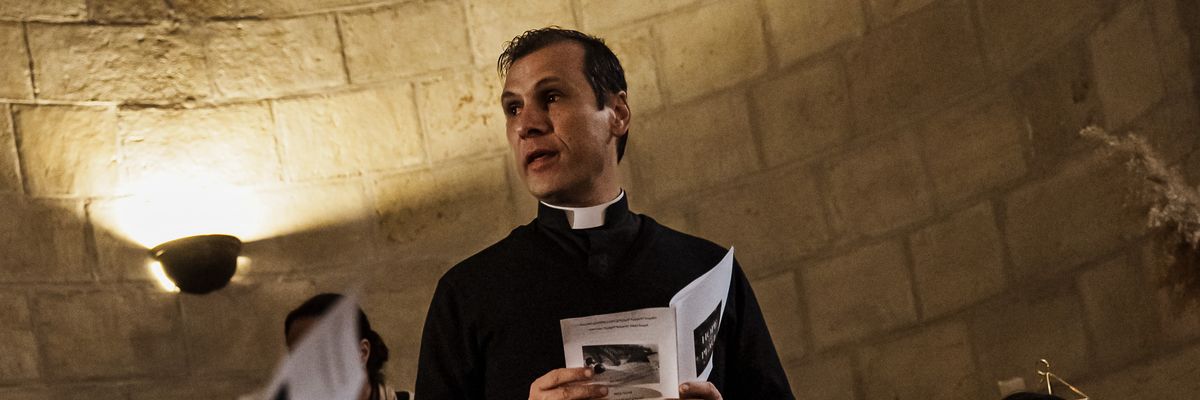
Rev. Munther Isaac leads a Christmas carol and prayer event in Bethlehem in the occupied West Bank on December 14, 2023. 

(Photo: Marcus Yam/Los Angeles Times via Getty Images)

“Gaza today has become the moral compass of the world,” said Rev. Dr. Munther Isaac. “If you fail to call this a genocide, it is on you. It is a sin and a darkness you willingly embrace.”

JAKE JOHNSON

Dec 25, 2023 (CommonDreams.org)

In an unsparing Christmas sermon delivered from the occupied West Bank over the weekend, Rev. Dr. Munther Isaac decried the complicity of the church and Western governments in Israel’s ongoing assault on Gaza, a nearly three-month military campaign that he called an “annihilation” and a “genocide.”

“Leaders of the so-called ‘free’ lined up one after the other to give the green light for this genocide against a captive population. They gave the cover,” Isaac, a Palestinian Christian theologian, said during a service titled, “Christ in the Rubble: A Liturgy of Lament.”

“Not only did they make sure to pay the bill in advance, they veiled the truth and context, providing political cover. And, yet another layer has been added: the theological cover with the Western Church stepping into the spotlight,” Isaac added. “Here in Palestine, the Bible is weaponized against us. Our very own sacred text… The theology of the empire becomes a powerful tool to mask oppression under the cloak of divine sanction.”

With most of the territory’s population struggling to survive under the intertwined threats of starvationdisease, and near-constant bombing, Isaac said that “Gaza today has become the moral compass of the world.”

“If you are not appalled by what is happening, if you are not shaken to your core, there is something wrong with your humanity,” Isaac said from Bethlehem, which Israeli forces attacked on Monday. “And if we, as Christians, are not outraged by this genocide, by the weaponizing of the Bible to justify it, there is something wrong with our Christian witness, and we are compromising the credibility of our Gospel message. If you fail to call this a genocide, it is on you. It is a sin and a darkness you willingly embrace.”

Isaac delivered his sermon a day before Israel launched one of its deadliest barrages of airstrikes of the 11-week war, killing dozens of people in central Gaza.

Displaced Gazans described fearing for their lives as Israeli warplanes and tanks bombarded homes, a refugee camp, and main roads, disrupting efforts to transport airstrike victims to the territory’s overwhelmed and collapsing hospitals.

Aided by the United States, Israel has dropped hundreds of 2,000-pound bombs on the densely populated Gaza Strip since October 7, killing more than 20,000 people and destroying huge swaths of the enclave’s infrastructure. A New York Timesinvestigation found that Israel dropped many of the bombs on southern Gaza, where the Israeli military had ordered people to move as it assailed the north in the early stages of the war.

Isaac said Saturday that he was in the U.S.—Israel’s leading arms supplier—last month just after Thanksgiving.

“I was amazed by the amount of Christmas decorations and lights, and all the commercial goods,” he recounted. “And I couldn’t help but think: They send us bombs while celebrating Christmas in their land. They sing about the prince of peace in their land while playing the drum of war in our land.”

“Christmas in Bethlehem, the birthplace of Jesus, is this manger. This is our message to the world today,” Isaac continued. “It is a gospel message, it is a true and authentic Christmas message, about the God who did not stay silent, but said his word, and his word was Jesus. Born among the occupied and marginalized. He is in solidarity with us in our pain and brokenness. This message is our message to the world today, and it is simply this: This genocide must stop now.”

Reutersreported Monday that instead of their usual Christmas celebrations, Palestinian Christians in Bethlehem held a candle-lit vigil and prayed for peace in Gaza.

“There was no large tree, the usual centerpiece of Bethlehem’s Christmas observances,” Reuters noted. “Nativity figurines in churches were placed amid rubble and barbed wire in solidarity with the people of Gaza.”

Our work is licensed under Creative Commons (CC BY-NC-ND 3.0). Feel free to republish and share widely.

JAKE JOHNSON

Jake Johnson is a senior editor and staff writer for Common Dreams.

Full Bio >

The PsychoMagic of Alejandro Jodorowsky with Paul J. Leslie

New Thinking Allowed with Jeffrey Mishlove • Feb 9, 2020 Paul J. Leslie, EdD, is a psychotherapist in private practice in Aiken, South Carolina. He is professor of psychology at Aiken College. He is author of The Art of Creating a Magical Session: Key Elements for Transformative Psychotherapy, Low Country Shamanism: An Exploration of the Magical and Healing Practices of the Coastal Carolinas and Georgia, Potential Not Pathology: Helping Your Clients Transform Using Ericksonian Psychotherapy, and Shadows in the Session: The Presence of the Anomalous in Psychotherapy. Here Paul and Jeff share a passion that they both feel for the legendary filmmaker, psychotherapist, surrealist, and Tarot master, Alejandro Jodorowsky. The discussion focuses on the films, El Topo, The Holy Mountain, The Dance of Reality, and Endless Poetry. It also touches on Jodorowsky’s many graphic novels and his work in psychotherapy. (Recorded on December 17, 2019)

The Important Things, The Infinite Things

David Price

David Price

14 hours ago (davidprice-26453.medium.com)

Ruth Evans

Inner emptiness is not a void to be filled with comforts; it is a window to be looked through.

~ Alan Watts

*

How much grief you’ve had in your life from grasping at and solidifying transient moments. So the key focus of the practice is to relax out of identification with the content of the mind, with what’s arising in the mind, and with this open to the empty mind knowing that the empty mind is always full. The mind is unborn and it’s filling or it’s showing or it’s display never stops. This is form and emptiness.

– James Low

*

… The decisive question for man is this: is he facing infinity or not? This is the main issue of his life. Only if we know that the essential is the unlimited, can we avoid placing our interest in futile things, and in every kind of things that are not really important.

— Jung

*

… Renunciation here means overcoming that very hard, tough, aggressive mentality which wards off any gentleness that might come into our hearts. Fear does not allow fundamental tenderness to enter into us. When tenderness tinged by sadness touches our heart, we know that we are in contact with reality.

— Chögyam Trungpa

*

The most important lesson that man can learn from life, is not that there is pain in this world, but that it is possible for him to transmute it into joy.

~Rabindranath Tagore

*

The unanswered question of what’s actually happening here — when the answer is wrong — introduces a certain desperation into your life. You fasten yourself to futile things, things that are not really important. You enlist in a wild goose chase that never catches so much as a pigeon, and you die exhausted from the exertion.

We do need to know we’re related to the Infinite and that the implications go deeper than our religion tells us. Our childish beliefs can’t imagine what the word “infinite” entails. I think it entails a responsibility to Creation and it implies a role, a purpose in living. Living for anything less is to lose the thread of meaning we and the world need if we’re going to thrive, or even survive.

We show, by chasing ephemera, that we haven’t figured out what is important. It’s important to ask ourselves what is futile and what is essential, and to answer the question so that we feel connected to an eternal and overriding sacred project.

Conventional religion proposes a myth we moderns have a hard time swallowing because its logic is too mythological for our literal minds. But those stories aren’t talking to the surface mind our culture thinks is the only mind. There’s a deeper mind that understands mythological thinking, we’ve just lost touch with it.

I’ve stepped back in time by living in a culture that celebrates mythological language in relation to the infinite, and it shows me that the deeper mind craves that language even if it can’t believe it literally. At deeper levels of ourselves we require metaphor and miracles, beauty and overriding meaning. This ancient mind that we’ve inherited needs mystery and overwhelming beauty or it loses touch with a sense of divine purpose.

Paul Klee

Our culture offers us an array of peripheral things we might devote ourselves to. We don’t know when we’re young how dangerous it would be to devote our lives to such things. To begin with, our education should show us how to start our investigation into what’s not important by paying attention to how we grasp and try to fix our pleasures into some kind of permanent system.

It looks like we prefer building sand castles at the moment.

Trying to hold onto what’s ephemeral but denying the inevitable death of our individual identity puts us at odds with life. Going through a whole lifetime at odds with reality is a common misfortune.

Our whole life is a “transient moment.” If we can put that fact into a context that relates us to the Creative Principle, so that we accept our transience but know we are eternal, we will know why we live and we will have the energy to do it.

From Eldo Stellucci

*

Volume four of my series Meditations on Living is now published on Amazon. If you read it, please leave a review.

It will look like this:

David Price

Written by David Price

I write about creativity, loving, language learning and psycho/spirituality. I’m a longtime painter and reader.

Free Will Astrology: Long-Term Forecasts

Rob Brezsny

Rob Brezsny

3 days ago (Medium.com)

Long-Term Forecasts

CAPRICORN (Dec. 22-Jan. 19): “All the things I really like to do are either illegal, immoral, or fattening,” quipped Capricorn author Alexander Woollcott (1887–1943). Since he was never arrested, I conclude he didn’t get to enjoy some of the activities he relished. Was he immoral? Not exactly, though he could be caustic. Offering his opinion about a famous pianist, he said, “There is absolutely nothing wrong with Oscar Levant that a miracle couldn’t fix.” The good news for you, Capricorn, is that 2024 will be mostly free of the problems Woollcott experienced. You will be offered an abundance of perfectly legal and moral enjoyments. They may sometimes be fattening, but so what?

AQUARIUS (Jan. 20-Feb. 18): Author Augusten Burroughs is a devoted urban dweller. He says, “When I get a craving for nature, I turn on TV’s Discovery Channel and watch bear-attack survivors recount their horror.” Martial arts master Morihei Ueshiba had a different perspective. “Mountains, rivers, plants, and trees should be your teachers,” he advised. “Study how water flows in a valley stream, smoothly and freely between the rocks.” I recommend Ueshiba’s approach to you in 2024, Aquarius — not Burroughs’. Here are my predictions: 1. You will have no dangerous encounters with nature. 2. You will learn more than ever from the wild world. 3. To the degree that you wander in the outdoors, your spiritual life will thrive.

PISCES (Feb. 19-March 20): A study done at Union College in New York found that being fraternity members raised students’ future income by 36 percent, but lowered their grade point average by 0.25 points. Would you make a similar trade-off, Pisces? Would you pursue a path that made you more successful in one way but less successful in another? I suspect you will encounter unusual decisions like this in 2024. My job is not to advise you what to do, but to make you alert for the provocative riddles.

ARIES (March 21-April 19): Aries educator Booker T. Washington advised us, “Do the common thing in an uncommon way.” That’s a useful motto for you in the coming months. If you carry out ordinary activities with flair, you will generate good fortune and attract excellent help. As you attend to details with conscientious enthusiasm, you will access your finest inner resources and exert constructive influences on the world around you. Be thorough and unique, persistent and imaginative, attentive and innovative. Adore your chores in 2024!

TAURUS (April 20-May 20): Taurus philosopher John Stuart Mill (1806–1873) was among the smartest people who ever lived. As is often the case with geniuses, he believed in the supreme value of liberty for all. He was a feminist long before that word existed. Like another genius, architect Frank Lloyd Wright, he thought that “individuality realized is the supreme attainment of the human soul, the master-master’s work of art. Individuality is sacred.” I nominate Mill to be a role model for you in 2024, Taurus. This could be a time when you reach unprecedented new heights and depths of unique self-expression and liberation. PS: Here’s a quote from Mill: “Eccentricity has always abounded where strength of character has abounded; and the amount of eccentricity in a society has been proportional to the amount of genius, mental vigor, and moral courage which it contained.”

GEMINI (May 21-June 20): Emotionally and spiritually, you will ripen at a robust rate in 2024. Your intelligence will mature into wisdom in surprising and gratifying ways. Harvesting rich lessons from long-smoldering confusions and long-simmering mysteries will be your specialty. PS: Some of you Geminis joke around and say you never want to grow up. But I hope you minimize that attitude in the coming months.

• • • • • • • • • • • • • • • • • • • • • • • • • • • • • • • • • • • • • • • • • • • • • • • • • • • • • • •

START EXPLORING YOUR LONG-RANGE FUTURE

This week my EXPANDED AUDIO HOROSCOPES offer you a teaser, sneak-peek look of some major themes you’ll be working and playing with in 2024.

Who do you want to be in the coming year? What do you want to do? Where do you want to go? Your destiny is more wide-open than you might imagine. You have a lot of power to shape the flow of events.

I hope to inspire you to take advantage of the possibilities!

The cost is $7, with a discount for multiple purchases.

To get your sneak peek of some of 2024’s major themes:

1. Go to https://RealAstrology.com

2. Register and/or log in

3. Then click on the link “This week (Dec. 19, 2023).”

  • • • • • • • • • • • • • • • • • • • • • • • • • • • • • • • • • • • • • • • • • • • • • • • • • • • • • • •

CANCER (June 21-July 22): Indigenous people study the intelligence of animals and incorporate it into their own lives. If you’re game to do that in 2024, I suggest you choose elephants as a source of teaching and inspiration. Have fun studying and meditating on their ways! Here are a few facts to get you started. Problem-solving is one of their stengths. They are experts at learning how to get what they need and passing that knowledge on to their offspring. They seldom suffer from sickness, but if they do, they often self-medicate with plants in their environment. Elder females are the knowledge keepers, retaining inner maps of where food, drink, and other resources are located.

LEO (July 23-Aug. 22): Writer Janet Champ speaks about the joy of locating “the big wow, the big yesyesyes.” It happens when you find something or someone you regard as “better, greater, cuter, wiser, more wonderful than anything you have ever known.” I’ll be lavish and predict you will encounter a big wow and yesyesyes like this in 2024. Will you know what to do with it? Will you be able to keep it? Those possibilities are less certain, but I have high hopes for you. For best results, cultivate a vivid vision of how the big wow and big yesyesyes will benefit others as well as you.

VIRGO (Aug. 23-Sept. 22): In 1916, most women in the world could not vote. Many men considered women to be inferior — lacking in courage and initiative. It was the Dark Ages! That summer, two sisters named Augusta and Adeline Van Buren rebelled against the stereotypes by riding their motorcycles across America. Roads were poor, rains were frequent, and police arrested them frequently for wearing men’s clothes. Male-dominated media derided them, with one newspaper criticizing their escape from “their proper roles as housewives.” I nominate them to be your role models in 2024, no matter what gender you are. It will be a favorable time to transcend conventional wisdom, override decaying traditions, and be a cheerful rebel.

LIBRA (Sept. 23-Oct. 22): For hundreds of years, European nations stole land and resources from Indigenous people all over the world. Among the thefts were art, ritual objects, cultural treasures, and human skeletons. Museums in the West are still full of such plunder. But in recent years, some museums have begun to return the loot. Germany sent back hundreds of artifacts to Nigerian museums. France restored many objects to the African country of Benin. Let’s apply this scenario as a useful metaphor for you in 2024, Libra. Is there a part of your past that was hijacked? Your memories appropriated or denied? Your rightful belongings poached, or your authentic feelings infringed upon? It’s time for corrections and healing.

SCORPIO (Oct. 23-Nov. 21): I suggest we choose the brilliant Scorpio physicist and chemist Marie Curie (1867–1934) as your role model in 2024. She is the only person to win a Nobel Prize in two different fields. She managed to pursue a rigorous scientific career while raising two children and having a fulfilling marriage. Being of service to humanity was a central life goal. She grew up in poverty and sometimes suffered from depression, but worked hard to become the genius she aspired to be. May the spirit of Marie Curie inspire you, dear Scorpio, as you make dramatic progress in expressing your unique soul’s code.

SAGITTARIUS (Nov. 22-Dec. 21): In my fairy tale about your year ahead, I see you searching for treasure. It’s not a wild and wandering exploration, but a diligent, disciplined quest. You are well-organized about it, carefully gathering research and asking incisive questions. You ruminate on the possibilities with both your logical and intuitive faculties. You meditate on how you might make adjustments in yourself so as to become fully available for the riches you seek. Your gradual, incremental approach gives you strength. You draw inspiration from your sheer persistence and relentless inquiry. And it all pays off by the second half of 2024.

Rob Brezsny

Written by Rob Brezsny

I write the column Free Will Astrology and wrote the book Pronoia Is the Antidote for Paranoia: How the Whole World Is Conspiring to Shower You with Blessings

The 13 Best Books on Philosophy According to Mark Manson

Novel Nest

Novel Nest

Aug 10, 2023 (Medium.com)

Photo By Maria Midoes

Mark Manson, known for his candid insights and thought-provoking perspectives, has compiled a list of thirteen remarkable books that offer profound insights into the intricate realms of philosophy.

From ancient wisdom to contemporary reflections, these books have left an indelible mark on Manson’s understanding of life, meaning, and the human condition.

Let’s embark on a journey through the 13 best books on philosophy according to Mark Manson.

Affiliate Disclaimer: This post features Amazon affiliate links, which means I may earn a small commission if you make a purchase through these links.

1. The Republic by Plato

Plato, a foundational figure in Western philosophy, challenges our understanding of governance and the nature of justice in “The Republic.” This thought-provoking work presents a vivid portrayal of an ideal society, a utopian vision that continues to stimulate discussions on political theory and social order.

“The heaviest penalty for declining to rule is to be ruled by someone inferior to yourself.”

― Plato, The Republic

2. The Nicomachean Ethics by Aristotle

Aristotle’s exploration of ethics and human flourishing in “The Nicomachean Ethics” is a cornerstone of moral philosophy. Through Aristotle’s insightful examination, readers are invited to contemplate the principles that underpin virtuous living and the pursuit of the ‘good life.’

“For the things we have to learn before we can do them, we learn by doing them.”

― Aristotle, The Nicomachean Ethics

3. Meditations by Marcus Aurelius

In “Meditations,” Marcus Aurelius, the Roman emperor and Stoic philosopher, offers a personal guide to self-improvement and resilience. Aurelius’ reflections provide a window into the mind of a leader grappling with the challenges of power, duty, and inner peace.

“You have power over your mind — not outside events. Realize this, and you will find strength.”

― Marcus Aurelius, Meditations

4. On the Shortness of Life by Seneca

Seneca’s concise yet profound treatise on the brevity of life, “On the Shortness of Life,” prompts us to reconsider our priorities and the meaningful use of our limited time. This Stoic meditation encourages us to embrace the present moment and cultivate a life of purpose.

“You act like mortals in all that you fear, and like immortals in all that you desire”

― Lucius Annaeus Seneca, On the Shortness of Life: Life Is Long if You Know How to Use It

5. Confessions by St. Augustine

“Confessions” by St. Augustine represents one of the earliest autobiographical works and is a cornerstone of Christian theology. Augustine’s introspective exploration of faith, sin, and redemption has resonated across centuries, inviting readers to engage with the complexities of human spirituality.

“The mind commands the body and is instantly obeyed. The mind commands itself and meets resistance.”

― St. Augustine of Hippo, Confessions

6. Meditations of First Philosophy by Rene Descartes

Descartes’ declaration “I think, therefore I am” in “Meditations of First Philosophy” ignited a philosophical revolution. By challenging established beliefs and advocating for rational skepticism, Descartes laid the groundwork for modern philosophical inquiry.

“It is only prudent never to place complete confidence in that by which we have even once been deceived.”

― René Descartes, Meditations on First Philosophy

The Ultimate Digital Reading Journal (My First Digital Product)

How I Organize Every Single Book I’ve Read

medium.com

7. Ethics by Benedict de Spinoza

Benedict de Spinoza’s “Ethics” redefines our understanding of God, nature, and human emotions. Through his rationalist approach, Spinoza offers a comprehensive exploration of ethics that challenges traditional religious and moral frameworks.

“Emotion, which is suffering, ceases to be suffering as soon as we form a clear and precise picture of it.”

― Baruch Spinoza, Ethics

8. An Essay Concerning Human Understanding by John Locke

In “An Essay Concerning Human Understanding,” John Locke delves into the origins of human knowledge and the nature of perception. Locke’s empiricism profoundly influenced Enlightenment thought and ignited debates about the limits of human understanding.

“The great question which, in all ages, has disturbed mankind, and brought on them the greatest part of their mischiefs … has been, not whether be power in the world, nor whence it came, but who should have it.”

― John Locke, An Essay Concerning Human Understanding

9. The Critique of Pure Reason by Immanuel Kant

Immanuel Kant’s magnum opus, “The Critique of Pure Reason,” revolutionized philosophy by reconciling rationalism and empiricism. Kant’s exploration of the boundaries of human reason and cognition reshaped our understanding of metaphysics and epistemology.

“I had to deny knowledge in order to make room for faith.”

― Immanuel Kant, Critique of Pure Reason

10. Beyond Good and Evil by Friedrich Nietzsche

Friedrich Nietzsche’s provocative work, “Beyond Good and Evil,” challenges conventional moral norms and calls for a reevaluation of values. Nietzsche’s exploration of individualism and the ‘will to power’ continues to spark debates on morality and human nature.

“Madness is something rare in individuals — but in groups, parties, peoples, and ages, it is the rule.”

― Friedrich Nietzsche, Beyond Good and Evil

11. Everything is F*cked: A Book About Hope by Mark Manson

In “Everything is F*cked,” Mark Manson offers a contemporary perspective on the human condition, blending philosophy with practical self-help advice. Manson’s exploration of hope and its paradoxes encourages readers to confront life’s challenges with resilience and authenticity.

“The problem isn’t that we don’t know how not to get punched in the face. The problem is that, at some point, likely a long time ago, we got punched in face, and instead of punching back, we decided we deserved it.”

― Mark Manson, Everything is F*cked: A Book About Hope

12. The Denial of Death by Ernest Becker

Ernest Becker’s profound reflection on mortality, “The Denial of Death,” delves into the psychological and existential implications of our awareness of mortality. Becker’s work sheds light on the intricate ways our fear of death shapes our motivations and behaviors.

“The road to creativity passes so close to the madhouse and often detours or ends there.”

― Ernest Becker, The Denial of Death

13. Reasons and Persons by Derek Parfit

“Reasons and Persons” by Derek Parfit challenges conventional notions of self-interest and personhood. Parfit’s intricate reasoning invites readers to grapple with the complexities of personal identity, moral responsibility, and the nature of ethical choices.

“My life seemed like a glass tunnel, through which I was moving faster every year, and at the end of which there was darkness. When I changed my view, the walls of my glass tunnel disappeared. I now live in the open air.”

― Derek Parfit, Reasons and Persons

I hoped you have found this article useful. If you did, it would be awesome if you gave me a clap or left a response!

If you enjoyed this article and want to support Novel Nest, click this link to get notified whenever I publish something new.

If you enjoyed these book recommendations, check out the rest of my book lists on my blog- https://www.thenovelnest.com/blog

Affiliate Disclaimer: This post features Amazon affiliate links, which means I may earn a small commission if you make a purchase through these links.

Novel Nest

Written by Novel Nest

Discover Non-Fiction and Intellectual Books Recommendations. Find new favorites in our diverse book lists and on our blog: https://www.thenovelnest.com/blog