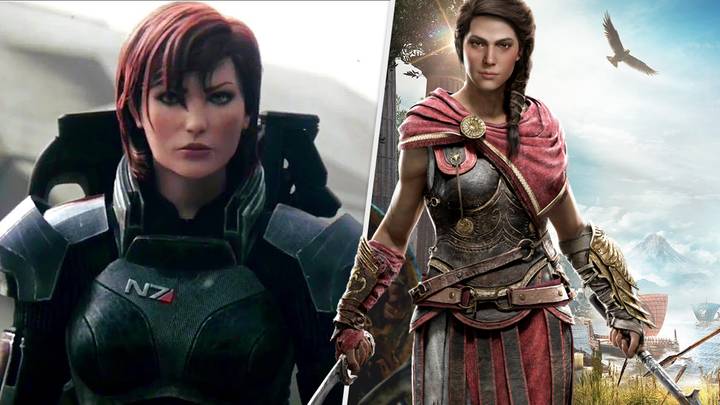
According to a fascinating new study, one in three male gamers will always choose to play as a female character when given the option in a video game.
New research compiled by Quantic Foundry (thanks, TheGamer) finds that just 29% of males would go for the likes of Kassandra over Alexios in Assassin’s Creed Odyssey, or female Shephard over male Shephard in Mass Effect. This is compared to less than one in ten female gamers picking male characters if given the choice.
Personally, I’d typically choose female wherever possible. A lot of the time it’s because I find it to be the more interesting choice! Maybe I prefer the female voice actor (as is the case in Assassin’s Creed Odyssey and Mass Effect), or maybe I just want a change of pace from the last several decades of games where the default option is a grizzled white dude.
Whatever the case, 48% of male respondents said they’d preferred playing as characters of the same gender. That’s a staggering contrast to the female participants: 76% said they preferred to play as a woman, with 9% going for male when given a choice. Again, I’d assume a large part of this is because women aren’t exactly showered with opportunities to play as other women – at least they haven’t been, historically speaking.
GTA 6 Official Trailer
The researchers posit that some men may choose to play as a female because they find the characters more attractive when compared to male avatars. They also suggest that video games in which you can choose to be a man or a woman give men a safer space to explore their own relationship with gender norms and push the boundaries on their own terms.
Non-binary players and characters were also included in the study, with non-binary gamers opting to play as non-binary characters where possible. Of course, there’s still a massive lack of non-binary representation in video games right now, with most character creators offering up plain male/female options.
In these instances, 33% of non-binary respondents would choose female, and 10% male.
A young person holds a sign that reads “Anti-Zionism is not Anti-Semitism” during a “Freedom for Palestine” protest march that drew thousands of participants on November 4, 2023, in Berlin, Germany.(Sean Gallup / Getty)
The cynicism of House Resolution 894 “strongly condemning and denouncing the drastic rise of antisemitism in the United States and around the world” is boundless. Put forward by two Jewish Republicans, Representatives David Kustoff and Max Miller, it states that the official view of the US Congress is that “anti-Zionism is antisemitism.” This is unserious, inane, and dangerous.
Democratic Representative Jerry Nadler, also Jewish, replied to HR 894, by saying: “With this resolution, the GOP has shown themselves fundamentally unserious about combatting antisemitism.… its authors carefully avoided mentioning any of the obvious instances of antisemitism coming from their own leaders.… For example, the resolution implicitly compares some peaceful protesters with the January 6th rioters and insurrectionists.… More problematically, the resolution suggests that ALL anti-Zionism—it states that all anti-Zionism is antisemitism. That is either intellectually disingenuous or just factually wrong.… the authors, if they were at all familiar with Jewish history and culture should know about Jewish anti-Zionism that was and is expressly NOT anti-Semitic. ”
Good for Nadler for speaking truth in the face of Orwellian absurdity. But it’s not enough. This bill is part of a larger movement to make people feel unsafe to say that they oppose Israel’s war crimes in Gaza. If you think it is a coincidence that we are getting this “resolution” as the temporary cease-fire ends and as Israel is expanding its killing campaign into the south of Gaza, then, as my Bubbe would say, I have this bridge in Brooklyn you just have to buy. If you think that the rash of stories this week where Israeli police are releasing “new information” about the Hamas killings of October 7 just as the bombings move south are also a coincidence, then maybe I could throw in the Manhattan Bridge for free.
This is a bill that will receive near-unanimous support from antisemitic Republicans and Christian Zionists like Speaker of the House Mike Johnson: the people who love Israel and hate Jews. That any Democrat would link arms, or in Chuck Schumer’s case hold hands, with these people is a mark of shame.
But that’s not the only reason to oppose HR 894. We must stand against condemning anti-Zionism as antisemitism, because it will only feed the existing hate against the Jewish community, much of which is already afraid. While it’s true, as I wrote in October and as Nadler affirms, that anti-Zionism and antisemitism should never be conflated, it is also true that this kind of ham-fisted, coercive defense of Israel aids and abets antisemitism—an antisemitism that then becomes exploited and weaponized to support Benjamin Netanyahu’s martial agenda.
What Netanyahu, Jonathan Greenblatt of the Anti-Defamation League, and Hollywood amplifiers like Juliana Margulies (three people who seem to be trying to “out-racist” one another) push is the idea that criticism and protests against Israel’s policies are inherently antisemitic and therefore need to be silenced by the state. Their logic threatens Jews everywhere. If politically confronting Israel is branded as antisemitic, then for people new to this movement, it may stand to reason that to be Jewish is to be a Zionist. Netanyahu has devoted his life to binding the fate of all Jews to the furtherance of the Israeli state. This is rank antisemitism: the assumption that to be Jewish is to support Israel’s crimes. To be clear: Anyone who attempts to fasten a 5,000-year-old religion to a 150-year-old colonial project is guilty of antisemitism. They are pushing the idea that my family, merely because of our religion, supports war crimes abroad and the crackdown on critics at home.
It is naïve to think that this won’t create blowback against Jews. We are already seeing an increasing number of disturbing protests at Jewish institutions throughout the world. If the GOP and many Democrats push the idea that being Jewish means supporting Zionism and its current agenda, then the consequences will fall on the shoulders of Jews outside Israel’s borders. As leftists, we must forcefully oppose the idea of collective guilt or collective punishment of Jews for Israel’s crimes. If Israel believed the same logic about Palestinians, then thousands more kids would be alive today.
It can’t be surprising that the GOP would be insensitive to the fallout of these kinds of declarations. Their right-wing base is a cauldron of antisemitism, and their presidential candidate Donald Trumpmet with avowed Nazis while president. Netanyahu and Greenblatt have never minded this, because Trump has reserved most of his violent ire for “liberal Jews,” a group that many Zionists also hold in great contempt. With every anti-Jewish attack stoked by Trump, from Charlottesville to Pittsburgh, Netanyahu steps in to thank Trump and say that this is proof that Jews need their own ethno-state for protection. The opposite is true. What Jews need is a mass left resistance to antisemitism, and that resistance also needs to be against Zionism and for Palestinian liberation. If antisemitism is “the socialism of fools,” then Zionism is Judaism for reactionaries.
As a left, we need to fight against any hint of antisemitism in our ranks. But ridding the struggle of this scourge is our job, not the job of a Congress trying to squelch protest and dissent. Every day I hear from people whose employment is being threatened over Instagram posts or surreptitiously taped classroom lectures. HR 894 will fuel this suffocating reaction. We need to say no to the war on Gaza and no to the brazen neo-McCarthyism aimed at silencing critics. As Jews, we also need to be aware that our best hope against antisemitism lies in defeating Israel’s dual campaign to raze Gaza and bind our fate to those war crimes.
Dave Zirin is the sports editor at The Nation. He is the author of 11 books on the politics of sports. He is also the coproducer and writer of the new documentary Behind the Shield: The Power and Politics of the NFL.
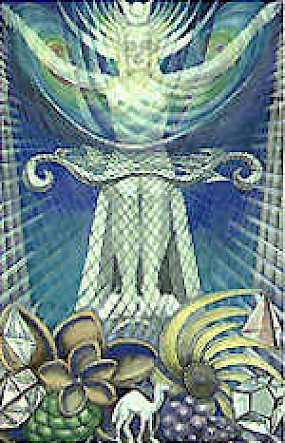
The Priestess (or High Priestess, Papess, Pope Joan, Isis) is numbered two. This is the representation of the Goddess. She is the complementary partner of the Magician, possessing all his skill and ability, but with far more insight and psychism. She is more subtle yet somehow far more noticeable.
She is almost always shown with the Lunar Crescent, conveying her natural affinity with the forces of Nature and natural cycles. The Magician generates his own power, whereas the Priestess draws upon the forces of life itself.
She sits between two pillars with veils suspended between them – it is the Priestess who allows us to penetrate the innermost secrets of life. She is also the bridge between our conscious and Higher selves, by teaching us through our dreams and our subconscious. It is in our subconscious that we hold the keys to the Universe.
“My brother raised his hand when Dad told us we were Indians, and through the tears in his eyes he asked our father, ‘But we’re still part human, right?'”
–Helen Knott from In My Moccasins: A Memory of Resilence
Helen Knott is an Indigenous spoken word poet, grassroots activist, leader and social worker from the Prophet River First Nation. She is of Dane-Zaa, Nehiyaw, Métis, and European descent. Wikipedia
“Pleasure is ‘This feels good. I want more.’ Happiness, on the other hand, is ‘This feels good. I am contented. I am complete.'”
–Rob Lustig
Robert H. Lustig (born 1957) is an American pediatric endocrinologist. He is Professor emeritus of Pediatrics in the Division of Endocrinology at the University of California, San Francisco, where he specialized in neuroendocrinology and childhood obesity. Wikipedia
“Making an injury visible and public is usually the first step in remedying it, and political change often follows culture, as what was long tolerated is seen to be intolerable, or what was overlooked becomes obvious. Which means that every conflict is in part a battle over the story we tell, or who tells and who is heard.”
–Rebecca Solnit in Hope in the Dark
Rebecca Solnit (born 1961) is an American writer. She has written on a variety of subjects, including feminism, the environment, politics, place, and art. Wikipedia
Translation is a 5-step process of “straight thinking in the abstract.” The first step is an ontological statement of being beginning with the syllogism: “Truth is that which is so. That which is not truth is not so. Therefore Truth is all there is.” The second step is the sense testimony (what the senses tell us about anything). The third step is the argument between the absolute abstract nature of truth from the first step and the relative specific truth of experience from the second step. The fourth step is filtering out the conclusions you have arrived at in the third step. The fifth step is your overall conclusion.
The claims in a Translation may seem outrageous, but they are always (or should always) be based on self-evident syllogistic reasoning. Here is one Translation from this week.
1) Truth is that which is so. That which is not truth is not so. Therefore Truth is all that is. Truth being all is therefore total, therefore whole, therefore otherless, therefore one, therefore united, therefore harmonious, therefore orderly. I think, therefore I am. Since I am and since Truth is all that is, therefore I am Truth. Since I am Truth, therefore I am all the attributes of Truth. Therefore, being, I am total, whole, otherless, one, united, harmonious, orderly. Since I am mind and since I am Truth, therefore Truth is Mind (Consciousness).
2) Some psyches can be split in two by trauma at an early age.
Word-tracking: psyche: spirit, breathe, life, being split: divided, separated trauma: wound, shock, jolt, to strike, surprise, unexpected early age: not fully developed, youth, not adult old: elder, superior, senior, senator
3) Truth being one cannot be divided into superior/inferior, senior/junior, adult/child, Therefore Truth is and always has been and always will be fully mature, fully grown, fully able. Truth being Mind (Consciousness) and Truth being all that is, therefore Truth is all-knowing. Truth being all-knowing, there can be no surprises, no jolts, no trauma in Truth, therefore Truth is that which is expected. Truth being one cannot be split into two, therefore Truth is indivisible. Truth being indivisible and Truth being Mind, therefore Mind is indivisible.
4) Truth is and always has been and always will be fully mature, fully grown, fully able. Truth is all-knowing. Truth is that which is expected. Truth is indivisible. Mind is indivisible.
5) Mind, all-knowing, indivisible, fully grown, fully mature, fully able, is all that is expected.
Does this eerie parlor game really give voices to ghostly spirits? While the answer is debatable, scientists envision even more intriguing clinical applications.
When I was a teenager, nothing was as terrifying as watching the movie The Exorcist. The story tells the tale of Regan, a 12-year-old girl who uses the family Ouija board to ask questions of “Captain Howdy” — a demon who takes possession of her soul. Generous head-spinning and pea-soup spitting ensue.
As an adolescent girl, I found the movie so thoroughly horrifying that (duh) my BFFs and I just had to play Ouija at our next sleepover.
For those unfamiliar with Ouija (pronounced WEE-gee), here’s how it goes: Two or more people sit around the board. It’s flat, with the letters of the alphabet laid out in semi-circles above the numbers 0 through 9, plus the words “Yes,” “No,” “Hello,” and “Goodbye.”
You place your fingers on the “planchette” — a type of sliding pointer — and ask a question. Then you watch, dumbfounded, as the pointer glides about the board, spelling out the answer.
Naturally, as hormonal teenage girls, we had to ask Ouija which boys liked us and who we would marry. (I know, our game preferences tended more toward Mystery Date than Ouija — but what can I say?)
It was all fun and games until suddenly, the answers began coming not just from the Ouija board…but also from above us, through a sinister, deep-throated voice.
We immediately scattered and called our moms to take us home.
The strange history of Ouija
In 1891, “Ouija, the Wonderful Talking Board” first appeared in a Pittsburgh novelty shop. Its popularity took off in the uncertain decades around World War I, when the country became obsessed with spiritualism.
At the end of World War I, Ouija was such a hit that Norman Rockwell was commissioned to create this cover for the May 1920 Saturday Evening Post. Norman Rockwell, Public domain, via Wikimedia Commons
Surges in the game’s popularity coincided with other difficult times — including the Great Depression, the Vietnam War, and the 1967 race riots in Detroit, Newark, and Milwaukee.
In recent years, Ouija is once again in high demand, driven in part by the new sequel The Exorcist: Believer. And while a new crop of teenagers will likely take their turns wetting themselves in their movie seats, the real question everyone wants to know is, How does Ouija really work?
Is Ouija all in the mind?
Some people attribute Ouija’s power to ghostly forces, while others point to deceptive pranksters. The real answer is as spooky as it is scientific.
Contrary to the insistence of the drum-circle-and-healing-crystals crowd, Ouija boards are not powered by the supernatural. When we play, we may swear on our grandmother’s grave that we’re really not pushing the pointer. But as it turns out, we really are.
That doesn’t mean the game is entirely useless. On the contrary, as science tells us, Ouija may in fact provide a portal into the secrets of human consciousness.
Science unveils a powerful “second intelligence”
At the University of British Columbia, Helen Gauchou and her team of researchers had that very same hunch. So they devised a two-part study.
For the first part, participants verbally answered yes-or-no trivia questions. These included inquiries such as“Is Buenos Aires the capital of Brazil?” and “Were the 2000 Olympic Games held in Sydney?”
For the second part, test subjects were blindfolded and paired with partners around a Ouija board. They then placed their fingers on the pointer and asked Ouija to help them answer another set of yes-or-no trivia questions.
Unbeknownst to the participants, their “partners” — actually fellow researchers — removed their fingers from the pointer, leaving the test subjects to move it by themselves.
According to Gachou, for the participants, this step triggered “ideomotor actions” — automatic muscular movements that occur outside of conscious thought. Put simply, they moved the pointer but were unaware they were doing so.
Scientists have long been aware of the ideomotor effect. In 1852, physician and physiologist William Benjamin Carpenter published a report for the Royal Institution of Great Britain, examining these automatic muscular movements that take place without a person’s conscious will.
More recently, researchers at the University of Plymouth witnessed the effect through a 2018 study that demonstrated for the first time that involuntary movements could be elicited from people simply by encouraging them to imagine those movements.
When Gachou and her fellow researchers compared the results of their two experiments, they were astonished. During the first portion of the study, when participants verbally guessed at questions they were unsure of, they answered correctly 50 percent of the time. But when subjects erroneously believed they were receiving help from their partners, they guessed correctly more often: 65 percent of the time.
The study, published in Consciousnessand Cognition, showed that many of the pointer’s movements emanated from information stored at an unconscious level — not readily accessible to the conscious mind.
“These surprising results suggest we have a powerful ‘second intelligence’ resting beyond our conscious minds that can be accessed under the right conditions,” Gauchou said in a statement. “We may believe we don’t know an answer consciously but actually have the answer right there in our subconscious.”
Could early medical diagnoses be next?
While Ouija may not let us communicate with our dearly departed, it may help unlock vexing medical mysteries.
For example, Gauchou and her teammates speculate that using a Ouija board could raise early warnings of Alzheimer’s and other neurodegenerative diseases — afflictions that may be missed by our conscious minds, but recognized by our subconscious ones.
In other words, the Ouija board may be a powerful communication tool — just not in the way we expected.
Which leads me back to the deep-throated voice that terrified me and my teenage sleepover buddies so many years ago. Turns out, as I learned the next day, the voice belonged to my friend’s not-so-funny big brother, who spoke through the heating vents from the floor above us.
Discovering that trick didn’t mean I stopped believing in the power of Ouija. Because when it comes to Ouija, there may be something equally as mysterious and captivating at play here: Our own minds.
Thanks for reading! Your support makes my writing possible. You can sign up for emails when I publish on Medium, or join Medium to directly support me and gain full access to all Medium stories.
On the surface, it can look like the Universe is at best indifferent to human needs, and at worst chaotic, ill-tempered, capricious, and mean-spirited.
But I’m a spiritual person, at least in a half-assed way that lets me indulge in magical thinking without spending hours cross-legged on a hardwood floor, no closer to God but with searing pain in my thighs. My soul prefers to ponder and evolve in comfort, say in the shower or half-asleep on the couch with a cat resting on my chest.
This Lazy Person’s Path to Enlightenment has led me to believe there is a sentient Universe, Source, or Prime Mover of which we are all part, and which communicates with us to educate, enlighten, and give guidance.
And now there may be some science to support me.
Disclaimer: I also think there are fairies in the backyard oak tree and that socks have feelings, so any belief system I advocate should be taken with a grain of salt.
Some 68 percent of the known universe is made up of dark matter and another 27 percent is dark energy. Science doesn’t really know what either of these things are, just that they should exist in order to make the calculations work. Regardless, everything we understand about anything is based on the 5 percent of the visible universe which we can see.
And the visible portion of the universe is tiny. Even our most powerful telescopes only see a fraction of a trillionth of a percent of that 5 percent of the universe which is neither dark energy nor dark matter. If the cosmos is infinite, as seems likely, then the size of our data set for analyzing it is effectively zero.
We know very little about the universe except that it’s vast beyond imagining.
But the parts we can see offer intriguing clues as to how things might work.
Science has observed that the universe resembles a gigantic neural network similar to the human brain, with galaxies the equivalent of neurons. I’m vastly oversimplifying a complex concept mostly because it’s beyond my intellectual grasp, but that’s the gist of it, and enough for our purposes.
In this scenario, information would be moving between galaxies in the same way signals flash between neurons in our brains. The universe might be literally thinking, learning, and creating.
But there’s a problem.
In classical physics as in our everyday lives, we observe locality — the principle that an object can be affected instantaneously by another object only when the two are in close proximity. If you throw a baseball in your yard, you don’t expect a window on the other side of town to get broken.
Locality isn’t a problem in our brain, where neurons are packed snugly together, and impulses travel between them more or less instantly. That speed allows us to think.
However, the enormous distances between galaxies and the absolute limit of the speed of light suggest that information in a universe-sized brain could only be exchanged very slowly, if at all.
This implies that God has the mental capacity of a sea sponge, which would explain a lot about organized religion but still be disappointing.
A possible workaround?
In quantum physics, there are circumstances where the principle of locality seems to break, with the most famous being quantum entanglement.
If two particles are entangled and then separated, a measurement of one will cause it to collapse into a spin state which is either up or down. When this happens, the second entangled particle will immediately collapse into the opposite state, even though the two are millions of miles apart and travelling away from each other at the speed of light.
It’s this apparent breach of the law of locality (and causality) that Einstein famously called “spooky action at a distance.” Einstein’s skepticism notwithstanding, it’s been proven true over and over again.
While it’s impossible to use quantum entanglement for communicating, it and other cutting-edge ideas may imply the possibility of non-local connections which we are simply unable to see, making communication between far-flung, fast-moving nodes a possibility — see this article by theoretical physicist Sabine Hossenfelder for a more comprehensive and coherent explanation.
As Hossenfelder notes, there is no evidence for these connections. Maybe it’s just a far-fetched theory.
Or maybe science is catching up with spirituality.
It’s a common theme in both religion and weed-fueled dorm room conversations, that the universe is a single grand organism of which we’re all a part.
Certain schools of Hinduism hold that everything is one, and every being is part of a larger soul. Buddhists believe in the interrelatedness of all things. Even monotheists get in on the action — medieval Christian mystic Meister Eckhart wrote “Everything is in God and is God”.
And many individuals report transcendent experiences that manifest as feelings of oneness with everything, sometimes chemically induced but valid nevertheless.
Scientists are often reluctant to venture into the realm of philosophy, let alone spirituality, and with good reason — slapping the “science” tag onto a pre-existing belief system would imply proof for the unprovable, and raise suspicions of bias in the experimental process.
But the more we learn about the Universe, the more it seems the mystics and shamans were right all along.
Here’s what I believe, and what science may one day validate.
We are not accidental machines, cogs in an uncaring cosmos, destined to flash into the world for a brief moment and disappear without meaning.
Our view of reality is tiny and blinkered. There is much, much, more to the world than we can easily see, and our intuition screams this truth to us.
If we stay quiet and listen, we can hear.
We are parts of a whole far larger than we can imagine, learning and growing and connecting with ourselves. We are creators, we are teachers, we are builders of worlds. We are eternal.
And the odds of it being a random fluke that you’re sitting here looking out at the universe, and consciously wondering about it, are vanishingly small.
So cheer the fuck up. Everything’s going to be ok.
ARIES (March 21-April 19): I will cheer you on as you tenderly push yourself to be extra exploratory in the coming weeks. It’s exciting that you are contemplating adventures that might lead you to wild frontiers and half-forbidden zones. The chances are good that you will provoke uncanny inspirations and attract generous lessons. Go higher and deeper and further, dear Aries. Track down secret treasures and lyrical unpredictability. Experiment with the concept of holy rebellion.
TAURUS (April 20-May 20): In January, I will tempt you to be a spirited adventurer who undertakes smart risks. I will invite you to consider venturing into unknown territory and expanding the scope of your education. But right now, I advise you to address your precious needs for stability and security. I encourage you to take extra good care of your comfort zone and even add cozy new features to it. Here’s a suggestion: Grab a pen and paper, or open a new file on your favorite device, then compose a list of everything you can do to feel exceedingly safe and supported.
GEMINI (May 21-June 20): Booker T. Washington (1856–1915) was an American Black leader who advocated a gradual, incremental approach to fighting the effects of racism. Hard work and good education were the cornerstones of his policies. Then there was W. E. B. Dubois (1868–1963). He was an American Black leader who encouraged a more aggressive plan of action. Protest, agitation, pressure and relentless demands for equal rights were core principles in his philosophy. In the coming months, I recommend a blend of these attitudes for you. You’ve got two big jobs: to improve the world you live in and get all the benefits you need and deserve from it.
CANCER (June 21-July 22): I periodically get a big jolt of feeling how much I don’t know. I am overwhelmed with the understanding of how meager my understanding of life really is. On the one hand, this is deflating to my ego. On the other hand, it’s wildly refreshing. I feel a liberating rush of relief to acknowledge that I am so far from being perfect and complete that there’s no need for me to worry about trying to be perfect or complete. I heartily recommend this meditation to you, fellow Cancerian. From an astrological perspective, now is a favorable time to thrive on fertile emptiness.
LEO (July 23-Aug. 22): Have you reached your full height? If there were ever a time during your adult life when you would literally get taller, it might be in the coming weeks. And that’s not the only kind of growth spurt that may occur. Your hair and fingernails may lengthen faster than usual. I wouldn’t be shocked if your breasts or penis got bigger. But even more importantly, I suspect your healthy brain cells will multiply at a brisk pace. Your ability to understand how the world really works will flourish. You will have an increased flair for thinking creatively.
VIRGO (Aug. 23-Sept. 22): I like Virgo author Cheryl Strayed’s thoughts about genuine togetherness. She says, “True intimacy isn’t a cluster fuck or a psychodrama. It isn’t the highest highs and lowest lows. It’s a tiny bit of those things on occasion, with a whole lot of everything else in between. It’s communion and mellow compatibility. It’s friendship and mutual respect.” I also like Virgo author Sam Keen’s views on togetherness. He says, “At the heart of sex is something intrinsically spiritual, the desire for a union so primal it can be called divine.” Let’s make those two perspectives your guideposts in the coming weeks, Virgo.
LIBRA (Sept. 23-Oct. 22): According to my interpretation of your astrological prospects, you now have the capacity to accelerate quickly and slow down smoothly; to exult in idealistic visions and hunker down in pragmatic action; to balance exuberant generosity with careful discernment—and vice versa. In general, Libra, you have an extraordinary ability to shift moods and modes with graceful effectiveness—as well as a finely honed sense of when each mood and mode is exactly right for the situation you’re in. I won’t be surprised if you accomplish well-balanced miracles.
SCORPIO (Oct. 23-Nov. 21): Dear Goddess — Thank you a trillion times for never fulfilling those prayers I sent your way all those years ago. Remember? When I begged and pleaded with you to get me into a sexy love relationship with You Know Who? I am so lucky, so glad, that you rejected my prayers. Though I didn’t see it then, I now realize that being in an intimate weave with her would have turned out badly for both her and me. You were so wise to deny me that misguided quest for “pleasure.” Now dear Goddess, I am asking you to perform a similar service for any Scorpio readers who may be beseeching you to provide them with experiences they will ultimately be better off without.
SAGITTARIUS (Nov. 22-Dec. 21): Among our most impressive superpowers is the potency to transform ourselves in alignment with our conscious intentions. For example, suppose you feel awkward because you made an insensitive comment to a friend. In that case, you can take action to assuage any hurt feelings you caused and thereby dissolve your awkwardness. Or let’s say you no longer want to be closely connected to people who believe their freedom is more important than everyone else’s freedom. With a clear vision and a bolt of willpower, you can do what it takes to create that shift. These are acts of true magic—as wizardly as any occult ritual. I believe you will have extra access to this superpower in the coming weeks. Homework: Identify three situations or feelings you will use your magic to change.
CAPRICORN (Dec. 22-Jan. 19): The eminent Capricorn philosopher William James (1842–1910) is referred to as the “Father of American Psychology.” He was a brilliant thinker who excelled in the arts of logic and reason. Yet he had a fundamental understanding that reason and logic were not the only valid kinds of intelligence. He wrote, “Rational consciousness is but one special type of consciousness, whilst all about it, parted from it by the filmiest of screens, there lie potential forms of consciousness entirely different.” This quote appears in his book “The Varieties of Religious Experience.” In accordance with astrological omens, I invite you to investigate those other types of consciousness in the coming months. You don’t need drugs to do so. Simply state your intention that you want to. Other spurs: dreamwork, soulful sex, dancing, meditation, nature walks, deep conversations.
AQUARIUS (Jan. 20-Feb. 18): Are people sometimes jealous or judgmental toward you for being so adept at multi-tasking? Are you weary of dawdlers urging you not to move, talk, and mutate so quickly? Do you fantasize about having more cohorts who could join you in your darting, daring leaps of logic? If you answered yes to these questions, I expect you will soon experience an enjoyable pivot. Your quick-change skills will be appreciated and rewarded more than usual. You will thrive while invoking the spiritual power of unpredictability.
PISCES (Feb. 19-March 20): Romantic relationships take work if you want them to remain vigorous and authentic. So do friendships. The factors that brought you together in the first place may not be enough to keep you bonded forever. Both of you change and grow, and there’s no guarantee your souls will continue to love being interwoven. If disappointment creeps into your alliance, it’s usually wise to address the issues head-on as you try to reconfigure your connection. It’s not always feasible or desirable, though. I still feel sad about the friend I banished when I discovered he was racist and had hidden it from me. I hope these ruminations inspire you to give your friendships a lot of quality attention in 2024. It will be an excellent time to lift the best ones up to a higher octave.