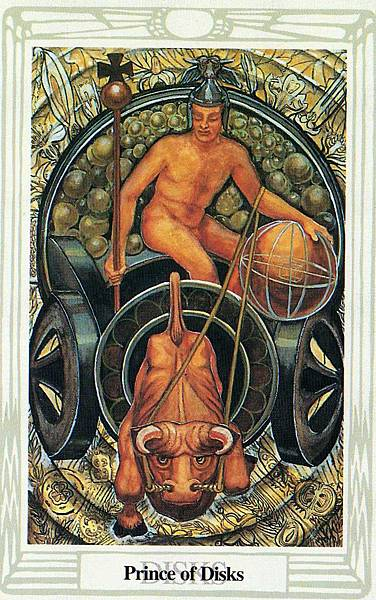
The man represented by the Prince of Disks is a quiet and meditative man, who works with unfailing determination towards the goals he sets himself. He is reliable and resourceful, unswerving and creative in his dedication.
He is more imaginative than the Knight of Disks, though he has the same quiet strength and gentleness. His quality of contemplation often yields fruit in surprising ways, generating a deep and broad-sweeping understanding about the inner workings of life.
If he is ill-dignified, the Prince of Disks can become stubborn and short-sighted – even bloody-minded in his attitudes. Faithful and loyal himself, he will not tolerate faithlessness in others. Neither will he accept lack of integrity, nor dishonesty.
He is hard-working, trustworthy and inventive, often producing unusual yet practical solutions which resolve otherwise intractable problems. As a friend he is non-judgemental and supportive, though capable of shedding new perspectives on situations. He’s generally a good listener, though he has little patience with histrionics and manipulation.
His approach to life overall is one of industrious practicality. He believes that all things yield to a determined will and well-directed activity.
Though emotionally he at first gives the impression that he is solid and perhaps even a little unimaginative, when his feelings are roused, he can be deeply passionate and sensual.
He rarely comes up to indicate a change of mood in a person, though sometimes he will appear to indicate some-one learning to take responsibility in everyday life.
New Thinking Allow Nov 9, 2022 • Charles Upton’s first books of poetry were published in 1968 and 1969 by Lawrence Ferlinghetti of City Light Books in San Francisco. He was then considered the youngest member of the “beat generation” as he was still in high school. He has subsequently written many books associated with the traditionalist school of spirituality including The Science of the Greater Jihad, System of the Antichrist, Vectors of the Counter-Initiation, Folk Metaphysics, Alien Disclosure Deception: The Metaphysics of Social Engineering, and Day and Night on the Sufi Path, The Way Forward for Perennialism: After the Antinomianism of Frithjof Schuon, and Findings: In Metaphysic, Path, and Lore. His website is https://charles-upton.com/. Here he defines spiritual metaphysics as a structured approach with both an ontology and epistemology, designed to be tested in the contemplative and ritual practices of aspirants in different traditions. Because of its practical application and testing, it differs from conventional academic metaphysics. Spiritual metaphysics always starts with the ground of being, or the divine. It differs in its cultural expression in Christianity, Islam, Buddhism, and Yoga. Nevertheless there are many similarities, such as the distinction between the personal god and the god without any attributes. New Thinking Allowed host, Jeffrey Mishlove, PhD, is author of The Roots of Consciousness, Psi Development Systems, and The PK Man. Between 1986 and 2002 he hosted and co-produced the original Thinking Allowed public television series. He is the recipient of the only doctoral diploma in “parapsychology” ever awarded by an accredited university (University of California, Berkeley, 1980). He is also the Grand Prize winner of the 2021 Bigelow Institute essay competition regarding the best evidence for survival of human consciousness after permanent bodily death. (Recorded on October 21, 2022)
On November 8th, 2022 we have a Full Moon and Total Lunar Eclipse at 16° Taurus.
To say this eclipse is intense is an understatement. The Eclipse is conjunct Uranus (at 16° Taurus), opposite Mercury (at 15° Scorpio), and square Saturn (at 18° Aquarius).
The eclipse can bring some unexpected shake ups and developments, and Saturn at the apex of the T-square will make things real.
This is a North Node eclipse that will initially shake us to the core, but will eventually open us up to new possibilities and realities. Whatever happens is for the sake of our growth and development.
Lunar Eclipses are Full Moons on steroids. When the Moon is eclipsed, its surface is progressively shadowed, mirroring the 29.5 lunar cycle from New Moon, 1st Quarter, Full Moon – to Last Quarter, Balsamic and New Moon again. What should normally happen in a month (a full lunar cycle), it now happens in one hour only (the duration of the Eclipse).
That’s why Eclipses – and especially Lunar Eclipses – come with an intensification and culminations.
Things seem to happen out of the sudden, and we may feel we have no say in the process.
Every Full Moon has a specific goal: to integrate the polarity of the signs on the axis. Since the Moon is in Taurus, the Sun is in the opposite sign, Scorpio, so we are talking about a Lunar Eclipse on the Taurus-Scorpio axis.
Taurus-Scorpio is the most fixed axis of the zodiac. Taurus and Scoprio are stable and loyal signs that will go to great lengths to preserve the status quo.
You need something of the magnitude of an earthquake to break a Taurus-Scorpio bond. Uranus, the planet of freedom, will try the impossible.
At the Lunar Eclipse, Uranus will be exactly conjunct the Moon.
The Moon, Uranus and the North Node will align to create incredible forward momentum.
Will this be the earthquake that will finally push the Bull out of its green pastures and into the most feared unknown?
Lunar Eclipse In Taurus – Taurus Vs. Scorpio
The Moon, North Node and Uranus in Taurus on one side are opposed Sun, Mercury and the South Node in Scorpio. There is a strong pull (Scorpio) to cling to old mental models (Mercury conjunct South Node) that have defined us and perhaps served us well in the past.
However, Uranus and North Node no longer want to live in the past. They want to move on. They want to create new realities.
Taurus is our self autonomy, what we build as a result of our own efforts.
Scorpio, on the other side of the axis, is what we share with others, and how other people’s affairs influence us. Scorpio is also power dynamics, is where we hold power over others, but also where others hold power over us.
Sometimes it’s more comfortable to live in the Scorpio space, because there’s always a trump card to be played, or there are always other people we can blame for what goes wrong.
But there comes a time where even the most complex Scorpionic mind games become boring and predictable.
We have a choice: we can continue to over complicate our lives OR we can keep things simple. Note your resistance to this truism and recognize your Scorpionic tendency to search for “buts” and “what ifs”.
Lunar Eclipse In Taurus – Some Chains Don’t Break
The planets in Taurus and the planets in Scorpio also square Saturn in Aquarius. Saturn is in fact at the apex of this highly intense fixed T-square. In a T-square, the planet at the apex is the ‘release’ or the manifestation point of the tension created by the planets in opposition.
So the way we resolve the Taurus-Scorpio conflict is with Saturn in Aquarius. Saturn is the adult in the room. In its domicile sign, Saturn is level headed and understands the bigger picture.
Perhaps sometimes life it’s less about what’s mine (Taurus) vs. what’s yours (Scorpio). Perhaps sometimes we need to zoom out of the situation and do what adults do. Aquarius is a humanitarian sign that’s concerned with what’s best for society as a whole.
The Lunar Eclipse T-square will draw attention to what’s shaky in your life. What’s not built on stable foundations will crumble.
But there will also be things that will stay. Some chains don’t break, and sometimes we need an Uranian truth slap to see the obvious.
Uranus is not the angry Mars, nor the power-tripped Pluto. Uranus doesn’t disrupt our life for nothing. Uranus is not a rebel without a cause.
Uranus is the planet of higher truth. Uranus simply acknowledges the truth. Its role is to remove all the barriers that stand between you and the truth, whatever these might be.
We have had the Saturn-Uranus square for a while now (2 years). Is not that we are not aware of the tensions in our life. The Saturn-Uranus square has pretty much shown us all the cracks. We know what’s not working.
Empowered by the Lunar Eclipse, Uranus will just do the deed. Which can mean inevitable change, or simply acknowledging the complexities and paradoxes in our life – and seeing things for what they are.
We may make the decision to change something fundamental about our lives. Or we may stay where we are. Either way, we will take responsibility for our choices. We will accept what’s working, what’s not working, and make peace with it.
If you have planets or angles between 15°-19° in fixed signs (Taurus, Leo, Scorpio, Aquarius), the eclipse will speak to you directly.
Once Buddha was walking from one town to another town with a few of his followers. While they were travelling, they happened to pass a lake. They stopped there and Buddha told one of his disciples, “I am thirsty. Do get me some water from that lake.”
The disciple walked up to the lake. When he reached it, he noticed that some people were washing clothes in the water and, right at that moment, a bullock cart started crossing through the lake. As a result, the water became very muddy and turbid. The disciple thought, how can I give this muddy water to Buddha to drink! So he came back and told Buddha,”The water in there is very muddy. I don’t think it is fit to drink.”
After about half an hour, again Buddha asked the same disciple to go back to the lake and get him some water to drink. The disciple obediently went back and found that the lake had absolutely clear water in it. The mud had settled down and the water above it looked fit to be had. So he collected some water in a pot and brought it to Buddha.
Buddha looked at the water, and then he looked up at the disciple and said, “See what you did to make the water clean. You let it be; the mud settled down on its own and you got clear water. Your mind is also like that. When it is disturbed, just let it be. Give it a little time. It will settle down on its own. You don’t have to put in any effort to calm it down. It will happen. It is effortless.”
Report at Cop27 shows the world is now deep into the climate emergency, with the 1.5C heating limit ‘barely within reach’
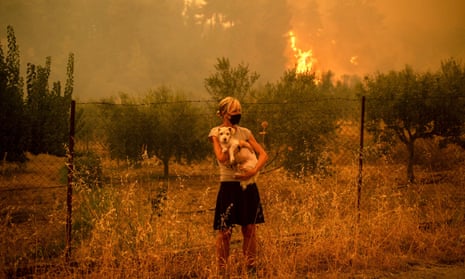
Forest fires approach the village of Pefki on Evia, Greece’s second-largest island, in August during the worst heatwave in decades. Photograph: Angelos Tzortzinis/AFP/Getty Images
The past eight years were the eight hottest ever recorded, a new UN report has found, indicating the world is now deep into the climate crisis. The internationally agreed 1.5C limit for global heating is now “barely within reach”, it said.
The report, by the UN’s World Meteorological Organization (WMO), sets out how record high greenhouse gases in the atmosphere are driving sea level and ice melting to new highs and supercharging extreme weather from Pakistan to Puerto Rico.
The stark assessment was published on the opening day of the UN’s Cop27 climate summit in Egypt and as the UN secretary-general warned that “our planet is on course to reach tipping points that will make climate chaos irreversible”.
The WMO estimates that the global average temperature in 2022 will be about 1.15C above the pre-industrial average (1850-1900), meaning every year since 2016 has been one of the warmest on record.https://interactive.guim.co.uk/uploader/embed/2022/11/warmestyears-zip/giv-6562w4mvPSgJPm18/
For the past two years, the natural La Niña climate phenomenon has actually kept global temperatures lower than they would otherwise have been. The inevitable switch back to El Niño conditions will see temperatures surge even higher in future, on top of global heating.
The WMO report said:
Carbon dioxide, methane and nitrous oxide are at record levels in the atmosphere as emissions continue. The annual increase in methane, a potent greenhouse gas, was the highest on record.
The sea level is now rising twice as fast as 30 years ago and the oceans are hotter than ever.
Records for glacier melting in the Alps were shattered in 2022, with an average of 13ft (4 metres) in height lost.
Rain – not snow – was recorded on the 3,200m-high summit of the Greenland ice sheet for the first time.
The Antarctic sea-ice area fell to its lowest level on record, almost 1m km2 below the long-term average.
“The greater the warming, the worse the impacts,” said the WMO secretary-general, Prof Petteri Taalas. “We have such high levels of CO2 in the atmosphere now that the lower 1.5C [target] of the Paris Agreement is barely within reach. It’s already too late for many glaciers [and] sea level rise is a long-term and major threat to many millions of coastal dwellers and low-lying states.”
António Guterres, UN secretary-general, said ahead of Cop27: “Emissions are still growing at record levels. That means our planet is on course for reaching tipping points that will make climate chaos irreversible. We need to move from tipping points to turning points for hope.”
A series of recent reports signalled how near the planet is to climate catastrophe, with “no credible pathway to 1.5C in place” and the current level of action set to see no fall in emissions and global temperature rise by a devastating 2.5C.
Rising global heating is making extreme weather more severe and more frequent around the world. The WMO report highlighted the drought in east Africa, where rainfall has been below average for four consecutive seasons, the longest in 40 years. About 19 million people are now suffering a food crisis.
The WMO analysis also reported:
Devastating flooding in Pakistan, with at least 1,700 deaths and 7.9 million people displaced.
A series of cyclones that battered southern Africa, which hit Madagascar hardest with torrential rain.
“All too often, those least responsible for climate change suffer most, but even well-prepared societies this year have been ravaged by extremes,” said Prof Taalas.
Prof Mike Meredith, at the British Antarctic Survey, said: “The messages in this report could barely be bleaker – all over our planet, records are being shattered as different parts of the climate system begin to break down. The loss of ice is especially alarming as the impacts on people, societies and economies are huge. If this doesn’t focus the minds of the global leaders at Cop27, I don’t know what will.”
The simple narrative of a diabolical Putin vs the freedom-loving west distorts the multifaceted, complex history of the conflict.
BY CHRIS HEDGES NOVEMBER 4, 2022 (therealnews.com)
Medea Benjamin, an activist from the organization called CODEPINK, shouts at U.S. President Barack Obama while he speaks at the National Defense University May 23, 2013 in Washington, DC. Photo by Win McNamee/Getty Images.
Eight months in, there is no clear end in sight for the war in Ukraine. Millions have been uprooted from their homes, and thousands killed in the conflict. Simultaneously, billions in US taxpayer dollars have been stuffed into the pockets of defense contractors in the name of providing military aid to Ukraine, perpetuating a war profiteering bonanza that has cost trillions of dollars over the past two decades and brought ruin to Afghanistan, Libya, Syria, Iraq, Yemen, and other nations. Meanwhile, mass media has loyally propagated a narrative of the war that favors the interests of NATO and the US in manufacturing consent for a prolonged conflict designed to weaken Russia. The complex history of the conflict and region have been intentionally obscured by a simplistic tale of good vs. evil, and democracy vs. authoritarianism. Significant information like the role of NATO’s expansion, the Russian ethnic minority in Ukraine, and the consequences of the war on working people worldwide are totally ignored, if not denounced as “pro-Putin” talking points. Peace activist and author Medea Benjamin joins The Chris Hedges Report to discuss the history of Ukraine as explained in her new book, War in Ukraine: Making Sense of a Senseless Conflict, co-authored with Nicholas Davies.
Studio: Adam Coley, Cameron Granadino, Dwayne Gladden
Post-Production: Adam Coley
TRANSCRIPT
Chris Hedges: No one, including the most bullish supporters of Ukraine, expect the nation’s war with Russia to end soon. The fighting has been reduced to artillery duels across hundreds of miles of front lines and creeping advances and retreats. Ukraine, like Afghanistan, will bleed for a very long time, and this is by design. The militarists who have waged permanent war costing trillions of dollars over the past two decades have invested heavily in controlling the public narrative. The enemy, whether Saddam Hussein or Vladimir Putin, is always the epitome of evil, the new Hitler. Those we support are always heroic defenders of liberty and democracy. Anyone who questions the righteousness of the cause is accused of being an agent of a foreign power and a traitor.
The mass media cravenly disseminates these binary absurdities in 24-hour news cycles. Its news, celebrities, and experts, universally drawn from the intelligence community and the military, rarely deviate from the approved script. Day and night, the drums of war never stop beating. Its goal: to keep billions of dollars flowing into the hands of the war industry and prevent the public from asking inconvenient questions.
Medea Benjamin, who, along with Nicolas Davies, authored War in Ukraine: Making Sense of a Senseless Conflict, placed the war in Ukraine in its proper historical and cultural context, warning that protracted war in Ukraine threatens open warfare between the United States and Russia, a nuclear Armageddon. Joining me to discuss her book is Medea Benjamin, co-founder of Code Pink, and author of Drone Warfare, Kingdom of the Unjust: Behind the US Saudi Connection, and Inside Iran.
So in the book, Medea, you begin first by setting Ukraine in historical context, and in particular the Russian speaking regions. Just lay out for us, because I think there is this perception that Ukraine or Russia’s interest or claims over Ukraine are somehow new.
Medea Benjamin: I think people don’t understand how close Ukraine and Russia have been for centuries, how many Russian speakers there are in Ukraine, how the connection between Ukraine and Russia has gone back and forth for a long time, but Ukraine was part of the Soviet Union. And places like Crimea, people in Russia have told me that the Americans might think of the state of Alaska, that’s how people in Russia see Ukraine, as a part of their country for a long time. And it’s really recently that there has been this discrimination against Russian speakers, against Russian publications, against using Russian language in the schools. And of course, that is part of the conflict that we have seen raging in the last decade.
Chris Hedges: Well, with this caveat that Crimea was part of Russia a century before we got Alaska, wasn’t it?
Medea Benjamin: That’s right. And I think just the idea that anyone would say that Crimea’s not part of Russia, for the people in Ukraine now calling for all of Crimea to be taken back, and the way the US media is portraying it as part of this fight right now is to get Crimea back into Russia. I think people should think of how it would feel if a hostile power in Canada, for example, decided that Alaska would no longer be part of the United States.
Chris Hedges: Let’s talk a little bit about the antecedents to the conflict. I was in Eastern Europe in 1989. I covered the revolutions in East Germany, Czechoslovakia, and Romania. I was there when promises were made to Gorbachev – Who, by the way, wanted to build a security and economic alliance with Europe and the United States. But promises were made not to expand NATO beyond the border of a unified Germany. This is a historical fact. It’s one I reported. And yet, to even bring this up is an anathema among the media. So before we talk about what happened in 2014, let’s talk a little bit about what happened between 1989 and 2014.
Medea Benjamin: Well, in terms of the NATO expansion, as you said, people today are trying to act like that promise was never made because it wasn’t written down in some kind of treaty. But we do have evidence from all kinds of US politicians, academics, diplomats, saying that this was just common knowledge, that it was part of the deal brokered between secretary of State James Baker and Gorbachev, and how this was part of the agreement around the reunification of Germany. It’s also important to note that the Warsaw Pact was dissolved after the downfall of the Soviet Union. And it was at that time that many thought that would be the end of NATO, that NATO had done its job protecting the West from the Soviet Union.
And yet, these promises were violated by Democratic presidents like Clinton, Republican presidents like George Bush. In fact, it was at that 2008 meeting of NATO in Budapest where George Bush twisted the arms of other leaders in NATO to say that we would promise membership to Georgia and to Ukraine, against the best interests of the region and against many of the other NATO members that knew that would be tremendously problematic, which is why they agreed to make the announcement but not to set a date. And then as progressive from there, the continuous US expansions that not only went Eastward but went right to Russia’s border are somehow disregarded today.
But it is important to try to imagine what it would be like in the United States if a hostile force, let’s say in Mexico or in Canada, were building bases right on our borders, and the NATO expansion was also accompanied by the redesign of NATO not to be a defensive alliance but to be an offensive one. We saw that in Yugoslavia, and then we saw it far from the North Atlantic countries when NATO got involved in the invasion of Afghanistan, in the invasion of Libya, and not in the beginning, but later on in the US occupation of Iraq as well. So Russia was seeing not only the movement of NATO towards its borders, but it also saw the increasingly aggressive nature of NATO itself.
Chris Hedges: And despite this, Putin, in the beginning, cooperated within the so-called war on terror. Of course, they had problems with Islamic extremism after the wars in Chechnya. Russia provided resupply routes for US troops in Afghanistan. There was a real effort on the part of the Russian government to reach out.
Medea Benjamin: Well, yes. And that has been the case even in more recent times when Russia worked with the United States, for example, to get an agreement on the Iran nuclear deal; when Russia worked with the United States around Syria to try to solve this crisis around Syrian biological weapons. I think there are many examples that we can point to today of Russia working with the United States, which is one of the reasons why it’s so ridiculous to hear this common phrase that you can’t negotiate with Putin, you can’t negotiate with Russia. The US has been doing it for quite a long time.
Chris Hedges: What do you think is driving the hostility towards, or what drove it? I’m not defending, of course, the war in Ukraine, as you don’t either. A preemptive war is a war crime. But what drove that hostility? Andrew Bacevich argues that it was just the hubris of a broken Soviet empire and a weakened Russia. I’ve got to believe that the billions in profit that were made, are being made by the war industry, by refitting Warsaw Pact countries with NATO equipment was also a factor. But what do you believe drove this hostility?
Medea Benjamin: I think there are many factors behind it, and you named some of it. We also have, within the Democratic Party, the last years of the demonization of Russia around Russia-gate, instead of admitting that Hillary Clinton was a bad candidate, blaming the Russians on the victory of Donald Trump. We know that we have two war parties. I think the Republicans are more focused on China as the adversary and the Democrats more focused on Russia. But in any case, we have this growing militarization that has taken over NATO, but a militarization of Ukraine by the US. And even under Obama, we see that right after the Minsk Agreement was signed and there was supposed to be some peaceful solution to the conflict in the Donbas, you see him sending weapons to Ukraine, supposedly defensive weapons.
And now of course, all of that charade of defensive versus offensive have been lifted, but it has been both Democrats and Republicans who have really pushed for increased hostility towards Russia, increased militarization of Europe. And this is also a way to get Europe totally behind the United States, whereas I think with the Europeans, like the Germans and many other European countries becoming so dependent on Russia for their energy supplies, the US was trying to find a way to sever the ties between Western Europe and Russia, and make sure that Western Europe was solidly behind the United States. And this terrible invasion by Putin has given them exactly what the US wanted.
Chris Hedges: Let’s talk about the Minsk Agreement. This was an agreement that Ukraine never honored. Explain what it was and what it was meant to do.
Medea Benjamin: When the Maidan protests began and they were overtaken by violent protests and a government that was corrupt, but an elected government was overthrown, there was the protest that happened in the Donbas, and the civil war broke out between the supporters of Russia inside the Donbas and the opponents, many of them hard right elements that had neo-Nazi origins like the Azov Brigade. And the European security organization sent in monitors after an agreement was reached that there would be greater autonomy given to Donbas, that there would be elections there, that there would be talks between the leaders of the breakaway republics and the heads of state in Ukraine. That political part never happened.
What happened was that the monitors did indeed come in, and many of the explosions of the conflict, of the killing that happened in the first year, was calmed down by the presence of these monitors. But the political agreement was never implemented. There was never an election that was held. There were never the talks with the leaders of the breakaway republics. And every time one of the leaders in Ukraine tried to go ahead and implement the process, they were threatened by the extreme right. And this is true when Zelenskyy came in, having come to power on a popular agenda of creating peace in the Ukraine, of implementing these Minsk accords. Then he was threatened, his life was threatened by the extreme right, saying that they would hang him from a tree if indeed he went ahead with this. So the political elements of the Minsk II were never implemented, but they actually did form the basis of what could have been and still could be a solution to the conflict in the Donbas.
Chris Hedges: We should be clear, when Zelenskyy ran, he made quite a fact of the fact, or he brought up the fact that he was a Russian speaker, which was seen as an asset.
Let’s go back to 2014, Victoria Nuland. I think the US put $5 million. Explain what happened. Many Russian speakers in Ukraine argue this was a coup, and I think there’s much validity to that, but explain. And also the intrusion of the United States into the domestic politics of Ukraine, something that Soviet experts like George Kennan, even Burns, argued was dangerous.
Medea Benjamin: Absolutely. When you saw the protest that broke out against an unpopular and corrupt government that was talking to both the Europeans about joining the European Union as well as joining an economic pact with Russia, there were segments of the population that rose up and said, we want to be pro Western, we don’t want these ties with Russia. And they started a peaceful protest, and that gathered steam and gathered steam, and was overtaken by violent extreme right elements. Now, there were talks going on between the Ukrainian leadership, the government in power, and the European countries to say, how can we come up with a solution to this? And they planned on having new elections.
This was not good enough for those right-wing elements, and they decided that they were going to continue to escalate. And they took over the building in Parliament, they forced the government in power out, and they started these violent actions in reaction to the breakaway republics in the Donbas.
So Victoria Nuland was the assistant secretary of state at the time, and she was directly involved in trying to engineer what would be the outcome of these protests, who would be in charge. It’s quite astounding that we have that audiotape of her talking to the US ambassador in Ukraine about how they were going to disregard, although she didn’t use that nice word, she used another word, the European Union, and the person that they wanted to put in power, and instead put in who the US had wanted to put.
We have a video that we did to accompany our book, Chris, in which we show her out in the Maidan giving out sweets to the protestors, but her role in this was not very sweet. And I think in years to come, just as we’ve seen the National Security Archives and other groups get documents long after the fact about US involvement in coups in other countries around the world, we have yet to see the extent of US involvement. But we know that the National Endowment for Democracy, we know that the US State Department was heavily involved in promoting the protests and heavily involved in deciding who exactly would come to power.
Chris Hedges: I want to go back to the Azov Battalion and these neo fascist elements, because there’s a strong fascist tradition in Ukraine going back to World War II. This was also true, of course, when I lived in Croatia with the [inaudible]. But explain that. And then after the fall of communism, you saw the resurrection of these fascistic, or fascist-allied movements, they sprouted back up out of the soil.
Medea Benjamin: Well, that’s right. And there were several different branches of them, and they also had their political party, which at one point, in 2016, I think they got about 10% of the electorate, and then in the elections after that, got a much smaller amount. And so people say, well, they’re not important because they have no significant power when it comes to the elected government. But that’s not where their power lies. Their power lies in the paramilitary groups, in the armed elements, in the ones who refuse to allow the Minsk Accords to be implemented, and the ones that have been fighting and killing many people in the Donbas. They are the ones who have the power. They are the ones right now that are stopping Zelenskyy from negotiating, as he tried to do early on, because he has gotten threatened when he talked about a compromise that would include some autonomy for those breakaway republics. And they pushed back and said, no, we want every inch of Donbas to go back to Ukraine.
So their power has been in the military, and that’s why there were, years ago, there were elements in the US government like Ro Khanna, who tried to stop US weapons from getting into the hands of the Azov Battalion because of their human rights abuses, because of their Nazi ties. And yet, after the invasion of Russia, that has all been swept away and the weapons are just pouring in. And we have no idea who is getting those weapons, we have no idea how much this is empowering not only the neo-Nazi elements in Ukraine, but similar right-wing fascists who have come into join in the fight from many places around the world. And just like we see the pouring in of US weapons in places like Iraq and Afghanistan, what it led to, the creation of groups like ISIS. I fear that in the future, and let’s hope we don’t go towards nuclear war, but in the future, we will see the tremendous empowerment of these groups with so many of the weapons that the US has sent in.
Chris Hedges: And I think I’m right when I say the estimate is there are hundreds of internationals who have joined the Azov Battalion. Is that correct?
Medea Benjamin: Well, that’s right. And when we talk about all of the weapons that are going into their hands, let’s remember that the CBS report that talked about perhaps only 30% of the weapons that the US is sending are getting into the hands of the Ukrainian fighters and that so many of them were on the black market. And imagine who is getting so many of those weapons. It’s going to be right-wing extremists that have come into Ukraine to take advantage of this situation.
Chris Hedges: So after, let’s call it the coup of 2014, but certainly the installation of an anti-Russian government, you also saw NATO become very heavily involved in Ukraine. Although Ukraine is not a NATO country, in many ways it became a de facto NATO country. I wondered if you could discuss that.
Medea Benjamin: Well, it’s interesting that Zelenskyy himself, when he recently made his fast track application for NATO, said as much. He said, we are a de facto member of NATO and we’d like to be a de jure, i.e. a legal member of NATO. And when you look at how, starting in 2015, the US, the West, NATO, poured in weapons and trainers and trained 10,000 Ukrainian troops every single year. Chris, when the Russians invaded and the Western press said that they were going to crush the Ukrainians, many people did not realize that about 100,000 Ukrainian troops had already been trained and equipped by NATO. So certainly, there was a lot of preparation that led up to the kind of resistance that we’re seeing today.
And the fact that the US is using its intelligence to help the Ukrainians with their targets, so it’s weapons, it’s training, it’s intelligence. How much more do you need to say that the US is involved and that NATO is involved in this war? It’s a charade to say that we don’t have troops on the ground, so this is not a proxy war, this is not a direct involvement. But you have a lot of CIA agents on the ground. You have trainers. And I think very much for Russia, it is definitely a war with the US, with NATO, and with Ukraine.
Chris Hedges: Why such staggering sums of money, over $50 billion? the State Department budget is, I think, about $60 billion, or requests for 2023. It is just an eye popping sum of money, and the spigot’s been turned on. There’s no end in sight. Can you talk about the cost of the war to the US taxpayer?
Medea Benjamin: Well, it is absolutely staggering, Chris. And I think the US taxpayer has no inkling that this is happening. On the one hand, you have the justification for increasing the Pentagon budget itself now to over $800 billion, when there should have been a “peace dividend” now that the US is no longer in Afghanistan. But the war in Ukraine was used to justify this tremendous increase in the Pentagon budget. But the Ukraine money, including the military budget for Ukraine, is separate from the Pentagon budget, so it’s on top of that. And yes, we saw that astounding vote for $40 billion. I mean, we can all imagine all kinds of things that we could be doing in this country with $40 billion. And there was not a peep from a Democrat when that vote happened.
More recently, there’s been another $13 billion, and the year isn’t even over yet. You compare this to the budget of the State Department. I’ve heard many people in the environmental movement, particularly in other countries, comparing it to what they see as the existential crisis for the planet, of the environment, and saying that there was this global climate fund that was supposed to be funded a decade ago for $100 billion. They never got more than $10 billion. And if you count all the money that all the Western countries and the US have put into Ukraine, it’s about $100 billion right now. So yes, these are astounding sums of money. The spigot is still on. And we are having a hard time even getting progressive Democrats to start questioning this.
You might remember that Senator Rand Paul did question the money, and saying, there is no setup for any accountability of how this money is going to be used. And that was pushed aside by people in his own party, as well as the Democrats saying, oh, come on. Don’t rain on our parade. And the Democrats and Republican leadership have been falling over themselves to say, it’s not enough money. We have to increase it. And meanwhile, the American public, when it comes to the elections, their greatest concern is around inflation, and yet the mainstream media has not made the connection between this war in Ukraine, the inflation that the American people are facing, and who is responsible for this in the White House and in the Congress.
Chris Hedges: Well, I think the head of NATO, head of the IMF, have all warned of social unrest this winter as fuel prices skyrocket. Saudi Arabia, which you know well, has just proven which side they’re on. But the feeling is we have to endure the cost. I can’t remember who you quote in the book, but somebody said, well, that’s the price of liberty and freedom. But there’s a blindness to the social cost of what’s happening. Can you address that?
Medea Benjamin: Yes, absolutely. I feel that the entire world is being affected by this war in so many different ways. One is by the difficulties of getting the grain out from both Ukraine and Russia, and the fertilizers from Russia, that have affected the global hunger crisis and have increased food prices everywhere. We have the issue of the climate, where this war and the sanctions on Russia has actually led to the use of more dirty energy, whether it’s more exploration for oil and gas, more use of coal, stopping the decommissioning of nuclear plants. It’s been disastrous for the environment. And the increase in militarization, we talked about the increased budget in the United States, but this is happening in all of the NATO countries. It’s happening in Russia. It’s happening in China. And this has a terrible effect on people around the world as well because it’s money that should be used for other causes.
It strengthens the hard liners in all of our countries. It strengthens NATO. So there are so many negative effects of this war, and that’s why I think it’s so important that we the public get involved, get the information we really need to see how our government has actually been thwarting efforts at negotiations, how the secretary of state, Anthony Blinken, refuses to talk to his counterpart in Russia, how Biden refuses to talk to Putin, and how this is just leading us into an endless crisis that could lead to nuclear war. And even if it doesn’t lead to nuclear war, it has all these other consequences that I just mentioned that are disastrous for the world.
Chris Hedges: Well, during the Cuban Missile Crisis I think Kennedy spoke to Khrushchev almost daily, which prevented a nuclear incident. How worried are you about where we’re headed? I mean, the rhetoric has been ramped up. You have the Pimps of War, the Elliot Abrams, and the Robert Kagans, and others assuring us that Russia will never use nuclear weapons, including tactical nuclear weapons. I’ve covered war long enough to tell you that once you open that Pandora’s box, you don’t control it. No one controls it. If this conflict continues, what do you see happening?
Medea Benjamin: Well, I certainly see the real possibility of nuclear war, and it terrifies me, which is why I’m going on a 50 city tour, organizing, getting people active. But I find, Chris, that while older people understand the threat of a nuclear war and are terrified about it, it’s something that younger people really don’t understand. It doesn’t resonate with them. They don’t have the history that some of us have of hiding under our desks.
Chris Hedges: Right.
Medea Benjamin: But what resonates with them is the climate crisis. And so I’ve been talking more about the connections of this war and the climate issues. But I think that both of them, and the fact that President Biden just talked at one of his fundraisers at the home of the Murdoch family about the possibility of a nuclear Armageddon, is just the first time that he’s really mentioned this as a real possibility. And I don’t think that those in the US leadership are taking it seriously enough. Many of them say he’s only bluffing. But, Chris, it’s odd, because some of them say, well, Putin’s a madman. Well, if he’s a madman, wouldn’t you really want to make sure that you have some negotiations going on so he doesn’t use nuclear weapons?
And when you bring up the Cuban Missile Crisis, I think we have to go back and recognize what John F. Kennedy said, which is, you don’t push a powerful nation into a position where they have to choose between a humiliating defeat and the use of nuclear weapons. And that is exactly what Biden is doing today, cornering Putin, trying to humiliate him into a defeat that would hopefully, according to the US government, mean his demise. And yet, when you corner the leader of a powerful nuclear nation, you are courting Armageddon.
Chris Hedges: Well, Henry Kissinger gave the same warning. It pains me to be on the same side as Kissinger, but he said exactly the same thing.
Medea Benjamin: That’s right. And he asked, where is this headed? And I think that is a question we have never heard Biden answer. Where do they hope this is going to go? Is it really realistic to think that Ukraine can “win this war by taking back every inch of territory”? Absolutely not. What does it mean to weaken Russia? Do they want to see Putin leave? Well, who do they think is going to take over? Somebody, perhaps, more extreme. So I would like more questioning publicly of Biden about where he thinks this is going to end, because we have never heard any rational discourse about what the US government thinks can be the endgame of this.
Chris Hedges: That was Medea Benjamin, co-author of War in Ukraine: Making Sense of a Senseless Conflict. I want to thank The Real News Network and its production team: Cameron Granadino, Adam Coley, Dwayne Gladden, and Kayla Rivera. You can find me at chrishedges.substack.com.
We know capitalism exacerbates injustice and inequality worldwide. So how can we fix it? Professor and social entrepreneur Manish Bhardwaj thinks we need to integrate “moral clarity” — which he defines as “doing the right thing because it is right, and not from fear of sanction or in expectation of reward” — into society at a foundational level. In this practical talk, he explains how to use the language of moral clarity as a compass for organizations, communities and our person…SHOW MORERead transcript
This talk was presented at an official TED conference. TED’s editors chose to feature it for you.
Learn more about moral clarity and sign up for the Moral Clarity newsletter, examining current debates from a moral perspective.
MeidasTouch Streamed live on Nov 6, 2022 Democratic strategist and elections expert Simon Rosenberg joins Ben Meiselas to discuss the latest encouraging numbers for Democrats as we head into Election Day 2022. Shop Meidas Merch at: https://store.meidastouch.com Join us on Patreon: https://patreon.com/meidastouch
(Courtesy of Caroline W. Casey at info@coyotenetworknews.com)
The Fool is the first card of the Tarot and is generally unnumbered, or numbered zero. The Fool is at the start of our journey and is the initiator. Seen by many as the innocent, he has an eagerness and freshness about him. He is young and carefree, entering the World without preconceptions.
The Fool trusts in life and expects his path to be a happy and rewarding one. There is faith in the gods to see him through and a complete absence of fear.
Sometimes the Fool is seen as too carefree – certainly a good dose of other people’s more negative reality could damage him. However, for as long as the Fool has faith in his own purity and innocence, others will not be able to take advantage.
This is the child within. This is how we were before the many experiences of life forced us to build up so many walls. The Fool does not shade himself from the light – here we are born and from here we walk the path. It’s time to jump off the cliff…
(via angelpaths.com and Alan Blackman)
Consciousness, spirituality, biography, sexuality, androgyny, futurism, space, the arts, science, astrology, democracy, humor, books, movies and more