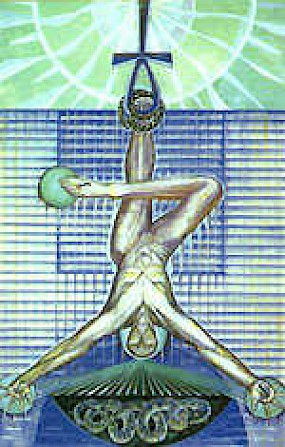
The Hanged Man is numbered twelve and is depicted as a figure, usually male, hanging upside down from a tree or branch. He often has his hands behind his back, as though tied (though as you can see the Thoth interpretation moves away from this aspect of apparent helpnessness). Usually one leg is tucked behind the other to form a triangle shape. Strangely though, he tends to look quite happy and content with his situation.
Not a very popular card, the Hanged Man deals with sacrifice, delays and waiting – and also being bogged down and helplessness. We sacrifice every time we make a choice – reading this web page means you have sacrificed reading the alternatives. Since sacrifice can mean giving up one thing of value for another thing of equal or greater value, this card can easily be seen as representing the natural and normal function of disposing of something that no longer suits its purpose as well as its replacement will.
The Hanged Man is totally vulnerable, his attitude is “whatever will be, will be”. He accepts everything that happens with equanimity and courage – he is, after all, simply giving in to his destiny. He can sometimes represent the person who has waited too long, who is perhaps scared to change. We should endure with strength and inner peace, but also be courageous enough to take action when destiny calls.
“The future is a choice between Utopia and Oblivion. Whether it is to be Utopia or Oblivion will be a touch and go relay race right up to the final moment.”
–Bucky Fuller
Richard Buckminster Fuller (July 12, 1895 – July 1, 1983) was an American architect, systems theorist, writer, designer, inventor, philosopher, and futurist. Wikipedia
“There are only two industries that call their customers ‘users’: illegal drugs and software”
–Edward Tufte
Edward Rolf Tufte, sometimes known as “ET”, (born March 14, 1942) is an American statistician and professor emeritus of political science, statistics, and computer science at Yale University. He is noted for his writings on information design and as a pioneer in the field of data visualization. Wikipedia
227,753 views • Oct 7, 2022The (gnostic?) Gospel of Mary provide us a glimpse into a radically alternative form of ancient Christianity. One where inner, spiritual knowledge is the key to salvation, where women and men have equal standing based on their understanding of the message of the Savior and one where the soul must rise above the demonic gatekeepers of the physical cosmos rather than to believe in credal formulas or even the salvific power of the death and resurrection of Jesus. In this Gospel, Mary Magdalene is the true inheritor of the spiritual Gospel of Christ rather than Peter who attacks her solely based on her gender, despite her profound relationship with the Savior and her understanding of his secret teachings.
Russell Brand • Nov 13, 2022 Here’s my Subcutaneous discussion with Eckhart Tolle. We discussed a vast range of topics that we are facing collectively around the world & how we can enlighten ourselves in dark times. #thegreatreset#eckharttolle#conspiracy
New Thinking Allowed with Jeffrey Mishlove • Nov 13, 2022 Jude Currivan, PhD, is a cosmologist and author of The Cosmic Hologram: In-Formation at the Center of Creation, CosMos (with Irvin Laszlo), The Eighth Chakra, The Wave, and The Thirteenth Step. Her newest book is The Story of Gaia. In this video from 2017, she notes that certain mathematical patterns are expressed throughout nature. For example, the way that galaxies evolve from variations in matter density in the early universe is equivalent to the way cities grow from changes in population density. The frequency and strength of earthquakes is mathematically similar to the frequency and strength of armed conflicts. She maintains that this information can be used, positively, to create situations that attract peaceful resolutions. New Thinking Allowed host, Jeffrey Mishlove, PhD, is author of The Roots of Consciousness, Psi Development Systems, and The PK Man. Between 1986 and 2002 he hosted and co-produced the original Thinking Allowed public television series. He is the recipient of the only doctoral diploma in “parapsychology” ever awarded by an accredited university (University of California, Berkeley, 1980). He is also the Grand Prize winner of the 2021 Bigelow Institute essay competition regarding the best evidence for survival of human consciousness after permanent bodily death. (Recorded on October 27, 2017)
Jouissance is a French term meaning “enjoyment”, which in Lacanianism is taken in terms both of rights and property,[1] and of sexual orgasm. The latter has a meaning partially lacking in the English word “enjoyment”.[2] The term denotes a transgressive, excessive kind of pleasure linked to the division and splitting of the subject involved, which compels the subject to constantly attempt to transgress the prohibitions imposed on enjoyment, to go beyond the pleasure principle.[3]
English editions of the works of Jacques Lacan have generally left jouissance untranslated in order to help convey its specialised usage.[4] Lacan first developed his concept of an opposition between jouissance and the pleasure principle in his Seminar “The Ethics of Psychoanalysis” (1959–1960). Lacan considered that “there is a jouissance beyond the pleasure principle”[5] linked to the partial drive. Yet according to Lacan, the result of transgressing the pleasure principle is not more pleasure, but instead pain, since there is only a certain amount of pleasure that the subject can bear.
Beyond this limit, pleasure becomes pain, and this initial “painful principle” develops into what Lacan calls jouissance.[6] Thus jouissance is suffering, epitomized in Lacan’s remark about “the recoil imposed on everyone, in so far as it involves terrible promises, by the approach of jouissance as such”.[7] Lacan also linked jouissance to the castration complex,[8] and to the aggression of the death drive.[9]
In his seminar “The Other Side of Psychoanalysis” (1969–1970), Lacan introduced the concept of “surplus-enjoyment” (French plus-de-jouir) inspired by Marx‘s concept of surplus-value: he considered objet petit a is the excess of jouissance, which has no use value, and which persists for the mere sake of jouissance.
Lacan considered that jouissance is essentially phallic, meaning that it does not relate to the “Other” as such. In his seminar “Encore” (1972–1973), however, Lacan introduced the idea of specifically femininejouissance, saying that women have “in relation to what the phallic function designates of jouissance, a supplementary jouissance…a jouissance of the body which is…beyond the phallus“.[10] This feminine jouissance is ineffable, for both women and men may experience it, yet know nothing about it.[citation needed]
In philosophy and literary theory
The Slovenian philosopher Slavoj Žižek, a known Lacanian theorist, has adopted the term in his philosophy; it also plays an important role in the work of Julia Kristeva and Roland Barthes.
In his 1973 literary theory book The Pleasure of the Text, Barthes divides the effects of texts into two: plaisir (translated as “pleasure”) and jouissance. The distinction corresponds to a further distinction Barthes makes between “readerly” and “writerly” texts. The pleasure of the text corresponds to the readerly text, which does not challenge the reader’s position as a subject. The writerly text provides bliss, which explodes literary codes and allows the reader to break out of his or her subject position.
For Barthes plaisir is, “a pleasure… linked to cultural enjoyment and identity, to the cultural enjoyment of identity, to a homogenising movement of the ego.”[11] As Richard Middleton puts it, “Plaisir results, then, from the operation of the structures of signification through which the subject knows himself or herself; jouissance fractures these structures.”[12]
In feminist theory
The French feminist writer Hélène Cixous uses the term jouissance to describe a form of women’s pleasure or sexual rapture that combines mental, physical and spiritual aspects of female experience, bordering on mystical communion: “explosion, diffusion, effervescence, abundance…takes pleasure (jouit) in being limitless”.[13] Cixous maintains that jouissance is the source of a woman’s creative power and that the suppression of jouissance prevents women from finding their own fully empowered voice.[14][15] The concept of jouissance is explored by Cixous and other authors in their writings on Écriture féminine, a strain of feminist literary theory that originated in France in the early 1970s.
Other feminists have argued that Freudian “hysteria” is jouissance distorted by patriarchal culture and say that jouissance is a transcendent state that represents freedom from oppressive linearities. In her introduction to Cixous’ The Newly Born Woman, literary critic Sandra Gilbert writes: “to escape hierarchical bonds and thereby come closer to what Cixous calls jouissance, which can be defined as a virtually metaphysical fulfillment of desire that goes far beyond [mere] satisfaction… [It is a] fusion of the erotic, the mystical, and the political.”[16]
Many French feminists have resisted against translating the word jouissance claiming that “It is impossible to give an adequate translation of jouissance” and “not to assimilate it, but to retain its foreignness.”[17]
Tristan Harris and Jonathan Haidt join 60 Minutes’ Bill Whitaker to discuss how social media companies are profiting off Americans’ online anger.
Published on November 6, 2022 • The co-founder of the Center for Humane Technology tells Bill Whitaker social media companies are profiting off Americans’ online anger.
The Astrology Podcast Nov 13, 2022 A deep dive into the meaning of the zodiac sign Scorpio in astrology, where we discuss some of the traits and characteristics associated with people who were born under this sign, with astrologers Samuel F. Reynolds, Kirah Tabourn, and Chris Brennan. Scorpio is the eighth sign of the zodiac, and it is a feminine or nocturnal sign, fixed, watery, and traditionally ruled by Mars. This is the eighth entry in our series of episodes where we do a detailed treatment of each of the signs of the zodiac, one per episode, in order to develop a detailed understanding of their core meaning and significations. Sam, Kirah, and Chris’s credentials for this episode are that they all have a stellium of planets in the sign of Scorpio in their birth charts. During the course of the episode we talk about different keywords and archetypes associated with Scorpio, and also look at the birth charts of celebrities who were born with different planets in that sign.
Anger is a powerful emotion — it warns us of threat, insult, indignity and harm. But across the world, girls and women are taught that their anger is better left unvoiced, says author Soraya Chemaly. Why is that, and what might we lose in this silence? In a provocative, thoughtful talk, Chemaly explores the dangerous lie that anger isn’t feminine, showing how women’s rage is justified, healthy and a potential catalyst for change.Read transcript
This talk was presented at an official TED conference. TED’s editors chose to feature it for you.
Learn the 10 steps to emotional competence and efficacy.



.jpeg)