The Universe as an Infinite Storm of Beauty: John Muir on the Transcendent Interconnectedness of Nature

By Maria Popova (themarginalian.org)

“I… a universe of atoms… an atom in the universe,” the Nobel-winning physicist Richard Feynman wrote in his lovely prose poem about the wonder of life“The fact that we are connected through space and time,” evolutionary biologist Lynn Margulis observed of the interconnectedness of the universe“shows that life is a unitary phenomenon, no matter how we express that fact.”

A century before Feynman and Margulis, the great Scottish-American naturalist and pioneering environmental philosopher John Muir (April 21, 1838–December 24, 1914) channeled this elemental fact of existence with uncommon poetic might in John Muir: Nature Writings (public library) — a timeless treasure I revisited in composing The Universe in Verse.

John Muir

Recounting the epiphany he had while hiking Yosemite’s Cathedral Peak for the first time in the summer of his thirtieth year — an epiphany strikingly similar to the one Virginia Woolf had at the moment she understood what it means to be an artist — Muir writes:

When we try to pick out anything by itself, we find it hitched to everything else in the universe. One fancies a heart like our own must be beating in every crystal and cell, and we feel like stopping to speak to the plants and animals as friendly fellow mountaineers. Nature as a poet, an enthusiastic workingman, becomes more and more visible the farther and higher we go; for the mountains are fountains — beginning places, however related to sources beyond mortal ken.

Later that summer, as he makes his way to Tuolumne Meadow in eastern Yosemite, Muir is reanimated with this awareness of the exquisite, poetic interconnectedness of nature, which transcends individual mortality. In a sentiment evocative of Rachel Carson’s lyrical assertion that “the lifespan of a particular plant or animal appears, not as drama complete in itself, but only as a brief interlude in a panorama of endless change,” Muir writes:

One is constantly reminded of the infinite lavishness and fertility of Nature — inexhaustible abundance amid what seems enormous waste. And yet when we look into any of her operations that lie within reach of our minds, we learn that no particle of her material is wasted or worn out. It is eternally flowing from use to use, beauty to yet higher beauty; and we soon cease to lament waste and death, and rather rejoice and exult in the imperishable, unspendable wealth of the universe, and faithfully watch and wait the reappearance of everything that melts and fades and dies about us, feeling sure that its next appearance will be better and more beautiful than the last.

[…]

More and more, in a place like this, we feel ourselves part of wild Nature, kin to everything.

One of Chiura Obata’s paintings of Yosemite

A year earlier, during his famous thousand-mile walk to the Gulf of Mexico, Muir recorded his observations and meditations in a notebook inscribed John Muir, Earth-Planet, Universe. In one of the entries from this notebook, the twenty-nine-year-old Muir counters the human hubris of anthropocentricity in a sentiment far ahead of his time and, in many ways, ahead of our own as we grapple with our responsibility to the natural world. More than a century before Carl Sagan reminded us that we, like all creatures, are “made of starstuff,” Muir humbles us into our proper place in the cosmic order:

The universe would be incomplete without man; but it would also be incomplete without the smallest transmicroscopic creature that dwells beyond our conceitful eyes and knowledge… The fearfully good, the orthodox, of this laborious patchwork of modern civilization cry “Heresy” on every one whose sympathies reach a single hair’s breadth beyond the boundary epidermis of our own species. Not content with taking all of earth, they also claim the celestial country as the only ones who possess the kind of souls for which that imponderable empire was planned.

Long before Maya Angelou reminded us that we are creatures “traveling through casual space, past aloof stars, across the way of indifferent suns,” Muir adds:

This star, our own good earth, made many a successful journey around the heavens ere man was made, and whole kingdoms of creatures enjoyed existence and returned to dust ere man appeared to claim them. After human beings have also played their part in Creation’s plan, they too may disappear without any general burning or extraordinary commotion whatever.

However disquieting and corrosive to the human ego such awareness may be, Muir argues that we can never be conscientious citizens of the universe unless we accept this fundamental cosmic reality. In our chronic civilizational denial of it, we are denying nature itself — we are denying, in consequence, our own humanity. A century before the inception of the modern environmental movement, he writes:

No dogma taught by the present civilization seems to form so insuperable an obstacle in the way of a right understanding of the relations which culture sustains to wildness as that which regards the world as made especially for the uses of man. Every animal, plant, and crystal controverts it in the plainest terms. Yet it is taught from century to century as something ever new and precious, and in the resulting darkness the enormous conceit is allowed to go unchallenged.

I have never yet happened upon a trace of evidence that seemed to show that any one animal was ever made for another as much as it was made for itself. Not that Nature manifests any such thing as selfish isolation. In the making of every animal the presence of every other animal has been recognized. Indeed, every atom in creation may be said to be acquainted with and married to every other, but with universal union there is a division sufficient in degree for the purposes of the most intense individuality; no matter, therefore, what may be the note which any creature forms in the song of existence, it is made first for itself, then more and more remotely for all the world and worlds.

Illustration by Oliver Jeffers from Here We Are: Notes for Living on Planet Earth

This revelatory sense of interconnectedness comes over Muir again a decade later, as he journeys to British Columbia on a steamer in the spring of 1879, experiencing for the first time the otherworldly wonder and might of the open ocean. A century after William Blake saw the universe in a grain of sand, Muir writes:

The scenery of the ocean, however sublime in vast expanse, seems far less beautiful to us dry-shod animals than that of the land seen only in comparatively small patches; but when we contemplate the whole globe as one great dewdrop, striped and dotted with continents and islands, flying through space with other stars all singing and shining together as one, the whole universe appears as an infinite storm of beauty.

More than a century later, Muir’s complete Nature Writings remain a transcendent read. Complement this portion with Loren Eiseley on the relationship between nature and human nature and Terry Tempest Williams — a modern-day spiritual heir of Muir’s — on the wilderness as an antidote to the war within ourselves, then revisit Muir’s British contemporary Richard Jefferies on how nature’s beauty dissolves the boundary between us and the world.
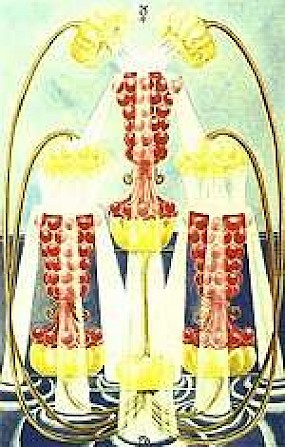
Tarot Card for November 17: The Three of Cups

The Three of Cups

The Lord of Abundance is a warm and joyous card, which indicates a rare and precious type of love – a love which, once experienced, reminds us of the richness of shared emotion and commitment.

It is also a card which refers to the wellspring of fertility, whether spiritual or material. Here we see the first seeds sown of a bright and bountiful harvest. Accordingly, the card will sometimes come up to indicate high days of celebration – like weddings or other intimate celebrations of love.

The emotional quality represented by this card is deep and unusual – indicating the love felt not only by lovers, but also the love between close friends, or family. These relationships are gifts, which need to be cared for with great respect and gratitude.

The Lord of Abundance offers one word of warning – this type of love cannot be created, nor engineered. When it occurs in our lives we are lucky and blessed. Some people spend a lifetime looking for such depth of emotion. And sometimes, people try to pretend it exists where it does not. So when you raise this card in a reading be aware that you are fortunate indeed!

The Three of Cups

(via angelpaths.com and Alan Blackman)

The Thunder, Perfect Mind

Jennifer Sodini May 12, 2020 Audio recording of The Thunder, Perfect Mind (without music) from The Nag Hammadi Library. “The Thunder, Perfect Mind is an exhortatory poem discovered among the Gnostic manuscripts in the Nag Hammadi library in 1945. The Thunder, Perfect Mind (the title may alternately be translated The Thunder, Perfect Intellect) takes the form of an extended, riddling monologue, in which an immanent divine saviour speaks a series of paradoxical statements alternating between first-person assertions of identity and direct address to the audience. These paradoxical utterances echo Greek identity riddles, a common poetic form in the Mediterranean. Moreover, it is a non-epistolic, non-narrative unmediated divine speech.” (SOURCE: Wikipedia) The translation of this poem is by George W. MacRae Voiceover by Jennifer Sodini: http://www.jennifersodini.com + http://www.amentioracle.com TRANSCRIPTION SOURCE: http://www.gnosis.org/naghamm/thunder…

Word-Built World: Nocebo

From Wikipedia, the free encyclopedia

For the film, see Nocebo (film). For the album, see Nocebo (album).

nocebo effect is said to occur when negative expectations of the patient regarding a treatment cause the treatment to have a more negative effect than it otherwise would have.[1][2] For example, when a patient anticipates a side effect of a medication, they can experience that effect even if the “medication” is actually an inert substance.[1] The complementary concept, the placebo effect, is said to occur when positive expectations improve an outcome. The effect is also said to occur in someone who falls ill owing to the erroneous belief that they were exposed to a toxin, or to a physical phenomenon they believe is harmful, such as EM radiation.[3]

Both placebo and nocebo effects are presumably psychogenic, but they can induce measurable changes in the body.[1] One article that reviewed 31 studies on nocebo effects reported a wide range of symptoms that could manifest as nocebo effects, including nausea, stomach pains, itching, bloating, depression, sleep problems, loss of appetite, sexual dysfunction, and severe hypotension.[1]

Etymology and usage

The term nocebo (Latin nocēbō, ‘I shall harm’, from noceō, ‘I harm’)[4] was coined by Walter Kennedy in 1961 to denote the counterpart to the use of placebo (Latin placēbō, ‘I shall please’, from placeō, ‘I please’)[5] a substance that may produce a beneficial, healthful, pleasant, or desirable effect). Kennedy emphasized that his use of the term nocebo refers strictly to a subject-centered response, a quality inherent in the patient rather than in the remedy”.[6] That is, Kennedy rejected the use of the term for pharmacologically induced negative side effects such as the ringing in the ears caused by quinine.[6] That is not to say that the patient’s psychologically induced response may not include physiological effects. For example, an expectation of pain may induce anxiety, which in turn causes the release of cholecystokinin, which facilitates pain transmission.[7]

Response

In the narrowest sense, a nocebo response occurs when a drug-trial subject’s symptoms are worsened by the administration of an inert, sham,[8] or dummy (simulator) treatment, called a placebo. According to current pharmacological knowledge and the current understanding of cause and effect, a placebo contains no chemical (or any other agent) that could possibly cause any of the observed worsening in the subject’s symptoms. Thus, any change for the worse must be due to some subjective factor. Adverse expectations can also cause the analgesic effects of anesthetic medications to disappear.[9]

The worsening of the subject’s symptoms or reduction of beneficial effects is a direct consequence of their exposure to the placebo, but those symptoms have not been chemically generated by the placebo. Because this generation of symptoms entails a complex of “subject-internal” activities, in the strictest sense, we can never speak in terms of simulator-centered “nocebo effects”, but only in terms of subject-centered “nocebo responses”. Although some observers attribute nocebo responses (or placebo responses) to a subject’s gullibility, there is no evidence that an individual who manifests a nocebo/placebo response to one treatment will manifest a nocebo/placebo response to any other treatment; i.e., there is no fixed nocebo/placebo-responding trait or propensity.[10]

McGlashan, Evans & Orne found no evidence in 1969 of what they termed a placebo personality.[11] Also, in a carefully designed study, Lasagna, Mosteller, von Felsinger and Beecher in 1954,[12] found that there was no way that any observer could determine, by testing or by interview, which subject would manifest a placebo reaction and which would not. Experiments have shown that no relationship exists between an individual’s measured hypnotic susceptibility and their manifestation of nocebo or placebo responses.[13][14][15]

Effects

Side effects of drugs

It has been shown that, due to the nocebo effect, warning patients about side effects of drugs can contribute to the causation of such effects, whether the drug is real or not.[16][17] This effect has been observed in clinical trials: according to a 2013 review, the dropout rate among placebo-treated patients in a meta-analysis of 41 clinical trials of Parkinson’s disease treatments was 8.8%.[18] A 2013 review found that nearly 1 out of 20 patients receiving a placebo in clinical trials for depression dropped out due to adverse events, which were believed to have been caused by the nocebo effect.[19] A 2018 review found that half of patients taking placebos in clinical trials report intervention-related adverse events.[20]

In January 2022, a systematic review and meta-analysis concluded that nocebo responses accounted for 72% of adverse effects after the first COVID-19 vaccine dose and 52% after the second dose.[21][22]

Electromagnetic hypersensitivity

Evidence suggests that the symptoms of electromagnetic hypersensitivity are caused by the nocebo effect.[23][24]

Pain

Verbal suggestion can cause hyperalgesia (increased sensitivity to pain) and allodynia (perception of a tactile stimulus as painful) as a result of the nocebo effect.[25] Nocebo hyperalgesia is believed to involve the activation of cholecystokinin receptors.[26]

Ambiguity of medical usage

Stewart-Williams and Podd argue that using the contrasting terms “placebo” and “nocebo” to label inert agents that produce pleasant, health-improving, or desirable outcomes versus unpleasant, health-diminishing, or undesirable outcomes (respectively), is extremely counterproductive.[27] For example, precisely the same inert agents can produce analgesia and hyperalgesia, the first of which, from this definition, would be a placebo, and the second a nocebo.[28]

A second problem is that the same effect, such as immunosuppression, may be desirable for a subject with an autoimmune disorder, but be undesirable for most other subjects. Thus, in the first case, the effect would be a placebo, and in the second, a nocebo.[27] A third problem is that the prescriber does not know whether the relevant subjects consider the effects that they experience to be desirable or undesirable until some time after the drugs have been administered.[27] A fourth problem is that the same phenomena are being generated in all the subjects, and these are being generated by the same drug, which is acting in all of the subjects through the same mechanism. Yet because the phenomena in question have been subjectively considered to be desirable to one group but not the other, the phenomena are now being labelled in two mutually exclusive ways (i.e., placebo and nocebo); and this is giving the false impression that the drug in question has produced two different phenomena.[27]

Ambiguity of anthropological usage

Some people maintain that belief kills (e.g., voodoo death: Cannon in 1942 describes a number of instances from a variety of different cultures) and belief heals (e.g., faith healing).[29] A self-willed death (due to voodoo hexevil eyepointing the bone procedure,[30][31] etc.) is an extreme form of a culture-specific syndrome or mass psychogenic illness that produces a particular form of psychosomatic or psychophysiological disorder which results in a psychogenic death. Rubel in 1964 spoke of “culture bound” syndromes, which were those “from which members of a particular group claim to suffer and for which their culture provides an etiology, diagnosis, preventive measures, and regimens of healing”.[32]

Certain anthropologists, such as Robert Hahn and Arthur Kleinman, have extended the placebo/nocebo distinction into this realm in order to allow a distinction to be made between rituals, like faith healing, that are performed in order to heal, cure, or bring benefit (placebo rituals) and others, like “pointing the bone”, that are performed in order to kill, injure or bring harm (nocebo rituals). As the meaning of the two inter-related and opposing terms has extended, we now find anthropologists speaking, in various contexts, of nocebo or placebo (harmful or helpful) rituals:[33]

  • that might entail nocebo or placebo (unpleasant or pleasant) procedures;
  • about which subjects might have nocebo or placebo (harmful or beneficial) beliefs;
  • that are delivered by operators that might have nocebo or placebo (pathogenic, disease-generating or salutogenic, health-promoting) expectations;
  • that are delivered to subjects that might have nocebo or placebo (negative, fearful, despairing or positive, hopeful, confident) expectations about the ritual;
  • which are delivered by operators who might have nocebo or placebo (malevolent or benevolent) intentions, in the hope that the rituals will generate nocebo or placebo (lethal, injurious, harmful or restorative, curative, healthy) outcomes; and, that all of this depends upon the operator’s overall beliefs in the harmful nature of the nocebo ritual or the beneficial nature of the placebo ritual.

Yet it may become even more terminologically complex, for as Hahn and Kleinman indicate, there can also be cases where there are paradoxical nocebo outcomes from placebo rituals, as well as paradoxical placebo outcomes from nocebo rituals (see also unintended consequences).[33] Writing from his extensive experience of treating cancer (including more than 1,000 melanoma cases) at Sydney Hospital, Milton in 1973 warned of the impact of the delivery of a prognosis, and how many of his patients, upon receiving their prognosis, simply turned their face to the wall and died a premature death: “there is a small group of patients in whom the realization of impending death is a blow so terrible that they are quite unable to adjust to it, and they die rapidly before the malignancy seems to have developed enough to cause death. This problem of self-willed death is in some ways analogous to the death produced in primitive peoples by witchcraft (‘pointing the bone’)”.[34]

Ethics

A number of researchers have pointed out that the harm caused by communicating with patients about potential treatment adverse events raises an ethical issue. In order to respect autonomy, one is required to inform a patient about what harms a treatment is likely to cause. Yet the way in which potential harms are communicated could cause additional harm, which may violate the ethical principle of non-maleficence.[35] It may be possible that nocebo effects can be reduced while respecting autonomy using different models of informed consent, including the use of a framing effect[36] and the authorized concealment. In fact, it has been argued that forcing patients to learn about all potential adverse events against their will could violate autonomy.[37]

More at: https://en.wikipedia.org/wiki/Nocebo

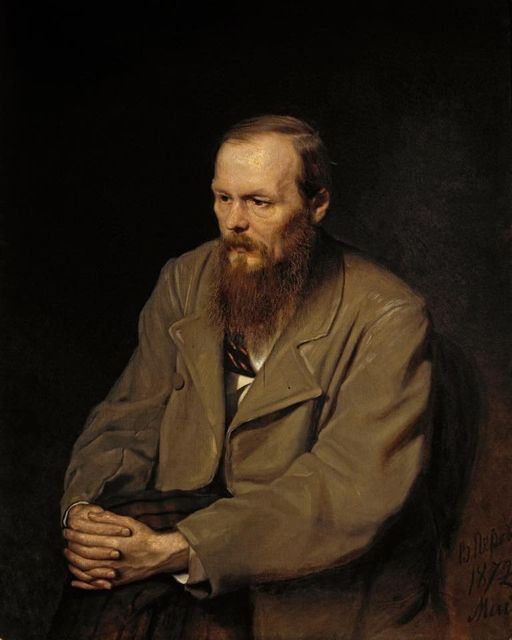
Dostoevsky on not lying to yourself

Today (November 11), Dostoevsky turns 201 years old & he has not aged one bit…

In honor of his birthday, these timeless words from his masterful final novel, The Brothers Karamazov:

“Above all, don’t lie to yourself. The man who lies to himself and listens to his own lie comes to a point that he cannot distinguish the truth within him, or around him and so loses all respect for himself and for others. And having no respect he ceases to love.”

Yahia Lababid

Fyodor Mikhailovich Dostoevsky, sometimes transliterated as Dostoyevsky (November 11, 1821 – February 9, 1881), was a Russian novelist, short story writer, essayist and journalist. Wikipedia

Buckminster Fuller: The Man Who Saw The Future

Joe Scott Apr 25, 2019 Buckminster Fuller wasn’t the massive success that he wanted to be, but he became a defining influence on the engineering, architecture, and design that shapes our world today.

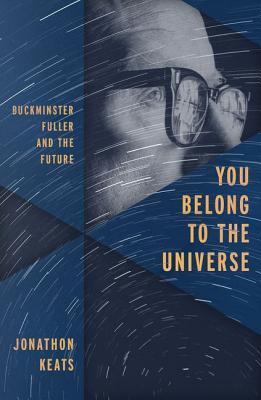
You Belong to the Universe: Buckminster Fuller and the Future

Jonathan Keats

A compelling call to apply Buckminster Fuller’s creative problem-solving to present-day problems

A self-professed comprehensive anticipatory design scientist, the inventor Buckminster Fuller (1895-1983) was undoubtedly a visionary. Fuller’s creations often bordered on the realm of science fiction, ranging from the freestanding geodesic dome to the three-wheel Dymaxion car to a bathroom requiring neither plumbing nor sewage. Yet in spite of his brilliant mind and life-long devotion to serving mankind, Fuller’s expansive ideas were often dismissed, and have faded from public memory since his death.

You Belong to the Universe documents Fuller’s six-decade quest to make the world work for one hundred percent of humanity. Critic and experimental philosopher Jonathon Keats sets out to revive Fuller’s unconventional practice of comprehensive anticipatory design, placing Fuller’s philosophy in a modern context and dispelling much of the mythology surrounding Fuller’s life. Keats argues that Fuller’s life and ideas, namely doing the most with the least, are now more relevant than ever as humanity struggles to meet the demands of an exploding world population with finite resources. Delving deeply into Buckminster Fuller’s colorful world, Keats applies Fuller’s most important concepts to present-day issues, arguing that his ideas are now not only feasible, but necessary.

From transportation to climate change, urban design to education, You Belong to the Universe demonstrates that Fuller’s holistic problem-solving techniques may be the only means of addressing some of the world’s most pressing issues. Keats’s timely book challenges each of us to become comprehensive anticipatory design scientists, providing the necessary tools for continuing Fuller’s legacy of improving the world.

(Goodreads.com)