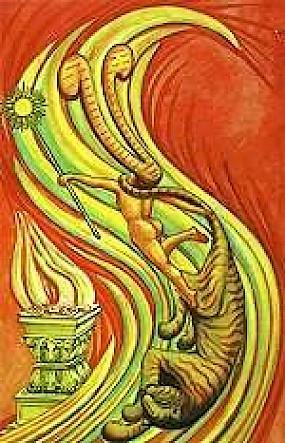
The Lord of Dominion is an important card when we consider our personal freedom of choice, for it relates to the way in which we live in accordance with our own Will, and the consequent results of this.
The card indicates that we are in charge of the way that our lives are unfolding, and that this happens in the fashion we had anticipated. It does not rule out the occasional nice surprise, nor obstacle, but it does promise us that we are in a state of mind which allows us to fulfil our needs and chase our destiny.
There’s harmony and contentment when we manage to achieve this position in life. Events take place in an ordered and positive fashion. Things unfold around us the way that we want them to. Everything goes according to plan.
In fact, this is probably a natural state for a healthy human being. The fact that we have to struggle so hard to achieve it, and then maintain it, is more a comment on the type of life we lead, than anything else.
When we can bring ourselves in harmony with the forces of our Universe, achieving our dreams becomes far more possible than at any other time. We attain harmony when we are centred and at ease with ourselves.
Careful planning is always important when this card comes up – again there is a need to order our future so that we know where we’re headed. And it’s also important to reconcile any uncertainty or confusion generated within us. Both of these actions will ensure that nothing interferes with the flow of our own Will out into the Universe.
On very rare occasions this card will come up with others like the Star, or the Priestess, to indicate periods of huge spiritual breakthrough. Make the best of them when they arrive!!
Rebel Wisdom Sep 23, 2022 Iain McGilchrist has been outlining for many years that a fundamental problem in the way we are perceiving the world is likely to lead us into trouble. Now in 2022 he believes the situation is reaching a crucial turning point and we need to wake up urgently. In this conversation with Rebel Wisdom’s David Fuller he talks about how our current culture’s domination by a ‘left brain’, reductionistic, materialist and literalist perspective had reached crisis point. He explains how this is manifesting as a ‘war on reality’, and a series of attacks on free speech. Iain’s work can be found here: https://channelmcgilchrist.com/
“The world is a Phoenix. It perishes in flames and even as it dies it is born again.”
BY MARIA POPOVA (themarginalian.org)
“Our minds are all threaded together,” the twenty-one-year-old Virginia Woolf wrote in her diary in the first years of the twentieth century, “& all the world is mind.” A world war, an airplane, and a radio later, nearly half a century before the birth of the true Internet and eight years before Vannevar Bush imagined the personal computer, another far-seeing mind envisioned the revolutionary reality beyond Woolf’s metaphor.
On August 20, 1937 — while the Great Depression was savaging a world on the brink of its second global war — H.G. Wells (September 21, 1866–August 13, 1946) addressed the archivists, librarians, and bibliographers gathered at the World Congress on Universal Documentation in Paris, where the encyclopedia had been invented two centuries earlier.
Wells made a daring proposition: Saving humanity from itself calls for the creation of a new system for “universal organisation and clarification of knowledge and ideas.” He called it a “World Brain” — a “permanent central Encyclopaedic organisation with a local habitat and a world-wide range,” decentralizing and democratizing that supreme antidote to propaganda and manipulation: knowledge.
The World Brain would be readily available to every human being, no matter their income level or the political rule of their society. Only such a World Brain could fully close the abyssal gap between the small percentage of human beings whose education has empowered the full use of their natural human potential — the people now disparagingly termed “elites,” with that fashionable recrimination that falsely equates an intellectual condition (the effects of good education) with a moral condition (the stance of superiority) — and the vast global majority who have been denied such honing of their natural gifts under the industrialism-warped landscape of material possibility. Wells told his audience:
It is dawning upon us, we lay observers, that this [is] the beginning of a world brain, a common world brain… a sort of cerebrum for humanity, a cerebral cortex which (when it is fully developed) will constitute a memory and a perception of current reality for the entire human race.
Embroidery by Debbie Millman
He even envisioned the cloud:
In these days of destruction, violence and general insecurity, it is comforting to think that the brain of mankind, the race brain, can exist in numerous replicas throughout the world.
But Wells — one of the keenest and most nuance-capable intellects of his time, and a model for ours — was no hollow techno-utopian. He saw this not just as a technological network of information, but “a process of mental organisation throughout the world.” He recognized that the single decisive factor in making such a World Brain not only possible but salutary for humanity rather than dangerous was the cultivation of what he called the “Competent Receiver” — the person who engages with the output of the World Brain with thoughtfulness, sensitivity, and critical thinking. (Isn’t “Competent Receiver” an infinitely lovelier and more generous term for the “user” Silicon Valley has perpetrated on our language and our consciousness?)
Wells continued developing these ideas in various papers and lectures, eventually publishing them in the slender 1938 gem World Brain (public library). In a sentiment that makes the modern heart sigh with recognition, he writes in the preface:
The human individual is born now to live in a society for which his fundamental instincts are altogether inadequate… in a world of fluctuating and generally expanding communities and ranges of reaction.
One of Edward Gorey’s 1960 illustrations for Wells’s The War of the Worlds
To be made “adequate,” we must be educated into our social roles, rendering our social selves the “manufactured product” of our natural selves that remain at the nucleus of our being. But for the World Brain to work, Wells cautions, we must also be educated into being Competent Receivers, which would require a deliberate transcendence of our reflexive reactions. In a passage of extraordinary prophecy against the web-powered social reality of the 2020s, he writes:
Man* reflects before he acts, but not very much; he is still by nature intellectually impatient. No sooner does he apprehend, in whole or in part, the need of a new world, than, without further plans or estimates, he gets into a state of passionate aggressiveness and suspicion and sets about trying to change the present order… with anything that comes handy, violently, disastrously, making the discordances worse instead of better, and quarrelling bitterly with any one who is not in complete accordance with his particular spasmodic conception of the change needful. He is unable to realise that when the time comes I to act, that also is the time to think fast and hard. He will not think enough.
There has been, therefore, an enormous waste of human mental, moral and physical resources in premature revolutionary thrusts, ill-planned, dogmatic, essentially unscientific reconstructions and restorations of the social order, during the past hundred years. This was the inevitable first result of the discrediting of those old and superseded mental adaptations which were embodied in the institutions and education of the past. They discredited themselves and left the world full of problems.
One of Edward Gorey’s 1960 illustrations for Wells’s The War of the Worlds
Such hasty destructiveness, Wells acknowledges, is the first and most instinctual response to the recognition that change is needed. But real change — lasting change, change that reconstitutes society rather than merely dismantling the old order and leaving the world ashambles, the kind of change Octavia Butler wrote about — requires something else entirely, or else all we end up with are “psychological storms which give gangster dictators their opportunities.” He writes:
It is becoming apparent that the real clue to that reconciliation of freedom and sustained initiative with the more elaborate social organisation which is being demanded from us, lies in raising and unifying, and so implementing and making more effective, the general intelligence services of the world.
Only such a shift, Wells argues, would ensure “a reconditioned and more powerful Public Opinion,” which is humanity’s most robust defense against those “gangster dictators.” (Mere months after Wells published this vision far ahead of its time, one such dictator plunged humanity into its darkest hour.) He envisions the World Brain as the path to freedom, peace, and a harmonious humanity:
A World Brain, operating by an enhanced educational system through the whole body of mankind… will replace our multitude of uncoordinated ganglia, our powerless miscellany of universities, research institutions, literatures with a purpose, national educational systems and the like; in that and in that alone, it is maintained, is there any clear hope of a really Competent Receiver for world affairs, any hope of an adequate directive control of the present destructive drift of world affairs. We do not want dictators, we do not want oligarchic parties or class rule, we want a widespread world intelligence conscious of itself. To work out a way to that World Brain organisation is therefore our primary need in this age of imperative construction.
It is an immense undertaking but not an impossible undertaking… There are favourable conditions for it, encouraging precedents and a plainly evident need.
Crowning his vision for the World Brain is a sentiment both buoyant and uncompromising:
The world is a Phoenix. It perishes in flames and even as it dies it is born again. This synthesis of knowledge is the necessary beginning to the new world.
In its original Latin use, the word genius was more readily applied to places — genius loci: “the spirit of a place” — than to persons, encoded with the reminder that we are profoundly shaped by the patch of spacetime into which the chance-accident of our birth has deposited us, our minds porous to the ideological atmosphere of our epoch. It is a humbling notion — an antidote to the vanity of seeing our ideas as the autonomous and unalloyed products of our own minds.
This has been the case in every culture across all the epochs since the dawn of minds. In ours, its most menacing manifestation — both unflattering and alarming — is something unprecedented: We are now porous not only to the collective ambience of human thought, but also to something half-human, something sub-human: It is neither you nor I deciding which of the photographs and poems I post on my Instagram you get to see; the algorithm that decides for you is not sentient in the sense that you and I are. It was once composed in code by human hands moved by human minds, and now it steers the bottom line of a human-governed company, but at that moment, that inflection point where it metes out your allotment of cultural material, it is pure machine — an automaton of variables, not one of them visible to you, not one controllable, together shaping what truth and beauty may appear before you, feeding what you may think about today and dream about tonight and dream up tomorrow or next year, furnishing the building blocks of your own genius.
On June 13, 1863, a letter was printed in a New Zealand newspaper under the heading “Darwin Among the Machines,” by someone who signed himself Cellarius and who later turned out to be the English writer Samuel Butler (December 4, 1835–June 18, 1902). At only twenty-seven, a century and a half ahead of his time, Butler prophesied the future of what we now call artificial intelligence and what he, epochs before the first modern computer and the golden age of algorithms, called “mechanical life” or “the mechanical kingdom.” Radiating from his visionary thought experiment is a calm, lucid admonition about what it would take to preserve our humanity — our singular human genius — amid this sea change changing the very fabric of consciousness.
Samuel Butler
Butler begins:
There are few things of which the present generation is more justly proud than of the wonderful improvements which are daily taking place in all sorts of mechanical appliances. And indeed it is matter for great congratulation on many grounds. It is unnecessary to mention these here, for they are sufficiently obvious; our present business lies with considerations which may somewhat tend to humble our pride and to make us think seriously of the future prospects of the human race. If we revert to the earliest primordial types of mechanical life, to the lever, the wedge, the inclined plane, the screw and the pulley, or (for analogy would lead us one step further) to that one primordial type from which all the mechanical kingdom has been developed, we mean to the lever itself… we find ourselves almost awestruck at the vast development of the mechanical world, at the gigantic strides with which it has advanced in comparison with the slow progress of the animal and vegetable kingdom. We shall find it impossible to refrain from asking ourselves what the end of this mighty movement is to be. In what direction is it tending? What will be its upshot?
Proceeding “to give a few imperfect hints towards a solution of these questions,” he adds:
In these last few ages, an entirely new kingdom has sprung up of which we as yet have only seen what will one day be considered the antediluvian prototypes of the race.
A century before Gordon Moore drew on his work with semiconductors to formulate his eponymous law for the exponential shrinking and acceleration of technology over time, Butler observes the unprecedented pace at which this “kingdom” of near-life has emerged:
As some of the lowest of the vertebrata attained a far greater size than has descended to their more highly organised living representatives, so a diminution in the size of machines has often attended their development and progress. Take the watch for instance. Examine the beautiful structure of the little animal, watch the intelligent play of the minute members which compose it; yet this little creature is but a development of the cumbrous clocks of the thirteenth century — it is no deterioration from them. The day may come when clocks, which certainly at the present day are not diminishing in bulk, may be entirely superseded by the universal use of watches, in which case clocks will become extinct like the earlier saurians, while the watch (whose tendency has for some years been rather to decrease in size than the contrary) will remain the only existing type of an extinct race.
One need only follow this progression to its logical conclusion to face the inevitable question of “what sort of creature man’s next successor in the supremacy of the earth is likely to be”:
We are ourselves creating our own successors; we are daily adding to the beauty and delicacy of their physical organisation; we are daily giving them greater power and supplying, by all sorts of ingenious contrivances, that self-regulating, self-acting power which will be to them what intellect has been to the human race. In the course of ages we shall find ourselves the inferior race.
Discus chronologicus — a German depiction of time from the early 1720s. (Available as a print and as a wall clock.)
And yet Butler defies our lazy modern binaries of techno-utopians versus techno-dystopians. Inside his cautionary vision pulsates a childlike optimism — this was, after all, the infancy of the machine age — that our machines might become not only superior in power but superior in moral might: capable of supreme self-control with cognition “in a state of perpetual calm,” afflicted with “no evil passions, no jealousy, no avarice, no impure desires,” free from the notions of sin and shame that so savage human behavior. The cost of this higher consciousness, however, would be our ceaseless servitude — we would have to maintain the machines, fix their every malfunction, and “feed” their unremitting appetites. (It is curious, haunting even, that Butler uses the word “feed” a century and a half before it became the standard term for the machine-selected cultural matter served to our consciousness by our social media, to become the very content of our thoughts, beliefs, and values.)
Butler considers the cost of this codependence:
When the state of things shall have arrived which we have been above attempting to describe, man will have become to the machine what the horse and the dog are to man. He will continue to exist, nay even to improve, and will be probably better off in his state of domestication under the beneficent rule of the machines than he is in his present wild state… Our interests are inseparable from theirs, and theirs from ours. Each race is dependent upon the other for innumerable benefits, and, until the reproductive organs of the machines have been developed in a manner which we are hardly yet able to conceive, they are entirely dependent upon man for even the continuance of their species.
Butler closes with an uncompromising prescription for the only route to self-salvation — also childish, as all absolutism in the face of complexity is, but at the same time more mature than what our present self-infantilized civilization is capable of conceding:
Day by day, however, the machines are gaining ground upon us; day by day we are becoming more subservient to them; more men are daily bound down as slaves to tend them, more men are daily devoting the energies of their whole lives to the development of mechanical life. The upshot is simply a question of time, but that the time will come when the machines will hold the real supremacy over the world and its inhabitants is what no person of a truly philosophic mind can for a moment question… war to the death should be instantly proclaimed against them. Every machine of every sort should be destroyed by the well-wisher of his species. Let there be no exceptions made, no quarter shown… If it be urged that this is impossible under the present condition of human affairs, this at once proves that the mischief is already done, that our servitude has commenced in good earnest, that we have raised a race of beings whom it is beyond our power to destroy and that we are not only enslaved but are absolutely acquiescent in our bondage.
Fearing indeed that, in 1863, human civilization was too far gone for such total reeling back, Butler spent the next nine years elaborating on this prophesy and envisioning alternate futures in what became his novel Erewhon, or, Over the Range (public library | public domain) — the story of a contemporary traveler who, by some unnamed accident of spacetime, finds himself a visitor to a strange kingdom in a remote corner of Earth, inhabited by a self-contained culture that had long ago reached more advanced stages of civilization than ours, but sensed this impending enslavement by technology in the recognition that “the machines were ultimately destined to supplant the race of man, and to become instinct with a vitality as different from, and superior to, that of animals, as animal to vegetable life”; Erewhonians had managed to save themselves — to save their moral spirit, their happiness, and the life of the mind — by enacting the radical proposition with which Butler ended “Darwin Among the Machines,” banning all mechanical devices whatsoever.
In the novel, Butler builds on the ideas laid out in his essay and, contrasting the slow evolution of life and consciousness on Earth with the rapid evolution of machines, composes what is essentially a stunning warning label for what we now call artificial intelligence — the next stage of consciousness:
There was a time, when the earth was to all appearance utterly destitute both of animal and vegetable life, and when according to the opinion of our best philosophers it was simply a hot round ball with a crust gradually cooling. Now if a human being had existed while the earth was in this state and had been allowed to see it as though it were some other world with which he had no concern, and if at the same time he were entirely ignorant of all physical science, would he not have pronounced it impossible that creatures possessed of anything like consciousness should be evolved from the seeming cinder which he was beholding? Would he not have denied that it contained any potentiality of consciousness? Yet in the course of time consciousness came. Is it not possible then that there may be even yet new channels dug out for consciousness, though we can detect no signs of them at present?
Again. Consciousness, in anything like the present acceptation of the term, having been once a new thing — a thing, as far as we can see, subsequent even to an individual centre of action and to a reproductive system (which we see existing in plants without apparent consciousness) — why may not there arise some new phase of mind which shall be as different from all present known phases, as the mind of animals is from that of vegetables?
It would be absurd to attempt to define such a mental state (or whatever it may be called), inasmuch as it must be something so foreign to man that his experience can give him no help towards conceiving its nature; but surely when we reflect upon the manifold phases of life and consciousness which have been evolved already, it would be rash to say that no others can be developed, and that animal life is the end of all things. There was a time when fire was the end of all things.
Primordial Chaos by Hilma af Klint, 1906-1907. (Available as a print and as stationery cards.)
At the heart of Butler’s thought experiment is an invitation, repeated almost the way in meditation one is continually invited to return to the breath, to consider the alarming rapidity with which mechanical proto-consciousness has emerged and already begun dominating tasks that organic consciousness has spent eons evolving for. In that regard, and in the way our own tasks have become so entwined with theirs, our machines are already conscious. “Where does consciousness begin, and where end?” he asks. “Who can draw the line?… Is not everything interwoven with everything?” With an eye to these disquieting questions, and to the grimly shortened arrow of evolutionary time, he writes:
The more highly organised machines are creatures not so much of yesterday, as of the last five minutes, so to speak, in comparison with past time. Assume for the sake of argument that conscious beings have existed for some twenty million years: see what strides machines have made in the last thousand! May not the world last twenty million years longer? If so, what will they not in the end become? Is it not safer to nip the mischief in the bud and to forbid them further progress?
[…]
It must always be remembered that man’s body is what it is through having been moulded into its present shape by the chances and changes of many millions of years, but that his organisation never advanced with anything like the rapidity with which that of the machines is advancing.
Embroidery by Debbie Millman
Once again epochs of thought ahead of his time — a time when “God” was considered the creator of all life and life was thought to be of metaphysical rather than physical fundament — Butler alludes to Hermann von Helmholtz’s discovery, a decade earlier, of the speed of electricity across human nerve fibers, intimating that if the basic infrastructure of consciousness as we know it and feel it is but a matter of electricity across wires, then our mechanical companions are not so far removed from the concept of consciousness: If every sensation is “chemical and mechanical in its operation,” why do we think that “those things which we deem most purely spiritual are anything but disturbances of equilibrium in an infinite series of levers, beginning with those that are too small for microscopic detection, and going up to the human arm and the appliances which it makes use of?”
One of the novel’s characters captures the corollary of these questions in a sentiment that may well be — and perhaps must be — aimed at the fundamental assumptions of our own time:
I fear none of the existing machines; what I fear is the extraordinary rapidity with which they are becoming something very different to what they are at present. No class of beings have in any time past made so rapid a movement forward. Should not that movement be jealously watched, and checked while we can still check it? And is it not necessary for this end to destroy the more advanced of the machines which are in use at present, though it is admitted that they are in themselves harmless?
[…]
We cannot calculate on any corresponding advance in man’s intellectual or physical powers which shall be a set-off against the far greater development which seems in store for the machines. Some people may say that man’s moral influence will suffice to rule them; but I cannot think it will ever be safe to repose much trust in the moral sense of any machine.
In what may be the single most hauntingly prescient sentence written in his century, Butler adds:
Our bondage will steal upon us noiselessly and by imperceptible approaches.
A century and a half hence, Butler appears to have been right on every count. It is a chilling thought to consider that the reins of our own humanity might already be too far out of our hands. Felicitously, this remains an open question, to be answered with our very lives. Every act of resistance counts.
It may be that creativity is just the name we give to how we awaken ourselves from the slumber of near-living.
While working on his semi-autobiographical novel Tropic of Capricorn, published at the outbreak of WWII and banned in America for a quarter century, Henry Miller (December 26, 1891–June 7, 1980) found himself deadened to an entire dimension of life — a dimension that came alive when he set down the pen and picked up the brush. Painting was always something he did in the margins of his primary calling, but it sprang from the heart of his being and made him fall in love with life anew.
Two decades before publishing the aptly titled out-of-print treasure To Paint Is to Love Again, Miller first began formulating his thoughts on art, life, and the dialogue between the two in the slender 1950 book The Waters Reglitterized (public library). Only 250 copies were published by a small press in Santa Barbara, on the occasion of his first watercolor exhibition in Paris, after twenty years of painting. The book had begun as a series of letters to his friend Emil Schnellock — the artist who opened his world to watercolor. In consonance with Miller’s conviction that good friends are a pillar of the creative life, the printed dedication reads: From Henry to Emil in moments of inspiration or perplexity, with gratitude for having put me on the right Path.
Living at the turn of a cultural epoch when humanity was growing increasingly afraid of being sincere, Miller holds sincerity as the most inviolable of “the canons” and reflects on the unselfconscious abandon with which children make art before they have been taught to be self-conscious — that supreme assault on sincerity:
The remarkable thing to observe, in children’s work…, is that the child gives the impression of having done it with his whole being. They surrender themselves completely to what is in hand. Whereas even the biggest artist has to wage a constant fight against distraction. He is conscious not only of the future opinions of the critics, the price it will fetch (or not fetch!), the value of his tubes, the nicety of his choice of color or line, but also the temperature of the room, the stains on the floor, the bath he forgot to take, and so on.
In his own practice, Miller finds that he can access this state only after his primary work, his adult occupation, has exhausted him into a kind of exhale:
How wonderful that feeling, as happens sometimes, when coming home about midnight, the place extremely quiet, the light giving just the right glow about my work table, my senses keenly alive, yet not so sharp as to push me on to further writing, (a sort of sifting-of-the-ashes feeling, the fire warm but dying), I sit down before the little pad, determined to do just one water color in peace and harmony. To paint in this way is like communing with oneself — and with all the world too.
After having done what I imagine to be my utmost, [I realize] that it won’t do at all. I decide to convert the quiet, static picture in front of me into a live, careless, free and easy thing. I strike out boldly with whatever comes to hand — pencil, crayon, brush, charcoal, ink — anything which will demolish the studied effect obtained and give me fresh ground for experiment. I used to think that the striking results obtained in this fashion were due to accident, but I no longer am of this mind. Not only do I know today that it is the method employed by some very famous painters…, but, I recognize that it is often the same method which I employ in writing. I don’t go over my canvas, in writing…, but I keep breaking new ground until I reach the level of exact expression, leaving all the trials and gropings there, but raising them in a sort of spiral circumnavigation, until they make a solid under-body or under-pinning, whatever the case may be. And this, I notice, is precisely the ritual of life which is practiced by the man who evolves. He doesn’t go back, figuratively, to correct his errors and defects: he transposes and converts them into virtues. He makes wings of his larval cerements.
The greatest joy, and the greatest triumph, in art, comes at the moment when, realizing to the fullest your grip over the medium, you deliberately sacrifice it in the hope of discovering a vital hidden truth within you. It comes like a reward for patience — this freedom of mastery which is born of the hardest discipline. Then, no matter what you do or say, you are absolutely right and nobody dare criticize you. I sense this very often in looking at Picasso’s work. The great freedom and spontaneity he reveals is born, one feels, because of the impact, the pressure, the support of the whole being which, for an endless period, has been subservient to the discipline of the spirit. The most careless gesture is as right, as true, as valid, as the most carefully planned strokes… Picasso here is only demonstrating a wisdom of life which the sage practices on another, higher level.
There is something evocative of the Chinese notion of wu wei — that orientation of “trying not to try,” the effortless effort by which we arrive at the only places worth going — in the way Miller reflects on this truth in his own life. Four years earlier, he had contoured this idea in his exquisite letter to Anaïs Nin about how to control for surrender; now, he shades it in:
I see that my steadfast desire was alone responsible for whatever progress or mastery I have made. The reality is always there, and it is preceded by vision. And if one keeps looking steadily the vision crystallizes into fact or deed. There is no escaping it. It doesn’t matter what route one travels — every route brings you eventually to the goal… If one accepted that fully, one would get there so much more quickly. One should not be worrying about the degree of “success” obtained by each and every effort, but only concentrate on maintaining the vision, keeping it pure and steady. The rest is sleight-of-hand work in the dark, a genuine automatic process, no less somnambulistic because accompanied by pains and aches.
“I felt down in my soul the clear and unmistakable conviction to disobey all, and pursue my own way,” the young Whitman wrote of his momentous critique-walk with his greatest literary hero, Ralph Waldo Emerson (May 25, 1803–April 27, 1882) — the walk from which the young poet wrested his wisdom on how to keep criticism from sinking your soul, for Emerson, who had inspired Leaves of Grass, had just lashed upon one of its primary poem sequences “argumentstatement, reconnoitring, review, attack, and pressing home, (like an army corps in order, artillery, cavalry, infantry,) of all that could be said against [it].”
But rather than offended, Emerson must have been pleased with Whitman’s decision to stay his course — for Whitman was in many ways the embodiment of the spirit Emerson so fiercely celebrated against the tide of his time: a spirit animated by the central doctrine “trust thyself,” anchored in resolute resistance to the tyranny of opinion, and rooted in the belief that had gotten Emerson banned from Harvard’s campus for thirty years when he was Whitman’s age — the belief that divinity is to be found not in some outside deity, but in the human soul itself, in its fidelity to itself as a fractal of nature, a particle of the perfect totality of the universe, which Margaret Fuller — Emerson’s greatest influence — called “the All.”
Throughout Emerson’s immense body of work, no question vibrates more resonantly than that of how to trust yourself. He takes it up in his essay “Character,” found in his indispensable Essays and Lectures (public library | free ebook):
What I must do is all that concerns me, not what the people think. This rule, equally arduous in actual and in intellectual life, may serve for the whole distinction between greatness and meanness. It is the harder because you will always find those who think they know what is your duty better than you know it. It is easy in the world to live after the world’s opinion; it is easy in solitude to live after our own; but the great man* is he who in the midst of the crowd keeps with perfect sweetness the independence of solitude.
In “Nature” — perhaps his finest essay, for being the most all-encompassing and spiritually lucid — he considers what solitude actually means, refuting the common conception of it as a kind of self-isolation from other selves behind the walls of seclusion, for even the thinking mind, the writing mind, the creating mind is a symposium of outside voices when trapped within itself.
To go into solitude, a man* needs to retire as much from his chamber as from society. I am not solitary whilst I read and write, though nobody is with me. But if a man would be alone, let him look at the stars.
[…]
In the woods, we return to reason and faith. There I feel that nothing can befall me in life, — no disgrace, no calamity, (leaving me my eyes,) which nature cannot repair. Standing on the bare ground, — my head bathed by the blithe air, and uplifted into infinite space, — all mean egotism vanishes. I become a transparent eye-ball; I am nothing; I see all; the currents of the Universal Being circulate through me; I am part or particle of God.
“Life is a moderately good play with a badly written third act.”
–TRUMAN CAPOTE
Born this week in 1924
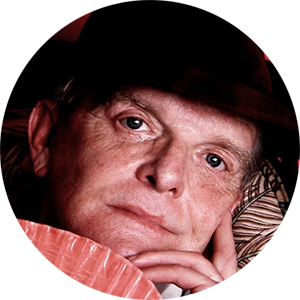
Truman Garcia Capote (September 30, 1924 – August 25, 1984) was an American novelist, screenwriter, playwright and actor. Several of his short stories, novels, and plays have been praised as literary classics, including the novella Breakfast at Tiffany’s and the true crime novel In Cold Blood, which he labeled a “non-fiction novel.” Wikipedia
September 25, 2022 (support@craighamiltonglobal.com)
The Future of GodA Call to Consciously Evolve
Never before in human history have we had so much complexity, uncertainty, and change to deal with. Religion used to tell us how to navigate life. But those of us who have close religious affinity have often been left wanting because religions evolved in a different time, and are now challenged in their ability to adequately equip us to deal with the complexities of the lives we’re living. What prophet of the past, no matter how enlightened, could have told us how to relate to a global climate crisis, or how to live in the face of the chaos and uncertainty of modern life? Most of us would probably agree that losing the repressive religious dogmas of the past has been a good thing, allowing us the space and freedom to create our own personal meaning about life. But the price for that freedom might also be the loss of a unifying mythology—a collective compass that would help us navigate our challenging times.
How can we resurrect our sense of the sacred within a scientifically enlightened, evolutionary worldview? How can we discover a unifying context of meaning and purpose without adopting any dogmatic or superstitious belief systems? In this 2-hour talk, Craig explores the future of religion, spirituality, and God in an evolving universe.
This card represents dynamic passion – for life in general. If it comes up relating to an inner energy then it will indicate that you are overcoming old fears, breaking out of old patterns, and setting yourself free. There will be confidence, decisive action, an assertive leap forward into the heart of your life. It will often come up to indicate that you have broken through habitual limitations and restrictions, thereby freeing off your power to be used constructively.
It can indicate a spiritual breakthrough, which will always include the courage to face your fears, and see them for what they truly are. One strange fact about unacknowledged fears is that they take on the darkest, most horrifying shape with which your subconscious can imbue them. Yet when you drag them out into the light of day, you suddenly realise that what you were so scared of might a) never happen; b) not be as bad as you thought it would be when you feared it; and c) you’ve probably got what it takes to deal with it anyway!
If the Princess of Wands comes up to indicate a person, then she will be strong, forceful, determined, unswerving… and perhaps a touch bossy! She is a faithful and trustworthy friend, whose insight and perception will often steer you in the right direction. She will be energetic and enthusiastic about life, with a big personality.
As a partner she’s independent, sometimes a touch stubborn, but loyal and caring. These are often career women, and usually wait till later on to start families. She will be experienced, and intelligent, though regularly you find that such young women have had to learn most of their lessons the hard way.
As an enemy she’s dangerous – she’s usually outspoken, and unafraid to express her anger. If you manage to make an enemy of one of these women, you need to think very carefully about how that happened. Mostly their engagement with life is so total that they don’t waste time on negative pursuits. All the Wand people place morality and ethics high on their list of priorities. They are honest decent people with a strong code of behaviour to which they adhere faithfully.
This card will rarely come up to indicate an event – she almost always shows either another person in your life, or an aspect of self.
New Thinking Allowed with Jeffrey Mishlove Sep 25, 2022 Dr. Bernard Beitman, MD, is a Visiting Professor at the University of Virginia and former Chair of the Department of Psychiatry at the University of Missouri-Columbia. He is the first psychiatrist since Carl Jung to attempt to systematize the study of coincidences. He has edited two issues of Psychiatric Annals that focus on coincidences, and is the founder of The Coincidence Project, that is a global initiative cultivating world-wide use of coincidence, synchronicity, and serendipity. He is the host of the podcast, Connecting with Coincidence. He is author of a dozen books, including Connecting with Coincidence: The New Science of Using Synchronicity and Serendipity in Your Life and Meaningful Coincidences: How and Why Synchronicity and Serendipity Happen. His website is coincider.com. Bernard shares that a meaningful coincidence, synchronicity, and serendipity are a coming together of apparently unrelated events, by cause, in a surprising and unexpected way. The psychosphere – our mental atmosphere – is the medium in which we exchange energy and information. Love and connection seem to increase the probability of meaningful coincidences. They can occur in times of great emotion, need, and stressors. A majority believe that God or the Universe make them happen. He says we play a role in them and have much more of an ability to know what’s going on around us than we think. He encourages people to talk to each other about meaningful coincidences. They may help increase awareness, open to possibilities, help with decision-making, find purpose, and reduce challenges in relationships and on planet earth. New Thinking Allowed CoHost, Emmy Vadnais, OTR/L, is an occupational therapist and integrative medicine practitioner based in St. Paul, Minnesota. She is the author of Intuitive Development: How to Trust Your Inner Knowing for Guidance With Relationships, Health, and Spirituality. Her website is https://emmyvadnais.com/ (Recorded on August 10, 2022)
Consciousness, spirituality, biography, sexuality, androgyny, futurism, space, the arts, science, astrology, democracy, humor, books, movies and more




 There are few things of which the present generation is more justly proud than of the wonderful improvements which are daily taking place in all sorts of mechanical appliances. And indeed it is matter for great congratulation on many grounds. It is unnecessary to mention these here, for they are sufficiently obvious; our present business lies with considerations which may somewhat tend to humble our pride and to make us think seriously of the future prospects of the human race. If we revert to the earliest primordial types of mechanical life, to the lever, the wedge, the inclined plane, the screw and the pulley, or (for analogy would lead us one step further) to that one primordial type from which all the mechanical kingdom has been developed, we mean to the lever itself… we find ourselves almost awestruck at the vast development of the mechanical world, at the gigantic strides with which it has advanced in comparison with the slow progress of the animal and vegetable kingdom. We shall find it impossible to refrain from asking ourselves what the end of this mighty movement is to be. In what direction is it tending? What will be its upshot?