Krista Tippett Wants You to See All the Hope That’s Being Hidden

July 7, 2022 (NYTimes.com)
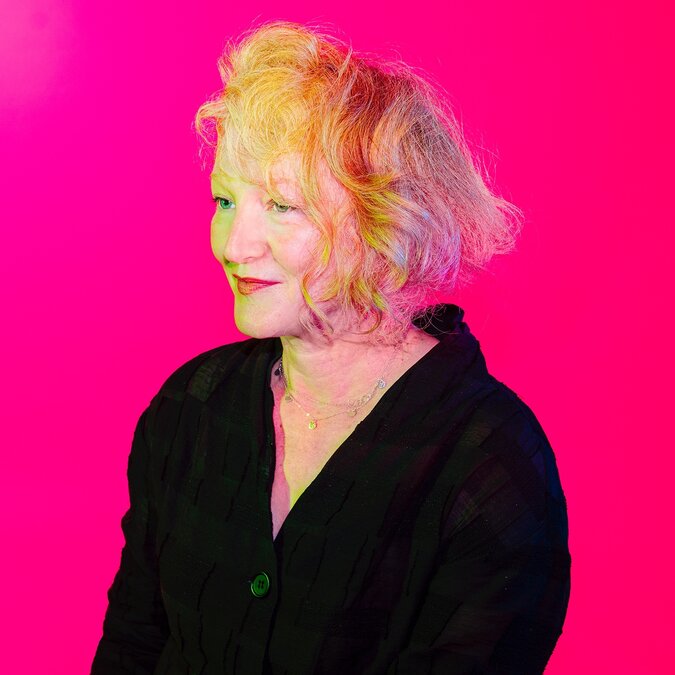
By David Marchese Photograph by Mamadi Doumbouya

During her 20-plus years as host of public radio’s “On Being” show — which aired on some 400 stations across the country — Krista Tippett and her beautifully varied slate of guests explored profound and inexhaustible questions about theology, ethics, science, the soul and what it means to be a human. While the questions were inexhaustible, the format, it turns out, was not. Late last month, “On Being” broadcast its last episode as a weekly radio program. The show will start afresh as a seasonal podcast, part of Tippett’s effort to find new ways — including mining the “On Being” archive for material as well as conducting smaller public conversations — for her mind- and heart-expanding work to flourish. “Power for any media project is being on as many platforms as possible,” says Tippett, who is 61. “But does it have to be that way? What if growth means that you step away from the powerful platforms and go deeper into the quieter things? That’s a risk, but it’s one we needed to take.”

Update: After publication Tippett’s company said the release date had been delayed from this fall to early 2023.

The conversations you have on your show are always so alive with empathy and understanding and mutuality. But do you ever want to have more oppositional conversations? Ones where the ideas could be tested and sharpened by friction or debate? If you were at a dinner party with me you’d find me to be a very opinionated person who has edge to what I say. But one of the things I’ve been attentive to from the very beginning is how, in this culture, what we often praise as a great question or a hard question is a question that makes the question-asker look smart.

I’m not familiar with ever doing anything remotely like that. [Laughs.] Right? Those questions make the journalist look smart, often because they embarrass or make the other person become speechless. There are times and places where you need to say the hard thing to someone, and it may need to be shown that they have nothing to say. The thing we need to do more of is getting at an understanding — even with people who are mysterious to us. So a lot of my questions, they’re not oppositional but they get people to say things they haven’t said before in public.

Do you think the kind of conversations you have for your job have changed who you are? Absolutely. But it’s hard for me to get enough distance from that to articulate it. Sometimes people will say to me — and maybe they say this to you too — “You have the best job in the world. You get to spend time in conversation with these amazing people.” I spend 95 percent of my time in admin and human drama. I don’t go around all the time thinking deep thoughts. This idea that I’m wise in everything — sometimes people put me on a pedestal. The truth is that I use these conversations like therapy. I am in it to get some wisdom. But something I’m aware of, which feels like a responsibility, is that these conversations that I’ve had have been far-flung but they’re in conversation inside me. I have this feeling that the conversation in my head has a lot to say to this world we’ve entered, which is a hard, hard place. I am aware of how this big conversation in my head is about all of us.

It’s clear that your self-identity is pretty closely wrapped up with your work. Are there parts of yourself that aren’t expressed through the show? Here’s an honest answer: Part of my role is drawing out voices that deserve to be heard and shedding light on generative possibilities and robust goodness. Not goodness on a pedestal but the messy drama of goodness that makes it riveting and also means it’s not just for saints. I talk about hope being a muscle. It’s not wishful thinking, and it’s not idealism. It’s not even a belief that everything will turn out OK. It’s an imaginative leap, which is what I’ve seen in people like 

John Lewis1

1From the politician and civil-rights icon’s 2013 “On Being” appearance: “I think sometimes people are afraid to say, ‘I love you.’ . . . Maybe people tend to think something is so emotional about it. Maybe it’s a sign of weakness. And we’re not supposed to cry. We’re supposed to be strong, but love is strong. Love is powerful.”

 and 

Jane Goodall.2

2The primatologist appeared on “On Being” in 2020: “Bizarre, isn’t it, that the most intellectual creature, surely, that’s ever lived on the planet is destroying its only home. And I always believe it’s because there’s a disconnect between that clever, clever brain and human heart, love and compassion.”

 These are people who said: “I refuse to accept that the world has to be this way. I am going to throw my life and my pragmatism and my intelligence at this insistence that it could be different and put that into practice.” That’s a muscular hope. So, to your question, I don’t always feel robustly hopeful. Depression is something I’ve struggled with. I’ve found the world an unbearable place for months at a time in the last two years. But at the same time I don’t feel like there’s a place in my work for my despair.

You just used the phrase “generative possibilities,” which reminds me of a favorite phrase of yours: “the generative landscape of our time.” What exactly does that mean? I’m contrasting it with the dysfunctional landscape of our time, which is very well publicized. What I am investigating and trying to make more visible to the world is people who are doing their best. None of us are perfect, but all over the place in every community and field of endeavor, there are people who are working generatively with the challenges before us; meeting them, rising to their best human capacities — at least on their good days — and creating new possibilities and realities. They’re not publicized, they’re not investigated, but that landscape is as real and important as that landscape of everything we can point out as failing and corrupt and catastrophic.

But what about politics and power? Where do they fit into creating the landscape you’d like to see? It’s a really good question. A simple answer is that the civilizational challenges are also happening at the personal level. A huge turning point of my life was when I had been working in the political realm as a journalist and then with the State Department and with this nuclear-arms expert who drove me to 

divinity school3

3As a young woman, Tippett worked in Berlin as a stringer for The Times and as an ambassador’s aide. She later earned a master’s degree from the Yale Divinity School.

 — not what he intended! I was sitting around tables with people who were doing the “powerful” things. Determining whether missiles were shot off or not and who was in power. Then you had people in divided Berlin, and some were creating lives of dignity and beauty, and some weren’t, and it wasn’t determined by which side of the wall they were on. There was something mysterious about that. We are capable of such beauty and goodness. But it’s so complicated now. The places of power are broken. I don’t know what we do about Jeff Bezos or Elon Musk. The power that very wealthy companies and people wield is our new wild card. And this is the third level of my answer: Our very last show was with 

Adrienne Maree Brown.4

4Brown is a co-host of multiple podcasts, including “Octavia’s Parables,” about the science-fiction author Octavia E. Butler, as well as a prolific nonfiction writer who has written fiction too. She also edited and wrote for the New York Times best seller “Pleasure Activism: The Politics of Feeling Good.”

 She’s one of these people who I think is the evolution of our species. She’s queer, she’s biracial and she is deep in what she calls 

“emergent strategy.”5

5Brown has described emergent strategies as “informed by complexity, by learning from nature how to be in right relationship with each other and the earth.” In the business world, the term refers to strategies that arise spontaneously rather than deliberately.

 She’s an example of something that I’m watching now: We are learning about the true nature of vitality, which is modeled on the natural world. It’s ecosystem-based. It’s not hierarchy-based. It’s about mutuality and reciprocity. It’s almost as if there are parallel universes. There’s the universe of our addiction to Amazon and of the people who are building spaceships to Mars — and then there’s this wild, fertile, imaginative but also pragmatic world of rethinking success and vitality and reality. It’s an incredible time to be alive. It’s terrible in a lot of ways and also full of unbelievable possibilities.

So what’s a new possibility you’re inspired by? I love your questions. You’re pushing in the really important way. Here’s what I think of: I see the disarray. I see the broken power structures. I see the damage and the pain. I also see people tending to that. At the heart of some of these national-level or community-level conflicts, there is space to move below the radar and start stitching together relationships and quiet conversations at a very human, granular level. We’re going to work on 

quiet conversations that will not be publicized.6

6Tippett told me that in addition to moving to a 10-to-12-episode-per-season podcast format and holding smaller public discussions, she and her team are creating something called the Lab for the Art of Living, which she described to me as “a kit for better conversations.”

 That feels to me like a power move in this world.

When you’re having one of these conversations, do you have an ideal flow or structure in mind for how they should go? I’m thinking about a narrative arc. There has to be a beginning, and the beginning is not just about the listeners’ experience. It’s in some ways more about the guests’ experience — about getting them planted in the place I want them, in order to talk about the things I want them to talk about. So starting with memory and origins and getting people not just in their heads but into their bodies, because memory resides in the body. That question I often 

ask about spiritual background7

7Tippett frequently begins her conversations by asking, “Was there a religious or spiritual background to your childhood, however you define that now?”

 — what that gets people in touch with, in addition to memories, is questions. That’s an interesting thing, because religion is associated with answers and certainties, but that part of us is full of big searching questions that really don’t have answers. I also prepare by trying to get a sense of how someone thinks, and part of that is not just for the quality of the conversation but so they will relax. Because we’ve all had this experience — I had this experience with you — when you know somebody gets you. You relax. You breathe. The other experience that we have all the time is when we’re with someone and we know we’re going to have to explain ourselves or defend ourselves. To strip that away and just have them sink into their body and be who they are. Some of my questions are about that. Often that takes 10 to 15 minutes. So I am definitely guiding and getting to an interesting middle and a satisfying ending.

I sometimes wonder if it’s even possible to have someone be truly comfortable and open during a conversation with a stranger that’s intended for the public, let alone get them to that place in 10 to 15 minutes. Don’t you think there’s some implicitly mutually agreed-upon artifice going on during interviews like these? I’m engineering their comfort, is that what you’re saying?

I think one can do that, yeah, and if you’re aware of doing that and building a narrative arc, then what’s happening probably isn’t quite the same thing as a natural, stripped-away conversation like you’re describing. Oh, I understand what you’re saying. But you have a different platform. The New York Times Magazine is a place people go to be respected. That is shaping how people turn up with you. So you’re right. But, maybe it’s 

living in Minnesota,8

8“On Being” and its associated projects have long been based in Minneapolis.

 I just assume that nobody has heard the show. I also think that when we are with somebody who truly sees and appreciates us, that has an effect. We don’t walk around the world having that experience a lot. I’m also in this position where I only invite people to be on the show whom I think the world needs to know and see more of. I hold them in esteem. There’s a human reaction to people feeling that, an animal thing. We know whether we can be trusting. Occasionally, we’re wrong. But I think a conversation is an adventure, and I treat it like that.

Why are you so drawn to conversations? I feel a sense of calling. I’m attending to the pain in our world. I’m attending to the human. I realize that this thing I do is not something that everybody does, which is to ask what is happening at a human level. Can we see how fear works in us? Can we attend to pain and fear directly and maybe in that way affect the bigger political, societal picture? Can we attend to the power of love and joy, which actually do move things? We’ve belittled them and pretended they’re sideline things, and they’re not. That’s what I’m attending to, and that has to flow into how I run my business. It doesn’t have to be the biggest thing, but maybe it has to be as beautiful as I can make it.

A lot of people worry about finding their calling. Do you have any advice for them? I’m very aware that in this culture, in the 20th-century world, we’ve diminished the idea of a calling to mean your job title. I think there are many callings in a life. I want people to liberate the idea of their calling from what they’re being paid to do for a living. Your calling may be something that you do that gives you joy but that you’re never going to get paid for. It may be certain relationships that you’re holding that are primary. Being a parent or being a child, being a friend, being a neighbor, the service you do in your community. It can be how you show up through your day, how you treat strangers. You can play an instrument. You can write. It’s the things that amplify your best humanity. I don’t think I have to define that, because we all intuitively know what it is. I talk so much on this show about Rilke —

I know where you’re going: 

“Living the questions.”9

9From Rilke’s “Letters to a Young Poet”: “And the point is, to live everything. Live the questions now. Perhaps you will then gradually, without noticing it, live along some distant day into the answer.”

 Yes! The notion of living the questions in a world that is in love with answers. I’ve been reading Rilke since I was in Berlin almost 40 years ago, but what I feel coming back to our world is this idea that to do justice to a question means that you cannot rush to an answer. What you’re called to do is hold the question itself, dwell with the question respectfully, and love the question. Live your way into the answer. If you hold a question, if you’re faithful, the question will be faithful back to you.

OK, what was the last thing that blew your mind? For me the last two years have been one seismic event after the other. That experience of the ground shaking beneath our feet and that happening to every person on the planet — that is what all of our spiritual traditions tell us is the reality at any given moment, and it’s what our culture gives us a million devices to deny. But there it was: We are fragile. Civilization rests on something as tender as bodies breathing in proximity to other bodies. We were reminded of that. And living in Minneapolis when George Floyd was killed. The West Coast caught fire. Our political fragmentation that we’ve been walking into for such a long time. We have a war in Europe. We pretended like capitalism triumphing would lead to a moral universe. It just goes on and on. It’s all before-and-after now.


This interview has been edited and condensed from two conversations.

David Marchese is a staff writer for the magazine and the columnist for Talk. Recently he interviewed Neal Stephenson about portraying a utopian future, Laurie Santos about happiness and Christopher Walken about acting.

(Contributed by Michael Kelly, H.W.)

Rowan Atkinson Live | Earful Comedy

Earful Comedy Jan 4, 2019 Rowan Atkinson’s Live show re-edited for podcast Stay tuned – https://www.youtube.com/channel/UCQ11… Rowan Atkinson and Angus Deayton in Boston doing a live performance of the same styles of humor we’ve seen in Mr. Bean and Blackadder. Included are lessons on Shakespearean acting, a school headmaster meeting with the father of a boy he’s beaten to death, and tips for having a successful date. Welcome to Earful Comedy, are you after the comedy on the go? You’ve come to the right place. Have an earful of the funniest stand-ups, interviews and game shows.

“The Second”: Carol Anderson on the Racist Roots of the Constitutional Right to Bear Arms

Democracy Now! Jun 3, 2021 Do African Americans have Second Amendment rights? That’s the question Emory University professor Carol Anderson set out to answer in her new book, “The Second,” which looks at the constitutional right to bear arms and its uneven application throughout U.S. history. She says she was prompted to write the book after the 2016 police killing of Philando Castile, who was fatally shot during a traffic stop after he told the officer he had a legal firearm. Anderson says the Second Amendment was always intended to be a means of arming white people to control the Black population. “There was this massive fear about these slave revolts, Black people demanding their freedom, being willing to have an uprising to gain their freedom,” says Anderson. “What I saw was that it wasn’t about guns. It was about the fear of Black people.”

Archetypal Psychology: The Tao of Synchronicity with Jean Shinoda Bolen

New Thinking Allowed with Jeffrey Mishlove Jul 9, 2022 This video is a special release from the original Thinking Allowed series that ran on public television from 1986 until 2002. It was recorded in about 1993.  Jean Shinoda Bolen, a Jungian analyst, is author of The Tao of Psychology, Goddesses in Every Woman, Gods in Every Man, and The Ring of Power.  She discusses Carl Jung’s concept of synchronicity, an acausal connecting principle.  This principle of connection is like the ancient Chinese concept of the Tao in that it cannot be rationally understood. Now you can watch all of the programs from the original Thinking Allowed Video Collection, hosted by Jeffrey Mishlove. Subscribe to the new Streaming Channel (https://thinkingallowed.vhx.tv/) and watch more than 350 programs now, with more, previously unreleased titles added weekly. New!! Free month of the classic Thinking Allowed streaming channel for New Thinking Allowed subscribers only. Use code THINKFREELY.

” Heaven” from TOP HAT (1935)

FilmStruck Mar 1, 2018 TOP HAT, now streaming on FilmStruck: http://flms.tk/yt While staying in a London hotel with his English theatrical backer, Horace Hardwick (Edward Everett Horton), American musical revue star Jerry Travers (Fred Astaire) wakes up Dale Tremont (Ginger Rogers), with his compulsive tap dancing. Upon seeing the furious Dale, Jerry falls instantly in love and, in spite of her snubbing, daily sends flowers to her room. During the remainder of the film, Jerry tries to dance his way into Dale’s heart, but a case of mistaken identity leads her to think that Jerry is married. Collection: Rogers & Astaire – The Complete Collection Cast: Ginger Rogers, Fred Astaire, Edward Everett Horton

Can Virtual Reality Help Ease Chronic Pain?

Credit…Illustration by Deanne Cheuk

V.R. treatments may provide relief similar to intravenous opioids — a tantalizing prospect for the millions of Americans living with chronic pain.

Credit…Illustration by Deanne Cheuk

By Helen Ouyang

  • April 26, 2022 (NYTimes.com)

After an hour-and-a-half bus ride last November, Julia Monterroso arrived at a white Art Deco building in West Hollywood, just opposite a Chanel store and the Ivy, a restaurant famous for its celebrity sightings. Monterroso was there to see Brennan Spiegel, a gastroenterologist and researcher at Cedars-Sinai who runs one of the largest academic medical initiatives studying virtual reality as a health therapy. He started the program in 2015 after the hospital received a million-dollar donation from an investment banker on its board. Spiegel saw Monterroso in his clinic the week before and thought he might be able to help alleviate her symptoms.

Monterroso is 55 and petite, with youthful bangs and hair clipped back by tiny jeweled barrettes. Eighteen months earlier, pain seized her lower abdomen and never went away. After undergoing back surgery in September to treat a herniated disc — and after the constant ache in her abdomen worsened — she had to stop working as a housecleaner. Eventually, following a series of tests that failed to reveal any clear cause, she landed in Spiegel’s office. She rated her pain an 8 on a 10-point scale, with 10 being the most severe.

Chronic pain is generally defined as pain that has lasted three months or longer. It is one of the leading causes of long-term disability in the world. By some measures, 50 million Americans live with chronic pain, in part because the power of medicine to relieve pain remains woefully inadequate. As Daniel Clauw, who runs the Chronic Pain and Fatigue Research Center at the University of Michigan, put it in a 2019 lecture, there isn’t “any drug in any chronic-pain state that works in better than one out of three people.” He went on to say that nonpharmacological therapy should instead be “front and center in managing chronic pain — rather than opioids, or for that matter, any of our drugs.”

Virtual reality is emerging as an unlikely tool for solving this intractable problem. The V.R. segment in health care alone, which according to some estimates is already valued at billions of dollars, is expected to grow by multiples of that in the next few years, with researchers seeing potential for it to help with everything from anxiety and depression to rehabilitation after strokes to surgeons strategizing where they will cut and stitch. In November, the Food and Drug Administration gave authorization for the first V.R. product to be marketed for the treatment of chronic pain.

Spiegel, who has the slim build of someone who runs marathons (he has finished 18 of them), fastened a black V.R. set onto Monterroso’s head. It was wired to a computer, behind whose monitor sat Omer Liran, a psychiatrist and self-taught programmer who created the virtual worlds for this use. “The beauty of doing everything here is that I can very quickly change things with patient feedback,” Liran told me. “If we outsourced it, it would be pretty much impossible,” he said — or at least slow and expensive.

The week before, Spiegel and Liran started collecting various biometric data from patients while they were in virtual reality. Liran’s computer showed what was happening to Monterroso’s heart and eyes and to her cognitive load, or mental effort, while a two-dimensional version of what she was seeing in the headset played on another screen. Monterroso sat in a plastic chair under fluorescent lights, but in virtual reality she stood on a footbridge in a lush forest. As she looked around at the giant trees, she trembled, and tears suddenly started streaming down her face. Her cognitive load, shown as a pink line on the computer, started to increase.

“I feel like I’m there with my son,” she said in Spanish. Her 21-year-old son died in a car accident in June. They loved visiting Yosemite together, and in these virtual woods, she felt as if she were hiking with him again. Spiegel reassured her that such intense reactions are very common, then leaned over to whisper to me, “She’s doing her own therapy right now.”

‘I’ve tried breathing exercises before, but this is much more relaxing. I don’t have pain in my stomach now.’

As her tears dried, Monterroso slowly moved her head to look over a menu of choices. Selecting a beach-scene option with her gaze, she found herself beside a placid sea, under a brilliant blue sky. A mandala moved toward and away from her, syncing her breathing rates to a relaxation-inducing tempo. Her cognitive load and heart rate slowed, and her pupils became less dilated, all signs of relaxation. After a while, she headed to the mountains, where goats trotted by.

“Welcome back,” Spiegel said as Monterroso removed the headset. He pulled up some of her measurements on the computer monitor. He explained that larger pupils, for example, indicate stress. “In the forest, they’re big.”

“Because my emotions were very strong then,” Monterroso replied.

“In the mountains, the pupils were smaller because you were relaxed,” Spiegel continued, his finger tracing a downward-sloping line on the screen.

“I’ve tried breathing exercises before,” she said, “but this is much more relaxing.” She rubbed her abdomen. “I don’t have pain in my stomach now.”

Next, Monterroso entered another virtual environment that Liran built specifically for patients with chronic gastrointestinal symptoms. In this setting, unlike the previous one, Monterroso used hand controls. Inside a virtual clinic, a robot named Maia — short for “mixed-reality artificial-intelligence assistant” — guided her to a young blond woman, who expressed frustration with abdominal symptoms. Monterroso examined the patient with her virtual hands, placing a stethoscope on her stomach to listen to the sounds of digestion. Maia explained how the brain and the gut work together. As she spoke, an image of a brain popped up, connected to intestines by a yellow flashing line. When the brain became stressed, it turned fuchsia in color, and the yellow line to the gut metamorphosed into a stream of fire. A pounding heart appeared. Because the program is in English, Spiegel translated Maia’s speech into Spanish: “When you have a lot of stress, the heart beats faster, the intestines can move faster and oxygen in the body goes to the brain, away from your intestines.”

“This really helped me to understand how the brain and the intestines work together, because after the accident of my son, I’ve been very sad,” Monterroso told Spiegel after her V.R. session. She looked around the room, seemingly surprised to see everyone. “I didn’t even notice the people here,” she said.

Six Tips for Treating Chronic Pain


1. Understand it. For those who experience it in chronic form, pain is its own disease, not just a symptom. Scientists now say it might be caused by specialized nerve cells going haywire.

2. Exercise helps. If you have chronic pain, you can still exercise. And, in many cases, it might just help you reduce feelings of discomfort and raise your pain threshold.

3. Control pain from the source. Although chronic pain is a disease, you have a great deal of power over it and can tap into your mind to start finding relief. One thing that may help? Keeping a diary to vent your feelings.

4. Reframe your thoughts. Experts are finding that pain psychologists can help you change how your brain processes pain.

5. Use helpful descriptive language. Using different metaphors or second languages to talk about your pain can actually change how much you feel it. For example, swearing outright may be more beneficial than using substitute words.

6. Find your team. In an ideal world, doctors would know how to deal with chronic conditions like pain. In this world, you might need to actively track down the care team for you.

“That’s because people can’t live in two realities at once,” Spiegel said. He was describing V.R.’s “unique ability to convey a sense of just ‘being there,’ wherever there happens to be,” as he puts it in his book “VRx: How Virtual Therapeutics Will Revolutionize Medicine.” “All of its revolutionary potential tumbles out of its ability to compel a person’s brain and body to react to a different reality.” Humans may use roughly 50 percent of our brains in visual processing, Spiegel writes, so “bombard the eyes with spectacular and dynamic visions, and next thing you know, those three billion neuronal firings per second will ricochet through half the brain to process the overwhelming load of visual data.” In this reality, Monterroso no longer experienced pain.

“What we saw today with Julia was like a ‘cyberdelic,’ as if she took psilocybin,” Spiegel told me, referring to the hallucinogen. “She had explosive insights into how to modify her own life.” Her amygdala was “on fire,” he added, referring to the almond-shaped structure in the brain that processes emotions. The real-time biodata helped her connect the dots between brain and body, while Maia taught her how she could potentially turn the pain off. Even though Spiegel tried to explain all this to her the week before, she did not grasp it until she tried V.R.

“I almost don’t even care what the mechanism is of how it’s working,” Spiegel told me. And indeed, its impact on chronic pain still isn’t fully understood. What really matters to him is the answer to his question: “Is it clinically working or not?”

Credit…Illustration by Deanne Cheuk

I began looking into novel treatments for chronic pain because, as an emergency-room doctor, I’ve long grappled with caring for patients at the extremes of persistent suffering. I’ve seen what happens when our medical treatments turn deadly. Years after telling a man that his son had died of an opioid overdose — which resulted from an addiction to prescription painkillers following foot surgery — I can still hear his wails, and recall how they brought my hospital’s bustling E.R. to near silence.

The opioid epidemic, an American tragedy, has no clear end in sight. Drug-overdose deaths, most of them from opioids, rose 30 percent during the first year of the pandemic. While illicit fentanyl is largely to blame, the health care system is also complicit in this harrowing statistic: At one point, 80 percent of those who were using heroin first misused prescription opioids. Patient-rated pain scores in siren red used to be a regular feature on my E.R.’s dashboard, having gained the same importance as other vital signs like oxygen levels and blood pressure — until they quickly disappeared after Purdue Pharma became implicated in the unethical marketing of opioids. The health care system, confronted with evidence that these drugs were being overprescribed and even harming some patients, then began cutting them off abruptly in some cases instead of tapering their use or offering alternative treatments.

Continue reading Can Virtual Reality Help Ease Chronic Pain?

Free Will Astrology: Week of July 7, 2022

JULY 5, 2022 AT 5:30 AM BY ROB BREZSNY (NewCity.com)

Photo: Lidya Nada

ARIES (March 21-April 19): My readers and I have collaborated to provide insights and inspirations about the topic “How to Be an Aries.” Below is an amalgam of my thoughts and theirs—advice that will especially apply to your life in the coming days. 1. If it’s easy, it’s boring. —Beth Prouty. 2. If it isn’t challenging, do something else. —Jennifer Blackmon Guevara. 3. Be confident of your ability to gather the energy to get unstuck, to instigate, to rouse—for others as well as yourself. 4. You are a great initiator of ideas and you are also willing to let go of them in their pure and perfect forms so as to help them come to fruition. 5. When people don’t get things done fast enough for you, be ready and able to DO IT YOURSELF.

TAURUS (April 20-May 20): I know three people who have told me, “I don’t like needing anyone for anything.” They fancy themselves to be rugged individualists with impeccable self-sufficiency. They imagine they can live without the help or support of other humans. I don’t argue with them; it’s impossible to dissuade anyone with such a high level of delusion. The fact is, we are all needy beings who depend on a vast array of benefactors. Who built our houses, grew our food, sewed our clothes, built the roads, and create the art and entertainment we love? I bring this up, Taurus, because now is an excellent time for you to celebrate your own neediness. Be wildly grateful for all the things you need and all the people who provide them. Regard your vigorous interdependence as a strength, not a weakness.

GEMINI (May 21-June 20): Bounce up and down when you walk. Express eleven different kinds of laughs. Be impossible to pin down or figure out. Relish the openings that your restlessness spawns. Keep changing the way you change. Be easily swayed and sway others easily. Let the words flowing out of your mouth reveal to you what you think. Live a dangerous life in your daydreams but not in real life. Don’t be everyone’s messenger, but be the messenger for as many people as is fun for you. If you have turned out to be the kind of Gemini who is both saintly and satanic, remember that God made you that way—so let God worry about it.

CANCER (June 21-July 22): As a child, Cancerian author June Jordan said, “I used to laugh all the time. I used to laugh so much and so hard in church, in school, at the kitchen table, on the subway! I used to laugh so much my nose would run and my eyes would tear and I just couldn’t stop.” That’s an ideal I invite you to aspire to in the coming days. You probably can’t match Jordan’s plenitude, but do your best. Why? The astrological omens suggest three reasons: 1. The world will seem funnier to you than it has in a long time. 2. Laughing freely and easily is the most healing action you can take right now. 3. It’s in the interests of everyone you know to have routines interrupted and disrupted by amusement, delight and hilarity.

LEO (July 23-Aug. 22): In accordance with the astrological omens, here’s your assignment for the next three weeks: Love yourself more and more each day. Unleash your imagination to come up with new reasons to adore and revere your unique genius. Have fun doing it. Laugh about how easy and how hard it is to love yourself so well. Make it into a game that brings you an endless stream of amusement. PS: Yes, you really are a genius—by which I mean you are an intriguing blend of talents and specialties that is unprecedented in the history of the human race.

VIRGO (Aug. 23-Sept. 22): Novelist Lydia Peelle writes, “The trouble was, I knew exactly what I wasn’t. I just didn’t know who I was.” We all go through similar phases, in which we are highly aware of what we don’t want, don’t like, and don’t seek to become. They are like negative grace periods that provide us with valuable knowledge. But it’s crucial for us to also enjoy periods of intensive self-revelation about what we do want, what we do like, and what we do seek to become. In my astrological estimation, you Virgos are finished learning who you’re not, at least for now. You’re ready to begin an era of finding out much, much more about who you are.

LIBRA (Sept. 23-Oct. 22): You need the following experiences at least once every other day during the next fifteen days: a rapturous burst of unexpected grace; a gentle eruption of your strong willpower; an encounter with inspiration that propels you to make some practical improvement in your life; a brave adjustment in your understanding of how the world works; a sacrifice of an OK thing that gives you more time and energy to cultivate a really good thing.

SCORPIO (Oct. 23-Nov. 21): This might sound like an unusual assignment, but I swear it’s based on two unimpeachable sources: research by scientists and my many years of analyzing astrological data. Here’s my recommendation, Scorpio: In the coming weeks, spend extra time watching and listening to wild birds. Place yourself in locations where many birds fly and perch. Read stories about birds and talk about birds. Use your imagination to conjure up fantasies in which you soar alongside birds. Now read this story about how birds are linked to happiness levels: tinyurl.com/BirdBliss

SAGITTARIUS (Nov. 22-Dec. 21): In accordance with current astrological omens, I have four related suggestions for you. 1. Begin three new projects that are seemingly beyond your capacity and impossible to achieve with your current levels of intelligence, skill and experience—and then, in the coming months, accomplish them anyway. 2. Embrace optimism for both its beauty and its tactical advantages. 3. Keep uppermost in mind that you are a teacher who loves to teach and you are a student who loves to learn. 4. Be amazingly wise, be surprisingly brave, be expansively visionary—and always forgive yourself for not remembering where you left your house keys.

CAPRICORN (Dec. 22-Jan. 19): If you ever wanted to use the Urdu language to advance your agendas for love and romance, here’s a list of endearments you could use: 1 jaan-e-man (heart’s beloved); 2. hamraaz (secret-sharer; confidante); 3. priitam (beloved); 4. sona (golden one); 5. bulbul (nightingale); 6. yaar (friend/lover); 7. natkhat (mischievous one). Even if you’re not inclined to experiment with Urdu terms, I urge you to try innovations in the way you use language with your beloved allies. It’s a favorable time to be more imaginative in how you communicate your affections.

AQUARIUS (Jan. 20-Feb. 18): Author John Berger described birch trees as “pliant” and “slender.” He said that “if they promise a kind of permanence, it has nothing to do with solidity or longevity—as with an oak or a linden—but only with the fact that they seed and spread quickly. They are ephemeral and recurring—like a conversation between earth and sky.” I propose we regard the birch tree as your personal power symbol in the coming months. When you are in closest alignment with cosmic rhythms, you will express its spirit. You will be adaptable, flexible, resourceful and highly communicative. You will serve as an intermediary, a broker and a go-between.

PISCES (Feb. 19-March 20): People who don’t know much about astrology sometimes say that Pisceans are wishy-washy. That’s a lie. The truth is, Pisceans are not habitually lukewarm about chaotic jumbles of possibilities. They are routinely in love with the world and its interwoven mysteries. On a regular basis, they feel tender fervor and poignant awe. They see and feel how all life’s apparent fragments knit together into a luminous bundle of amazement. I bring these thoughts to your attention because the coming weeks will be an excellent time to relish these superpowers of yours—and express them to the max.

Homework: Take a specific action to diminish the sadness you feel about your number one regret. Newsletter.FreeWillAstrology.com

FRIDAY TRANSLATION GROUP

Translation is a 5-step process of “straight thinking in the abstract.” The first step is an ontological statement of being beginning with the syllogism: “Truth is that which is so. That which is not truth is not so. Therefore Truth is all there is.” The second step is the sense testimony (what the senses tell us about anything). The third step is the argument between the absolute abstract nature of truth from the first step and the relative specific truth of experience from the second step. The fourth step is filtering out the conclusions you have arrived at in the third step. The fifth step is your overall conclusion

The Ukraine Emergency Translation Group meets every Friday at 11 a.m. Pacific time via Zoom. We call it the Ukraine Emergency Translation Group but we welcome Translations about anything. Here are sense testimonies (2nd steps) we translated and their corresponding conclusions: (5th steps) this week.

2) There is no safe place.
5)  Truth is always and only everpresent whole, complete, infinite thinking conscious beingness.

2) Fear drives persona more than being curious.
5) ONE INFINITE MIND Knows All is Whole and Complete

2) People can fall and break their hips.
5) Happily, there is integrity in all that is.

All Translators are welcome to join us on Fridays at 11 a.m. Pacific time. The link is  https://us02web.zoom.us/j/84023755291

For information about Translation or other Prosperos classes go to: https://www.theprosperos.org/teaching

Some comments from group members about this group:

“I like the group interaction and different perspectives. Also, at least for me, it gives me a sense of accountability and keeps the practice fresh in my mind. ” –Sarah Flynn

“This group has freed me up to have more fun with my Translations.”
–Mike Zonta

The rise of boring architecture — and the case for radically human buildings

Where did all the lumps and bumps on buildings go? When did city architecture become so … dull? Here to talk about why cities need inspiring architecture, designer Thomas Heatherwick offers a path out of the doldrums of urban monotony — and a vision of cities filled with soulful buildings that people cherish for centuries.Read transcript

This talk was presented at an official TED conference. TED’s editors chose to feature it for you.

About the speaker

Thomas Heatherwick

Designer See speaker profile

Thomas Heatherwick brings together design, architecture and urban planning to create soulful and interesting places that spark emotion and celebrate complexity.