
 Astro Butterfly Apr 28 Astro Butterfly Apr 28On April 30th, 2022 we have a New Moon and Solar Eclipse at 10° Taurus. This is one of the most anticipated – if not THE, most anticipated – New Moons and Eclipses of the year. Not only is this New Moon Eclipse conjunct Uranus, so we can “expect the unexpected”, but the Venus-Jupiter conjunction that happens on the same day promises the right kind of “unexpected developments”. Solar Eclipses are New Moons on steroids. Solar Eclipses always happen at a New Moon, however, when we have an Eclipse, the Sun and the Moon also align with one of the Lunar Nodes. This special Sun-Moon-Lunar Node alignment is what creates the eclipses. This Solar Eclipse is a North Node eclipse. North Node Eclipses, unlike South Node Eclipses, are connected with the future. Something new comes up and changes the trajectory of our destiny.  North Node Eclipses push us out of our comfort zone, but also come with opportunities for those who are ready to seize them. At a North Node Eclipse, we create new karma. Solar Eclipses, just like New Moons, work at subtle levels. This is when new things are set into motion, when new cycles begin. Nothing obvious may happen on the day of the eclipse (although it might). However, if we were to accurately trace the most important turning points of our life, we would probably find out that they were initiated when we had a Solar Eclipse. New Moon Solar Eclipse In Taurus – The Aspects When we look at the aspects, the New Moon Eclipse in Taurus screams “opportunity”. The Eclipse is conjunct Uranus and the North Node, and it is sextile Mars. The conjunction with Uranus will feel like a lightbulb moment of clarity, and it will help us understand something very fundamental about our core values, about what truly matters to us. Something about our life purpose, about what we were truly born to do in this lifetime (North Node) will be suddenly revealed to us (Uranus). That being said, an eclipse conjunct Uranus may not be for the faint of the heart. If we’ve been living in a misalignment with our purpose, then the Uranian awakening can be quite shocking – something like Neo in the Matrix. If instead, we’ve been aware of our purpose but we never really got the chance to get closer to our goals, the New Moon and Solar Eclipse in Taurus will make it easier than ever. The Eclipse comes with a green light from the Universe – yes, you can now follow your path. The time is NOW! Most of us are in between these extremes, so the Uranian Eclipse can come with a mix of shocking events that will turn our lives upside down – sometimes too quickly, too soon, and also with incredible opportunities to step into our true purpose. Chances are we won’t only be dreaming about these opportunities and watching them slip through our fingers. New Moon Eclipse is sextile Mars, so we are given an extra push, incentive, and determination to actually make things happen. New Moon Solar Eclipse In Taurus – Metonic Cycles And Saros Cycles The New Moon and Solar Eclipse will influence each one of us differently depending on our natal chart. If you’re not familiar with your natal chart, then looking into past New Moons and Eclipses that resemble this one, will help you identify possible influences. New Moons and eclipses have two cycles, Metonic cycles, and Saros cycles. The Metonic and Saros cycles come with common themes and can help you identify how the New Moon will influence you at a personal level, by looking at events from your past. The Metonic cycles are lunar cycles that happen every 19 years at the same degree of the zodiac, triggering a specific part of your natal chart. The previous New Moon at 10° Taurus happened 19 years ago, on May 1st, 2003, and 19 years before that, on April 30th, 1984, on May 1st, 1965, and so on. If any of these dates rings a bell, that may be because the New Moons belonging to this particular Metonic cycle trigger certain planets, angles or houses in your chart. If you find a common theme, you can expect a similar theme to come into focus now. If for example 19 years ago you moved homes, you may move homes again. The Saros Eclipse cycles repeat every 18 years. Saros eclipses don’t happen at the same zodiacal degree, but they have the same energy because they share the same ‘mother eclipse’.  Every 18 years, a Saros eclipse moves 10° along the zodiac, from the degree of the previous eclipse. The previous eclipses from the same Saros family (119) occurred on April 19th, 2004, on April 9th, 1986, and March 28th, 1968. The 119 Saros mother eclipse is conjunct Jupiter, so the Solar Eclipse in Taurus on April 30th also carries the beneficial energy of Jupiter. The Taurus eclipse is truly a time of expansion – a time to say YES to opportunities that come your way. New Moon Solar Eclipse In Taurus And Venus Conjunct Jupiter We can’t talk about the New Moon without talking about its ruler, Venus. Right now, Venus is engaged in a magical, once-in-a-lifetime triple conjunction with Jupiter and Neptune in Pisces. A few days before the New Moon, Venus formed a conjunction with Neptune, and literally 45 minutes after the eclipse, Venus connects with Jupiter at 27° Pisces, for astrologers’ favorite 5-star transit of the year. If the influence of the Jupiter-Neptune conjunction has been somewhat abstract, Venus will help us understand what it means in concrete terms. With Jupiter’s help, Venus will translate Neptune’s foggy messages, and will make the intangible, tangible. Venus is our heart – what we care for, what truly matters to us. The New Moon Eclipse in Taurus is the best time to listen to your heart – what do you really want? New Moon Solar Eclipse In Taurus – What If? There’s so much potential with this Eclipse – the world is our oyster. Dreams can come true right now. But for that, we have to start with believing that living a life of joy and fulfillment is indeed an option.  “What if?” Our brains are wired for wishful thinking and overconfidence bias. We overestimate how quickly we can do work, or how much money we’ll earn, and underestimate how long it will take us to get things done, or finish that 3-week (turning into a 3-month) writing project. A lot of these expectation management lessons are about mastering Saturn, about learning what we can realistically achieve with our skills and resources. But life is not only about mastering Saturn. While we tend to overestimate our skills vs. Saturnian realities, at the same time, when it comes to the important, less tangible things in life – like our happiness and fulfillment – the opposite is true. While we may say we want to be happy, we sabotage ourselves in unconscious ways, or miss out on opportunities because deep inside we don’t believe happiness is an option, because we don’t believe we can turn our dreams into realities. And that’s exactly where the beauty of the New Moon and Eclipse in Taurus lies. The New Moon comes with an important message “What if?”. What if a life of happiness is truly possible? What if we can live up to our potential? The New Moon may not give you THE recipe to a happy life just yet – but things will certainly begin to shift. Your perspective will change. You will start seeing things in a different light – in a more beautiful light. The New Moon and Solar Eclipse in Taurus may not bring you the prince/princess charming, or may not help you climb Kilimanjaro. But it will bring you something way more important: a deep understanding of what makes you truly happy, what kind of person you want to be, and what kind of life you want to live going forward. |
Monthly Archives: April 2022
An English teacher asks his class: ‘What’s the opposite of a gun?’
If you’ve spent even a minute with a child, you know that asking them a single question can kindle any number of surprising counter-questions, tangents, emotions and insights. This is especially true in a classroom, where, subject to the whims of a sea of passionate and developing minds, a lesson can change course or sink in an instant. Inspired by events in his own English classroom, the US writer and teacher Brendan Constantine’s poem ‘The Opposites Game’ traces an exercise in which a teacher asks young students to identify antonyms for each word from the title of Emily Dickinson’s poem ‘My Life had stood – a Loaded Gun’. After working through the more obvious answers – ‘your’, ‘death’ and so on – an argument begins to brew when the class reaches the final word. The question ‘What is the opposite of a gun?’ unleashes a heated debate, with the children insisting everything from a whisper to a star, sword, snowball or midwife must be the correct answer.
Part of the TED-Ed series There’s a Poem for That, this animated treatment of Constantine’s poem, which he also narrates, is an inspired act of creativity in its own right. For the visuals, the filmmakers Anna Samo and Lisa LaBracio whited out the stanzas in a book of Emily Dickinson’s poems, transforming its pages into a clever venue for a discussion of how best to reverse her work. Childlike sketches inspired by the brainstorm session and crafted from charcoal pencils and pastels are superimposed on the pages, which flip to keep pace with the frenetic flow of ideas. It’s an impressive high-wire act, as Samo and LaBracio skilfully fold the poem’s heavy themes into their playful aesthetic. Beyond simply illustrating the words, the duo use their form to lend Constantine’s exploration of creation and destruction a heightened audiovisual depth.
The Opposites Game is, to be sure, imbued with an anti-gun message. Constantine dedicates his words to his friend Patricia Maisch, a bystander who helped to disarm a gunman during a deadly mass shooting in Tuscon, Arizona in 2011. That the poem unfolds in a classroom – an all-too-frequent venue for unthinkable gun violence in the United States – hangs heavy in the subtext. Yet the film never plays like a heavy-handed protest or call to action. Instead, it captures the raw energy of a spontaneous, open-ended discussion among children – and all the messiness that entails. Through centring the work on the inversion of words, the creative team seems to invert the annihilative power of the gun itself, as the children flood the classroom with their imaginative interpretations. So, what is the opposite of a gun? The question is, of course, open to interpretation, and never quite answered. Still, the writer and filmmakers are able to pierce through the ambiguity, drawing the work to a powerful conclusion with a countervailing creative force of their own.
Written by Adam D’Arpino
Directors and animators: Anna Samo, Lisa LaBracio
Producer: TED-Ed, Gerta Xhelo
Writer and narrator: Brendan Constantine 27 APRIL 2022
Religion gives life meaning. Can anything else take its place?
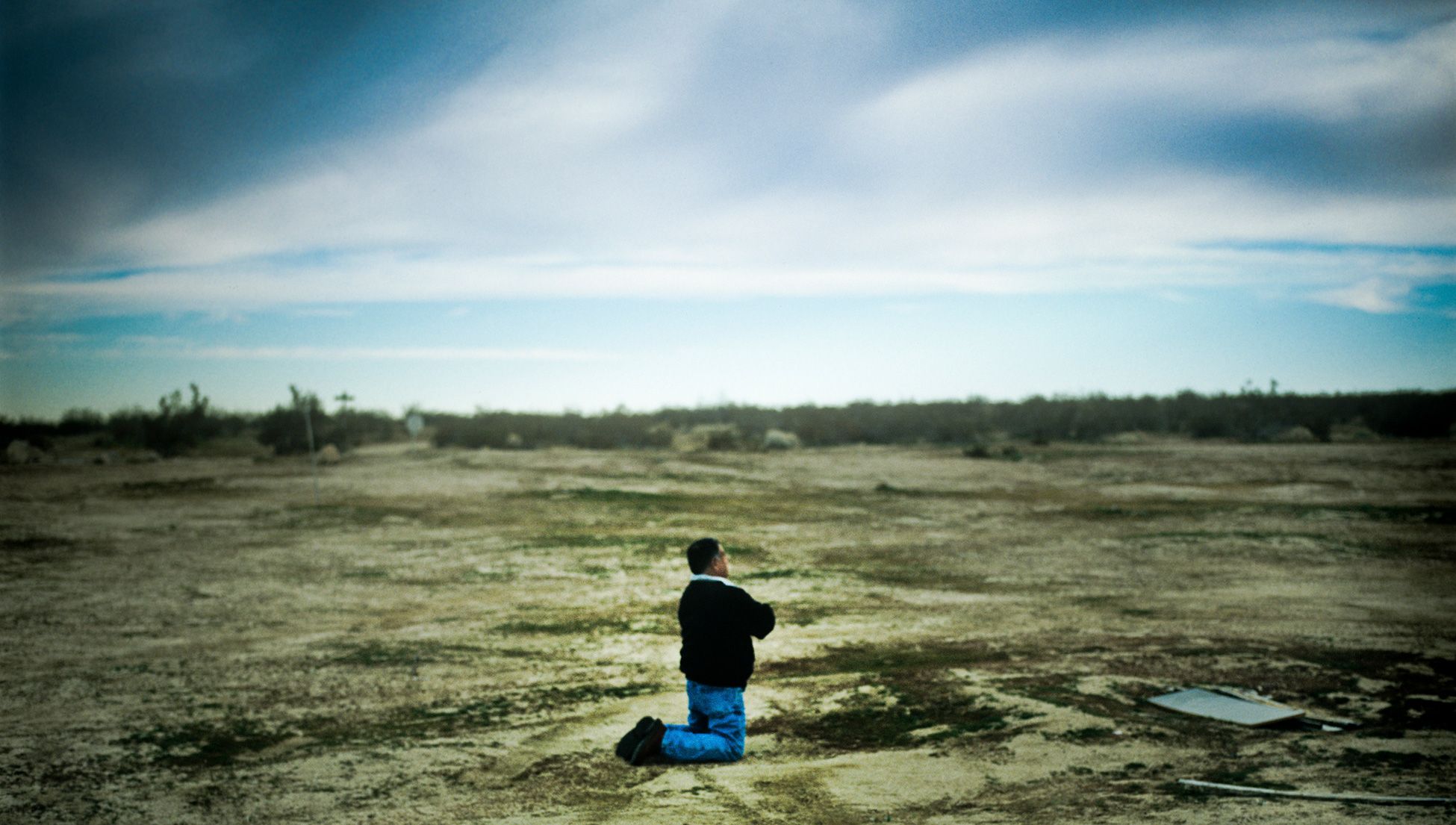
Praying at dawn near Our Lady of the Rock, a church in the Mojave Desert, California. Photo by Zackary Canepari/Panos
Michael M Prinzingis a philosopher and scientist who studies human flourishing. His writing features in Greater Good magazine, and on his blog, The Practical Philosopher.
Edited by Matt Huston
27 APRIL 2022 (psyche.co)
Theologians sometimes argue that, without the existence of God, life would be meaningless. Some secular people agree. For instance, in his book An Atheist’s Guide to Reality (2011), the philosopher Alex Rosenberg claims that, because the observable physical universe is all that exists, human life is meaningless. Whether you accept this philosophical claim or not, the fact that many people seem to believe that God or other supernatural entities are necessary for life to be meaningful suggests that, psychologically, there is some important connection between religious faith and the sense of meaning in life.
Although psychologists are divided on exactly how to define perceived meaning in life – some suggest it is about making sense of one’s life, others that it’s about seeing value and significance in it – they often assess meaning in life simply by asking how strongly people agree with statements such as: ‘At present, I find my life very meaningful.’ And research has consistently supported the idea that perceived meaning in life is tightly linked with religion. One study from the 1970s found that nuns scored higher on such measures than lay people. More recently, a study published in 2021 found that theists report experiencing more meaning in life than atheists. Numerous other studies have found that religiousness is positively correlated with perceived meaning in life. There is also some experimental evidence that, when presented with a threat to their sense of meaning, people show increased belief in miraculous events – suggesting that they are turning to religion to bolster their perceptions of meaning in life.
Of course, the observation that religion can be a source of existential comfort is not new. Since the 19th century, philosophers (eg, Friedrich Nietzsche), novelists (eg, Fyodor Dostoyevsky) and sociologists (eg, Émile Durkheim) have speculated that societal trends away from religion would lead to a crisis of meaning. Since recent data indicate that people around the world are becoming less religious, it is natural to wonder whether secular society can duplicate the existential benefits of religion. In order to do so, we would need to understand how it is, exactly, that religious faith makes life feel meaningful.
Religious faith helps people to feel that they matter not just to others, but in the grand scheme of things
One possible explanation has to do with the way religion tends to act like social glue, drawing the faithful into likeminded communities. People often find social support and a sense of belonging within such communities, which can be a powerful source of perceived meaning in life. Imagine, for instance, the close personal relationships that someone might find in a Bible study group. Hence, one route from religion to the feeling that life is meaningful could be through this sense that one matters to others. We can call this explanation the ‘social mattering hypothesis’.
Another possibility is that religious faith helps people to feel that they matter not just to others, but in the grand scheme of things. The observable universe is inconceivably vast and ancient: it is approximately 93 billion light-years in diameter and c14 billion years old. Against that backdrop, it’s easy to see why some regard humanity as utterly insignificant. As Stephen Hawking once put it, science tells us that humanity ‘is just a chemical scum on a moderate-size planet, orbiting around a very average star in the outer suburb of one among a hundred billion galaxies’. That’s not a particularly uplifting thought. In fact, in the experiment mentioned above, the ‘threat’ used to reduce participants’ sense of meaning was an essay about the smallness of human life in the vast expanse of time and space.
This is where religion comes in. Ernest Becker, a cultural anthropologist, argued in The Denial of Death (1973) that religious faith buffers people from the conclusion that humanity is cosmically insignificant by connecting us with an infinite being. Many religious traditions come with stories about the origins and purpose of the Universe. Many claim that humanity has some kind of important relationship with a higher power, that our lives are part of a grand plan, or even that the Universe was ‘designed with you in mind’. We find this idea in the Bible:
When I consider your heavens, the work of your fingers, the moon and the stars, which you have set in place, what is mankind that you are mindful of them, human beings that you care for them? You have … crowned them with glory and honour. You made them rulers over the works of your hands; you put everything under their feet.
The author of this psalm seems to suggest that, despite our small size, human beings have special importance because of God’s love for us. It’s easy to see why someone who believed this would perceive their life to have cosmic significance and hence a great deal of meaning. We can call this explanation – the idea that religious faith supports perceived meaning in life by fostering a sense of cosmic significance – the ‘cosmic mattering hypothesis’.
These two candidate explanations were well summarised by Rabbi Harold Kushner. Defending the importance of religion, he wrote:
Religion offers us a cure for the plague of loneliness by bringing us into a community of people with whom we share what is most vital in our lives … [R]eligious faith also satisfies another, even deeper human need – perhaps the most fundamental human need of all. That is the need to know that somehow we matter, that our lives mean something, count as something more than just a momentary blip in the Universe.
The primary reason why religiousness is associated with perceived meaning in life is because it is also associated with perceptions of cosmic significance
To test these hypotheses, I and the psychologists Patty Van Cappellen and Barbara L Fredrickson recently conducted four studies that included more than 3,000 participants from across the United States. We used surveys to assess various aspects of religiousness, including attendance of religious services, private practices (such as prayer), and the self-rated importance of religion in one’s life. We assessed perceived meaning in life using questionnaires that ask how strongly study participants agree or disagree with statements such as ‘My life as a whole has meaning’ and ‘I am able to spend most of my time in meaningful activities and pursuits.’ We also assessed perceptions of social and cosmic mattering using questionnaires that asked participants how strongly they agreed or disagreed with statements such as ‘My life matters to other people’ (social mattering) or ‘My life matters in the grand scheme of the Universe’ (cosmic mattering).
Sign-up to our weekly newsletter
Intriguing articles, practical know-how and immersive films, straight to your inbox.SubscribeSee our newsletter privacy policy
Across these four studies, the results consistently supported both the social mattering and cosmic mattering hypotheses, but also suggested that the cosmic mattering hypothesis was by far the stronger of the two explanations. In other words, the correlation between religiousness and perceived meaning in life was statistically accounted for by both forms of perceived mattering – but perceived cosmic mattering accounted for a much larger proportion of that association. This suggests that the primary reason why religiousness is associated with perceived meaning in life is because it is also associated with perceptions of cosmic significance.
It’s worth reiterating that these studies were conducted in the US, where most religious people are adherents of Abrahamic monotheisms (Judaism, Christianity and Islam). Things might look very different in other cultures. But, if these findings are correct – at least in this Western context, where being religious typically means believing in a creator God – they raise the question of whether secular Western society is in a position to reproduce the existential benefits of religion.
Unfortunately, the data suggest a pessimistic answer. If religiousness were associated with perceived meaning in life primarily because of the social resources that come from religion, then new forms of social organisation could be developed to step in for religious ones. In fact, a number of ‘atheist churches’ have already been established with this goal in mind. Such communities are likely to be very beneficial for their members. Yet our research suggests that these secular substitutes will be less powerful sources of perceived meaning than religious faith because they are unlikely to support perceptions of cosmic significance.
Is it possible to cultivate a sense of cosmic significance without adopting religious beliefs? One might contribute to science (ie, attempt to comprehend the Universe), or work to protect Earth from the climate crisis or other global threats. These are enormously important and good things to do with one’s life. Yet the impacts of such endeavours are confined to the comparatively humble scale of our planet – which, again, is a very small part of the cosmos overall. Moreover, even if one’s efforts were successful, these secular sources of significance are likely to require an enormous amount of hard work, dedication and opportunities that are not available to everyone. Hence, religion might be a unique source of perceived meaning in life.
If you’re not religious, you might side with Karl Marx, who wrote that ‘Religion is the sigh of the oppressed creature, the heart of a heartless world, and the soul of soulless conditions. It is the opium of the people.’ That is, you might think that religion makes life feel meaningful by fostering positive illusions – ie, it’s consoling, but nothing more than a fantasy. On the other hand, if you are religious, you might take this research to demonstrate the importance of faith, the distinctive and perhaps irreplaceable role that it plays in making life worth living.
In any case, one clear implication of this research is that a person’s sense that their life is meaningful depends on their perceptions of their own significance. But a person can be significant in various ways. Hence, those seeking to lead more meaningful lives would do well to seek out ways in which they can matter – whether that means mattering to other individuals, to their communities, or perhaps even in the grand scheme of the Universe.
Harvard devotes $100m to closing educational gap caused by slavery
President says institution has ‘helped to perpetuate racial oppression and exploitation’ as it establishes endowment fund

Reuters Tue 26 Apr 2022 11.46 EDT (TheGuardian.com)
Harvard University is setting aside $100m for an endowment fund and other measures to close the educational, social and economic gaps that are legacies of slavery and racism, according to an email the university’s president sent to all students, faculty and staff on Tuesday.
The email from Harvard’s president, Lawrence Bacow, included a link to a 100-page report by his university’s 14-member committee on Harvard and the legacy of slavery and acknowledged that the elite institution “helped to perpetuate … racial oppression and exploitation”.
The move comes amid a wider conversation about redressing the impacts of centuries of slavery, discrimination and racism. Some people have called for financial or other reparations.
The report laid out a history of enslaved people toiling on the campus and of the university benefiting from the slave trade and industries linked to slavery after slavery was outlawed in Massachusetts in 1783, 147 years after Harvard’s founding.
The report also documents Harvard excluding Black students and its scholars advocating racism.
While Harvard employed notable figures among abolitionists and in the civil rights movement, the report said: “The nation’s oldest institution of higher education … helped to perpetuate the era’s racial oppression and exploitation.”
The report’s authors recommended offering descendants of people enslaved at Harvard educational and other support so they “can recover their histories, tell their stories, and pursue empowering knowledge”.
Other recommendations included that the Ivy League school fund summer programs to bring students and faculty from long-underfunded historically Black colleges and universities to Harvard, and to send Harvard students and faculty to the institutions, known as HBCUs, such as Howard University, in Washington DC.
In his email, Bacow said a committee would explore transforming the recommendations into action and that a university governing board had authorized $100m for implementation, with some of the funds held in an endowment.
“Slavery and its legacy have been a part of American life for more than 400 years,” Bacow wrote. “The work of further redressing its persistent effects will require our sustained and ambitious efforts for years to come.”
Other US institutions of higher learning have created funds in recent years to address legacies of slavery.
A law enacted in Virginia last year requires five public state universities to create scholarships for descendants of people enslaved by the institutions.
John Bradshaw defines spirituality

The Most Argumentative Zodiac Sign, According to Astrologers
Ilana KaplanWed, April 27, 2022, 9:03 AM · (Yahoo.com)
It’s natural to disagree or even argue from time to time, but there are some people who just can’t keep their cool in any situation. Whether it’s debating endlessly with an authority figure or having never-ending quarrels with a friend, certain individuals always take it to the next level. There could be a reason for it written in the stars: Astrology says that some signs are more combative than others. Read on to discover the six most argumentative zodiac signs, from slightly disagreeable to constantly picking a fight.
RELATED: The Most Passive-Aggressive Zodiac Sign, According to Astrologers.
Libra

Libra loves to play devil’s advocate when arguing because they’re well-attuned to the dichotomy of right vs. wrong. “Libras can argue just for the fun of it, and they relish the opportunity of challenging you with an opposing point of view,” says astrologer and tarot reader Ryan Marquardt. “It’s a leisurely sport for them.” But in the end, Libra is the sign of mediation and compromise, so they’ll usually find a way to end up on the same page as you. Eventually, balance will be restored.-
Virgo

Virgos can drone on and on about the smallest things, leaving no detail unturned. Arguing with a Virgo can take up a ton of time. They don’t tend to raise their voice or have an aggressive tone, but they do like to stretch out an argument with detailed points. “If you get in an argument with a Virgo, chances are they’ve already had that argument with themselves over and over again, so they’ll be armed and ready to combat any points you feel like making,” explains Marquardt.
Jill Loftis, astrologer and founder of Nuit Astrology, adds, “Virgos have very specific ideas about how things should be done, and they are not afraid to let you know when you are out of line or not meeting their expectations.”
RELATED: The Zodiac Sign Best at Lying, According to an Astrologer.
Gemini

Nobody can persuade or wordsmith like a Gemini. Like Virgo, Gemini is also ruled by Mercury, but unlike Virgo, Gemini is rarely prepared to have a conversation with substance, facts, and sources. Ultimately, it doesn’t matter “because Gemini has an uncanny ability to connect dots on the spot, thanks to all the useless information that magically gets stored in their minds,” says Marquardt.
Loftis notes that Geminis are always arguing with themselves, which sometimes spills out into their interactions with others. “A Gemini might argue with you just to make a point or to keep the conversation going,” she explains. This sign will constantly bring in new perspectives that seem unrelated but somehow become important.
In short, “Gemini knows how to throw their opponent off in a battle of the wits,” Marquardt says.
Aries

Aries is extremely impassioned when they’re having an argument. They don’t handle losing well, and they’re usually quick at coming up with new subjects to toss into the conversation, forcing the other person to stay on their toes. “Ruled by Mars, the planet of war, Aries gives you the feeling of walking on broken glass when they argue with you,” says Marquardt. “Even if you’re 100 percent right, you know you have to be careful with how you present your side of the argument—otherwise, it could easily set them off like a ticking time bomb.”
Because they can act childish during a fight, it can be exhausting to keep up with Aries. They have enough force and vigor that it’s pretty much impossible to stay on the offense. A strong defense is the only remedy for an argument with Aries.
RELATED: For more astrology content delivered straight to your inbox, sign up for our daily newsletter.
Aquarius

Aquarius is a fixed air sign, which means “they can latch onto certain opinions and points of view with a white knuckle grip,” says Marquardt. As the eldest air sign, Aquarius is full of communicative experience, and in an argument, it can come off as a razor-sharp tongue full of wit and intellect. “It’s never fun getting into an argument with them, because they’ll come ready with science and facts to back up their opinion, and they’ll roast you for not having as much evidence to confirm your own opinion,” says Marquardt. So, how do you win them over? You need to show empathy. It’s the only way you might stand a chance against them.
Sagittarius

Sagittarius is the sign of wisdom, but that energy can spread out of control like a wildfire in arguments. “Even though Sagittarius is a mutable sign, which means they’re changeable, their perspectives are shaped through their life experiences, not through grounded facts and learnings,” says Marquardt. They stand firm in a belief that because they’ve lived that truth, their points of view are visceral and incredibly real for them. “Even if you have facts, science, or an academic background on something that you’re arguing about, it won’t matter to Sagittarius if they’ve experienced a contradictory circumstance,” he adds.
RELATED: The Zodiac Sign Least Likely to Fall in Love, According to Astrologers.
Free Will Astrology: Week of April 28, 2022
APRIL 26, 2022 AT 7:00 AM BY ROB BREZSNY (newcity.com)
Photo: Roberto Ourgant
ARIES (March 21-April 19): I recommend you adopt a limitation that will enable you to claim more freedom. For example, you could de-emphasize your involvement with a lukewarm dream so as to liberate time and energy for a passionate dream. Or you could minimize your fascination with a certain negative emotion to make more room for invigorating emotions. Any other ideas? You’re in a phase when increased discipline and discernment can be liberating.
TAURUS (April 20-May 20): “Imagining anything is the first step toward creating it,” wrote author and activist Gloria Steinem. “Believing in a true self is what allows a true self to be born,” she added. Those are excellent meditations for you to focus on right now, Taurus. The time is ripe for you to envision in detail a specific new situation or adventure you would like to manifest in the future. It’s also a perfect moment to picture a truer, deeper, more robust version of your beautiful self—an expanded version of your identity that you hope to give birth to in the coming months.
GEMINI (May 21-June 20): Gemini author William Butler Yeats won a Nobel Prize for Literature, so I conclude he had considerable talent and wisdom. But he cultivated interests and ideas that were at variance with most other literary figures. For example, he believed fairies are real. He was a student of occult magic. Two of his books were dictated by spirits during séances. In the coming weeks, I invite you to draw inspiration from his versatile repertoire. Welcome knowledge in whatever unusual ways it might materialize. Be eager to accept power and inspiration wherever they are offered. For inspiration, here’s a Yeats’ quote: “I have observed dreams and visions very carefully, and am certain that the imagination has some way of lighting on the truth that reason has not, and that its commandments, delivered when the body is still and the reason silent, are the most binding we can ever know.”
CANCER (June 21-July 22): You know what’s always good for your well-being? Helping people who are less fortunate and less privileged than you. To enhance your health, you can also fight bigotry, campaign against the abuse of animals, and remedy damage to the natural world. If you carry out tasks like these in the coming weeks, you will boost your vigor and vitality even more than usual. You may be amazed at the power of your compassion to generate selfish benefits for yourself. Working in behalf of others will uplift and nurture you. To further motivate you, here are inspirational words from designer Santiago Bautista: “I am in love with all the gifts of the world, and especially those destined for others to enjoy.”
LEO (July 23-Aug. 22): “There is a moment in each day that Satan cannot find,” wrote author and artist William Blake. Here’s how I interpret his poetic words: On a regular basis, you become relatively immune from the debilitating effects of melancholy, apathy and fear. At those times, you are blessed with the freedom to be exactly who you want to be. You can satisfy your soul completely. In the next six weeks, I suspect there will be more of these interludes for you than usual. How do you plan to use your exalted respite from Satan’s nagging?
VIRGO (Aug. 23-Sept. 22): Poet Louis Little Coon Oliver (1904–1991) was a member of the indigenous Mvskoke people. He declared, “I do not waste what is wild.” That might mean something different for him than what it would mean for you, but it’s an excellent principle for you to work with in the coming weeks. You will have more access than usual to wildness, and you might be tempted to use it casually or recklessly. I hope that instead you harness all that raw mojo with precision and grace. Amazingly, being disciplined in your use of the wildness will ensure that it enriches you to the max and generates potent transformative energy.
LIBRA (Sept. 23-Oct. 22): I suspect you will have the skills of an acrobat in the coming weeks—at least metaphorically. You will be psychically nimble. Your soul will have an exceptional ability to carry out spry maneuvers that keep you sane and sound. Even more than usual, you will have the power to adjust on the fly and adapt to shifting circumstances. People you know may marvel at your lithe flexibility. They will compliment you for your classiness under pressure. But I suspect the feats you accomplish may feel surprisingly easy and breezy!
SCORPIO (Oct. 23-Nov. 21): A Tumblr blogger named Af-70 gives copious advice. From his wide selection of wise counsel, I have selected six tips that are right for your needs in the coming weeks. Please study the following counsel. 1. “Real feelings don’t change fast.” 2. “Connect deeply or not at all.” 3. “Build a relationship in which you and your ally can be active in each other’s growth.” 4. “Sometimes what you get is better than what you wanted.” 5. “Enjoy the space between where you are and where you are going.” 6. “Keep it real with me even if it makes us tremble and shimmer.”
SAGITTARIUS (Nov. 22-Dec. 21): Consider putting a sign on your door or a message on your social media that says something like the following: “I’ve still got some healing to do. While I’m making progress, I’m only partway there. Am open to your suggestions, practical tips, and suggestions for cures I don’t know about.” Though the process is as yet incomplete, Sagittarius, I am proud of how diligent and resourceful you have been in seeking corrections and fixes. My only suggestions: 1. Be bold about seeking help and support. 2. Be aggressive about accessing your creativity. Expand your imagination about what might be therapeutic.
CAPRICORN (Dec. 22-Jan. 19): “To uncover what is hidden in my soul might take me a week or two,” my friend Allie told me. I told her she would be lucky if her brave and challenging exploration required such a short time. In contrast, some people I know have spent years trying to find what is buried and lost in their souls: me, for instance. There was one period of my life when I sought for over a decade to find and identify the missing treasure. According to my astrological analysis, you will soon enjoy multiple discoveries and revelations that will be more like Allie’s timeline than mine: relatively rapid and complete. Get ready! Be alert!
AQUARIUS (Jan. 20-Feb. 18): A Thai cook named Nattapong Kaweenuntawong has a unique method for cooking the soup served in his Bangkok restaurant. At the end of each night, he saves the broth for use the next day. He has been doing that daily for forty-five years. Theoretically, there may be molecules of noodles that were originally thrown in the pot back in 1977. In accordance with current astrological omens, I urge you to dream up a new tradition that borrows from his approach. What experience could you begin soon that would benefit you for years to come?
PISCES (Feb. 19-March 20): Pisces-born Casimir Pulaski (1745–1779) was a Polish nobleman and military commander. As a young man, he fought unsuccessfully to free Poland from Russian domination. Driven into exile, he fled to America, arriving during the Revolutionary War with Britain in 1777. General George Washington was impressed with Pulaski’s skills, making the immigrant a brigadier general. He distinguished himself as a leader of American forces, exhibiting brilliance and bravery. For that excellence, he has been honored. But now, over two centuries later, his identity is in flux. DNA analyses of Pulaski’s remains suggest he was an intersex person with both male and female qualities. (Read more: tinyurl.com/PulaskiSmithsonian.) I bring this to your attention, Pisces, because the coming months will be a favorable time to question and revise your understanding of your identity. May you be inspired by Pulaski’s evolving distinctiveness.
Homework: Make a guess about when you will fulfill your next sweet ambition. Newsletter.FreeWillAstrology.com
Tarot Card for April 28: The Knight of Cups
The Knight of Cups
This is the Lord of Waves and Water, often defined as the fiery aspect of water. As such, in many ways this card represents a contradiction. Most often when it appears, it will indicate an actual person who has influence. However sometimes it can also indicate a moodshift or a change of mode.
Since the Suit of Cups is all about love and loving relationships, it’s easy to see how the Knight can be regarded as the lover of the cards. When representing a moodshift, the card can indicate the period where a man falls in love.
When it represents a person he will be a complex and highly emotional being – creative and visionary, sensitive (and sometimes over-sensitive), romantic and intense. He will give the impression of being open and caring, though this is often misleading; the Knight of Cups is often subject to intense insecurity, needing constant re-assurance and attention.
He is attracted and attractive to women, and enjoys basking in their company. He will often be very charming, with a silver tongue and a powerful personal agenda. He will rarely manage practical matters well, tending to place rather more importance on buying two dozen red roses, than paying the bills. At his worst, he can be inconstant, unfaithful and selfish.
At his best, he is loving, generous with his emotions, supportive and tender. He can be capable of high levels of spiritual development, strong in intuition and warmly responsive. When he’s on form he is terrific company, having a good sense of humour and a keen interest in other people. He’s often an exciting and stimulating life partner and lover – but only at his best!
You see – I said he was contradictory!
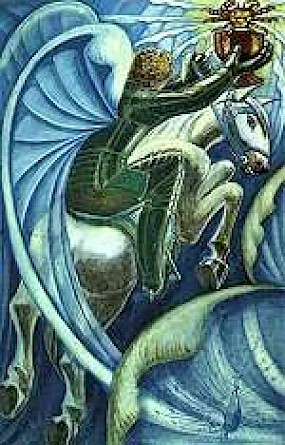
(via angelpaths.com and Alan Blackman)
Look on the dark side
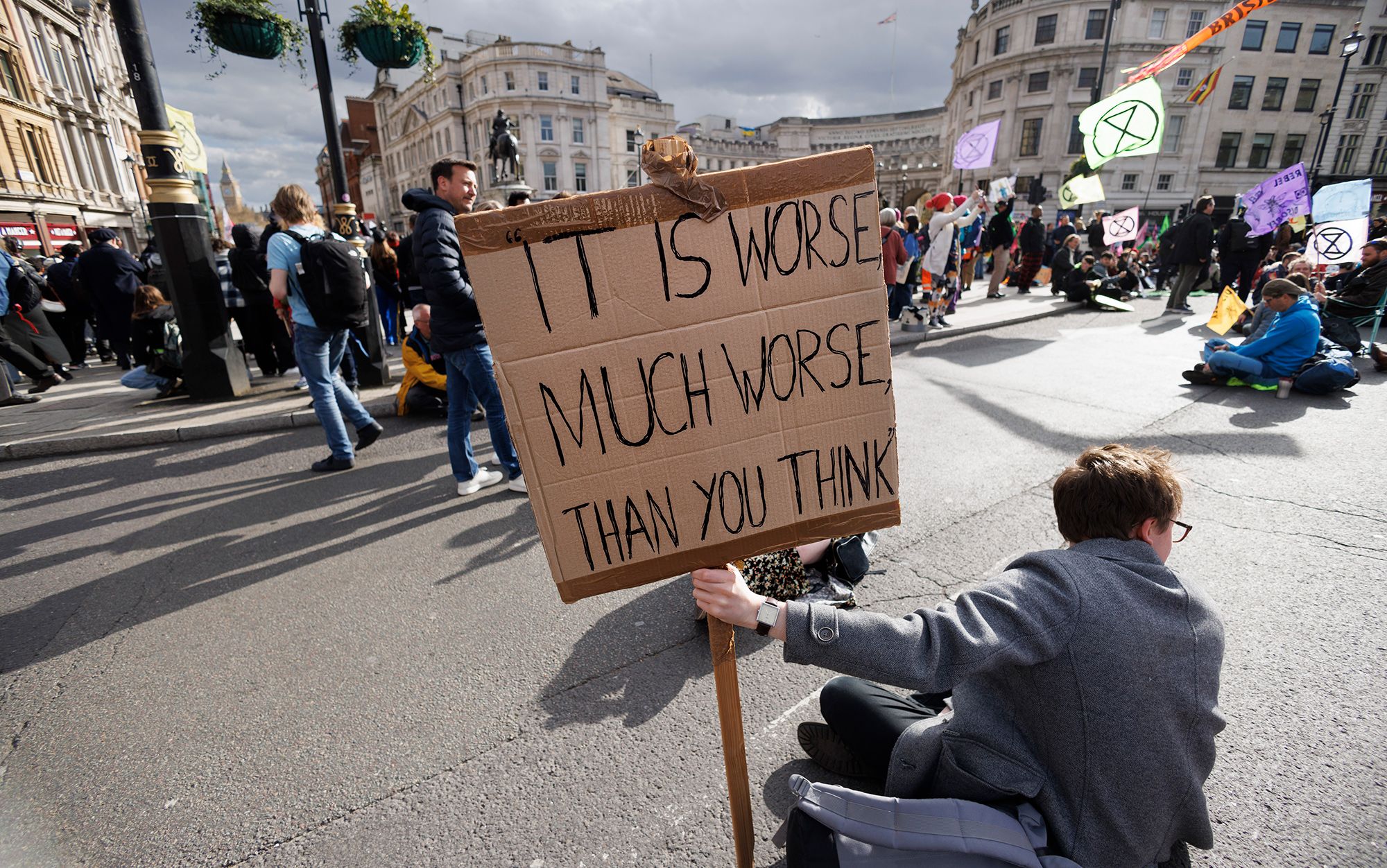
We must keep the flame of pessimism burning: it is a virtue for our deeply troubled times, when crude optimism is a viceExtinction Rebellion activists in Trafalgar Square, London. Photo by Crispin Hughes/Panos
Mara van der Lugt is lecturer in philosophy at St Andrews University in Scotland. She is the author of Bayle, Jurieu, and the ‘Dictionnaire Historique et Critique’ (2016) and Dark Matters: Pessimism and the Problem of Suffering (2021).
Edited by Sam Dresser
26 April 2022 (aeon.co)
Love Aeon?
Support our workDONATE
In the 17th and 18th centuries, a group of Western philosophers came to clashes, on the page at least, over the age-old problem of evil: the question of how a good God could allow the existence of evil and suffering in the world. Philosophers such as Pierre Bayle, Nicolas Malebranche and G W Leibniz, later followed by such pillars of the canon as Voltaire, David Hume and Immanuel Kant, vehemently disagreed not only on how the problem could be solved – if it could be solved at all – but also on how to speak of such dark matters.
Some of these arguments of ‘theodicy’ (the attempt to justify creation) may seem antiquarian to modern eyes – but in an age where young people question the morality of bringing new children into the world, they are surprisingly relevant. After all, the issue is not just about God: it is about creation and, more specifically, the extent to which creation can be justified, given the ills or ‘evils’ that are in the world.
The question of creation is urgent for us today. Considering the great uncertainties of the climate crisis, is it justified to create new people, not knowing what kind of future lies ahead of them? And if it is justified, is there any point at which it ceases to be? Most people would probably agree that some worlds are imaginable in which creation would be immoral. At what precise point is life too bad, or too uncertain, to pass on?
In the early Enlightenment, of course, there were no such concerns for the future of the planet. But there were evils in existence – plenty of them. Crimes, misfortunes, death, disease, earthquakes and the sheer vicissitudes of life. Considering such evils, these philosophers asked, can existence still be justified?
This longstanding philosophical debate is where we get the terms ‘optimism’ and ‘pessimism’, which are so much used, and perhaps overused, in our modern culture. ‘Optimism’ was the phrase coined by the Jesuits for philosophers such as Leibniz, with his notion that we live in ‘the best of all possible worlds’ (for surely, if God could have created a better one, he would have done so). ‘Pessimism’ followed not long afterwards to denote philosophers such as Voltaire, whose novel Candide (1759) ridiculed Leibnizian optimism by contrasting it with the many evils in the world. ‘If this is the best of all possible worlds,’ Voltaire’s hero asks, ‘what on earth are the others like?’
But really, Voltaire wasn’t much of a pessimist: other philosophers such as Bayle and Hume went much further in their demonstrations of the badness of existence. For Bayle, and for Hume after him, the point is not just that the evils of life outnumber the goods (though they believe this is also the case), but that they outweigh them. A life might consist of an equal number of good moments and bad moments: the problem is that the bad moments tend to have an intensity that upsets the scales. A small period of badness, says Bayle, has the power to ruin a large amount of good, just like a small portion of seawater can salt a barrel of fresh water. Similarly, one hour of deep sorrow contains more evil than there is good in six or seven pleasant days.
Against that bleak vision, thinkers such as Leibniz and Jean-Jacques Rousseau emphasised the goods of life, and the power we have to seek out the good in all things, for if we learned to adjust our vision we would see that life is in fact very good: that ‘there is incomparably more good than evil in the life of men, as there are incomparably more houses than prisons,’ Leibniz writes, and that the world ‘will serve us if we use it for our service; we shall be happy in it if we wish to be.’ Just as the pessimists believed the optimists were deceived in their insistence on the goods of life, so too the optimists thought the pessimists’ eyes were skewed towards the bad: each side accused the other of not having the right vision.
A large part of the question thus became: what is the right vision?
One thing that struck me as I dug deeper into these questions was how concerned both the optimists and the pessimists were with the ethical assumptions underlying the theoretical arguments. On the surface, the question was: can creation be justified? But beneath it, never far removed, lay a deeper question, a question just as ethically and emotionally imbued: how to speak of suffering in a way that offers hope and consolation?
There is not just a theoretical, but also a moral objection that each side makes against the other. The great objection that the pessimists lay at the feet of the optimists is that to insist that life is good even in the face of hard, unyielding suffering, or to stipulate that we are in control of our happiness, that we shall be happy ‘if we wish to be’ – that this is to make our suffering worse. It is to add to suffering the responsibility for that suffering; it is to burden the sufferer with a sense of their inadequacy. If life is so good, then the sufferer’s trials must be a case of wrong vision – and indeed the optimists tend to say things just like that. This is why optimism, so say the pessimists, is a cruel philosophy. If it gains us some hope, it fails in consolation.
But on their side, the optimists prove to be similarly concerned. Their objection to the pessimists is that, if we insist on the intensity and ubiquity and inescapability of suffering, if we describe it in all its depths and bleakness (as the pessimists indeed are wont to do), this heaps suffering on suffering – and it is this that makes suffering worse, as ‘evils are doubled by being given an attention that ought to be averted from them,’ as Leibniz says.
Pessimism, so say the optimists, is itself unconsoling – but more than that, it is unhopeful.
The question concerning these philosophers, then, is not just the theoretical one about whether life in general is good or bad, but also a more concrete one: face to face with one who suffers, what can philosophy bring to the table? What can philosophy offer in the way of hope and consolation?
Politicians are particularly keen to insist that they are optimists, or even to speak of a ‘duty of optimism’
Both strands of thought have the same aim, but they plot different routes to get there: the pessimists offer consolation by emphasising our fragility, by recognising that no matter how hard we try, we may fail to achieve happiness, for no fault of our own. Meanwhile, the optimists seek to unfold hope by emphasising our capacity, by insisting that no matter how dark, how bleak our circumstances, we can always change our vision and direction, we can always aim for better.
Of course, there is no reason in principle why both roads could not be combined, each to serve as the necessary counterpart for the other, an antidote for the poison each draught may become when served up undiluted. But the fact remains that these earliest optimists and pessimists saw them as opposed – and in fact we do too: we still have the tendency to think in binary terms, as if there is in life a stark choice to be made between optimism and pessimism, or, in Noam Chomsky’s words, for optimism or despair:
We have two choices. We can be pessimistic, give up, and help ensure that the worst will happen. Or we can be optimistic, grasp the opportunities that surely exist, and maybe help make the world a better place. Not much of a choice.
That last example itself makes manifest the coarseness and onesidedness of our use of these terms. Optimism tends to be positively charged, pessimism negatively charged. When we call someone an optimist, it’s usually praise. This is why politicians are particularly keen to insist that they are optimists, or even to speak of a ‘duty of optimism’. Conversely, to call someone a pessimist is usually to deride, denounce, deflate them. ‘Pessimism is for losers,’ as one recent book title has it.
But are our choices so dichotomous? If there are shadows on the road of pessimism, there are dangers on the opposite road also. And these are the very dangers that those older pessimists kept warning us against: that if we overemphasise the power we have over our minds, our lives, our destinies, it is all too easy to stumble into cruelty.
We need not look very far to see examples of what optimism, in its darkest forms, can become. When a 2008 London tower block named Heygate Estate was sold off to foreign investors, its inhabitants were first evicted then offered mindfulness courses by the local council to deal with their anxiety, so that they were themselves made responsible for their misfortunes. If we are each radically in control of our mental states, what reason is there to ask for social justice? This is the shadow-side that cleaves to the popular narrative that ‘you are responsible for your own happiness’, and is bolstered by the subtle terror of a social media regime that pushes us to broadcast our success and happiness to the world.
It is in such cases that the consoling force of pessimism reveals itself: it’s OK to not be OK. Sometimes we fail, sometimes we run up against the hard walls of our own capacities or the world’s boundaries – and it can be consoling to be reminded that our suffering, our fragility, is not our fault. That we suffer despite ourselves. That it can be right to grieve for what we are losing, or are yet to lose, or have already lost.
We are so quick to equate pessimism with passivity or fatalism or despair, and to reject it on that basis – for, of course, we do not want a philosophy that tells us to give up. But is that really what pessimism means? As Joshua Foa Dienstag argued in his book Pessimism: Philosophy, Ethic, Spirit (2006), far from leading to passivity, pessimism can be closely linked to a tradition of moral and political activism, as in the case of Albert Camus, whose courage and activism in the Second World War were infused by his pessimistic views.
Even the darkest pessimists never said that life would only get worse or can never be better: this is a caricature of pessimism, sketched quickly to dismiss it. Arthur Schopenhauer, the bleakest of them all, did not subscribe to it. On the contrary, he suggested that it is precisely because we cannot control the course of things that we can never know what the future holds: life may become worse or better. ‘The pessimist,’ in Dienstag’s words, ‘expects nothing.’ There is not much hope in this, perhaps, but it is a kind of hope nevertheless. And so too is the faint glimmering that can be found amid the darkest pages of these writers: the quick unquiet intuition that something can be gathered in the black vision; that our eyes may be opened in ways they were not before; that we may see in the darkness.
It is why hopeful pessimism may not be a contradiction, but a manifestation of the wild power that is harnessed only when life’s darkest forces are gathered into the strange alchemy of hope.
Ithink about these things in this age marked by ecological depletion and devastation, by floods and fires and heat ceilings that no one had thought possible, by the spectre of the climate crisis that takes shape all around us. This age is marked also by the quiet, or not so quiet, desperation of the young. The same criticisms once waged against the pessimists of yore are now laid at the feet of the despairing young by those techno-optimists and advocates of progress for whom any consideration of the mere possibility of decline is itself a sign of weakness, a lack of imagination, a moral flaw – a failure of vision, most of all. And so they denounce young people’s outcry as pessimism, as fatalism, as ‘mere’ despair. They criticise them for the bleakness of their vision, call their statements exaggerated and the speakers spoiled.
It is all too easy to miss the fact that this generation – the first to grow up in a world where a climate emergency is not just on the horizon, but a stark reality – is haunted by a real sense of losing the future, as all the things they have been told give life meaning are rendered either pointless or problematic. Things like: study, get a good job, settle down – but what jobs are still certain? Where will it be safe to settle down? As Greta Thunberg said in Parliament Square in London in 2018: ‘And why should I be studying for a future that soon will be no more, when no one is doing anything whatsoever to save that future?’ Things like: start a family – but if there is no future for one’s children, is it still OK to procreate? Even more trivial things, like developing oneself by travelling, are no longer straightforward: for how important is self-development when weighed against the carbon cost of modern travel?
This is a wholesale collapse of meaning that is only now becoming clear to us. There is a very real sense in which young people are experiencing not only the loss of concepts, but the loss of the future itself, as all the usual answers to the question of what makes life worthwhile become increasingly uncertain. They are in that darkness, searching for some kind of hope, some kind of consolation – and what can we offer them? Surely we can do better than give the manifestly inadequate answer (which may also be an outright lie) to assure them that all will be well – since we know there is every chance it won’t be.
It is clear that Greta Thunberg, at least, will continue to strive even if her efforts are doomed to fail
Any crude statements of optimism would be more than misplaced: it would be the kind of lie that deceives no one, least of all the sharpened moral senses of the young, who see through the empty promises and reassurances of politicians with an anger we know is justified. If we told them that everything will be OK, these are less than empty words: they are a failure to take their experience seriously, and that, as the pessimists would tell us, is the one thing guaranteed to make their suffering worse.
But if brute optimism fails – could pessimism do better? I have suggested that pessimism can have value – but could we go further? Could it be, in fact, a virtue?
To some, the very notion of a virtue of pessimism may seem absurd. For instance, we may subscribe to Hume’s notion that the mark of any virtue is that it is useful and agreeable, either to the person who possesses it or to others. But surely pessimism is neither useful nor agreeable. It is not useful, the argument goes, because it renders us passive, depresses not only ourselves but ‘our sense of the possible’, as Marilynne Robinson has said of cultural pessimism in particular. And it is not agreeable, since it intensifies our suffering, making us focus on the bad side of life rather than the good (or so arch-optimists such as Leibniz and Rousseau would have it). It is not surprising, then, that certain studies of supposed ‘moral exemplars’ identified positivity, hopefulness and optimism among the characteristics that such exemplars had in common.
But then, think of Greta Thunberg. If there is such a thing as a ‘climate virtue’, she would seem to exemplify it – considering the hard personal choices that she has made, the steadfastness of her vision, and the courage with which she holds world leaders to account and takes them to task for their half-heartedness, their unwillingness to commit fully to the cause. If this is not an exercise of virtues, then I don’t know what is – and yet there is nothing positive or optimistic about Thunberg. If there is hope, it’s a dark, bleak hope, full of rage and grief and pain for what is being lost – but infused also with insistence, perdurance, determination. It is clear that this activist, at least, will continue to strive even if her efforts are doomed to fail. This is not optimism: if anything, it is a hopeful pessimism, and I believe it has every right to be called a virtue in our age.
Hopeful pessimism breaks through the rusted dichotomy of optimism vs pessimism. It is this attitude, this perspective that is exemplified in Thunberg and other figures who by their example give an affirmative answer to the question posed by Paul Kingsnorth: ‘Is it possible to see the future as dark and darkening further; to reject false hope and desperate pseudo-optimism without collapsing into despair?’
The thing to avoid is not so much pessimism, but hopelessness or fatalism or giving up. Even despair need not be completely avoided, since it too can energise and encourage us to strive for change, but we should avoid the kind of despair that causes us to collapse. These things are not the same as pessimism, which is simply the assumption of a dark view of the present as well as the future and does not imply the loss of courage or insistence to strive for better: on the contrary, often these are the very gifts that pessimism can bestow.
One can be deeply, darkly pessimistic, one can find oneself in the cold hard clutches of despair, and yet not be depleted of the possibility (and it could just be a possibility) that better may yet arrive. This is a kind of hope that is dearly bought, that does not come lightly but is carved out of a painful vision which may just be the acknowledgment of all the suffering that life can and does hold. If anything, the pessimists have taught me this: that with eyes full of that darkness there can still be this strange shattering openness, like a door cracked open, for the good to make its entry into life. Since all things are uncertain, so too is the future, and so there is always the possibility of change for better as there is for worse.
To behold with open eyes the reality before us requires courage
This can itself be a moral stance: one that welcomes the good when it is given and urges it onwards on its journey, but also acknowledges the bad without explaining it away or overburdening the will of those it crushes in its path. Sometimes we are not in power to change the world as we would like to, and acknowledging this can be the greatest effort as well as the greatest consolation, while not taking away the drive to give our best and hardest labours to the cause.
As Jonathan Lear has written in his book Radical Hope (2006), one common phenomenon at times of cultural devastation is that old values lose their meaning. If they are to survive the collapse of the moral horizon, they need new meanings, new concepts to breathe life into them. The most difficult thing of all is to negotiate this change, to start inhabiting new virtues while the old are still among us. And this, I believe, is one way in which pessimism might serve us – as a virtue in itself, but also as a way of giving new meaning to virtues that are changing as part of this changing world. To behold with open eyes the reality before us requires courage, and not to turn away from it, forbearance, and yet not to decide that it ends there: this is hope.
Hope – not that everything will be all right in the end, but that nothing has ever truly ended; that there is this ‘crack in everything’ of which Leonard Cohen once sang, in the good as well as the bad, so that neither is ever entirely shut away from us. This is not the steadfast conviction that things are bound to get better – not the crude optimism that can no longer be a virtue in a breaking world, and might prove to be our besetting vice. It may be easier to lend our efforts under such a banner of assured success, but this ease is a deceptive one, for while it is possible to be dispirited by passivity or fatalism, it is possible to be depleted by continued disappointment also. What hopeful pessimism asks instead is that we strive for change without certainties, without expecting anything from our efforts other than the knowledge that we have done what we are called upon to do as moral agents in a time of change. This may just be the thinnest hope, the bleakest consolation – but it may also be the very thing that will serve us best in times to come, as a value, and yes, an exercise of moral fervour: a fragile virtue for a fragile age.
Virtues and vices Thinkers and theories Meaning and the good life

