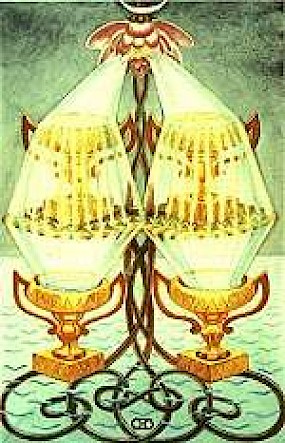
The Lord of Luxury is a card with a hidden sting in its tail. On the surface it indicates a wealth of loving affection, showing a person who is lucky enough to receive a great deal of devotion and tenderness.
At first look, you would think we would be all too pleased with this situation wouldn’t you? However, the sting is this – sometimes, when we are loved deeply and for a long period of time, we are foolish enough to forget what it feels like when we are lonely and unloved. And as soon as we make that mistake, we start to undervalue the tenderness and emotional investment that others are making in us.
We begin to get careless about the ways in which we treat those people who love us. We may hanker after love from some-one outside our circle, instead of valuing those people closer to hand who love us from the bottom of their hearts.
In other words, we can begin to take love for granted. And there are three things in this world we are all silly to take for granted – love, good health and tranquillity. Every one of them slips away silently if we stop paying it due attention.
So, when the Lord of Luxury appears, whilst you will know that there is a great deal of love in the air, there’s also a warning which must be taken on board – count your blessings, reciprocate, and don’t get your priorities in a mess. That way you’ll carry on being loved for a very long time.
MARCH 1, 2022 AT 7:00 AM BY ROB BREZSNY (newcity.com)
A group of vultures waiting for the storm to “Blow Over”—”Let Us Prey” (William “Boss” Tweed and members of his ring weathering a violent storm on a ledge with the picked-over remains of New York City), Thomas Nast, 1871/courtesy Library of Congress
ARIES (March 21-April 19): “I not only bow to the inevitable,” wrote Aries author Thornton Wilder. “I am fortified by it.” Wow. That was a brazen declaration. Did he sincerely mean it? He declared that he grew stronger through surrender, that he derived energy by willingly giving in to the epic trends of his destiny. I don’t think that’s always true for everyone. But I suspect it will be a useful perspective for you in the coming weeks, Aries.
TAURUS (April 20-May 20): Vive la différence! Hooray for how we are not alike! I am all in favor of cultural diversity, neurodiversity, spiritual diversity and physical diversity. Are you? The coming weeks will be an excellent time to celebrate the bounties and blessings that come your way because of the holy gift of endless variety. The immediate future will also be a perfect phase to be extra appreciative that your companions and allies are not the same as you. I encourage you to tell them why you love how different they are. Now here’s poet Anna Akhmatova to weave it together: “I breathe the moonlight, and you breathe the sunlight, but we live together in the same love.”
GEMINI (May 21-June 20): Gemini singer-songwriter Bob Dylan said, “I think of a hero as someone who understands the degree of responsibility that comes with his freedom.” I think that will be a key theme for you in the coming weeks. Dylan described the type of hero I hope you aspire to be. Be alert! You are on the cusp of an invigorating liberation. To ensure you proceed with maximum grace, take on the increased responsibility that justifies and fortifies your additional freedom.
CANCER (June 21-July 22): “I’d rather be seduced than comforted,” wrote author Judith Rossner. What about you, Cancerian? Do you prefer being enticed, invited, drawn out of your shell, and led into interesting temptation? Or are you more inclined to thrive when you’re nurtured, soothed, supported and encouraged to relax and cultivate peace? I’m not saying one is better than the other, but I urge you to favor the first in the coming weeks: being enticed, invited, drawn out of your shell, and led into interesting temptation.
LEO (July 23-Aug. 22): A woman from Cornwall, UK, named Karen Harris was adopted as a little girl. At age eighteen, she began trying to track down her biological parents. Thirty-four years later, she was finally reunited with her father. The turning point: He appeared on the “Suggested Friends” feature on her Facebook page. I propose we make Karen Harris your inspirational role model. Now is a favorable time to find what you lost a while ago; to re-link with a good resource that disappeared from your life; to reclaim a connection that could be meaningful to you again.
VIRGO (Aug. 23-Sept. 22): Buddhist teacher Chögyam Trungpa told us, “Meditation is not a matter of trying to achieve ecstasy, spiritual bliss or tranquility.” Instead, he said that meditation is how we “expose and undo our neurotic games, our self-deceptions, our hidden fears and hopes.” Excuse me, Mr. Trungpa, but I don’t allow anyone, not even a holy guy like you, to dictate what meditation is and isn’t. Many other spiritual mentors I’ve enjoyed learning from say that meditation can also be a discipline to achieve ecstasy, spiritual bliss and tranquility. And I suspect that’s what Virgo meditators should emphasize in the coming weeks. You people are in a phase when you can cultivate extraordinary encounters with all that fun stuff. If you’re not a meditator, now would be a good time to try it out. I recommend the books “Meditation for Beginners” by Jack Kornfield and “How to Meditate” by Pema Chödrön.
LIBRA (Sept. 23-Oct. 22): Comedian Fred Allen observed, “It is probably not love that makes the world go around, but rather those mutually supportive alliances through which partners recognize their dependence on each other for the achievement of shared and private goals.” That’s an unromantic thing to say, isn’t it? Or maybe it isn’t. Maybe it’s very romantic, even enchanting, to exult in how our allies help us make our dreams come true—and how we help them make their dreams come true. In my astrological opinion, the coming weeks will be an excellent time to focus on the synergies and symbioses that empower you.
SCORPIO (Oct. 23-Nov. 21): “It’s never too late to have a happy childhood!” declare many self-help gurus. “It’s never too early to start channeling the wise elder who is already forming within you,” declare I. Oddly enough, both of these guiding principles will be useful for you to meditate on during the coming weeks. According to my analysis of the astrological omens, you’re in an unusually good position to resurrect childlike wonder and curiosity. You’re also poised to draw stellar advice from the Future You who has learned many secrets that the Current You doesn’t know yet. Bonus: Your Inner Child and your Inner Elder could collaborate to create a marvelous breakthrough or two.
SAGITTARIUS (Nov. 22-Dec. 21): “A myriad of modest delights constitute happiness,” wrote poet Charles Baudelaire. That will be a reliable formula for you in the coming weeks, Sagittarius. You may not harvest any glorious outbreaks of bliss, but you will be regularly visited by small enchantments, generous details, and useful tweaks. I hope you won’t miss or ignore some of these nurturing blessings because you’re fixated on the hope of making big leaps. Be grateful for modest delights.
CAPRICORN (Dec. 22-Jan. 19): I found out some fun facts about renowned Capricorn poet Robert Duncan (1919–1988), who was a bohemian socialist and trailblazing gay activist. He was adopted by Theosophical parents who chose him because of his astrological make-up. They interpreted Robert’s dreams when he was a child. Later in life, he had an affair with actor Robert De Niro’s father, also named Robert, who was a famous abstract expressionist painter. Anyway, Capricorn, this is the kind of quirky and fascinating information I hope you’ll be on the lookout for. It’s time to seek high entertainment as you expedite your learning; to change your fate for the better as you gather interesting clues; to be voraciously curious as you attract stimulating influences that inspire you to be innovative.
AQUARIUS (Jan. 20-Feb. 18): “I always strive, when I can, to spread sweetness and light,” said P. G. Wodehouse. “There have been several complaints about it.” I know what he means. During my own crusade to express crafty, discerning forms of optimism, I have enraged many people. They don’t like to be reminded that thousands of things go right every day. They would rather stew in their disgruntlement and cynicism, delusionally imagining that a dire perspective is the most intelligent and realistic stance. If you’re one of those types, Aquarius, I have bad news for you: The coming weeks will bring you invitations and opportunities to cultivate a more positive outlook. I don’t mean that you should ignore problems or stop trying to fix what needs correction. Simply notice everything that’s working well and providing you with what you need. For inspiration, read my essay: tinyurl.com/HighestGlory
PISCES (Feb. 19-March 20): Pastor and activist Charles Henry Parkhurst (1842–1933) said, “All great discoveries are made by people whose feelings run ahead of their thinking.” The approach worked well for him. In 1892, he discovered and exposed monumental corruption in the New York City government. His actions led to significant reforms of the local police and political organizations. In my astrological opinion, you should incorporate his view as you craft the next chapter of your life story. You may not yet have been able to fully conceive of your future prospects and labors of love, but your feelings can lead you to them.
Homework: See if you can forgive yourself for a wrong turn you haven’t been able to forgive yourself for. Newsletter.FreeWillAstrology.com
A “Ukraine Emergency Translation Group” meeting is scheduled for this Friday, March 4, at 11 am Pacific time, noon Mountain time, 1 pm Central time, 2 pm East Coast time, 9 pm Greece, 10 pm Turkey.
All Translators welcome.
Hope you can make it.
Mike Zonta World Work Translation Group
You are invited to a scheduled Zoom meeting.
Topic: Ukraine Emergency Translation Group
Time: Mar 4, 2022 11:00 AM Pacific Time (US and Canada)
Meeting ID: 840 2375 5291 One tap mobile +16699006833,,84023755291# US (San Jose) +13462487799,,84023755291# US (Houston)
Dial by your location +1 669 900 6833 US (San Jose) +1 346 248 7799 US (Houston) +1 253 215 8782 US (Tacoma) +1 929 205 6099 US (New York) +1 301 715 8592 US (Washington DC) +1 312 626 6799 US (Chicago) Meeting ID: 840 2375 5291 Find your local number: https://us02web.zoom.us/u/kdNwwZt760
Petrarch’s rediscovery of Cicero‘s letters is often credited with initiating the 14th-century Italian Renaissance and the founding of Renaissance humanism.[2] In the 16th century, Pietro Bembo created the model for the modern Italian language based on Petrarch’s works, as well as those of Giovanni Boccaccio, and, to a lesser extent, Dante Alighieri.[3] Petrarch would be later endorsed as a model for Italian style by the Accademia della Crusca.
Petrarch’s sonnets were admired and imitated throughout Europe during the Renaissance and became a model for lyrical poetry. He is also known for being the first to develop the concept of the “Dark Ages,”[4] which most modern scholars now find misleading and inaccurate.[5][6][7]
Biography
Youth and early career
Petrarch was born in the Tuscan city of Arezzo on 20 July 1304. He was the son of Ser Petracco and his wife Eletta Canigiani. His given name was Francesco Petracco, which was Latinized to Petrarca. Petrarch’s younger brother was born in Incisa in Val d’Arno in 1307. Dante Alighieri was a friend of his father.[8]
Petrarch spent his early childhood in the village of Incisa, near Florence. He spent much of his early life at Avignon and nearby Carpentras, where his family moved to follow Pope Clement V, who moved there in 1309 to begin the Avignon Papacy. Petrarch studied law at the University of Montpellier (1316–20) and Bologna (1320–23) with a lifelong friend and schoolmate called Guido Sette. Because his father was in the legal profession (a notary), he insisted that Petrarch and his brother also study law. Petrarch, however, was primarily interested in writing and Latin literature and considered these seven years wasted. Additionally, he proclaimed that through legal manipulation his guardians robbed him of his small property inheritance in Florence, which only reinforced his dislike for the legal system. He protested, “I couldn’t face making a merchandise of my mind,” as he viewed the legal system as the art of selling justice.[8]
Petrarch was a prolific letter writer and counted Boccaccio among his notable friends to whom he wrote often. After the death of their parents, Petrarch and his brother Gherardo went back to Avignon in 1326, where he worked in numerous clerical offices. This work gave him much time to devote to his writing. With his first large-scale work, Africa, an epic in Latin about the great Roman general Scipio Africanus, Petrarch emerged as a European celebrity. On 8 April 1341, he became the second[9]poet laureate since classical antiquity and was crowned by Roman SenatoriGiordano Orsini and Orso dell’Anguillara on the holy grounds of Rome’s Capitol.[10][11][12]
He traveled widely in Europe, served as an ambassador, and (because he traveled for pleasure,[13] as with his ascent of Mont Ventoux) has been called “the first tourist“.[14] During his travels, he collected crumbling Latin manuscripts and was a prime mover in the recovery of knowledge from writers of Rome and Greece. He encouraged and advised Leontius Pilatus‘s translation of Homer from a manuscript purchased by Boccaccio, although he was severely critical of the result. Petrarch had acquired a copy, which he did not entrust to Leontius,[15] but he knew no Greek; Petrarch said, “Homer was dumb to him, while he was deaf to Homer”.[16] In 1345 he personally discovered a collection of Cicero‘s letters not previously known to have existed, the collection Epistulae ad Atticum, in the Chapter Library (Biblioteca Capitolare) of Verona Cathedral.[17]
Disdaining what he believed to be the ignorance of the era in which he lived, Petrarch is credited with creating the concept of a historical “Dark Ages“.[4]
Petrarch recounts that on 26 April 1336, with his brother and two servants, he climbed to the top of Mont Ventoux (1,912 meters (6,273 ft), a feat which he undertook for recreation rather than necessity.[18] The exploit is described in a celebrated letter addressed to his friend and confessor, the monk Dionigi di Borgo San Sepolcro, composed some time after the fact. In it, Petrarch claimed to have been inspired by Philip V of Macedon‘s ascent of Mount Haemo and that an aged peasant had told him that nobody had ascended Ventoux before or after himself, 50 years before, and warned him against attempting to do so. The nineteenth-century Swiss historian Jacob Burckhardt noted that Jean Buridan had climbed the same mountain a few years before, and ascents accomplished during the Middle Ages have been recorded, including that of Anno II, Archbishop of Cologne.[19][20]
Scholars[21] note that Petrarch’s letter[22][23] to Dionigi displays a strikingly “modern” attitude of aesthetic gratification in the grandeur of the scenery and is still often cited in books and journals devoted to the sport of mountaineering. In Petrarch, this attitude is coupled with an aspiration for a virtuous Christian life, and on reaching the summit, he took from his pocket a volume by his beloved mentor, Saint Augustine, that he always carried with him.[24]
For pleasure alone he climbed Mont Ventoux, which rises to more than six thousand feet, beyond Vaucluse. It was no great feat, of course; but he was the first recorded Alpinist of modern times, the first to climb a mountain merely for the delight of looking from its top. (Or almost the first; for in a high pasture he met an old shepherd, who said that fifty years before he had attained the summit, and had got nothing from it save toil and repentance and torn clothing.) Petrarch was dazed and stirred by the view of the Alps, the mountains around Lyons, the Rhone, the Bay of Marseilles. He took Augustine‘s Confessions from his pocket and reflected that his climb was merely an allegory of aspiration toward a better life.[25]
As the book fell open, Petrarch’s eyes were immediately drawn to the following words:
And men go about to wonder at the heights of the mountains, and the mighty waves of the sea, and the wide sweep of rivers, and the circuit of the ocean, and the revolution of the stars, but themselves they consider not.[22]
Petrarch’s response was to turn from the outer world of nature to the inner world of “soul”:
I closed the book, angry with myself that I should still be admiring earthly things who might long ago have learned from even the pagan philosophers that nothing is wonderful but the soul, which, when great itself, finds nothing great outside itself. Then, in truth, I was satisfied that I had seen enough of the mountain; I turned my inward eye upon myself, and from that time not a syllable fell from my lips until we reached the bottom again. … [W]e look about us for what is to be found only within. … How many times, think you, did I turn back that day, to glance at the summit of the mountain which seemed scarcely a cubit high compared with the range of human contemplation[22]
James Hillman argues that this rediscovery of the inner world is the real significance of the Ventoux event.[26] The Renaissance begins not with the ascent of Mont Ventoux but with the subsequent descent—the “return […] to the valley of soul”, as Hillman puts it.
Arguing against such a singular and hyperbolic periodization, Paul James suggests a different reading:
In the alternative argument that I want to make, these emotional responses, marked by the changing senses of space and time in Petrarch’s writing, suggest a person caught in unsettled tension between two different but contemporaneous ontological formations: the traditional and the modern.[27]
Later years
Petrarch spent the later part of his life journeying through northern Italy as an international scholar and poet-diplomat. His career in the Church did not allow him to marry, but he is believed to have fathered two children by a woman or women unknown to posterity. A son, Giovanni, was born in 1337, and a daughter, Francesca, was born in 1343. He later legitimized both.[28]Petrarch’s Arquà house near Padua where he retired to spend his last years
Giovanni died of the plague in 1361. In the same year Petrarch was named canon in Monselice near Padua. Francesca married Francescuolo da Brossano (who was later named executor of Petrarch’s will) that same year. In 1362, shortly after the birth of a daughter, Eletta (the same name as Petrarch’s mother), they joined Petrarch in Venice to flee the plague then ravaging parts of Europe. A second grandchild, Francesco, was born in 1366, but died before his second birthday. Francesca and her family lived with Petrarch in Venice for five years from 1362 to 1367 at Palazzo Molina; although Petrarch continued to travel in those years. Between 1361 and 1369 the younger Boccaccio paid the older Petrarch two visits. The first was in Venice, the second was in Padua.
About 1368 Petrarch and Francesca (with her family) moved to the small town of Arquà in the Euganean Hills near Padua, where he passed his remaining years in religious contemplation. He died in his house in Arquà early on 20 July 1374—his 70th birthday. The house hosts now a permanent exhibition of Petrarchian works and curiosities; inside is the famous tomb of Petrarch’s beloved cat, who was embalmed, among other objects. On the marble slab, there is a Latin inscription written by Antonio Quarenghi:
Etruscus gemino vates ardebat amore: Maximus ignis ego; Laura secundus erat. Quid rides? divinæ illam si gratia formæ, Me dignam eximio fecit amante fides. Si numeros geniumque sacris dedit illa libellis Causa ego ne sævis muribus esca forent. Arcebam sacro vivens a limine mures, Ne domini exitio scripta diserta forent; Incutio trepidis eadem defuncta pavorem, Et viget exanimi in corpore prisca fides.[29]
Petrarch’s will (dated 4 April 1370) leaves 50 florins to Boccaccio “to buy a warm winter dressing gown”; various legacies (a horse, a silver cup, a lute, a Madonna) to his brother and his friends; his house in Vaucluse to its caretaker; for his soul, and for the poor; and the bulk of his estate to his son-in-law, Francescuolo da Brossano, who is to give half of it to “the person to whom, as he knows, I wish it to go”; presumably his daughter, Francesca, Brossano’s wife. The will mentions neither the property in Arquà nor his library; Petrarch’s library of notable manuscripts was already promised to Venice, in exchange for the Palazzo Molina. This arrangement was probably cancelled when he moved to Padua, the enemy of Venice, in 1368. The library was seized by the lords of Padua, and his books and manuscripts are now widely scattered over Europe.[30] Nevertheless, the Biblioteca Marciana traditionally claimed this bequest as its founding, although it was in fact founded by Cardinal Bessarion in 1468.[31]
Works
Original lyrics by Petrarch, found in 1985 in ErfurtPetrarch’s Virgil (title page) (c. 1336) Illuminated manuscript by Simone Martini, 29 x 20 cm Biblioteca Ambrosiana, Milan.The Triumph of Death, or The 3 Fates. Flemish tapestry (probably Brussels, c. 1510–1520). Victoria and Albert Museum, London. The three Fates, Clotho, Lachesis and Atropos, who spin, draw out and cut the thread of life, represent Death in this tapestry, as they triumph over the fallen body of Chastity. This is the third subject in Petrarch’s poem “The Triumphs“. First, Love triumphs; then Love is overcome by Chastity, Chastity by Death, Death by Fame, Fame by Time and Time by Eternity
Petrarch is best known for his Italian poetry, notably the Rerum vulgarium fragmenta (“Fragments of Vernacular Matters”), a collection of 366 lyric poems in various genres also known as ‘canzoniere’ (‘songbook’), and I trionfi (“The Triumphs“), a six-part narrative poem of Dantean inspiration. However, Petrarch was an enthusiastic Latin scholar and did most of his writing in this language. His Latin writings include scholarly works, introspective essays, letters, and more poetry. Among them are Secretum (“My Secret Book”), an intensely personal, imaginary dialogue with a figure inspired by Augustine of Hippo; De Viris Illustribus (“On Famous Men”), a series of moral biographies; Rerum Memorandarum Libri, an incomplete treatise on the cardinal virtues; De Otio Religiosorum (“On Religious Leisure”)[32] and De vita solitaria (“On the Solitary Life”), which praise the contemplative life; De Remediis Utriusque Fortunae (“Remedies for Fortune Fair and Foul”), a self-help book which remained popular for hundreds of years; Itinerarium (“Petrarch’s Guide to the Holy Land”); invectives against opponents such as doctors, scholastics, and the French; the Carmen Bucolicum, a collection of 12 pastoral poems; and the unfinished epic Africa. He translated seven psalms, a collection known as the Penitential Psalms.[33]Petrarch revived the work and letters of the ancient Roman SenatorMarcus Tullius Cicero
Petrarch also published many volumes of his letters, including a few written to his long-dead friends from history such as Cicero and Virgil. Cicero, Virgil, and Seneca were his literary models. Most of his Latin writings are difficult to find today, but several of his works are available in English translations. Several of his Latin works are scheduled to appear in the Harvard University Press series I Tatti.[34] It is difficult to assign any precise dates to his writings because he tended to revise them throughout his life.
While Petrarch’s poetry was set to music frequently after his death, especially by Italian madrigal composers of the Renaissance in the 16th century, only one musical setting composed during Petrarch’s lifetime survives. This is Non al suo amante by Jacopo da Bologna, written around 1350.
Laura and poetry
On 6 April 1327,[39] after Petrarch gave up his vocation as a priest, the sight of a woman called “Laura” in the church of Sainte-Claire d’Avignon awoke in him a lasting passion, celebrated in the Rerum vulgarium fragmenta (“Fragments of Vernacular Matters”). Laura may have been Laura de Noves, the wife of Count Hugues de Sade (an ancestor of the Marquis de Sade). There is little definite information in Petrarch’s work concerning Laura, except that she is lovely to look at, fair-haired, with a modest, dignified bearing. Laura and Petrarch had little or no personal contact. According to his “Secretum”, she refused him because she was already married. He channeled his feelings into love poems that were exclamatory rather than persuasive, and wrote prose that showed his contempt for men who pursue women. Upon her death in 1348, the poet found that his grief was as difficult to live with as was his former despair. Later in his “Letter to Posterity”, Petrarch wrote: “In my younger days I struggled constantly with an overwhelming but pure love affair—my only one, and I would have struggled with it longer had not premature death, bitter but salutary for me, extinguished the cooling flames. I certainly wish I could say that I have always been entirely free from desires of the flesh, but I would be lying if I did”.Laura de Noves
While it is possible she was an idealized or pseudonymous character—particularly since the name “Laura” has a linguistic connection to the poetic “laurels” Petrarch coveted—Petrarch himself always denied it. His frequent use of l’aura is also remarkable: for example, the line “Erano i capei d’oro a l’aura sparsi” may both mean “her hair was all over Laura’s body”, and “the wind (“l’aura”) blew through her hair”. There is psychological realism in the description of Laura, although Petrarch draws heavily on conventionalised descriptions of love and lovers from troubadour songs and other literature of courtly love. Her presence causes him unspeakable joy, but his unrequited love creates unendurable desires, inner conflicts between the ardent lover and the mystic Christian, making it impossible to reconcile the two. Petrarch’s quest for love leads to hopelessness and irreconcilable anguish, as he expresses in the series of paradoxes in Rima 134 “Pace non trovo, et non ò da far guerra;/e temo, et spero; et ardo, et son un ghiaccio”: “I find no peace, and yet I make no war:/and fear, and hope: and burn, and I am ice”.[40]
Laura is unreachable and evanescent – descriptions of her are evocative yet fragmentary. Francesco de Sanctis praises the powerful music of his verse in his Storia della letteratura italiana. Gianfranco Contini, in a famous essay (“Preliminari sulla lingua del Petrarca”. Petrarca, Canzoniere. Turin, Einaudi, 1964), has described Petrarch’s language in terms of “unilinguismo” (contrasted with Dantean “plurilinguismo”).
Aura che quelle chiome bionde et crespe cercondi et movi, et se’ mossa da loro, soavemente, et spargi quel dolce oro, et poi ’l raccogli, e ’n bei nodi il rincrespe,
tu stai nelli occhi ond’amorose vespe mi pungon sí, che ’nfin qua il sento et ploro, et vacillando cerco il mio tesoro, come animal che spesso adombre e ’ncespe:
ch’or me ’l par ritrovar, et or m’accorgo ch’i’ ne son lunge, or mi sollievo or caggio, ch’or quel ch’i’ bramo, or quel ch’è vero scorgo.
Aër felice, col bel vivo raggio rimanti; et tu corrente et chiaro gorgo, ché non poss’io cangiar teco vïaggio?
Breeze, blowing that blonde curling hair, stirring it, and being softly stirred in turn, scattering that sweet gold about, then gathering it, in a lovely knot of curls again,
you linger around bright eyes whose loving sting pierces me so, till I feel it and weep, and I wander searching for my treasure, like a creature that often shies and kicks:
now I seem to find her, now I realise she’s far away, now I’m comforted, now despair, now longing for her, now truly seeing her.
Happy air, remain here with your living rays: and you, clear running stream, why can’t I exchange my path for yours?
Petrarch is very different from Dante and his Divina Commedia. In spite of the metaphysical subject, the Commedia is deeply rooted in the cultural and social milieu of turn-of-the-century Florence: Dante’s rise to power (1300) and exile (1302); his political passions call for a “violent” use of language, where he uses all the registers, from low and trivial to sublime and philosophical. Petrarch confessed to Boccaccio that he had never read the Commedia, remarks Contini, wondering whether this was true or Petrarch wanted to distance himself from Dante. Dante’s language evolves as he grows old, from the courtly love of his early stilnovisticRime and Vita nuova to the Convivio and Divina Commedia, where Beatrice is sanctified as the goddess of philosophy—the philosophy announced by the Donna Gentile at the death of Beatrice.[43]
In contrast, Petrarch’s thought and style are relatively uniform throughout his life—he spent much of it revising the songs and sonnets of the Canzoniere rather than moving to new subjects or poetry. Here, poetry alone provides a consolation for personal grief, much less philosophy or politics (as in Dante), for Petrarch fights within himself (sensuality versus mysticism, profane versus Christian literature), not against anything outside of himself. The strong moral and political convictions which had inspired Dante belong to the Middle Ages and the libertarian spirit of the commune; Petrarch’s moral dilemmas, his refusal to take a stand in politics, his reclusive life point to a different direction, or time. The free commune, the place that had made Dante an eminent politician and scholar, was being dismantled: the signoria was taking its place. Humanism and its spirit of empirical inquiry, however, were making progress—but the papacy (especially after Avignon) and the empire (Henry VII, the last hope of the white Guelphs, died near Siena in 1313) had lost much of their original prestige.[44]
Petrarch polished and perfected the sonnet form inherited from Giacomo da Lentini and which Dante widely used in his Vita nuova to popularise the new courtly love of the Dolce Stil Novo. The tercet benefits from Dante’s terza rima (compare the Divina Commedia), the quatrains prefer the ABBA–ABBA to the ABAB–ABAB scheme of the Sicilians. The imperfect rhymes of u with closed o and i with closed e (inherited from Guittone’s mistaken rendering of Sicilian verse) are excluded, but the rhyme of open and closed o is kept. Finally, Petrarch’s enjambment creates longer semantic units by connecting one line to the following. The vast majority (317) of Petrarch’s 366 poems collected in the Canzoniere (dedicated to Laura) were sonnets, and the Petrarchan sonnet still bears his name.[45]
Philosophy
Statue of Petrarch on the Uffizi Palace, in Florence
Petrarch is traditionally called the father of Humanism and considered by many to be the “father of the Renaissance.”[46] In his work Secretum meum he points out that secular achievements did not necessarily preclude an authentic relationship with God. Petrarch argued instead that God had given humans their vast intellectual and creative potential to be used to their fullest.[47] He inspired humanist philosophy which led to the intellectual flowering of the Renaissance. He believed in the immense moral and practical value of the study of ancient history and literature—that is, the study of human thought and action. Petrarch was a devout Catholic and did not see a conflict between realizing humanity’s potential and having religious faith. Many philosophers and scholars have regarded Petrarch as a Proto-Protestant who challenged the Pope’s dogma.[48][49][50][51][52]
A highly introspective man, he shaped the nascent humanist movement a great deal because many of the internal conflicts and musings expressed in his writings were seized upon by Renaissance humanist philosophers and argued continually for the next 200 years. For example, Petrarch struggled with the proper relation between the active and contemplative life, and tended to emphasize the importance of solitude and study. In a clear disagreement with Dante, in 1346 Petrarch argued in his De vita solitaria that Pope Celestine V‘s refusal of the papacy in 1294 was as a virtuous example of solitary life.[53] Later the politician and thinker Leonardo Bruni (1370–1444) argued for the active life, or “civic humanism“. As a result, a number of political, military, and religious leaders during the Renaissance were inculcated with the notion that their pursuit of personal fulfillment should be grounded in classical example and philosophical contemplation.[54]
The Romantic composer Franz Liszt set three of Petrarch’s Sonnets (47, 104, and 123) to music for voice, Tre sonetti del Petrarca, which he later would transcribe for solo piano for inclusion in the suite Années de Pèlerinage. Liszt also set a poem by Victor Hugo, ” O quand je dors” in which Petrarch and Laura are invoked as the epitome of erotic love.
While in Avignon in 1991, Modernist composer Elliott Carter completed his solo flute piece Scrivo in Vento which is in part inspired by and structured by Petrarch’s Sonnet 212, Beato in sogno. It was premiered on Petrarch’s 687th birthday.[56]
In November 2003, it was announced that pathologicalanatomists would be exhuming Petrarch’s body from his casket in Arquà Petrarca, to verify 19th-century reports that he had stood 1.83 meters (about six feet), which would have been tall for his period. The team from the University of Padua also hoped to reconstruct his cranium to generate a computerized image of his features to coincide with his 700th birthday. The tomb had been opened previously in 1873 by Professor Giovanni Canestrini, also of Padua University. When the tomb was opened, the skull was discovered in fragments and a DNA test revealed that the skull was not Petrarch’s,[57] prompting calls for the return of Petrarch’s skull.
The researchers are fairly certain that the body in the tomb is Petrarch’s due to the fact that the skeleton bears evidence of injuries mentioned by Petrarch in his writings, including a kick from a donkey when he was 42.[58]
On March 2nd, 2022 we have one of the most spectacular New Moons of the year.
The New Moon in Pisces is conjunct Jupiter, the planet of faith, trust and beliefs, and is close enough to Neptune, the planet of dreams and magic.
Pisces is the cosmic womb of creation. Anything – absolutely anything – is possible in this magical space where the past, present and future collide.
Anything is possible – but it all starts with a belief. We have to actually believe that something that is not there yet, something we can’t yet see in the mist of the Piscean waving waters, can actually take shape and become a reality.
Credit: Sleekmaus
Religions, the law of attraction and spiritual movements all say this, in one form or another: “You can have everything you want as long as you believe it”, “Faith moves mountains”, and my favorite, “The biggest decision you will ever make is where we live in a friendly or hostile or universe” which highlights the powerful co-creation role we can play in designing our reality.
You may ask yourself: it’s just not true that belief can move mountains. It’s just not true that intentions become realities. There are things in life that no matter how much we want them to happen, they never do.
Is that really true?
New Moon In Pisces – If You Can Dream It, You Can Do It
The New Moon in Pisces comes to challenge our doubts. Everything around us, everything we see, feel and touch, everything that is ‘real’, was first a thought in someone’s imagination.
It was the loving intention of 2 individuals that created another human being. Life first begins in the Piscean all-encompassing waters, and it is expelled out into our 3D reality with Aries’ Bigbang-like explosion.
Pisces is the last sign of the zodiac, and is followed by Aries, the sign of action. Aries actions may sometimes seem random, but they’re never random.
At first, there was an idea. A vision that was seeded in the fertile Piscean waters. If you can’t imagine it, if you can’t see it with your mind’s eyes first, it won’t happen.
This is what happens when we dream too. At night, the brain bypasses Mercurial logic, to help us find connections we couldn’t find otherwise, to help us see things we wouldn’t see with our limited cognitive processes.
We may not make sense of our dreams, but that’s not what the purpose of dreams is. Whether we remember them or not, whether we make sense of them or not, dreams work in the background and create new realities for us.
If we didn’t sleep, we would die. Sleep is so important – not only to give the physical body a rest, but also for rebooting purposes.
When we sleep, we plunge into the Piscean 5D multidimensionness, a space that is not available to us in our woken state – a space that cannot be available to us in woken state, because it interferes with the limitation of our Saturnian, material realities.
The first step to plugging into Piscean magic is understanding that we don’t know everything.
This knowing that we are “not knowing” releases us from the anxiety of being in control of things – an anxiety that keeps us stuck in the past – and automatically opens our minds to opportunities we would not have seen otherwise.
New Moon In Pisces – All Personal Planets Form Conjunctions
The New Moon in Pisces is supported by other powerful aspects: Mercury is conjunct Saturn in Aquarius, giving us the “how-to” framework to turn our dreams into Saturnian realities… while Venus, Mars and Pluto meet in Capricorn to seal a deal that will impact our lives for many years to come.
Venus, Mars and Pluto won’t conjunct in Capricorn for many centuries so this conjunction is truly a unique opportunity to create something that is rooted in our deepest dreams and desires.
All personal planets are engaged in conjunctions: Sun and Moon with Jupiter and Neptune, Mercury with Saturn, and Venus and Mars with Pluto in Capricorn.
I have tracked transits for 2 decades now, and I don’t remember ever witnessing such a powerful alignment. Conjunctions carry the energy of new beginnings.
New Moon In Pisces – All You Need Is Trust And A Little Bit Of Pixie Dust
And while in Pisces we may not see this new reality emerging just yet, rest assured that whatever you are imagining, designing, and dreaming of right now will eventually take a 3D shape when the time is right.
At the New Moon in Pisces, the whole universe conspires to make your dreams a reality. All you have to do is TRUST – when you trust, you allow the universe to throw the pixie dust.
Translation is the application of divine perception to your human experience. Our view of science is based on “cognito ergo sum”: I think therefore I exist.
For you and I to try to identify as pure consciousness or being is the only basis on which we can know what we are. This is the only premise or basis on which we can translate.
Live instruction by Rick Thomas H.W., M. Two full days (10 – 4 Pacific) of class on this weekend. Class fees: $150 New to class / $75 Review Class details with Zoom link will be emailed to you.
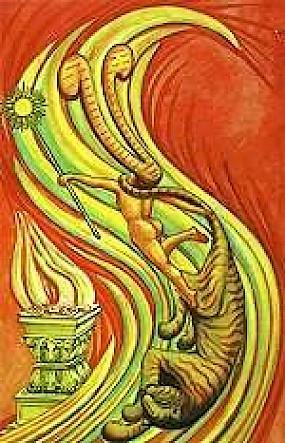
This card represents dynamic passion – for life in general. If it comes up relating to an inner energy then it will indicate that you are overcoming old fears, breaking out of old patterns, and setting yourself free. There will be confidence, decisive action, an assertive leap forward into the heart of your life. It will often come up to indicate that you have broken through habitual limitations and restrictions, thereby freeing off your power to be used constructively.
It can indicate a spiritual breakthrough, which will always include the courage to face your fears, and see them for what they truly are. One strange fact about unacknowledged fears is that they take on the darkest, most horrifying shape with which your subconscious can imbue them. Yet when you drag them out into the light of day, you suddenly realise that what you were so scared of might a) never happen; b) not be as bad as you thought it would be when you feared it; and c) you’ve probably got what it takes to deal with it anyway!
If the Princess of Wands comes up to indicate a person, then she will be strong, forceful, determined, unswerving… and perhaps a touch bossy! She is a faithful and trustworthy friend, whose insight and perception will often steer you in the right direction. She will be energetic and enthusiastic about life, with a big personality.
As a partner she’s independent, sometimes a touch stubborn, but loyal and caring. These are often career women, and usually wait till later on to start families. She will be experienced, and intelligent, though regularly you find that such young women have had to learn most of their lessons the hard way.
As an enemy she’s dangerous – she’s usually outspoken, and unafraid to express her anger. If you manage to make an enemy of one of these women, you need to think very carefully about how that happened. Mostly their engagement with life is so total that they don’t waste time on negative pursuits. All the Wand people place morality and ethics high on their list of priorities. They are honest decent people with a strong code of behaviour to which they adhere faithfully.
This card will rarely come up to indicate an event – she almost always shows either another person in your life, or an aspect of self.





.JPG)