
Centre Place Thomas Aquinas (1225-1274) was one of the most brilliant theologians and philosophers of the Middle Ages and all of human history. Aquinas famously believed that the existence of God could be proved by reason alone and he provided five arguments to this effect. John Hamer of Toronto Centre Place will look at each of the five arguments alongside the counter-arguments and will also consider what Aquinas’ philosophy tells us about his conception of God. A Q&A and discussion will follow the presentation. Please send your questions on the live chat. Lecture topics include: Existence of God, Theism and Atheism, Medieval Philosophy, Thomas Aquinas, Summa Theologica, Scholasticism, Reason and Religion, Cosmological argument, Ontological argument, Teleological argument, Intelligent Design,
Monthly Archives: March 2022
Richard & Adam – Climb Every Mountain
richardandadamVEVO Official ‘Climb Every Mountain’ video, taken from the upcoming album ‘Believe’. Preorder it here: http://smarturl.it/RABelieveAmz?iqid=yt The album features a personal selection of songs and arias made famous by the great classical singers, as well as immortal Welsh melodies held dear to Richard & Adam’s hearts since childhood. Follow Richard & Adam http://www.richardandadamofficial.co.ukhttps://www.facebook.com/richardandadamhttps://twitter.com/RichardAndAdam Music video by Richard & Adam performing Climb Every Mountain. (C) 2016 Sony Music Entertainment http://vevo.ly/DcbSCS#RichardAndAdam#ClimbEveryMountain#Vevo
Music in this video
Learn more
Listen ad-free with YouTube Premium
Song
Climb Every Mountain
Artist
Richard & Adam
Licensed to YouTube by
SME (on behalf of Sony Classical); Concord Music Publishing, LatinAutor – PeerMusic, and 14 Music Rights Societies
Free Will Astrology: Week of March 17, 2022
MARCH 15, 2022 AT 7:00 AM BY ROB BREZSNY (newcity.com)

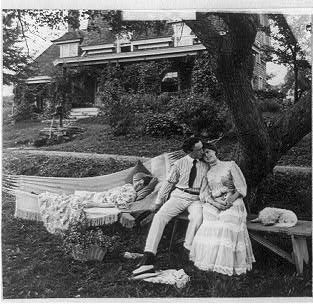
Man With Arm Around Woman on Bench and Chaperone Sleeping in Hammock. , ca. 1907. Photograph courtesy the Library of Congress
ARIES (March 21-April 19): Singer, dancer and comedian Sammy Davis Jr. disliked the song “The Candy Man,” but he recorded it anyway, heeding his advisors. He spent just a brief time in the studio, finishing his vocals in two takes. “The song is going straight to the toilet,” he complained, “pulling my career down with it.” Surprise! It became the best-selling tune of his career, topping the Billboard charts for three weeks. I suspect there could be a similar phenomenon (or two!) in your life during the coming months, Aries. Don’t be too sure you know how or where your interesting accomplishments will arise.
TAURUS (April 20-May 20): I love author Maya Angelou’s definition of high accomplishment, and I recommend you take steps to make it your own in the coming weeks. She wrote, “Success is liking yourself, liking what you do, and liking how you do it.” Please note that in her view, success is not primarily about being popular, prestigious, powerful, or prosperous. I’m sure she wouldn’t exclude those qualities from her formula, but the key point is that they are all less crucial than self-love. Please devote quality time to refining and upgrading this aspect of your drive for success.
GEMINI (May 21-June 20): “I’m not fake in any way,” declared Gemini actor Courteney Cox. On the face of it, that’s an amazing statement for a Gemini to make. After all, many in your tribe are masters of disguise and shapeshifting. Cox herself has won accolades for playing a wide variety of characters during her film and TV career, ranging from comedy to drama to horror. But let’s consider the possibility that, yes, you Geminis can be versatile, mutable and mercurial, yet also authentic and genuine. I think this specialty of yours could and should be extra prominent in the coming weeks.
CANCER (June 21-July 22): “Sometimes I prayed for Baby Jesus to make me good, but Baby Jesus didn’t,” wrote author Barbara Kingsolver about her childhood approach to self-improvement. Just because this method failed to work for her, however, doesn’t mean it won’t work for others. In saying that, I’m not implying you should send out appeals to Baby Jesus. But I suggest you call on your imagination to help you figure out what influences may, in fact, boost your goodness. It’s an excellent time to seek help as you elevate your integrity, expand your compassion, and deepen your commitment to ethical behavior. It’s not that you’re deficient in those departments; just that now is your special time to do what we all need to do periodically: Make sure our actual behavior is in rapt alignment with our high ideals.
LEO (July 23-Aug. 22): Leo classicist and author Edith Hamilton specialized in the history of ancient Greece. The poet Homer was one of the most influential voices of that world. Hamilton wrote, “An ancient writer said of Homer that he touched nothing without somehow honoring and glorifying it.” I love that about his work, and I invite you to match his energy in the coming weeks. I realize that’s a lot to ask. But according to my reading of the astrological omens, you will indeed have a knack for honoring and glorifying all you touch.
VIRGO (Aug. 23-Sept. 22): Starhawk, one of my favorite witches, reminds us that “sexuality is the expression of the creative life force of the universe. It is not dirty, nor is it merely ‘normal’; it is sacred. And sacred can also be affectionate, joyful, pleasurable, passionate, funny, or purely animal.” I hope you enjoy an abundance of such lushness in the coming weeks, Virgo. It’s a favorable time in your astrological cycle for synergizing eros and spirituality. You have poetic license to express your delight about being alive with imaginative acts of sublime love.
LIBRA (Sept. 23-Oct. 22): In 1634, English poet John Milton coined the phrase “silver lining.” It has become an idiom referring to a redemptive aspect of an experience that falls short of expectations. Over 350 years later, American author Arthur Yorinks wrote, “Too many people miss the silver lining because they’re expecting gold.” Now I’m relaying his message to you. Hopefully, my heads-up will ensure that you won’t miss the silver lining for any reason, including the possibility that you’re fixated on gold.
SCORPIO (Oct. 23-Nov. 21): “This is the most profound spiritual truth I know,” declares author Anne Lamott. “That even when we’re most sure that love can’t conquer all, it seems to anyway. It goes down into the rat hole with us, in the guise of our friends, and there it swells and comforts. It gives us second winds, third winds, hundredth winds.” Lamott’s thoughts will be your wisdom to live by during the next eight weeks, Scorpio. Even if you think you already know everything there is to know about the powers of love to heal and transform, I urge you to be open to new powers that you have never before seen in action.
SAGITTARIUS (Nov. 22-Dec. 21): Witty Sagittarian author Ashleigh Brilliant has created thousands of cheerful yet often sardonic epigrams. In accordance with current astrological omens, I have chosen six that will be useful for you to treat as your own in the coming weeks. 1. “I may not be totally perfect, but parts of me are excellent.” 2. “I have abandoned my search for truth and am now looking for a good fantasy.” 3. “All I want is a warm bed and a kind word and unlimited power.” 4. “Do your best to satisfy me—that’s all I ask of everybody.” 5. “I’m just moving clouds today, tomorrow I’ll try mountains.” 6. “A terrible thing has happened. I have lost my will to suffer.”
CAPRICORN (Dec. 22-Jan. 19): “All experience is an enrichment rather than an impoverishment,” wrote author Eudora Welty. That may seem like a simple and obvious statement, but in my view, it’s profound and revolutionary. Too often, we are inclined to conclude that a relatively unpleasant or inconvenient event has diminished us. And while it may indeed have drained some of our vitality or caused us angst, it has almost certainly taught us a lesson or given us insight that will serve us well in the long run—if only to help us avoid similar downers in the future. According to my analysis of your current astrological omens, these thoughts are of prime importance for you right now.
AQUARIUS (Jan. 20-Feb. 18): “Life swarms with innocent monsters,” observed poet Charles Baudelaire. Who are the “innocent monsters”? I’ll suggest a few candidates. Boring people who waste your time but who aren’t inherently evil. Cute advertisements that subtly coax you to want stuff you don’t really need. Social media that seem like amusing diversions except for the fact that they suck your time and drain your energy. That’s the bad news, Aquarius. The good news is that the coming weeks will be a favorable time to eliminate from your life at least some of those innocent monsters. You’re entering a period when you’ll have a strong knack for purging “nice” influences that aren’t really very nice.
PISCES (Feb. 19-March 20): “Never underestimate the wisdom of being easily satisfied,” wrote aphorist Marty Rubin. If you’re open to welcoming such a challenge, Pisces, I propose that you work on being very easily satisfied during the coming weeks. See if you can figure out how to enjoy even the smallest daily events with blissful gratitude. Exult in the details that make your daily rhythm so rich. Use your ingenuity to deepen your capacity for regarding life as an ongoing miracle. If you do this right, there will be no need to pretend you’re having fun. You will vividly enhance your sensitivity to the ordinary glories we all tend to take for granted.
Homework: What small change could you initiate that will make a big beneficial difference? Newsletter.FreeWillAstrology.com
Full Moon In Virgo – The Voice Of Reason
| by Astro Butterfly (astrobutterfly.com) |
On March 18th, 2022 we have a Full Moon in Virgo. Full Moons happen in the signs that are opposite from the Sun. We are now in the Pisces season, and we have a record number of planets in Pisces: the Sun, Mercury, Jupiter and Neptune.
What happens when we swim into too much Pisces energy? It’s easy to get lost in Pisces’ fertile field of endless possibilities.
To balance things out, every Pisces season we have a Full Moon in the opposite sign of Virgo.
Virgo is that part of us that is down to earth and remembers to set the alarm at night and makes sure we have enough food in the fridge.
The Full Moon in Virgo will remind us of the practical realities of our everyday life. If we want to achieve those crazy Piscean dreams, we also need Virgo’s practicality and attention to detail.
Ruled by Mercury, Virgo is the voice of reason.

The question Virgo asks is “Does it make sense?”. If it does, good. If it doesn’t, Virgo is the last sign of the zodiac that will try to spare our feelings.
The Full Moon in Virgo will call things for what they are. Even if the message may sound harsh or insensitive, it is well-intentioned. Virgo truly cares – she is the sign of service after all.
Virgo is a symbol for the harvest – all Full Moons in Virgo have a “time to reap what we have sown” energy. When the Moon is Full in Virgo, we are just before the equinox.
The Sun is in Pisces, the last sign of the zodiac. A full Solar cycle comes to an end.
The Full Moon in Virgo is our yearly opportunity to take an honest look at how far we’ve come, see what has worked and what hasn’t, and to come up with a plan for the new solar cycle.
Full Moon In Virgo – The Aspects
The Full Moon on March 18th, 2022 is at 27° Virgo and is opposite Neptune in Pisces, trine Pluto in Capricorn, and trine North Node in Taurus.
Neptune, Pluto and the North Node are collective energies that are beyond our individual control.
In astrology, the Sun symbolizes the world leaders, whereas the Moon symbolizes the people. The Full Moon in Virgo is about how we, the people, respond to worldwide events. And there’s no better way to respond to the Piscean chaos than with Virgo’s reason and common sense.
Neptune in Pisces asks us to restructure our relationship with the world we live in. We’re all in this together.
Pluto in Capricorn invites us to become our own authority. For this, we have to metaphorically slay the dragon or the umbilical cord that keeps us stuck in a dependency we’ve long outgrown. Corruption needs to be witnessed – in our power-hungry leaders, and also within ourselves.
The North Node in Taurus wants us to become self-reliant. Even if that means we have to reform that Scorpio sector of our life. Scorpio is our shared resources. That’s energy resources (the high price of gas is one of the ‘side effects’ of the South Node in Scorpio transit), material resources, emotional and psychological resources.
If a relationship has become one-sided, or one party takes advantage of the other, it’s time to reclaim our North Node in Taurus autonomy.
We can no longer wait for the ‘other’ to fix our problems. We can no longer stay in a relationship or a contract that has become a burden and doesn’t serve our interests.
Thankfully, these collective energies align harmoniously with the Full Moon. The Full Moon in Virgo can be our much-awaited wake-up call.
The world is going through a lot of turmoil at the moment. The Full Moon in Virgo is an opportunity to draw the line, take an honest look at what’s no longer working and come up with a realistic Virgoan plan on how to fix it.
Once we listen to Virgo’s voice of reason, the upcoming Aries season is our opportunity to start again – stronger, wiser, and more committed than ever.
PTSD looks different in young children – but it’s still treatable
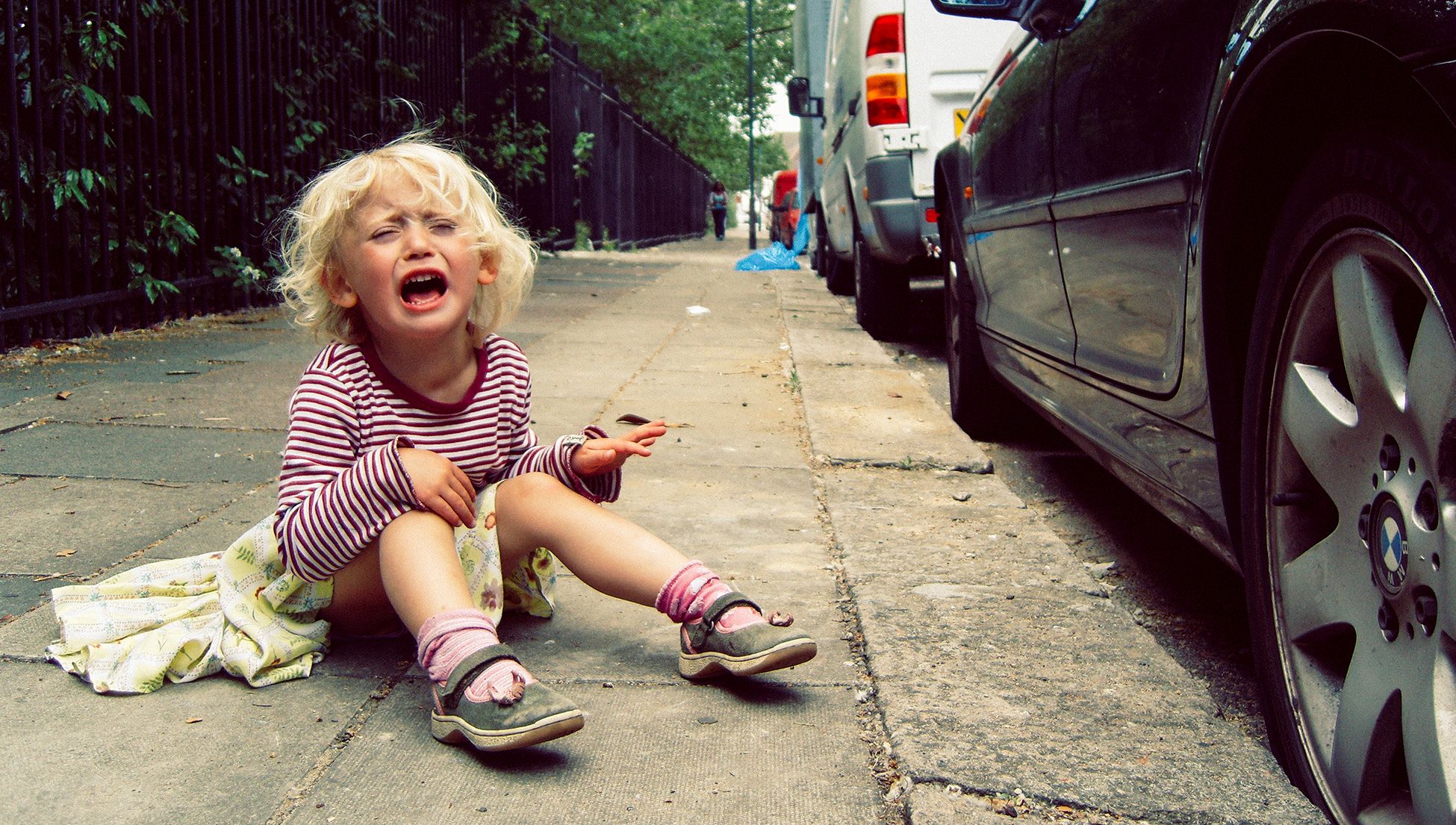
Photo by Richard Bailey Photography/Getty
Caitlin Hitchcockis an experienced clinical psychologist, senior research fellow at the University of Melbourne, and ESRC new investigator at the MRC Cognition and Brain Sciences Unit, University of Cambridge. Her research focus is on using cognitive science to improve the effects of psychological treatment.
Edited by Matt Huston
16 March 2022 (Psyche.co)
Taylor, aged four, is playing in the living room when there is loud and aggressive banging on the door. Mum opens the door – it is their neighbour, who has small children the same age as Taylor, and Taylor stands up to see if the children are at the door too. The neighbour starts yelling loudly. Mum yells back and tries to close the front door. The neighbour, still yelling, forces the door open, it hits Mum in the face, and her nose starts bleeding. As blood pours down Mum’s face and she becomes visibly upset, the neighbour leaves. Could this event have a lasting, negative effect on a young child – and what would it look like if that happened?
After a stressful or traumatic event, both children and adults can find themselves thinking about the event more often than they would like, feeling stressed, anxious or low, or have trouble sleeping. Often, this is a normal reaction to what the brain has perceived as a dangerous situation and, for most people, such reactions will subside within a month of the event. Post-traumatic stress disorder (PTSD) is a debilitating mental condition that occurs after the experience of a perceived threat to life, safety or personal integrity. For a diagnosis of PTSD, the current Diagnostic and Statistical Manual of Mental Disorders (DSM-5) lists key problems that must persist at least one month after a traumatic event, including involuntary reliving of the trauma (eg, through intrusive thoughts and images); avoidance of people, things or places that remind one of the trauma; negative changes in thinking and feelings; and heightened arousal.
Young children can develop PTSD after the same variety of events that cause PTSD in adults, such as abuse or assault, exposure to war, car accidents, or witnessing significant violence against another person. However, threatening or harmful experiences that might not produce PTSD symptoms in adults (eg, being attacked by a dog) can sometimes produce them in children. It is the perception of threat that is important – young children might not understand the causes of an event or the intent behind someone’s actions, and often have no active control over what happens. Therefore, PTSD symptoms can sometimes emerge in younger children following events such as aggressive or harmful behaviour toward a caregiver, or invasive medical procedures.
After the instantiation of the formal PTSD diagnosis in 1980, identification and assessment of PTSD increased. Since then, psychologists and other health professionals have recognised that younger children (aged three to six) tend to show a different profile of PTSD symptoms following a traumatic experience.
In Taylor’s case (which is fictional, but based on real cases), she is understandably upset and scared in the immediate aftermath of the event. But one month afterwards, Taylor still sticks close to Mum and doesn’t like Mum to go out without her. She starts refusing to sleep in her own bed like she used to. She has tantrums when taken to the dance class that she usually enjoys. She no longer plays in the living room or the garden. Taylor visibly freezes or becomes upset when the doorbell rings, which might also be expected from an adult with PTSD. But Taylor’s other behaviours do not seem to fit traditional descriptions of the disorder. Does that mean that Taylor is experiencing a normal reaction, or that her difficulties are unrelated to the event? Would she benefit from the support of a health professional?
The criteria outline symptoms specific to young children, such as re-enacting the trauma during play, having scary dreams that they struggle to describe, and temper tantrums
Researchers around the world have been working to improve the identification of young children who are experiencing PTSD – and, critically, to develop psychological treatments that can help them.
Meeting this challenge has required some rethinking of how PTSD is diagnosed in young children. A series of studies in the early 2000s suggested that the standard diagnostic criteria for PTSD were failing to identify a large number of young children who were in need of support. Consequently, researchers proposed an alternative, developmentally sensitive diagnostic algorithm for young children. Following minor refinements to this alternative algorithm, the most recent version of the DSM included new diagnostic criteria for a subtype of PTSD in children aged six and younger.
The core features of the PTSD in young children (PTSD-YC) subtype remain the same as in adults. However, there are important differences. For instance, the developmentally appropriate criteria reduce the extent to which certain kinds of symptoms, such as avoidance symptoms, are required for a diagnosis. (Young children are less able to control where they go: for example, even if a young child would like to avoid the scene of a trauma, a caregiver can pick them up and take them there.) The criteria outline variations on symptoms that might be specific to young children, such as re-enacting the trauma during play, having scary dreams that they struggle to describe, and having temper tantrums. As with adults, diagnosis requires a combination of multiple symptoms to be present, to ensure that normal behaviours are not pathologised, and the symptoms must cause significant disruption to daily functioning. It is also central to diagnosis that the behaviours must have started or worsened since the traumatic event.
When my colleagues and I recently applied the alternative algorithm for diagnosing young children to data from a British national survey, it identified a markedly higher number of very young children as having PTSD compared with the earlier, adult-based PTSD criteria. Our analysis of the survey data indicated that approximately 7 per cent of five- to six-year-old children in the UK had experienced a traumatic event, and that, of those trauma-exposed children, 5.4 per cent met criteria for a diagnosis of PTSD-YC. Data from a similar British survey with children in foster care suggested that 48 per cent of the five- to six-year-olds had experienced a trauma, with 57 per cent of those trauma-exposed children experiencing PTSD.
Much of the time, very young children who have experienced a traumatic event might not be assessed for PTSD, as the symptoms could be regarded as separate, unrelated behavioural problems rather than as representative of an underlying mental health issue. As a result, these children frequently do not receive any trauma-focused treatment. This is problematic for the child – if left untreated, PTSD can last for years, even into adulthood, and severely impact ongoing development, including the child’s ability to learn, form healthy relationships, and enjoy their life. But we do have PTSD treatments designed for adults that are also effective in treating younger children, and these are now recommended for use with children by international health guidelines.
One of the most effective approaches to treating PTSD in adults and older children is trauma-focused cognitive behavioural therapy (CBT). A core feature of trauma-focused CBT is working with an individual’s memory of the trauma – which can often be disjointed and lack coherence – to identify and adapt the unhelpful beliefs they hold about the event (eg, It was my fault; the world is not safe; bad things happen to people I love).
Like all of us, young children may also need reminding of the good things that they did in a scary situation (such as trying to protect a sibling)
Though younger children are still developing their language skills and might struggle to describe their memories and abstract concepts, a number of clinical trials now suggest that trauma-focused CBT can be adapted to successfully treat PTSD in these children. One such treatment protocol, CBT-3M, focuses on changing three key factors that drive PTSD: the trauma memory, the meaning the child makes about the event, and the maladaptive coping strategies the child uses to manage the impact of the trauma.
An organised and coherent memory of a traumatic event aids recovery from PTSD as it helps an individual to understand why the event occurred, and to constrain the meaning of the event to the appropriate context. For example, updating a disjointed memory of a traumatic car accident to include details you had not attended to at the time (eg, you had been obeying the road rules) or that you did not know at the time (eg, the other driver was drunk) can help adjust an unhelpful meaning you made from the event (driving is always dangerous; I will hurt others if I am in a car) to something more adaptive and representative of the situation (cars are dangerous only when driven irresponsibly). Maladaptive coping strategies that perpetuate symptoms must also be addressed. Avoiding reminders of the trauma, for instance, might reduce distress in the immediate term, but it also reinforces the idea that you cannot handle what is being avoided, when in fact you can.
To help a child improve on each of these factors, the therapist will complete therapeutic activities with either the child alone or the child together with a caregiver. Therapeutic tasks can involve using dolls, stuffed animals or toys (eg, cars, ambulances) to re-enact the traumatic event and help the child organise their memory to accurately represent what happened. The child might be guided to draw pictures or select cards with different emotional faces that show how the child feels and reacts to reminders of the trauma. This helps them to link the feelings they’ve been having to the traumatic event, and understand why these feelings suddenly arise, seemingly out of nowhere. Comics or short videos can also be used to explain how and why the brain produces the symptoms that the child is experiencing. Activities such as these seek to challenge maladaptive meanings that the child might have made (eg, I am going crazy; I am broken) by teaching the child that their symptoms are an understandable reaction to the trauma, and showing them that other children have had the same problems following a traumatic event.
A therapist can work with the child’s caregiver to instigate a routine for the child, in order to make their world more predictable and thus feel safer. Caregivers can also provide additional information that helps the child better understand the traumatic event. For example, a child might have felt that no one was coming to help them, when in fact an observer had called an ambulance or a lifeguard was swimming quickly toward them. Like all of us, young children may also need reminding of the good things that they did in a scary situation (such as trying to protect a sibling).
For Taylor, Mum might be able to explain that the neighbour had not intended to hurt her, and that, although there was lots of blood, it did not hurt as much as Taylor had feared. A recent trial has even trained parents in how to deliver sessions of trauma-focussed CBT to their children at home, with promising results. However, the child’s caregiver is often present during a child’s trauma, and as such could be in need of support themselves.
Research is steadily improving our understanding of how best to support young children experiencing PTSD. But it is clear that very young children do experience PTSD, and that we have psychological treatments that can help them overcome it. This support can enable children to escape their continual reliving of the trauma, feel more in control of their emotions, and re-engage with activities that they enjoy – minimising the risk that trauma will have a lasting impact on their future.
If you would like more information on how to support a young person who has experienced a potentially traumatic event, there are lots of free, useful resources at childtraumarecovery.com or phoenixaustralia.org.
Book: “God Is Here: Reimagining the Divine”
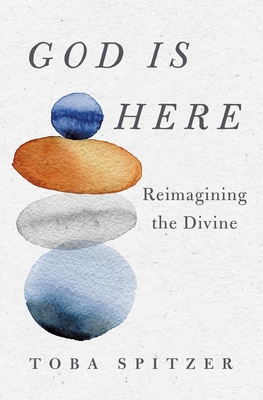
God Is Here: Reimagining the Divine
Toba Spitzer
Toba Spitzer’s God Is Here is a transformative exploration of the idea of God, offering new paths to experiencing the realm of the sacred.
Most of us are hungry for a system of meaning to make sense of our lives, yet traditional religion too often leaves those seeking spiritual sustenance unsatisfied. Rabbi Toba Spitzer understands this problem firsthand, and knows that too often it is traditional ideas of the deity—he’s too big, too impersonal, and too unbelievable—that get in the way. In God Is Here, Spitzer argues that whether we believe in God or fervently disbelieve, what we are actually disagreeing about is not God at all, but a metaphor of a Big Powerful Person that limits our understanding and our spiritual lives.
Going back to the earliest sources for Judaism as well as Christianity, Spitzer discovers in the Hebrew Bible a rich and varied palette of metaphors for the divine—including Water, Voice, Fire, Rock, Cloud, and even the process of Becoming. She addresses how we can access these ancient metaphors, as well as those drawn from rabbinic tradition and modern science, to experience holiness in our daily lives and to guide us in challenging times. In the section on water, for instance, she looks at the myriad ways water flows through the Biblical stories of the Israelites and emerges as a powerful metaphor for the divine in the Prophets and Psalms. She invites us to explore what it might mean to “drink from God,” or to experience godly justice as something that “rains down” and “flows like a river.”
Each chapter contains insights from the Bible and teachings from Judaism and other spiritual traditions, accompanied by suggestions for practice to bring alive each of the God metaphors. Rabbi Toba Spitzer has helped many people satisfy their spiritual hunger. With God Is Here she will inspire you to find new and perhaps surprising ways of encountering the divine, right where you are.
(Goodreads.com)
Our Need for Each Other and Our Need for Our Selves: Muriel Rukeyser on Our Source of Strength in Times of Turmoil
By Maria Popova (brainpickings.org)

“My one reader, you reading this book, who are you?” Muriel Rukeyser (December 15, 1913–February 12, 1980) asks with the large forthright eyes of her words in one of the most beautiful and penetrating books ever written on any subject. “What is your face like, your hands holding the pages, the child forsaken in you, who now looks through your eyes at mine?”
It is the summer of 1949. Her life is still only thirty-six years long but thirty thousand years wise. She has lived through two World Wars, has shared a small ship with fivefold the number of refugee bodies the vessel can hold, has been arrested for placing her own solid and unapologetic body on the right side of what is yet to be celebrated and capitalized as Civil Rights, has stood amid the anarchists in the Spanish Civil War and traveled home to tell their story, has staggered the world with her debut poetry collection at only twenty-two and followed it with a thoroughly unexpected sidewise triumph of vision in her staggering more-than-biography of one of the most influential and misunderstood scientists who ever lived.
But it is this book, The Life of Poetry (public library), that is and would remain her elemental statement of belief — a humanistic document for the epochs, a reliquary of rapture, a blueprint for resistance to the thousand desultory derogations by which living can desecrate life.
Muriel Rukeyser
Rukeyser writes in the introduction:
In times of crisis, we summon up our strength.
Then, if we are lucky, we are able to call every resource, every forgotten image that can leap to our quickening, every memory that can make us know our power. And this luck is more than it seems to be: it depends on the long preparation of the self to be used.
In time of the crises of the spirit, we are aware of all our need, our need for each other and our need for our selves. We call up, with all the strength of summoning we have, our fullness. And then we turn; for it is a turning that we have prepared; and act. The time of the turning may be very long. It may hardly exist.
However slow or subtle the turning, the fulcrum by which we turn is love. “In time of struggle,” Rukeyser tells us, “all people think about love” — never more so than amid uncertainty, when the familiar terrain grows foreign and uneven, when the very ground beneath our feet fails to hold steady:
If there is a feeling that something has been lost, it may be because much has not yet been used, much is still to be found and begun.

Art by Ofra Amit from A Velocity of Being: Letters to a Young Reader. Available as a print.
We have struggled to find this untapped potential, Rukeyser argues, because our standard modes of intellectual probing sidestep the life of feeling, which poetry — “this other kind of knowledge and love” — alone can access and allay:
A generation before Audre Lorde placed at the heart of poetry the courage to feel, from which all power and all change spring, Rukeyser distills the essence of poetry as “an approach to the truth of feeling,” insisting upon its clarifying and cohesionary power:
As we wade from the chaos without to the cohesion within, this is what we move through and move toward:
Experience taken into the body, breathed in, so that reality is the completion of experience, and poetry is what is produced. And life is what is produced.
In the final pages of the book, Rukeyser returns to what is left as the bedrock of our strength when all falls apart and away:
[…]
All the poems of our lives are not yet made.
We hear them crying to us, the wounds, the young and the unborn — we will define that peace, we will live to fight its birth, to build these meanings, to sing these songs.
Complement this fragment of Rukeyser’s uncommonly vitalizing The Life of Poetry with Maya Angelou’s poetic consolation for our crises and our contradictions, then revisit Rukeyser on the deepest wellspring of our aliveness.
Ukraine Emergency Translation Group
We have another Ukraine Emergency Translation Group meeting scheduled for this Friday, March 18 at 11:00 AM Pacific Time, noon Mountain time, 1pm Central time, 2pm Eastern time, 8pm Greece, 9pm Turkey. Time changes in Greece and Turkey reflect time change in the States.
We will share your Translation with the group, if you like. You can email your Translation to me at zonta1111@aol.com.
Or perhaps you have a sense testimony you’d like to share. Or other insights or questions you may have.
Open to all Translators.
See you Friday.
Mike Zonta
Ukraine Emergency Translation Group
Prosperos Meetings is inviting you to a scheduled Zoom meeting.
Topic: Ukraine Emergency Translation GroupTime: Mar 18, 2022 11:00 AM Pacific Time, noon Mountain time, 1pm Central time, 2pm Eastern time, 8pm Greece, 9pm Turkey
Every week on Fri, until Apr 15, 2022, 5 occurrence(s)
Join Zoom Meeting: https://us02web.zoom.us/j/84023755291
Meeting ID: 840 2375 5291
One tap mobile
+16699006833,,84023755291# US (San Jose)
+13462487799,,84023755291# US (Houston)
Dial by your location
+1 669 900 6833 US (San Jose)
+1 346 248 7799 US (Houston)
+1 253 215 8782 US (Tacoma)
+1 929 205 6099 US (New York)
+1 301 715 8592 US (Washington DC)
+1 312 626 6799 US (Chicago)
Meeting ID: 840 2375 5291
Find your local number: https://us02web.zoom.us/u/kdNwwZt760
Triple conjunction: Pluto, Mars and Venus — how this is impacting us collectively and individually
Heather Ensworth From February 23, 2022 through mid-March, Pluto, Mars and Venus will be conjunct each other (within a 5 degree orb). Mars and Venus will stay in conjunction with each other all of February and March, first in the sign of Capricorn and then in Aquarius. This is a powerful combination of planets that is supporting us in shifting how we relate to each other collectively and individually. In this video, I talk about the gifts and the challenges of this configuration and how we can work with these energies to move into higher consciousness and a rebalancing of the energies of the Sacred Masculine and Sacred Feminine within us and in our world. Heather Ensworth: website: risingmoonhealingcenter.com To become a patron: patreon.com/heatherensworth
(Contributed by Zoë Robinson, H.W.,M.)
Tarot Card for March 17: The Devil
The Devil
The Devil is numbered fifteen and shows a figure, usually male and satyr-like, half-man and half-animal. Sometimes, male and female forms are shown chained or trapped at his feet. The Thoth deck (shown here) has the Devil as a goat, appearing against a background of the male sex organs. His third eye represents the Eye of God and the staff across his chest is topped with the Winged Disk symbol and double-headed snakes.
The Devil card is often misunderstood and feared. However, before Christianity became a leading religion, there were several pantheons which contained fertility gods and they were often depicted as animals – the Horned God of the Wicca for example, servant and consort of the Goddess. The Devil does not therefore necessarily represent an evil being.
The Devil is the personification of the animal, instinctual and even bestial parts of us. Pre-occupation with matters connected to the Devil can lead to degradation and sheer ugliness, but by identifying and accepting the darkness within we learn to discover that it is simply the dark side of our light.
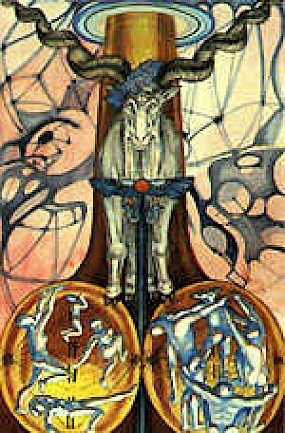
(via angelpaths.com and Alan Blackman)