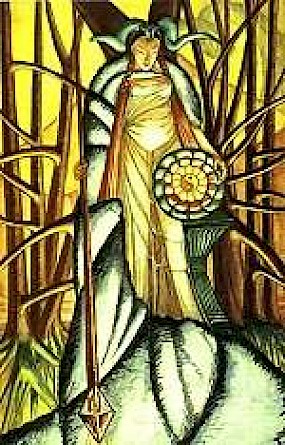
A young woman indicated by the Princess of Disks would be a quiet, reserved person – sometimes shy. She will be practical and capable, though rarely seeking the limelight. I used to know a stage manager who always came up as a Princess of Disks – she loved the glitz of the theatre as long as she could stay behind the scenes – having, of course, created them first!
She’s a gentle person who, like the Queen of Disks, is much concerned with domestic matters, and with Nature and growth. As a result, sometimes when this card comes up we may be looking at somebody who is expecting a child. The Princess of Cups often represents conception, the Princess of Disks shows the pregnancy and the Ace of Wands will then indicate the birth.
The Princess of Disks woman is a reliable and diligent person, trustworthy and hard-working. She is faithful by nature, and deals badly with conflict. She likes life to unfolds in an ordered fashion. In fact, she contemplates life very thoroughly, being sensitive to the needs of others, and sympathetic to their feelings.
Despite her quiet exterior, she has a huge resource of strength and support to offer to those who need it. She is also an excellent practical manager with marked proficiency in dealing with money and accounting. This will, however, generally be expressed in the home environment where she is at her most content.
When the card comes up to indicate a period in somebody’s life, rather than the person herself, we will be looking at a young woman on the threshold – of life, marriage, motherhood, though rarely on the threshold of some major career ambition. That step would be more readily indicated by the Princess of Wands.
The Indian city of Gaya, where Buddha is believed to have attained enlightenment, is caught in a row that doesn’t exactly showcase enlightenment.
The airport at the major pilgrimage and heritage site, located in the northern state of Bihar, could soon have its code “GAY” changed. No points for guessing that the existing one is deemed “offensive, embarrassing and inappropriate.”
The parliamentary committee on public undertakings, in its report on Feb. 4, recommended to the Narendra Modi government that Gaya’s code be changed to a “more appropriate one” like YAG.
“The committee has their apprehension that Gaya being a holy city, locals might be finding it offensive or embarrassing on their city being recognised in the international community with the code name GAY. The committee also finds it inappropriate and unsuitable,” it said.
The report recorded the government’s reply on the matter, which included the International Air Transport Association’s (IATA)—it assigned Gaya airport the code GAY—response to the issue. The organisation assigns a two-character code name for airlines and a three-character code for airports for easy identification.
IATA said, “Location codes are considered permanent and cannot be changed without strong justification primarily concerning air safety.” The panel, however, hasn’t found this satisfactory enough and has asked the centre to pursue the matter.
Meanwhile, Indian social media users called out the homophobia among the country’s political class.
The parliamentary panel has a problem with the "GAY" code for Gaya airport do they suggested "YAG" instead. That's still gay in reverse, so queers win!
Lesson 200 There is no peace except the peace of God.
Seek you no further. You will not find peace except the peace of God. Accept this fact, and save yourself the agony of yet more bitter disappointments, bleak despair, and sense of icy hopelessness and doubt. Seek you no further. There is nothing else for you to find except the peace of God, unless you seek for misery and pain.
This is the final point to which each one must come at last, to lay aside all hope of finding happiness where there is none; of being saved by what can only hurt; of making peace of chaos, joy of pain, and Heaven out of hell. Attempt no more to win through losing, nor to die to live. You cannot but be asking for defeat.
Yet you can ask as easily for love, for happiness, and for eternal life in peace that has no ending. Ask for this, and you can only win. To ask for what you have already must succeed. To ask that what is false be true can only fail. Forgive yourself for vain imaginings, and seek no longer what you cannot find. For what could be more foolish than to seek and seek and seek again for hell, when you have but to look with open eyes to find that Heaven lies before you, through a door that opens easily to welcome you?
Come home. You have not found your happiness in foreign places and in alien forms that have no meaning to you, though you sought to make them meaningful. This world is not where you belong. You are a stranger here. But it is given you to find the means whereby the world no longer seems to be a prison house or jail for anyone.
Freedom is given you where you beheld but chains and iron doors. But you must change your mind about the purpose of the world, if you would find escape. You will be bound till all the world is seen by you as blessed, and everyone made free of your mistakes and honored as he is. You made him not; no more yourself. And as you free the one, the other is accepted as he is.
What does forgiveness do? In truth it has no function, and does nothing. For it is unknown in Heaven. It is only hell where it is needed, and where it must serve a mighty function. Is not the escape of God’s beloved Son from evil dreams that he imagines, yet believes are true, a worthy purpose? Who could hope for more, while there appears to be a choice to make between success and failure; love and fear?
There is no peace except the peace of God, because He has one Son who cannot make a world in opposition to God’s Will and to his own, which is the same as His. What could he hope to find in such a world? It cannot have reality, because it never was created. Is it here that he would seek for peace? Or must he see that, as he looks on it, the world can but deceive? Yet can he learn to look on it another way, and find the peace of God.
Peace is the bridge that everyone will cross, to leave this world behind. But peace begins within the world perceived as different, and leading from this fresh perception to the gate of Heaven and the way beyond. Peace is the answer to conflicting goals, to senseless journeys, frantic, vain pursuits, and meaningless endeavors. Now the way is easy, sloping gently toward the bridge where freedom lies within the peace of God.
Let us not lose our way again today. We go to Heaven, and the path is straight. Only if we attempt to wander can there be delay, and needless wasted time on thorny byways. God alone is sure, and He will guide our footsteps. He will not desert His Son in need, nor let him stray forever from his home. The Father calls; the Son will hear. And that is all there is to what appears to be a world apart from God, where bodies have reality.
Now is there silence. Seek no further. You have come to where the road is carpeted with leaves of false desires, fallen from the trees of hopelessness you sought before. Now are they underfoot. And you look up and on toward Heaven, with the body’s eyes but serving for an instant longer now. Peace is already recognized at last, and you can feel its soft embrace surround your heart and mind with comfort and with love.
Today we seek no idols. Peace can not be found in them. The peace of God is ours, and only this will we accept and want. Peace be to us today. For we have found a simple, happy way to leave the world of ambiguity, and to replace our shifting goals and solitary dreams with single purpose and companionship. For peace is union, if it be of God. We seek no further. We are close to home, and draw still nearer every time we say:
There is no peace except the peace of God, And I am glad and thankful it is so.
The longer I live, the more deeply I learn that love — whether we call it friendship or family or romance — is the work of mirroring and magnifying each other’s light. Gentle work. Steadfast work. Life-saving work in those moments when life and shame and sorrow occlude our own light from our view, but there is still a clear-eyed loving person to beam it back. In our best moments, we are that person for another.
In learning this afresh — as we must learn all the great and obvious truths, over and over — I was reminded of a passage by James Baldwin (August 2, 1924–December 1, 1987) from Nothing Personal (public library) — his 1964 collaboration with the photographer Richard Avedon, his high school classmate and lifelong friend, which contains some of Baldwin’s least-known yet most intimate writings, including his antidote to dog-hour despair and his counterforce to entropy. (In the years since I first wrote about this forgotten treasure, it has been unforgotten in a new edition by Penguin Random House — regrettably, without Avedon’s photographs, razing the spirit of collaboration between friends that occasioned the project in the first place; redemptively, with a foreword by the dazzling Imani Perry, who considers herself Baldwin’s “pupil in the study of humanity” and who writes splendidly about his enduring gift of reminding us how reading “allows us to recognize each other” and “makes everything seem possible.”)
James Baldwin
In the final of the book’s four essays, Baldwin writes:
One discovers the light in darkness, that is what darkness is for; but everything in our lives depends on how we bear the light. It is necessary, while in darkness, to know that there is a light somewhere, to know that in oneself, waiting to be found, there is a light.
Love becomes a lens on the world, on space and on time — a pinhole through which a new light enters to project onto the cave wall of our consciousness landscapes of intimate importance from territories of being we would have never otherwise known.
Pretend, for example, that you were born in Chicago and have never had the remotest desire to visit Hong Kong, which is only a name on a map for you; pretend that some convulsion, sometimes called accident, throws you into connection with a man or a woman who lives in Hong Kong; and that you fall in love. Hong Kong will immediately cease to be a name and become the center of your life. And you may never know how many people live in Hong Kong. But you will know that one man or one woman lives there without whom you cannot live. And this is how our lives are changed, and this is how we are redeemed.
What a journey this life is! Dependent, entirely, on things unseen. If your lover lives in Hong Kong and cannot get to Chicago, it will be necessary for you to go to Hong Kong. Perhaps you will spend your life there, and never see Chicago again. And you will, I assure you, as long as space and time divide you from anyone you love, discover a great deal about shipping routes, airlines, earth quake, famine, disease, and war. And you will always know what time it is in Hong Kong, for you love someone who lives there. And love will simply have no choice but to go into battle with space and time and, furthermore, to win.
A master of metaphor — that handle on the door to new worlds — Baldwin takes the case of what we call long-distance love and finds in it a miniature of all love.
All love bridges the immense expanse between lonelinesses, becomes the telescope that brings another life closer and, in consequence, also magnifies the significance of their entire world.
All love is light’s battle against the entropy continually inclining spacetime toward nothingness, against the hard fact that you will die, and I will die, and everyone we love will die, and what will survive of us are only shoreless seeds and stardust.
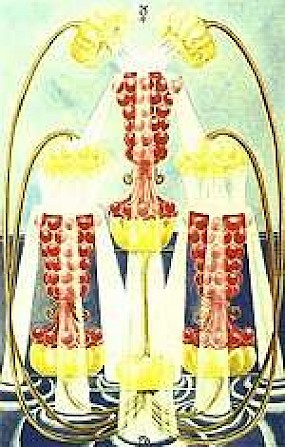
The Lord of Abundance is a warm and joyous card, which indicates a rare and precious type of love – a love which, once experienced, reminds us of the richness of shared emotion and commitment.
It is also a card which refers to the wellspring of fertility, whether spiritual or material. Here we see the first seeds sown of a bright and bountiful harvest. Accordingly, the card will sometimes come up to indicate high days of celebration – like weddings or other intimate celebrations of love.
The emotional quality represented by this card is deep and unusual – indicating the love felt not only by lovers, but also the love between close friends, or family. These relationships are gifts, which need to be cared for with great respect and gratitude.
The Lord of Abundance offers one word of warning – this type of love cannot be created, nor engineered. When it occurs in our lives we are lucky and blessed. Some people spend a lifetime looking for such depth of emotion. And sometimes, people try to pretend it exists where it does not. So when you raise this card in a reading be aware that you are fortunate indeed!
Changing of the Gods The series is coming out on 2.22.22. Sign up at https://changingofthegods.com/ to be part of the online premiere. Featuring… Richard Tarnas Ph.D. Luisah Teish Eve Ensler Stan Grof M.D. John A Powell Oren Lyons William Keepin Ph.D. Jay Harmon Jeremy Narby Ph.D. Xiuhtezcatl Martinez Thomas Linzey Mari Margil Co-Director, Producer and Writer Kenny Ausubel Co-Director Louie Schwartzberg Executive Producer Geralyn Dreyfous Producer Maximilian DeArmon Executive Producer Bill Benenson Creative Consultant Laurie Benenson Creative Consultant Nina Simons Executive Producer Regina Scully Executive Producer Dale Rodrigues Associate Producers Jeffrey Bronfman Carmen Sorrenti Nicholas Wong Robert J Barnhart The Astrology Shop Postproduction Assistant Veronica Lynn Lead Editor and Graphic Artist Theo Badashi Visual Effects and Motion Graphics Omid Pakbin Narrator Kirsten Kairos Music Composers Teese Gohl Mick Rossi Jamey Haddad Sound Mix and Master Kabby Kabakoff @ Kabby Sound Studios V.O. Engineer and Mixer Edgard Rivera @ Stepbridge Studios Music Supervisor: Rodney “Okai” Fleurimont
“We’re participating in a great mystery that’s unfolding for us.”
–Richard Tarnas
The Astrology Podcast An introduction to the meaning of the planet Pluto in astrology, with astrologers Richard Tarnas and Chris Brennan. In astrology Pluto is generally associated with power, control, manipulation, intensity, the underworld, taboos, transformations, destruction and regeneration, death and rebirth, making big things small and small things big. Richard is the author of the 2006 book Cosmos and Psyche: Intimations of a New World View, and he previously appeared on episode 84 of The Astrology Podcast in 2016 to talk about the book on its 10 year anniversary: https://www.youtube.com/watch?v=JTdwE… At the beginning of the episode we talked a bit about the recent conjunction of Saturn and Pluto in 2020, how it coincided with the beginning of the pandemic, and how Richard felt about having discussed that cycle in Cosmos and Psyche in retrospect. Some of this was tied into a discussion in episode 254 titled Misconceptions About Mundane Astrology in the Media: https://www.youtube.com/watch?v=ZvHiJ… Later we get into the discovery of Pluto, discuss how astrologers establish the meaning of new planets, and then read through some passages from different astrologers that talk about the meaning of Pluto. Later in the episode we also touch on how to deal with skeptics of astrology, and how to demonstrate the validity of astrology in general. We also discuss a new astrology documentary series based on Richard’s work titled Changing of the Gods, which will be released next month. Find out more about Changing of the Gods series at: https://changingofthegodsseries.com This is episode 336 of The Astrology Podcast: https://theastrologypodcast.com/2022/… Patreon: https://www.patreon.com/astrologypodcast#TheAstrologyPodcast Timestamps: 00:00:00 Introduction 00:02:25 Welcoming Richard + Changing of the Gods series 00:08:25 Uranus-Pluto alignments 00:11:10 Reflections on the Saturn-Pluto conjunction of 2020 00:32:07 How do astrologers establish the meaning of new planets? 00:57:00 Pluto significations in Reinhold Ebertin 01:05:09 Robert Hand’s Pluto significations 01:12:48 Richard Tarnas’ Pluto significations 01:31:30 World events coinciding with Pluto’s discovery 01:38:45 Pluto return of the United States 01:46:40 Depth psychology and Pluto 02:05:47 Pluto makes big things small and small things big 02:11:02 Venus-Pluto aspects 02:25:05 Jupiter-Pluto aspects 02:33:25 Orbs and Archetypal Explorer 02:43:04 Dealing with skeptics of astrology 02:57:35 The goal of Cosmos and Psyche 03:08:10 Experience vs. intellectual argument for convincing skeptics 03:15:30 Pluto’s demotion to dwarf planet 03:30:46 Astrology as a gift from the cosmos 03:36:09 Changing of the Gods documentary 03:39:16 Concluding remarks, patrons, and sponsors
Plum Village App The new, free mindfulness app Plum Village is now live in both app stores (iOS and Android): https://plumvillage.app/ Gregory Kennedy-Salemi & Stuart Jolley had the immense pleasure to accompany Thich Nhat Hanh and the Sangha at the GooglePlex and Stanford University, while on their USA Tour in 2013. Stanford University´s Center for Compassion and Altruism Researach and Education (CCARE) hosted a discussion with Thich Nhat Hanh about his life experiences and the role compassion has played throughout them. http://ccare.stanford.edu/ English Transcription by Terry Barber. Edited and Caption Creation by Peace Is The Way Films. Recorded by Stanford’s Media Department. With thanks to Parallax Press and Plum Village. Thích Nhất Hạnh is a Vietnamese Zen Buddhist monk, teacher, author, poet and peace activist. He lives in the Plum Village Monastery in the Dordogne region in the South of France, travelling internationally to give retreats and talks. He coined the term Engaged Buddhism in his book Vietnam: Lotus in a Sea of Fire. A long-term exile, he was given permission to make his first return trip to Vietnam in 2005. Thich Nhất Hạnh has published more than 100 books, including more than 40 in English. He is active in the peace movement, promoting nonviolent solutions to conflict and he is also refraining from animal product consumption as means of nonviolence towards non-human animals. Check out the Plum Village app for more insights, wisdom and guided meditations offered by Thich Nhat Hanh and the monastic sangha: https://plumvillage.app/ You can help us caption and translate this video: https://amara.org/en/videos/oIsga6WbvbGv
Recent findings from NASA rovers look tantalizingly like alien signatures—but Mars has fooled us before, and scientists have yet to fully explain all its planetary workings.NASA’s Curiosity rover took samples from Gale crater on Mars, seen in this image, that were enriched in a light isotope of carbon—something that is associated with life on Earth.NASA/CALTECH-JPL/MSSS
BY NADIA DRAKE
PUBLISHED JANUARY 31, 2022 • nationalgeographic.com
For scientists searching for alien lifeforms, the siren song of Mars is climbing toward a crescendo. Multiple recent observations made by rovers on the red planet could bear the signatures of microbes—a possible indication that Earth is not the only refuge for life in the solar system.
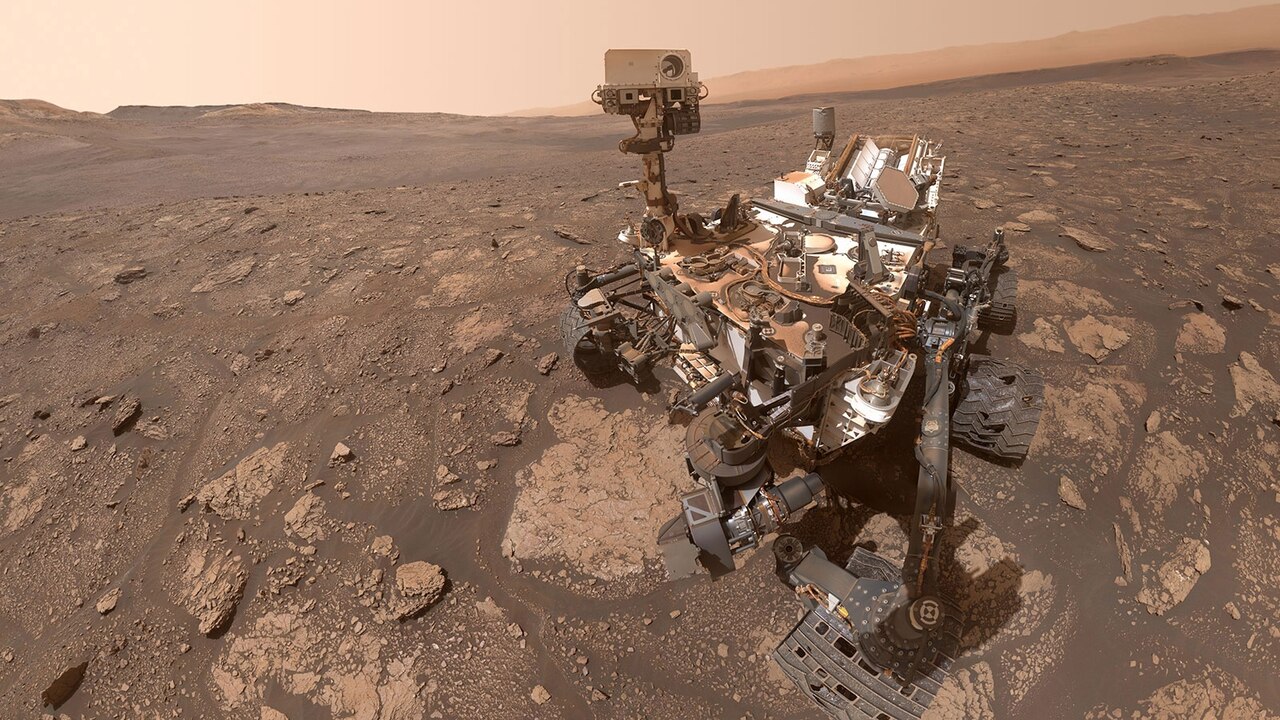
Curiosity took this selfie at a location nicknamed “Mary Anning” after the 19th-century English paleontologist. The rover snagged three samples of drilled rock at this site on its way out of the Glen Torridon region, where scientists believe ancient conditions could have been f…Read MoreNASA/JPL-CALTECH/MSSS
For now, though, scientists aren’t ready to conclude that our vermillion neighbor was once inhabited. Just about every alluring hint of biology could also be explained by some as-yet unfamiliar aspect of Mars’s geology or chemistry—there’s just so much we don’t know about how the planet works, and how nonliving phenomena could be masquerading as life’s fingerprints.
“This is an alien world that we’re looking at, and so who knows what we haven’t even thought of,” says Curiosity deputy project scientist Abigail Fraeman of NASA’s Jet Propulsion Laboratory.
Scientists say the next step in probing Mars for life is bringing bits of the planet back to labs on Earth, where the sharpest instruments available can search for answers to one of humanity’s oldest questions. The Perseverance rover is already busy collecting the first set of samples, which could contain evidence that microorganisms lived in Jezero crater billions of years ago.
No matter the answer, it will tell us something profound about the origins of life on our own planet.
“So much of [the two planets’] ancient history is similar, and it’s so intriguing that in our planetary evolution, those pathways have diverged so greatly,” says astrobiologist Amy Williams of the University of Florida. “If there isn’t life on Mars, why not? What changed? What happened? Why wouldn’t it be there? And if it took hold, what happened to it?”
Is there life on Mars?
In our fantasies, Mars has almost always been inhabited—if not by aliens, then at least by our future selves. But spacecraft observations quickly snuffed out dreams of advanced civilizations, seasonally flourishing vegetation, or even benign, gelatinous vegetarians.
“We don’t have anything glowing, we don’t have anything saying hello, we had no ray-guns when we landed there,” says Andrew Steele of the Carnegie Institution for Science.
In 1996, scientists announced that a Martian meteorite recovered from Antarctica’s Allan Hills region appeared to contain microfossils—tiny, worm-shaped, mineralized signs that life had crawled across the planet’s surface some 4.1 billion years ago. Those observations were ambiguous and extremely divisive, provoking debates that persist to this day. But there was an upside.
“The Allan Hills controversy has really fueled so much of the astrobiology field,” says astrobiologist Kennda Lynch of the Lunar and Planetary Institute. “I feel so grateful to that rock, because it’s made us really, really think about what we know about life.”
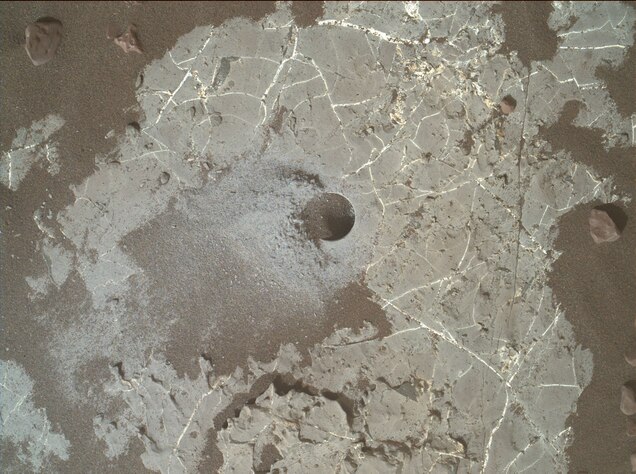
This image shows the Highfield drill hole made by the Curiosity rover as it was collecting a sample on Vera Rubin Ridge in Gale crater on Mars. Drill powder from this hole was enriched in a light isotope of carbon, a possible but unconfirmed sign of life.NASA/CALTECH-JPL/MSSS
A new era of Mars exploration began in 2012 when NASA’s six-wheeled Curiosity rover landed in Gale crater. Today, the 96-mile-wide gouge is home to a large mountain containing many layers of sediments that preserve a record of the Martian past. Curiosity’s primary goal is to search for signs of past habitability, such as water, organic compounds, and an energy source—the ingredients necessary for life as we know it.
Finding evidence of water was easy; after all, scientists already suspected the crater had once been filled by a deep lake. Curiosity almost immediately identified a swath of rocks that can form only when water is present.
The rest hasn’t been so simple.
Over the years, Curiosity has uncovered evidence in the crater for numerous organic molecules —the chemical building blocks for carbon-based lifeforms. And it has spotted signs of ancient hydrothermal activity, where heat and chemical compounds mixed with flowing water, creating possible energy sources.
The rover has also determined that methane gas in the crater rises and falls as the seasons change, and it has observed occasional, massive pulses of the gas, confirming Earth-based observations that have defied explanation for more than a decade. Such a fluctuation on Earth would be a strong sign of beings with active metabolisms.
However, none of these observations have so far been linked to biology, and there’s always a chance that processes we don’t fully understand are mimicking the signatures of life.
“Most carbon-related processes on Earth’s surface are biological, so to try and change our mindset around and think about a world where that might not be true is really a challenge,” says astrobiologist Christopher House of Pennsylvania State University. “Once you get out of the Earth-centric mindset, then you can start to think of these other ways in which Mars might behave.“
The curious case of Martian carbon
Curiosity’s weirdest, most tantalizing observation only emerged recently. In multiple rock samples from various locations in the crater, the rover found organic compounds containing odd ratios of carbon isotopes, or atoms of the same element that contain different numbers of neutrons in their nuclei.
On Earth, organisms prefer to use the lighterform of carbon in metabolic or photosynthetic reactions, leading to a skewed ratio in which the lighterform is much more abundant than the heavierform.
And in five locations in Gale Crater, scientists found the exact same thing: lightercarbon isotopes were much more abundant than their heavier cousins, relative to what scientists have seen in the Martian atmosphere and in meteorites. The observations resemble carbon ratios collected from Australia’s Tumbiana formation, a 2.7-billion-year-old outcrop that contains the carbon signatures of ancient, methane-metabolizing microbes.
“These really depleted carbon isotope results are so intriguing. So compelling. On Earth, the only way you do this is with biology,” Williams says.
But House, who led the analysis, says the story is far from clear. He and his colleagues offered three possible explanations for the imbalance.
The first is that the signature does indeed come from ancient microbes. Another possibility is that the solar system long ago sailed through an interstellar dust cloud with a peculiar carbon isotope ratio—such clouds are known to exist—and it left its traces on Mars. And a third possible explanation is that ultraviolet light interacting with Mars’s carbon dioxide atmosphere produced the odd signature.
“We don’t know the answer,” House says. “It may be biological, and it may not be biological. All three explanations fit the data.”
A mysterious coating on the rocks
NASA’s Perseverance rover arrived at Jezero crater on Mars last year, and it’s also on the hunt for signs of ancient life.
During its travels through Jezero, Perseverance spied numerous rocks with a purple, iron-rich coating. Purdue University’s Bradley Garczynski, who is studying the coating, says it’s unlike anything that rovers have spotted on Mars before—even though rocks with different coatings have been seen on other parts of the planet.
On Earth, such coatings are often observed in deserts, where conglomerates of rock-munching microbes thrive.
“They’re really intriguing, and they’re certainly on Earth of biological interest, so by translation they are then of great astrobiological interest to us when we see them forming on other worlds,” Williams says.about:blank
WHY MAPPING MARS COMPLETELY CHANGED HOW WE SEE ITMars has drawn our attention for millennia as the planet next door and a scientific object, but it was when we started mapping the planet that we began to see it as a place. Early mapmaking led to scientific discoveries—and a few far-fetched theories—which changed how we see the planet today.
Lynch, who studies terrestrial analogs of Martian environments, says it wouldn’t be out of the question to find biosignatures in the Jezero rock varnishes. “Microbes do amazing things. They put coatings and varnishes on the rocks because they like to eat the rock,” she says.
However, scientists have a lot more context about the environments on Earth in which such varnishes form, Lynch says, and that context is crucial for properly interpreting an observation. Even on our own planet, investigators need to rigorously evaluate whether such a material were produced by life or by some other process. That’s a much tougher question to answer from afar.
“It’s a wonderfully complicated and complex system that we’re exploring on Mars,” Fraeman says.
Ambiguity from another world
For now, definitive detection of life requires bringing pieces of Mars back to Earth, where scientists can use the most capable instruments available to scrutinize them. One of Perseverance’s primary tasks is to identify and collect rock samples for a future spacecraft to send home.
“The samples we’re collecting now, they’re being very carefully selected,” Fraeman says. “We know broadly the context that they’re coming from. … That’s going to be key to pulling apart these big questions.”
But even having chunks of Mars in the laboratory isn’t a salve for ambiguity. Scientists are still arguing about what might or might not have lived in ALH84001, that chunk of ancient Martian crust that crashed into Antarctica some 13,000 years ago. Steele, who recently led a fresh analysis of the meteorite, has been studying the rock for 25 years.
“One of the reasons I kept looking at is: If it’s not life, what is it?” he says.
Steele and his colleagues reported earlier this month that complex organics in ALH84001 had been crafted without life’s input, and that ordinary chemical reactions that occur when subterranean fluids interact with rocks and minerals were to blame.
“Does that mean there is no Martian life in that meteorite? Well, no I can’t prove that,” Steele says. “If a Martian organism exists in there, it’s not showing us something that is common to Earth organisms. It’s something totally different, and I’m still on the lookout for it.”
Might such geologic reactions be the source of Martian methane, or the organics that litter the planet, or the rock coatings in Jezero? It’s completely plausible, astrobiologists say. Mars is another world, a place with exotic chemistry and landscapes that, even though they look vaguely familiar, are still otherworldly.
“Time and again, Mars has demonstrated that it is not Earth. It is not an ancient Earth frozen in time,” Williams says. “It is its own, evolving planet, and the processes that are occurring there, some are still Earth-like, and some are very alien.”
Editor’s Note: Kennda Lynch’s affiliation has been corrected to the Lunar and Planetary Institute.
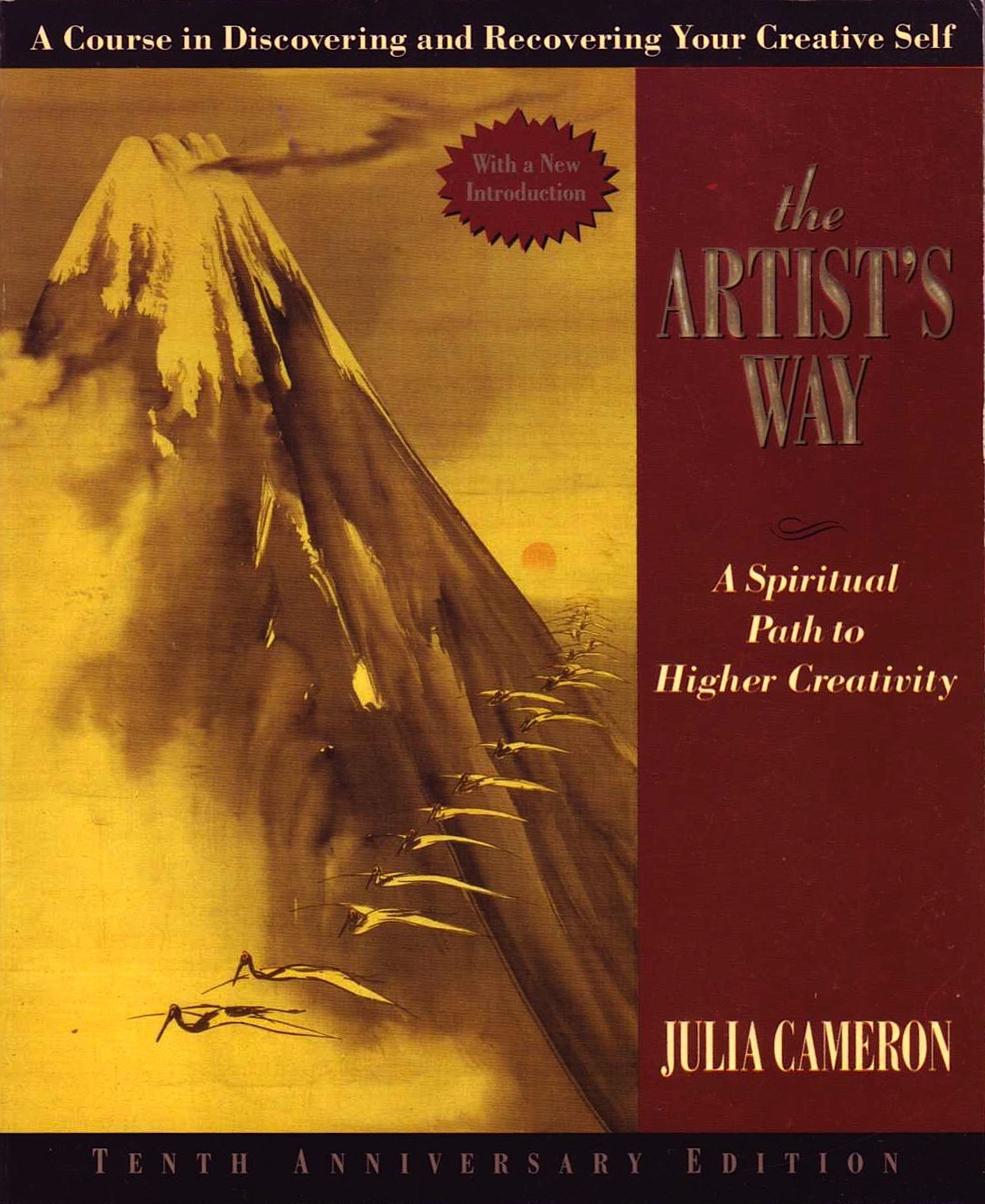
The Artist’s Way is the seminal book on the subject of creativity. An international bestseller, millions of readers have found it to be an invaluable guide to living the artist’s life. Still as vital today—or perhaps even more so—than it was when it was first published one decade ago, it is a powerfully provocative and inspiring work. In a new introduction to the book, Julia Cameron reflects upon the impact of The Artist’s Way and describes the work she has done during the last decade and the new insights into the creative process that she has gained. Updated and expanded, this anniversary edition reframes The Artist’s Way for a new century.
(Goodreads.com)
(Recommended by Sarah Flynn)
Consciousness, spirituality, biography, sexuality, androgyny, futurism, space, the arts, science, astrology, democracy, humor, books, movies and more





 One discovers the light in darkness, that is what darkness is for; but everything in our lives depends on how we bear the light. It is necessary, while in darkness, to know that there is a light somewhere, to know that in oneself, waiting to be found, there is a light.